Market Snapshot
Middle bar: base-year value × (1 + CAGR), rounded to two decimals. This is a calculated illustration, not a separately researched annual estimate.
The global electric off-road and overlanding SUV market size is estimated at USD 17,120.00 million in 2025 and is projected to reach USD 35,700.00 million by 2030, growing at a CAGR of 15.83% over 2026 – 2030. Annual sales rise from about 322,600 vehicles to 710,000, a 17.09% annual rate, while the average transaction price eases from about USD 53,070 to USD 50,280 per vehicle.
Marqstats defines the market as the retail transaction value of new plug-in off-road SUVs: battery-electric, extended-range and plug-in hybrid four-wheel-drive SUVs engineered for unpaved terrain, with high ground clearance, low-speed torque control, underbody protection and, in most models, a ladder frame or reinforced body. Road-focused electric crossovers with all-wheel drive, electric pickups, non-plug-in hybrids and accessories are excluded.
Plug-in hybrid four-by-fours account for 71.85% of 2025 value and ladder-frame models for 79.56%. China accounts for 49.07% of 2025 value and North America for 36.92%. The study segments the market by powertrain, chassis architecture, price band and region.
Key Takeaways
Market Overview & Analysis
Report Summary
Marqstats sizes the electric off-road and overlanding SUV market as the retail value of new plug-in SUVs engineered for serious off-road use. About 322,600 such vehicles were sold worldwide in 2025, worth an estimated USD 17,120.00 million at an average transaction price of about USD 53,070.
The category is narrow. It covers SUVs with high ground clearance, steep approach and departure angles, locking differentials or electric torque vectoring at each wheel, low-speed crawl control, protected batteries and, in most cases, a separate ladder frame. It is a small subset of the wider electric SUV market, which Marqstats sizes separately, and the two must not be added together.
China built the volume. Great Wall Motor turned its Tank brand into a plug-in hybrid business, selling 232,713 Tank vehicles in 2025, and BYD launched the Fangchengbao Bao 5 and Bao 8 plug-in hybrid off-roaders and the extended-range Yangwang U8. In North America the Jeep Wrangler 4xe has been the best-selling plug-in hybrid for several years, and Rivian, GMC and Mercedes-Benz sell battery-electric models.
Marqstats rebuilds the 2025 base from named models. The estimate includes about 112,000 Tank plug-in hybrids, 90,000 Fangchengbao Bao 5 and Bao 8 off-roaders, 55,000 Wrangler 4xe, 24,000 Rivian R1S, 7,100 Hummer EV SUVs, 6,500 Mercedes-Benz G 580, 2,600 Yangwang U8 and U8L in China and about 25,000 other models, including the Land Rover Defender plug-in hybrid, Jetour Shanhai and Dongfeng M-Hero.
The market grew from about 42,100 vehicles worth USD 2,860.00 million in 2021 to 96,000 in 2022, 168,000 in 2023 and 285,000 in 2024, worth USD 15,400.00 million. Growth slowed in 2025 as Tank sales flattened and US demand weakened after federal clean vehicle credits ended in September 2025. Marqstats expects about 352,000 vehicles worth USD 18,700.00 million in 2026.
Regulation shapes the vehicles. Under UN rules an off-road passenger vehicle must drive all axles, have at least one differential lock or equivalent, climb a 30% slope and meet minimum approach, departure and breakover angles and ground clearances. US rules use similar tests to classify four-wheel-drive SUVs as light trucks. In Europe, an ordinary car licence has been limited to vehicles of 3,500 kg, which many large electric off-roaders exceed when fully loaded, and the revised EU licence rules raise the limit to 4,250 kg for alternatively fuelled vehicles once member states apply them.
Engineering choices differ by maker. Great Wall Motor's Hi4-T system puts an electric motor between the engine and a nine-speed gearbox with a low range and three locking differentials, and newer Hi4-Z versions launched from August 2025 offer about 200 km of electric range. BYD's Yangwang U8 uses four 220 kW motors with a 49.05 kWh battery and a range-extending engine, can wade through 1,400 mm of water in its off-road version and can turn on the spot. The Mercedes-Benz G 580 keeps the G-Class ladder frame with four motors and a 116 kWh battery, and the Rivian R1S uses a skateboard platform with air suspension.
Global Electric Off-Road and Overlanding SUV Market Size and Forecast
The global electric off-road and overlanding SUV market grows from USD 17,120.00 million in 2025 to USD 35,700.00 million in 2030, a CAGR of 15.83%. Marqstats expects sales of about 410,000 vehicles worth USD 21,500.00 million in 2027, 495,000 worth USD 25,600.00 million in 2028 and 595,000 worth USD 30,300.00 million in 2029, before reaching 710,000 vehicles in 2030.
Volume grows faster than value. Average transaction prices ease from about USD 53,070 in 2025 to USD 50,280 in 2030 as cheaper Chinese plug-in hybrids and smaller models, such as the Mercedes-Benz 'Little G' and Land Rover's smaller electric models, widen the market below the luxury flagships. Unit sales therefore rise at 17.09% a year while value rises at 15.83%.
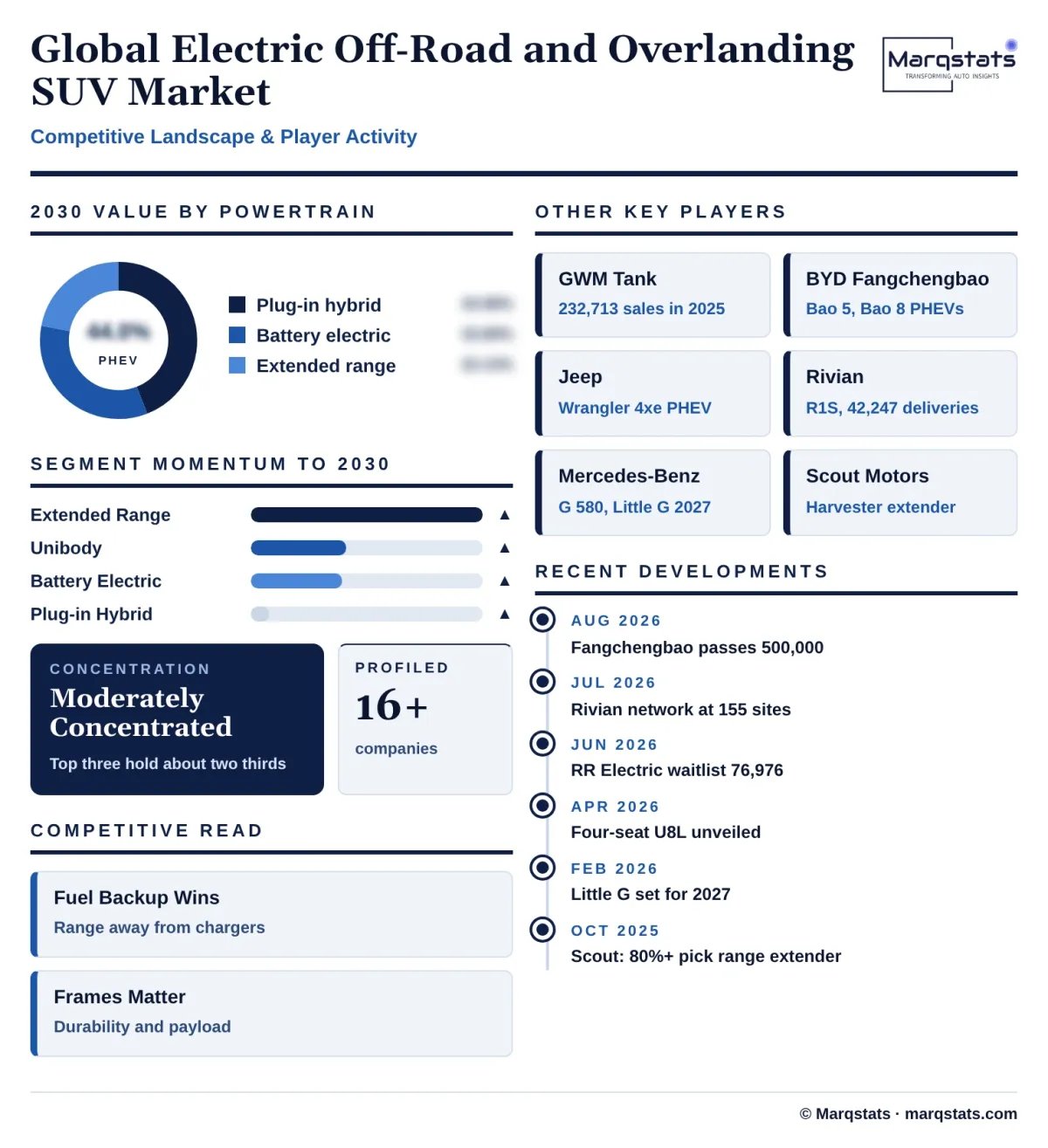
The powertrain mix shifts. Plug-in hybrids fall from 71.85% to 43.98% of value, battery-electric models rise from 24.07% to 33.89% and extended-range models from 4.09% to 22.13%. Extended-range SUVs drive a generator from a small engine and are driven by electric motors at all times, so they remove the transfer case and gearbox while keeping a fuel tank for remote travel.
Prices span a wide range. A Tank 300 plug-in hybrid sells for about RMB 300,000 in China, the Fangchengbao Bao 5 for less, the Jeep Wrangler 4xe and Rivian R1S for USD 55,000 to 90,000, and the Mercedes-Benz G 580 and Yangwang U8 above USD 150,000. Models under USD 50,000 account for 38.26% of 2025 value and grow at 16.74% a year.
Marqstats tracks four indicators to monitor the forecast: Tank and Fangchengbao monthly sales, Scout Motors and Range Rover Electric delivery start dates, national adoption of the EU 4,250 kg licence rule, and fast-charger coverage on remote touring routes.
Chassis and regional shares also change. Ladder-frame models fall from 79.56% to 69.47% of value as unibody models such as the Range Rover Electric and Rivian R2 grow. China's share falls slightly from 49.07% to 47.06%, North America's from 36.92% to 31.37%, and Europe and the rest of the world rise to 9.52% and 12.04% as Chinese exports and new European models arrive.
Real-world range sets the battery-electric ceiling. Marqstats estimates that a heavy battery-electric off-roader rated at 470 km can fall to 250 to 300 km on rocky climbs, and to about 150 to 200 km on sand or deep snow with a roof load in cold weather. A 400 W roof solar panel adds only a few kilometres of range a day, so remote touring depends on fuel backup or planned charging stops.
Market Dynamics
Key Drivers
Five forces are pushing purpose-built off-road SUVs toward electric drive.
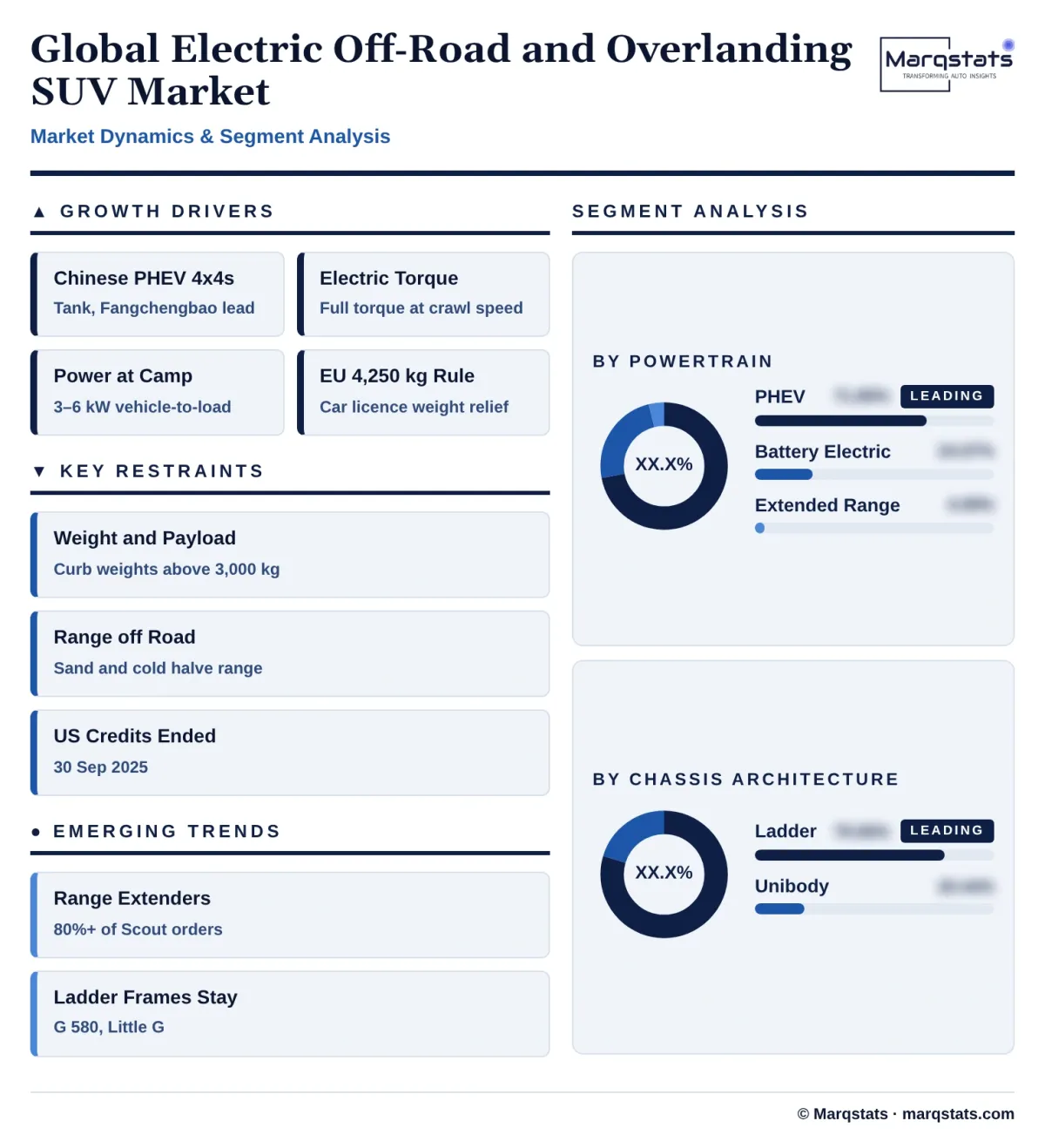
- Chinese plug-in hybrid four-by-fours. Great Wall Motor and BYD offer ladder-frame plug-in hybrids with 100 to 200 km of electric range, mechanical locking differentials and combined ranges above 1,000 km at prices close to petrol rivals.
- Low-speed electric torque. Electric motors deliver full torque from standstill and can control each wheel separately, which improves rock crawling, hill climbing and traction on sand and mud.
- Power at camp. Vehicle-to-load outlets of 3 to 6 kW on the Yangwang U8, Rivian R1S and Jeep Wrangler 4xe run fridges, cooking appliances and lights, replacing separate generators and second batteries.
- Licence weight relief in Europe. The EU's revised driving licence rules let holders of an ordinary car licence for at least two years drive alternatively fuelled vehicles up to 4,250 kg, removing a barrier for heavy electric SUVs; Norway applies the rule from 26 November 2027.
- New models from established brands. The Range Rover Electric, Scout Traveler, Mercedes-Benz 'Little G' and Land Rover's next Defender models bring electrified off-roaders to more buyers.
- Lower running costs. Electric drive avoids engine oil changes and gearbox wear and cuts energy cost per kilometre by about half compared with petrol or diesel when charged at home or at depots.
Key Restraints
Four constraints slow the move from fuel tanks to batteries in off-road SUVs.
- Weight and payload. Batteries of 100 kWh or more and underbody armour push curb weights above 3,000 kg, leaving limited payload for passengers, roof tents, water and recovery gear.
- Range off the road. Sand, mud, steep climbs, roof loads and cold weather can cut battery-electric range by half or more, and remote touring routes have few fast chargers.
- US demand after credits ended. The end of federal clean vehicle and lease credits on 30 September 2025 and the repeal of federal vehicle greenhouse gas standards in February 2026 weaken the case for plug-in models in North America.
- Resale values. Buyers in rural markets worry about battery replacement costs and hidden trail damage, so electric off-roaders lose value faster than petrol and diesel rivals such as the Toyota Land Cruiser.
Key Trends
Four shifts are changing how electrified off-road SUVs are engineered and sold.
- Range extenders. Scout Motors, BYD's Yangwang and several Chinese brands use a small engine as a generator, keeping all-electric drive with a fuel backup.
- Ladder frames for electric models. Mercedes-Benz kept a ladder frame for the G 580 and plans a ladder frame for the 'Little G', separating trail loads from the battery and body.
- Software control at each wheel. Four-motor layouts on the G 580, Yangwang U8 and Rivian R1S replace mechanical differentials with software that controls torque at each wheel, enabling tank turns and better traction.
- Charging networks for outdoor routes. Rivian's Adventure Network reached 155 sites and 1,073 stalls by mid-2026, with 97% of sites open to other electric vehicles, putting fast chargers near trailheads and parks.
Strategic Implications
- For carmakers, the powertrain choice depends on where buyers drive. Plug-in hybrid and extended-range layouts suit long-distance touring and remote regions, while battery-electric models suit day trips, trail parks and regions with good charging.
- For established four-by-four brands, the frame matters. Buyers judge electrified off-roaders by axle articulation, ground clearance, wading depth and durability, so cosmetic off-road trims on road crossovers will not hold value in this segment.
- For suppliers, electric drive axles with low crawl ratios, software-controlled locking differentials, battery armour and high-power vehicle-to-load inverters are the growth products.
- For the accessory industry, power integration replaces mechanical add-ons. DC-to-DC converters and approved connections to the traction battery replace second lead-acid batteries and separate generators.
- For regulators, weight rules shape the market. National adoption of the EU 4,250 kg licence rule and any trail weight limits in North America decide how many heavy battery-electric off-roaders can be sold.
- For fleet buyers in mining, energy and tourism, electrified off-roaders reduce fuel and maintenance costs and provide site power, but range-extender and plug-in hybrid versions remain the practical choice where charging is absent.
Market Segmentation
Plug-in hybrid off-road SUVs account for 71.85% of 2025 value, USD 12,300.00 million and about 271,000 vehicles, and grow at 5.00% a year to USD 15,700.00 million while their share falls to 43.98% by 2030. The Tank 300, 400, 500 and 700 plug-in hybrids, the Fangchengbao Bao 5 and Bao 8, the Jeep Wrangler 4xe and the Land Rover Defender plug-in hybrid keep a mechanical four-wheel-drive system with a low range and add an electric motor and a battery of 20 to 40 kWh.
Battery-electric off-road SUVs account for 24.07% of 2025 value, USD 4,120.00 million and about 42,000 vehicles, and grow at 24.04% a year to USD 12,100.00 million and 33.89% of 2030 value. The Rivian R1S, GMC Hummer EV SUV and Mercedes-Benz G 580 lead, and the Range Rover Electric, Scout Traveler battery version and Mercedes-Benz 'Little G' expand the segment from late 2026.
Extended-range off-road SUVs account for 4.09% of 2025 value, USD 700.00 million and about 9,600 vehicles, and grow fastest, at 62.37% a year, to USD 7,900.00 million and 22.13% of 2030 value. The Yangwang U8 and U8L, Dongfeng M-Hero and Chinese range-extender models lead today, and the Scout Traveler with its Harvester range extender is the largest new entrant.
Body-on-frame models account for 79.56% of 2025 value, USD 13,620.00 million, and grow at 12.73% a year to USD 24,800.00 million, 69.47% of 2030 value. A separate frame absorbs trail impacts and twisting loads, protects the battery and suits towing and heavy accessories.
Reinforced unibody and skateboard platforms account for 20.44% of 2025 value, USD 3,500.00 million, and grow at 25.51% a year to USD 10,900.00 million and 30.53% of 2030 value. The Rivian R1S, GMC Hummer EV SUV, Land Rover Defender and Range Rover Electric use these structures, relying on long-travel air suspension for articulation.
Models priced between USD 50,000 and 100,000 account for 46.96% of 2025 value, USD 8,040.00 million, and grow at 13.88% a year to USD 15,400.00 million. The Jeep Wrangler 4xe, Rivian R1S, higher Tank trims and the Fangchengbao Bao 8 lead.
Models below USD 50,000 account for 38.26% of 2025 value, USD 6,550.00 million, and grow at 16.74% a year to USD 14,200.00 million, 39.78% of 2030 value. Chinese plug-in hybrids such as the Tank 300 and Fangchengbao Bao 5 dominate this band.
Models above USD 100,000 account for 14.78% of 2025 value, USD 2,530.00 million, and grow at 19.25% a year to USD 6,100.00 million, 17.09% of 2030 value, as the Range Rover Electric joins the Mercedes-Benz G 580, Yangwang U8 and GMC Hummer EV SUV.
By Geography
China
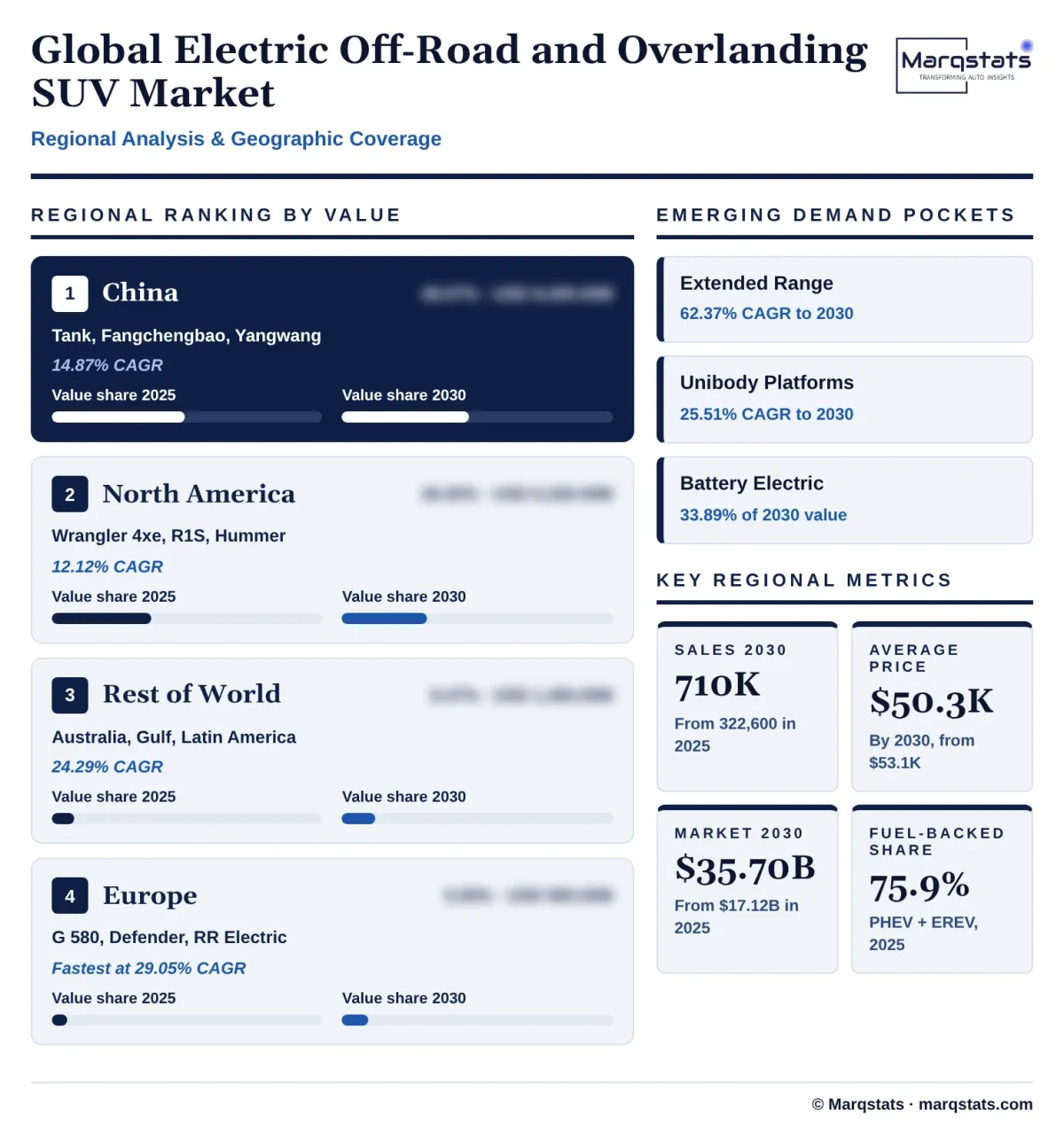
China is the largest market, with 49.07% of 2025 value, USD 8,400.00 million and about 200,000 vehicles, and grows at 14.87% a year to USD 16,800.00 million by 2030. Great Wall Motor's Tank and BYD's Fangchengbao and Yangwang brands dominate with ladder-frame plug-in hybrids and extended-range models, and Chinese buyers prefer combined ranges above 1,000 km. Fangchengbao sales rose 316.11% to 234,637 vehicles in 2025, although Tank's growth stalled, with 232,713 vehicles, up 0.74%.
North America
North America accounts for 36.92% of 2025 value, USD 6,320.00 million and about 83,000 vehicles, and grows at 12.12% a year to USD 11,200.00 million by 2030. The Jeep Wrangler 4xe, Rivian R1S and GMC Hummer EV lead, and Scout Motors plans to start production in South Carolina. The end of federal credits in September 2025 and the repeal of federal vehicle greenhouse gas standards in February 2026 slow demand, while public land trail networks and the Rivian Adventure Network support adoption.
Rest of the World
The rest of the world, led by Australia, the Gulf states, South Africa and Latin America, accounts for 8.47% of 2025 value, USD 1,450.00 million, and grows at 24.29% a year to USD 4,300.00 million by 2030. Long distances between chargers favour plug-in hybrid and extended-range models, and Chinese brands expand exports of Tank, Fangchengbao and Yangwang models.
Europe
Europe accounts for 5.55% of 2025 value, USD 950.00 million, and grows fastest, at 29.05% a year, to USD 3,400.00 million and 9.52% of the market by 2030. The Mercedes-Benz G 580, Land Rover Defender plug-in hybrid and Jeep Wrangler 4xe lead, and the Range Rover Electric, built at Solihull, starts deliveries. Trail access in Western Europe is restricted, and weight-based taxes such as France's weight malus discourage heavy models.
How Competition Is Evolving
The electric off-road and overlanding SUV market is moderately concentrated. Great Wall Motor, BYD and Stellantis account for about two thirds of 2025 value, followed by Rivian, Mercedes-Benz, General Motors and Land Rover.
Three groups compete. Chinese carmakers, led by Great Wall Motor's Tank and BYD's Fangchengbao and Yangwang, build high-volume plug-in hybrid and extended-range ladder-frame models. Established four-by-four brands, including Jeep, Mercedes-Benz, Land Rover and Toyota, electrify famous nameplates. Electric specialists, including Rivian and Scout Motors, design new platforms around batteries and software.
Chinese brands lead on price and features. Fangchengbao and Tank offer hydraulic suspension, crab walking, tank turns and drones on some models at prices that Western brands cannot match, and both are expanding exports to Australia, the Middle East and Southeast Asia.
Competition will be decided by range away from chargers, payload, durability and price. Brands that combine a strong frame, a fuel or battery range above 800 km, usable payload and reliable service outside cities will win the largest share.
Production plans are moving. Scout Motors is building its plant in Blythewood, South Carolina, for production from 2027, JLR builds the Range Rover Electric at Solihull, Mercedes-Benz plans the 'Little G' for 2027, and Fangchengbao passed 500,000 cumulative sales in August 2026. Tank sales fell in the first half of 2026 as competition in China's plug-in off-road segment intensified.
Pricing pressure rises in China. Fangchengbao and Tank compete directly with Jetour, BAIC Beijing Off-Road and Dongfeng M-Hero, and new models arrive every few months. The Yangwang U8 and U8L sold 2,629 vehicles in China in 2025, showing that the RMB 1 million luxury tier remains small next to the RMB 200,000 to 400,000 core of the market.
Companies Covered
Companies covered in the report include:
Recent Market Activity
Table of Contents
Coverage & Segmentation
The study covers the global electric off-road and overlanding SUV market, with 2025 as the base year, 2021 – 2025 as the historical period and 2026 – 2030 as the forecast period. Values are in US dollars at retail transaction prices, and volumes are new vehicle sales. The market is segmented by powertrain, chassis architecture, price band and region.
The market is a subset of the Global Electric SUV market published by Marqstats, which also counts plug-in off-road SUVs, so the two values must not be added together. Electric pickups, road-focused all-wheel-drive crossovers, non-plug-in hybrids, conversions and accessories are excluded. Model volumes, segment and regional splits and price bands are Marqstats estimates built on company sales releases, registration data and transaction price benchmarks.