Market Snapshot
Middle bar: base-year value × (1 + CAGR), rounded to two decimals. This is a calculated illustration, not a separately researched annual estimate.
The global eHighway and overhead catenary truck market size is estimated at USD 26.40 million in 2025 and is projected to reach USD 98.50 million by 2030, growing at a CAGR of 30.13% over 2026 – 2030. The market fell from USD 44.20 million in 2023 to USD 31.60 million in 2024 and USD 26.40 million in 2025 as Germany switched off its three public-road trial routes, and Marqstats expects it to recover from 2026 on industrial corridors in China and a small number of European pilot projects.
Marqstats defines the market as annual spending on overhead catenary electric road systems for heavy road trucks. It covers two-pole overhead contact lines and masts, traction substations and grid connections, roof-mounted truck pantographs and their vehicle integration, and the engineering, testing, operation, maintenance and research services that accompany them. Open-pit mine haul trucks running on trolley assist, which Marqstats covers in a separate report, ground-level conductive rail systems, in-road inductive charging, static depot and megawatt charging, trolleybuses and rail electrification are excluded, as is the value of the truck itself.
Industrial, port and logistics park corridors account for 63.64% of 2025 value and public road corridors for 36.36%. Engineering, testing and research services are the largest component at 39.77% of 2025 value. Asia-Pacific accounts for 56.44% of 2025 value and Europe for 36.36%. The study segments the market by component, road application, vehicle powertrain served and region.
Key Takeaways
Market Overview & Analysis
Report Summary
Marqstats sizes the eHighway and overhead catenary truck market as annual spending on overhead electric road systems for heavy road trucks, combining infrastructure construction, truck-side pantograph systems and the engineering, testing, operation and research work that surrounds them. In 2025 this spending was an estimated USD 26.40 million, down from a peak of USD 44.20 million in 2023.
An overhead catenary electric road system works like a trolleybus line built over the right-hand lane of a motorway. Traction substations every few kilometres take medium-voltage grid power and convert it to direct current, which feeds a two-pole contact line, one positive and one negative wire, because rubber-tyred trucks cannot return current through a rail. A pantograph on the cab roof uses sensors to find the wires and connects and disconnects automatically while the truck drives at motorway speed, retracting when the driver changes lane. While connected, the truck runs its electric motor from the wire and recharges its battery, so it needs a much smaller battery than a battery-electric truck that charges only when parked.
Siemens Mobility developed the eHighway system and built the main public-road trials with Scania trucks: about 2 km near Gävle in Sweden from 2016, a short demonstration near the ports of Los Angeles and Long Beach in 2017, and three German routes from 2019. On the A5 motorway in Hesse the ELISA project started with two 5 km sections between Frankfurt and Darmstadt and extended the southern section to about 17 km of overhead line in August 2023. Schleswig-Holstein ran the FESH route on the A1, and Baden-Württemberg ran eWayBW on the B462 federal road.
The trials ended at the end of 2024. The FESH and eWayBW projects expired as scheduled, the A5 test operation stopped and the power was switched off at the turn of the year, and the federal economics ministry said the time-limited research had produced its essential findings. In January 2026 RWTH Aachen reported that the overhead lines at all three German sites had been dismantled, so no public-road catenary for heavy trucks is now operating in Europe.
The research gave mixed results. The ELISA team assessed the technology at technology readiness level 7 and recommended the A5 corridor as the first candidate for a market introduction, but public acceptance was only neutral to slightly positive, and respondents preferred investment in battery-electric trucks over overhead lines. The Swedish Transport Administration found in December 2024 that the costs of electric roads were at least double earlier estimates and that a network would only make sense as part of a larger one with Germany and France.
Other countries have not filled the gap. The United States demonstration near the ports of Los Angeles and Long Beach was short and was not extended, and federal programmes now prioritise high-power static charging along interstate corridors. The United Kingdom funded an electric motorway feasibility study with Siemens Mobility, Scania and Costain, but current policy favours depot and public megawatt charging for heavy trucks. India has discussed electric highways, but its National Highway for EVs programme builds charging stations and its 5,500 km target refers to charging-equipped highways, not overhead lines.
China has become the main source of new activity. CRRC companies, which build locomotives and railway electrification, have developed heavy trucks that draw power from overhead lines through pantographs and fall back on onboard batteries off the wire. CRRC Datong has built its own DC catenary test line and targets coal enterprises, mines, power plants and coal logistics parks, while CRRC Zhuzhou Locomotive presented its system at a rail transport expo in Hunan in November 2025 after nearly 10,000 km of trials, including simulated rough and hilly roads.
Global eHighway and Overhead Catenary Truck Market Size and Forecast
The global eHighway and overhead catenary truck market grows from USD 26.40 million in 2025 to USD 98.50 million in 2030, a CAGR of 30.13%. Marqstats expects spending of USD 29.80 million in 2026, USD 38.60 million in 2027, USD 54.20 million in 2028 and USD 74.30 million in 2029.
The historical series reflects the life of the German trials. Spending was about USD 38.00 million in 2021 and USD 41.50 million in 2022, as the three German routes operated and Sweden prepared the E20 project, and peaked at USD 44.20 million in 2023 with the A5 extension and a second generation of overhead hybrid trucks. It fell to USD 31.60 million in 2024, the last year of operation, and to USD 26.40 million in 2025, when European spending consisted mainly of final research, standards work and dismantling. Over 2021 – 2025 the market contracted by 8.69% a year.
Corridor costs set the size of each project. The Netherlands research organisation TNO used about EUR 3.28 million per kilometre for both directions, roughly USD 3.71 million, in its May 2025 study of corridors from the Port of Rotterdam, within a range of EUR 1.2 million to EUR 4.6 million. A 10 km pilot corridor therefore costs about USD 30 million to USD 40 million to build, so one or two European projects reaching construction would move the market noticeably. Chinese industrial lines cost less per kilometre because they use shorter routes, lower speeds and local suppliers.
Marqstats builds the forecast from projects rather than from fleet targets. Growth to 2030 assumes Chinese industrial corridors for coal, steel and logistics parks move from test lines to commercial routes, at least one European pilot corridor reaches construction late in the period, and truck makers offer pantograph retrofits on standard battery-electric trucks. Marqstats tracks four indicators: corridor decisions by national road agencies, Chinese industrial line awards, pantograph approvals on series trucks and the cost per kilometre of contact line.
Spending shifts from services to hardware. Engineering, testing and research services account for 39.77% of 2025 value, because Europe spent on final studies and dismantling rather than new lines, but fall to 20.20% by 2030 as contact lines, substations and pantographs are built and fitted again.
Truck economics explain why catenary still attracts interest. A catenary truck needs a battery of roughly 80 kWh to 300 kWh for off-wire driving, against 600 kWh or more for a long-range battery-electric truck, saving well over a tonne of battery weight. The second-generation ELISA trucks carried a 99 kWh battery and the battery-electric overhead truck used in the trials a 297 kWh battery. On a busy industrial shuttle the contact line can supply several trucks at once and recover braking energy on downhill sections, which strengthens the case on fixed routes even where a national motorway network is not cost-effective.
Regional growth is similar in rate but different in source. Asia-Pacific grows at 31.51% a year on industrial corridors in China, Europe at 28.17% on pilot corridors and pantograph retrofit projects, North America at 26.76% from a very small base, and the rest of the world at 31.12% through early industrial projects. By 2030 Asia-Pacific accounts for 59.49% of value and Europe for 33.71%.
Market Dynamics
Key Drivers
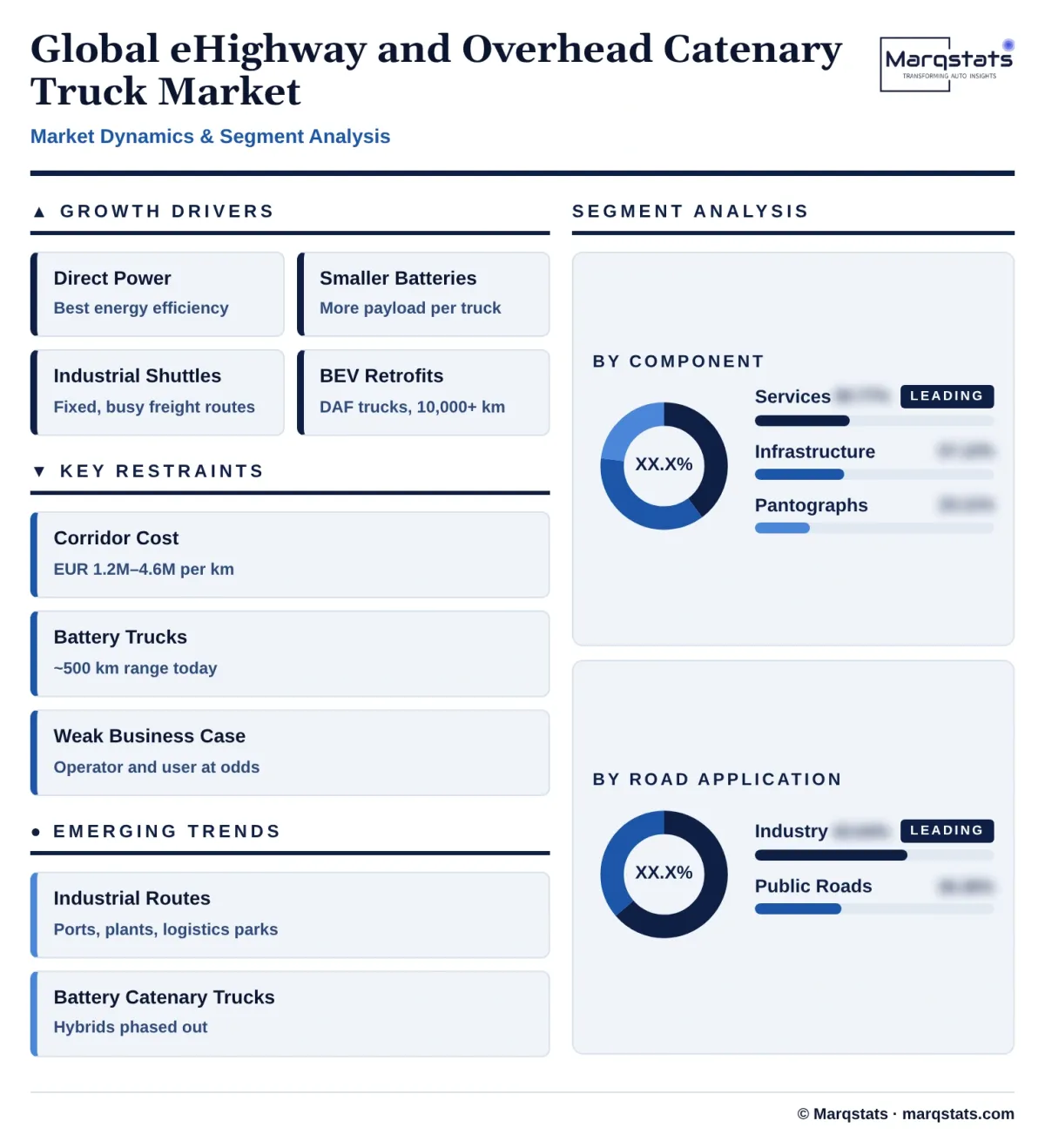
Five forces keep overhead catenary charging for heavy trucks alive after the end of Europe's public-road trials.
- Energy efficiency. Running a truck directly from an overhead wire avoids most charging and storage losses, so catenary trucks use about as little energy per kilometre as any zero-emission option for heavy freight and far less than hydrogen or synthetic fuels.
- Smaller batteries and more payload. A catenary truck needs a battery for the off-wire part of a trip only, so it can carry less battery weight than a long-range battery-electric truck and keep more of its legal payload.
- Short, repetitive industrial routes. Shuttle routes between mines, plants, rail yards and ports carry high truck volumes over the same few kilometres every day, which spreads the fixed cost of a contact line over many trips.
- Retrofit of battery-electric trucks. The BEV Goes eHighway project retrofitted two DAF XD Electric trucks with a new pantograph, gained road approval and drove more than 10,000 km, showing that standard battery trucks can use catenary lines without a dedicated hybrid design.
- Common technical standards. CLC/TS 50712:2024 defines the interaction between pantographs and overhead lines on electrified roads, reducing the risk that trucks and lines from different suppliers cannot work together.
- Payload limits for battery trucks. Heavy bulk and shuttle routes run close to legal weight limits, so a smaller battery directly increases the load each truck can carry.
Key Restraints
Four constraints have shrunk the market and limit how fast new corridors can be built.
- High upfront cost. A contact line must be built along a whole corridor before any fleet can benefit, and costs per kilometre have proved higher than early estimates, which led Sweden to pause the E20 project.
- Competition from long-range battery trucks. Trucks with about 500 km of range and megawatt charging at depots and motorway hubs let fleets electrify without waiting for public infrastructure.
- Unclear business case for operators. TNO found in May 2025 that a positive business case for both truck users and a contact line operator is difficult at the same electricity price, even where the societal case is positive.
- Public acceptance and visual impact. ELISA surveys found acceptance only neutral to slightly positive, and motorway masts and wires face planning objections.
- Lack of series trucks. No truck maker offers a series-production catenary truck, so each project must arrange pantograph fitment and approval for its own vehicles.
Key Trends
Four shifts are changing where catenary systems are built and which trucks use them.
- From public motorways to industrial routes. New lines are being planned for closed freight routes such as coal logistics parks and port shuttles rather than national motorway networks.
- Battery-electric catenary trucks. Pantographs are being fitted to battery-electric trucks that charge while connected, replacing the diesel hybrid trucks used in the first German trials.
- Corridor studies across borders. Studies such as the Dutch contribution to the E-CORE project look at corridors from Rotterdam to Germany and Belgium, reflecting the Swedish finding that only an international network would be cost-effective.
- Chinese suppliers enter the market. CRRC Zhuzhou Locomotive and CRRC Datong apply their rail traction and catenary experience to electrified heavy-truck systems.
- Standards for competing technologies. CLC/TS 50740:2025 for ground-based conductive systems and CLC/TS 50712:2024 for overhead pantographs give road agencies a basis to compare electric road technologies on the same corridor.
Strategic Implications
- For infrastructure suppliers, industrial customers are the near-term market. Mine-to-rail, plant-to-port and logistics park routes have one owner, predictable traffic and private land, so they can be built without waiting for national road policy.
- For truck makers, a pantograph retrofit option is a low-cost hedge. Offering a certified pantograph kit on a standard battery-electric truck allows fleets on electrified routes to buy smaller batteries without a separate catenary model.
- For road agencies, corridor selection decides the economics. Short corridors with heavy truck traffic close to ports and industrial hubs give the best chance of recovering the cost of the line.
- For fleets, catenary is a route-specific choice. Operators running fixed shuttles on an electrified route can cut battery cost and weight, while fleets on varied routes are better served by depot and megawatt charging.
- For investors, the market is small and project-driven. Annual spending is in the tens of millions of US dollars, and a single corridor decision can change it sharply, so project pipelines matter more than trend growth.
- For policymakers, cross-border coordination is the condition for public corridors. The Swedish and Dutch studies agree that isolated national lines are hard to justify, so any European public network depends on shared standards and coordinated corridors between neighbouring countries.
Market Segmentation
Overhead contact lines, masts, traction substations and grid connections account for 37.12% of 2025 value, USD 9.80 million, mainly from Chinese test and industrial lines, and grow fastest, at 39.73% a year, to USD 52.20 million and 52.99% of the market by 2030 as new corridors are built.
Roof-mounted pantographs, current collectors, DC converters and their integration into trucks account for 23.11% of 2025 value, USD 6.10 million, and grow at 34.05% a year to USD 26.40 million by 2030, helped by retrofit kits for battery-electric trucks.
Corridor studies, standards work, testing, operation, maintenance and dismantling account for 39.77% of 2025 value, USD 10.50 million, the largest component in 2025, and grow at 13.64% a year to USD 19.90 million, falling to 20.20% of the market by 2030.
Closed and semi-closed freight routes serving coal logistics parks, power plants, steel mills, rail yards and ports account for 63.64% of 2025 value, USD 16.80 million, and grow at 29.04% a year to USD 60.10 million by 2030. Open-pit mine haul roads used by mining trucks are excluded and covered in the Marqstats trolley assist mining report.
Public motorways and trunk roads account for 36.36% of 2025 value, USD 9.60 million, mostly European research, standards and dismantling work, and grow at 31.95% a year to USD 38.40 million by 2030 if pilot corridors such as Rotterdam–Venlo reach construction.
Systems serving trucks that combine a pantograph with a traction battery account for 72.73% of 2025 value, USD 19.20 million, and grow at 35.81% a year to USD 88.70 million and 90.05% of the market by 2030.
Systems serving diesel or gas hybrid trucks with a pantograph account for 27.27% of 2025 value, USD 7.20 million, and grow at 6.36% a year to USD 9.80 million as new projects specify battery-electric trucks.
By Geography
Asia-Pacific
Asia-Pacific is the largest region, with 56.44% of 2025 value, USD 14.90 million, rising to USD 58.60 million by 2030, a 31.51% CAGR and the fastest regional growth. China accounts for almost all of it. CRRC Zhuzhou Locomotive unveiled its Zhidao electrified highway transportation system at a rail transport expo in Hunan in November 2025, with test vehicles that had completed nearly 10,000 km, and CRRC Datong built its own DC catenary test line for dual-source heavy trucks aimed at coal enterprises, mines, power plants and coal logistics parks. India has discussed electric highways on the Delhi–Jaipur and Delhi–Mumbai routes, but its National Highway for EVs programme builds charging stations rather than overhead lines.
Europe
Europe accounts for 36.36% of 2025 value, USD 9.60 million, and grows at 28.17% a year to USD 33.20 million by 2030. Germany ended its three public-road trials at the end of 2024 and dismantled the lines, and Sweden paused the E20 Hallsberg–Örebro project in December 2024. Remaining activity is research and planning: the BEV Goes eHighway project, CENELEC standards and Dutch studies of corridors from Rotterdam to Venlo and Belgium, which the Dutch government sees as a possible pilot. France has run calls for projects on electric roads.
North America
North America accounts for 4.17% of 2025 value, USD 1.10 million, and grows at 26.76% a year to USD 3.60 million by 2030. The only public-road demonstration, near the ports of Los Angeles and Long Beach, ended years ago, and federal funding now favours static charging corridors. The US Environmental Protection Agency repealed vehicle greenhouse gas standards, including the Phase 3 heavy-duty standards, in February 2026, weakening one reason for fleets to invest in zero-emission trucks.
Rest of World
The rest of the world accounts for 3.03% of 2025 value, USD 0.80 million, and grows at 31.12% a year to USD 3.10 million by 2030, mainly through feasibility studies and early industrial projects in India, Latin America, the Middle East and Africa.

How Competition Is Evolving
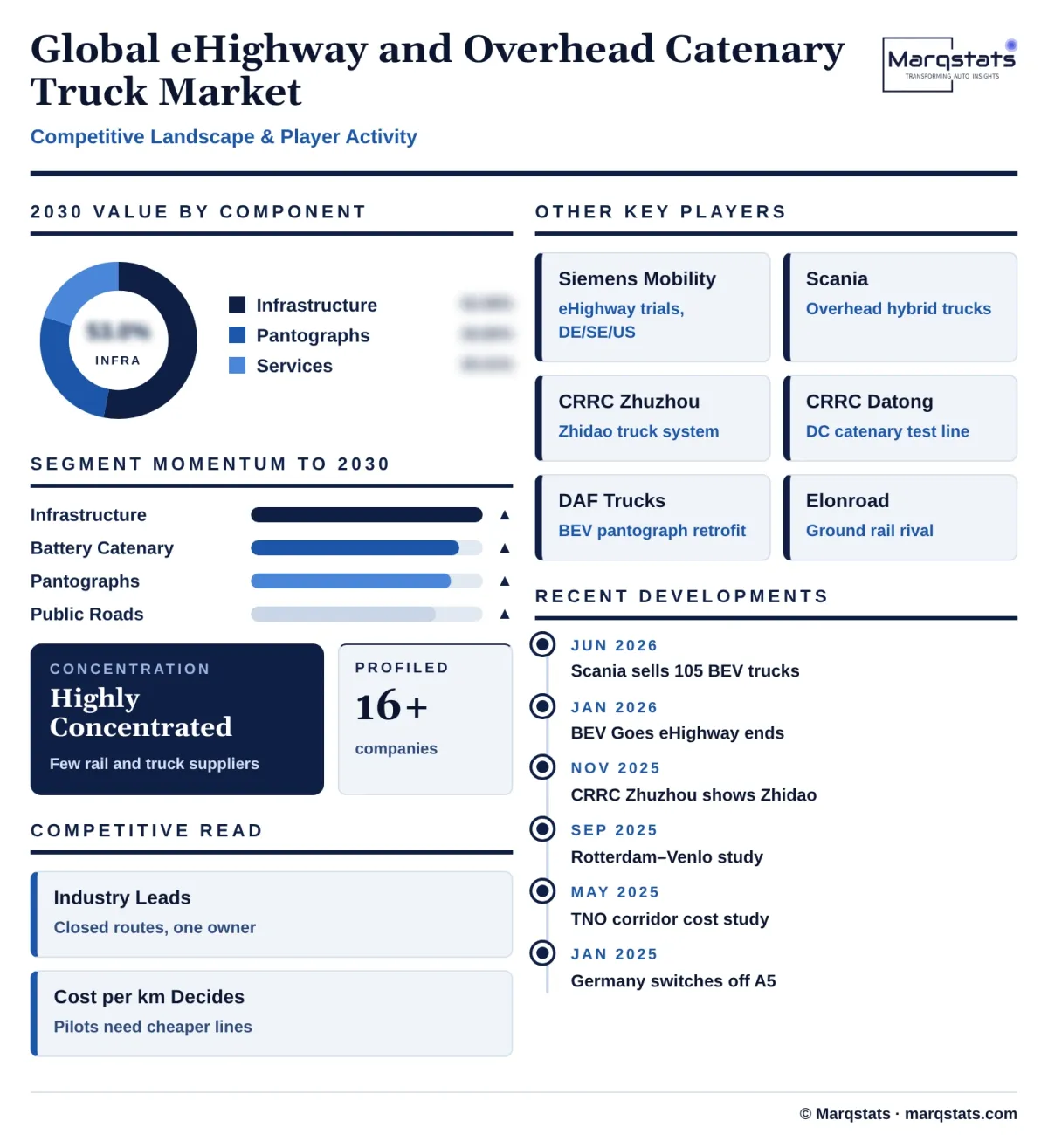
The eHighway and overhead catenary truck market is highly concentrated. Siemens Mobility built all of the main public-road trials in Germany, Sweden and the United States with Scania trucks, while CRRC Zhuzhou Locomotive and CRRC Datong lead in China. A small group of rail electrification suppliers, truck makers and research institutes account for almost all spending.
Suppliers come from rail. Contact lines, masts and traction substations draw on tram and railway electrification, so companies such as Siemens Mobility, Alstom, ABB, Hitachi Energy and the CRRC group have the engineering base, while Continental developed pantograph production with Siemens.
Truck makers decide whether the technology spreads. Scania supplied the overhead hybrid trucks used in Germany and Sweden, and DAF worked with RWTH Aachen on retrofitting battery-electric trucks, but no truck maker sells a series catenary truck today.
Other electric road technologies compete for the same corridors. Elonroad builds ground-level conductive rail, which is covered by CLC/TS 50740:2025, and Electreon builds in-road inductive charging, as on the A10 motorway trial in France, so road agencies choose between three technologies as well as against static charging.
Research institutes and public agencies remain central. TU Darmstadt led the scientific work on the A5, RWTH Aachen led the battery-electric retrofit project, Fraunhofer ISI and partners assessed the German trials, and TNO and ElaadNL studied Dutch corridors. Their findings shape government decisions, which in turn decide whether public corridors are built at all.
Competition will be decided by cost per kilometre, truck availability and corridor owners. Suppliers that can build lines cheaply on industrial routes, offer certified pantograph kits for standard battery-electric trucks and work with port, mine and logistics park owners will win most of the projects expected before 2030.
Companies Covered
Companies covered in the report include:
Recent Market Activity
Table of Contents
Coverage & Segmentation
The study covers the global eHighway and overhead catenary truck market, with 2025 as the base year, 2021 – 2025 as the historical period and 2026 – 2030 as the forecast period. Values are in US dollars and measure annual spending on overhead catenary infrastructure, truck pantograph systems and related engineering, testing, operation and research services for heavy road trucks. The market is segmented by component, road application, vehicle powertrain served and region.
Open-pit mine haul trucks running on trolley assist are excluded and covered in the Marqstats Trolley Assist Mining Market report, so the two markets must not be added. Ground-level conductive rail, in-road inductive charging, static depot and megawatt charging, trolleybuses, rail electrification and the value of the truck itself are also excluded. Values are converted from euros at about USD 1.13 per EUR and from yuan at 2025 average exchange rates. Segment and regional splits and the forecast are Marqstats estimates built on project disclosures, government reports, standards publications and corridor cost studies.