Market Snapshot
The Europe fleet depot charging market is valued at USD 2,250.30 million in 2025 and is projected to reach USD 5,586.63 million by 2030, a CAGR of 19.94%. Depot charging points added each year rise from 118,990 to 301,940 over the same window, a 20.47% rate. Electric trucks and buses were 12.64% of the region's 2025 electric commercial vehicle registrations, yet they absorb 69.81% of depot spend.
These are Marqstats estimates built bottom-up. We start from new registrations of electrically-chargeable vans, trucks and buses reported by the European Automobile Manufacturers' Association (ACEA) and the Society of Motor Manufacturers and Traders (SMMT), apply a ratio of depot charging points per new vehicle, and multiply by an installed cost per point for each power class. The ports-per-vehicle ratio for vans is the input the total is most sensitive to, because vans supply 87.36% of the vehicle count.
The money follows power, not volume. A new electric van brings about USD 3,266 of depot spend in 2025; a new electric truck brings about USD 47,094 and a new electric bus about USD 58,805. That fourteen-fold gap between a van and a truck is why the market grows faster than vehicle counts once heavy-duty registrations accelerate.
Trucks overtake every other layer. The truck segment rises from 35.58% of value in 2025 to 47.08% in 2030, at a 26.86% CAGR, while buses slow to 12.40% because the urban bus fleet is already well into its transition. Germany, the Netherlands and France together took 74% of EU electrically-chargeable truck registrations in the first half of 2026, so the fastest-growing layer of the market is also the most geographically concentrated.
The binding constraint sits outside the charger. Site power distribution and installation account for 44.85% of 2025 spend and grow faster than hardware, at 21.05% against 16.97%, because each move up the power ladder pulls a transformer, switchgear and cable bill behind it.
Key Takeaways
Market Overview & Analysis
Report Summary
Europe's commercial vehicle electrification has moved from vans to heavy freight, and the charging bill has moved with it. In the first half of 2026 the EU registered 8,235 electrically-chargeable trucks, up 47.7%, and 6,247 electric buses, up 56.8%, according to ACEA. Each of those vehicles needs a depot point several times more expensive than a van wallbox. The thesis of this analysis is simple. Fleet depot charging in Europe is now a heavy-duty power market that happens to have a large van tail, and suppliers who price it as a van market will misjudge where the money sits.
The measure is annual spend on charging at private and shared fleet depots across the EU27, the European Free Trade Association countries and the United Kingdom. It covers charging hardware, behind-the-meter site power distribution and installation, battery energy storage systems integrated with depot charging, and charging management software subscriptions. It excludes front-of-meter grid reinforcement charged by distribution system operators, electricity purchases, public corridor hubs built under the Alternative Fuels Infrastructure Regulation, workplace charging for passenger cars and temporary construction-site power. The live Marqstats Europe Megawatt Charging System Market page sizes public MCS hardware at USD 17.63 million for 2025 and the Europe Construction Site Charging Market page sizes jobsite power at USD 0.68 billion; neither is added to the depot total.
Four readers will use the figures differently. Charger manufacturers deciding where to place sales engineers need the truck-and-bus share by country. Electrical contractors and switchgear suppliers weighing capacity need the installation layer, which grows faster than hardware. Fleet operators and logistics real-estate owners deciding between owning, sharing or contracting depot charging need the per-vehicle investment benchmarks. Infrastructure investors pricing charging-as-a-service portfolios need the installed-base trajectory, which reaches 1,570,651 depot points by 2030 on Marqstats estimates.
Europe Fleet Depot Charging Market Size and Forecast
Marqstats estimates the market at USD 880.90 million in 2021, USD 1,065.39 million in 2022, USD 1,499.36 million in 2023, USD 1,630.25 million in 2024 and USD 2,250.30 million in 2025, a 26.42% annual rate over the historical period. The forecast runs to USD 2,950.83 million in 2026, USD 3,502.10 million in 2027, USD 4,131.45 million in 2028, USD 4,825.45 million in 2029 and USD 5,586.63 million in 2030. In euro terms the 2025 base equals EUR 1,991.42 million at the fixed rate of EUR 1 = USD 1.13. The 2024 pause reflects a fall in EU electric van registrations that year, when the van share dropped to 6.1% before recovering to 11.2% in 2025.
The build is units multiplied by price. For 2025 we take 208,000 electric vans, 17,000 electric trucks and 13,100 electric buses registered across Europe. The EU portion comes from ACEA full-year data: an 11.2% electric share of vans, a 4.2% share of 307,460 trucks and a 23.8% share of 38,238 buses. The United Kingdom adds 30,169 battery-electric vans reported by SMMT. Marqstats estimates the remaining EFTA and UK heavy-vehicle volumes from the gap between ACEA EU and EU+EFTA+UK tables for the first half of 2026. We then apply 0.45 depot points per new van, 0.80 per truck and 0.90 per bus, giving 118,990 points added in 2025.
Cost per point is set by power class and benchmarked against public subsidy schedules. France's Advenir programme pays up to EUR 2,200 for a 12 to 43 kW AC point and EUR 15,000 for a DC point above 140 kW at a 50% subsidy rate, which brackets the full installed cost from below. Spain caps its grant at EUR 40,000 for a 150 to 350 kW point at 40% to 60% of eligible cost. Against these, Marqstats uses EUR 3,400 per van AC point, EUR 38,000 per truck DC point up to 150 kW, EUR 72,000 per 151 to 350 kW point and EUR 150,000 per point above 350 kW, all including behind-the-meter site works. Battery storage and software are then added as separate layers.
Value grows slightly slower than port count, 19.94% against 20.47%, and the gap is a price effect. Hardware cost per point falls through 2030 while the mix shifts toward higher power, and the two forces nearly cancel. Van ports fall in unit cost and rise in number; truck ports rise in both. The 2026 step to USD 2,950.83 million is steeper than the five-year average because first-half 2026 registrations across EU, EFTA and UK markets rose 37.5% for vans and 53.3% for trucks.
Trucks and Buses Carry Seven in Ten Depot Dollars
Vehicle counts mislead in this market. Vans were 87.36% of Europe's electric commercial vehicle registrations in 2025, trucks 7.14% and buses 5.50%. On spend the order inverts: trucks hold 35.58%, buses 34.23% and vans 30.19%. That is the Signature Finding, and it rests on two published series, ACEA registrations and public subsidy schedules, combined in a Marqstats construction.
The mechanism is power per vehicle. A delivery van completing an urban round can refill overnight from an 11 or 22 kW wallbox costing a few thousand euros. A 40-tonne tractor running 70,000 km a year needs 50 to 150 kW, and a study by Fraunhofer ISI and the Oeko-Institut for Transport & Environment, published in February 2025, shows that 40 trucks charging at 50 kW overnight need about 2 MW of site capacity, rising to about 6 MW if they charge at 150 kW between shifts. A bus depot sits between the two but adds more points per vehicle, because nearly every bus returns to the depot every night.
The implication is that heavy-vehicle registrations, not van registrations, set the pace of revenue. A one-point rise in the electric truck share of the European truck market adds more depot spend than a two-point rise in the van share. Suppliers who allocate sales effort by vehicle count will over-serve the van tail.
Installation Is the Faster-Growing Half of the Bill
Charger hardware was 48.76% of 2025 value, at USD 1,097.21 million, and site power distribution and installation was 44.85%, at USD 1,009.25 million. By 2030 the order flips: installation reaches USD 2,623.45 million, or 46.96%, against USD 2,402.33 million for hardware. Hardware prices fall as manufacturers scale; transformers, switchgear and cable trenches do not.
Grid access is the reason installation matters. The Transport & Environment study reports that a German depot grid connection up to 8 MVA costs EUR 70,000 to EUR 350,000 and that transformer delivery in Germany can take up to twelve months. Those front-of-meter charges are excluded from the total, but the behind-the-meter equipment they connect to is included, and its cost scales with depot power. Battery storage is the release valve. Depot-integrated storage rises from USD 67.80 million in 2025 to USD 339.00 million in 2030, a 37.97% CAGR, as operators buffer peak demand rather than wait for a larger connection.
Depot Spend Sits Apart From the Public Megawatt Build
Public corridor charging and depot charging are different markets with different buyers. The Alternative Fuels Infrastructure Regulation, Regulation (EU) 2023/1804, which has applied since 13 April 2024, requires heavy-duty charging pools covering at least 15% of the trans-European transport network by the end of 2025 and 50% by the end of 2027, with pools of at least 1,400 kW. Those pools are built by charge point operators such as Milence B.V. and appear in the Marqstats Europe Megawatt Charging System Market page, which values public MCS hardware at USD 17.63 million in 2025 on a EUR 1 = USD 1.16 basis. None of that spend is inside the depot total.
The overlap that does exist is small and quantified. Marqstats sizes depot points above 350 kW at USD 49.25 million in 2025, about 37% of the roughly USD 134 million fleet-depot slice implied by the live global Megawatt Charging System Market page, which puts depot at about 47% of USD 285 million. That fits Europe's position as the largest MCS region on that page. The two figures should not be added to each other or to the depot total. The International Council on Clean Transportation estimated in October 2025 that the EU needs 150,000 to 175,000 private truck chargers by 2030; our Europe-wide truck depot base reaches about 188,600 points, consistent with that range once UK and EFTA volumes are included.
Market Dynamics
Key Drivers
Four instruments, each with a date attached, set the pace of depot investment.
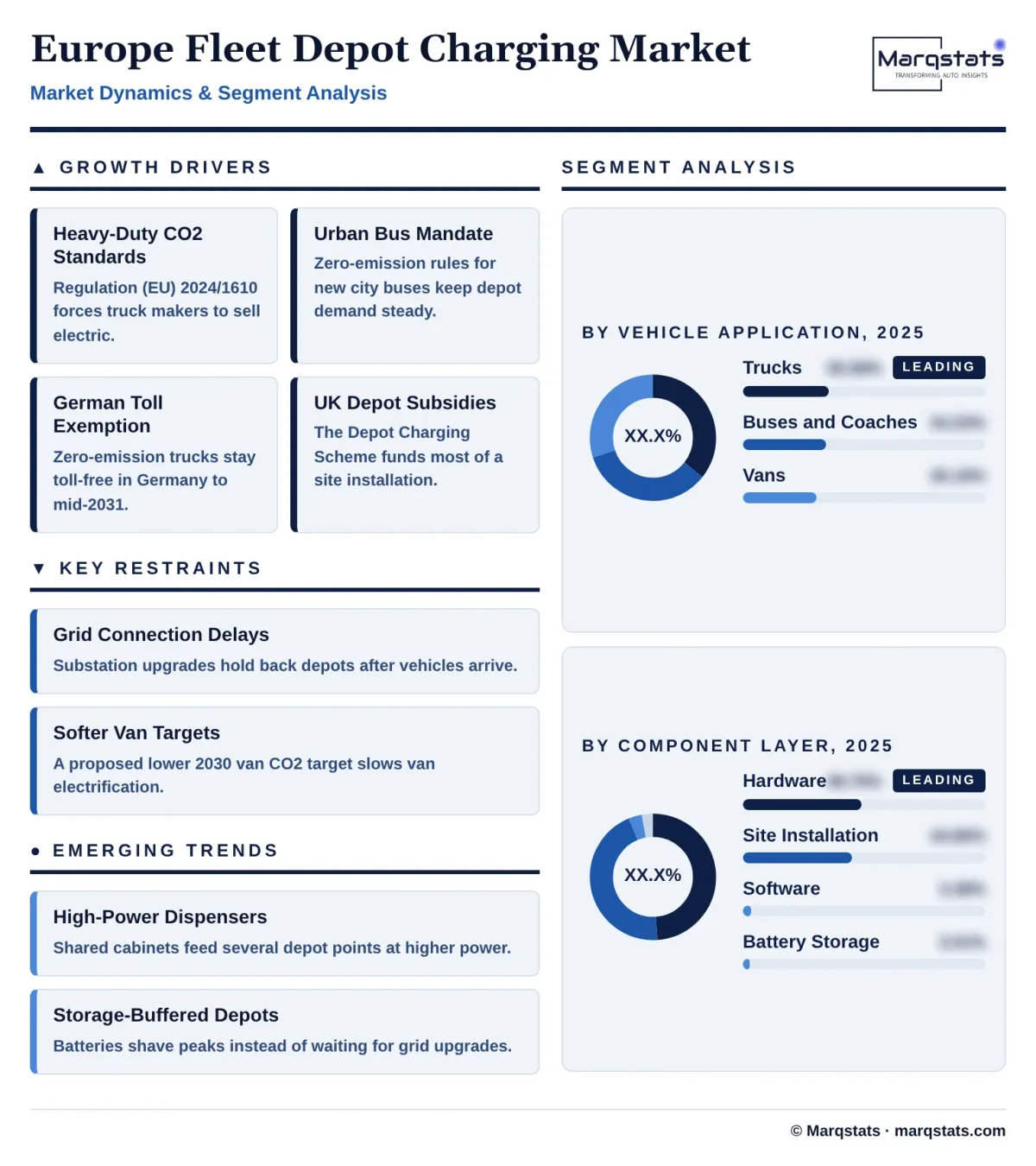
- Heavy-duty CO2 standards: Regulation (EU) 2024/1610, adopted in May 2024, requires a 45% cut in average CO2 emissions from new heavy trucks from 2030 against the 2019 baseline, after 15% from 2025, which forces manufacturers to sell electric trucks that need depot power.
- Urban bus mandate: the same regulation requires 90% of new urban buses to be zero-emission from 2030 and 100% from 2035, which keeps bus depot spend above USD 1,381.79 million in 2030 even as its growth rate slows.
- Toll relief in Germany: zero-emission trucks of 4.25 tonnes and above stay exempt from the German truck toll until 30 June 2031 under the amendment gazetted in December 2025, which keeps Germany the largest country market at 21.43% of 2025 value.
- Direct depot subsidies: the UK Government added GBP 170 million to its Depot Charging Scheme on 25 March 2026, covering up to 70% of installation cost and up to GBP 1 million per site, which lowers the hurdle for van and truck depots alike.
Key Restraints
The restraints are physical and commercial rather than regulatory.
- Grid connection lead times: Transport & Environment reports German connections taking from three months to several years and up to a decade in parts of the UK when substations need replacement, which delays depot projects even after vehicles are ordered.
- Softer van targets: the European Commission Automotive Package of 17 December 2025 proposes cutting the 2030 van CO2 target from 50% to 40%, which caps the pace of van electrification and holds the van share of depot value to 28.19% in 2030.
- Capital caution among buyers: Kempower Oyj cut the upper end of its 2026 revenue outlook to 25% growth in July 2026, citing slower charge point operator investment, and fleet deals are taking longer to close.
Key Trends
Three shifts in how depots are built are visible in 2025 and 2026 product and network decisions.
- Distributed high-power depot dispensers: Alpitronic GmbH launched a Depot Dispenser in September 2026 delivering up to 400 kW per point from a shared HYC1000 cabinet serving eight points, which pushes the 151 to 350 kW and above-350 kW classes to 33.06% of 2030 value combined.
- Shared and networked depots: in October 2026 Milence B.V. added its public hubs to the Depotcharge platform in Germany, letting fleets charge at private depots and public hubs on one bill, which raises the utilisation case for opening private depots to third parties.
- Storage in front of the charger: battery storage grows from 3.01% of value in 2025 to 6.07% in 2030, a 37.97% CAGR, as depots install buffers sized in hundreds of kilowatt-hours to avoid or defer grid upgrades.
Strategic Implications
- For entrants: the open position is the installation and storage layer for truck depots in Germany, the Netherlands and France, which took 74% of EU electric truck registrations in the first half of 2026; a contractor with transformer and switchgear capacity in those three markets addresses the fastest-growing slice of USD 2,630.19 million in 2030 truck depot value.
- For incumbents: charger manufacturers whose revenue is weighted to public charge point operators should rebalance toward fleets, since fleet order intake held up at Kempower Oyj in 2026 while operator orders softened, and depot points above 150 kW grow at 27.90% or faster.
- For suppliers and investors: charging management software is only 3.38% of 2025 value but rides on an installed base that grows from 448,640 points to 1,570,651 by 2030, which makes recurring software and charging-as-a-service contracts the steadiest return in the market.
Market Segmentation
Trucks are the largest and fastest-growing application, at USD 800.60 million in 2025 (35.58%) rising to USD 2,630.19 million in 2030 (47.08%), a 26.86% CAGR. The segment covers depot charging for medium trucks of 3.5 to 16 tonnes and heavy trucks above 16 tonnes. ACEA reported 7,867 electric medium trucks and 4,991 battery-electric heavy trucks in the EU in 2025.
Each new truck brings about USD 47,094 of depot spend on Marqstats estimates. The ratio of 0.80 depot points per new truck in 2025 eases to 0.72 by 2030 as larger fleets share points across shifts, but average power per point rises, so spend per truck holds.
Buses account for USD 770.34 million in 2025 (34.23%) and USD 1,381.79 million in 2030 (24.73%), a 12.40% CAGR. The EU registered 9,089 electric buses in 2025, 23.8% of the market, and 6,247 in the first half of 2026. Bus depots need nearly one point per vehicle, 0.90 in 2025, because almost every bus returns overnight.
Growth slows because the urban segment is already far along. Public transport authorities have committed most of their depot conversions, and the 90% zero-emission requirement for new urban buses from 2030 sustains replacement demand rather than creating new depots at the 2023 to 2025 pace.
Vans represent USD 679.36 million in 2025 (30.19%) and USD 1,574.65 million in 2030 (28.19%), an 18.31% CAGR. They are 87.36% of electric commercial vehicle registrations but bring only about USD 3,266 of depot spend each, since most points are 11 to 22 kW AC wallboxes and many vans charge at drivers' homes or on public networks.
The ratio of 0.45 depot points per new van is the most sensitive input in the model. A move to 0.50 would add roughly a tenth to van segment value in 2025. The Commission proposal of December 2025 to soften the 2030 van CO2 target from 50% to 40% is the main reason the van share edges down to 28.19% by 2030.
Charger hardware, meaning AC wallboxes, DC power cabinets and dispensers, is USD 1,097.21 million in 2025 (48.76%) and USD 2,402.33 million in 2030 (43.00%), a 16.97% CAGR. Hardware is 45% of installed cost for a van point and 55% for a truck or bus point in 2025, falling to 42% and 50% by 2030 as unit prices decline.
Behind-the-meter transformers, switchgear, cabling, civil works and commissioning total USD 1,009.25 million in 2025 (44.85%) and USD 2,623.45 million in 2030 (46.96%), a 21.05% CAGR. This layer overtakes hardware by 2028 on Marqstats estimates, because depot power per point rises faster than hardware prices fall.
Subscriptions for depot charging management, load balancing and fleet integration reach USD 76.04 million in 2025 (3.38%) and USD 221.85 million in 2030 (3.97%), a 23.88% CAGR. Marqstats applies EUR 300 a year per subscribed point in 2025, easing to EUR 250 by 2030, to half of the installed depot base.
Battery energy storage installed with depot charging stands at USD 67.80 million in 2025 (3.01%) and USD 339.00 million in 2030 (6.07%), a 37.97% CAGR. Scania Logistics in Oskarshamn, Sweden, pairs four 350 kW charging satellites with a 600 kW, 1.12 MWh storage unit, an arrangement Marqstats treats as representative of grid-constrained truck depots.
DC points up to 150 kW dominate at USD 1,426.27 million in 2025 (63.38%) and USD 3,048.51 million in 2030 (54.57%), a 16.41% CAGR. This class covers overnight truck and bus charging and the DC share of van depots, and it holds the majority because most heavy vehicles dwell long enough at the depot.
Points between 151 and 350 kW total USD 467.45 million in 2025 (20.77%) and USD 1,600.08 million in 2030 (28.64%), a 27.90% CAGR. Operators running two shifts or regional haulage with short turnarounds move up to this class.
AC points up to 43 kW account for USD 307.33 million in 2025 (13.66%) and USD 691.32 million in 2030 (12.37%), a 17.60% CAGR. Almost all of this class sits in van depots, where 80% of depot points are AC in 2025.
Points above 350 kW, including Megawatt Charging System units and 400 kW CCS dispensers, total USD 49.25 million in 2025 (2.19%) and USD 246.72 million in 2030 (4.42%), a 38.03% CAGR. The class is small because MCS was still being standardised in 2025, and Scania CV AB only opened MCS orders in May 2026 without a delivery date.
By Geography
Germany
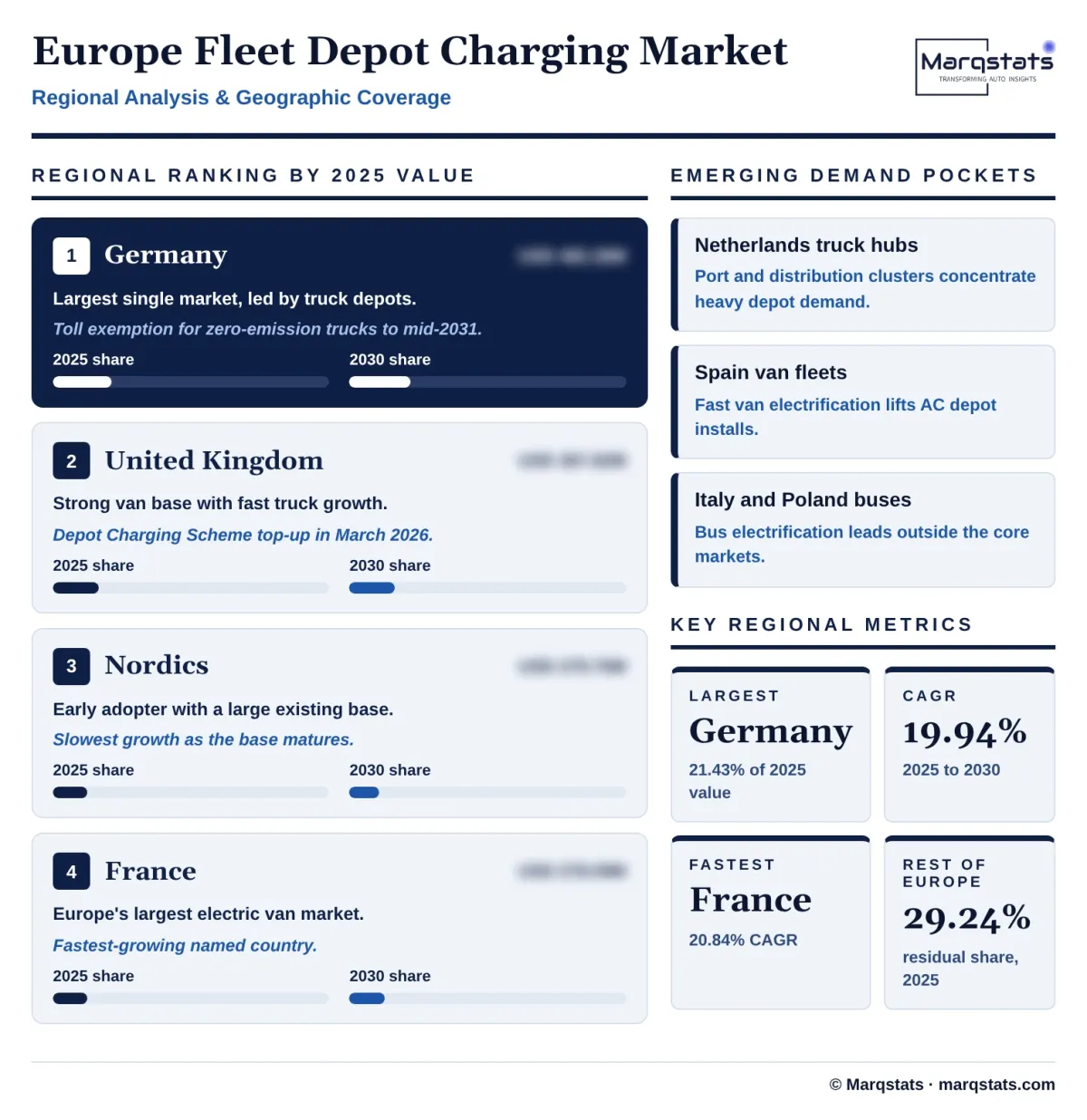
Germany is the largest single market at USD 482.28 million in 2025 (21.43%), reaching USD 1,232.87 million in 2030 (22.07%) at a 20.65% CAGR. It registered 3,545 electric trucks in the first half of 2026, up 88.5%, more than any other European country, and the toll exemption for zero-emission trucks to 30 June 2031 keeps the truck case strong. Its weight in trucks, 31.0% of the European electric truck count in that period, is why its value share exceeds its van share.
United Kingdom
The United Kingdom accounts for USD 367.82 million in 2025 (16.35%) and USD 908.97 million in 2030 (16.27%), a 19.83% CAGR. SMMT recorded 30,169 battery-electric vans in 2025, up 36.2%, and ACEA counted 1,958 electric trucks in the first half of 2026, up 68.6%. The GBP 170 million top-up to the Depot Charging Scheme in March 2026 is the main local driver.
Nordics
The Nordics, Sweden, Norway, Denmark and Finland, hold USD 279.70 million in 2025 (12.43%) and USD 607.55 million in 2030 (10.88%), a 16.78% CAGR, the slowest in the region. Sweden and Norway registered 6,243 and 6,433 electric vans and 587 and 596 electric trucks in the first half of 2026. Early adoption means a larger existing base and slower growth from here.
France
France stands at USD 278.09 million in 2025 (12.36%) and USD 716.42 million in 2030 (12.82%), the fastest named-country CAGR at 20.84%. It is Europe's largest electric van market, with 23,437 registrations in the first half of 2026, and its electric truck registrations rose 43.7% in that period. The Advenir subsidy schedule for depot points supports both segments.
Netherlands
The Netherlands accounts for USD 184.39 million in 2025 (8.19%) and USD 455.58 million in 2030 (8.15%), a 19.83% CAGR. It registered 1,412 electric trucks in the first half of 2026, up 44.5%, the third-highest count in the EU, and its port and distribution-centre clusters concentrate depot demand on a small number of large sites.
Rest of Europe
The residual, covering Italy, Spain, Poland, Belgium, Austria, Switzerland and the remaining EU, EFTA and Balkan markets, totals USD 658.02 million in 2025 (29.24%) and USD 1,665.24 million in 2030 (29.81%), a 20.41% CAGR. Spain registered 11,566 electric vans in the first half of 2026, up 50.9%, and Italy and Poland lead bus electrification outside the core markets.
How Competition Is Evolving
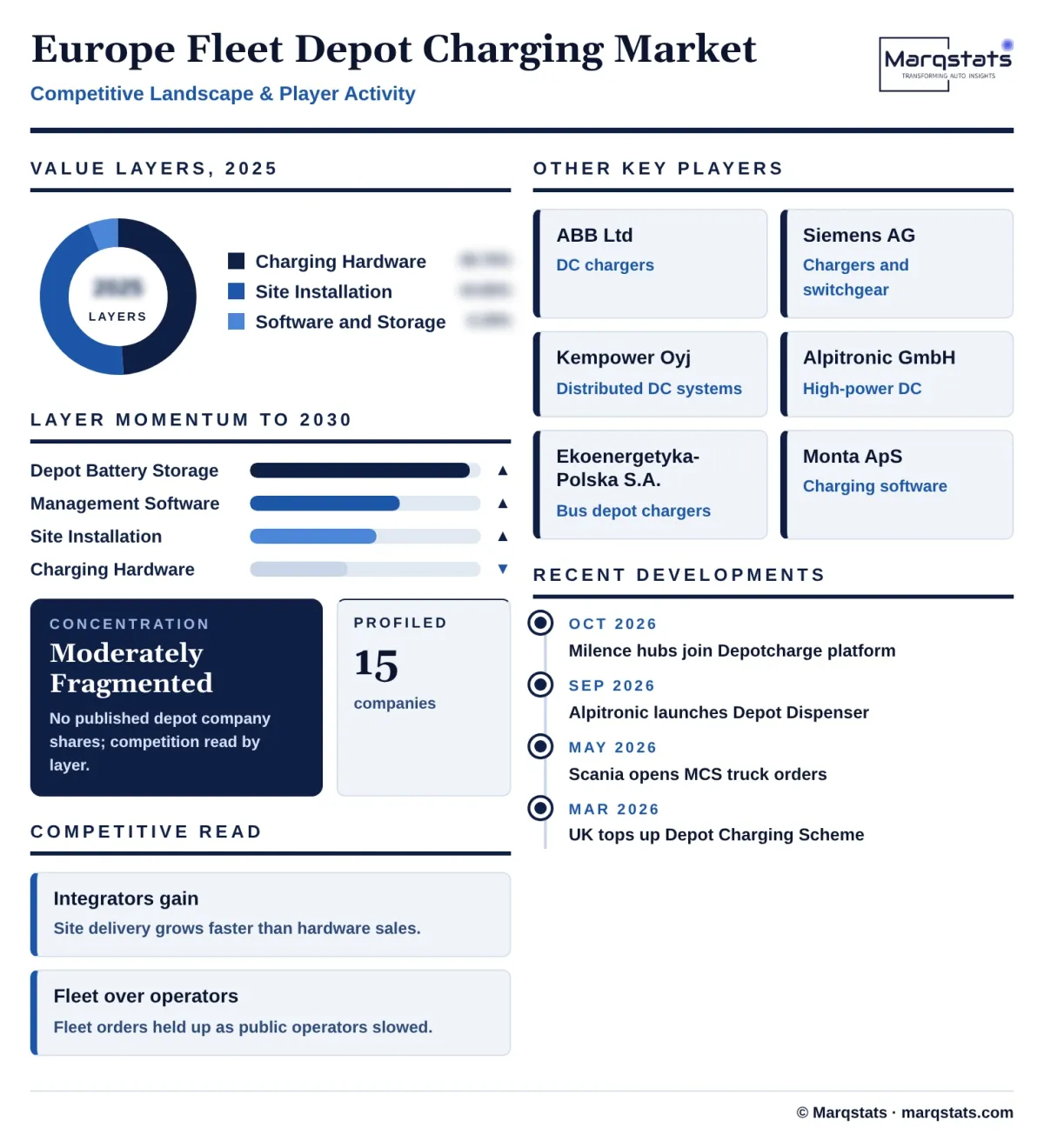
The market is moderately fragmented, and no named official source publishes depot-specific company shares, so Marqstats describes competition by layer rather than by ranking. Charger hardware is led by a group of European specialists and electrical majors, including ABB Ltd, Siemens AG, Kempower Oyj, Alpitronic GmbH and Ekoenergetyka-Polska S.A. on the DC side and Alfen N.V., Zaptec ASA, Mennekes Elektrotechnik GmbH & Co. KG and KEBA AG on the AC side. Kempower reported H1 2026 revenue of EUR 135.5 million, up 28%, with fleet order intake described as strong, which places it among the larger pure-play suppliers.
Suppliers compete on power density, uptime and the ability to deliver a whole site. Truck and bus customers buy distributed architectures, where one power cabinet serves several dispensers, because it lets a depot add points without adding grid capacity. The Alpitronic Depot Dispenser launched in September 2026 is a typical example. Software and storage together were only 6.39% of 2025 value, so integration matters as much as hardware; Scania CV AB, through its Erinion charging business, and E.ON SE sell turnkey depot projects that bundle design, installation, storage and financing.
The structural divide is between equipment makers and site integrators. Transformers and switchgear come from Schneider Electric SE, Siemens AG and Hitachi Energy Ltd, and installation is local. Software is a separate layer where Monta ApS and ChargePoint Holdings, Inc. sell charging management to fleets. As installation grows faster than hardware, integrators that control the site programme will capture a rising share of each project.
Companies Covered
Companies covered in the report include:
Recent Market Activity
Table of Contents
Coverage & Segmentation
The study measures annual spend on fleet depot charging in Europe, defined as the EU27, the EFTA countries and the United Kingdom, for 2021 to 2030 with 2025 as the base year and 2026 to 2030 as the forecast. Spend covers charging hardware, behind-the-meter site power distribution and installation, battery storage integrated with depot charging, and charging management software. It excludes front-of-meter grid reinforcement and connection charges, electricity purchases, public corridor charging hubs, passenger car workplace charging and temporary jobsite power. Values are in US dollars at a constant EUR 1 = USD 1.13 and GBP 1 = USD 1.32.
Three dimensions are quantified: vehicle application with three segments, component layer with four and charging power class with four, plus six regional groupings. Registrations are the primary series and value is derived. Fifteen companies are profiled. Boundary notes: the Marqstats Europe Megawatt Charging System Market covers public MCS hardware and the Europe Construction Site Charging Market covers temporary jobsite power; do not add either to this total. The above-350 kW depot class overlaps the fleet-depot slice of the global Megawatt Charging System Market; do not add them. The US Fleet Depot Charging Infrastructure Market is a separate geography and includes front-of-meter make-ready, so it is context only.