Market Snapshot
The Vietnam electric bus market size is estimated at USD 158.02 million in 2025 and is projected to reach USD 281.99 million by 2030, growing at a CAGR of 12.28% over 2026 – 2030. Annual deliveries of new battery-electric buses rise from 1,140 to 1,900, a 10.76% annual rate, and the average value per bus climbs from about USD 138,614 to USD 148,416 as large city buses and electric sleeper coaches take a larger share of the mix.
Marqstats defines the market as the value of new battery-electric buses and coaches with ten or more seats, including the driver, delivered to operators in Vietnam, whether assembled in Vietnam by VinFast, Kim Long Motor and other builders or imported complete. Value is the ex-factory or landed price including the body and the traction battery, before value added tax, registration fees and finance charges. Depot chargers, grid connections, operating subsidies, used buses, electric vans below ten seats and buses built in Vietnam for export are excluded.
Medium electric city buses of 8 to 9.5 metres account for 54.01% of 2025 value, municipal subsidised routes for 82.00% and Southern Vietnam for 62.00%. Large electric buses and coaches of 10 metres and above grow fastest among length classes, at 28.89% a year, because intercity operators began to buy electric sleeper coaches in October 2026 and Ho Chi Minh City wants every intercity bus in the city to be electric by 2029.
Key Takeaways
Market Overview & Analysis
Report Summary
Marqstats sizes the Vietnam electric bus market as the delivered value of new battery-electric buses and coaches with ten or more seats, in three length classes: mini and midi buses of up to 8 metres, medium city buses of 8 to 9.5 metres, and large buses and coaches of 10 metres and above. The count covers city buses for subsidised routes, buses for non-subsidised and intercity services, and school, corporate and resort shuttles, built by VinFast in Hai Phong, by Kim Long Motor in Hue and by smaller builders and importers.
No official series counts electric buses. The Vietnam Automobile Manufacturers Association (VAMA) does not include VinFast and reports buses only in total, and Vietnam Register releases no monthly series of battery-electric bus registrations. Marqstats therefore builds the count from deliveries named by operators, cities and builders. The anchor is the batch of 650 Kim Long Motor buses for FUTA Bus Lines reported in July 2025, of which 450 were battery-electric and 200 diesel, and the 443 electric buses that entered service on 27 routes in Ho Chi Minh City on 1 August 2025, which lifted the electric fleet of the city to 613 buses, 26.2% of about 2,342.
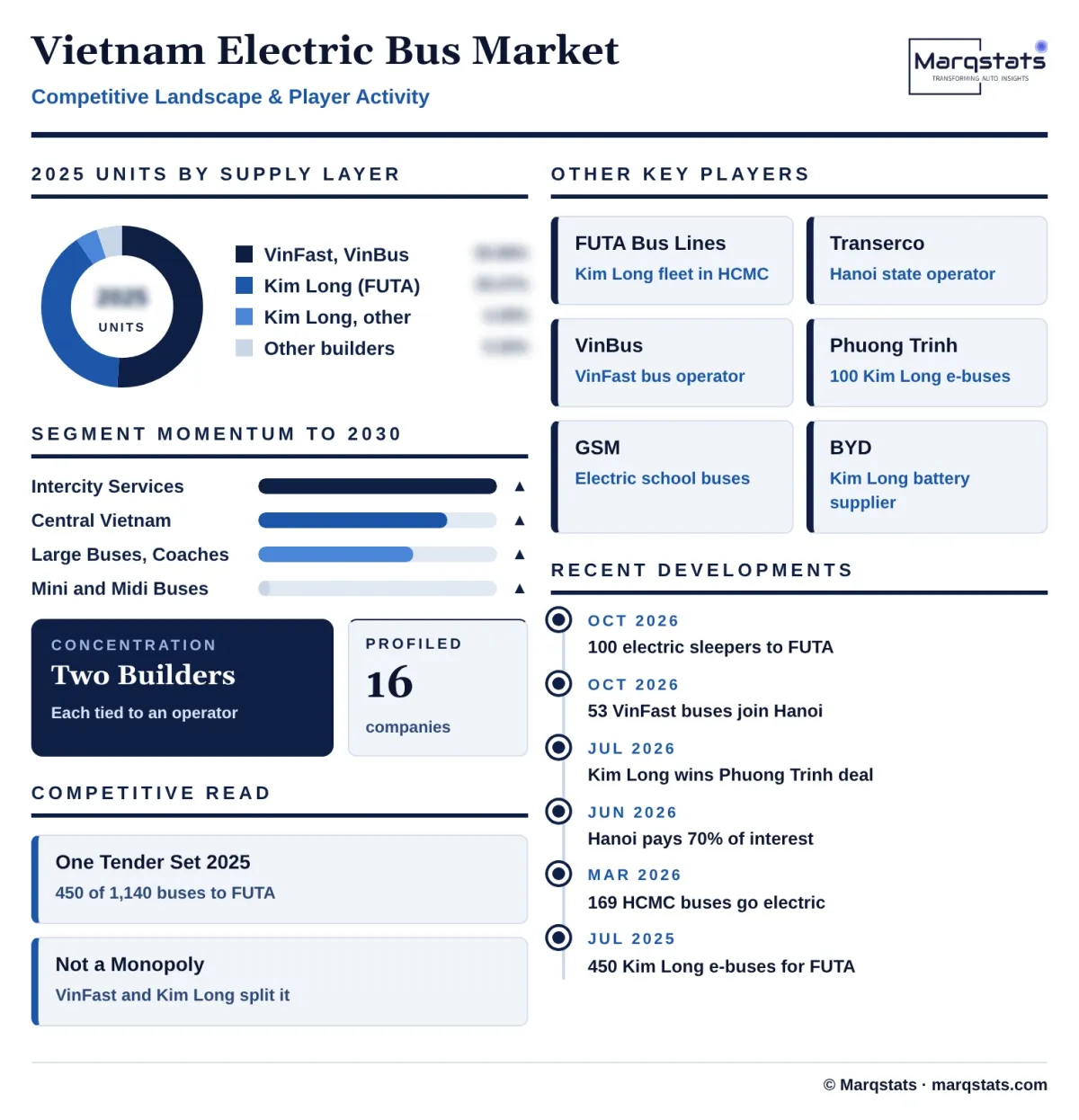
The 2025 layers are Kim Long Motor at 500 buses, made up of the 450 FUTA Bus Lines vehicles and about 50 for other domestic customers, VinFast and VinBus at about 580, and other builders and importers at about 60. The Kim Long and VinFast layers beyond the published batch, and the other-builder layer, are a Marqstats construction, not a registration count, and are checked against fleet changes in Hanoi and Ho Chi Minh City and against the 58 VinFast EB 8 buses that VinBus put on routes 33 and 150 in December 2025.
At the 2025 average rate of VND 26,009 per US dollar, the 2025 market of USD 158.02 million equals about VND 4.11 trillion, an average of about USD 138,614 (VND 3,605 million) per bus. The price anchor is the Green Bus 8, the 8.61 metre medium bus that Transerco runs on route 90 in Hanoi, which was reported at VND 4.1 billion in April 2026.
Vietnam also has a live Marqstats analysis of the electric vehicle market, which counts electric cars, buses, trucks and two-wheelers. The electric buses sized here are a subset of that market and the two figures should not be added. The analysis here is the dedicated deep-dive on buses, with its own delivery count, price ladder and route-level evidence.
Vietnam Electric Bus Market Size and Forecast
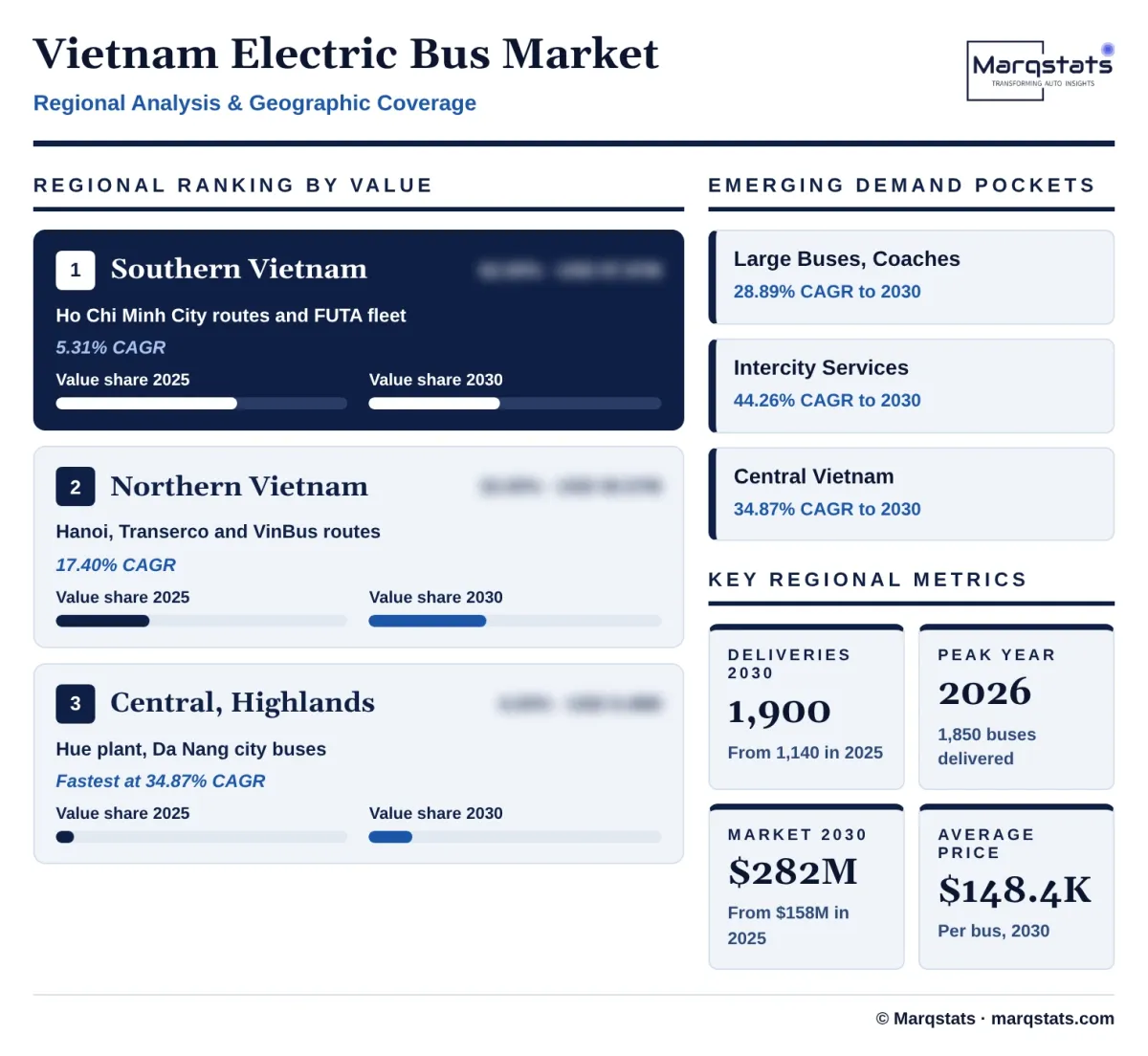
The Vietnam electric bus market grows from USD 158.02 million in 2025 to USD 281.99 million in 2030, a CAGR of 12.28%. Volume supplies most of the growth: deliveries rise 10.76% a year from 1,140 to 1,900 buses, and the average value per bus rises 1.38% a year from about USD 138,614 to USD 148,416, because the mix moves toward large buses and coaches even as the price of each class eases by about 1% a year with higher local content.
The path is not a straight line. Marqstats expects 1,850 deliveries in 2026, worth USD 266.07 million, then 1,650 in 2027, worth USD 241.43 million, a fall of 9.26%. Ho Chi Minh City reported on 19 June 2026 that 1,649 of its 2,432 buses, about 68%, already ran on electricity or green energy and that the whole fleet should do so by early 2027, so most of its remaining conversions land in 2026. Hanoi had 682 electric buses and 139 compressed natural gas buses at the end of April 2026, a green share of 42.1%, and must convert the rest by 2030.
From 2028 the market grows again, by 2.46% in 2028, 7.09% in 2029 and 6.45% in 2030, carried by the remaining Hanoi routes, by intercity electric coaches and by provincial cities. The 2030 forecast assumes 420 mini and midi buses, 800 medium city buses and 680 large buses and coaches.
The 2025 value is built bottom-up from classes and prices. Marqstats estimates 360 mini and midi buses at about VND 2,500 million (USD 96,121), 600 medium city buses at about VND 3,700 million (USD 142,258) and 180 large buses at about VND 5,500 million (USD 211,465), all before value added tax. The medium price sits close to the VND 4.1 billion reported for the Green Bus 8 once value added tax is removed, and the large-bus price reflects the 422 kWh battery of the 12.11 metre VinFast EB 12 against 359 kWh for the EB 8.
Marqstats tracks four indicators to monitor the forecast: route tender awards and contract expiries in Hanoi and Ho Chi Minh City, the monthly green-fleet share that each city reports, the order book of Kim Long Motor with FUTA Bus Lines, Phuong Trinh and other operators, and the uptake of the 70% interest support that Hanoi opened to bus operators in June 2026.
Market Dynamics
Key Drivers
Five forces lift deliveries of electric buses in Vietnam, led by city route tenders that now admit only electric or green-energy vehicles and by cheap credit for the operators who win them.
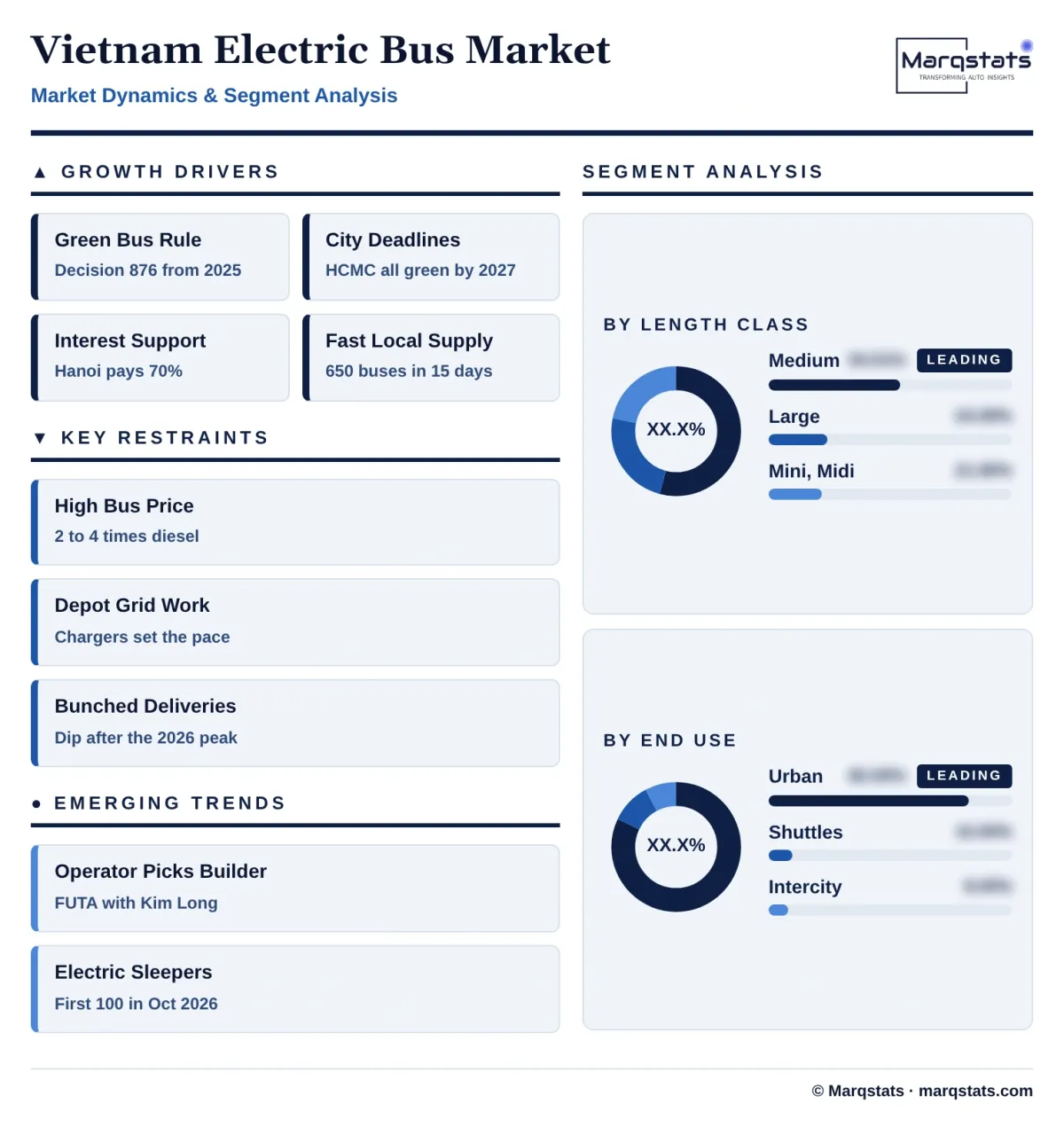
- National rules close the door on new diesel city buses. Decision 876/QD-TTg of 22 July 2022 requires urban buses that are newly added or replaced from 2025 to use electricity or green energy, and all buses to do so by 2050. Hanoi revised its programme in May 2025 to convert all public buses to electric or green energy by 2030, with every bus inside Ring Road 4 electric, which is 20 years ahead of the national deadline.
- City deadlines compress demand into a few years. Ho Chi Minh City reported 1,649 of 2,432 buses on electricity or green energy on 19 June 2026 and set early 2027 for the whole fleet, and it wants all intercity buses operating in the city to be electric by 2029. Transerco, the state bus operator of Hanoi, targets a green share of more than 51% by the end of 2026 and added 120 electric buses in April 2026 alone.
- Cheap credit lowers the cost of entry for operators. The Hanoi People's Council adopted Resolution 37/2025/NQ-HĐND on 29 September 2025, and the Hanoi People's Committee issued Decision 71/2026/QĐ-UBND on 19 June 2026 to put it into effect: the city budget pays 70% of the loan interest on electric and green-energy buses and their charging and transformer stations, for the full loan term up to 10 years, for operators that hold a public bus contract with the Hanoi Department of Construction.
- Domestic builders deliver at speed. Kim Long Motor produced and delivered the 650 buses of the FUTA Bus Lines order within 15 days, and VinFast reports a bus plant capacity of 1,500 to 2,000 vehicles a year in Hai Phong, so supply did not hold back the 2025 and 2026 conversions.
- Tax rules favour electric vehicles. Decree 51/2025/ND-CP keeps the first-time registration fee for battery-electric vehicles at 0% until 28 February 2027, and Decree 202/2026/ND-CP of 8 June 2026 keeps it at 0% from 1 March 2027 to 31 December 2030, which removes a cost that diesel buses still pay.
Key Restraints
Four constraints keep the market below the pace that the city plans imply and make delivery years uneven.
- Electric buses still cost far more to buy. Participants at a Hanoi roundtable in November 2023 put the price of green buses at two to four times that of diesel buses, and the Green Bus 8 was reported at VND 4.1 billion in April 2026, so operators without a route contract and interest support keep buying diesel.
- Depots and grid connections set the pace. Each converted route needs depot chargers, a transformer station and a grid connection, and the Hanoi interest support covers transformer and charging stations because operators cannot finance them from fares, so a city can only accept electric buses as fast as its depots are wired.
- Deadlines bunch deliveries and then leave gaps. Most of the Ho Chi Minh City conversions fall in 2025 and 2026, so Marqstats expects deliveries to fall from 1,850 in 2026 to 1,650 in 2027 before Hanoi, intercity services and provincial cities take over.
- Long routes and provincial cities lag. Vietnam stretches over 1,650 kilometres from north to south, the first 100 electric sleeper coaches were only handed over in October 2026, and most provincial cities have no route tender rules like those of Hanoi and Ho Chi Minh City, so electric buses stay concentrated in two cities through 2028.
Key Trends
Four shifts are changing who builds electric buses, who buys them and which routes they serve.
- The operator chooses the builder. FUTA Bus Lines buys from Kim Long Motor and VinBus runs VinFast buses, so whoever wins a route concession brings its own supplier, and route tenders decide supplier share more than product rivalry does.
- Electric coaches arrive on intercity routes. The KIMLONG99 EV-G34 sleeper coaches handed to FUTA Bus Lines on 23 October 2026 carry a 357 kWh BYD battery, a range of about 400 kilometres and two CCS2 ports for 240 kW chargers, with 60% local content and a target of 90% by the end of 2026.
- Non-subsidised routes go electric too. VinBus opened routes 179 and 180 in Ho Chi Minh City on 5 October 2026 with 67-seat electric buses and free fares until 31 December 2026, and Kim Long Motor signed on 24 July 2026 to supply 100 electric buses of 30, 40 and 60 seats to Phuong Trinh Joint Stock Company, a Ho Chi Minh City operator.
- Vietnamese builders look abroad. VinFast showed the EB 8 and EB 12 at Busworld Europe in Brussels in October 2025 and announced in October 2026 that it would bring its bus platform to the United States through NexMove Certified, with the first certified buses targeted for the first quarter of 2028, while Kim Long Motor sells electric buses to DAON Mobility of South Korea.
Strategic Implications
- For bus builders, the sales effort belongs at the operator and the route tender, not at the city transport department alone. FUTA Bus Lines chose Kim Long Motor and VinBus runs VinFast, so a builder without an operator partner needs to secure one before the next tender round in Hanoi.
- For battery and component suppliers, the entry route is a supply contract with a domestic builder. Kim Long Motor uses BYD batteries and targets 90% local content, and VinFast builds in Hai Phong, so packs, motors and chargers reach the market through these two plants.
- For operators, the Hanoi interest support changes the economics of a route bid. Operators that hold a contract with the Hanoi Department of Construction can finance buses, chargers and transformers with the city paying 70% of the interest for up to 10 years, and should price their bids on that basis.
- For charging and energy providers, the depot is the market. Every route conversion needs chargers, a transformer station and a grid connection, and the intercity coaches of FUTA Bus Lines need 240 kW chargers along their routes, which opens a market outside the two big cities.
- For investors, the 2026 peak is not the trend. Deliveries fall in 2027 after the Ho Chi Minh City deadline, and the growth after that comes from Hanoi, intercity coaches and provincial cities, so a plan built on the 2026 run rate overstates the market.
Market Segmentation
Mini and midi electric buses of up to 8 metres account for 21.90% of 2025 value, USD 34.60 million, and grow at 2.10% a year to USD 38.39 million. Marqstats estimates 360 units at about VND 2,500 million each, covering the 30-seat Kim Long B30-EV with a range of about 270 kilometres, the VinFast EB 6 and school and resort shuttles. The class grows slowly because cities now prefer larger buses on trunk routes, and its share falls to 13.61% in 2030.
Medium electric city buses of 8 to 9.5 metres account for 54.01% of 2025 value, USD 85.36 million, and grow at 4.86% a year to USD 108.23 million. Marqstats estimates 600 units at about VND 3,700 million, including the VinFast EB 8 and Green Bus 8, which are 8.61 metres long, carry up to 60 passengers and have a range of about 290 kilometres, and the 40 and 60 seat Kim Long models. They remain the largest class in 2030 with 38.38% of value.
Large electric buses and coaches of 10 metres and above account for 24.09% of 2025 value, USD 38.06 million, and grow fastest, at 28.89% a year, to USD 135.37 million and 48.01% of the market. Marqstats estimates 180 units at about VND 5,500 million in 2025, mostly 12 metre city buses such as the VinFast EB 12 with up to 90 passengers, and 680 units in 2030, when electric sleeper coaches such as the KIMLONG99 EV-G34 add a second source of demand.
Municipal subsidised routes account for 82.00% of 2025 value, USD 129.58 million, and grow at 5.48% a year to USD 169.19 million. They include the 35 subsidised routes that FUTA Bus Lines won in Ho Chi Minh City and the Transerco and VinBus routes in Hanoi. Their share falls to 60.00% in 2030 because both big cities are close to a fully green fleet by then.
Non-subsidised and intercity services account for 8.00% of 2025 value, USD 12.64 million, and grow fastest, at 44.26% a year, to USD 78.96 million and 28.00% of the market. VinBus routes 179 and 180, the Phuong Trinh order and the electric sleeper coaches of FUTA Bus Lines show that operators now buy electric buses without a fare subsidy.
School, corporate and resort shuttles account for 10.00% of 2025 value, USD 15.80 million, and grow at 16.45% a year to USD 33.84 million. Green and Smart Mobility and VinBus launched an electric school bus service in December 2025, and resort, industrial park and airport shuttles use small electric buses on fixed routes.
By Geography
Southern Vietnam
Southern Vietnam accounts for 62.00% of 2025 value, USD 97.97 million, and grows at 5.31% a year to USD 126.89 million, so its share falls to 45.00% in 2030. Ho Chi Minh City took the 450 Kim Long Motor buses of FUTA Bus Lines in 2025 and 169 VinBus buses on nine routes from 1 March 2026, and it plans an all-green fleet by early 2027, so its conversion is front-loaded.
Northern Vietnam
Northern Vietnam accounts for 32.00% of 2025 value, USD 50.57 million, and grows at 17.40% a year to USD 112.80 million and 40.00% by 2030. Hanoi had 682 electric buses at the end of April 2026, Transerco added 53 more on 5 and 6 October 2026, and the city must convert the rest of a fleet of about 1,950 buses by 2030 with interest support for operators.
Central Vietnam and Highlands
Central Vietnam and the Highlands account for 6.00% of 2025 value, USD 9.48 million, and grow fastest, at 34.87% a year, to USD 42.30 million. Kim Long Motor builds its buses in Hue, FUTA Bus Lines also runs Kim Long electric city buses in Da Nang, and intercity coaches on the north-south corridor pass through the region.
How Competition Is Evolving
The market is a contest between two domestic builders, each tied to an operator. Kim Long Motor supplied about 500 electric buses in 2025, 43.86% of deliveries, most of them to FUTA Bus Lines, VinFast and VinBus supplied about 580, 50.88%, and other builders and importers about 60. These are Marqstats estimates built around the published FUTA Bus Lines batch, because no registration series reports electric buses by brand.
VinFast Trading and Production Joint Stock Company is the incumbent. More than 2,000 VinFast electric buses run in Vietnam, VinBus Ecology Transport Services operates about 600 of them directly, and VinFast builds the EB 6, EB 8 and EB 12 in Hai Phong. It also sells to Transerco, which ran 28 Green Bus vehicles on routes 22A and 22B and 25 EB 8 buses on routes 30 and 50 from 5 and 6 October 2026.
Kim Long Motor Hue Joint Stock Company is the challenger that won the largest single order. It delivered 699 electric buses to FUTA Bus Lines for Ho Chi Minh City by July 2025, works with FUTA Bus Lines on about 700 electric city buses for Ho Chi Minh City and Da Nang, signed for 100 electric buses with Phuong Trinh on 24 July 2026 and handed over the first 100 electric sleeper coaches on 23 October 2026.
Other builders hold small positions. Truong Hai Auto Corporation (THACO AUTO) and Saigon Transportation Mechanical Corporation (SAMCO) lead diesel bus production, Green and Smart Mobility operates electric school buses with VinBus, and imported complete buses face the tariff wall that favours local assembly, so a new entrant needs a local plant or an operator partner.
Companies Covered
Companies covered in the report include:
Recent Market Activity
Table of Contents
Coverage & Segmentation
The study covers the Vietnam electric bus market, with 2025 as the base year, 2021 – 2025 as the historical period and 2026 – 2030 as the forecast period. It covers new battery-electric buses and coaches with ten or more seats including the driver, assembled in Vietnam or imported complete, segmented by length class, end use and region. Values are ex-factory or landed prices including the body and the traction battery, in US dollars, before value added tax, registration fees and finance charges, and dong figures use the 2025 average of VND 26,009 per US dollar.
Diesel and compressed natural gas buses, depot chargers and grid connections, operating subsidies, used buses, electric vans and cars below ten seats, and buses built in Vietnam for export are excluded. The live Marqstats Vietnam electric vehicle report counts electric cars, buses, trucks and two-wheelers; the electric buses sized here are a subset of that market and should not be added to it. Splits are Marqstats estimates built on operator, city and builder disclosures and price reports.
