Market Snapshot
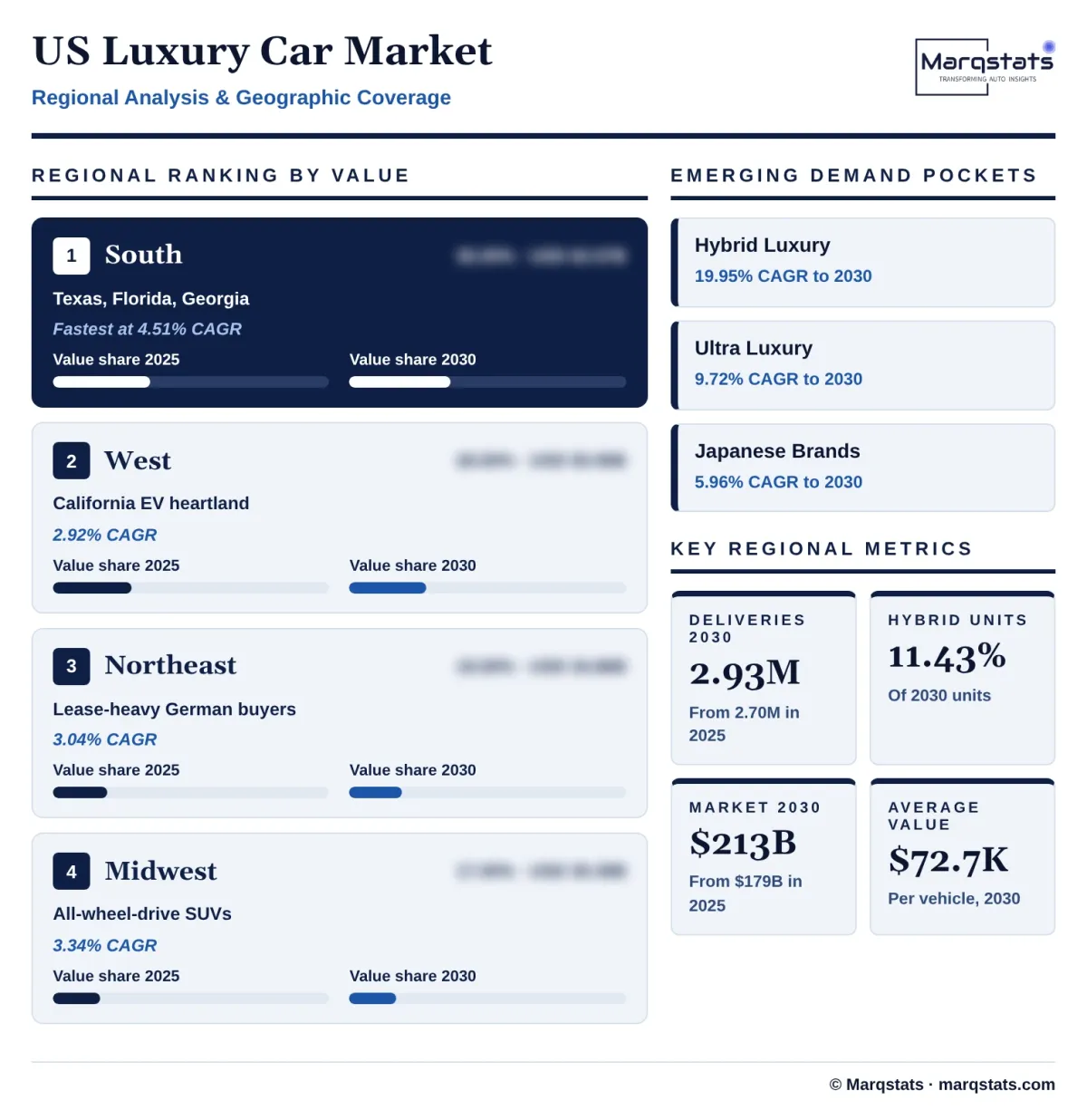
The US luxury car market size is estimated at USD 178.78 billion in 2025 and is projected to reach USD 213.15 billion by 2030, growing at a CAGR of 3.58% over 2026 – 2030. Deliveries rise from about 2,704,969 to 2,930,000 vehicles, a 1.61% annual rate, while value per vehicle climbs from about USD 66,092 to USD 72,748.
Marqstats defines the market as the transaction value of new passenger cars, SUVs, crossovers and pickups sold in the United States under luxury and premium brands, from Acura, Lexus, Genesis and Volvo through BMW, Mercedes-Benz, Cadillac and Porsche to Rolls-Royce and Ferrari, together with the premium-priced electric brands Tesla, Rivian, Lucid and Polestar. Value is counted at the dealer or direct-sale transaction price after incentives and before sales tax and fees. Used and certified pre-owned vehicles, MINI and Mercedes-Benz vans are excluded.
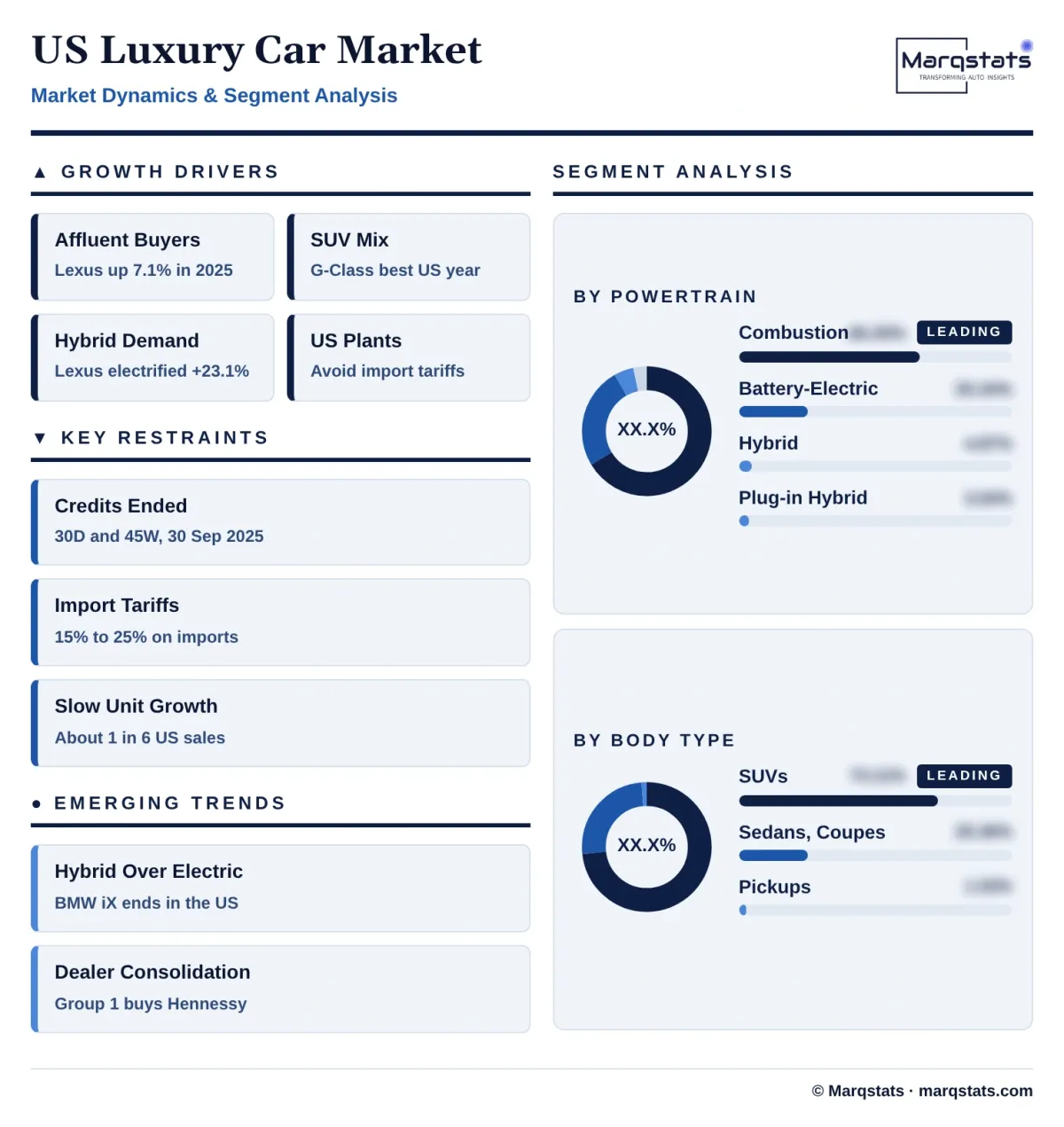
SUVs and crossovers account for 73.11% of 2025 value and combustion and mild-hybrid vehicles for 66.25%. The South accounts for 35.00% of value, and full hybrids grow fastest among powertrains at 19.95% a year after the federal electric vehicle credits ended on 30 September 2025.
Key Takeaways
Market Overview & Analysis
Report Summary
Marqstats sizes the US luxury car market as the transaction value of new light vehicles sold in the United States under luxury and premium brands. The market covers passenger cars, SUVs, crossovers and pickups sold by the traditional luxury brands, including BMW, Lexus, Mercedes-Benz, Cadillac, Audi, Acura, Volvo, Lincoln, Genesis, Land Rover, Porsche and Infiniti, the ultra-luxury makers such as Bentley, Rolls-Royce, Lamborghini, McLaren and Ferrari, and the premium-priced electric brands Tesla, Rivian, Lucid and Polestar. Value is the price paid after incentives and before sales tax, title and registration fees.
The luxury tier is a small share of units and a large share of spending. The National Automobile Dealers Association (NADA) put 2025 US new light-vehicle sales at 16.2 million units, up 2.4%, and Marqstats estimates that luxury and premium brands sold about 2,704,969 of them, or 16.70%. At an average of about USD 66,092 a vehicle, those sales were worth USD 178.78 billion. Luxury buyers are less sensitive to rates, so the tier held up through a year of tariffs, high loan costs and the end of the electric vehicle credits.
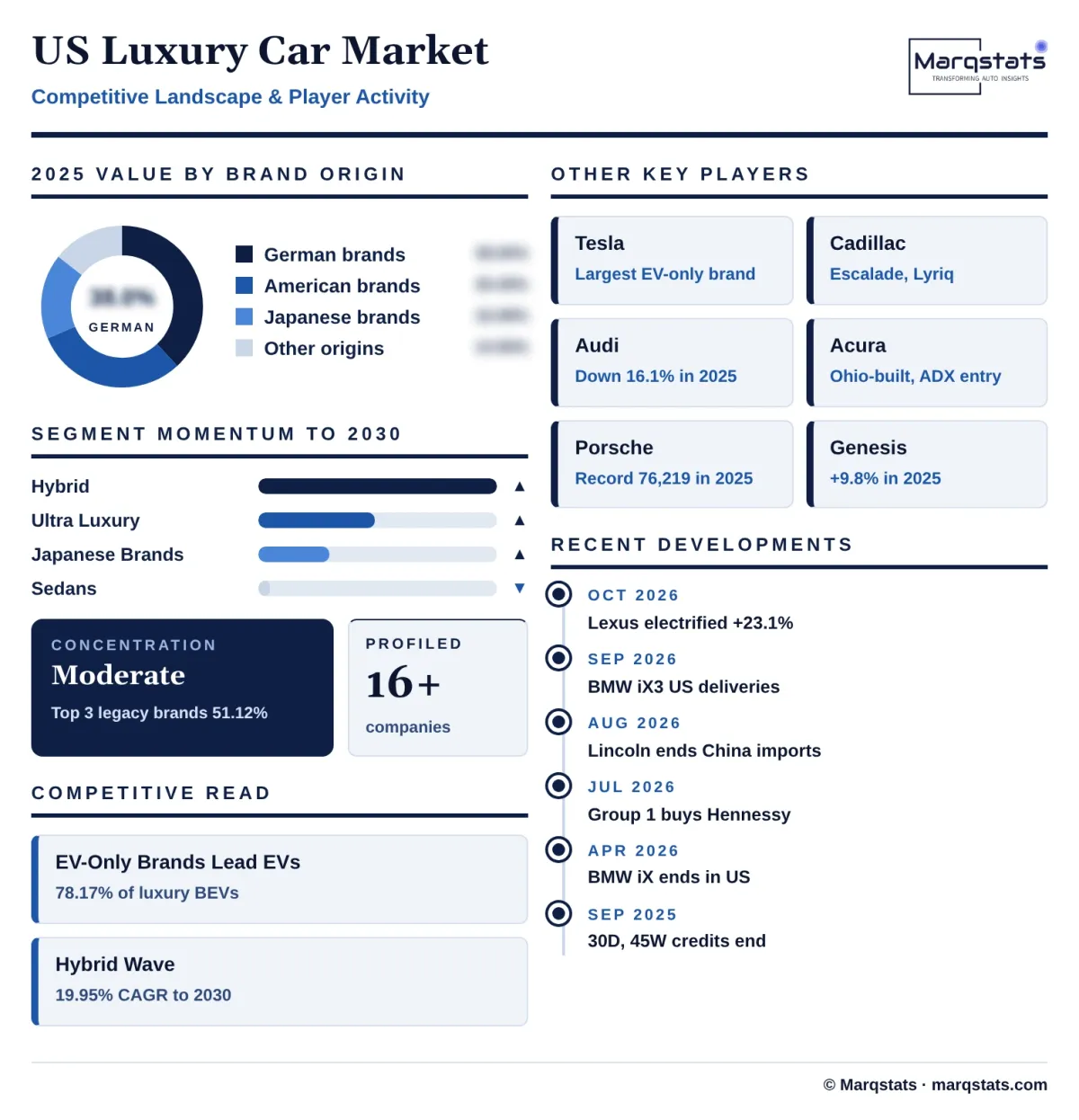
Brand results diverged in 2025. BMW of North America sold 388,897 BMW vehicles, up 4.7%, and kept the lead among traditional luxury brands. Lexus sold 370,260, up 7.1%, Mercedes-Benz USA sold 303,200 passenger vehicles, up 1%, with the G-Class up 26% to its best year, and Cadillac sold 173,515, up 8.3%. Audi fell 16.1% to 164,942. Porsche Cars North America set a record with 76,219 retail deliveries, led by the Macan at 27,139 and the Cayenne at 20,314, and Genesis grew 9.8% to 82,331.
Policy turned against battery-electric luxury vehicles in 2025. The One Big Beautiful Bill Act, signed on 4 July 2025, ended the Section 30D clean vehicle credit and the Section 45W commercial clean vehicle credit for vehicles acquired after 30 September 2025. The 45W credit had let captive finance companies pass USD 7,500 into lease payments with no price cap, which made leasing the normal way to buy a luxury electric car. In June 2025 Congress also revoked the waiver that allowed California to enforce Advanced Clean Cars II, removing the state zero-emission sales mandate that had been due to start with model year 2026.
Tariffs raised costs for most of the tier. A 25% Section 232 tariff on imported cars took effect on 3 April 2025, and later trade deals set a 15% rate for vehicles from Japan, the European Union and South Korea and a 10% rate for up to 100,000 British vehicles a year. Brands that build in the United States, including BMW at Spartanburg, Mercedes-Benz at Tuscaloosa, Cadillac at Spring Hill and Lansing, Lexus at Georgetown and Princeton, Acura at Marysville and East Liberty, Volvo at Ridgeville, Genesis at Montgomery and Tesla, Rivian and Lucid at their own plants, carry less of that cost than importers of German sedans, British SUVs and Italian sports cars.
US Luxury Car Market Size and Forecast
The US luxury car market grows from USD 178.78 billion in 2025 to USD 213.15 billion in 2030, a CAGR of 3.58%. Price contributes more than volume: deliveries rise at 1.61% a year, from about 2,704,969 to 2,930,000 vehicles, and value per vehicle rises at 1.94% a year, from about USD 66,092 to USD 72,748, as tariff costs pass through, high-trim SUVs take share and hybrids replace cheaper combustion trims.
The 2025 base is built bottom-up from brand sales and Marqstats price estimates. Reported 2025 US sales were 388,897 for BMW, 370,260 for Lexus, 303,200 for Mercedes-Benz passenger vehicles, 173,515 for Cadillac, 164,942 for Audi, 133,433 for Acura, 121,607 for Volvo, 106,868 for Lincoln, 82,331 for Genesis, 76,219 for Porsche and 52,846 for Infiniti, with Land Rover at about 78,500. Tesla reports only global deliveries, and published US estimates range from 544,500 to 589,160, so Marqstats uses about 566,830. Each brand volume is multiplied by an estimated average transaction price, from about USD 47,500 for Acura to more than USD 400,000 for Lamborghini and Rolls-Royce.
The 2025 to 2026 path is not smooth. Third-quarter 2026 results showed BMW up 3.4% to 100,210, Lexus up 1.6% to 93,056 and Mercedes-Benz up 4% to 76,200, while Audi fell 15% to 39,751, Cadillac fell 30% to 32,560 and Lincoln fell 18% to 19,488. Brands with heavy electric or imported mixes are losing ground in 2026, and Marqstats expects total luxury deliveries to recover as hybrids, the BMW iX3 and US-built models arrive, giving the 2025 to 2030 rate above.
Powertrain mix shapes value growth. Battery-electric deliveries rise only from about 801,745 to 870,000, so their share of units holds near 29.64%, while hybrids grow from about 145,000 to 335,000 and plug-in hybrids from 80,000 to 125,000. Combustion and mild-hybrid vehicles fall from about 1,678,224 to 1,600,000 units but remain the largest value pool, at 61.17% of 2030 value, because they include the Cadillac Escalade, Lincoln Navigator, BMW X7, Mercedes-Benz GLS and G-Class, Range Rover and most Porsche and ultra-luxury models.
Marqstats tracks four indicators to monitor the forecast: quarterly brand sales released by BMW of North America, Toyota Motor North America, Mercedes-Benz USA, General Motors and Porsche Cars North America; the tariff rates and quotas set under Section 232 and the trade deals with Japan, the European Union, South Korea and the United Kingdom; California New Car Dealers Association registration shares for hybrid and zero-emission vehicles; and captive lease terms and residual values after the end of the 45W credit.
Market Dynamics
Key Drivers
Five forces keep affluent households buying new luxury vehicles and lift the value of each sale.
- Affluent households keep buying. Luxury buyers are older and wealthier than mainstream buyers and depend less on loans, so the tier grew in 2025 while mainstream brands such as Volkswagen fell 13%. Lexus rose 7.1%, BMW 4.7%, Cadillac 8.3% and Genesis 9.8%, which shows that demand at the top of the market held up through high interest rates and tariff price rises.
- SUVs raise the value of each sale. Buyers keep moving from sedans to SUVs, which sell at higher prices. The Mercedes-Benz G-Class had its best US year in 2025, up 26%, the GLE was up 14% and the GLC up 20%, while Porsche sold 27,139 Macans and 20,314 Cayennes against 4,651 Panameras.
- Hybrids give buyers electric driving without charging. Toyota Motor North America reported Lexus electrified sales of 38,140 in the third quarter of 2026, up 23.1%, about 41% of Lexus sales, and the California New Car Dealers Association reported that hybrids took 19.4% of the state market in 2025, with registrations up more than 30%.
- US plants protect margins. BMW Spartanburg, Mercedes-Benz Tuscaloosa, Lexus Georgetown and Princeton, Acura Marysville, Cadillac Spring Hill and Volvo Ridgeville build vehicles that avoid the 15% tariff on imports from Europe and Japan, and the One Big Beautiful Bill Act lets buyers deduct up to USD 10,000 a year of interest on loans for new vehicles assembled in the United States, although the deduction phases out above USD 100,000 of income, or USD 200,000 for joint filers.
- New models refresh demand. BMW began US deliveries of the Neue Klasse iX3 on 16 September 2026 at USD 61,500 before destination, Acura added the ADX crossover below the RDX, and Cadillac now offers four electric SUVs, the Lyriq, Optiq, Vistiq and Escalade IQ, alongside the combustion Escalade.
Key Restraints
Four constraints cap unit growth and move the electric transition off its earlier path.
- The end of federal credits removed the electric lease subsidy. The Section 30D and 45W credits ended for vehicles acquired after 30 September 2025. The 45W credit had passed USD 7,500 into lease payments with no price cap, so luxury electric leases now cost more each month, and Cadillac sales fell 30% in the third quarter of 2026 while Audi fell 15%.
- Tariffs raise import costs. The 25% Section 232 tariff from 3 April 2025 and the 15% deal rates on vehicles from Japan, the European Union and South Korea add thousands of dollars to imported models, and Ford said in August 2026 that it would stop importing the China-built Lincoln Nautilus and grow Lincoln production in the United States from 2030.
- Sedan demand keeps falling. Brands are cutting car lines in favour of SUVs, so buyers who want a smaller, lower-priced luxury car have fewer choices, and entry luxury value grows at only about 0.34% a year to 2030 on Marqstats estimates.
- Unit growth is limited. Total US new light-vehicle sales were 16.2 million in 2025, and the luxury tier already holds about one in six of those sales. Marqstats expects luxury deliveries to grow at only about 1.61% a year, because household formation is slow and the pool of buyers with high incomes grows only gradually.
Key Trends
Four shifts are changing which luxury vehicles are built for, priced for and sold to US buyers.
- Electrified luxury shifts from battery-electric to hybrid. Lexus, Lincoln, BMW, Mercedes-Benz, Porsche and Volvo are adding hybrid and plug-in hybrid trims, while BMW confirmed in April 2026 that the iX would be discontinued in the United States and Canada after model year 2026.
- Production moves to the United States. Ford plans to replace the China-built Lincoln Nautilus with US production from 2030, and German, Japanese and Korean brands are moving more SUV output to Southern US plants to reduce tariff exposure.
- Dealer groups buy luxury stores in the Sunbelt. Group 1 Automotive signed an agreement on 30 July 2026 to buy the Hennessy dealerships in Atlanta, 10 stores with about USD 1.7 billion in annual revenue, taking Group 1 to 15 dealerships in the city.
- Prices and trims move up. As the share of SUVs, high trims and ultra-luxury models rises, Marqstats expects the average luxury transaction value to climb from about USD 66,092 in 2025 to about USD 72,748 in 2030, faster than the growth in unit sales.
Strategic Implications
- For new luxury entrants, a battery-electric sedan priced between USD 55,000 and USD 80,000 is the hardest product to sell in the United States after 30 September 2025. A crossover with a hybrid or plug-in hybrid option, built in or near the United States, matches what affluent buyers are choosing and avoids the 15% to 25% tariff on imports.
- For incumbent luxury brands, the lesson from 2025 and 2026 is that flexible plants beat single-powertrain plants. Lexus grew electrified sales 23.1% in the third quarter of 2026 with hybrids, while Cadillac fell 30% with a heavy electric mix, so brands should keep combustion, hybrid and electric versions on shared lines and shift output each quarter.
- For captive finance companies, the loss of the 45W credit means higher electric lease payments and more residual-value risk on vehicles leased in 2024 and 2025. Lenders that price new leases on realistic residuals and offer hybrid alternatives at lease end protect both the balance sheet and the customer.
- For suppliers, the growth is in hybrid systems, 48-volt electrics, electric all-wheel-drive axles and US-sourced parts that help vehicles qualify for the USMCA content rules and the loan interest deduction. Battery suppliers should plan for smaller packs in plug-in hybrids as well as large packs in battery-electric SUVs.
- For dealer groups, luxury value is concentrating in the South, which holds about 35% of 2025 value on Marqstats estimates. Store purchases in Texas, Florida, Georgia and the Carolinas, as Group 1 Automotive did in Atlanta, give access to the fastest-growing luxury region and to service revenue from a growing fleet of high-value vehicles.
Market Segmentation
Combustion and mild-hybrid vehicles account for 66.25% of 2025 value, USD 118.46 billion, and grow at 1.94% a year to USD 130.40 billion. Units fall from about 1,678,224 to 1,600,000, so growth comes from price: this segment includes the Cadillac Escalade, Lincoln Navigator, BMW X5 and X7, Mercedes-Benz GLE, GLS and G-Class, Range Rover and nearly all Porsche and ultra-luxury models, where average values rise as tariffs pass through and trims move up.
Battery-electric vehicles account for 25.34% of 2025 value, USD 45.30 billion, and grow at 2.36% a year to USD 50.90 billion. Marqstats estimates about 801,745 luxury battery-electric deliveries in 2025, of which Tesla, Rivian, Lucid and Polestar delivered 78.17%. Growth slows after the end of the 30D and 45W credits, and new models such as the BMW iX3 and the Cadillac electric SUVs compete for a buyer pool that no longer receives a federal subsidy.
Full hybrids account for 4.87% of 2025 value, USD 8.70 billion, and grow fastest, at 19.95% a year, to USD 21.61 billion and 10.14% of the market. Lexus supplies most hybrid luxury volume through the RX, NX, TX, ES and GX, and Lincoln, Acura, BMW and Mercedes-Benz are adding hybrid trims. Marqstats expects hybrid units to grow from about 145,000 to 335,000.
Plug-in hybrids account for 3.54% of 2025 value, USD 6.32 billion, and grow at 10.15% a year to USD 10.25 billion. Volvo, BMW, Porsche, Land Rover, Mercedes-Benz and Lexus sell plug-in versions of their main SUVs, and buyers who charge at home use them as electric cars for most trips without depending on public chargers.
SUVs and crossovers account for 73.11% of 2025 value, USD 130.70 billion, and grow at 4.87% a year to USD 165.78 billion and 77.77% of the market. The Tesla Model Y, Lexus RX and NX, BMW X3 and X5, Mercedes-Benz GLC and GLE, Cadillac Escalade, Audi Q5 and Porsche Macan lead the segment.
Sedans, coupes and convertibles account for 25.36% of 2025 value, USD 45.34 billion, and decline at 0.81% a year to USD 43.54 billion. The Tesla Model 3, BMW 3 Series, Mercedes-Benz C-Class and E-Class, Lexus ES, Acura Integra, Cadillac CT5 and Porsche 911 keep the segment large, but brands keep cutting car lines and moving investment to SUVs.
Pickups account for 1.53% of 2025 value, USD 2.73 billion, and grow at 6.96% a year to USD 3.83 billion. The segment covers the Rivian R1T and Tesla Cybertruck, which sell at high prices to a small group of buyers; luxury-trim pickups sold under mainstream brands such as GMC, Ford and Ram are excluded.
Vehicles sold below USD 50,000 account for 20.25% of 2025 value, USD 36.20 billion, and grow at only 0.34% a year to USD 36.82 billion. Base Tesla Model 3 and Model Y, the Acura Integra and ADX, Lexus UX and NX, BMW X1 and Audi Q3 sit here, where shoppers compare luxury brands against fully equipped mainstream models.
Vehicles sold between USD 50,000 and USD 79,999 account for 46.71% of 2025 value, USD 83.51 billion, and grow at 2.59% a year to USD 94.90 billion. This is the core of the market, covering the Lexus RX, BMW X3 and X5, Mercedes-Benz GLC, Audi Q5, Volvo XC90, Genesis GV80, Cadillac Lyriq and most electric SUVs.
Vehicles sold between USD 80,000 and USD 149,999 account for 25.92% of 2025 value, USD 46.34 billion, and grow at 5.72% a year to USD 61.21 billion. The Cadillac Escalade, Lincoln Navigator, BMW X7, Mercedes-Benz GLS, Range Rover Sport, Porsche Cayenne and 911 and the Rivian R1S lead the band.
Vehicles sold at USD 150,000 and above account for 7.12% of 2025 value, USD 12.72 billion, and grow fastest, at 9.72% a year, to USD 20.23 billion. Bentley sold 3,015, Lamborghini 2,915, Rolls-Royce 1,590 and McLaren 1,125 vehicles in 2025, and top trims of the Mercedes-Benz G-Class, Maybach, Range Rover and Porsche 911 join them in this band.
BMW, Mercedes-Benz, Audi and Porsche account for 38.00% of 2025 value, USD 67.94 billion, from about 933,258 vehicles, and grow at 3.48% a year to USD 80.62 billion. BMW and Mercedes-Benz build their large SUVs in South Carolina and Alabama, which limits tariff costs, while Audi imports most of its range from Europe and Mexico and lost 16.1% of its volume in 2025.
Cadillac, Lincoln, Tesla, Rivian and Lucid account for 30.45% of 2025 value, USD 54.44 billion, from about 899,803 vehicles, and grow at 2.20% a year to USD 60.68 billion. This group carries most of the battery-electric exposure, so it grows slowest after the end of the federal credits, even though all of its brands build their main models in North America.
Lexus, Acura and Infiniti account for 16.99% of 2025 value, USD 30.38 billion, from about 556,539 vehicles, and grow fastest, at 5.96% a year, to USD 40.57 billion. Lexus hybrids and US-built Acura models suit buyers who want electrified driving without charging, and Toyota Motor North America reported Lexus electrified sales up 23.1% in the third quarter of 2026.
Volvo, Genesis, Land Rover, Jaguar, Polestar, Alfa Romeo, Maserati and the ultra-luxury makers account for 14.56% of 2025 value, USD 26.03 billion, from about 315,369 vehicles, and grow at 3.75% a year to USD 31.28 billion. Genesis grew 9.8% in 2025 and builds the Electrified GV70 in Alabama, while Maserati, Alfa Romeo and Jaguar lost volume as their ranges aged.
By Geography
South
The South matters most because household wealth and luxury dealers are moving there. It accounts for 35.00% of 2025 value, USD 62.57 billion, and grows fastest, at 4.51% a year, to USD 78.01 billion and 36.60% by 2030. Texas, Florida, Georgia and the Carolinas favour large SUVs such as the Escalade, Navigator and X7, BMW, Mercedes-Benz and Volvo build vehicles there, and Group 1 Automotive's July 2026 agreement to buy the Hennessy dealerships shows dealer groups buying into Atlanta.
West
The West is the electric and import heartland. It accounts for 28.50% of 2025 value, USD 50.95 billion, and grows at 2.92% a year to USD 58.83 billion. California leads the country in luxury electric sales, but the California New Car Dealers Association reported that zero-emission vehicles fell to 20.9% of state registrations in 2025 from 22.0% in 2024, the first fall since 2020, and Tesla registrations fell 11.4%, so the West grows more slowly than the South.
Northeast
The Northeast holds old wealth and European brands. It accounts for 19.50% of 2025 value, USD 34.86 billion, and grows at 3.04% a year to USD 40.50 billion. Buyers in New York, New Jersey, Connecticut and Massachusetts favour all-wheel-drive German and Japanese SUVs and sedans, and leasing is common, so the end of the 45W lease credit is felt here.
Midwest
The Midwest is the steadiest region. It accounts for 17.00% of 2025 value, USD 30.39 billion, and grows at 3.34% a year to USD 35.81 billion. Chicago, Minneapolis, Detroit and Columbus buyers favour all-wheel-drive SUVs from Cadillac, Lincoln, BMW, Lexus and Acura, and Acura builds its main models in Ohio.
How Competition Is Evolving
The market is moderately concentrated, and the leaders differ by powertrain. Among traditional luxury brands, BMW, Lexus and Mercedes-Benz sold 1,062,357 vehicles in 2025, 51.12% of the 2,078,224 sold by those brands. Tesla is the largest seller of luxury battery-electric vehicles; Marqstats estimates its 2025 US deliveries at about 566,830, against published estimates of 544,500 to 589,160, because Tesla reports only global deliveries.
By brand origin, German brands hold 38.00% of 2025 value on Marqstats estimates, American brands 30.45%, Japanese brands 16.99% and Korean, Swedish, British and Italian brands 14.56%. German brands sell at higher prices per vehicle, so their share of value is larger than their 34.51% share of units, while the Japanese brands sell more units at lower prices.
Competition is moving from electric range to powertrain choice. BMW sells combustion, plug-in hybrid and electric versions of the X3, X5 and 5 Series, Lexus offers hybrids across almost every model, and Mercedes-Benz is adding combustion and hybrid versions after weak demand for its electric EQ models. Cadillac, which built the broadest electric SUV range among traditional brands, saw its sales fall 25% in the first nine months of 2026.
Tariffs reward local production. BMW Spartanburg is BMW's largest plant worldwide, Mercedes-Benz builds the GLE and GLS in Alabama, Lexus builds the ES, TX and RX in Kentucky and Indiana, Acura builds the MDX, RDX, TLX and Integra in Ohio, and Volvo builds the EX90 in South Carolina. Importers of German sedans, British SUVs and Italian sports cars carry the full 10% to 25% duty, so they compete on brand and exclusivity rather than price.
Companies Covered
Companies covered in the report include:
Recent Market Activity
Table of Contents
Coverage & Segmentation
The study covers the US luxury car market, with 2025 as the base year, 2021 – 2025 as the historical period and 2026 – 2030 as the forecast period. It covers new passenger cars, SUVs, crossovers and pickups sold in the United States under luxury and premium brands, including the premium-priced electric brands Tesla, Rivian, Lucid and Polestar, segmented by powertrain, body type, price band, brand origin and Census region. Values are transaction prices in US dollars after incentives and before sales tax, title and registration fees.
Used and certified pre-owned vehicles, MINI, Mercedes-Benz and other vans, luxury trims sold under mainstream brands such as GMC Denali, Ford Platinum and Ram Limited, heavy-duty trucks and aftermarket conversions are excluded. Segment and regional splits are Marqstats estimates built on brand sales releases, price benchmarks and registration data. The live Marqstats United States Used Car and Pre-Owned Luxury Car reports cover used vehicles, so their figures do not overlap with and should not be added to this market.