Market Snapshot
The US electric vehicle market, measured as EV sales in the US (new electric car sales including plug-in hybrids), stands at 1,511,549 new electric vehicles (EV) sold in 2025 and is estimated at 1,186,500 units in 2026. Marqstats forecasts it to reach 1,768,154 units by 2030, a CAGR of 3.19% over 2026 – 2030 that adds 256,605 units between 2025 and 2030.
California is the largest market, Plug-in hybrid and extended-range pickups and SUVs is the fastest growing and Battery Electric is the dominant segment, in a market that is highly concentrated. The report covers 7 segments and 4 regions and profiles 16 companies, with 2025 as the base year, history from 2021 – 2025 and a forecast for 2026 – 2030.
Key Takeaways
Market Overview & Analysis
Report Summary
The US electric vehicle market covers new light-duty battery electric, plug-in hybrid, extended-range and fuel cell electric vehicles sold in the United States. Marqstats uses the Alliance for Automotive Innovation's count of 1,511,549 EVs in 2025, 9.6% of new light-duty vehicle sales, based on new registrations, as the headline. Argonne National Laboratory, which reports monthly plug-in sales to the US Department of Energy, put 2025 battery electric sales at 1,239,560 and total plug-in sales at about 1.5 million, down 4% from 2024. Marqstats estimates 1,186,500 EVs in 2026 and forecasts 1,768,154 by 2030, a CAGR of 3.19% over 2026 – 2030, as the market rebuilds from a lower 2026 base.
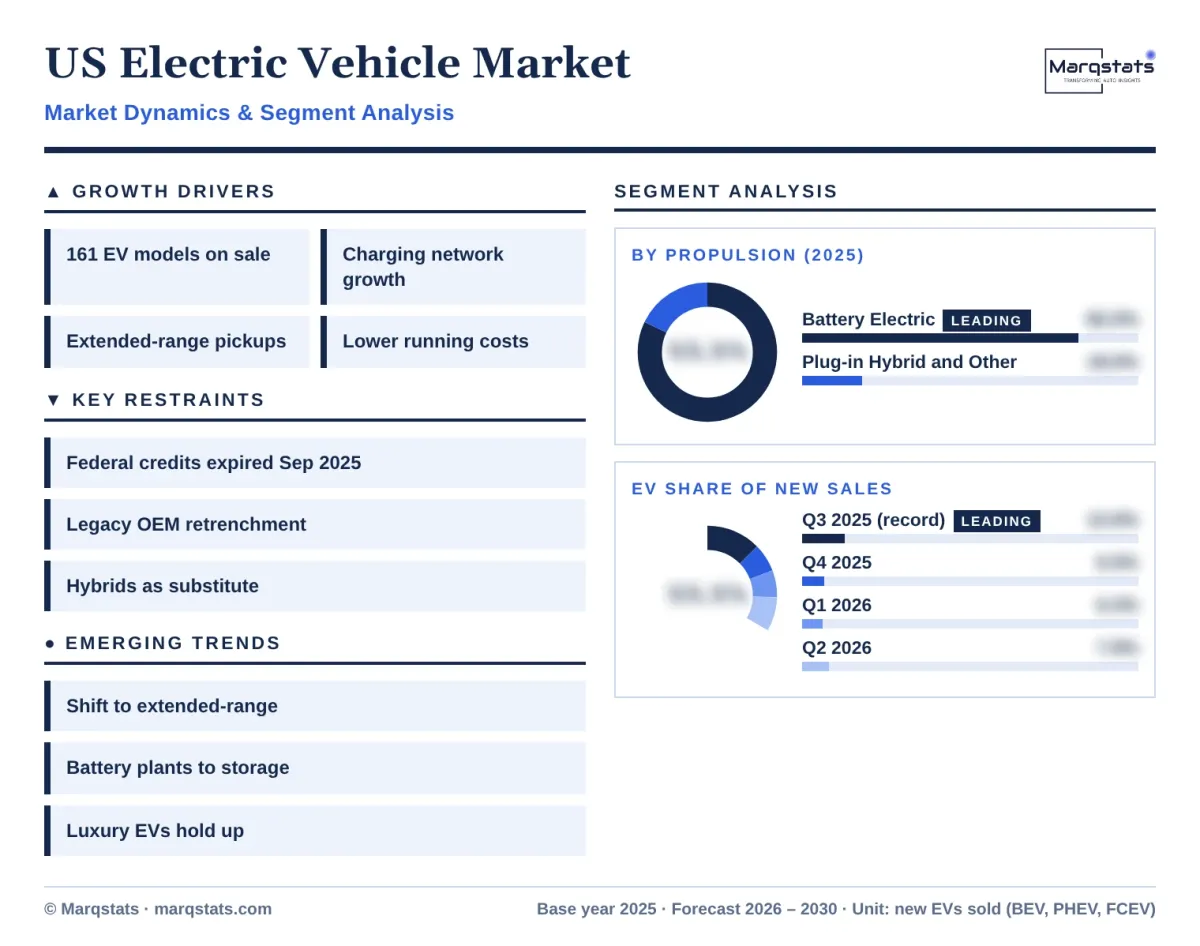
The tax credit pulled 2026 demand into 2025. The federal clean vehicle credits expired on 30 September 2025, and buyers rushed to buy first: EVs reached a record 12.6% of sales in the third quarter of 2025, then fell to 6.5% in the fourth quarter with 246,755 sales. First-half 2026 sales were 556,477, down 26.8%, at a 7.1% share, while hybrids, which never qualified for the credit, reached a record 16% of sales. The overall light-duty market grew 2% in the second quarter of 2026, so EV losses were a shift to hybrids and combustion vehicles rather than lower car buying.
The market is finding a floor. EV share rose to 7.9% in the second quarter of 2026 from 6.3% in the first, the first sequential gain since the third quarter of 2025, and first-quarter volume was 39% lower than a year earlier against 15% lower in the second. The 2026 estimate combines first-half sales with a third quarter level with the second and a fourth quarter about 22% above the depressed fourth quarter of 2025.
The 2027 to 2030 forecast is a Marqstats construction: growth of 8% in 2027, 10% in 2028 and 12% a year in 2029 and 2030 as lower-priced EVs, extended-range pickups and SUVs and maturing charging networks lift demand without federal incentives. The market that emerges is smaller and more concentrated than planned in 2022 to 2024, and less dependent on subsidies.
Market Dynamics
Key Drivers
- More models and lower prices: 161 EV models were on sale in the second quarter of 2026, up from 155 a year earlier, and carmakers have announced lower-priced EVs to compete without the credit. EV prices remain above comparable petrol models for most buyers, so the EV share rises again only as the price gap narrows in the US$30,000 to US$40,000 bracket where most mainstream buyers shop. Cheaper battery packs, simpler designs and more competition in that bracket are the main levers for recovery.
- Charging network growth: Public and private charging continues to expand, and Tesla's network is open to other brands through the North American Charging Standard, which reduces range anxiety for non-Tesla buyers. EVs made up 2.63% of registered light-duty vehicles at the end of June 2026, about 7.8 million vehicles, and more than 8.1 million plug-ins had been sold since 2010 by April 2026. This installed base makes charging investment more viable, since utilisation depends on vehicles already on the road, not only on new sales.
- Extended-range pickups and SUVs: The Ram 1500 REV, Ford's next F-150 Lightning, Scout's Terra and Traveler and Hyundai's Santa Fe extended-range model target large-vehicle buyers who rejected battery electric versions. The Ram 1500 REV offers about 145 miles of electric range and 690 miles in total, which addresses the towing and long-distance concerns that limited battery electric pickups. 85% of Scout's more than 150,000 reservations chose the range-extender model, a sign of demand in segments where EVs have struggled.
- Lower operating costs: EVs remain cheaper to fuel and maintain than combustion vehicles in most states, which supports demand among high-mileage drivers and fleets. The US Energy Information Administration reports that electrified vehicles of all types, hybrids included, held 24% of light-duty sales in the second quarter of 2026, which shows that buyers still want lower fuel costs. Leasing and residual values have become central to EV affordability, and carmakers with their own finance arms hold share more easily.
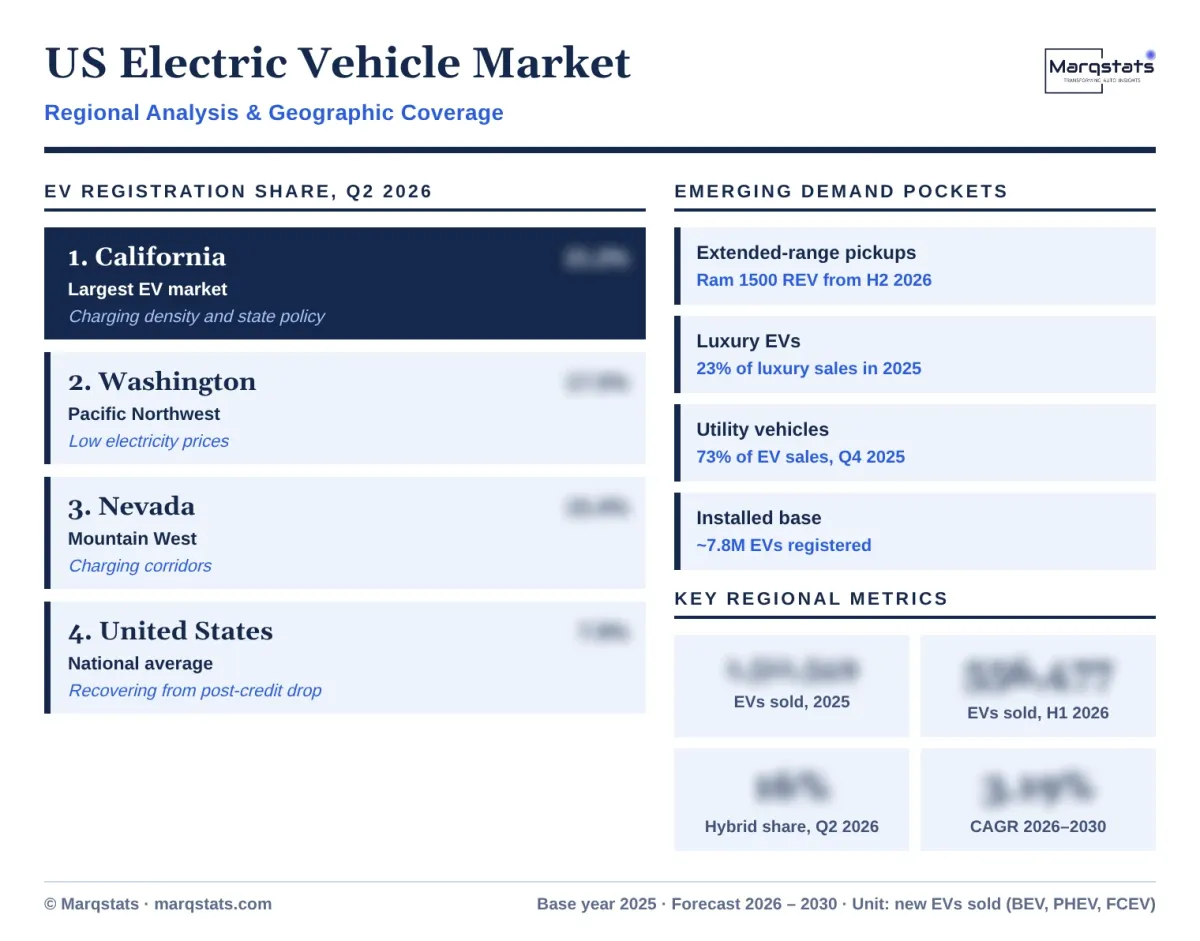
- State policy: California, Washington and other states continue to support EV adoption through registrations, utility programmes and charging investment, keeping their EV shares well above the national average. California recorded EVs at 21.2% of new registrations in the second quarter of 2026, Washington 17.5% and Nevada 15.4%, and several states and the District of Columbia recorded shares above 10%. A meaningful part of the country already behaves like a mature EV market even while the national share sits below 8%.
Key Restraints
- Loss of federal incentives: The New Clean Vehicle Credit and Qualified Commercial Clean Vehicle Credit both expired on 30 September 2025, raising effective EV prices by up to US$7,500 and ending leasing deals built on the commercial credit. Argonne recorded 169,357 plug-ins in September 2025, 13.55% of sales, then 91,067 in October, 7.16%. From January to July 2026 Americans bought 660,373 plug-in vehicles, 28.3% fewer than a year earlier, with plug-in hybrids down 42.5% and battery electric vehicles down 24.8%.
- Legacy carmaker retrenchment: General Motors took a US$6 billion charge in January 2026 to unwind EV investments, Ford and SK On dissolved BlueOval SK, and Ford's Model e unit lost a further US$4.8 billion in 2025. BlueOval SK was part of an US$11.4 billion Ford and SK investment programme in Tennessee and Kentucky, supported by a US$9.6 billion Department of Energy loan, the largest under its vehicle manufacturing loan programme. Honda agreed to buy the Ohio battery plant assets of its LG joint venture, reducing EV supply and marketing from established brands.
- Weaker federal emissions pressure: Recent policy moves reduce regulatory pressure to improve fuel economy and cut emissions, leaving EV growth to consumer choice and carmaker strategy. Without tightening standards, carmakers have less reason to sell EVs at a loss to balance their fleet averages, which removes a hidden subsidy that supported low EV prices in earlier years. This shifts the burden of growth to product cost and buyer preference.
- Hybrids as a substitute: Hybrid electric vehicles, which never relied on the credit, reached a record 16% of sales in the second quarter of 2026, absorbing buyers who would otherwise have chosen an EV. In April 2026 alone, 209,456 hybrids were sold, up 10.1%, with Toyota accounting for 37.9% of them. In the third quarter of 2026, electrified vehicles of all kinds made up 23% of sales against 24% a year earlier, as hybrid gains no longer fully offset EV losses.
Key Trends
- Shift from battery electric to extended-range: Carmakers are replacing battery electric pickups with extended-range versions. Stellantis' Ram 1500 REV enters production in the second half of 2026, Ford plans the next F-150 Lightning as an extended-range model, and Scout will launch its Terra and Traveler at the end of 2027 with most reservations for the range-extender version. Large-vehicle buyers who tow and drive long distances have rejected battery electric versions, so extended-range models become the main EV route into the full-size pickup and SUV segments.
- Battery plants pivoting to energy storage: Battery makers and carmakers are converting US cell capacity to stationary storage, where demand is growing faster than for EVs. Ford's Kentucky battery plants are moving toward energy storage, and SK On plans to supply storage customers from the Tennessee plant it took over from the venture. The pivot keeps US cell capacity in use, however it reduces the pool of domestic cells available for lower-priced EVs in the near term.
- Luxury EVs holding up better: Battery electric vehicles accounted for 23% of US luxury vehicle sales in 2025, against about 8% of the total market, and several luxury EVs grew even after the credit expired, including the Porsche Taycan and Cadillac Escalade IQ. Luxury buyers were less dependent on the credit, which often did not apply above its price caps. Luxury vehicles were 14% of all light-duty sales in 2025, so they carry an outsized share of EV demand.
- Utility vehicles dominating EV sales: Electric utility vehicles were 73% of EV sales in the fourth quarter of 2025, and light trucks, including utility vehicles and pickups, reached 85% of the EV market in the third quarter. EV demand follows the wider US preference for crossovers and SUVs, and new launches concentrate on these body types. Tesla remained the largest EV seller by far, with the Model Y as the volume model.
Market Segmentation
Battery electric vehicles sold 1,239,560 units in 2025, about 82.01% of EVs, slightly fewer than in 2024. Their share of new light-duty sales fell to about 6% in the second quarter of 2026 from 7% a year earlier, and battery electric sales in November 2025 hit a 39-month low after the credit expired. Battery electric vehicles declined less than plug-in hybrids in January to July 2026, down 24.8%, because Tesla and luxury brands depended less on the credit. Recovery depends on lower-priced models and charging growth.
Plug-in hybrids, extended-range EVs and fuel cell vehicles made up the remaining 271,989 units, about 17.99%. Plug-in hybrids fell to 1.4% of sales in the second quarter of 2026 from 1.9%, and fell 42.5% in January to July 2026, a sharper drop than battery electric vehicles, because many relied on the credit to justify their price premium over regular hybrids. Extended-range pickups and SUVs launching from 2026 revive this segment and make it the fastest-growing propulsion type through 2030.
Electric utility vehicles, including crossovers and SUVs, are the largest body type, with 73% of EV sales in the fourth quarter of 2025. The Tesla Model Y and electric crossovers from Hyundai, Kia, GM and Ford account for most of the volume. Utility vehicles match the wider US market's preference, and most of the 161 EV models on sale in the second quarter of 2026 are crossovers or SUVs. Hyundai's Santa Fe extended-range model and Genesis's EREV extend this segment to buyers who want a fuel backup.
Electric cars, with the Tesla Model 3 as the largest model, are a shrinking share of EV sales as buyers prefer utility vehicles, although they remain important in the luxury segment, where models such as the Porsche Taycan grew after the credit expired. Light trucks made up 85% of the EV market in the third quarter of 2025, leaving cars at about 15%. Few new mainstream electric sedans are planned, so the car share continues to decline through 2030.
Electric pickups and vans are a small share today, and the segment is moving toward extended-range models such as the Ram 1500 REV and the next F-150 Lightning. Ford's battery electric F-150 Lightning sold a little over 30,000 units in its peak year before Ford ended it. Scout's Terra pickup and Traveler SUV follow at the end of 2027, with most reservations for the extended-range version. Full-size pickups are North America's most profitable segment, which makes extended-range success here central to carmakers' electrification plans.
Luxury EVs held up better after the credit expired; battery electric vehicles were 23% of US luxury vehicle sales in 2025, against about 8% of the total market. Luxury vehicles were 14% of all light-duty sales in 2025, so they carry an outsized share of EV demand. Luxury buyers were less dependent on the credit, which often did not apply above its price caps, and several models, including the Cadillac Escalade IQ, grew after September 2025. This tier stabilises EV volumes while the mass market resets.
Mass-market EVs were hit hardest by the end of the credit, since the US$7,500 represented a large share of their price and their buyers are most price-sensitive. Their recovery depends on lower-priced new models in the US$30,000 to US$40,000 bracket, on lease terms that support residual values, and on falling used EV prices that compete with new models. Hybrids, which reached a record 16% of sales in the second quarter of 2026, are the main alternative mass-market buyers chose instead.
By Geography
California
California is the largest EV market and the national leader in adoption, with EVs at 21.2% of new registrations in the second quarter of 2026. It has about a quarter of the country's charging ports, which supports its lead, and state policy continues to promote adoption after the federal credit ended. The regional series is based on registration shares rather than unit sales, so a state volume split is not published.
Pacific Northwest and West
Washington, at 17.5% EV share, Nevada at 15.4%, Oregon and Colorado all recorded EV registration shares above 10% in the second quarter of 2026, supported by charging networks and state policy. Low electricity prices in parts of the Pacific Northwest improve the running-cost advantage of EVs. These states behave like mature EV markets and are the first targets for new models and charging investment.
Northeast
The Northeast and Mid-Atlantic have above-average EV adoption in several states, supported by state incentives and dense populations, and the District of Columbia recorded an EV share above 10% in the second quarter of 2026. Dense urban areas favour smaller EVs and home or workplace charging, while colder winters make range and heat-pump performance more important to buyers in the region.
South and Midwest
The South and Midwest have lower EV shares and large vehicle markets, and they are the main target for extended-range pickups and SUVs. Texas and Florida are large EV markets by volume despite lower shares, and both are home to EV and battery manufacturing, including Tesla's Texas plant. Long distances, towing needs and sparse fast charging in rural areas make extended-range models better suited than battery electric versions.
How Competition Is Evolving
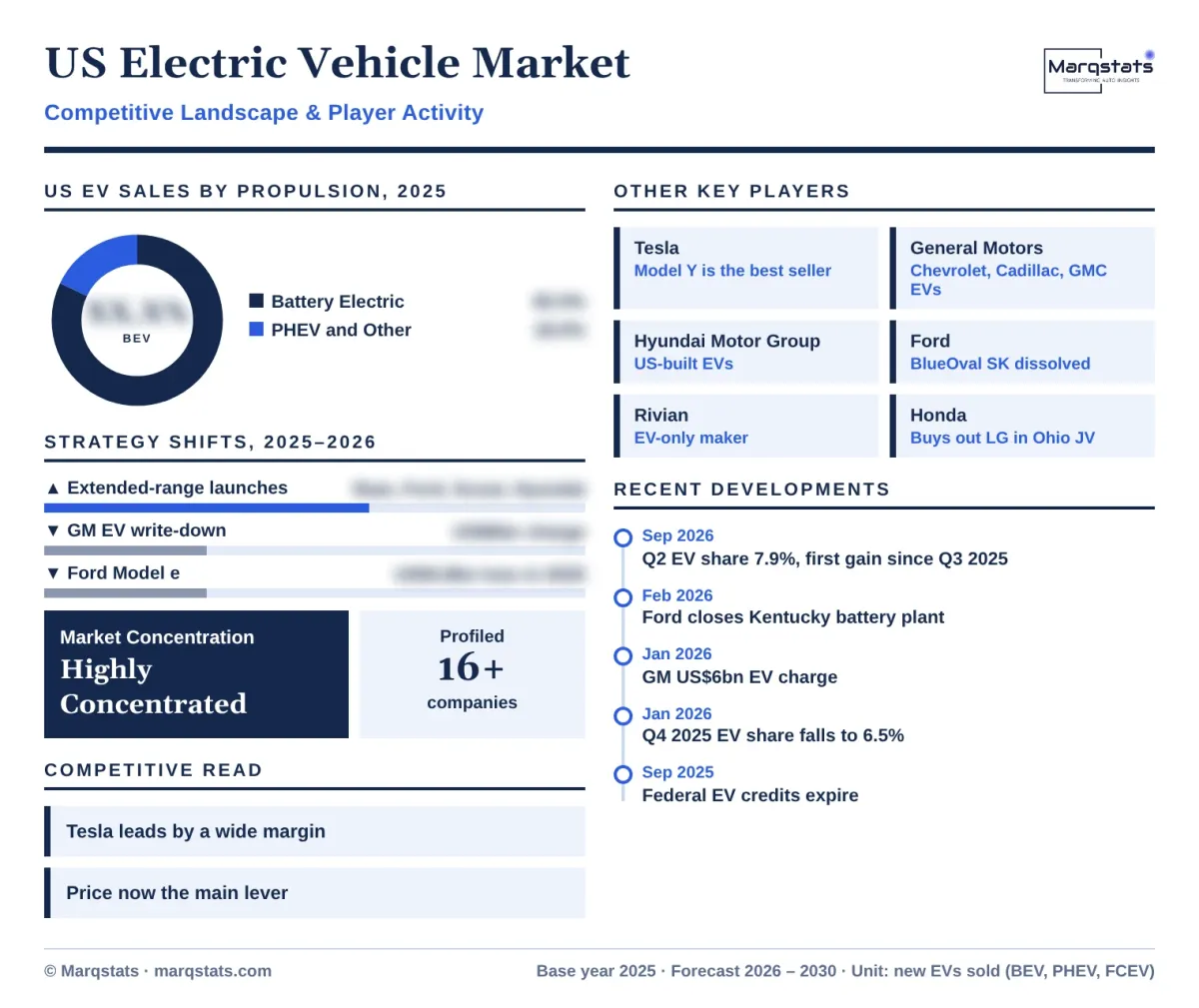
The US EV market is highly concentrated. Tesla remains the largest EV seller by a wide margin, with the Model Y and Model 3 leading, followed by General Motors with its Chevrolet, Cadillac and GMC brands, Hyundai Motor Group, Ford and a range of luxury and start-up brands. Brand-level shares are not published by government sources, so Marqstats describes positions qualitatively. Tesla's lead widened in practice in 2026, as legacy brands cut EV output and marketing while Tesla kept producing at scale, though Tesla's own US sales have declined from their 2023 peak. The Tesla Model Y price sets the reference for the electric SUV class, and the Hyundai Ioniq 5 and the relaunched Chevy Bolt compete below and around it.
Competition runs on price, range and charging access. Tesla benefits from scale and its charging network; General Motors from a broad range of electric models on a common platform; Hyundai and Kia from fast-charging technology and US production; and luxury brands from buyers less sensitive to the loss of the credit.
Legacy carmakers are cutting back. Ford, General Motors and Honda have reduced EV investments, dissolved battery ventures or redirected plants, while Rivian and Lucid continue as EV-only makers. This retrenchment reduces the number of competitive EVs from established brands in the near term and increases Tesla's relative position.
Model availability is still broad despite the retreat. 164 EV models were sold in the fourth quarter of 2025, including 102 battery electric vehicles: 26 cars, 58 utility vehicles, seven pickups and 11 vans. The challenge is not choice but price, since many models were designed with the credit in mind, and carmakers are now cutting prices, adding lease offers or dropping slower-selling versions. Electric vehicles for sale in the US therefore span every body type, even as some carmakers trim their ranges.
Honda's buyout of LG Energy Solution from their Ohio battery joint venture, valued at US$2.8 billion, and Ford's restructuring of BlueOval SK show how battery partnerships formed for an EV boom are being unwound or reshaped. The companies that keep battery capacity flexible between EVs, hybrids and storage are likely to be the strongest competitors when EV demand recovers.
Companies Covered
Companies covered in the report include:
Recent Market Activity
Table of Contents
Coverage & Segmentation
The study covers new light-duty battery electric, plug-in hybrid, extended-range and fuel cell electric vehicles sold in the United States. The base year is 2025, the historical period 2021 – 2025 and the forecast period 2026 – 2030. The unit is new vehicles sold or registered. Conventional hybrids are covered as a benchmark, and used EVs are discussed qualitatively.
Seven segments across three dimensions and four regions are covered, and 16 companies are profiled. The headline uses the Alliance for Automotive Innovation's registration-based count; battery electric volume uses Argonne National Laboratory's sales data, with plug-in hybrids and others as the residual. The 2026 estimate and 2027 to 2030 forecast are Marqstats constructions.
Known limits are stated plainly. Registration-based and sales-based series differ slightly, so the propulsion split combines two sources; brand-level shares are not published by government sources; and state data are available only as registration shares. The forecast assumes no reinstatement of federal purchase credits; a new incentive would raise the trajectory, while further tariff increases on imported EVs or components would lower it.
