Market Snapshot
The global sodium-ion battery market for EVs, covering every sodium-ion battery for EV use (the Na-ion battery or sodium battery), stands at 1.93 GWh of sodium-ion batteries for electric vehicles in 2025 and is estimated at 3.80 GWh in 2026. Marqstats forecasts it to reach 34.25 GWh by 2030, a CAGR of 77.75% over 2026 – 2030 that adds 32.32 GWh between 2025 and 2030.
China is the largest market, Passenger Cars and Light Commercial Vehicles is the fastest growing and Two- and Three-Wheelers and Micro Vehicles is the dominant segment, in a market that is highly concentrated. The report covers 7 segments and 5 regions and profiles 16 companies, with 2025 as the base year, history from 2021 – 2025 and a forecast for 2026 – 2030.
Key Takeaways
Market Overview & Analysis
Report Summary
The global sodium-ion battery market for EVs covers sodium-ion cells and packs fitted to road vehicles: two- and three-wheelers, micro and small cars, passenger cars, light commercial vehicles and buses, including hybrid packs that combine sodium-ion and lithium-ion cells. Stationary energy storage is an adjacent market excluded from the totals. The unit is gigawatt-hours (GWh) shipped for vehicles. No public source splits sodium-ion shipments by vehicle type, so Marqstats builds the figure from about 9 GWh of total 2025 shipments, up about 150%, of which stationary storage took about 78.6%, and estimates 1.93 GWh for vehicles in 2025, 3.80 GWh in 2026 and 34.25 GWh by 2030, a CAGR of 77.75% over 2026 – 2030.
Sodium-ion works like lithium-ion and moves sodium ions between the electrodes. Sodium is far more abundant and evenly spread than lithium, and sodium-ion cells avoid cobalt, nickel and lithium entirely. The trade-off is energy density: the latest cells reach up to about 175 Wh/kg, against up to 205 Wh/kg for the latest lithium iron phosphate (LFP) cells, according to the International Energy Agency (IEA). In return they retain about 90% of capacity at -40°C and operate at up to 70°C. Global sodium-ion production in 2025 was less than 1% of lithium-ion production.
The first sodium-ion car matters less than the scooter. Changan and CATL unveiled the Nevo A06 in February 2026, which the partners call the first mass-production sodium-ion passenger car, with a 45 kWh CATL Naxtra pack. CATL expects 10,000 to 20,000 EVs to use its sodium-ion cells in 2026, roughly 0.45 to 0.9 GWh, less than the 1.83 GWh that went into two- and three-wheelers and micro vehicles in 2025.
Energy per vehicle shapes the growth curve. A scooter battery holds one or two kWh, a micro car pack 20 to 25 kWh and the Nevo A06 pack 45 kWh, so GWh demand grows much faster than vehicle numbers as sodium-ion moves into cars. The forecast assumes growth of 110%, 85%, 60% and 45% a year from 2027 to 2030, with passenger cars and light commercial vehicles overtaking two- and three-wheelers in GWh terms around 2028.
Market Dynamics
Key Drivers
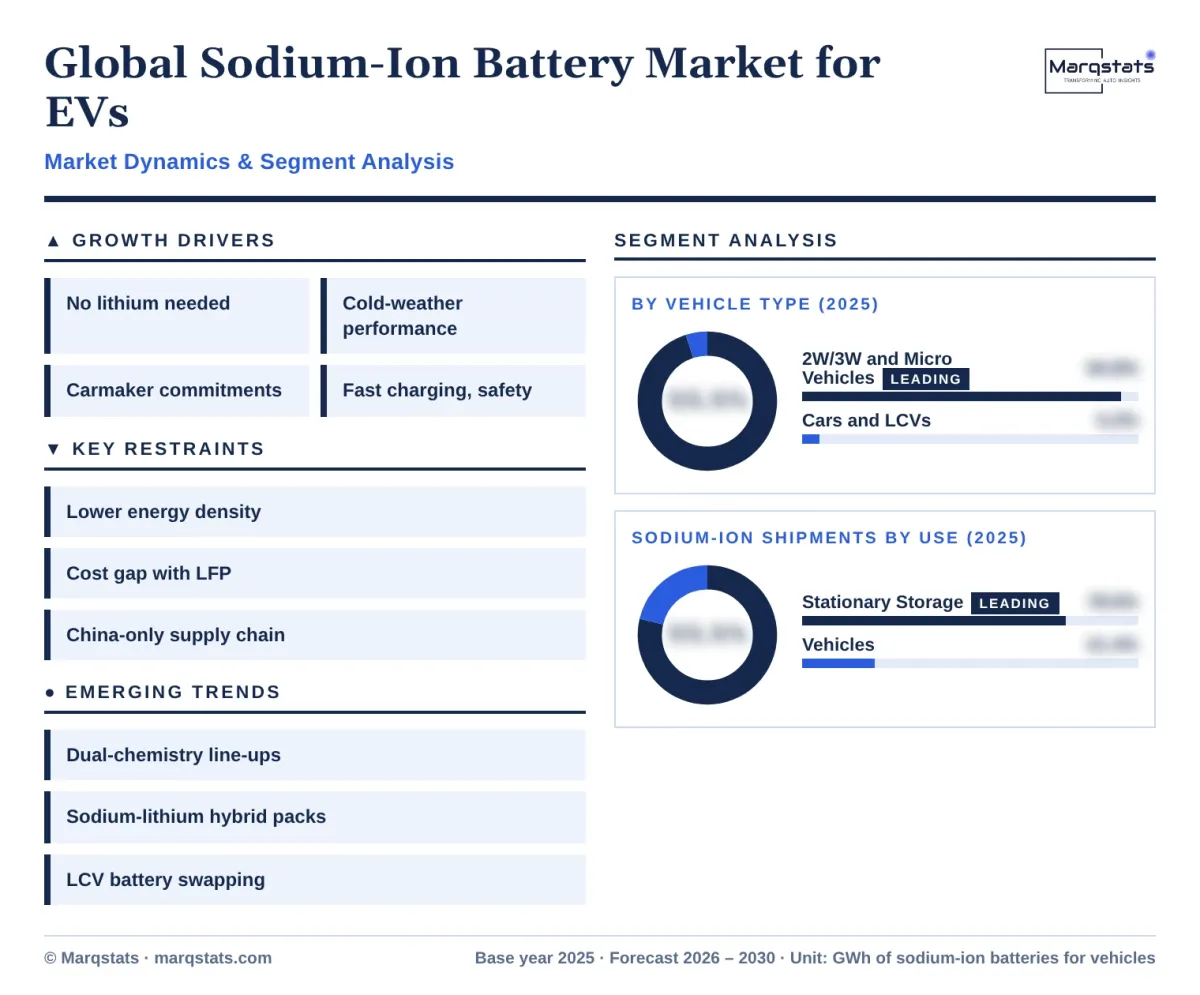
- Cheap, abundant raw materials: Sodium-ion avoids lithium, cobalt and nickel, so its cost is less exposed to lithium price swings. Lithium carbonate prices were about 70% below their 2022 peak in 2026, however they had roughly doubled over the previous year, renewing interest in alternatives. Sodium can be extracted from common salt and soda ash, produced in many countries, which reduces dependence on a small number of lithium producers. China, which holds more than 95% of existing and announced 2030 sodium-ion capacity, gains most from this shift in the near term.
- Cold-weather performance: Sodium-ion cells retain about 90% of nominal capacity at -40°C and can be charged at -30°C, which helps EVs in northern China, Russia, the Nordic countries and Canada keep range in winter. LFP cells lose much more capacity in the cold, so sodium-ion offers a practical advantage in exactly the markets where LFP struggles most. The IEA notes that sodium-ion is already cost-effective for vehicles and storage in cold climates even where it is not yet cheaper than LFP elsewhere.
- Carmaker commitments: CATL will supply Naxtra cells across Changan's brands, including Avatr, Deepal, Qiyuan and UNI, fits sodium-ion packs to GAC Aion cars from the second quarter of 2026, and Chery is the launch customer for its second-generation cells. CATL's chief manufacturing officer said in June 2026 that 10,000 to 20,000 EVs would use its sodium-ion cells during the year. These commitments move sodium-ion from a demonstration chemistry to a supply-chain decision at several of China's largest carmakers.
- Fast charging and safety: Sodium-ion cells handle high charging rates with little heat rise, and Yadea, the largest electric two-wheeler maker, launched four sodium-ion scooters in January 2025 priced from 3,299 to 4,299 yuan that charge to 80% in 15 minutes. The chemistry is less prone to thermal runaway than many lithium-ion cells, and cells can be stored and shipped at zero volts, which reduces transport risk and cost for cell makers and pack assemblers.
- Capacity investment: Global announced investment in sodium-ion capacity has passed US$20 billion, as reported by industry trackers, and CATL is spending about 5 billion yuan to add 40 GWh a year of sodium-ion capacity at its Fuding base in Fujian. More than 370 GWh of sodium-ion cell capacity is tracked globally, as reported, far above current demand, so capacity does not limit adoption in the forecast period. Storage contracts, such as CATL's three-year, 60 GWh supply deal with HyperStrong, absorb new capacity and drive down cell costs for vehicles.
Key Restraints
- Lower energy density: At up to about 175 Wh/kg, sodium-ion cells give an average SUV up to about 350 km of range, against 400 to 600 km for lithium-ion, according to the IEA, which limits them to smaller vehicles and shorter ranges. Nickel-rich chemistries reach around 255 Wh/kg. CATL aims to reach energy densities comparable to current LFP cells within three years, and plans packs with around 500 km of range for Changan, which would remove much of this gap for mainstream cars.
- Cost gap with LFP: At current lithium prices sodium-ion is not yet cheaper than LFP in most uses, according to the IEA, and in a September 2026 storage tender in Hebei sodium-ion systems were bid at about twice the price of LFP, as reported. Cell prices are quoted inconsistently, from low targets announced by cell makers to tender prices well above LFP, and vehicle pack prices are not disclosed, so the market is reported in GWh and value is treated qualitatively. A sharp fall in lithium prices would slow adoption.
- Small, concentrated supply chain: Nearly all sodium-ion manufacturing capacity is in China, and Western start-ups have struggled: Natron Energy in the United States shut down in September 2025. Concentration exposes carmakers outside China to the same single-country dependence they face in lithium-ion, and limits local supply for markets with content rules. Western carmakers are unlikely to fit sodium-ion batteries to their own vehicles before the end of the decade.
- Competing improvements in LFP: LFP batteries made up more than 55% of EV batteries deployed globally in 2025, and continuing gains in LFP density and cost raise the bar sodium-ion must clear. Every year that LFP gets cheaper and denser, sodium-ion needs to improve as fast simply to stay in the same place. Lead-acid batteries also remain the low-cost incumbent in Chinese e-scooters, so sodium-ion must compete on cost at both ends of the vehicle market.
Key Trends
- Dual-chemistry line-ups: CATL describes the arrival of sodium-ion in Changan's cars as the start of a dual-chemistry era, with sodium-ion and lithium-ion offered side by side in the same model ranges. CATL launched its Naxtra sodium-ion brand in April 2025, four years after introducing its first-generation sodium-ion battery in July 2021, and the first sodium-ion car, from JAC with HiNa Battery cells, appeared in late 2023. CATL has said sodium-ion may eventually hold 30% to 40% of the battery market.
- Sodium-lithium hybrid packs: Packs that combine sodium-ion and lithium-ion cells use sodium-ion for cold-weather and high-power performance and lithium-ion for range, and are being developed for plug-in and range-extended vehicles. In these vehicles smaller batteries and cold-weather performance matter more than energy density, which suits sodium-ion's strengths. Hybrid packs let carmakers introduce sodium-ion without accepting the full range penalty of a sodium-only pack.
- Light commercial vehicles and battery swapping: CATL's 45 kWh Tectrans II pack for light trucks and vans, scheduled for mass production in July 2026, offers both plug-in and battery-swap versions and completed winter testing in JAC light trucks and mid-size vans. Urban delivery vehicles run fixed daily routes within sodium-ion's range and benefit from fast charging and cold performance, which makes them an early volume outlet beyond passenger cars.
- Western entrants focused on storage: General Motors said in June 2026 that it is developing sodium-ion cells with Peak Energy for grid storage, with commercial production expected around 2029, while LG Energy Solution is preparing a sodium-ion pilot line in Nanjing. Western carmakers are therefore leaving vehicle sodium-ion to Chinese carmakers for now. If sodium-ion proves itself in Chinese cars, Western carmakers may first import packs or cells for low-cost models before building local supply.
Market Segmentation
Two- and three-wheelers and micro vehicles took an estimated 1.83 GWh, 94.82% of the 2025 market. Yadea launched four sodium-ion scooters in January 2025, and Chinese micro-car makers used small sodium-ion packs, where low cost and fast charging matter more than range. Lead-acid batteries still dominate low-cost Chinese e-scooters, so sodium-ion has a large replacement market in this segment alone. The segment remains larger in GWh terms than passenger cars until around 2028, and it is the first outlet for sodium-ion in India and South-East Asia.
Passenger cars and light commercial vehicles took an estimated 0.10 GWh, 5.18% of the 2025 market, and are the fastest-growing segment as the Changan Nevo A06, GAC Aion models and CATL's Tectrans II van and light-truck pack enter production in 2026. The Nevo A06 offers more than 400 km of CLTC range from its 45 kWh pack, and CATL plans packs with around 500 km of range for Changan and other carmakers. Because each car adds 20 to 40 times the capacity of a scooter, this segment overtakes two- and three-wheelers in GWh terms around 2028.
Layered oxide cathodes offer the highest energy density among sodium-ion chemistries and are used in most vehicle cells, including the high-density cells for passenger cars such as CATL's Naxtra. They are the chemistry that brings sodium-ion closest to LFP in energy density, which is why they dominate the passenger car segment. Their main challenges are moisture sensitivity and cycle life, which cell makers address through coatings and electrolyte design.
Polyanion cathodes offer long cycle life and high safety at lower energy density, and are gaining share in storage and in vehicles where durability matters more than range, such as delivery vehicles and buses on fixed routes. Their stable structure supports thousands of charge cycles, which suits commercial fleets with high daily use. They are less suited to passenger cars that need maximum range from a given pack size.
Prussian blue analogue cathodes use cheap, abundant materials and suit high-power applications. They have faced manufacturing and stability challenges, particularly control of water content during production, which has limited their use in vehicle cells so far. Natron Energy, which used this chemistry, shut down in September 2025, and its main remaining applications are in storage and high-power niches.
Battery electric vehicles use sodium-ion as the main traction battery, mainly in two- and three-wheelers, micro cars and entry-level passenger cars such as the Changan Nevo A06. In these vehicles sodium-ion replaces LFP or lead-acid where range needs are modest and cold performance or low cost matters most. This application accounts for almost all of the 2025 market and remains the largest through 2030 as Changan extends sodium-ion across its brands.
Plug-in hybrid and range-extended vehicles are an emerging application for sodium-ion and sodium-lithium hybrid packs, where smaller batteries and cold-weather performance matter more than energy density. A range-extended vehicle's generator covers long trips, so the battery's energy density matters less, while sodium-ion's high charging rates and cold performance improve everyday electric driving. China's large range-extended vehicle market gives this application a ready base of potential adopters.
By Geography
China
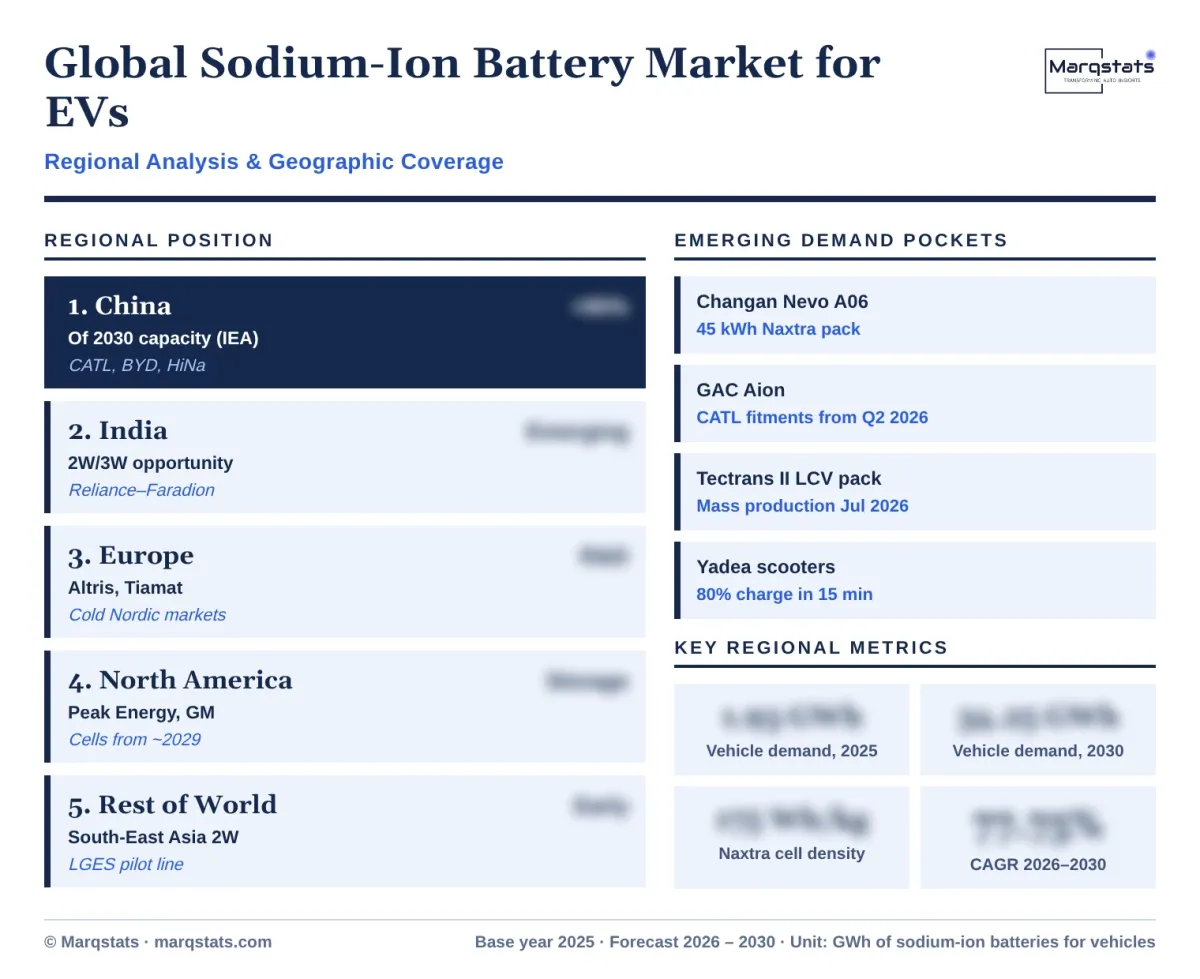
China is the largest market by far, with almost all sodium-ion vehicle applications in 2025 and more than 95% of existing and announced 2030 sodium-ion capacity. CATL, BYD and HiNa are the main producers; Changan, GAC Aion, JAC and Chery are the main car adopters, and Yadea is the main two-wheeler adopter. Cold northern provinces offer a natural market for sodium-ion's low-temperature performance.
Europe
Europe has research programmes and start-ups such as Altris in Sweden and Tiamat in France, coordinated in part through German research consortia, however no series-production sodium-ion vehicle programme. European carmakers are watching Chinese launches before committing. Cold Nordic markets and low-cost city cars are the most likely first applications, and the EU Battery Regulation's material and carbon footprint rules may favour a chemistry that avoids lithium, nickel and cobalt.
North America
North America is focused on storage. Peak Energy develops sodium-ion storage systems and is partnering with General Motors, which expects commercial cell production around 2029, while Natron Energy shut down in 2025. No North American carmaker has announced a sodium-ion vehicle, so the region's vehicle demand stays negligible in the forecast period, while cold Canadian markets are a long-term opportunity.
India
India is a promising market for sodium-ion in two- and three-wheelers, where cost and heat tolerance matter. Reliance Industries agreed to acquire UK developer Faradion in 2021 and took full ownership in October 2024 to build sodium-ion capability, although volume production has not been announced. India's large electric two- and three-wheeler market and high summer temperatures suit a low-cost, heat-tolerant chemistry.
Rest of World
The rest of the world, including South-East Asia, Japan and South Korea, is at an early stage. LG Energy Solution is preparing a pilot line in Nanjing, and South-East Asian two-wheeler markets are natural targets for low-cost sodium-ion packs. Indonesia and Vietnam, two of the largest motorcycle markets in the world, are electrifying their two-wheeler fleets, which makes them candidates to be the first large sodium-ion markets outside China, supplied from Chinese plants.
How Competition Is Evolving
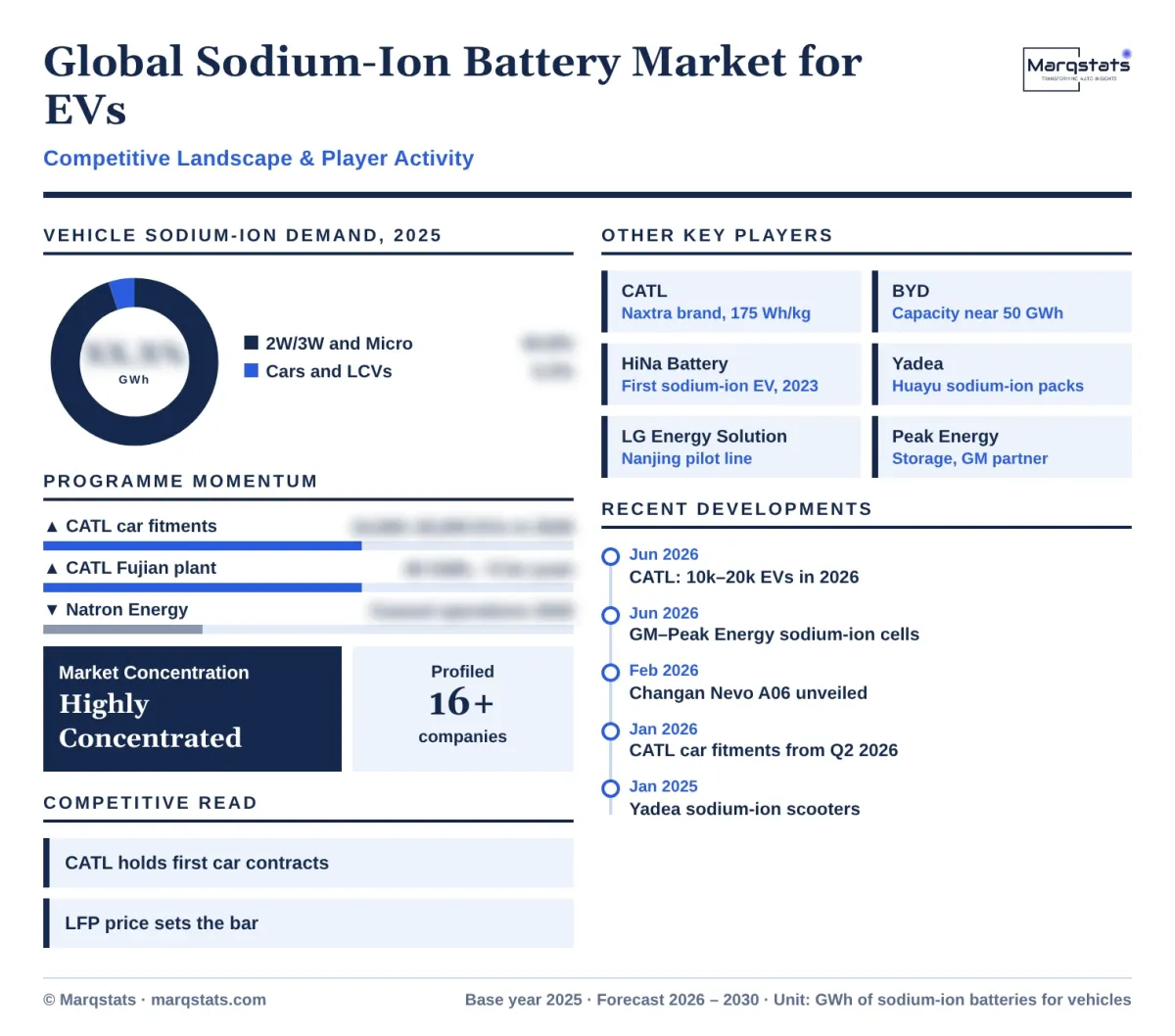
The sodium-ion battery market for EVs is highly concentrated in China. CATL leads vehicle applications through its Naxtra brand, a result of about a decade of research and roughly 10 billion yuan of investment, and partnered with Changan on the Nevo A06. BYD has a large sodium-ion programme, including a planned 30 GWh-a-year project with Huaihai in Xuzhou, and HiNa Battery powered the first sodium-ion EV in 2023. Market shares are not published, so Marqstats describes the market by named programmes and dated actions. CATL sodium-ion cells, sold under the Naxtra brand, set the benchmark for vehicle use, while BYD sodium battery work has focused mainly on energy storage and small vehicles.
Carmakers are choosing partners early. Changan named CATL its exclusive sodium-ion partner across its brands, GAC Aion is CATL's first car customer for in-vehicle installation from the second quarter of 2026, JAC tested the Tectrans II pack in its light trucks and vans, and Chery is the launch customer for CATL's second-generation cells. These early contracts make it hard for later entrants to win the first wave of car programmes. Once a carmaker has validated a cell for safety and cold-weather performance, it rarely changes supplier during a model cycle. That gives CATL, an early partner of Changan, an advantage that could last into the late 2020s.
Two-wheeler makers have built their own sodium-ion capability. Yadea launched its Huayu sodium-ion battery brand and a fast-charging ecosystem in January 2025, showing that the largest two-wheeler makers can integrate the chemistry themselves rather than rely only on cell suppliers.
Outside China, competitors are mainly start-ups and research programmes. Faradion, owned by Reliance Industries, Altris, Tiamat and Peak Energy work on sodium-ion cells or systems, mostly for storage, and LG Energy Solution runs a pilot line. The failure of Natron Energy in 2025 shows the risk for companies without a large anchor customer.
The next phase of competition will turn on energy density and cost. CATL's second-generation cells of 175 Wh/kg or more, BYD's large-scale capacity and HiNa's advanced EV cells will compete for the same car programmes, and lithium-ion makers can respond by cutting LFP prices. The winners will be the companies that can supply both chemistries from the same plants and switch the mix as raw material prices move.
Companies Covered
Companies covered in the report include:
Recent Market Activity
Table of Contents
Coverage & Segmentation
The study covers sodium-ion cells and packs for road vehicles worldwide, including two- and three-wheelers, micro and small cars, passenger cars, light commercial vehicles and buses, and hybrid sodium-lithium packs. The base year is 2025, the historical period 2021 – 2025 and the forecast period 2026 – 2030. The unit is GWh of battery capacity shipped for vehicles. Stationary storage is discussed but excluded from totals.
Seven segments across three dimensions and five regions are covered, and 16 companies are profiled. The 2025 figure is a Marqstats construction from reported total sodium-ion shipments and the reported storage share. The 2026 estimate and the 2027 to 2030 forecast are Marqstats constructions.
Known limits are stated plainly. Total 2025 shipments of about 9 GWh and the 78.6% storage share are as reported by industry trackers and not independently verified; the IEA gives no GWh figure. The split between two-wheelers and cars is a Marqstats estimate, value in US dollars is not sized because cell prices are not published consistently, and cathode chemistry shares are described qualitatively.
