Market Snapshot
The Mexico electric car market, covering electric cars in Mexico (autos eléctricos México) including hybrids and plug-in hybrids, stands at 146,724 electrified light vehicles (HEV, PHEV and BEV) sold in Mexico in 2025 and is estimated at 210,000 electrified vehicles in 2026. Marqstats forecasts it to reach 350,000 electrified vehicles by 2030, a CAGR of 18.99% over 2026 – 2030 that adds 203,276 electrified vehicles between 2025 and 2030. Electric cars, Mexico's fastest-growing powertrain group, are led by Chinese brands.
Mexico City is the largest market, Plug-in hybrids is the fastest growing and Hybrid Electric (HEV) is the dominant segment, in a market that is moderately concentrated. The report covers 6 segments and 5 regions and profiles 16 companies, with 2025 as the base year, history from 2021 – 2025 and a forecast for 2026 – 2030.
Key Takeaways
Market Overview & Analysis
Report Summary
The Mexico electric car market covers new electrified light vehicles sold in Mexico: hybrid electric vehicles (HEV), plug-in hybrids (PHEV) and battery electric vehicles (BEV), as reported by the National Institute of Statistics and Geography (INEGI) through its light vehicle industry register (RAIAVL). Electrified sales reached 146,724 in 2025, up 18% and a record 9.6% of light vehicle sales, from 8,265 units in 2016. Marqstats estimates 210,000 in 2026 and forecasts 350,000 by 2030, a CAGR of 18.99% over 2026 – 2030, when electrified vehicles would take about a fifth of light vehicle sales.
Hybrids are the backbone of the market: in 2025 they made up 76.4% of electrified sales, battery electric vehicles 14.3% and plug-in hybrids 9.3%, according to Mexican Automotive Industry Association (AMIA) data, about 112,097, 20,982 and 13,645 units. Buyers prefer hybrids because of range anxiety and limited charging. Registration-based estimates from the International Council on Clean Transportation (ICCT) put 2025 battery electric sales at about 54,000 and plug-in hybrids at about 60,000, because not all importers report to INEGI.
Mexico's 50% tariff on cars from China was meant to slow Chinese electric cars, and in 2026 it slowed the arrival of new stock rather than sales. China exported 625,187 vehicles to Mexico in 2025, and at least 217,838 arrived early to be sold in 2026 free of the new duty. Imports of Chinese cars fell 31.1% in the first half of 2026 while sales of Chinese brands grew 27.7%, and the electrified share rose to 13.1% in January to October 2026, from 9.5% a year earlier.
The forecast assumes 245,000 in 2027, 280,000 in 2028, 315,000 in 2029 and 350,000 in 2030. Growth slows in 2027 as pre-tariff inventory runs out and prices rise, then continues as hybrids spread across mainstream brands and local electric production begins at BMW San Luis Potosí and through the Olinia project. A tariff reduction or rapid Chinese local assembly would lift the forecast; a weaker economy would slow it.
Market Dynamics
Key Drivers
- Hybrid model launches: Japanese, Korean and Chinese brands have added hybrids across popular segments, and hybrids from Japanese and Chinese brands now sell at small premiums over petrol versions. INEGI recorded 87,706 hybrids in January to August 2026. Hybrids need no change in refuelling habits, which makes them an easy first step for buyers worried about charging, and Toyota, Nissan, Honda and Kia are the main hybrid sellers among non-Chinese brands.
- Affordable Chinese models: BYD, Geely and MG offer hybrids, plug-in hybrids and electric cars at competitive prices, and pre-tariff inventory kept prices low through 2026. BYD sold about 33,969 electrified vehicles in the first half of 2026, according to Mexican Association of Automotive Distributors (AMDA) estimates, with four battery electric models and seven plug-in hybrids including the Dolphin Mini, and Geely sold 22,258 vehicles in 2025, up 237.4%. China supplied 92% of battery electric and plug-in hybrid vehicles sold in the first half of 2025, according to the ICCT.
- Urban advantages: Electrified vehicles benefit from exemptions from driving restrictions and lower running costs in Mexico City and other large cities, where most sales take place. Mexico City recorded 40,694 electrified sales in January to October 2026, 24.1% of the national total. High incomes, shorter urban distances and better charging availability concentrate demand, and Mexico had 263,928 battery electric, plug-in hybrid and range-extended vehicles in circulation by June 2026, according to the Electro Movilidad Asociación (EMA).
- Local production and Olinia: BMW plans to build electric Neue Klasse models at San Luis Potosí from 2027, and the government's Olinia project unveiled the Olinia Uno on 7 June 2026 at a price from 150,000 pesos including value-added tax, with battery assembly in Puebla, first deliveries from summer 2027 and a long-term aim of up to 50,000 vehicles a year. At that price the Olinia Uno would be among the cheapest new cars of any type in Mexico.
- Fuel costs: Rising petrol prices make hybrids and plug-in hybrids more attractive, as drivers can cut fuel spending substantially in city driving. Plug-in hybrids offer electric driving in the city and petrol range on highways, which suits Mexico's limited charging network, and Chinese plug-in hybrids compete directly with mid-range petrol SUVs. Fuel savings are the main reason buyers accept the remaining price premium on electrified models.
Key Restraints
- 50% tariff on Chinese cars: From 1 January 2026, Mexico raised the tariff on light vehicles from countries without a trade agreement, including China, to 50%, the maximum allowed by the World Trade Organization, and battery electric vehicles were included. Once pre-tariff stock is sold, Chinese brands must absorb part of the tariff, raise prices or supply Mexico from other countries. Their decision shapes electrified sales in 2027 and 2028 and is the largest single risk in the forecast.
- Limited charging infrastructure: Public charging is concentrated in Mexico City, Monterrey and Guadalajara and along a few highways, and corridors between major cities still have long gaps between fast chargers. Most battery electric owners charge at home. This favours hybrids and plug-in hybrids, which do not depend on public charging, and explains why hybrids still made up about three-quarters of electrified sales in 2025.
- Price premium: Battery electric vehicles still carry a larger premium over comparable petrol cars than hybrids do, except for small models such as the BYD Dolphin Mini. Battery electric vehicles accounted for only about 1.4% to 1.6% of all new car sales according to INEGI-based figures, and premium brands and BYD dominate that segment. Most buyers choose hybrids instead, so battery electric growth depends on cheaper models such as the Olinia Uno.
- Data and reporting gaps and trade tensions: Not all brands report detailed electrified sales to INEGI, so official figures may understate battery electric and plug-in hybrid sales. The United States has raised concerns about Chinese vehicles in Mexico in the context of the United States-Mexico-Canada Agreement (USMCA), and global brands that import some models from China, such as General Motors, Kia and Volvo, are also affected by the tariff, adding policy uncertainty.
Key Trends
- Plug-in hybrids growing fastest: Plug-in hybrid sales rose 222.4% in January to July 2026 as Chinese brands launched new models. INEGI recorded 21,893 plug-in hybrids in January to August 2026, and plug-in hybrids rose to about 17% of electrified sales from 9.3% in 2025, while hybrids fell to about 68% from 76.4%. Marqstats expects plug-in hybrids to keep gaining share through 2027, because they combine Chinese supply prices with independence from public charging.
- Rising electrified share in a growing market: Electrified sales reached 112,313 in January to July 2026, 12.7% of the 885,353 light vehicles sold, 146,183 in January to September and about 169,000 in January to October, when the share reached 13.1%. October alone saw 19,836, up 42.6%, after 14,173 in January, 10.8% of light vehicle sales. Total light vehicle sales rose 4.8% to 1,287,268 in January to October, so electrified vehicles are gaining share in a growing market.
- Chinese brands adapting to tariffs: Chinese brands built up stock before the tariff and are considering supply from other countries and local assembly in Mexico to reduce exposure. Pacific ports, the main gateway for cars assembled in China, handled 977,480 vehicles in 2025, imports and exports combined, as reported by Expansión. Vehicles originating in China represented about one in five new car sales before the tariff, so how Chinese brands adapt sets the market's direction from 2027.
- National electric vehicle project and local production: The Olinia project presented its first prototype in June 2026 and plans battery assembly in Puebla and first deliveries from summer 2027, and BMW's San Luis Potosí plant adds premium electric production from 2027. Several global carmakers build hybrids and electric vehicles in Mexico mainly for export. Local production reduces dependence on Chinese imports and the exposure of electrified sales to the tariff.
Market Segmentation
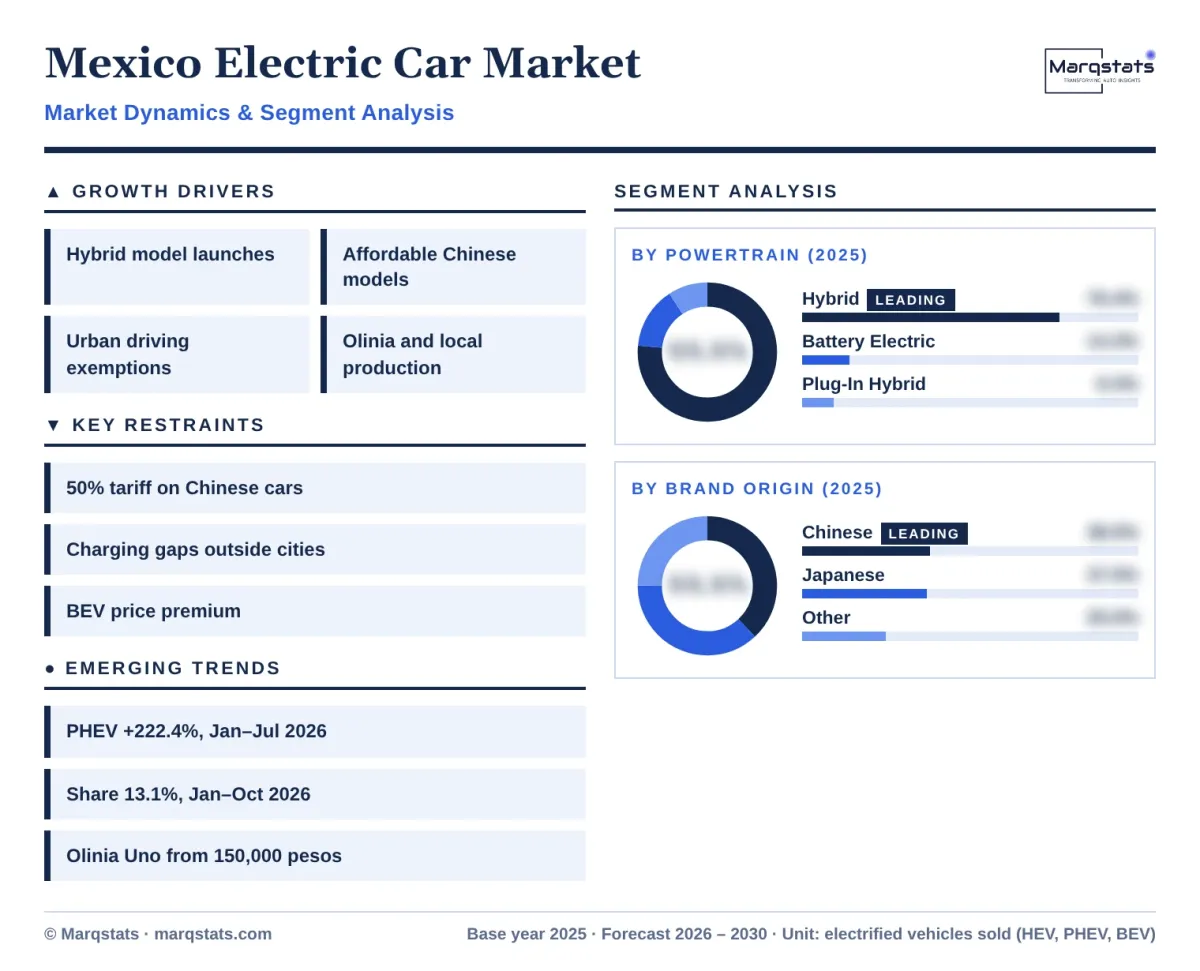
Hybrids accounted for about 76.4% of electrified sales in 2025, about 112,097 units, based on AMIA's 2025 mix. Buyers choose hybrids because they need no charging and cost little more than petrol models, and Toyota, Nissan, Honda, Kia and Chinese brands all sell them. INEGI recorded 87,706 hybrids in January to August 2026. Hybrids' share of electrified sales falls as plug-in hybrids grow, although they remain the largest powertrain through 2030 because charging stays limited outside the largest cities.
Battery electric vehicles accounted for about 14.3%, about 20,982 units, and reached 21,709 in January to September 2026, 14.9% of electrified sales. Registration-based estimates suggest higher volumes, about 54,000, because of differences in reporting coverage. BYD, Tesla, Volvo, BMW and Mercedes-Benz are the main brands. Most owners charge at home, and growth depends on cheaper models such as the Dolphin Mini and the Olinia Uno and on charging expansion beyond the main cities.
Plug-in hybrids accounted for about 9.3%, about 13,645 units, and are the fastest-growing type, up 222.4% in January to July 2026, with Chinese brands as the main sellers. They offer electric driving in cities and petrol range on highways, which suits Mexico's limited charging network. BYD's seven plug-in hybrid models are central to this segment. Plug-in hybrids are exposed to the tariff once pre-tariff stock runs out, which makes local assembly decisions critical.
Chinese brands, including BYD, Geely, MG, Changan, Chirey, JAC and GAC, account for an estimated 38.00% of electrified sales, about 55,755 units. BYD sold about 33,969 electrified vehicles in the first half of 2026 and reached close to 5% of the total light vehicle market in 2025, according to the ICCT. Chinese brands built their position on price and range, and their sales grew 27.7% in the first half of 2026 despite the tariff, supported by pre-tariff inventory.
Japanese brands, with Toyota, Nissan, Honda and Mazda as the main sellers, account for an estimated 37.00%, about 54,288 units, mainly hybrids. Japanese brands have long experience with hybrid systems and strong dealer networks across the country, which keeps them competitive against Chinese brands even as Chinese models gain share in plug-in hybrids and battery electric vehicles. The tariff on Chinese imports improves their relative price position from 2027.
Other brands, including BMW, Volvo, Mercedes-Benz, Kia, Hyundai, Tesla, Ford and General Motors, account for an estimated 25.00%, about 36,681 units. European premium brands and Tesla are strong in battery electric vehicles, while Kia and Hyundai sell hybrids and electric models. BMW's San Luis Potosí plant and Kia's Nuevo León plant give these brands local production options, while brands importing models from China face the same tariff as Chinese brands.
By Geography
Mexico City
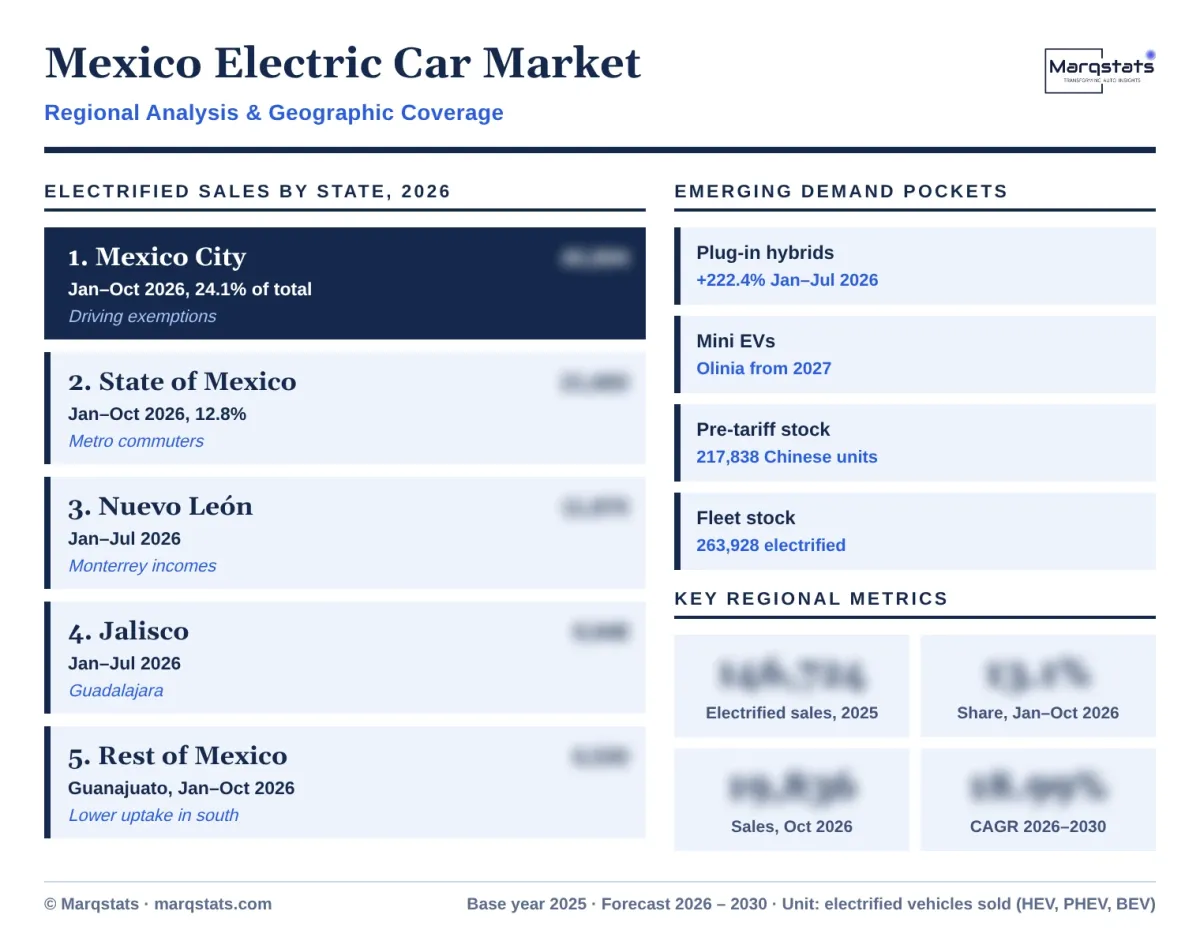
Mexico City is the largest market, with 40,694 electrified sales in January to October 2026, 24.1% of the national total, and the highest sales per million inhabitants. Exemptions from driving restrictions and the densest charging network support demand. High incomes and short urban distances make the capital the main market for battery electric vehicles as well as hybrids.
State of Mexico
The State of Mexico recorded 21,660 electrified sales in January to October 2026, 12.8% of the national total, driven by commuters in the Mexico City metropolitan area. Longer commuting distances than in the capital favour hybrids and plug-in hybrids over battery electric vehicles. Together with Mexico City, the state accounts for more than a third of national electrified sales.
Nuevo León
Nuevo León, centred on Monterrey, recorded 11,870 electrified sales in January to July 2026, supported by high incomes and industrial employment. Kia's plant in the state is a major car producer. Monterrey has one of the main public charging networks outside the capital, which supports battery electric adoption.
Jalisco
Jalisco, centred on Guadalajara, recorded 9,948 electrified sales in January to July 2026 and ranks among the top four states for electrified sales. Guadalajara's public charging network and growing middle class support demand. Hybrids dominate, with plug-in hybrids gaining as Chinese brands expand dealer networks in the city.
Rest of Mexico
Guanajuato recorded 6,530 electrified sales in January to October 2026, 3.9% of the total, and San Luis Potosí 2,292 in January to September, where BMW plans electric production from 2027. Southern states such as Chiapas and Guerrero have the lowest sales per million inhabitants. Limited charging and lower incomes outside the main cities favour hybrids.
How Competition Is Evolving
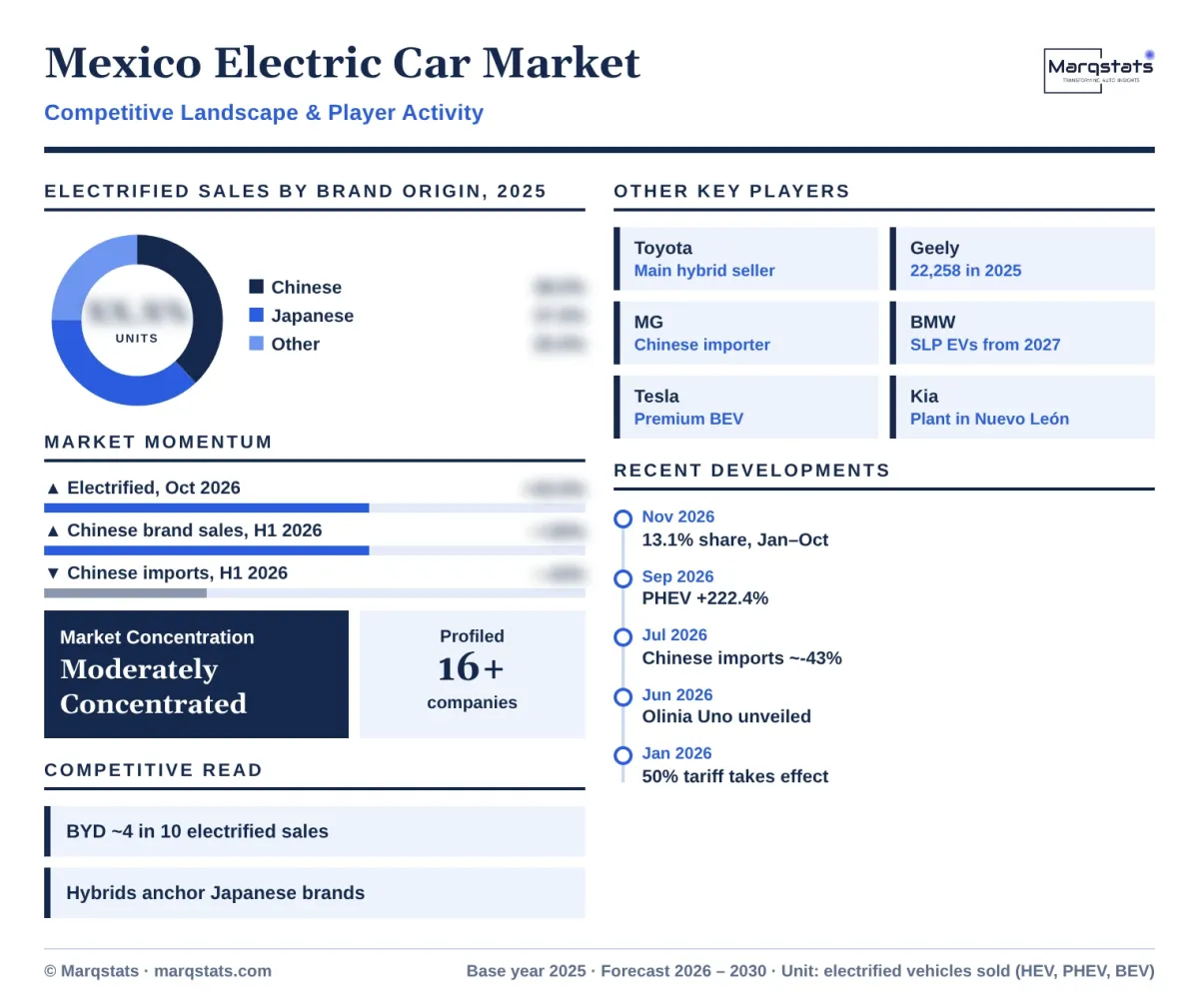
The Mexico electric car market is moderately concentrated. BYD sold about 33,969 electrified vehicles in the first half of 2026, according to AMDA estimates, and reached close to 5% of the total light vehicle market in 2025, according to the ICCT. Toyota leads among hybrid sellers from traditional brands, followed by Nissan, Honda and Kia, while Geely, MG and Changan are growing quickly. Carros eléctricos precios (electric car prices) have fallen as BYD widened its range, and electric cars in Mexico now span every price band.
Chinese brands built their position on price and range. BYD offers four battery electric models and seven plug-in hybrids, and Geely sold 22,258 vehicles in 2025, up 237.4%. The 50% tariff from January 2026 threatens this model, but large pre-tariff inventories have kept prices competitive through 2026. Sales of Chinese brands grew 27.7% in the first half of 2026 even as imports from China fell 31.1%.
Premium brands lead battery electric sales outside BYD. Volvo, BMW, Mercedes-Benz and Tesla sell battery electric models mainly in Mexico City and Monterrey. BMW's plan to build electric Neue Klasse models at San Luis Potosí from 2027 will add local supply. Carros Tesla precios position the Tesla Model Y in Mexico at the premium end, and public charging networks such as ChargePoint in Mexico remain concentrated in the major cities.
Local and new entrants add competition. The Olinia project plans a mini electric car from 150,000 pesos with production in Puebla from 2027, and Mexican start-ups and fleet operators are exploring electric taxis and delivery vehicles.
Companies Covered
Companies covered in the report include:
Recent Market Activity
Table of Contents
Coverage & Segmentation
The study covers new electrified light vehicles sold in Mexico: hybrids, plug-in hybrids and battery electric vehicles, as reported by INEGI. Mild hybrids reported as hybrids are included; vehicles without electrification, used vehicles and heavy vehicles are excluded. The base year is 2025, the historical period 2021 – 2025 and the forecast period 2026 – 2030. The unit is vehicles sold.
Six segments across two dimensions and five regions are covered, and 16 companies are profiled. The 2025 base of 146,724 is the INEGI total. The powertrain split applies AMIA's January to October 2025 mix to the full year; brand-origin shares are Marqstats constructions. The 2026 estimate and the 2027 to 2030 forecast are Marqstats constructions.
Known limits are stated plainly. INEGI-based figures may understate battery electric and plug-in hybrid sales because not all importers report detailed data; registration-based estimates are higher. State figures cover different periods depending on the latest published data.
