Market Snapshot
The UAE electric bus market, from the Dubai RTA electric bus programme to Abu Dhabi ITC fleets, stands at about 100 electric buses in operation in the UAE (battery-electric and hydrogen fuel-cell electric) in 2025 and is estimated at 170 electric buses in 2026. Marqstats forecasts it to reach 700 electric buses by 2030, a CAGR of 47.58% over 2026 – 2030 that adds 600 electric buses between 2025 and 2030. The electric bus, Dubai's priority for zero-emission transit, is the fastest-growing part of the fleet.
Abu Dhabi is the largest market, Dubai is the fastest growing and Public Transit Authorities is the dominant segment, in a market that is highly concentrated. The report covers 2 segments and 4 regions and profiles 16 companies, with 2025 as the base year, history from 2021 – 2025 and a forecast for 2026 – 2030.
Key Takeaways
Market Overview & Analysis
Report Summary
The UAE electric bus market covers battery-electric and hydrogen fuel-cell buses in operation in the UAE, run by public transport authorities and by private and institutional operators such as airport, corporate, campus and school shuttles, measured as buses in operation at year end. Diesel and hybrid buses are excluded. No authority publishes a national count, so Marqstats estimates about 100 electric buses in 2025, about 55 with public authorities and about 45 with private operators, well under 5% of public buses. Marqstats forecasts 170 in 2026 and 700 by 2030, a CAGR of 47.58% from a very small base.
Dubai's 735-bus order is not an electric bus order. Only 40 of the 735 buses, 5.4%, are Zhongtong electric buses; the other 695 are Euro 6 diesel buses from MAN, Zhongtong, Volvo and Anadolu Isuzu, even though some 2026 reports described all 735 as electric. Dubai's longest-serving buses have run 18 years and more than 2 million km, so these diesel buses can stay in service into the 2040s. Dubai's 2030 electric fleet depends on new orders after 2026, and its 2050 zero-emission target will be met mostly by replacing buses bought today.
Abu Dhabi leads on zero-emission buses, with 40.00% of the fleet in 2025 through its Green Bus Programme of electric and Hyundai fuel-cell buses, which covered more than 1.3 million km from September 2024 to April 2026 with energy costs about 40% lower than conventional buses. Sharjah runs 20 intercity electric buses. Heat, purchase price and depot grid capacity limit the pace, and Chinese suppliers such as Zhongtong lead electric tenders.
Marqstats forecasts 242 buses in 2027, 345 in 2028 and 491 in 2029, assuming at least one dedicated electric order in Dubai and continued additions in Abu Dhabi, with public authorities rising to 70.00% of the fleet by 2030. Electric buses stay under 20% of UAE public buses in 2030. The forecast is a single most likely path; the timing of the next RTA and Abu Dhabi Mobility tenders is the most important variable.
Market Dynamics
Key Drivers
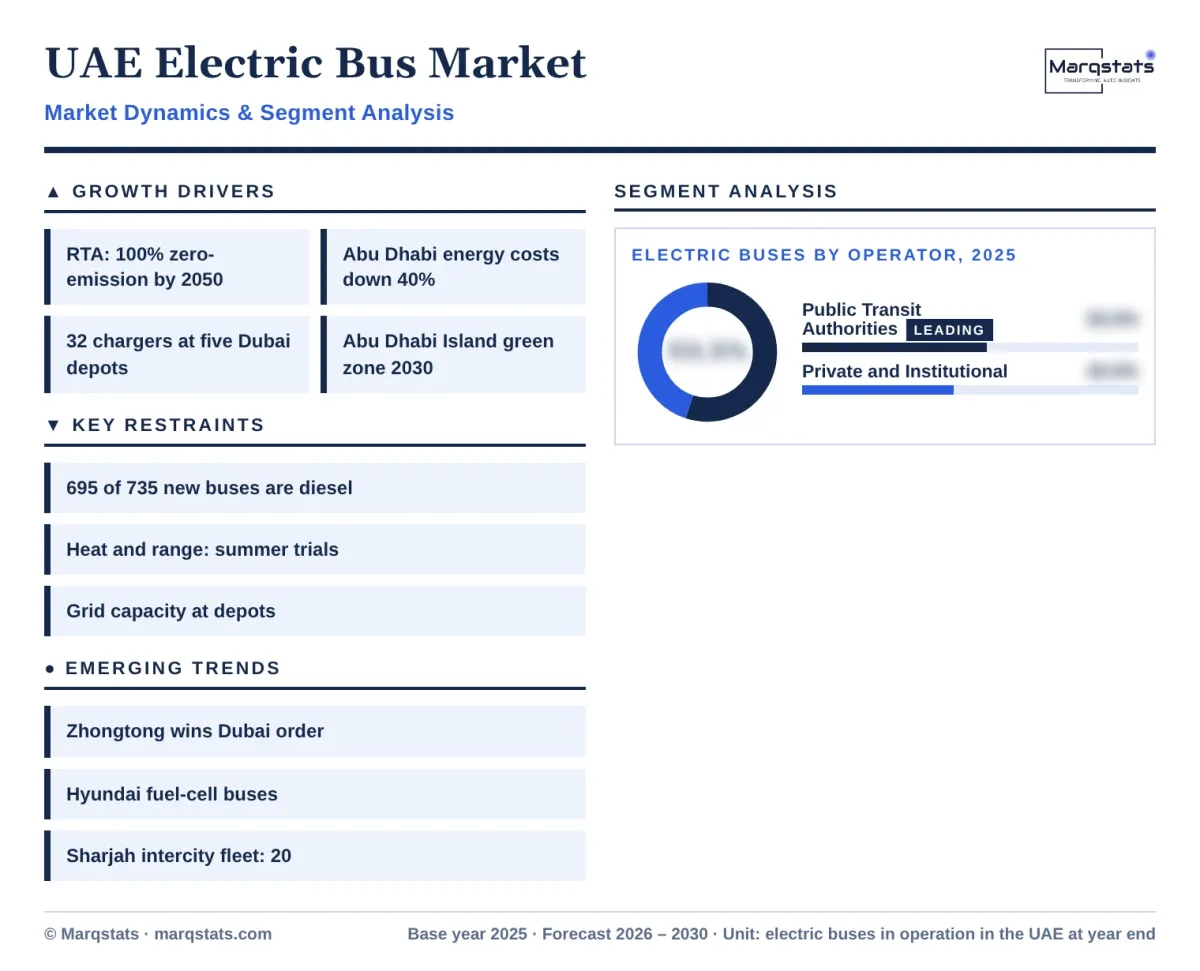
- Net zero targets: Dubai Roads and Transport Authority's Zero-Emission Public Transport Strategy 2050 aims for 100% of public buses on electric and hydrogen power by 2050, and Dubai targets a 30% cut in public transport emissions by 2030. Abu Dhabi Mobility aims to make Abu Dhabi Island a Green Public Transport Zone by 2030 and convert half the emirate's public transport fleet to electric and hydrogen buses. Marqstats forecasts about 260 Abu Dhabi buses by 2030, short of that goal.
- Energy savings: Abu Dhabi's green bus fleet recorded energy costs about 40% below conventional fleets and cut CO2 emissions by an estimated 1,332 tonnes in 2025, and Sharjah Roads and Transport Authority reports significantly lower operating and maintenance costs. RTA reported greenhouse gas emissions down 12% in 2025 and 44% from the 2022 baseline across its operations. Published savings help authorities justify higher purchase prices.
- Depot charging: RTA completed charging at five depots, Al Quoz, Al Ruwayyah, Lehbab, Business Bay and Jebel Ali, with 32 chargers of 360 kW each, and the Dubai Electricity and Water Authority (DEWA) supplies depot power. Dubai's Zhongtong bus carries 70 passengers, a 434 kWh battery and a range of up to 280 km on an ABB 360 kW charger, enough for a full day of service; a test bus on Route F13 carried 470 kWh and up to 370 km.
- Green zone plan: Abu Dhabi launched its Green Bus Programme in September 2024 under agreements with South Korea and China, reaching 19 hydrogen and electric buses by late 2024, including Hyundai's Elec City and Universe fuel-cell buses. Route 65 between Marina Mall and Al Reem Island, serving about 6,000 passengers and more than 2,000 km a day, converted fully to green buses in March 2025, and Route 184 links the Central Bus Station with Yas Island.
- Ridership growth: Dubai's public buses carried 188 million passengers in 2024, up 8%, and 95.7 million in the first half of 2025, on 187 routes and 11,000 daily trips. Growing ridership supports fleet expansion, and each order is a chance to add electric buses. RTA's bus priority at signals improved arrival times by 12%, and dedicated lanes reached 20 km, helping electric buses complete daily duty within battery range.
Key Restraints
- Diesel lock-in: RTA signed agreements in June 2025 worth AED 1.1 billion for 637 buses, later expanded to 735: 40 Zhongtong electric, 549 city-service buses (400 MAN and 149 Zhongtong), 76 Volvo double-deckers and 70 Anadolu Isuzu articulated buses. Dubai Media Office states the contract covers 735 Euro 6 buses including 40 electric. With fleet availability above 93% in 2025 and long service lives, these diesel buses shape the fleet well beyond 2030.
- Heat and range: Summer temperatures above 45°C raise air-conditioning load and reduce battery range, so authorities run long summer trials before ordering. The Zhongtong bus passed a three-month Dubai trial on air-conditioning, braking and energy efficiency with 95% driver and passenger satisfaction. In June 2025 RTA signed a memorandum with BYD Company Limited to pilot a bus with BYD's latest batteries through the summer.
- Upfront cost: Electric buses cost more than Euro 6 diesel buses, and authorities buy outright on multi-year budgets, so mixed contracts such as Dubai's show authorities still choose diesel for most capacity. Leasing, battery warranties and service contracts used in other markets have not yet been adopted by UAE authorities. Electric buses must match diesel availability before authorities shift large volumes, which keeps early orders small.
- Grid capacity: City buses charge overnight and between shifts at depots, so depot space and grid connections are the constraint rather than public charging. Dubai's five depots can support the first wave, while a larger fleet needs more depot capacity and grid upgrades planned with DEWA and other utilities. Depot readiness limits how fast dedicated electric orders can follow.
Key Trends
- Chinese e-buses: RTA received its first 250 contract buses in January 2026, including the 40 Zhongtong electric buses, described as the UAE's largest and first-of-its-kind electric bus procurement, with remaining deliveries in 2026. Zhongtong's buses were built to Gulf specifications with low-floor access, bicycle space, Wi-Fi, 360-degree cameras and driver monitoring. BYD, Yutong, King Long and Higer compete for future tenders, while European suppliers MAN and Volvo lead diesel.
- Hydrogen testing: Abu Dhabi tests fuel-cell buses alongside battery buses under the National Hydrogen Strategy, and RTA has tested a hydrogen bus in Dubai's climate. Hyundai Motor Company delivered fuel-cell buses in November 2024, and Abu Dhabi sent young Emirati engineers to China and South Korea to learn operation and maintenance. Marqstats counts fuel-cell buses as electric while expecting battery-electric buses to dominate by 2030.
- Intercity e-buses: Sharjah Roads and Transport Authority launched 10 intercity electric buses in September 2024 to Dubai, Ajman and Al Hamriyah, completing 14,961 trips in seven months, and added 10 more in October 2025, taking the fleet to 20. Sharjah's first electric bus was tested on the Sharjah–Ajman route in 2019 with Reliance Motors, agent of China Shangan Bus. Intercity routes with predictable distances suit early adoption.
- Heat trials: Every major order follows a summer heat trial, as with Zhongtong and BYD in Dubai, and authorities choose busy, predictable routes close to charged depots for first deployments. Private operators of airport, hotel, campus and event shuttles add volume on short fixed routes, and school transport fleets, which park at depots overnight, are a future segment that Marqstats counts only once buses enter service. Qatar's large Doha orders raise the regional benchmark.
Market Segmentation
Public transit authorities ran 55 electric buses or 55.00% in 2025 and grow at a 54.87% CAGR, rising to 70.00% of the fleet by 2030. RTA owns and operates Dubai's fleet, Abu Dhabi Mobility contracts operators, and SRTA runs Sharjah's intercity buses. Their tender timing sets the market's pace.
Private and institutional operators ran about 45 or 45.00%, mainly in Dubai and Abu Dhabi, and grow at a 36.08% CAGR. Airport, hotel, corporate, university and event shuttles on short fixed routes suit battery range. Dubai's Urban Plan 2040 and rising visitor numbers support shuttle fleets.
12-metre city buses such as the Zhongtong e-bus dominate public fleets and serve busy routes like Abu Dhabi's Route 65. They charge at depots overnight. Dedicated electric city-bus orders after 2026 drive most fleet growth.
Sharjah intercity buses and private shuttles run fixed routes between emirates and within campuses and airports. Predictable distances and depot access make them early adopters. Sharjah's fleet doubled to 20 in 2025.
Most electric buses in the UAE are battery-electric, from Zhongtong, China Shangan and others. Battery buses benefit from depot charging investment and falling Chinese prices. They make up most of the fleet by 2030.
Abu Dhabi tests Hyundai fuel-cell buses under the National Hydrogen Strategy, and Dubai has tested a hydrogen bus. Fuel-cell buses offer longer range and fast refuelling while hydrogen supply remains limited. They remain a small share before 2030.
By Geography
Dubai
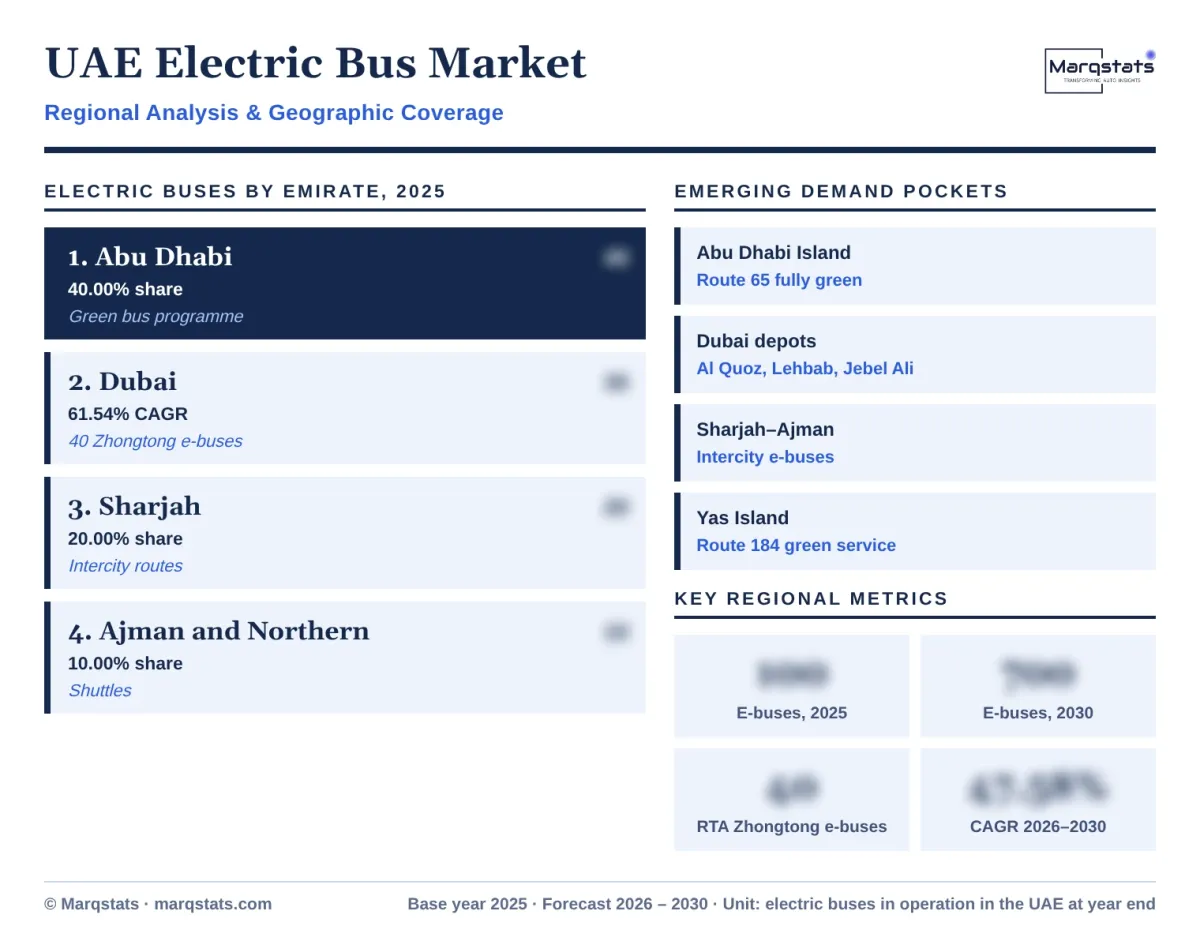
Dubai had about 30 electric buses in 2025 and grows fastest at a 61.54% CAGR to 330 by 2030 as RTA follows its first 40 buses with dedicated orders and private shuttles grow. Its 1,390-bus fleet remains mostly diesel.
Abu Dhabi
Abu Dhabi led with 40.00% of electric and fuel-cell buses in 2025, about 40, growing at a 45.41% CAGR to 260 and 37.14% of the total by 2030. The Green Public Transport Zone plan supports continued additions.
Sharjah
Sharjah runs 20 intercity electric buses, 20.00% of the total, growing at a 28.47% CAGR to 70 by 2030. SRTA focuses on intercity routes to Dubai, Ajman and Al Hamriyah.
Ajman and Northern Emirates
Ajman and the Northern Emirates had about 10 electric buses or 10.00%, mainly shuttles, rising to 40 by 2030. Intercity links with Sharjah and Dubai support adoption.
How Competition Is Evolving
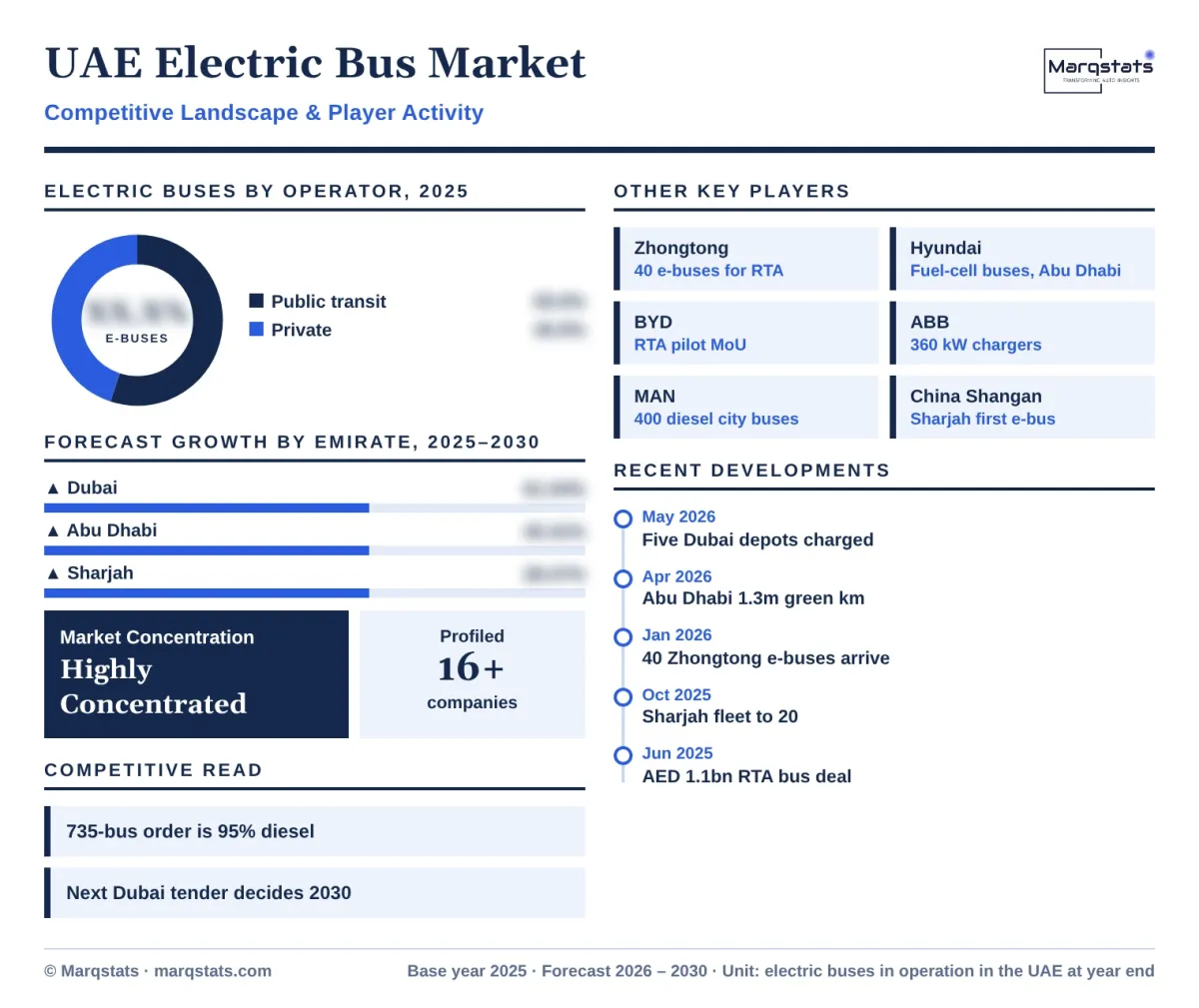
The UAE electric bus market is highly concentrated on the buyer side: three transport authorities, RTA, Abu Dhabi Mobility and SRTA, operate most electric buses.
On the supplier side, Zhongtong holds Dubai's largest order, Hyundai supplies fuel-cell buses in Abu Dhabi and China Shangan supplied Sharjah's first electric bus. Each electric bus in Dubai under this order will run on RTA routes with depot charging.
BYD, Yutong, King Long and Higer compete for future tenders, while MAN, Volvo and Anadolu Isuzu supply most diesel buses.
Charging suppliers such as ABB and utilities such as DEWA are essential partners in every project.
Companies Covered
Companies covered in the report include:
Recent Market Activity
Table of Contents
Coverage & Segmentation
The study covers battery-electric and hydrogen fuel-cell electric buses in operation in the UAE by operator type, bus type, technology and emirate. The base year is 2025, the historical period 2021 – 2025 and the forecast period 2026 – 2030. The unit is electric buses in operation at year end.
Two operator types and four emirate groups are covered, and 16 companies and authorities are profiled. Counts combine authority announcements with Marqstats estimates for private fleets.
Known limits are stated plainly. No national electric bus count is published, private fleets are estimated, and news reports have overstated electric numbers.
