Market Snapshot
The Germany electric bus market is valued at USD 1,379.68 million in 2025 and is forecast to reach USD 1,969.02 million by 2030, a CAGR of 7.37%. Registrations of zero-emission buses above 8 tonnes rise from 1,794 units in 2025 to 2,800 units in 2030, a 9.31% unit CAGR. Germany registered 1,458 battery-electric and 336 fuel-cell buses in 2025, more than double the 711 battery-electric buses of 2024.
Marqstats builds the value bottom-up: Kraftfahrt-Bundesamt (KBA) battery-electric registrations and DVV Media Group fuel-cell registrations, split by length class, multiplied by acquisition prices anchored on the PwC E-Bus-Radar 2026 benchmark of about EUR 580,000 for a 12-metre battery-electric bus. Every euro figure converts at EUR 1 = USD 1.13. The panel is most sensitive to the articulated-bus price, because 18-metre vehicles carry 36.32% of 2025 value on 31.0% of units.
The 2025 peak was not a new baseline. DVV Media Group counted only 553 battery-electric and 26 fuel-cell bus registrations in Germany in the first half of 2026, so Marqstats expects the full year to fall to 1,340 units and USD 1,012.25 million before the EUR 500 million federal funding call of May 2026 and the Deutsche Bahn frameworks lift volumes from 2027.
Germany is Europe's hydrogen bus market. Its 336 fuel-cell registrations in 2025 were 60.2% of the 558 registered across Europe, yet fuel-cell value is forecast to shrink at 15.33% a year as operators such as those reviewed in the E-Bus-Radar 2026 realign planned hydrogen projects toward battery-electric fleets.
Supply is concentrated. Daimler Buses, MAN Truck & Bus and BYD took 83.5% of German battery-electric registrations in 2025, and the Deutsche Bahn framework signed in December 2025 makes MAN the main supplier for more than 3,000 DB Regio buses from 2027 to 2032.
Key Takeaways
Market Overview & Analysis
Report Summary
German bus electrification moved from pilot fleets to volume procurement in 2025, and then hit a funding gap. Battery-electric registrations above 8 tonnes doubled to 1,458 units, fuel-cell registrations reached 336, and the PwC E-Bus-Radar 2026 counted 4,752 zero-emission buses in operation at year-end, about 14% of a city fleet of roughly 35,000. The first half of 2026 then delivered only 579 zero-emission registrations. The question for 2026 to 2030 is no longer whether German operators will buy electric buses, but how fast federal money, depot grid connections and the 2030 EU urban-bus requirement can be lined up behind each other.
The measure is the annual value of new zero-emission buses above 8 tonnes gross vehicle weight registered in Germany: battery-electric and hydrogen fuel-cell city buses, intercity buses and coaches, valued at vehicle acquisition price before subsidy. It excludes plug-in hybrid and other hybrid buses, trolleybuses (90 in service), electric minibuses below 8 tonnes, depot charging hardware, grid connection, hydrogen refuelling stations, energy, maintenance contracts and leasing margins. The broader Europe Electric Bus Market page counts battery-electric plus plug-in hybrid buses above 3.5 tonnes and excludes fuel-cell buses; Germany is a dedicated deep-dive within it, not an addition to it.
Four readers use this analysis. Bus manufacturers deciding German capacity and dealer-workshop coverage need the 2026 trough and the 2027 recovery timing. Public transport operators and their municipal owners writing tenders under the second reference period of the Saubere-Fahrzeuge-Beschaffungs-Gesetz need the price and length-class benchmarks. Battery, fuel-cell and drivetrain suppliers deciding between hydrogen and battery-electric programmes need the fuel-cell decline. Lenders and infrastructure investors pricing depot projects need the 397-unit gap between registration and service entry.
Germany Electric Bus Market Size and Forecast
Value rises from an estimated USD 398.66 million in 2021 to USD 439.21 million in 2022, USD 609.92 million in 2023 and USD 584.72 million in 2024, then jumps to USD 1,379.68 million in 2025. Marqstats forecasts USD 1,012.25 million in 2026, USD 1,187.22 million in 2027, USD 1,421.26 million in 2028, USD 1,682.42 million in 2029 and USD 1,969.02 million in 2030. The history rests on published registrations: 555 battery-electric and 33 fuel-cell buses in 2021, 632 zero-emission buses in 2022, 809 battery-electric buses in 2023 and 711 in 2024, with fuel-cell volumes for 2023 and 2024 estimated by Marqstats. All years convert at the fixed 2025 rate, so the series shows volume and price, not currency.
The 2025 build is explicit. Marqstats splits the 1,458 battery-electric registrations into 860 solo buses of about 12 metres at EUR 580,000, 520 articulated buses at EUR 780,000 and 78 midibuses above 8 tonnes at EUR 420,000. The 336 fuel-cell buses split into 300 solo vehicles at EUR 820,000 and 36 articulated vehicles at EUR 1,050,000. The total is EUR 1,220.96 million, or USD 1,379.68 million, a blended EUR 680,600 per bus. The solo price is the PwC E-Bus-Radar 2026 benchmark; the other prices are Marqstats estimates from published tender awards and the specification gap to the solo vehicle.
Volume is the primary series and value is derived. Units grow at 9.31% a year while value grows at 7.37%, and the gap has two named causes. Battery-electric prices fall by about 1% a year as NMC4 and LFP packs get cheaper, taking the 12-metre benchmark to EUR 550,000 by 2030. Fuel-cell buses, the most expensive vehicles in the mix, drop from 18.7% of units to 5.7%. Partly offsetting both, articulated buses rise from 31.0% of units to 36.1%, which lifts the average. The blended price falls from EUR 680,600 in 2025 to EUR 622,300 in 2030.
The path is not a straight line. Marqstats places 2026 at 1,340 registrations because the first half delivered 579 and the EUR 500 million call opened only on 26 May 2026, with applications due on 21 July 2026; buses funded under it cannot reach the road in volume before 2027. From 2027 the curve is set by three instruments: the second reference period of the Clean Vehicles Directive from 1 January 2026, the DB Regio frameworks for deliveries from 2027, and Regulation (EU) 2024/1610, which requires 90% of new urban buses to be zero-emission from 2030.
Registrations Outran Service Entry by 397 Buses in 2025
Germany registered more zero-emission buses in 2025 than its operators could put into service. The KBA counted 1,458 battery-electric buses above 8 tonnes and DVV Media Group counted 336 fuel-cell buses, a total of 1,794. The PwC E-Bus-Radar 2026, published on 16 March 2026, counted 1,397 zero-emission buses newly commissioned into municipal service in the same year. The gap is 397 units, 22.1% of registrations.
Part of the gap is scope. The E-Bus-Radar tracks city-bus fleets of public transport operators, while the registration count also includes intercity buses, private operators and coaches. Marqstats sizes that non-municipal layer at 134 units in 2025. The remaining 263 or so buses are vehicles registered in late 2025 that waited for depot chargers, software integration or driver training before carrying passengers. Comparing the 4,034 battery-electric buses in service at year-end with the PwC statement that the battery-electric stock grew 37% shows net additions of about 1,090, against 1,458 registrations.
The implication is practical. A German tender is now won or lost on depot readiness. Daimler Buses Solutions GmbH sells depot projects with the vehicles, and Hamburger Hochbahn AG built a battery-electric-only depot at Meiendorf, which began trial operations in October 2026 for 30 buses and is sized for 130. Vehicle makers that cannot commission charging alongside the bus will see delivered vehicles sit idle, and operators will price that risk into the next award.
The 2026 Dip Is a Funding Gap, Not Lost Demand
Germany slipped to fifth place in Europe for battery-electric registrations in the first half of 2026. DVV Media Group data published on 31 August 2026 show 553 battery-electric buses in Germany, behind Italy at 1,559, the United Kingdom at 1,075, Poland at 1,060 and Norway at 660. The 2025 surge drew on grants from federal rounds since 2021, which together supported around 3,000 battery-electric buses. The last round under the old directive gave EUR 417 million to 151 companies for 1,887 electric buses, and the next call opened only in May 2026.
The new directive changes the economics. It was published in the Bundesanzeiger on 6 May 2026, funds at least 1,500 buses across up to 150 operators, and cuts the subsidy on the extra cost over a diesel bus from 80% to up to 70% for operators that are just starting and up to 55% for the rest. Charging and refuelling infrastructure stays at up to 40%, with a cap of EUR 30 million per company and project. With a 12-metre battery-electric bus at about EUR 580,000 and a diesel equivalent at about EUR 310,000, a 55% grant on the EUR 270,000 gap leaves an operator EUR 121,500 above diesel per bus, against EUR 54,000 under the old 80% rate.
Marqstats reads this as a deferral rather than a loss. The 6,400 further zero-emission buses that municipal operators have in their plans to 2030, as counted by PwC, have not gone away, and the EU urban-bus requirement in 2030 does not wait for subsidy. The recovery starts in 2027, when buses funded under the 2026 call and the first DB Regio call-offs arrive.
Germany Leads Europe in Hydrogen Buses at the Point Its Operators Start to Turn Away
Germany registered 336 fuel-cell buses in 2025, 60.2% of the 558 registered in Europe, and its fuel-cell fleet rose to 628 buses at year-end, about 13% of the zero-emission stock. Cologne runs 127, Rostock 71 and Wuppertal 52. Solaris Bus & Coach sp. z o.o. supplied 277 of the 558 European fuel-cell buses, 49.6% of the segment, ahead of Wrightbus with 95 and Mercedes-Benz with 85.
The peak looks like a one-off. Only 26 fuel-cell buses were registered in Germany in the first half of 2026, and the E-Bus-Radar 2026 reports that planned hydrogen projects are being reviewed or realigned in favour of battery-electric solutions. A fuel-cell solo bus costs about EUR 820,000 in Marqstats estimates, roughly EUR 240,000 more than its battery-electric equivalent, before the cost of hydrogen and refuelling.
Marqstats forecasts 160 fuel-cell registrations in 2030 and a value of USD 139.55 million, down from USD 320.69 million. Fuel-cell buses keep a role on long regional routes and in networks with existing hydrogen supply, such as the Rhineland, but the volume growth of the German market is now battery-electric.
Market Dynamics
Key Drivers
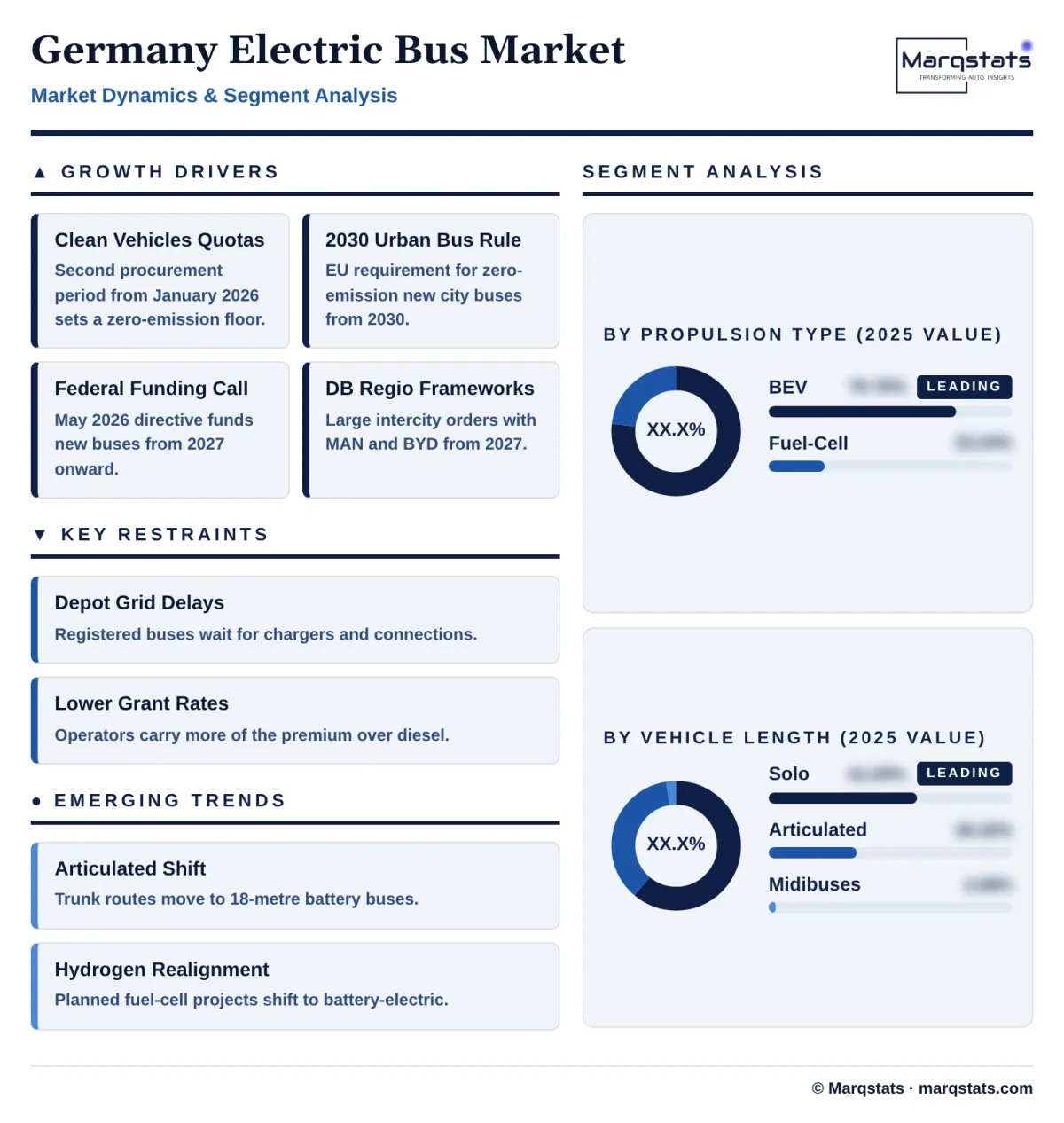
Four dated instruments set German zero-emission bus demand from 2026 to 2030.
- Second Clean Vehicles Directive period: from 1 January 2026 the Saubere-Fahrzeuge-Beschaffungs-Gesetz requires 65% of buses procured by public contracting bodies to be clean and at least 32.5% to be zero-emission until 31 December 2030, about 940 zero-emission buses a year on PwC's count. Germany already registered 1,794 in 2025, so the quota is a floor, not the ceiling.
- Regulation (EU) 2024/1610 urban-bus requirement: 90% of new urban buses must be zero-emission from 2030 and 100% from 2035. On an average intake of about 2,900 new city buses a year in Germany, the 2030 step implies up to about 2,600 zero-emission city buses. Marqstats places 2030 city-bus registrations at 2,380, because the requirement binds each manufacturer's EU-wide fleet rather than each country.
- Federal funding call of May 2026: the directive published on 6 May 2026 funds at least 1,500 buses across up to 150 operators from a budget of up to EUR 500 million, with applications open from 26 May to 21 July 2026. Its buses arrive mostly in 2027 and 2028.
- Deutsche Bahn frameworks: on 13 December 2025 Deutsche Bahn AG signed frameworks for more than 3,000 DB Regio buses worth more than EUR 1 billion, deliveries 2027 to 2032, with MAN Truck & Bus SE as main supplier at about 95% and BYD supplying electric intercity buses from Hungary. This is the largest single source of intercity electrification in Germany.
Key Restraints
Three constraints cap the speed of the recovery.
- Depot grid connections: the 397-unit gap between 2025 registrations and service entry shows operators waiting for chargers, transformers and depot software. Large depots such as Berlin's Köpenicker Landstraße site for about 200 buses, planned for full operation in 2027, take years from approval to first charge.
- Lower subsidy intensity: the 2026 directive cuts the grant on the diesel price gap from 80% to 70% or 55%, which raises an operator's own outlay per 12-metre bus from EUR 54,000 to as much as EUR 121,500 over diesel in Marqstats arithmetic.
- Price premium: a 12-metre battery-electric bus still costs about EUR 580,000 against about EUR 310,000 for a diesel bus in 2025, an 87% premium, and an articulated battery-electric bus costs about EUR 780,000 in Marqstats estimates.
Key Trends
Three shifts change what German operators buy.
- Bigger buses: articulated vehicles rise from 31.0% of zero-emission registrations in 2025 to 36.1% in 2030 as Hamburg, Berlin, Cologne and Kiel electrify trunk routes; KVG Kiel ordered 28 eCitaro G articulated buses in June 2026.
- Larger NMC4 packs: the Kiel eCitaro G order specifies five NMC4 packs of 111 kWh each, 555 kWh per bus, and the Deutsche Bahn frameworks call for a range above 300 km without recharging.
- Turnkey depots: Hamburger Hochbahn AG began trial operations at its battery-electric-only Meiendorf depot in October 2026, with 30 buses due in regular service at the year-end timetable change and space for 130.
Strategic Implications
- For entrants: German tenders reward depot integration and workshop reach more than list price. BYD reached 167 registrations in 2025 and a share of the DB Regio intercity framework, which shows the route in: Hungarian assembly, intercity products and a named workshop network.
- For incumbents: Daimler Buses held 45.5% of 2025 battery-electric registrations, down from 53% in 2024, while MAN rose from 94 to 386 units. The 2026 trough is the time to secure call-offs under the new funding call before the 2027 recovery fills order books.
- For suppliers and investors: plan battery-electric capacity around 2,640 registrations in 2030 and treat fuel-cell volume as a declining niche. Depot finance, grid connection and charging-management software sit on the critical path for every German award from 2027.
Market Segmentation
Battery-electric buses are the market. They are worth USD 1,058.99 million in 2025, 76.76% of value, on 1,458 registrations, and grow to USD 1,829.47 million in 2030, 92.91% of value, a CAGR of 11.55%. Registrations rise to 2,640 units.
The KBA count of 1,458 units above 8 tonnes in 2025 compares with 711 in 2024 and 809 in 2023. Daimler Buses registered 664, MAN Truck & Bus 386 and BYD 167. Growth to 2030 comes from articulated city buses and battery-electric intercity buses under the DB Regio frameworks.
Fuel-cell buses are worth USD 320.69 million in 2025, 23.24% of value, on 336 registrations, and decline to USD 139.55 million in 2030, 7.09% of value, a CAGR of -15.33%. Registrations fall to 160 units.
The 2025 total was 60.2% of European fuel-cell bus registrations. Only 26 followed in the first half of 2026. Remaining demand is concentrated in regional networks with existing hydrogen supply.
Solo buses are the largest length class, worth USD 841.62 million in 2025, 61.00% of value, on 1,160 units (860 battery-electric, 300 fuel-cell). They reach USD 1,011.35 million in 2030, 51.36% of value, a CAGR of 3.74%, on 1,570 units.
Value grows more slowly than units because most fuel-cell buses are solo vehicles, and their decline drags the class. The battery-electric solo bus is the PwC price anchor at about EUR 580,000.
Articulated buses are worth USD 501.04 million in 2025, 36.32% of value, on 556 units, and reach USD 858.23 million in 2030, 43.59% of value, a CAGR of 11.36%, on 1,010 units.
Large city operators electrify their highest-capacity routes last, because these buses need the biggest batteries. The KVG Kiel order of June 2026 for 28 eCitaro G buses with 555 kWh each is typical of the next wave.
Midibuses are worth USD 37.02 million in 2025, 2.68% of value, on 78 units, and reach USD 99.44 million in 2030, 5.05% of value, a CAGR of 21.85%, on 220 units.
They serve old-town routes and low-demand suburban lines. Smaller minibuses below 8 tonnes fall outside the measure.
City buses are worth USD 1,294.27 million in 2025, 93.81% of value, on 1,660 units, and reach USD 1,714.32 million in 2030, 87.06% of value, a CAGR of 5.78%, on 2,380 units.
They carry the quota under the Saubere-Fahrzeuge-Beschaffungs-Gesetz and the 2030 EU urban-bus requirement. Hamburg alone runs 709 zero-emission buses and Berlin 277.
Intercity buses and coaches are worth USD 85.41 million in 2025, 6.19% of value, on 134 units, and reach USD 254.70 million in 2030, 12.94% of value, a CAGR of 24.42%, on 420 units.
The DB Regio frameworks are the main driver, calling for electric intercity buses with a range above 300 km. Coaches stay small: Europe registered 267 electric coaches in 2025.
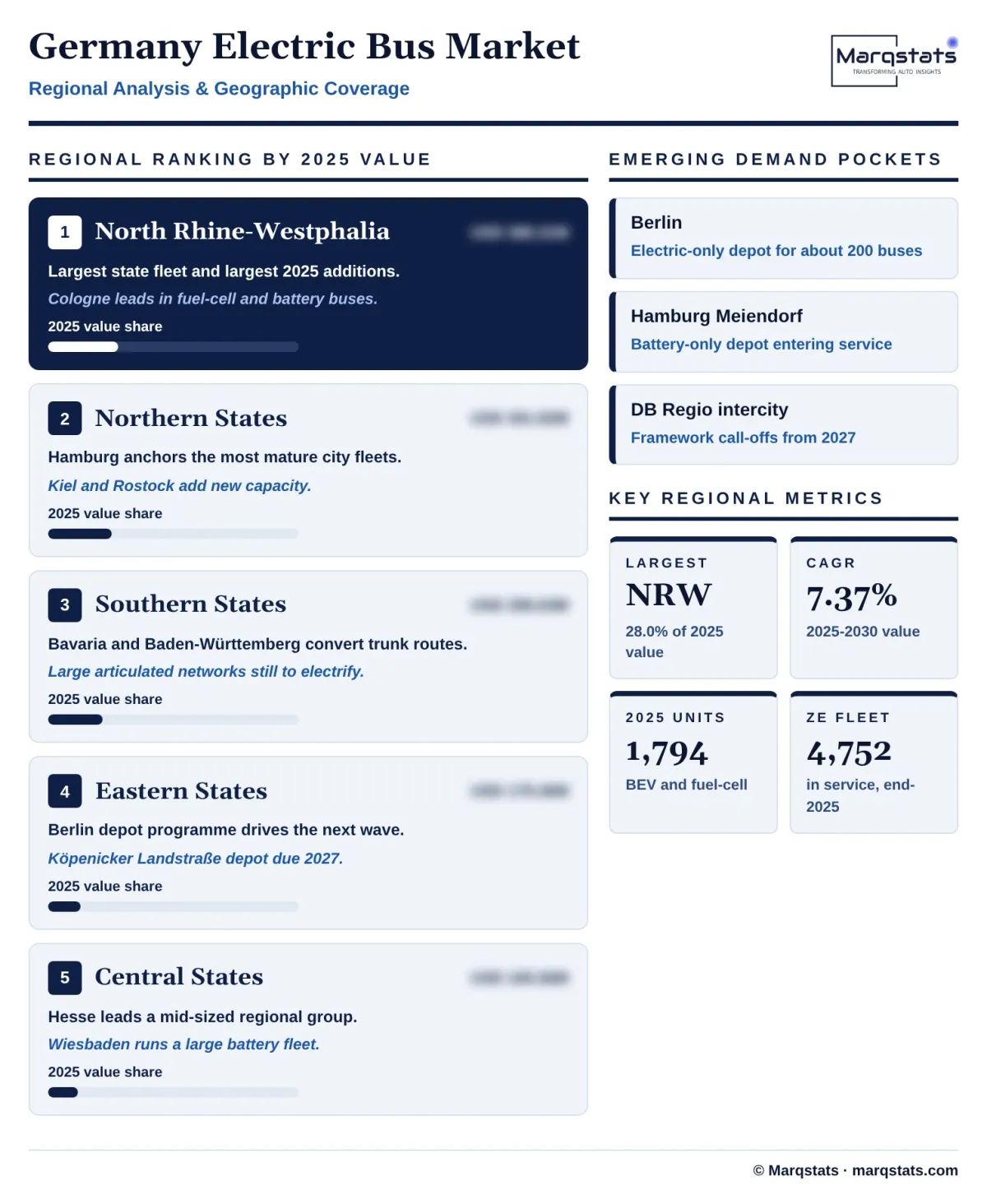
By Geography
North Rhine-Westphalia
North Rhine-Westphalia is the largest regional market, worth USD 386.31 million in 2025, 28.0% of value in a Marqstats allocation. The state became the first to pass 1,000 zero-emission buses and ran 1,113 at the end of 2025, 415 more than a year earlier, the largest addition of any state. Cologne runs 127 fuel-cell and 129 battery-electric buses, which makes the state the centre of German hydrogen bus operation as well as of battery-electric growth.
Northern States
The northern states, Hamburg, Schleswig-Holstein, Lower Saxony, Bremen and Mecklenburg-Western Pomerania, are worth USD 351.82 million in 2025, 25.5% of value. Hamburg runs 709 zero-emission buses at Hamburger Hochbahn AG and Verkehrsbetriebe Hamburg-Holstein, Lower Saxony 358 and Schleswig-Holstein 253. KVG Kiel had 122 electric buses in a fleet of 218 and ordered 28 more in June 2026. Rostock runs 71 fuel-cell buses. Hamburg's share of new value is below its 14.9% share of the national fleet because much of its city fleet converted in earlier years.
Southern States
Bavaria and Baden-Württemberg are worth USD 296.63 million in 2025, 21.5% of value. Bavaria runs 598 zero-emission buses and Baden-Württemberg 412, and Nuremberg runs 123 battery-electric buses. Both states have large articulated-bus networks still to convert, which supports above-average growth to 2030.
Eastern States
Berlin, Brandenburg, Saxony and Saxony-Anhalt are worth USD 179.36 million in 2025, 13.0% of value. Berlin runs 277 electric buses in a fleet of about 1,500, and Berliner Verkehrsbetriebe is building a depot for about 200 electric buses at Köpenicker Landstraße, managed by Drees & Sommer, planned for full operation in 2027. Marqstats expects the eastern states to gain share as Berlin's depot programme opens.
Central States
Hesse, Rhineland-Palatinate, Saarland and Thuringia are worth USD 165.56 million in 2025, 12.0% of value. Hesse runs 409 zero-emission buses and Wiesbaden 121 battery-electric buses. Outside the eight largest states, the other eight federal states together ran 623 zero-emission buses at the end of 2025.
How Competition Is Evolving
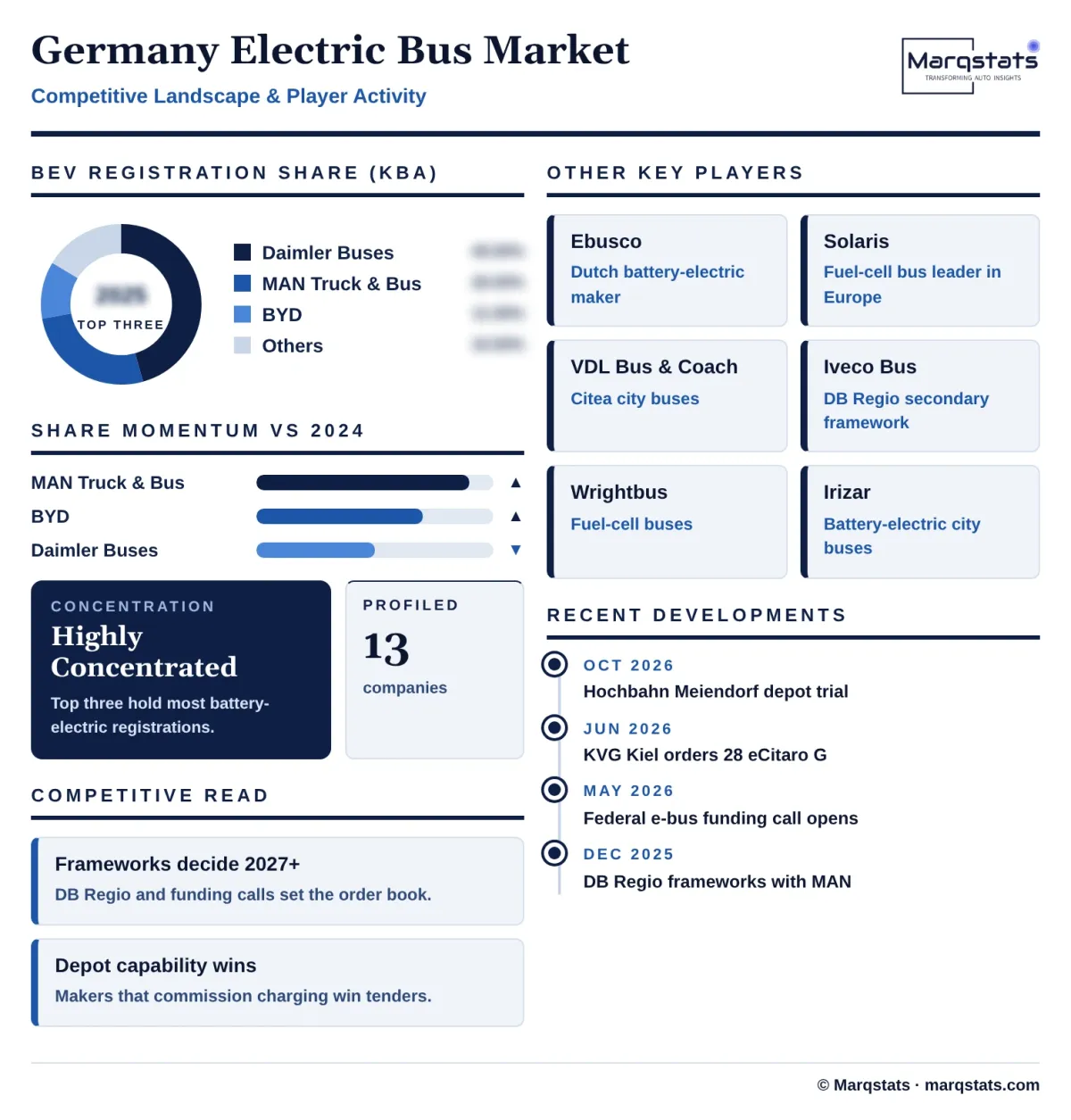
German battery-electric bus supply is highly concentrated. KBA registrations above 8 tonnes for 2025 put Daimler Buses at 664 units (45.5%), MAN Truck & Bus at 386 (26.5%) and BYD at 167 (11.5%). Ebusco registered 63, Solaris 51, VDL Bus & Coach 50, MCV 22, Irizar 18 and Iveco 12; other makers account for the remaining units of the 1,458 total. These shares are KBA registry counts as reported by electrive on 26 February 2026.
The ranking moved sharply in a year. In 2024 Daimler Buses held 53% of 711 battery-electric registrations with 379 units, MAN registered 94, Ebusco 75, VDL 63 and BYD 44. MAN's fourfold rise and BYD's near-fourfold rise came at the expense of Daimler's share, although Daimler's volume still grew by 285 units. Across Europe, MAN registered 1,409 battery-electric buses in 2025 and Daimler Buses 1,395, behind Zhengzhou Yutong Bus Co., Ltd. at 1,801, which has a small German presence.
The installed fleet tells a different story. The PwC E-Bus-Radar 2026 counts Daimler Buses at 1,853 of the 4,752 zero-emission buses in service, Solaris at 735, MAN at 723, VDL at 405, Ebusco at 312 and BYD at 247. Solaris owes its fleet position to fuel-cell and earlier battery-electric deliveries; its battery-electric registrations in Germany fell to 51 in 2025, while it supplied 49.6% of Europe's fuel-cell buses.
Competition from 2027 runs through frameworks and funding calls. The DB Regio frameworks of December 2025 name MAN as main supplier, BYD for electric intercity buses and Iveco, Scania, Daimler Buses and Zhongtong in secondary frameworks. Marqstats tracks maker positions by length class and propulsion in the delivered analysis.
Companies Covered
Companies covered in the report include:
Recent Market Activity
Table of Contents
Coverage & Segmentation
Included: new registrations in Germany of battery-electric and hydrogen fuel-cell buses above 8 tonnes gross vehicle weight (category M3), covering city buses, intercity buses and coaches, valued at vehicle acquisition price before federal or state subsidy. Base year 2025, history 2021 to 2025, forecast 2026 to 2030, all values in USD at EUR 1 = USD 1.13.
Excluded: plug-in hybrid and other hybrid buses, natural-gas buses, trolleybuses (90 in service at the end of 2025), electric minibuses below 8 tonnes, depot and opportunity charging equipment, grid connection, hydrogen refuelling stations, energy, maintenance and leasing. Sibling boundary: the Europe Electric Bus Market page counts battery-electric and plug-in hybrid buses above 3.5 tonnes and records 1,808 electrically chargeable buses for Germany in 2025, which includes plug-in hybrids and light electric buses and excludes fuel-cell buses; the two German counts measure different things and must not be added. The Europe Electric City Bus Market page covers urban battery-electric buses only. Do not add the Germany figures here to either European total.