Market Snapshot
The Thailand electric bus market (รถเมล์ไฟฟ้า), counting every electric bus in Thailand (EV bus Thailand fleets), stands at about 2,500 electric buses in operation in Thailand (Marqstats estimate) in 2025 and is estimated at 2,580 buses in 2026. Marqstats forecasts it to reach 5,800 buses by 2030, a CAGR of 18.33% over 2026 – 2030 that adds 3,300 buses between 2025 and 2030.
Bangkok Metropolitan Region is the largest market, Provincial, Intercity and Shuttle Buses is the fastest growing and Bangkok City Buses is the dominant segment, in a market that is highly concentrated. The report covers 2 segments and 2 regions and profiles 16 companies, with 2025 as the base year, history from 2021 – 2025 and a forecast for 2026 – 2030.
Key Takeaways
Market Overview & Analysis
Report Summary
The Thailand electric bus market, รถเมล์ไฟฟ้า in Thai, covers battery electric buses operating in Thailand: Bangkok city buses run by private concessionaires and the Bangkok Mass Transit Authority (BMTA), provincial city buses, intercity coaches and airport and campus shuttles, measured as buses in operation at year-end. No official register exists, so Marqstats estimates about 2,500 at the end of 2025: Thai Smile Bus's 2,350 buses including reserves, after retiring its NGV fleet, plus about 150 provincial, intercity and shuttle buses. Marqstats forecasts 2,580 in 2026 and 5,800 by 2030, a CAGR of 18.33%.
One industrial group builds almost every Thai electric bus. Energy Absolute and its affiliate NEX Point supplied Thai Smile Bus's fleet and will build and maintain all 1,520 buses in BMTA's THB 14.9 billion lease, signed with Nakhonchaiair Co., Ltd. on 29 January 2026. Their Ban Pho plant can assemble about 3,000 buses a year on standard shifts, more than Thailand's estimated replacement demand of about 2,500 buses a year, so after 2027 the plant needs exports and provincial fleets to stay busy.
The fleet nearly doubles in 2027 as BMTA's buses arrive between March and May, about 17 months later than first planned, replacing non-air-conditioned buses on nearly 50 of 107 reformed routes. BMTA projects savings of up to THB 4.1 billion a year as diesel and old-bus maintenance give way to electricity costs of about THB 800 million. Carbon credits add income: the Bangkok E-Bus Programme has transferred 108,960 ITMOs to Switzerland's KliK Foundation.
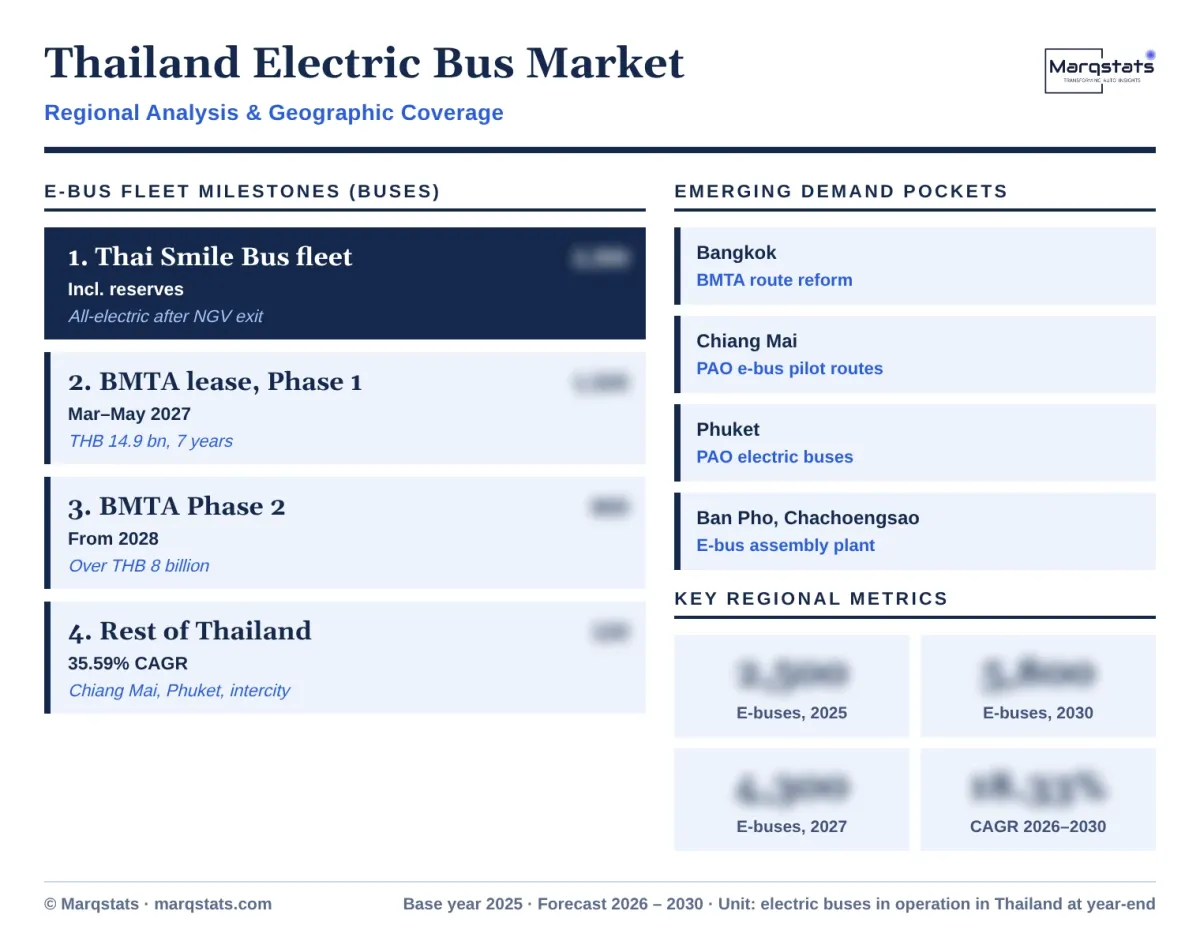
Marqstats forecasts 4,300 buses in 2027, 5,000 in 2028 with BMTA's planned 800-bus second phase, and 5,400 in 2029, after which provincial and intercity programmes add about 400 a year. Bangkok holds about 95% of the fleet in 2025, while provincial cities grow faster. The forecast is a single most likely path; faster provincial procurement would raise it, while delays in the second-phase budget would lower it.
Market Dynamics
Key Drivers
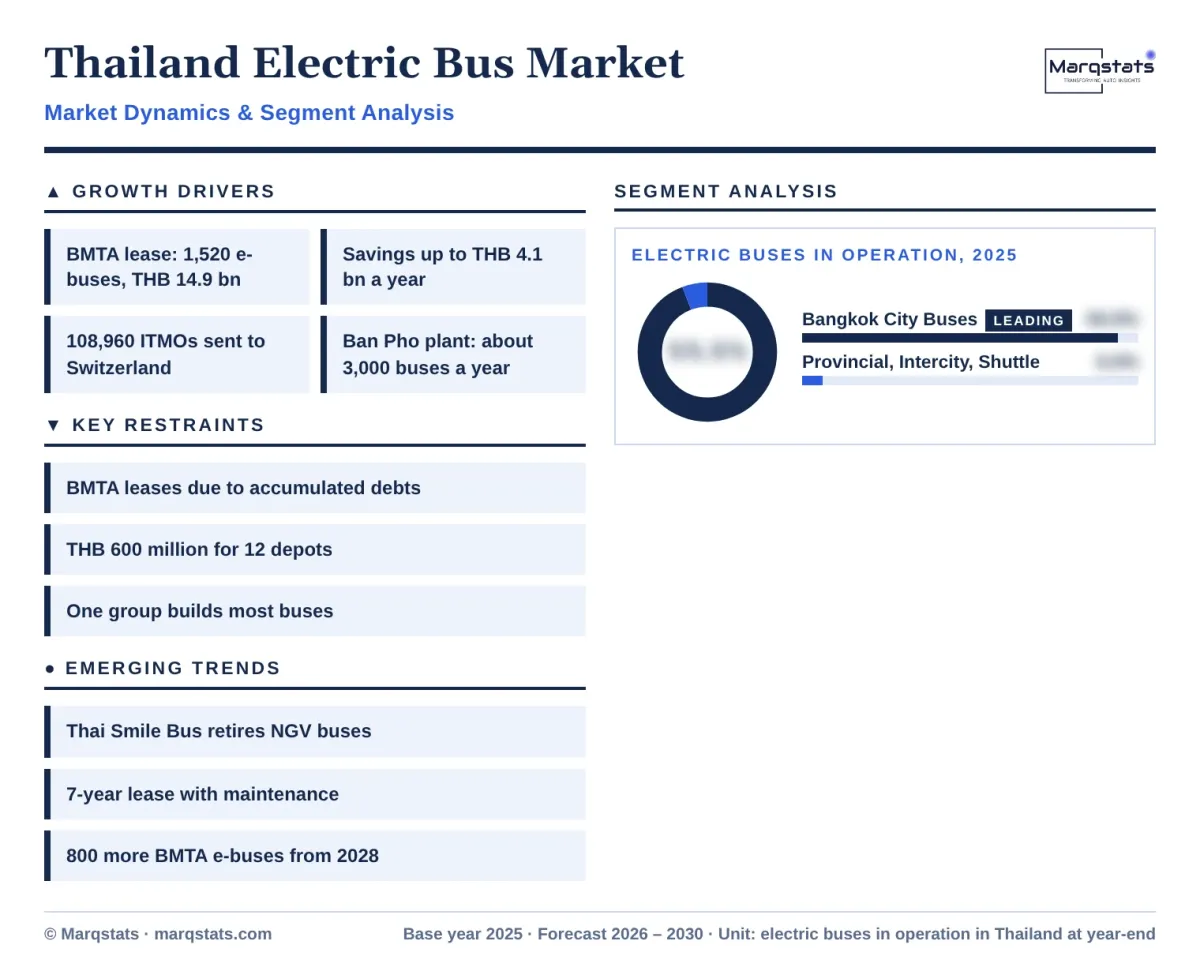
- BMTA lease: BMTA's seven-year lease for 1,520 air-conditioned electric buses was chosen because of its accumulated debts, transferring capital and maintenance costs to the private sector. The first 500 are due within 300 days of the notice to proceed, around March 2027, with all delivered by May 2027, and a prototype was planned for BMTA's 50th anniversary on 24 September 2026. The buses will carry 550,000 to 650,000 passengers on weekdays at fares of 15 to 25 baht.
- Cost savings: BMTA's projected savings come from replacing old-bus maintenance contracts of over THB 2 billion and diesel costs of THB 1.8 billion a year with electricity of about THB 800 million, about 56% to 60% cheaper than diesel. City buses run fixed routes and return to depots nightly, making overnight charging simple, and use far more fuel than cars. Thai Smile Bus reported positive EBITDA for the first time in the fourth quarter of 2025 and targets 2026 revenue of THB 2.6 billion, up 18%.
- Carbon credits: The Bangkok E-Bus Programme transferred 57,327 Internationally Transferred Mitigation Outcomes from 2025 operations under Article 6.2 of the Paris Agreement, and on 2 April 2026 Thailand and Switzerland approved a further 49,717. The programme was recognised as the first authorised Article 6 programme in Asia, and Thai Smile Bus first traded credits with KliK in January 2024. Energy Absolute has an export quota of up to 500,000 tonnes through 2030.
- Local assembly: Energy Absolute's Ban Pho plant in Chachoengsao, in a Free Zone, has standard capacity of about 3,000 buses and maximum output of up to 9,000, with 40% local content in labour and domestic components such as bodies, seats, glass, wiring and air-conditioning. Mass production for BMTA began on 1 September 2026, and in November 2026 more than 200 BMTA buses had been assembled at 7 to 10 a day. EA projects THB 6.0 to 7.0 billion of revenue from the contract.
- Import taxes: Thailand's November 2026 excise rise to 35% covers imported passenger vehicles with up to ten seats, not full-size buses, and import duty on completed buses varies by classification and origin, so tariff protection for local electric buses is case by case. Local assembly with Chinese components remains the dominant model for city buses, and public procurement by BMTA, provincial administrations and The Transport Co., Ltd. favours suppliers who bundle maintenance.
Key Restraints
- Operator finances: BMTA's debts mean it cannot buy buses outright, and its second phase of 800 buses, with a budget of over THB 8 billion, depends on a seven-year binding budget for 2027 to 2033 under consideration by the House of Representatives. Under its BMTA Moving Plan, the authority aims for 3,390 electric buses by the end of 2028 or later, with budget requests of about THB 2.2 billion a year from fiscal 2026 to 2031. Delays in parliamentary approval would push additions later.
- Depots: BMTA budgeted about THB 600 million in fiscal 2026 to upgrade 12 depots for parking and charging, five run by BMTA and seven by partners. The Ministry of Transport set 22 May 2026 to hand over depots, with Khlong Toei the most ready and the Chiang Rak site leased from the Expressway Authority of Thailand, and physical upgrades piloted at Chiang Rak, Samut Prakan Housing and Khlong Bang Phai by late October 2026. Depot readiness is a key timing risk.
- Grid connections: Large depots charging hundreds of buses overnight need high-voltage connections from the Metropolitan Electricity Authority in Bangkok and the Provincial Electricity Authority elsewhere. Operators negotiate night tariffs, and changes in tariffs or demand charges would erode the energy saving BMTA projects. Intercity coaches need larger batteries and route charging, so their adoption is slower than city buses.
- Supplier concentration: Energy Absolute and NEX Point build and maintain nearly all Thai electric city buses, so electrification depends on one group's production, maintenance and finances. Battery cells and drive units are still largely imported from China. Battery life is the long-term cost question, since a seven-year lease covers most of a battery's useful life in heavy city service, and Thai Smile Bus's early buses reach mid-life later in the decade.
Key Trends
- Full electrification: Thai Smile Bus grew from 800 buses in early 2022 to more than 2,200 by late 2023 on 123 routes and retired its 350 NGV buses, running about 1,600 of its 2,350 buses daily and carrying 370,000 to 400,000 passengers on weekdays. The Transport Ministry says there will be no non-air-conditioned buses by 2027, and BMTA, The Transport Co., Ltd. and Thai Smile Bus together plan more than THB 38 billion of investment to shift buses to electric.
- Leasing model: Under the BMTA lease, NEX Point and Energy Absolute maintain the buses for seven years, so BMTA pays a fixed monthly charge instead of running workshops for ageing diesel buses. Bundled maintenance moves battery and drivetrain risk to the supplier, which is attractive for operators with weak balance sheets. Leasing with maintenance is likely to become the standard model for public operators in provincial cities.
- Provincial buses: Thai Smile Bus plans services with provincial administrations in Chiang Mai, Nan and Lamphun and aims for about 450,000 daily riders. Phuket tested electric buses in December 2024, Chiang Mai's provincial administration signed an agreement in December 2025 for two pilot routes to ease traffic and PM2.5 pollution, and Greenbus introduced northern Thailand's first electric intercity fleet of 12 buses. The government plans electric interprovincial buses by 2029.
- Phase 2: BMTA's 800-bus second phase targets service from 2028, and Energy Absolute is evaluating that procurement in early 2027. BYD licensed its Thai distributor Rêver Automotive in April 2024 to build an electric bus and truck factory, and BYD, Yutong, King Long, Higer and Golden Dragon supply buses across Southeast Asia, so more bidders may compete for the second phase. Energy Absolute is exploring right-hand-drive bus exports to Southeast Asia.
Market Segmentation
Bangkok city buses, about 2,350 or 94.00% in 2025, dominate and grow at a 16.76% CAGR with BMTA's lease and second phase. Route reform across more than 100 routes ties electrification to route reassignment. Air-conditioned electric buses help public transport compete with motorcycles and cars in congested streets.
Provincial, intercity and shuttle buses, about 150 or 6.00%, grow fastest at a 36.08% CAGR. Chiang Mai, Phuket, Nan and Lamphun programmes and Greenbus's intercity fleet lead, and some operators import Chinese buses for airport, campus and tourist shuttles. Provincial and intercity replacement is the remaining market once Bangkok is electric.
Thai Smile Bus runs about 2,350 electric buses including reserves and is the largest private operator, having electrified its routes as it took them over. It is expanding into provincial cities. Its improving profitability shows private electric bus operations can pay.
The state operator leases 1,520 electric buses from 2027 and becomes the largest public operator of electric buses. Its second phase of 800 depends on budget approval. Electric buses are central to BMTA's recovery plan and cost savings.
Thai Smile Bus bought its fleet from NEX Point, owning the assets and the carbon credit income. Purchase requires capital that public operators often lack. Owners bear battery replacement costs later in the decade.
BMTA leases buses with maintenance included, avoiding capital spending and transferring technical risk. Leasing suits operators with weak balance sheets and is likely to spread to provincial cities. Fixed monthly charges make budgets predictable.
By Geography
Bangkok Metropolitan Region
Bangkok and its suburbs held about 2,380 electric buses or 95.20% in 2025, rising to 5,250 by 2030 as BMTA's two phases arrive. Depot charging, route reform and air-quality pressure make Bangkok the centre of Thai bus electrification.
Rest of Thailand
Provincial cities such as Chiang Mai had about 120 electric buses or 4.80%, growing at a 35.59% CAGR. Provincial administration programmes, intercity routes and Thai Smile Bus's expansion drive growth after 2027.
How Competition Is Evolving
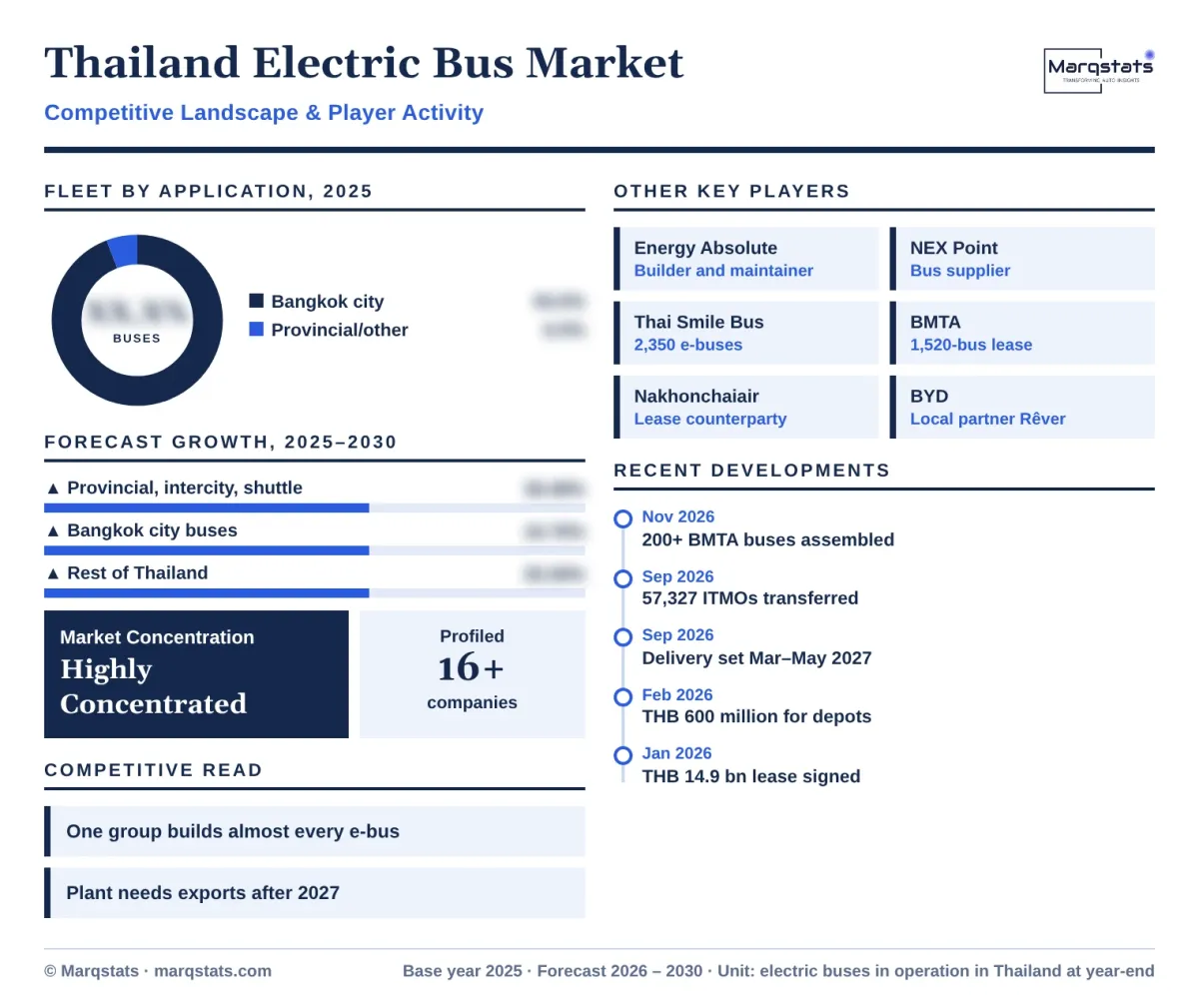
The Thailand electric bus market is highly concentrated: Energy Absolute and NEX Point supply and maintain nearly all electric city buses in Bangkok.
Thai Smile Bus is the largest private operator, and BMTA becomes the largest public operator of electric buses from 2027.
Chinese bus makers, including BYD, Yutong and King Long, compete in shuttle and provincial segments and supply components to local assemblers.
Rising import taxes and local content rules favour assembly in Thailand.
Companies Covered
Companies covered in the report include:
Recent Market Activity
Table of Contents
Coverage & Segmentation
The study covers electric buses in operation in Thailand by application, operator, ownership and region. The base year is 2025, the historical period 2021 – 2025 and the forecast period 2026 – 2030. The unit is electric buses in operation at year-end.
Two application segments and two regions are covered, and 16 companies are profiled. Base and forecast are Marqstats estimates from operator and supplier disclosures.
Known limits are stated plainly. No official register of electric buses in service exists, and operator counts include reserve buses.
