Market Snapshot
The Thailand used car market (รถมือสอง), covering every used car and second hand car in Thailand sold through dealers and online, stands at 317,000 used cars sold in Thailand in 2025 and is estimated at 320,000 used cars in 2026. Marqstats forecasts it to reach 351,497 used cars by 2030, a CAGR of 2.09% over 2026 – 2030 that adds 34,497 used cars between 2025 and 2030.
Bangkok and Vicinity is the largest market, Used hybrid and battery electric cars is the fastest growing and Passenger Cars (Sedan, Hatchback, Eco Car) is the dominant segment, in a market that is fragmented. The report covers 11 segments and 5 regions and profiles 16 companies, with 2025 as the base year, history from 2021 – 2025 and a forecast for 2026 – 2030.
Key Takeaways
Market Overview & Analysis
Report Summary
The Thailand used car market (รถมือสอง) covers retail resale of second-hand passenger cars, pickups, SUVs, PPVs and vans to end buyers through independent used-car dealers, carmaker-certified programmes, franchised dealers and online-led retailers. The unit is used cars sold. Sales were 317,000 in 2025, as reported by Krungthai COMPASS, after 406,000 in 2023 and 316,000 in 2024, according to the Thai Used Car Dealers Association, so the market lost about 89,000 annual sales in two years and has levelled off at a lower base. Marqstats estimates 320,000 in 2026 and forecasts 351,497 by 2030, a CAGR of 2.09% over 2026 – 2030.
The decline was driven by credit, not by a lack of cars. Thailand's household debt is high, and lending for used cars fell 24.6% from THB 122 billion in 2023 to THB 92 billion in 2024, with about THB 83 billion lent in January to May 2025. Repossessions of about 24,000 to 25,000 cars a month in 2023 and 2024, against a normal 12,500 to 15,000, flooded auctions and dealer lots, and used prices fell about 25% against the 2019 to 2022 average.
The used market has stopped shrinking and has lost the recovery to new cars. New-car sales rose 8.47% to 621,166 in 2025 and 16.6% to 465,971 in January to August 2026, according to the Federation of Thai Industries, driven by electric cars, while used-car organisers reported first-half 2026 used sales flat. Battery electric cars took 30.31% of new registrations in January to October 2026, and every new-EV price cut resets the value of the used car a buyer would otherwise choose.
The forecast assumes growth of 2.0%, 2.5%, 2.5% and 2.5% a year from 2027, as repossessions return toward normal, lenders gradually reopen used-car credit and the new-EV price war eases under the EV3.5 programme. Even by 2030 the market stays below its 2023 level of 406,000. Vehicle, fuel and vendor shares are Marqstats constructions, because individual dealer sales are not published.
Market Dynamics
Key Drivers
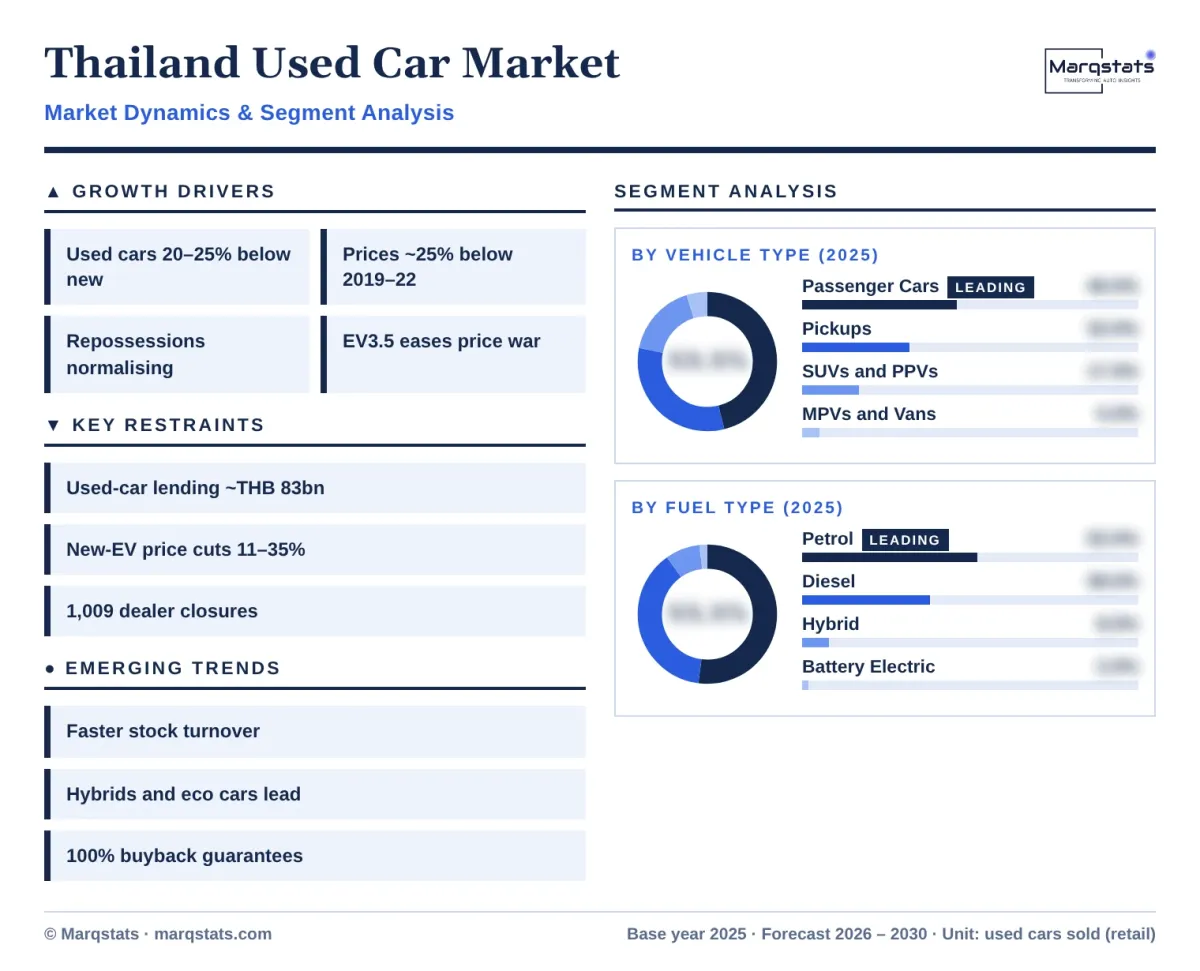
- Affordability: Used cars are priced 20% to 25% below comparable new models, according to the Fast Auto Show Thailand organisers, and average monthly household income fell about 3%, from THB 29,030 in 2023 to THB 28,151 in the first half of 2025, according to National Statistical Office data cited by Krungthai COMPASS. Many buyers can only afford a used car, which keeps a floor under demand even when credit is tight. Cash buyers and those with good credit gain most from lower prices.
- Lower prices for popular models: Used prices about 25% below the 2019 to 2022 average make used cars better value for buyers who can pay or borrow. Hybrids, eco cars and PPVs offer low running costs at much lower prices than new, and hybrids, fuel-efficient cars, small 1,200 cc to 1,500 cc cars and PPVs were the fastest-selling used models in 2026. A Toyota Fortuner that sold for about THB 1.0 million in 2025 sold for about THB 900,000 in mid-2026.
- Normalising repossessions: Repossessions of 24,000 to 25,000 cars a month in 2023 and 2024, nearly double the normal level, are expected to ease as weaker loans work through the system. Union Auction Public Company Limited reported auction revenue down 23.7% in the first quarter of 2025 and 20.7% in the second, as fewer cars reached its yards. Fewer repossessions support prices and dealer confidence, and falling non-performing loans let lenders approve more used-car loans.
- Easing of the new-EV price war: The EV3.5 programme set subsidies at THB 50,000 for eligible 2026 passenger BEVs with packs of at least 50 kWh, according to the Board of Investment, and Chinese carmakers raised some 2026 prices after EV3.0 ended. Chinese carmakers had cut new battery electric car prices by 11% to 35% in 2023 to 2025, some by 30% to 40%. Smaller price cuts stop resetting used values downwards, which encourages buyers who delayed purchases to return.
- Online platforms and certified programmes: one2car lists more than 30,000 cars nationwide, and Carsome, Carro, Kaidee and Motorist offer inspection, appraisal and financing; Motorist offers free appraisals within one hour and one2car instant valuation in its app. Carmaker programmes such as Toyota Sure and Honda Certified Selection add inspection and warranties. These tools make it easier for buyers to compare and trust used cars, which matters in a market where condition risk has kept buyers cautious.
Key Restraints
- Tight credit and high household debt: Lending for used cars fell to around THB 83 billion in 2025, down about 10%, and lenders remain cautious, especially with farmers, small traders and first-time buyers. Many buyers who want a used car cannot get financing, and buyers without credit stayed out of both new and used markets in 2026. Credit is the binding constraint on recovery, and the forecast depends on lenders reopening as non-performing loans fall.
- Falling residual values: New-EV price cuts of 11% to 35% have lowered used values across segments. Buyers delay purchases expecting prices to fall further, and lenders worry about collateral values, which tightens credit further. Dealers holding stock bought at higher prices have had to sell at a loss. Used EVs need lower prices and longer selling times than comparable petrol cars, as dealers report, because battery health and future values are uncertain.
- Competition from discounted new cars: New-car sales jumped 53.77% in January 2026 as battery electric cars ordered under the EV3.0 incentive were delivered, and the Bangkok International Motor Show supported sales again in March and April. Battery electric cars took 19.37% of new-car sales in 2025, 120,301 units. Buyers with good credit chose discounted new EVs over used cars, so the used market did not share in the new-car rebound.
- Weak dealer finances: Some 1,009 used-car businesses closed or went bankrupt in 2023 to 2025, 2.3 times the 2018 to 2022 total, and dealer net margins fell from about 1% in 2019 to 0.5% to 0.6% in 2024 and 2025. Krungthai COMPASS forecasts used-car dealer revenue of about THB 32.6 billion in 2026, about 9% below the 2021 to 2023 average. Dealers that cannot fund stock lose sales to better-capitalised rivals and platforms.
Key Trends
- Faster stock turnover: Krungthai COMPASS found that the top-performing used-car businesses sell stock in about 95 days, 26 days faster than the industry average of about 121, and that each extra 30 days of selling time cuts gross margin by nearly 2%. An industry representative urged dealers in 2024 to cut holding periods to one month. Many dealers now buy fewer cars and sell some within days of purchase without major refurbishment, which protects margins when prices are falling.
- Hybrids and small cars in demand: Hybrids, fuel-efficient cars and small 1,200 cc to 1,500 cc cars led used sales in 2026 as buyers sought low running costs. Hybrid new-car sales rose 24% to 146,059 in 2025, building future used supply, and Thailand had 734,831 hybrids registered at 30 September 2026. Used hybrids also benefit from buyers' caution about battery electric cars, sitting between petrol cars hit by EV price cuts and used EVs with uncertain values.
- Guarantees and buyback promises: Exhibitors at the Fast Auto Show Thailand 2026 guaranteed that cars were free of flood damage, fire damage, body splicing and major crash damage, that registrations were legal and mileage genuine, with a 100% buyback if any condition was broken. The show, organised with Grand Prix International and Sue Sakol, brought large used-car dealers and 13 new-car brands together in July 2026. Guarantees are becoming the standard buyers expect.
- Digital selling and consolidation: Dealers use online listings, live-stream sales, instant appraisal and online financing applications, and online channels matter most for buyers outside Bangkok. Krungthai COMPASS found that only 11 businesses, about 4.2% of those analysed, grew revenue and made a profit in each of the three years to 2025. Larger groups such as Rod Sethee, Yo Ratchada and DDS Car Center use scale, events and guarantees to win buyers as weaker dealers exit.
Market Segmentation
Passenger cars, including sedans, hatchbacks and eco cars, account for an estimated 46.00% of used sales, about 145,820 cars in 2025. The Toyota Corolla Altis and Honda Civic are among the most popular used models. Small 1,200 cc to 1,500 cc cars and eco cars sold well in 2026 because of low running costs, and they suit buyers whose incomes fell after 2023. Petrol passenger cars are also the vehicles whose values were hit hardest by new-EV price cuts, which makes this segment both the largest and the most price-pressured.
Pickups account for an estimated 32.00% of used sales, about 101,440 cars, with the Toyota Hilux and Isuzu D-Max dominant. Pickups are central to farming, small business and rural transport, and their buyers depend heavily on credit. New pickup sales fell 16.67% in January to August 2026 as lenders stayed cautious with farmers and small traders, and supply of used trucks rose 25% to 30% as fleets retired vehicles aged five to seven years. Used pickups face more supply and weaker financed demand than used passenger cars.
SUVs and PPVs, pickup-based seven-seat SUVs such as the Toyota Fortuner and Isuzu MU-X, account for an estimated 17.00%, about 53,890 cars. PPVs remained popular in 2026 and were among the fastest-selling used models, although prices fell; a Fortuner that sold for about THB 1.0 million in 2025 sold for about THB 900,000. Their durability and seven seats appeal to families in regional Thailand, and lower used prices bring them within reach of buyers who previously bought sedans.
MPVs and vans account for an estimated 5.00%, about 15,850 cars, bought by families, tour operators and small businesses. Demand is closely linked to tourism and small-business activity, so it is strongest in tourist areas such as Pattaya, Chiang Mai and the southern provinces, where vans serve transport services. Credit availability for small businesses is the main constraint on this segment's recovery.
Petrol cars account for an estimated 52.00% of used sales, about 164,840 cars, reflecting Thailand's large stock of petrol passenger cars. Their values have been hit hardest by new-EV price cuts, as each reduction in new battery electric car prices lowers the value of comparable used petrol cars. Petrol's share declines through 2030 as hybrids and EVs registered in recent years reach resale age.
Diesel vehicles, mainly pickups and PPVs, account for an estimated 38.00%, about 120,460 cars. Diesel's share follows the pickup and PPV market, so it is most exposed to cautious lending to farmers and small traders and to rising supply from retired fleet trucks. Diesel vehicles remain essential in rural areas and are less directly affected by new-EV price cuts than petrol passenger cars.
Hybrids, including plug-in hybrids, account for an estimated 8.00%, about 25,360 cars, and are the most sought-after used cars in 2026. Thailand had 734,831 hybrids and 97,183 plug-in hybrids registered at 30 September 2026, and hybrid new-car sales rose 24% in 2025, so used supply rises quickly. Hybrids offer low running costs without the battery-value uncertainty of used EVs, which makes this the segment with the strongest demand-supply balance.
Battery electric cars account for an estimated 2.00%, about 6,340 cars, and are the fastest-growing segment as the 562,029 BEVs registered at 30 September 2026 begin to age. Most are less than four years old and are only now reaching the used market. Uncertainty about battery health and future prices keeps used-EV values low, and dealers report that used EVs need lower prices and longer selling times. Battery health checks and warranties are the main levers to stabilise this segment.
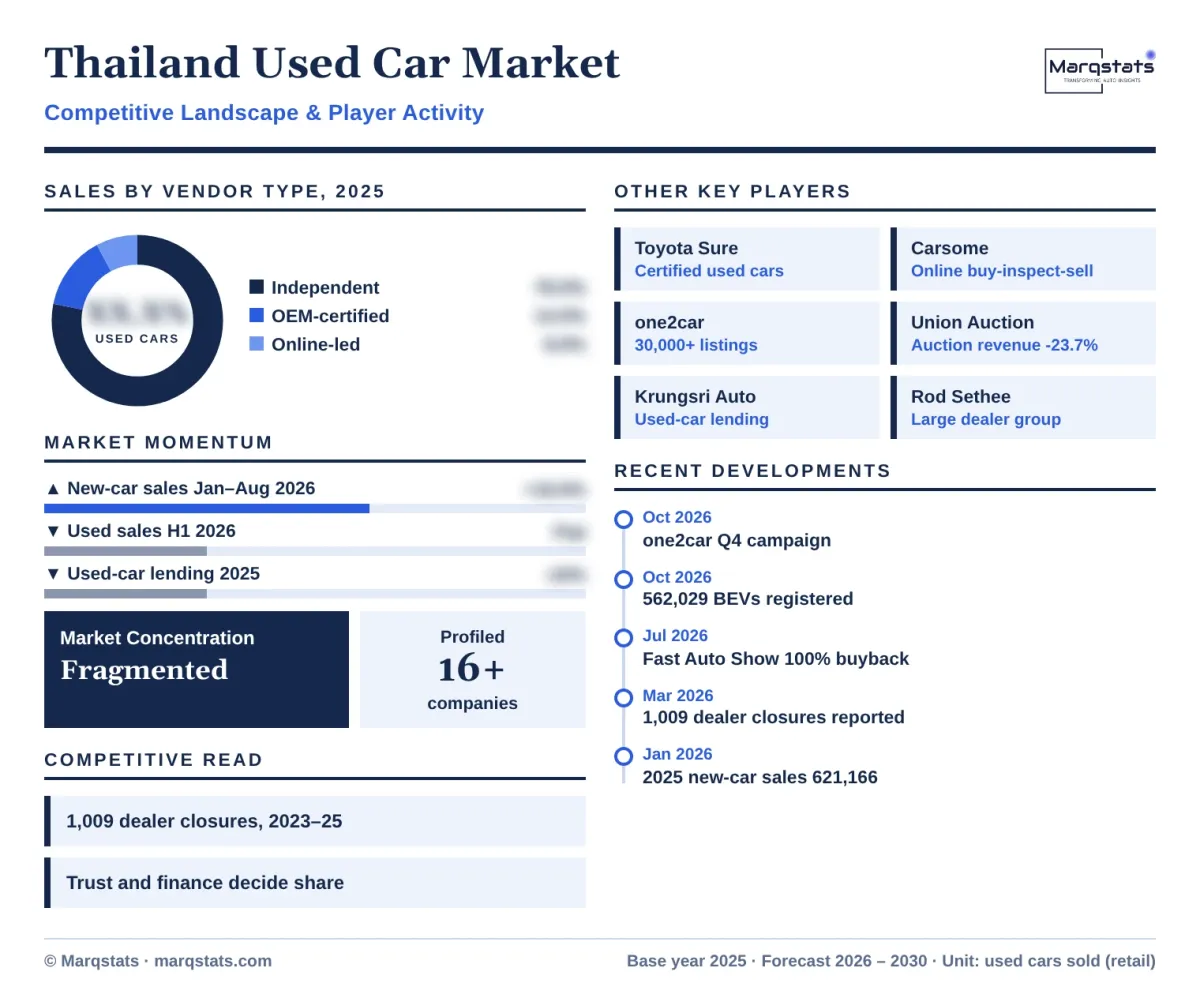
Independent used-car dealers, known in Thailand as car tents, account for an estimated 78.00% of sales, about 247,260 cars. The segment is highly fragmented and under pressure: 1,009 businesses closed or went bankrupt in 2023 to 2025, and net margins of 0.5% to 0.6% leave little capital for stock. Most used cars for sale are listed by these dealers, with the deepest stock in Bangkok and tourist-city clusters such as Pattaya. Larger groups such as Rod Sethee, Yo Ratchada and DDS Car Center are gaining share as weaker dealers exit.
Carmaker-certified programmes and franchised dealers, such as Toyota Sure and Honda Certified Selection, account for an estimated 14.00%, about 44,380 cars, offering inspection and warranties on younger cars. They draw on trade-ins at new-car dealers, which fell as new-car sales dropped to 572,675 in 2024, the lowest in 15 years, before recovering. Krungsri Research reported that new-car dealers averaged a net margin of -0.3% in 2025, which pushes franchised dealers to earn more from used cars.
Online-led retailers and platforms that buy, inspect and sell cars, such as Carsome and Carro, account for an estimated 8.00%, about 25,360 cars. They offer fixed prices, inspection reports and financing, and classified sites such as one2car and Kaidee support sales across all vendor types. Online channels are most important for buyers outside Bangkok, who can compare prices nationwide before travelling to buy, and this segment gains share as guarantees and digital tools become standard.
By Geography
Bangkok and Vicinity
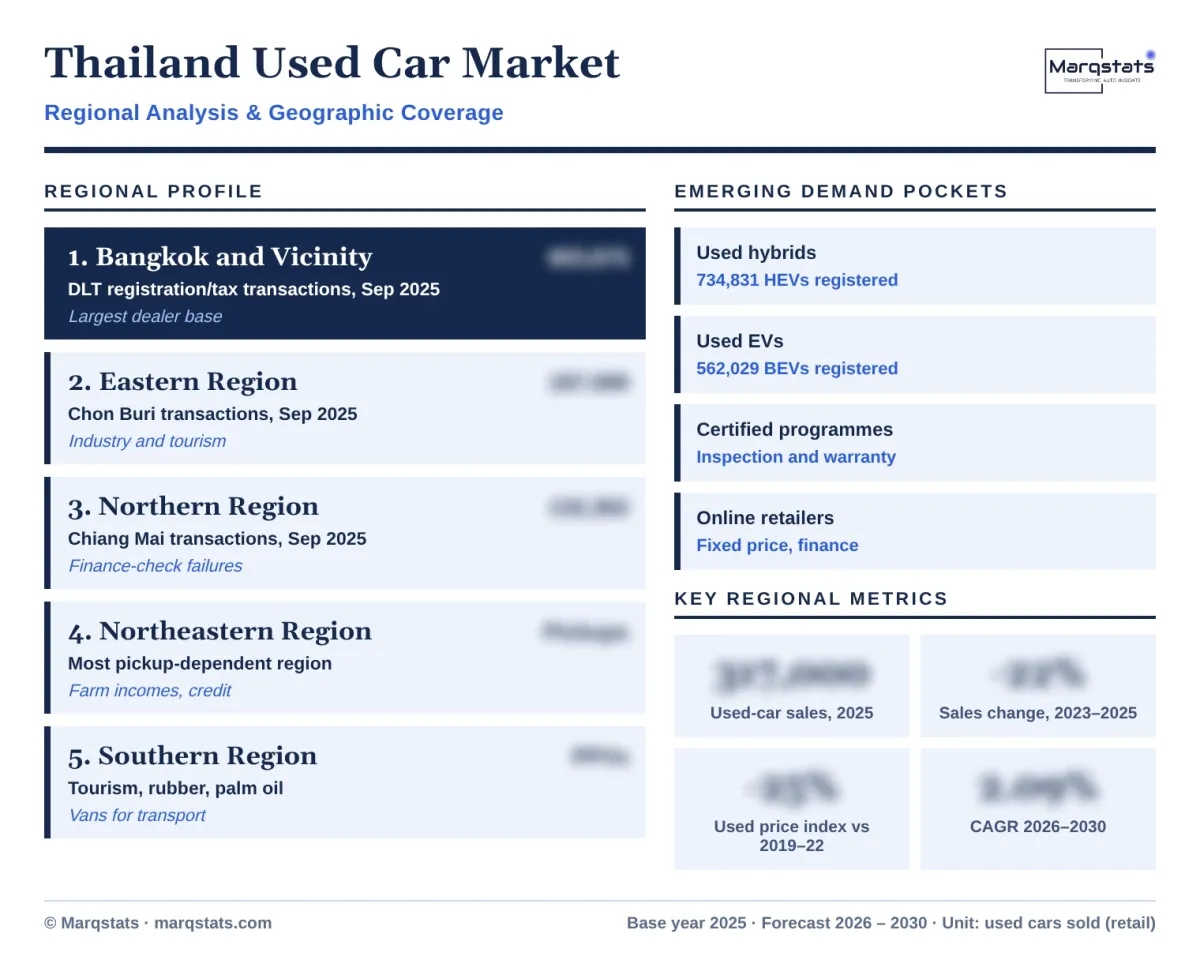
Bangkok and its surrounding provinces form the largest market, with the most dealers, the largest auction yards and the highest incomes. Bangkok accounted for 893,875 of the 3,911,716 vehicle registration and tax transactions handled by the Department of Land Transport in September 2025, about 23%. Online-led retailers and certified programmes are concentrated here, and buyers with good credit are most likely to choose discounted new EVs instead of used cars.
Eastern Region
The Eastern Region, including Chon Buri, Rayong and Pattaya, is the second-largest market. Chon Buri recorded 187,589 registration and tax transactions in September 2025. Industrial workers, the automotive manufacturing cluster and tourism support demand for used passenger cars, pickups and vans. Pattaya's dealer clusters serve both local buyers and tourism businesses that use vans and MPVs.
Northern Region
The Northern Region is led by Chiang Mai, which recorded 132,362 registration and tax transactions in September 2025. A Chiang Mai dealer described conditions in 2024 as the toughest in 25 years, with few customers passing finance checks, and several dealers have reduced branches or closed. Tourism and agriculture support demand for pickups, PPVs and vans, and recovery depends on lenders reopening credit to local buyers.
Northeastern Region
The Northeast is the most pickup-dependent region, with farming and small business driving demand. Falling farm incomes and cautious lending to farmers have hit used pickup sales hardest here. Rising supply of used trucks from fleet retirements adds price pressure. Online listings help buyers in the Northeast compare prices with Bangkok, where the deepest stock is held.
Southern Region
The Southern Region depends on tourism, rubber and palm oil, so used-car demand follows commodity prices and visitor numbers. Demand for pickups and PPVs is strong, and buyers in tourist areas also purchase vans and MPVs for transport services. Long distances from Bangkok's auction yards make online channels and regional dealer groups important sources of stock.
How Competition Is Evolving
The Thailand used car market is fragmented. Thousands of independent dealers, known locally as car tents, sell most used cars, alongside carmaker-certified programmes, franchised new-car dealers, online-led retailers, classified platforms and auction houses. Krungthai COMPASS found that only 11 businesses, about 4.2% of the companies it analysed, grew revenue and made a profit in each of the three years to 2025. Vendor shares on the page are Marqstats constructions; individual dealer sales are not published.
The downturn is consolidating the market. Some 1,009 used-car businesses closed or went bankrupt in 2023 to 2025, 2.3 times the number in 2018 to 2022, as reported by Krungthai COMPASS. Surviving dealers have cut stock, sell faster and use online tools, while larger groups such as Rod Sethee, Yo Ratchada and DDS Car Center use scale, events and guarantees to win buyers. The Fast Auto Show Thailand, organised with Grand Prix International and Sue Sakol, brought large used-car dealers and 13 new-car brands together in July 2026. Weak new Thailand car sales since 2023 have also reduced trade-in supply.
Carmakers and platforms compete on trust. Toyota Motor Thailand's Toyota Sure and Honda's Honda Certified Selection programme offer inspected, warranted cars, and Mercedes-Benz Certified dealers such as Benz Keng Hong Thong serve the premium segment. Carsome and Carro buy, inspect and sell cars online with fixed prices, Carsome has partnered with PTT Oil and Retail Business's FIT Auto service centres for inspection, and one2car, run by iCar Asia (Thailand), lists more than 30,000 cars nationwide.
Lenders and auction houses shape supply. Banks and leasing companies, including Bank of Ayudhya's Krungsri Auto, Kasikorn Leasing, TISCO Bank and TMBThanachart Bank, decide who can buy, and their repossessions feed auction yards. Union Auction Public Company Limited, a listed auction house, saw auction revenue fall about 20% to 24% a year in early 2025 as fewer cars entered its yards and fewer sold.
Companies Covered
Companies covered in the report include:
Recent Market Activity
Table of Contents
Coverage & Segmentation
The study covers retail sales of used passenger cars, pickups, SUVs, PPVs, MPVs and vans in Thailand through independent dealers, carmaker-certified programmes, franchised dealers and online-led retailers. The base year is 2025, the historical period 2021 – 2025 and the forecast period 2026 – 2030. The unit is used cars sold. Wholesale auction sales between dealers, ownership transfers within families and motorcycles are excluded.
Eleven segments across three dimensions and five regions are covered, and 16 companies are profiled. The 2025 base of 317,000 is as reported by Krungthai COMPASS, consistent with the Thai Used Car Dealers Association's 316,000 for 2024. Vehicle-type, fuel and vendor shares are Marqstats constructions based on new-car sales mix, the registered vehicle stock and dealer interviews reported in the press. The 2026 estimate and the 2027 to 2030 forecast are Marqstats constructions.
Known limits are stated plainly. Thailand does not publish an official count of used-car retail sales; Department of Land Transport ownership-transfer data include family transfers and finance-company title changes and are not used as the base. Segment shares are estimates, and the 2025 figure is as reported and not independently verified.
