Market Snapshot
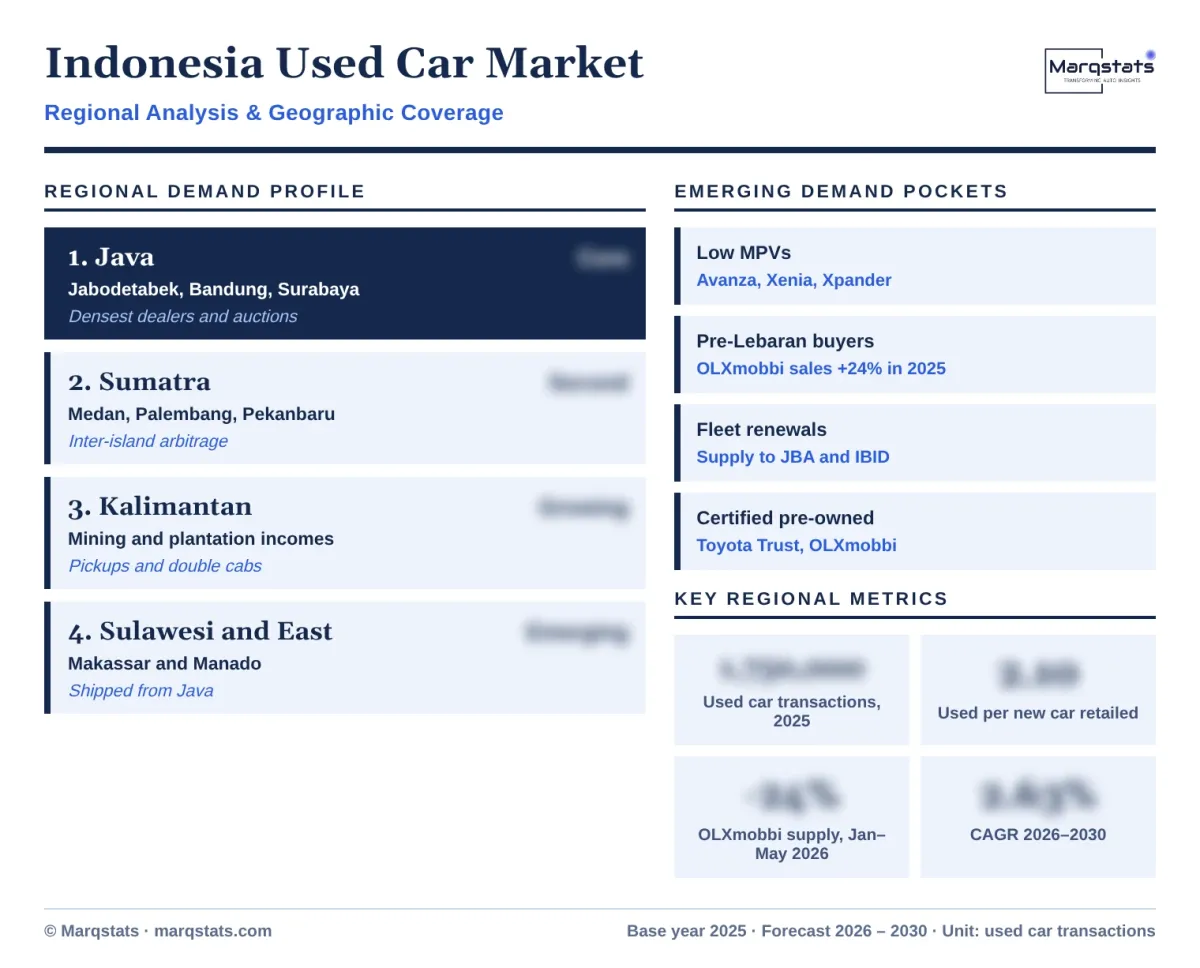
The Indonesia used car market, known locally as the mobil bekas or mobil second market, stands at 1,750,000 used car transactions in 2025 and is estimated at 1,770,000 transactions in 2026. Marqstats forecasts it to reach 1,992,151 transactions by 2030, a CAGR of 2.63% over 2026 – 2030 that adds 242,151 transactions between 2025 and 2030.
Java (Jabodetabek) is the largest market, Online and certified pre-owned channels is the fastest growing and Passenger Cars is the dominant segment, in a market that is fragmented. The report covers 4 segments and 4 regions and profiles 15 companies, with 2025 as the base year, history from 2021 – 2025 and a forecast for 2026 – 2030.
Key Takeaways
Market Overview & Analysis
Report Summary
The Indonesia used car market (mobil bekas) is measured as the number of resale transactions of used passenger cars and light commercial vehicles through dealers, consumer-to-consumer sales, auctions and online platforms. No official series records these transactions, since ownership transfers are registered with regional police and tax offices without a published national total. Marqstats estimates 1,750,000 transactions in 2025, about 2.10 for every new car retailed, anchored to the 833,692 new cars retailed in 2025 and to the Association of Indonesia Automotive Industries (Gaikindo) estimate of 1.8 million used car sales in 2024. Marqstats estimates 1,770,000 transactions in 2026 and forecasts 1,992,151 by 2030, a CAGR of 2.63% over 2026 – 2030.
Structurally, this is a fragmented market built on informal traders. Thousands of independent showrooms and individual sellers handle most transactions, while organised players, Astra's OLXmobbi, Toyota Trust, Caroline.id, Carsome and Carro, handle a small share with inspection, warranty and financing. Buyers are middle-income families and first-time car owners for whom a new low MPV is out of reach, and weak purchasing power pushed these buyers toward used cars in 2025.
Three conditions frame the market. New car supply is the first: wholesales fell from 1,005,802 in 2023 to 803,687 in 2025, so fewer young used cars reach the market from 2027. Financing is the second, since multifinance companies regulated by the Financial Services Authority (OJK) and banks set loan-to-value ratios and tenors. Prices are the third: new car prices rose about 7.5% a year against middle-class income growth near 3% inflation, which keeps pushing buyers to the used market.
The size of the market is itself uncertain. Gaikindo has stated that it lacks exact data, and the Indonesian Used Car Association (AMBI) has said no valid annual transaction data exists and has started collecting data from members. Any published figure, including the Marqstats estimate, is a model rather than a count, and Marqstats publishes the method and ratio so that buyers can adjust the estimate as AMBI data becomes available.
Market Dynamics
Key Drivers
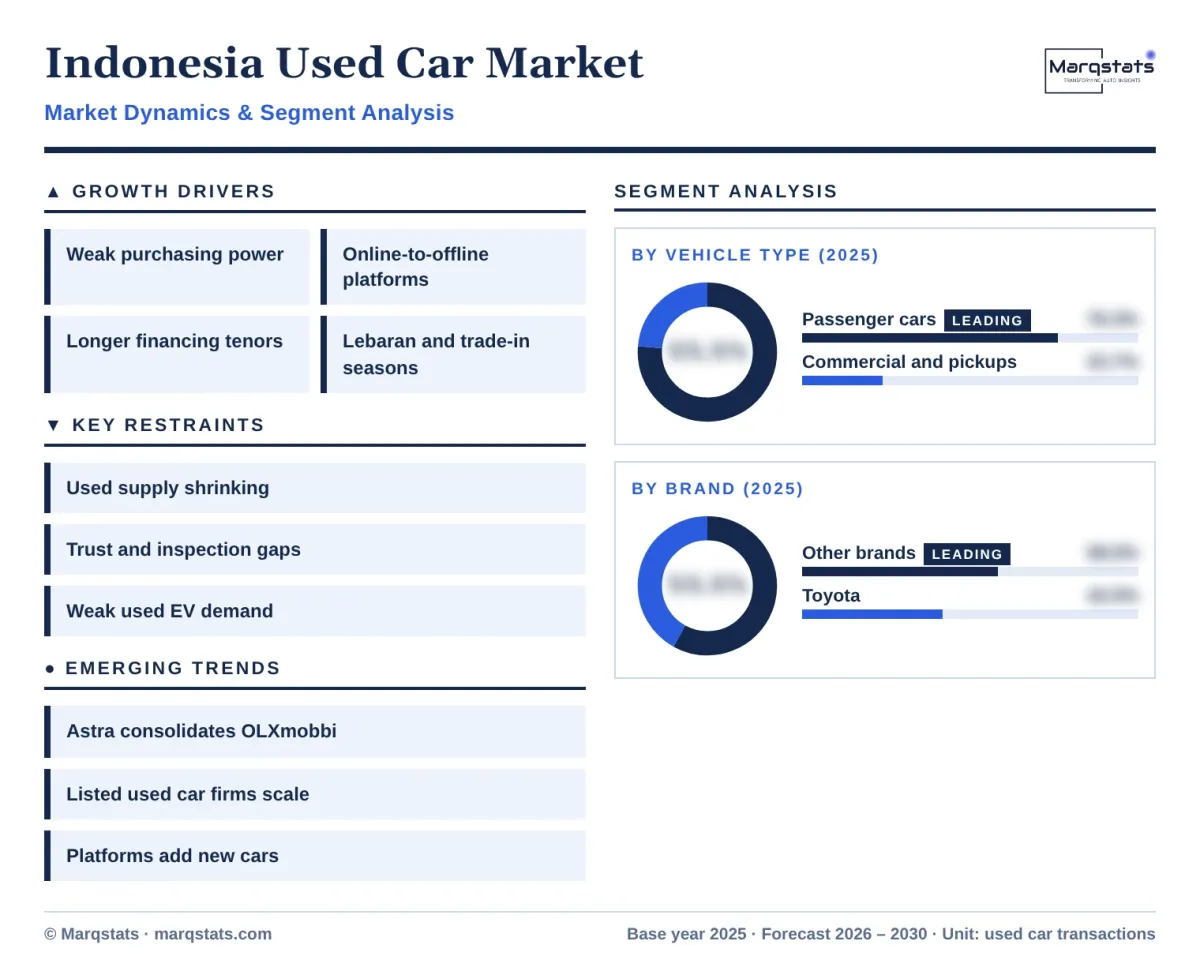
- Weak purchasing power shifting buyers from new to used: Indonesia's middle class shrank by 9.48 million people in five years, to 47.85 million, according to Statistics Indonesia (BPS) data cited by economists, and new car prices have risen faster than incomes. A new low MPV such as the Toyota Avanza starts at Rp250 million or more, while a five-year-old facelifted model sells for around Rp180 million and a pre-facelift 2020 model for around Rp150 million, according to used car dealers. That Rp70 million to Rp100 million gap is the core of the used car proposition, and it widens each year that new car prices outpace incomes.
- Online platforms making used cars easier to buy: OLX has more than 8.5 million monthly active users and recorded 10.3 million visits in February 2025 alone. OLXmobbi combines online listings with inspection centres and financing in an online-to-offline model created by merging mobil88, mobbi and OLX Autos in 2024. Platforms reduce the trust gap that has kept buyers with informal traders and make used car prices more transparent. OLXmobbi sold just over 27,000 cars in 2024, so most buyers who search online still complete the purchase elsewhere, and converting more of that traffic into organised sales is the main growth lever for platforms.
- Longer financing tenors widening access: OLXmobbi offers used car loan packages of up to seven years, and OJK data show outstanding used motor vehicle financing, covering cars and motorcycles, rising 10% year on year to Rp117.55 trillion in May 2025. Longer tenors cut monthly payments for buyers whose incomes have not kept pace with car prices, allowing more middle-income households to move from motorcycles or older cars into a newer used car. Lending terms are therefore the swing factor that decides how much latent demand converts into transactions.
- Seasonal demand around Lebaran and trade-in events: Used car demand rises before the Eid homecoming (mudik), and OLXmobbi's used car sales rose 24% in the week before Lebaran in 2025, while used car interest rose about 6% in January 2026 against December 2025 as buyers prepared for the holiday. Trade-in programmes at the Gaikindo Indonesia International Auto Show (GIIAS) feed used supply into organised channels each year. These seasonal peaks concentrate transactions and give organised players an opportunity to capture buyers who usually deal informally.
- Fleet renewals adding steady supply: Rental and ride-hailing fleet operators replace cars on fixed cycles, releasing large batches of similar models into auctions such as JBA Indonesia and IBID, which supply dealers across the country. JBA Indonesia sold more than 124,000 vehicles in FY2025. Ride-hailing drivers, who often buy cars on credit and sell them after a few years, are both sellers and buyers, and their activity rises and falls with platform incentives. Fleet disposals provide a predictable flow of young, inspected cars at a time when private supply is tightening.
Key Restraints
- Shrinking used car supply: New car wholesales fell from 1,005,802 in 2023 to 865,723 in 2024 and 803,687 in 2025, down 7.2% on the year, and used car supply on OLXmobbi fell 24% in January to May 2026 while buyer interest fell about 6%. OLXmobbi described prices as more stable than a year earlier. Fewer three- to five-year-old cars for resale limits the market's growth even when demand is firm, and makes sourcing, rather than selling, the main challenge for dealers and platforms through 2027.
- Trust and inspection gaps raising transaction costs: Most transactions happen between individuals and small traders without standard inspection, so buyers discount prices for unknown condition, odometer tampering and flood-damage risk, and lenders charge higher risk premiums on used car loans. Inspection reports from platforms such as OLXmobbi and independent services such as Otospector are reducing this gap, however they cover only a small share of transactions. Until standard inspection becomes common, the informal discount on condition risk keeps transaction values and financing penetration lower.
- Difficult trading conditions for dealers: AMBI's chairman described 2025 as one of the hardest years, with Jakarta and Surabaya weaker than the national total, and OLX recorded used car searches down 5% in January to September 2025 even as listings rose 2%. Used car demand is sensitive to the same income pressures that hit new car sales, so the shift from new to used does not fully offset weaker overall car demand among middle-income households.
- Limited market for used electric cars: OLXmobbi has reported weak demand for used electric cars, as buyers worry about battery life and resale values after rapid price cuts on new EVs. Used EVs will remain a small share until battery warranties and certified checks become standard. With BYD alone wholesaling 46,711 new cars in 2025, the first large wave of used EVs reaches the market from 2027, and how dealers price them will set residual values for the whole segment.
Key Trends
- Astra consolidating the organised used car business: PT Astra International Tbk merged mobil88, mobbi and OLX Autos into OLXmobbi in 2024, alongside Toyota Trust, SEVA and the IBID auction, giving one group a presence across inspection, retail, auction and financing. Toyota Trust certifies used Toyotas through the Toyota dealer network, which supports the brand's resale values and gives Astra a direct line into trade-in supply. With new car sales down three years running, groups with trade-in partnerships, fleet buyback deals and auction access hold the main competitive advantage.
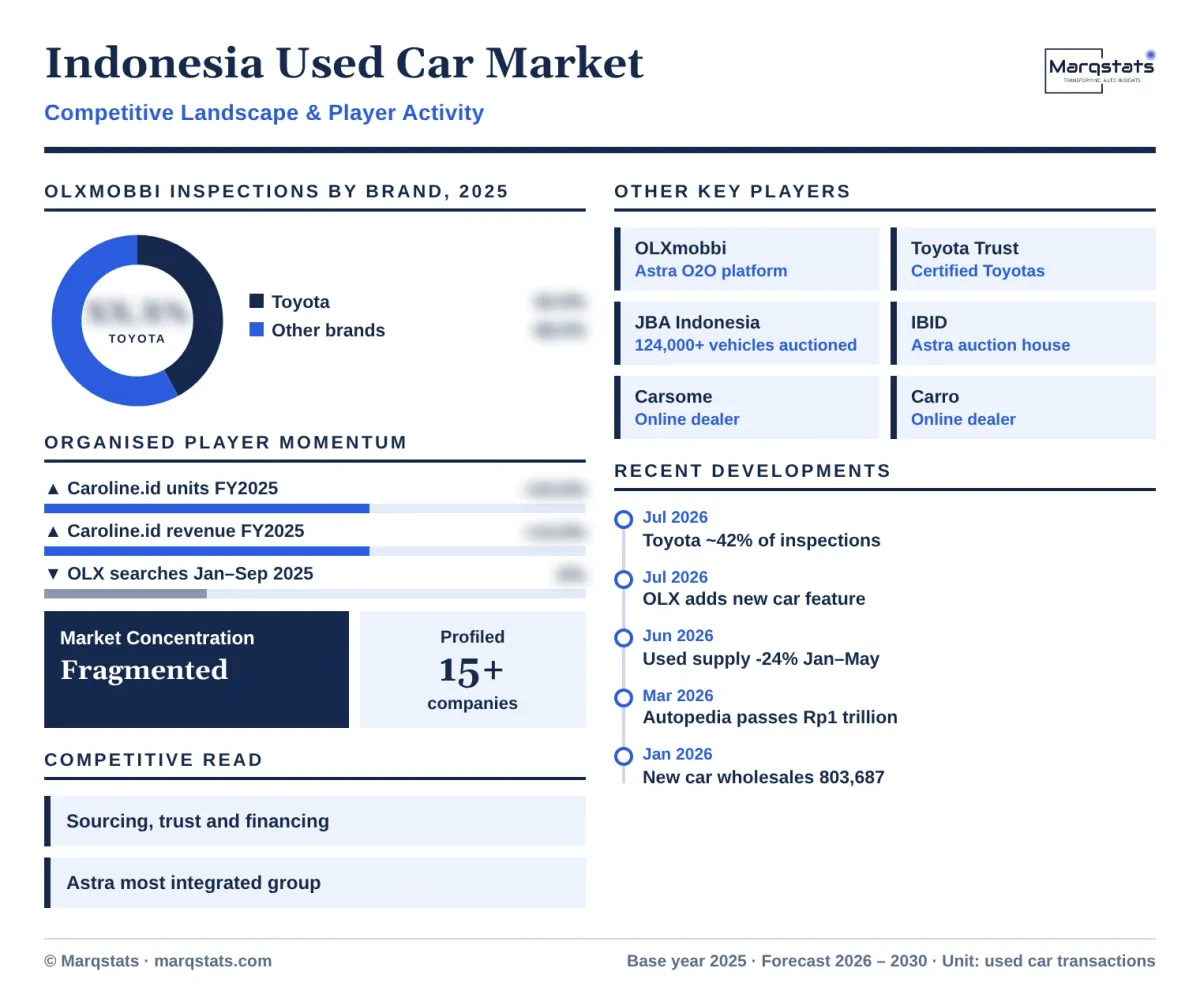
- Listed used car companies scaling: PT Autopedia Sukses Lestari Tbk became the first listed used car company to pass Rp1 trillion in revenue in FY2025, selling almost 4,500 cars through Caroline.id, up 24.5%, while its JBA Indonesia auction business sold more than 124,000 vehicles. Its results show that organised retail and auctions can grow faster than the market as a whole, and that scale in auctions, where fleet and leasing disposals are concentrated, is the main route to volume for organised players.
- Platforms extending into new cars and digital tools spreading to traders: OLX added a new car feature in mid-2026 ahead of GIIAS 2026 as used car interest weakened, aiming to keep buyers on the platform through the whole purchase decision. Independent dealers now list stock on OLX and social media, use online valuation tools and arrange financing through platform partners. The line between the organised and informal market is blurring, and price data from platforms lets lenders price used car loans more accurately.
- Japanese brands keeping resale value leadership: The top five brands inspected by OLXmobbi in 2025 were all Japanese, led by Toyota at about 42%, ahead of Honda, Daihatsu, Mitsubishi and Suzuki. Chinese brands such as BYD, Chery and Wuling, which grew in new car sales in 2025, have yet to build used car resale track records. Certified pre-owned programmes protect residual values, so Chinese brands entering Indonesia need resale programmes to win buyers who judge cars on resale value.
Market Segmentation
Passenger cars, mainly low MPVs such as the Toyota Avanza, Daihatsu Xenia and Mitsubishi Xpander, small SUVs and city cars, account for an estimated 1,334,725 transactions in 2025, 76.27% of the market. The share is a Marqstats estimate that applies the 2025 new vehicle mix, in which light passenger vehicles were about 613,000 of 803,687 wholesales, to used transactions. Low MPVs are the most traded used vehicles because they are Indonesia's most common family cars and because the gap between a new and a five-year-old Avanza is widest in this segment. Used car prices for popular models such as the Xpander and Wuling Almaz are widely tracked online, making this the most transparent part of the market.
Commercial vehicles and pickups account for an estimated 415,275 transactions, 23.73% of the market. Used pickups such as the Suzuki Carry and Daihatsu Gran Max serve small businesses, traders and farmers, and they hold their value well because buyers use them as working capital. Demand follows commodity incomes, so it is stronger outside Java, in the plantation and mining economies of Sumatra and Kalimantan. Pickups stay in service longer than passenger cars before they are scrapped, which keeps a steady supply of older units in informal trade, while fleet disposals through auctions add younger stock.
Toyota is the dominant used car brand with about 42% of cars inspected by OLXmobbi in 2025, an estimated 735,000 transactions when applied to the national estimate. Toyota models such as the Avanza, Innova, Rush and Calya hold resale value strongly, which reinforces new car demand for the brand. Toyota's share of used inspections is close to its share of new car wholesales, 250,431 of 803,687 in 2025, so the used market mirrors the new car parc with a lag. Toyota Trust certification through the Toyota dealer network adds a premium layer that supports residual values and channels trade-ins into Astra's organised business.
Other brands account for the remaining 58%, an estimated 1,015,000 transactions, led by Honda, Daihatsu, Mitsubishi and Suzuki. Daihatsu and Toyota under PT Astra International Tbk together took more than half of 2025 new car wholesales, so Astra-linked brands dominate the used parc. Chinese and Korean brands are a small share of used transactions because their Indonesian parc is still young. As BYD, Chery and Wuling cars sold in 2024 and 2025 reach resale age from 2027, the other-brands share rises and resale values for these brands will be tested for the first time.
By Geography
Java
Java, and Jabodetabek in particular, is the core of the used car market, with the densest dealer networks, auction centres and platform inspection points. Bandung, Surabaya and Semarang are the other major used car cities on the island, each with large showroom clusters. AMBI reported used car sales up about 5% year on year to September 2025 while Jakarta and Surabaya declined, which shows that regional demand and metropolitan trade-in supply can move in different directions. Java is also the main source of supply for other islands through auctions and traders. No regional transaction series exists, so regional shares are not published.
Sumatra
Sumatra is the second-largest region, with demand centred on Medan, Palembang and Pekanbaru and strong use of pickups and MPVs in plantation economies. Used cars move from Java to Sumatra through auctions and traders, as price differences between islands create arbitrage. Traders buy at Java auctions and ship cars by ferry, adding logistics costs that are recovered in higher island prices. Commodity incomes from palm oil and rubber make demand in Sumatra more cyclical than in Java.
Kalimantan
Kalimantan's used car demand follows mining and plantation incomes, and pickups and double-cab trucks are a larger share of transactions than in Java. Thin dealer networks mean buyers rely more on informal sellers and online listings. The development of the new capital, Nusantara, in East Kalimantan adds a source of future demand as government staff and contractors relocate, and it is likely to attract organised dealers and platforms to a region they currently serve mostly through shipments from Java.
Sulawesi and Eastern Indonesia
Sulawesi and eastern Indonesia are smaller, developing markets around Makassar and Manado, served by shipments of used cars from Java. Logistics costs keep used car prices higher than in Java, which limits volume growth. Online listings have opened these markets to buyers who previously had to travel to Java, and platforms now arrange shipping for buyers outside the main islands. As platform reach extends, these regions offer the largest gap between latent demand and organised supply.
How Competition Is Evolving
The Indonesia used car market is fragmented. Thousands of independent dealers and individual sellers account for most transactions, and the largest organised retailers sell in the tens of thousands a year at most: OLXmobbi sold more than 27,000 cars in 2024 and Caroline.id almost 4,500 in 2025. Auctions handle larger volumes, with JBA Indonesia selling more than 124,000 vehicles in 2025.
Competition runs on inventory sourcing, trust and financing. Organised players compete for trade-ins at new car dealers and at events such as GIIAS, invest in inspection and certification, and bundle financing from captive lenders such as PT Adira Dinamika Multi Finance Tbk, PT BCA Finance and PT Mandiri Tunas Finance. Platforms such as Carsome, Carro, Mobil123 and Moladin compete on digital reach.
Astra is the most integrated player. Through OLXmobbi, Toyota Trust, SEVA, IBID and its finance companies, the group covers sourcing, inspection, retail, auction and lending, and its share of new car sales feeds its used car pipeline. PT Tunas Ridean Tbk and other dealer groups run their own used car operations. Consolidation is likely as weaker independent traders struggle with tighter supply. Listing sites remain the main search channel: the OLX mobil bekas classifieds and other portals carry most cars for sale in Indonesia, and Greater Jakarta is the deepest pool for buyers looking for a used car in Jakarta.
Margins sit in reconditioning and financing rather than in the car itself. A used car dealer earns a modest spread on the vehicle, and more on reconditioning, warranty products and the commission from arranging a loan. That is why the organised players are integrated with finance companies, and why platforms that cannot attach financing struggle to make money. Auction houses earn fees from both sides and benefit from volume regardless of price direction, which made JBA Indonesia one of the steadiest businesses in the sector through the 2025 slowdown.
Regional reach is the next competitive frontier. Organised players are concentrated in Jabodetabek and large Java cities, while most transactions outside Java still run through local traders. Platforms that add inspection points and shipping across islands, and lenders that extend used car credit beyond Java, can capture demand that the informal market serves poorly today. Caroline.id's MotoHub showrooms, which let buyers inspect cars and arrange financing on site, are one model for that expansion.
Companies Covered
Companies covered in the report include:
Recent Market Activity
Table of Contents
Coverage & Segmentation
The study covers resale transactions of used passenger cars and light commercial vehicles in Indonesia through organised dealers, independent dealers, consumer-to-consumer sales, auctions and online platforms. The base year is 2025, the historical period 2021 – 2025 and the forecast period 2026 – 2030. The unit is used vehicle transactions. Motorcycles and heavy trucks are excluded.
Two vehicle-type groups and two brand groups are covered across four regions, and 15 companies are profiled across platforms, auctions, dealer groups and auto finance companies. The 2025 headline is a Marqstats estimate built from new car retail sales and published industry estimates; the vehicle-type split applies the 2025 new vehicle mix, and the brand split uses OLXmobbi inspection data. The forecast is a Marqstats construction.
Because no national transaction count exists, the vehicle-type and brand splits are proxies and are labelled as such. The vehicle-type split assumes the used market mirrors the 2025 new vehicle mix; the brand split assumes OLXmobbi's inspection mix represents the national market. Neither split is published by any official body or trade association in Indonesia, and each is recalculated in the report when better data appears. Both assumptions are reasonable for a market dominated by a few Japanese brands and by family MPVs, and both are refined in the delivered report with platform listing data.
