Market Snapshot
The Chinese car brands in Europe market, covering Chinese cars in Europe from MG, BYD Europe, Chery and others, stands at 810,982 units registered by Chinese brands in the EU, UK and EFTA in 2025 and is estimated at 1,782,000 units in 2026. Marqstats forecasts it to reach 2,850,000 units by 2030, a CAGR of 28.58% over 2026 – 2030 that adds 2,039,018 units between 2025 and 2030. Chinese cars, Europe's fastest-growing brand group, are led by MG and BYD.
United Kingdom is the largest market, Chery group (Jaecoo, Omoda, Chery) is the fastest growing and SAIC Motor (MG) is the dominant segment, in a market that is moderately concentrated. The report covers 3 segments and 5 regions and profiles 16 companies, with 2025 as the base year, history from 2021 – 2025 and a forecast for 2026 – 2030.
Key Takeaways
Market Overview & Analysis
Report Summary
The Chinese car brands in Europe market covers new passenger car registrations of brands owned by Chinese groups across the European Union, the United Kingdom and the European Free Trade Association, including MG (SAIC Motor), BYD and Denza, Chery with Omoda and Jaecoo, Leapmotor, Xpeng, Polestar, Lynk & Co, Geely, GWM and Changan, wherever the cars are built. Chinese brands delivered 810,982 cars in 2025, up 99% and a 6.1% share of a 13,295,075-unit market, according to registration data reported by Automotive News Europe. Marqstats estimates 1,782,000 in 2026 and 2,850,000 by 2030, a CAGR of 28.58%.
The EU's tariffs on Chinese electric cars redirected Chinese brands rather than slowing them. The countervailing duties in force since 30 October 2024 apply only to battery electric cars, at 17.0% for BYD, 18.8% for Geely and 35.3% for SAIC Motor on top of the 10% import duty, so Chinese brands grew through plug-in hybrids, hybrids and petrol models. Their share reached 12.7% in the third quarter of 2026, overtaking Japanese brands at 11.9% for the first time, with a record 14.5% in September.
Leadership among Chinese groups is changing. SAIC Motor sold 307,812 cars in 2025, almost all MG, while BYD grew 276% to 186,612 and Chery's group rose from 17,038 to 120,207; BYD led the 2026 ranking after eight months with 232,600. Competition is also moving from imports to plants: Stellantis began building the Leapmotor B10 at Zaragoza on 16 October 2026, BYD's Szeged plant in Hungary is set to start in the fourth quarter of 2026, and Geely takes 34% of a joint venture at Ford's Valencia plant from 2028.
Marqstats forecasts 2,100,000 units in 2027, 2,400,000 in 2028, 2,650,000 in 2029 and 2,850,000 in 2030, about 19–20% of a market of roughly 14.5 million cars, a Marqstats assumption. Growth slows after the 2026 step change because the base is larger and southern European markets are already penetrated. The forecast is a single most likely path; extension of EU measures to plug-in hybrids or a minimum-price regime is the main risk.
Market Dynamics
Key Drivers
- Price and equipment: Chinese brands offer larger cars with more equipment at prices below European equivalents, and in 2026 they expanded into the core C-SUV segment with plug-in hybrids such as the BYD Seal U and Jaecoo 7, where buyers are less brand-loyal than in premium segments. Analysts covering registrations reported surprise at the rapid uptake in southern Europe, where buyers are more flexible in their choice of brand, and Spain and Italy roughly doubled their Chinese shares in 2025.
- Hybrid shift: Plug-in hybrids and hybrids are not covered by the countervailing duties and pay only the standard 10% import duty, so the price advantage is larger than in battery electric cars. The BYD Seal U PHEV recorded 72,667 registrations in 2025, up tenfold, and Chinese brands accounted for about 11% of Europe's electrified car market in 2025 and 16% in December, according to a Bloomberg analysis of registration data. In the third quarter of 2026 hybrids and petrol cars led Chinese growth.
- Brand launches: Chery's group rose from 17,038 units in 2024 to 120,207 in 2025, with Jaecoo at 56,944, Omoda at 52,950 and the Chery brand at 10,247, and reached 207,871 in the first eight months of 2026, up almost 280%, according to Center of Automotive Management data. Leapmotor reached almost 33,000 units in its debut year, Changan rose from seven European sales in July 2025 to 1,249 in July 2026, and Geely launched Geely Auto France in April 2026.
- Local plants: Leapmotor International, owned 51% by Stellantis and 49% by Zhejiang Leapmotor Technology, began B10 production at Zaragoza in October 2026, launched in Germany at €29,900 for the electric version and €32,400 for the range extender. BYD's Szeged plant, reported at about €4 billion, is planned at about 150,000 vehicles a year initially, rising to 300,000, starting with the Dolphin Surf. Local production avoids tariffs and qualifies cars for Made in Europe rules.
- Spare capacity: Stellantis said its European plants ran at about 60% utilisation in 2025, and Ford's Almussafes plant in Valencia, with capacity of about 400,000 to 500,000 vehicles a year, ran at about a quarter of capacity. Geely agreed to pay €221 million for its 34% stake in the Valencia joint venture, which will build three Ford multi-energy models and two Geely electric models from 2028. Idle European factories give Chinese brands a faster route to local production than greenfield plants.
Key Restraints
- Tariffs: The EU's definitive countervailing duties of 17.0% to 35.3% for BYD, Geely and SAIC Motor, on top of the 10% import duty, raise the price of Chinese-built battery electric cars and pushed SAIC's MG, the most exposed, to grow more slowly than rivals. The UK applies no equivalent tariffs, which is why it is the most attractive large market for Chinese battery electric cars. Local production at Zaragoza and Szeged is designed to remove this restraint for some models.
- Political risk: If the EU extended trade measures to plug-in hybrids, or replaced duties with minimum prices that narrowed the price gap, growth would slow below the Marqstats path. Chinese groups' 84% share of Europe's market growth from January to August 2026 has increased political pressure on Chinese imports. BYD has paused its planned plant in Turkey, and Chery's joint venture with Ebro in Barcelona has been delayed several times, showing that local production plans also carry risk.
- Networks: Dealer and service reach remains thin in northern European markets and is the main constraint on growth there. Omoda and Jaecoo expanded their UK dealer networks in 2025 and expected more partners in 2026, and Leapmotor uses Stellantis's dealer and service network across Europe. Brands without a partner network must build distribution from scratch, which slows entry into markets such as Germany, where Chinese penetration lags.
- Residual values: Chinese brands are new to most European buyers, and fleet and leasing companies are cautious about residual values, which limits penetration in company car markets such as Germany, Belgium and the Netherlands. Company cars are a large share of registrations in these countries, so cautious residual value assumptions raise lease rates and blunt the price advantage. Proven resale performance over several years is needed before fleets adopt Chinese brands widely.
Key Trends
- Share record: Chinese brands accounted for barely 1% of European sales five years ago. They overtook US carmakers in the second quarter of 2025, South Korean carmakers in the fourth quarter of 2025 and Japanese carmakers in the third quarter of 2026. They took 10.9% in June 2026 on 150,272 registrations, up 118%, 11.7% in August on 97,639, and a record 14.5% in September. Each step took a single quarter to become visible.
- Leadership shift: BYD overtook MG in May, July and August 2026, and reached 234,099 registrations in the first eight months, up 144.1%, according to Center of Automotive Management data. BYD's EU registrations rose 158.9% to 99,578 in the first five months of 2026, and Chery's rose 265.2% to 65,621. In August, BYD and Chery together accounted for about 61% of the 51,296-unit increase in Chinese sales. The contest is now as much between Chinese brands as against incumbents.
- Plant deals: Ford and Geely Auto agreed on 23 July 2026 to form a joint venture at Ford's Valencia plant, owned 66% by Ford and 34% by Geely, and an Opel C-SUV on Leapmotor technology may follow at Zaragoza in 2028. Spanish suppliers are joining too, such as Lieder Automotive, a joint venture of Duoli Technology and Fagor Ederlan making B10 chassis components. Spanish national and regional governments have actively courted Chinese investment to use spare capacity.
- New entrants: Changan, Xpeng and the Chery brand expanded in Europe from 2025; Xpeng was the most successful premium Chinese brand in the first half of 2025 with 8,338 registrations, and Chery first delivered the Tiggo 7 and Tiggo 8 in Poland in October 2025. Geely sold 474,228 vehicles overseas in the first half of 2026, up 158%. Each new brand adds distribution and pushes the Chinese share higher even as the leaders mature, while incumbents such as Volkswagen Group, Hyundai and Renault Group lose share.
Market Segmentation
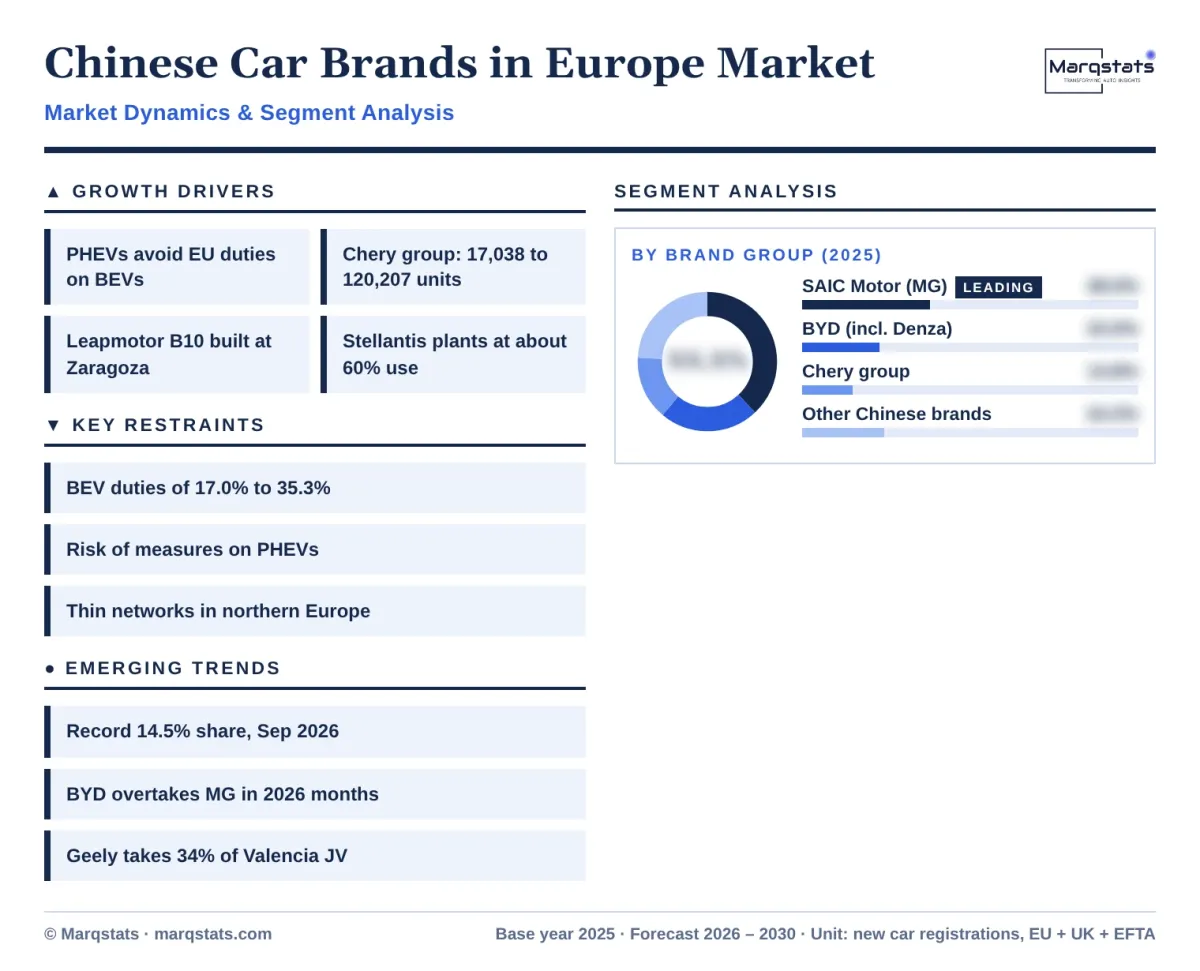
SAIC Motor sold 307,812 cars in Europe in 2025, 37.96% of Chinese registrations, up from 244,121, of which 307,282 were MG and 530 Maxus. MG is the long-standing leader with an established network and value positioning, and took 45,163 registrations in Spain and 85,155 in the UK. Because SAIC faces the highest countervailing duty, 35.3%, on Chinese-built battery electric cars, MG grew more slowly than rivals and lost the monthly lead to BYD in 2026.
BYD and Denza sold 186,612 cars in 2025, 23.01%, up 276%, led by the Seal U PHEV with 72,667 registrations. BYD sold 51,422 cars in the UK in 2025 and led the European ranking after eight months of 2026 with 232,600. It combines technology, plug-in hybrids and its own battery supply, and its Szeged plant will give it European production of battery electric cars from the fourth quarter of 2026, avoiding its 17.0% duty.
Chery's group sold 120,207 cars in 2025, 14.82%, up from 17,038 in 2024, with Jaecoo and Omoda each above 50,000, the fastest rise of any group. It competes on price and rapid dealer expansion, recording 28,232 Jaecoo and 19,855 Omoda registrations in the UK. Adding the Chery brand in 2026 gave the group a third European line-up, and its registrations reached 207,871 in the first eight months of 2026.
Other Chinese brands, including Leapmotor, Polestar, Xpeng, Lynk & Co and Geely, sold 196,351 cars in 2025, 24.21%, a Marqstats residual. Leapmotor, with almost 33,000 in its debut year and more than 550% growth in the first half of 2026, is the largest growth engine here through Stellantis. Marqstats includes Polestar and Lynk & Co and excludes Geely-owned Volvo Cars, following the brand-based definition.
Plug-in hybrids are the main growth engine because the EU duties apply only to battery electric cars, so they pay only the 10% import duty. The BYD Seal U PHEV had 72,667 registrations in 2025, and Chinese brands' lower prices for large PHEV SUVs put direct pressure on European models in the same segment, helped by tax incentives in several countries. Any extension of trade measures to plug-in hybrids would hit this segment first.
Battery electric cars remain important for BYD, MG and Leapmotor despite the countervailing duties, and are strongest in markets outside the EU tariffs such as the UK and Norway. Local production at Zaragoza and Szeged is designed to avoid the duties and qualify for Made in Europe rules. The Leapmotor B10 and BYD Dolphin Surf are the first European-built Chinese battery electric cars.
Hybrids and petrol cars led Chinese growth in the third quarter of 2026, as Chinese brands moved into mainstream powertrains where European, Japanese and Korean brands earn most of their profit. In Poland almost two-thirds of Chinese cars sold had combustion engines. Lower prices and generous equipment win buyers who do not want to charge a car, extending Chinese reach beyond electric early adopters.
BYD, MG and Chery group brands sell through their own national importers and dealer partners, which gives them control over pricing and brand building. Building these networks takes time and investment, and their reach is thinnest in northern Europe. Omoda and Jaecoo's UK dealer expansion shows how quickly a well-funded importer can scale.
Leapmotor sells through Stellantis, and Geely will share production with Ford, giving faster access to dealers, service and existing plants. Leapmotor's growth of more than 550% in the first half of 2026 shows the speed of the partner model. Partnerships also give European carmakers use for idle factories and access to Chinese electric technology.
By Geography
United Kingdom
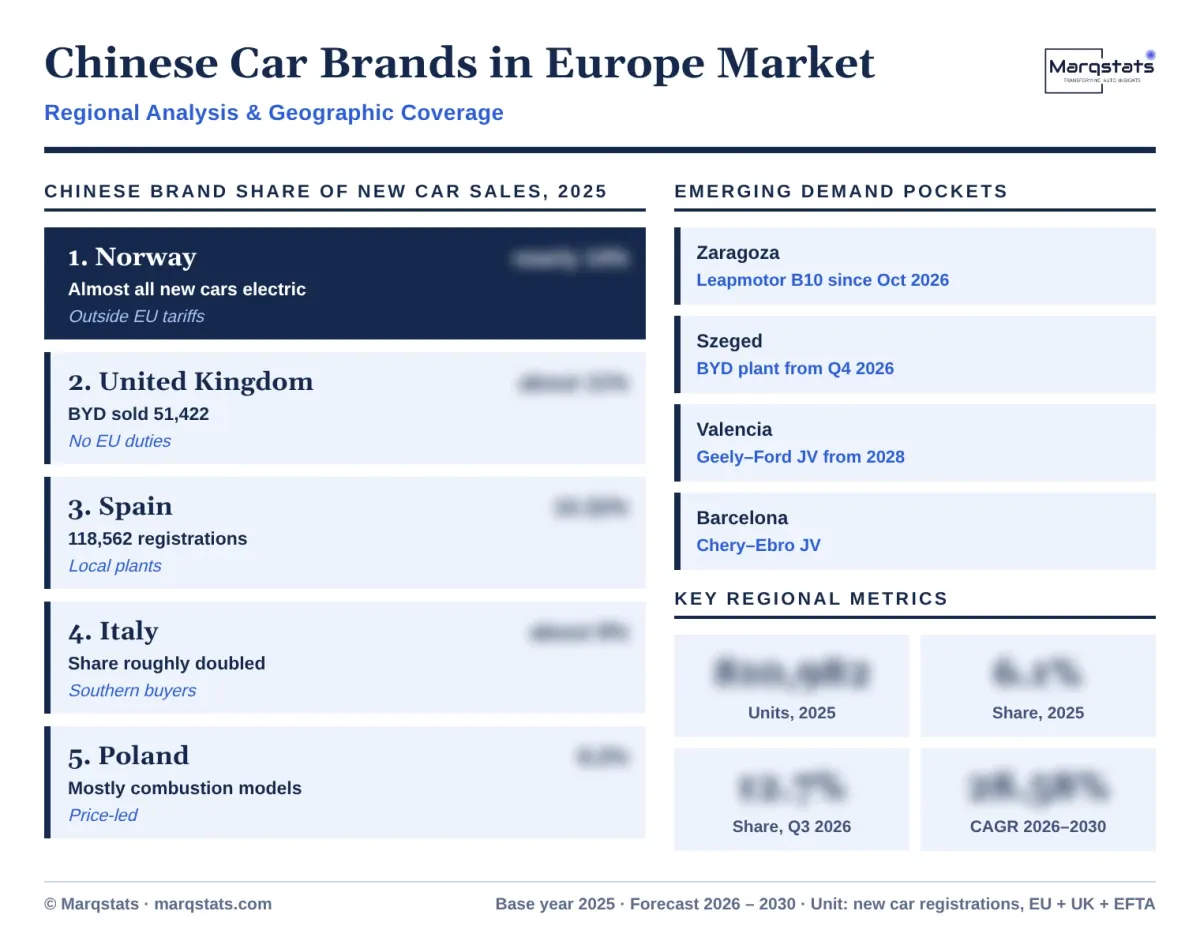
The UK is the largest single market for Chinese brands, at about 11% of registrations in 2025 according to Inovev data reported by Reuters, within a market of more than 2.02 million cars, according to SMMT. BYD sold 51,422 cars and Jaecoo 28,232, and BYD, Jaecoo and Omoda recorded the three biggest increases in UK registrations; the absence of EU-style tariffs favours Chinese battery electric cars.
Spain
Spain had 118,562 Chinese registrations in 2025, a 10.32% share of 1,148,650 cars, led by MG with 45,163. It is also the industrial hub, hosting Leapmotor production in Zaragoza, the Geely–Ford joint venture in Valencia and Chery's planned joint venture with Ebro in Barcelona.
Italy
Italy's Chinese share roughly doubled to about 9% in 2025, as southern European buyers proved open to new brands. Price-sensitive private buyers and the growth of plug-in hybrids make it one of the fastest-adopting large markets.
Norway
Norway had the highest share in 2025, nearly 14%, because almost all new cars are electric and Norway is outside the EU tariffs. Chinese battery electric cars therefore compete there on price without countervailing duties.
Rest of Europe
Poland reached 8.2% with mostly combustion models, while large company car markets such as Germany, Belgium and the Netherlands lag because fleets are cautious about residual values. Hungary will host BYD's first European car plant at Szeged.
How Competition Is Evolving
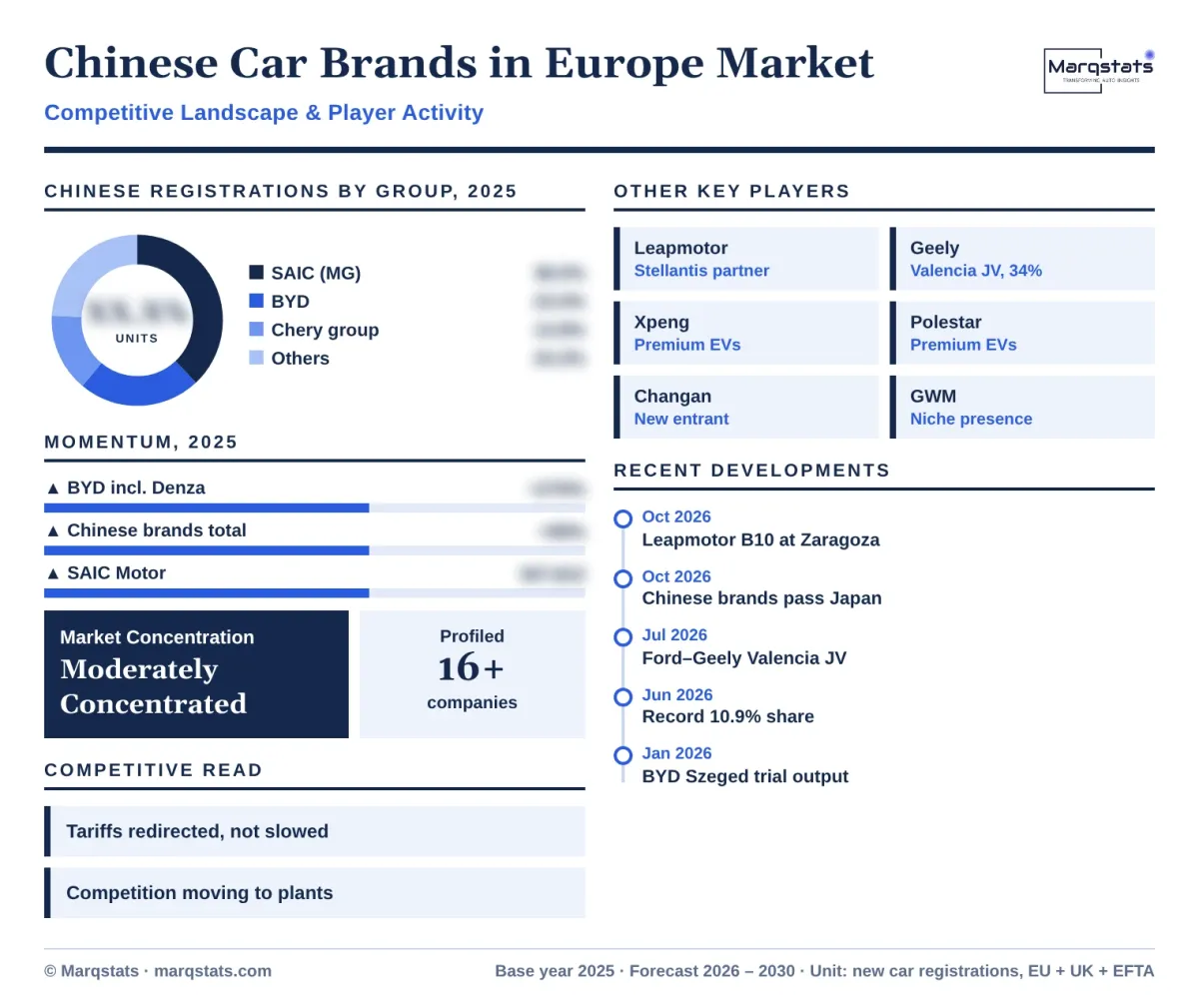
The Chinese car brands in Europe market is moderately concentrated: SAIC Motor, BYD and Chery held about 76% of Chinese registrations in 2025.
MG competes on value and an established network, BYD on technology and plug-in hybrids, and Chery's Omoda and Jaecoo on price and rapid dealer expansion.
Partnership models are growing: Leapmotor with Stellantis, Geely with Ford, and Chery with Ebro in Spain.
Chinese brands compete with all incumbents, and in the third quarter of 2026 overtook Japanese brands in European registrations.
Companies Covered
Companies covered in the report include:
Recent Market Activity
Table of Contents
Coverage & Segmentation
The study covers new passenger car registrations of Chinese-owned brands in the EU, UK and EFTA, by brand group, powertrain, sales channel and country. The base year is 2025, the historical period 2021 – 2025 and the forecast period 2026 – 2030. The unit is vehicles registered.
Three segments and five regions are covered, and 16 companies are profiled. The 2025 base is registration data reported by Automotive News Europe; the 2026 estimate and forecast are Marqstats constructions.
Known limits are stated plainly. Definitions of Chinese brands differ between data providers, and country shares come from several sources.
