Market Snapshot
The Chinese car brands in Southeast Asia market, covering Chinese cars in Southeast Asia from BYD, Wuling, GWM and others, stands at about 395,558 Chinese-brand light vehicles sold in Thailand, Indonesia, Malaysia, the Philippines and Vietnam in 2025 and is estimated at 535,000 vehicles in 2026. Marqstats forecasts it to reach 770,000 vehicles by 2030, a CAGR of 14.25% over 2026 – 2030 that adds 374,442 vehicles between 2025 and 2030. Chinese cars, Southeast Asia's fastest-growing brand group, are led by BYD.
Thailand is the largest market, Vietnam is the fastest growing and Battery Electric (BEV) is the dominant segment, in a market that is moderately concentrated. The report covers 3 segments and 5 regions and profiles 16 companies, with 2025 as the base year, history from 2021 – 2025 and a forecast for 2026 – 2030.
Key Takeaways
Market Overview & Analysis
Report Summary
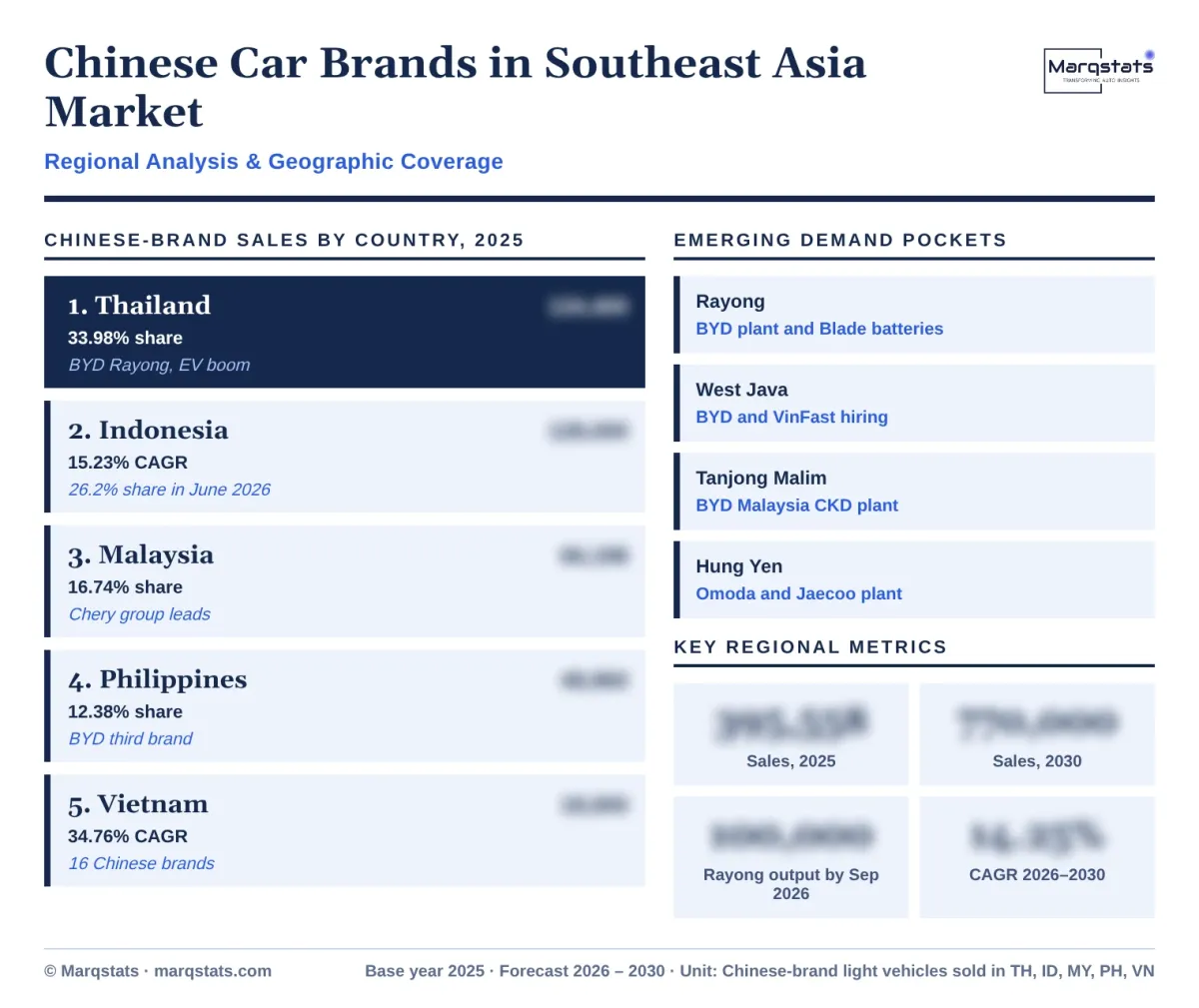
The Chinese car brands in Southeast Asia market covers new light vehicles of Chinese-owned brands sold in Thailand, Indonesia, Malaysia, the Philippines and Vietnam, imported or assembled locally, including BYD, MG, Wuling, Chery with Omoda, Jaecoo and Jetour, GWM, Geely, Changan, GAC Aion, Neta, XPeng, Zeekr and Leapmotor, measured in units sold; Proton and VinFast are excluded. Marqstats estimates about 395,558 sales in 2025 from national data: about 134,400 in Thailand, 128,000 in Indonesia, 66,198 in Malaysia, 48,960 in the Philippines and about 18,000 in Vietnam. Marqstats estimates 535,000 in 2026 and 770,000 by 2030, a CAGR of 14.25%.
Chinese brands in Southeast Asia now have more factory capacity than they can fill, and Thailand is about to make importing more expensive. BYD's Rayong plant, rated at 150,000 vehicles a year, took 26 months to build 100,000 and slowed to about 3,100 a month in 2026, roughly a quarter of capacity, while the Thai Cabinet approved a 35% excise on imported battery electric and range-extended cars from 1 January 2027. Growth after 2026 depends on filling local plants and exporting from them.
The fastest gains move to Indonesia and Vietnam. Chinese brands reached about 21.6% of Thai sales in 2025 and 26.2% of Indonesian light vehicle sales in June 2026, up from 19.6%, and Malaysia's share rose from 0.08% in 2022 to 8.92% in early 2026. Across six ASEAN markets the Chinese share rose from under 1% in 2019 to about 12% in 2025, while Japanese brands' share of Thailand fell from close to 90% to about 68%.
Growth slows after the 2026 step as the excise takes effect and price wars squeeze margins, reaching 586,000 in 2027, 641,800 in 2028 and 703,000 in 2029, with Indonesia overtaking Thailand by 2030. Hybrids grow fastest as BYD adds locally built DM-i plug-in hybrids, and brands increasingly take share from each other. The forecast is a single most likely path; faster localisation would raise it, while tougher import rules or brand exits would lower it.
Market Dynamics
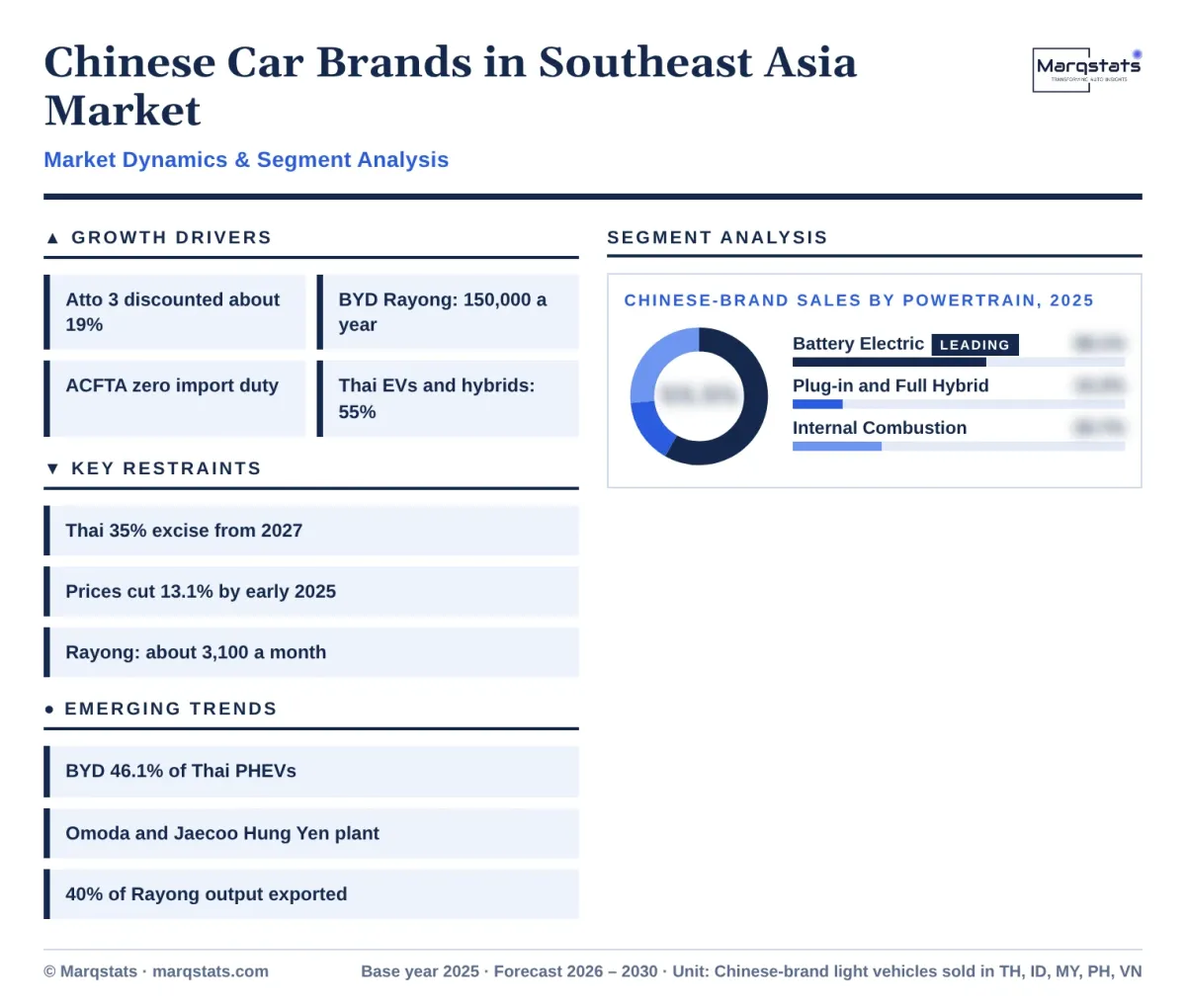
Key Drivers
- Affordable EVs: Chinese imports retained a 30% to 40% cost advantage over locally built rivals in Thailand, with price gaps of up to 50% in some segments. In early 2026 dealers advertised discounts of THB 200,000, about 22%, on the BYD Atto 3 and THB 160,000 on the MG4 Electric. Southeast Asia's electric car sales more than doubled to over 500,000 in 2025, close to one in five new cars, according to the International Energy Agency, and Chinese brands supplied most of them.
- Local plants: BYD's Rayong plant opened in July 2024, assembles the Dolphin, Atto 3, Seal 5 DM-i, Sealion 5 DM-i and Sealion 6 DM-i, sources about 50% locally and has a nearby Blade battery plant for 150,000 packs a year. Omoda and Jaecoo Vietnam, a Geleximco–Chery joint venture, is building a plant of about USD 800 million in Hung Yen, and BYD named Sime Motors' Inokom plant in Kulim, Kedah, as its Malaysian CKD partner in October 2026. Indonesia aims to produce 600,000 EVs a year by 2030.
- Free trade: Two years of tariff-free imports under the ASEAN-China Free Trade Area and low excise under Thailand's EV 3.0 and EV 3.5 programmes gave Chinese brands 90.5% of Thai battery electric car registrations in 2025. Chinese registrations in Thailand rose 81.4% while the market grew 8.5% to 621,100, according to the Federation of Thai Industries. Industry data put combined deliveries in four markets at over 377,450 in 2025, up 95%.
- EV shift: Electric and hybrid vehicles took a record 55% of Thailand's new car market in the first seven months of 2026, according to the Board of Investment, and Thai combustion passenger car production fell 29% to almost 248,000 in 2025. Indonesia's battery electric sales more than doubled to 106,644, with BYD and Denza at 54,248, 51%, followed by SAIC-GM-Wuling with 16,122. Malaysian EVs rose to 5.1% of registrations in 2025 from 2.5%.
- Indonesia growth: Chinese brands rose to more than 128,000 Indonesian sales in 2025, about 16% of a wholesale market that fell 7.2% to 803,687, according to Gaikindo, with BYD sixth on 46,711 and Chery ninth on 19,391. Their share reached 17.6% in the first quarter of 2026, wholesale sales rose 72% to 63,274 in January to May, and June registrations were 15,290. Zeekr launched at IIMS in February 2026 and Leapmotor at GIIAS 2026.
Key Restraints
- Import excise: Thailand's 35% excise on imported BEVs and EREVs from January 2027, following National Electric Vehicle Policy Committee resolutions of 25 November 2025 and 10 September 2026, ties rates to local value added and EV 3.5 production commitments. Malaysia ended tax exemptions for fully imported EVs at the end of 2025, causing a late rush of BYD sales. Import-reliant brands must localise or raise prices.
- Price wars: Chinese EV brands cut Thai prices by 10.2% between the 2023 and 2024 motor shows and a further 13.1% at Motor Expo 2024, according to Krungsi Research. More than 20 brands fight in Thailand's EV price war and a record 98 brands registered at least one vehicle in Malaysia in 2025. Fast price cuts reduce used-car values, hurting financing and fleet buyers, and Marqstats expects some smaller brands to exit or merge by 2030.
- Idle capacity: Rayong built its 10,000th vehicle in November 2024, 70,000th in November 2025 and 100,000th in September 2026, with monthly output slowing from about 4,800 to about 3,100. Plants have been built or announced faster than local demand has grown, so the next phase is about filling factories, cutting costs and exporting. BYD shelved its own Tanjong Malim plant in Malaysia in favour of a partner.
- Japanese incumbents: Toyota still holds about 38% of Thai sales, and Japanese brands hold about 57% of the region despite a 22% fall in their combined sales across six markets between 2019 and 2025. Toyota, Honda and Suzuki are expanding hybrids, and Thailand's new excise rewards local parts where Japanese makers have deep supplier networks. Cumulative Thai hybrid registrations of 605,000 exceed 372,600 battery electric vehicles.
Key Trends
- Plug-in hybrids: BYD held 46.1% of Thai passenger plug-in hybrid registrations in the first seven months of 2026, and Rayong now builds three DM-i plug-in hybrids. Hybrids let Chinese brands compete in the segment Japanese brands defend, and they avoid the new import excise when built locally. BYD registered a record 12,830 units in Thailand in January 2026, a 14.1% share, when Chinese brands took 46.4% of the month's sales.
- Local assembly: BYD, GWM, Changan, MG and Chery build locally, and Thai nationals make up 95% of Rayong's workforce. Chinese car imports into Vietnam in the first eight months of 2026 approached the full 2025 total, ahead of local production in Hung Yen. Distributors shape entry, such as Rever Automotive for BYD in Thailand and Geleximco in Vietnam, and partner quality affects dealer and service coverage.
- Regional exports: About 40% of Rayong's output in the first half of 2026 was exported to more than 10 markets, including Vietnam, Malaysia, Brunei, India, Australia, Pakistan, the Middle East and parts of Europe. BYD passed 130,000 cumulative Thai deliveries in July 2026. Exports from Thai plants fill capacity that local demand cannot, positioning Thailand as a Chinese export hub.
- New entrants: Zeekr and Denza have entered the premium segment in Thailand and Indonesia, GWM showed its WEY G9 and BYD its Denza B5 at the 2025 Thailand Motor Expo, and sixteen Chinese brands operate in Vietnam, most without publishing sales. After-sales becomes the battleground, with Omoda and Jaecoo Vietnam offering warranties of up to 1 million km and parts within 48 hours. In Malaysia, Omoda and Jaecoo fell 14.8% in the first half of 2026, showing brands taking share from each other.
Market Segmentation
BEVs, about 230,000 or 58.15% in 2025, grow at an 11.70% CAGR. In Thailand about 90% of Chinese-brand sales were new energy vehicles. The import excise and Malaysian tax change slow imported BEVs, shifting growth to locally built models.
Plug-in and full hybrids, about 60,000 or 15.17%, grow fastest at 30.83% to 230,000 in 2030. BYD's Thai-built DM-i models lead, and hybrids compete directly with Japanese strengths. They suit buyers wary of charging gaps.
Combustion models, about 105,558 or 26.69%, grow at 5.81% a year, sold by Wuling, Chery, GWM and Changan. They serve price-sensitive buyers in Indonesia, the Philippines and Vietnam. Their share falls as electrified models grow.
Imports from China dominated early sales under ACFTA, with zero duty and low excise. The 2027 Thai excise and Malaysia's end of import exemptions reduce this route's appeal. Import volumes into Vietnam remain high until local plants open.
BYD, GWM, Changan, MG and Chery build locally, in Thailand, Indonesia, Malaysia and soon Vietnam. Local assembly qualifies for tax incentives and local-content rules. Filling these plants, through domestic sales and exports, is the core challenge to 2030.
BYD was the top Chinese brand in four of the five markets in 2025, registering 14,407 EVs in Malaysia and 26,000 sales in the Philippines, up from 5,000, where it ranked third behind Toyota and Mitsubishi. It ranked fourth in Thailand with about 6.9%, peaking at 12.2% in June 2025. It has the largest local manufacturing base.
The Chery group, MG, Wuling, GWM, Geely and Changan follow. Omoda and Jaecoo were fifth in Malaysia with 17,845 and Chery eighth with 12,942, and Jaecoo ranked eighth in Indonesia in early 2026. Smaller brands face consolidation as competition intensifies.
By Geography
Thailand
Thailand sold 134,400 Chinese-brand vehicles, 33.98% of the total, growing at 11.34% to 230,000 by 2030. Chinese brands held five of the top ten positions in 2025, and the 2027 excise favours local builders.
Indonesia
Indonesia sold about 128,000, 32.36%, growing at 15.23% to 260,000 and 33.77% by 2030, overtaking Thailand. Sales rose 33% to 77,550 in June 2026 across all brands, with Chinese brands taking a large share of growth.
Malaysia
Malaysia registered 66,198, 16.74%, growing at 10.69% to 110,000. The Malaysian Automotive Association expects 2026 sales of 800,000, about 2.5% below 2025, which intensifies competition among Chinese brands.
Philippines
The Philippines sold about 48,960, 12.38%, about 11% of a 489,000-unit market, growing at 12.95% to 90,000. Toyota, with 228,000 sales, and Mitsubishi still dominate.
Vietnam
Vietnam registered about 18,000, 4.55%, growing fastest at 34.76% to 80,000. More than 600,000 cars were sold in 2025, up 19%, and the Hung Yen plant supports local supply alongside VinFast.
How Competition Is Evolving
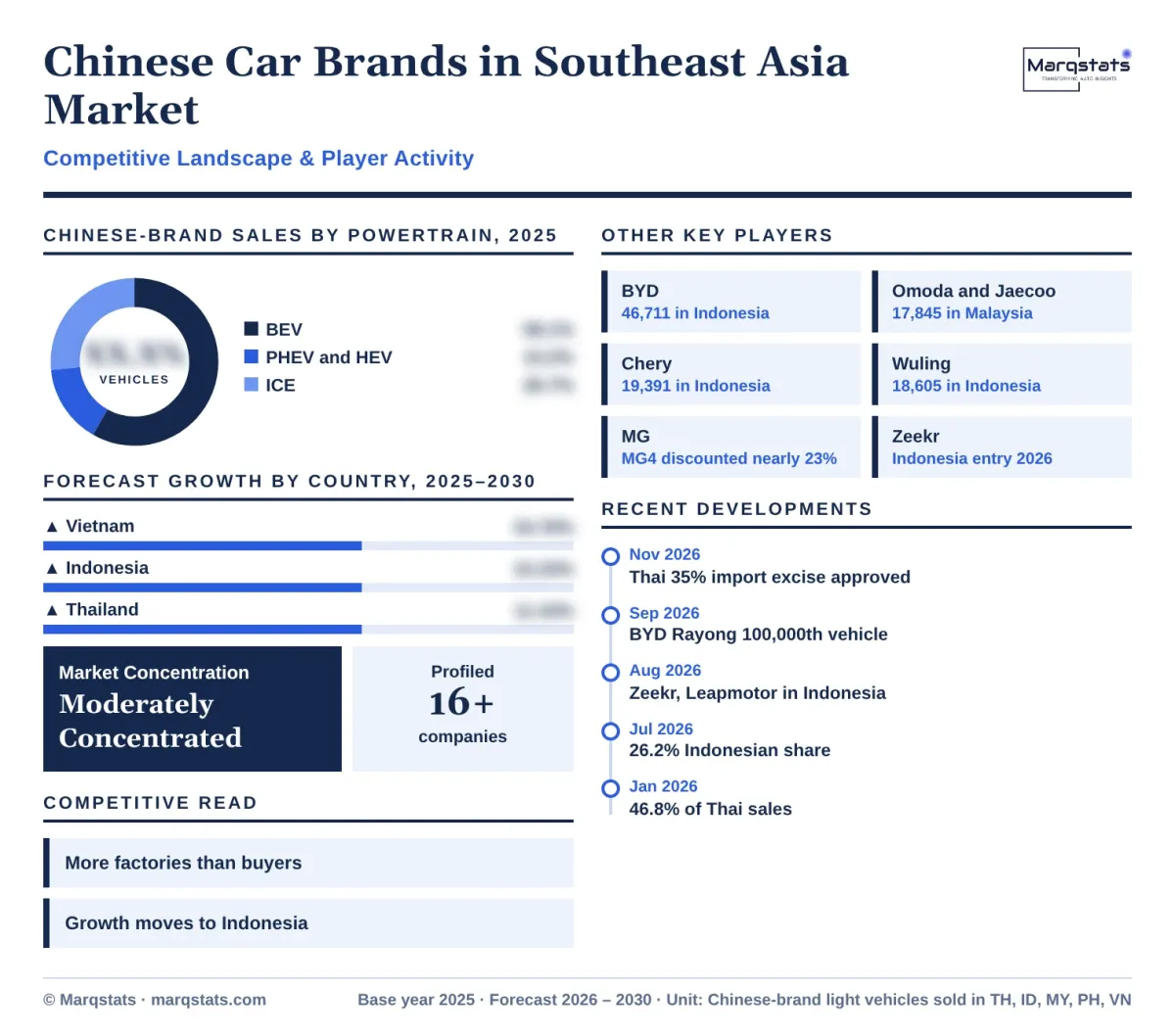
Chinese brands in Southeast Asia are moderately concentrated: BYD leads in four of five markets, followed by the Chery group, MG and Wuling.
BYD has the largest local manufacturing base, with its Rayong plant in Thailand and plants under way in Indonesia and Malaysia. BYD Thailand built its early lead on the BYD Atto 3 in Thailand, the first mass-market electric SUV in the country.
The Chery group, through Chery, Omoda, Jaecoo and Jetour, is the largest Chinese force in Malaysia and is building in Vietnam.
GWM, Changan, GAC Aion, Geely, Neta, XPeng, Zeekr and Leapmotor compete for the remaining share, mostly in Thailand and Indonesia.
Companies Covered
Companies covered in the report include:
Recent Market Activity
Table of Contents
Coverage & Segmentation
The study covers Chinese-brand light vehicles sold in Thailand, Indonesia, Malaysia, the Philippines and Vietnam by powertrain, supply route, brand and country. The base year is 2025, the historical period 2021 – 2025 and the forecast period 2026 – 2030. The unit is vehicles sold.
Three powertrain segments and five countries are covered, and 16 companies are profiled. Proton and VinFast are excluded.
Known limits are stated plainly. Some brands do not report sales in Vietnam and the Philippines, and sources differ between wholesale, retail and registration counts.
