Market Snapshot
The Thailand automotive industry and vehicle export market, the export side of the Thailand auto industry and Thailand car production, stands at 935,750 completely built vehicles exported from Thailand in 2025 and is estimated at 890,000 vehicles in 2026. Marqstats forecasts it to reach 930,000 vehicles by 2030, a CAGR of -0.12% over 2026 – 2030 that adds -5,750 vehicles between 2025 and 2030.
Australia and Oceania is the largest market, Asia is the fastest growing and Combustion and Hybrid Vehicles is the dominant segment, in a market that is moderately concentrated. The report covers 5 segments and 5 regions and profiles 16 companies, with 2025 as the base year, history from 2021 – 2025 and a forecast for 2026 – 2030.
Key Takeaways
Market Overview & Analysis
Report Summary
The Thailand automotive export market covers completely built light and commercial vehicles produced in Thailand and shipped abroad: one-ton pickups, pickup passenger vehicles (PPVs) and SUVs, passenger cars and trucks. The Federation of Thai Industries (FTI) recorded exports of 935,750 vehicles in 2025, excluding motorcycles, down 8.19%, from production of 1,455,569, down 0.91%. Marqstats estimates 890,000 exports in 2026 and forecasts 930,000 by 2030, a CAGR of -0.12% over 2026 – 2030.
Thailand is Southeast Asia's largest automotive manufacturing hub, exporting about two-thirds of what it builds, with the industry contributing over 10% of national GDP and employing about 800,000 people. Carmakers built the export base around one-ton pickups: Toyota, Isuzu, Mitsubishi, Ford and Nissan use Thailand as a main pickup base, and Isuzu alone serves about 120 countries from it. Toyota Motor Thailand exported 358,135 vehicles in 2025, 38.27% of national exports.
Thailand's export base is holding volume and losing its old engine. Combustion passenger car exports fell 39.66% from January to April 2026 and pickup exports to the Middle East 37.73% in January to September, while hybrid car exports rose 62.90% and battery electric car exports nearly tenfold. Exports from January to September 2026 reached 655,009, down 4.94%, as the US–Iran conflict and the closure of the Strait of Hormuz cut pickup exports to the Middle East by 33,118 units. The transition, not total volume, decides which plants survive.
The forecast is a single most likely path: 870,000 in 2027, as remaining combustion export programmes end and Chinese competition intensifies, then 890,000, 910,000 and 930,000 as Chinese brands expand EV exports from Thai plants and Japanese brands ramp up hybrid and electric pickups. Exports do not regain the 2024 level of more than one million within the forecast period. The FTI cut its 2026 export production target to 900,000 from 950,000.
Market Dynamics
Key Drivers
- Pickup export base: Thailand is the main pickup production base for Toyota, Isuzu, Mitsubishi, Ford and Nissan, serving more than 100 markets. Isuzu moved pickup production from Japan to Thailand in 2002 and pickup research and development in 2010, and its Thai-built D-Max and MU-X passed 3 million cumulative exports in August 2025. Pickups made up about 63% of exports in January to April 2026, and Toyota's three plants at Samrong, Gateway and Ban Pho can build about 770,000 vehicles a year.
- Hybrid exports: Hybrid passenger car exports rose 62.90% to 27,759 from January to April 2026, and December 2025 exports rose 11.29% to 84,963, helped by hybrid shipments. Hybrids and EVs now outsell combustion cars in Thailand's passenger car exports. Domestically, hybrid passenger car sales rose 24% to 146,059 in 2025 and overtook combustion cars, so carmakers can use the same lines for export. Toyota exported 40,500 Yaris ATIV sedans in the first seven months of 2026.
- EV localisation policy: On 3 November 2026 the Cabinet approved raising excise tax on fully imported battery electric and range-extended vehicles from 10% (15% for range-extended) to 35% from 1 January 2027, while locally built EVs keep a 2% rate. The policy favours Chinese brands with Thai plants, including BYD, Great Wall, MG, Changan and GAC Aion, which may become significant exporters of right-hand-drive EVs. The National Electric Vehicle Policy Committee approved a structure linking tax to value created in Thailand on 10 September 2026.
- New investment: In April 2026 the Board of Investment (BOI) approved more than THB 15 billion, about US$461 million, of Isuzu investment in automation, robotics, clean energy and Euro 6 pickups. In July 2026 Mitsubishi Motors said it would invest Bt16 billion, about US$473 million, by 2030, developing an electric Pajero with Thailand as the hub. On 19 October 2026 the BOI approved Toyota's THB 1.49 billion project to build the Hilux fuel cell electric vehicle at Ban Pho.
- Asian demand and value per unit: Exports to Asia rose 27.16% in September 2026 and took 28.61% of shipments, helped by ASEAN tariff-free trade and demand for hybrid cars. Value has held up better than units: automotive export value including parts from January to September 2026 was 638,081.34 million baht, down 2.99%, against a 4.94% fall in units, and September vehicle export value rose 13.18% to 63,130.05 million baht while units rose 4.55%, because hybrids and EVs carry higher prices.
Key Restraints
- Middle East conflict: Pickup exports to the Middle East fell 37.73% from January to September 2026, which the FTI attributed to the US–Iran conflict and the closure of the Strait of Hormuz, and total Thai vehicle exports to the region fell 38.35% in the first half. Domestic production of combustion-engine pickup parts fell by more than 300,000 components. February exports were broadly flat at 81,195 with shipments delayed by security risks around Hormuz.
- Chinese competition: Chinese EVs compete with Thai-made vehicles in Southeast Asia, Australia and Oceania, and the FTI and the Thai Automotive Industry Association (TAIA) warned that rising Chinese vehicle exports to Australia threaten Thailand's position in its single most important pickup market. Whether Chinese plants in Thailand expand exports or scale back after EV incentives end is the main swing factor for exports after 2027.
- Declining combustion car exports: ICE passenger car exports fell 39.66% to 25,159 from January to April 2026 as some combustion passenger car models for export were discontinued. In 2025, production for export fell 8.39% in January to November while domestic production rose 13.42%. Plants and suppliers tied to combustion passenger cars face the steepest decline, and Thai parts makers are already losing orders across the supply chain.
- 2027 EV transition and other pressures: Industry groups warned of a production collapse when EV 3.5 support ends in 2027, under which carmakers must build two and three local cars per imported car in 2026 and 2027; Neta still had 24,000 compensation-production units outstanding after building only 4,700. The FTI also cited US tariffs and stricter emission rules in importing countries. If Chinese brands scale back, exports fall below 850,000.
Key Trends
- Electrified exports rising: Battery electric car exports rose 984.24% to 7,156 from January to April 2026, after 12,695 in 2025, when Thailand manufactured 70,914 battery electric cars, up 631.98%, mostly for the domestic market. Battery electric passenger car sales in Thailand rose 98.56% to 161,532 in January to September 2026, and cumulative registrations reached 561,978 battery electric vehicles at 30 September 2026. Domestic EV scale is the base for future EV exports.
- Hydrogen pickups: Toyota's Hilux fuel cell line at Ban Pho will have capacity of 3,000 vehicles a year from December 2027, with initial output entirely for export to Europe, Australia and New Zealand. It is the first hydrogen fuel cell pickup made in Thailand. Volume is small, and it keeps Thailand at the centre of Toyota's pickup technology, alongside the Hilux, which made up about 66% of Toyota's exports in the first seven months of 2026.
- Shift to Asia: Australia and Oceania took 29.30% of shipments in September 2026, the largest region, while Asia took 28.61% after rising 27.16%. Destinations are shifting from the Middle East toward Asia, supported by ASEAN and Japan trade agreements. September exports rose 4.55% to 89,972 even as flooding around Amata City Industrial Estate in Chon Buri disrupted parts supply and cut production 6.08% to 120,319.
- Euro 6 and electric pickups: Isuzu is upgrading its Thai pickups to Euro 6 standards for stricter export markets and began producing the D-Max EV electric pickup for Europe in April 2025, with first shipments in the third quarter of 2025. Thailand exported 363 electric pickups in 2025. Japanese brands are investing in hybrid, electric and hydrogen pickups to protect their export base as combustion demand weakens.
Market Segmentation
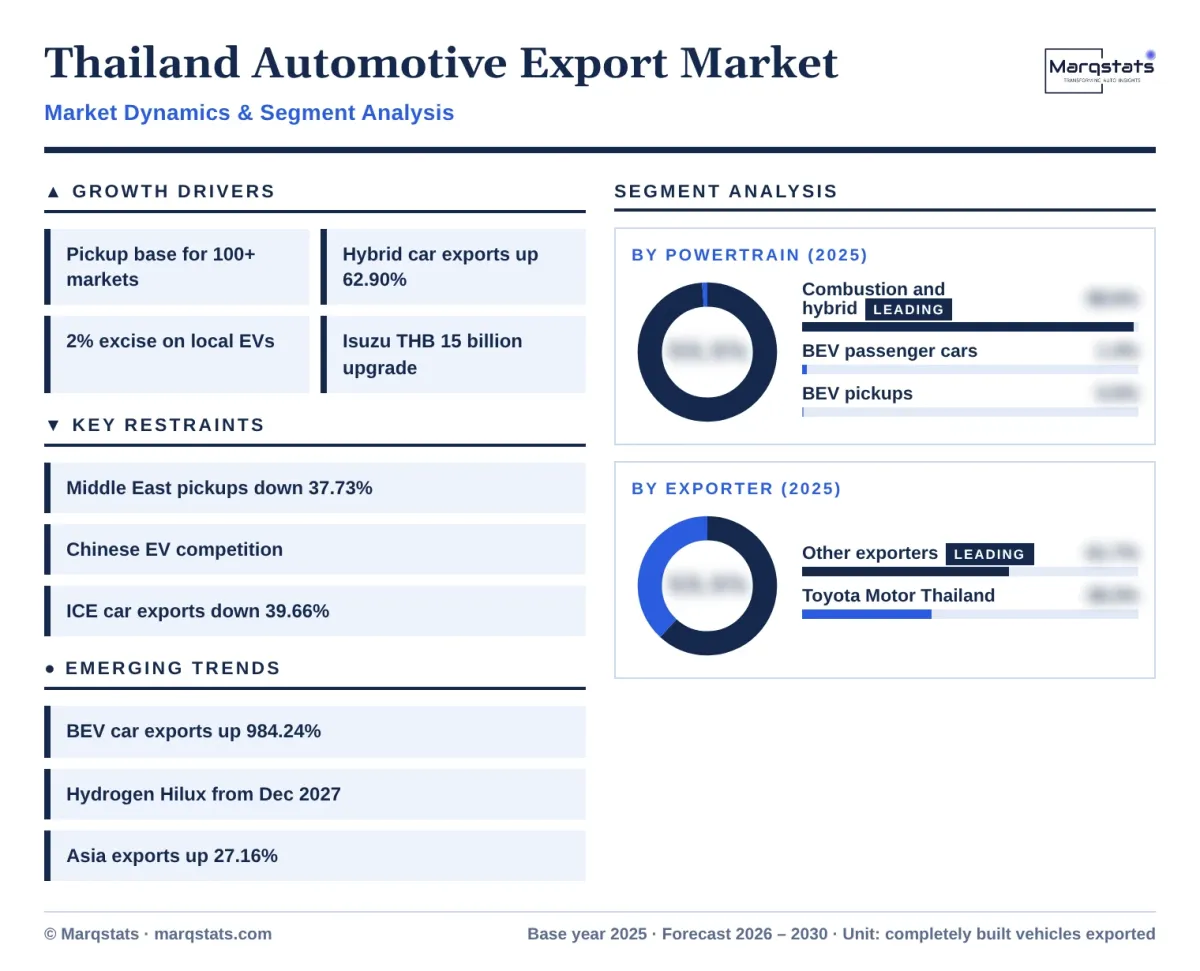
Combustion and hybrid vehicles made up 922,692 exports in 2025, 98.60% of the total, dominated by one-ton pickups and PPVs. Within this group, hybrid passenger car exports are rising fast, up 62.90% in January to April 2026, while combustion passenger car exports are falling, down 39.66%. Pickup exports fell 5.88% to 176,415 in the same period, mainly because of the Middle East. This segment's share declines through 2030 as electrified exports grow.
Battery electric passenger cars made up 12,695 exports in 2025, 1.36%, and rose 984.24% to 7,156 in January to April 2026 alone. Most battery electric cars built in Thailand still serve the domestic market. The 35% excise on imported EVs from 2027 pushes Chinese brands to build locally, which positions this segment as the main source of export growth after 2027, especially to right-hand-drive markets.
Battery electric pickups made up 363 exports in 2025, 0.04%, including the Isuzu D-Max EV for Europe; 155 were exported in January to April 2026. Electric pickups extend Thailand's core pickup strength into electrification, and Toyota's hydrogen Hilux adds a fuel cell variant from late 2027. Volumes remain small through 2030, with Europe the main early market.
Other exporters, including Isuzu, Mitsubishi, Ford, Nissan, Honda, Mazda, Suzuki and Chinese brands, shipped about 577,615 vehicles in 2025, 61.73% of the total, a Marqstats residual. Isuzu, Mitsubishi and Ford are the largest pickup exporters in this group and are investing to upgrade their Thai plants. Chinese brands are small exporters today and their export decisions after 2027 will change this group's composition.
Toyota Motor Thailand exported 358,135 vehicles in 2025, 38.27%, up 6%, from production of 564,933, with the Hilux and Yaris ATIV as its main export models. Toyota held a 48.5% share of Thailand's pure pickup market from January to November 2025 and domestic sales of 230,038 in 2025, a domestic base that keeps pickup lines at efficient volumes when Middle East demand falls. It exported 208,500 vehicles in the first seven months of 2026.
By Geography
Australia and Oceania
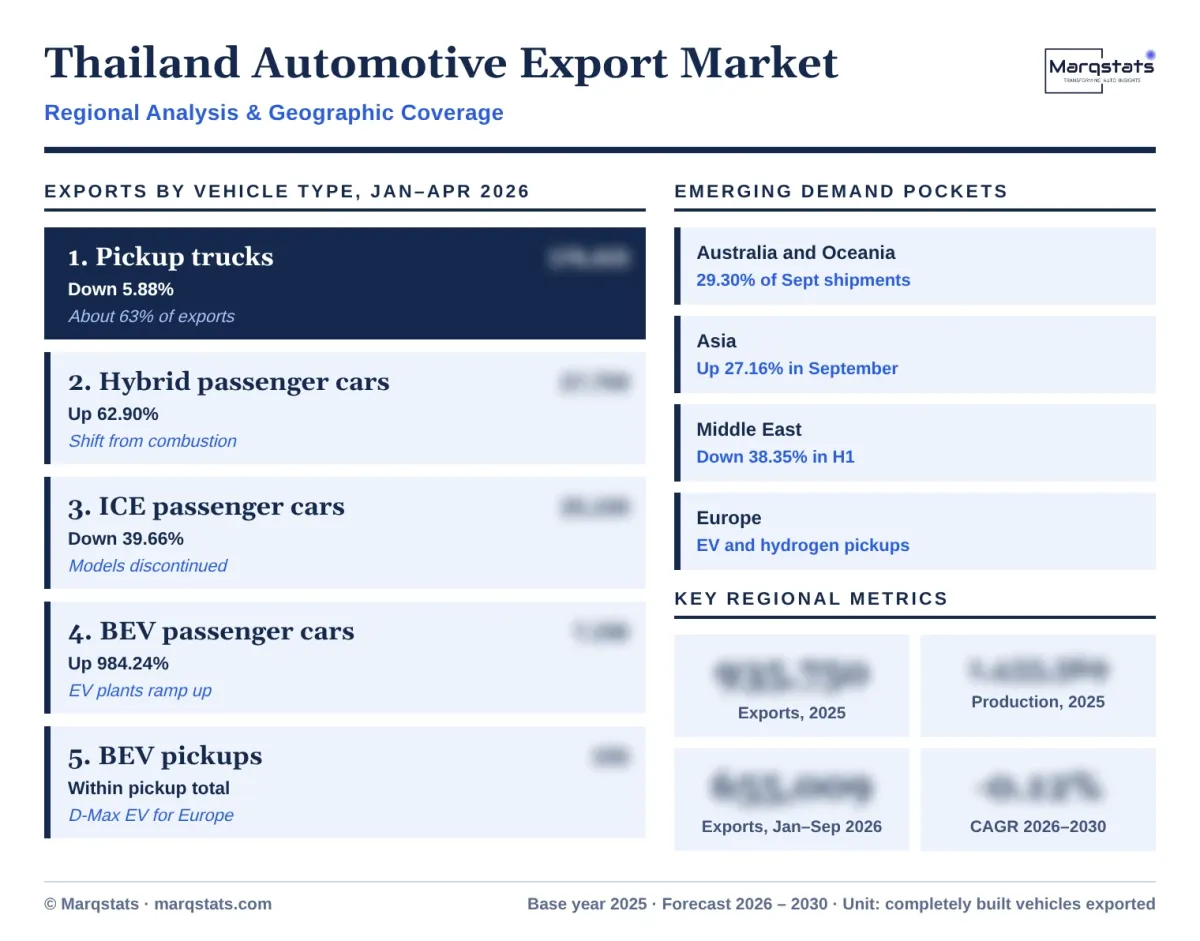
Australia and Oceania took 29.30% of Thai vehicle shipments in September 2026, the largest region, mainly pickups and PPVs under Thailand's free trade agreement with Australia. Australia is the single most important pickup market. Chinese competition is rising there, which the FTI and TAIA see as the main threat to Thailand's position.
Asia
Asian markets took 28.61% of shipments in September 2026 and exports there rose 27.16%, helped by ASEAN tariff-free trade, Japan agreements and demand for hybrid cars. Asia is the fastest-growing destination and offsets part of the Middle East decline, although Chinese EVs compete strongly in Southeast Asia.
Middle East
The Middle East was a major pickup market, and exports there fell 38.35% in the first half of 2026 after the closure of the Strait of Hormuz. Pickup exports to the region fell by 33,118 vehicles in January to September. Recovery depends on the conflict easing and shipping routes reopening, which Marqstats does not assume before 2027.
Europe
Europe is a small and growing market for Thai electric and hydrogen pickups, including the Isuzu D-Max EV and, from late 2027, the Toyota Hilux fuel cell vehicle. Stricter European emission rules make Euro 6 and zero-emission pickups the only route to grow there, which is why Japanese brands are investing in these technologies in Thailand.
Africa and Latin America
Africa and Latin America take Thai pickups and SUVs through Japanese brand networks, supported by Isuzu's reach of about 120 countries. The FTI does not publish regular shares for these regions. They provide steady demand for durable combustion pickups and help absorb volume lost in the Middle East.
How Competition Is Evolving
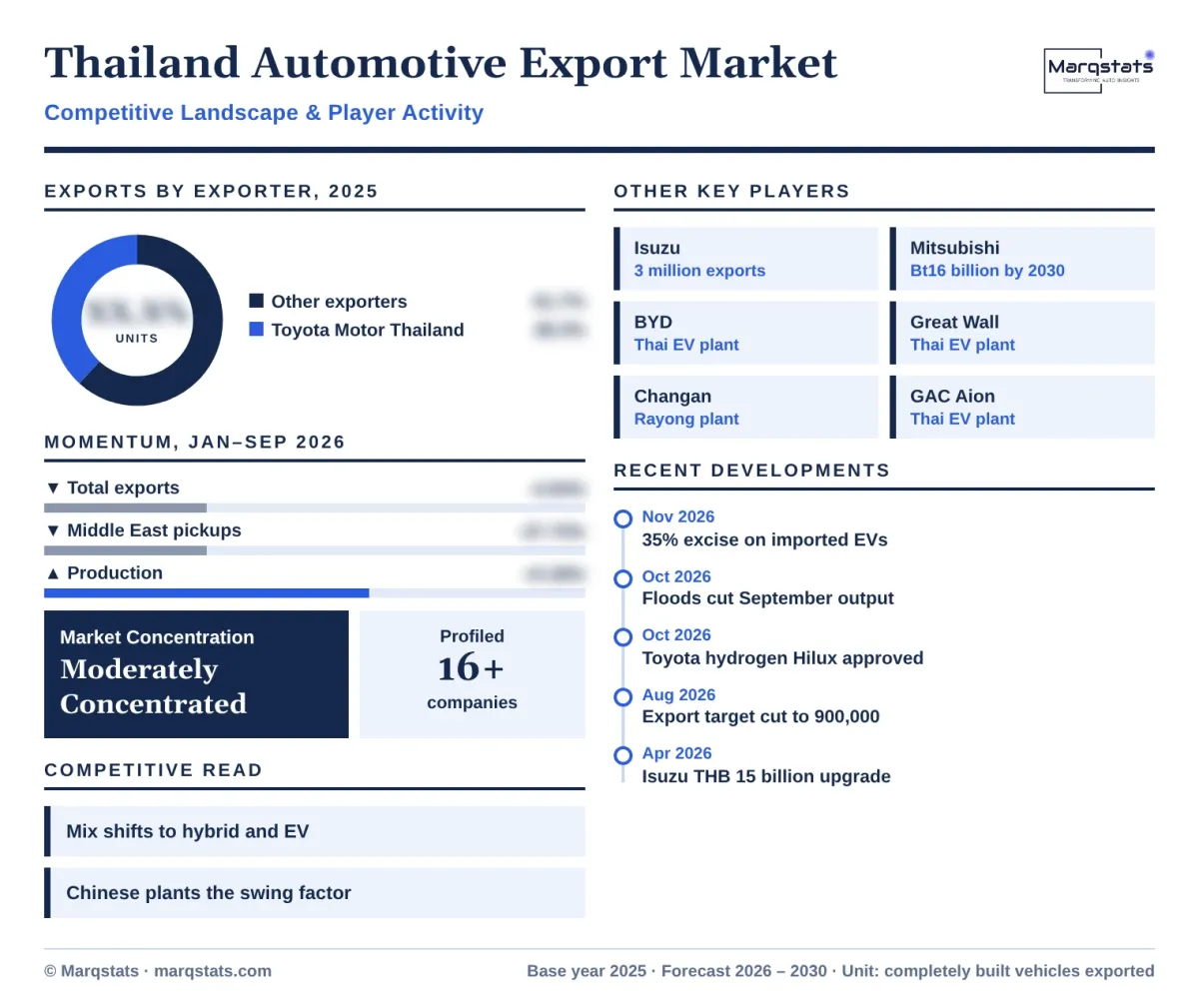
Thailand's vehicle export market is moderately concentrated. Toyota Motor Thailand alone exported 38.27% of vehicles in 2025, and Toyota, Isuzu, Mitsubishi and Ford together account for most pickup exports.
Japanese brands are investing to defend their base. Isuzu's THB 15 billion upgrade, Mitsubishi's Bt16 billion plan and Toyota's hydrogen Hilux line all aim to keep Thailand central to their pickup and SUV exports.
Chinese brands are the challengers. BYD, Great Wall, MG, Changan, GAC Aion and others built plants in Thailand under EV incentives; the 35% import excise from 2027 will push them to produce locally and expand their exports.
Competition is shifting from cost to technology. Exporters with hybrid, electric and hydrogen pickups will capture markets with stricter emission rules, while combustion-only programmes face decline.
Companies Covered
Companies covered in the report include:
Recent Market Activity
Table of Contents
Coverage & Segmentation
The study covers completely built vehicles produced in Thailand and exported, by powertrain and exporter, with production and domestic sales as context. Motorcycles, engines and parts are excluded from the unit total. The base year is 2025, the historical period 2021 – 2025 and the forecast period 2026 – 2030. The unit is vehicles exported.
Five segments across two dimensions and five destination regions are covered, and 16 companies are profiled. The 2025 base and powertrain figures are FTI data; Toyota's export total is a company figure; the exporter residual, the 2026 estimate and the forecast are Marqstats constructions.
Known limits are stated plainly. FTI destination shares are published only for selected months, brand exports are not published consistently, and some figures are preliminary, so regional analysis is partly qualitative.
