Market Snapshot
The Mexico automotive export market, covering Mexico car exports and Mexico auto production of light vehicles, stands at 3,385,785 light vehicles exported from Mexico in 2025 and is estimated at 3,230,000 light vehicles exported in 2026. Marqstats forecasts it to reach 3,300,000 light vehicles exported by 2030, a CAGR of -0.51% over 2026 – 2030 that adds -85,785 light vehicles between 2025 and 2030. Exports are the core of the Mexico automotive industry.
United States is the largest market, Canada is the fastest growing and General Motors is the dominant segment, in a market that is moderately concentrated. The report covers 18 segments and 5 regions and profiles 16 companies, with 2025 as the base year, history from 2021 – 2025 and a forecast for 2026 – 2030.
Key Takeaways
Market Overview & Analysis
Report Summary
The Mexico automotive export market covers light vehicles, meaning passenger cars and light trucks such as pickups, SUVs and crossovers, built in Mexico and shipped abroad. INEGI's light-vehicle register (RAIAVL) recorded 3,385,785 exports in 2025, down 2.68% from the record 3,479,086 in 2024, from production of 3,953,494 units, the second-highest on record according to the Asociación Mexicana de la Industria Automotriz (AMIA). Marqstats estimates 3,230,000 exports in 2026 and forecasts 3,300,000 by 2030, a CAGR of -0.51% over 2026 – 2030.
Mexico is the most export-dependent major car-making country in the Americas, exporting about 86% of the light vehicles it built in 2025, while domestic sales of 1,524,638 were met partly by imports. The United States has applied a 25% tariff on imported cars since April 2025, and USMCA-compliant vehicles pay it only on non-US content. January to October 2026 exports fell 3.28% to 2,786,760, with October down 17.85% to 258,137, the steepest monthly fall since October 2021.
Mexico's export base is not collapsing, it is being re-sorted. Losses sit with a few names: Nissan down 25.9%, Mercedes-Benz down 48.5% and General Motors down 47.2% in October alone, accounting for about 70% of that month's decline, while Stellantis rose 24.6%, Volkswagen 13.2% and Kia 7.9%. The US share of exports slipped from 78.4% to 76.6% as Canada took 12.1%, the largest destination shift in years.
The forecast is a single most likely path: 3,200,000 in 2027, the first full year without the COMPAS plant and with Toyota's Tacoma transfer under way, then 3,240,000, 3,270,000 and 3,300,000 by 2030 as new models from Kia, Volkswagen, Stellantis and General Motors offset losses. Exports do not regain the 2024 record within the forecast period. A full USMCA extension would lift the path; a US exit or higher tariffs would push exports below 3 million.
Market Dynamics
Key Drivers
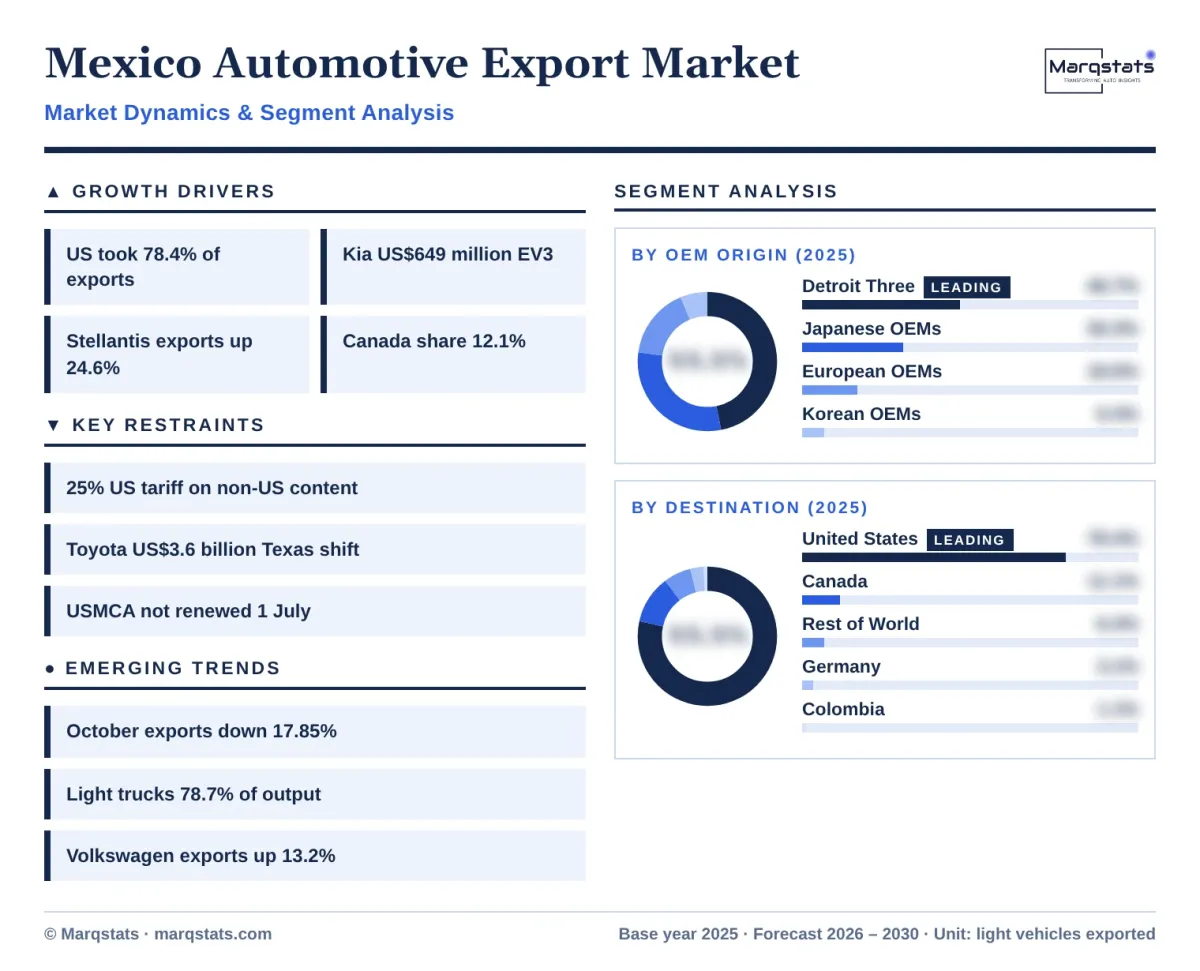
- Proximity and USMCA access: The United States took 2,653,897 Mexican-built light vehicles in 2025, 78.39% of exports, and Canada 376,251, 11.11%, so North America absorbed nearly nine in ten. USMCA-compliant vehicles pay the 25% US tariff only on non-US content, which protects models with high regional content. Most vehicles move north by rail and truck through crossings such as Laredo, giving Mexico a logistics advantage no Asian or European exporter can match.
- New OEM investment: Kia announced on 29 July 2026 a US$649 million programme from 2026 to 2028 at Pesquería, Nuevo León, with more than US$260 million for an EV3 line that started on 4 August 2026, its first battery-electric vehicle built in Mexico. General Motors announced a US$1 billion investment in January 2026 and will assemble the Chevrolet Groove at Ramos Arizpe from 2027, followed by the Aveo, aiming for 80,000 vehicles a year by 2030, mainly for the domestic market.
- Gains at Stellantis and Volkswagen: From January to October 2026, Stellantis exports rose 24.6% to 347,844 and production 12.6% to 368,432, and Volkswagen exports rose 13.2% to 258,234 and production 10.5% to 314,370. Audi rose 7.2% to 126,593, Kia 7.9% to 197,660 and BMW Group 1.6% to 75,590. These gains show that a tariff on non-US content does not hit every product equally: models with high regional content, strong US demand or no US-built substitute keep moving.
- Integrated supplier base: Mexico's auto parts industry, represented by the Industria Nacional de Autopartes (INA), produced US$110.04 billion of parts from January to November 2025, down 2.86%, with exports of US$95.73 billion. General Motors alone buys from about 650 Mexican suppliers with annual purchases of about US$28 billion. Integrated supplier networks are the main reason assembly is hard to move and support high regional content under USMCA rules.
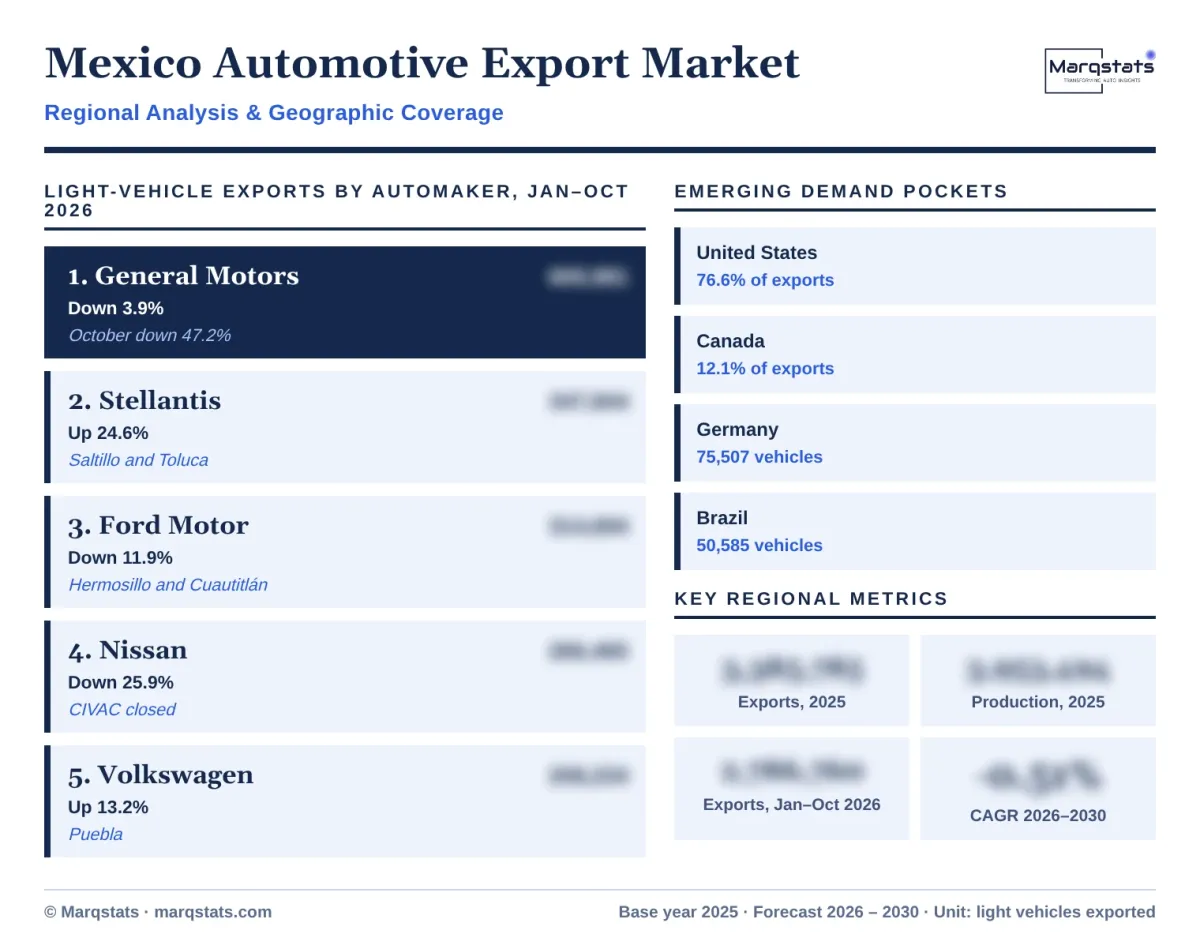
- Destination diversification: Canada's share rose to 12.1% in January to October 2026, with exports to Canada up 29% in the first five months, and exports to Germany rose 32.7% in the same period. Germany took 75,507 units and Brazil 50,585 over the ten months, and all other countries 187,793. Diversification increases demand for port and shipping capacity and makes Mexico more of a global hub and less an extension of US assembly.
Key Restraints
- US tariffs: The 25% US tariff on imported cars since April 2025 raises the cost of non-US content. Exports fell 13.7% in January 2025, recovered mid-year with June up 14.0% and July up 7.9%, then fell again, with December down 14.5% to 227,262. Light trucks reached 78.7% of production in January to October 2026, so Mexico's export mix is built around the most tariff-exposed US segments, which US automakers and transplants are most willing to build in the United States.
- Reshoring to the United States: On 6 July 2026, Toyota Motor North America announced a US$3.6 billion expansion of its San Antonio, Texas, plant, adding a second line, about 2,000 jobs and more than 150,000 units of capacity, and said Tacoma production would move there from Tijuana over about four years. The Tacoma was Mexico's most exported light vehicle in 2025, with 278,794 units or 8.23% of exports. Toyota will continue Tacoma production at Apaseo el Grande, Guanajuato.
- Plant closures: Nissan closed its CIVAC plant in Morelos, its first factory outside Japan, consolidating at Aguascalientes under the Re:Nissan plan, and the COMPAS joint venture with Mercedes-Benz in Aguascalientes was scheduled to stop production on 31 May 2026. Mercedes-Benz exports fell 13.6% in 2025 and 48.5% in January to October 2026, with none recorded in October, and Nissan's production fell 24.3% and exports 25.9% over the ten months.
- USMCA review uncertainty: At the first mandatory joint review on 1 July 2026, the United States did not agree to renew the agreement in its current form, which triggered annual reviews instead of an automatic 16-year extension. The agreement remains in force, and bilateral rounds in May, June and July 2026 covered rules of origin, steel and aluminium, economic security and labour. For automakers planning platforms that last six to eight years, annual reviews make Mexico a harder place to commit new US-bound capacity.
Key Trends
- Concentrated losses: General Motors exported 43,650 vehicles in October 2026, down 47.2% from 82,684, accounting for about 70% of the national decline; excluding General Motors, exports fell 7.4%. The cause has not been confirmed publicly and may reflect plant pauses, model changeovers or weaker US orders, so Marqstats treats it as a one-quarter shock until November and December data confirm otherwise. Buyers of export capacity, logistics or parts must look at plant and model exposure, not the national total.
- Light-truck mix: Light trucks accounted for 77.2% of 2025 production, 3,052,163 units, and passenger cars 22.8%, 901,331 units, and light trucks rose to 78.7% of production, 2,560,201 units, in January to October 2026. Pickups and SUVs are what US buyers want most, which keeps demand strong, and they are also the vehicles most likely to be reshored. Compact cars no longer competitive in the US are increasingly shipped to Latin America.
- European and Korean gains: Volkswagen, Audi, Kia and Stellantis grew exports in 2026, while Japanese automakers lost the most volume: Nissan fell 25.9%, Mazda 14.0% to 70,708, Honda 8.3% to 153,494 and Toyota 4.5% to 248,743, although Acura rose 14.2% to 33,317. Japanese automakers built much of their Mexican capacity for small cars and compact SUVs, where margins are thin and a tariff on non-US content takes a larger share of profit.
- Electric production starts: Kia began EV3 production in Pesquería on 4 August 2026, Ford builds the Mustang Mach-E in Cuautitlán and General Motors built electric models at Ramos Arizpe. US demand for battery electric vehicles weakened after federal tax credits ended in September 2025, and General Motors laid off 1,900 workers at Ramos Arizpe in 2026 because of weaker EV demand, so electric exports are not expected to drive volume before 2028.
Market Segmentation
General Motors exported 822,858 vehicles in 2025, 24.29% of the total, down 1.0%, mainly pickups and SUVs from Silao, Ramos Arizpe and San Luis Potosí. Its January to October 2026 exports fell 3.9% to 669,981, and October alone fell 47.2%. General Motors remains the largest exporter by a wide margin, and its new Groove and Aveo programmes at Ramos Arizpe target the domestic market rather than exports.
Ford exported 423,283 vehicles in 2025, 12.50%, up 11.4%, led by the Bronco Sport and Maverick from Hermosillo, Sonora, and the Mustang Mach-E from Cuautitlán. Its January to October 2026 exports fell 11.9% to 314,694 and 21.4% in October alone, and Stellantis overtook it as the second-largest exporter. Weaker US EV demand affects the Mach-E.
Nissan exported 401,242 vehicles in 2025, 11.85%, down 12.2%, and 266,465 in January to October 2026, down 25.9%, after closing CIVAC and consolidating in Aguascalientes. The COMPAS closure removes further capacity. Nissan's small cars and compact SUVs face thin margins under the tariff, making it the largest single source of lost export volume.
Stellantis exported 336,149 vehicles in 2025, 9.93%, and was the fastest-growing major exporter in 2026, with January to October exports up 24.6% to 347,844 from Saltillo and Toluca. Its Ram pickups from Saltillo serve strong US demand, and it became the second-largest exporter in 2026, showing how product mix decides exposure to the tariff.
Toyota exported 318,812 vehicles in 2025, 9.42%, up 30.1%, mostly Tacoma pickups, and its January to October 2026 exports fell 4.5%. It will move Tijuana Tacoma output to San Antonio, Texas, over about four years under a US$3.6 billion investment, while keeping Tacoma production at Apaseo el Grande. The transfer is the largest announced reshoring of Mexican export volume.
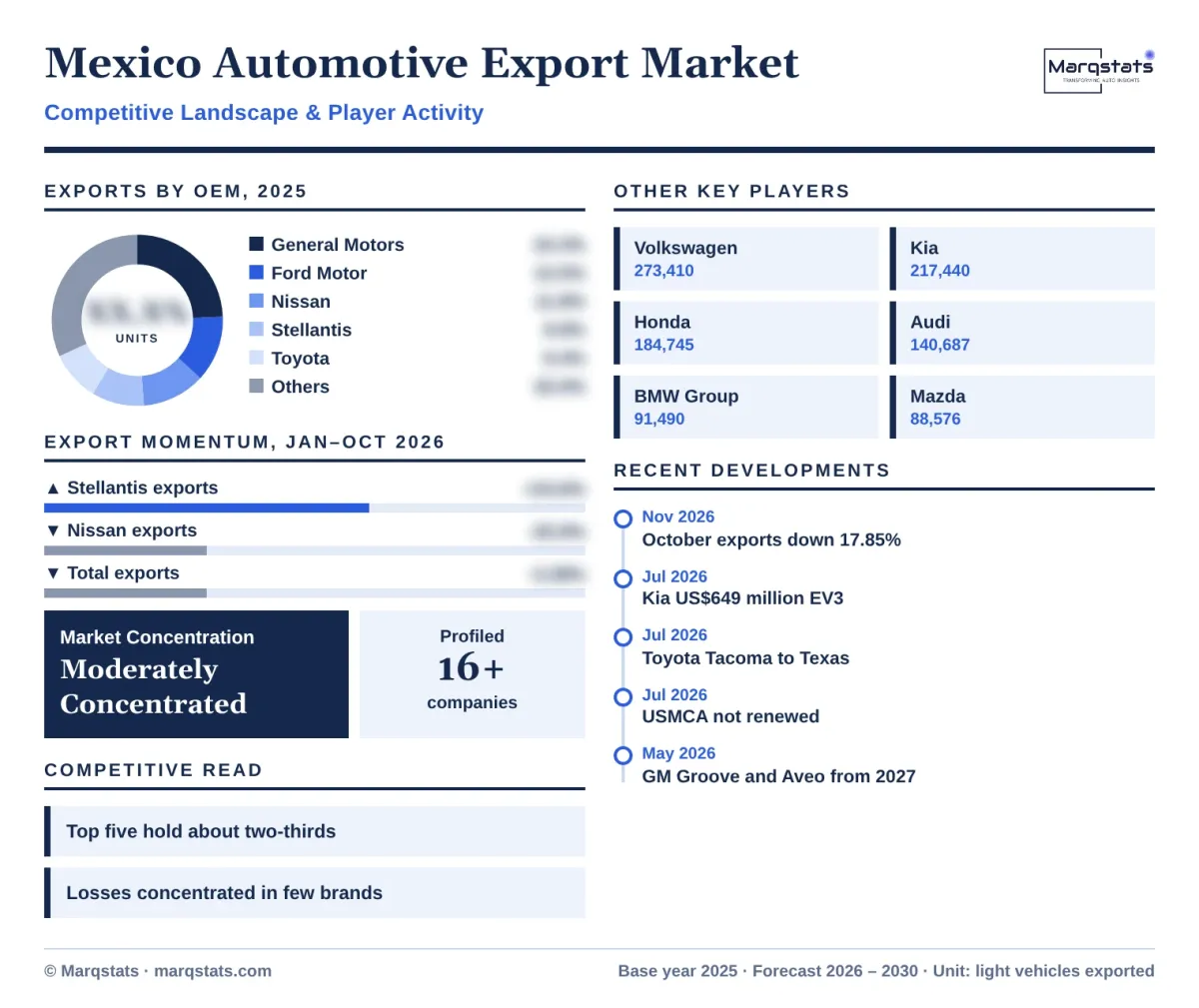
Volkswagen exported 273,410 vehicles in 2025, 8.08%, down 16.2%, and recovered in 2026 with January to October exports up 13.2% to 258,234 from Puebla. Its SUVs for North America carry high regional content and face less direct US competition, which supports growth. Volkswagen and Audi together make Puebla the centre of European exports from Mexico.
Kia exported 217,440 vehicles in 2025, 6.42%, up 5.4%, and 197,660 in January to October 2026, up 7.9%, with EV3 production added at Pesquería in August 2026 under a US$649 million programme. Kia is the only Korean automaker building in Mexico and is one of the few adding capacity, making it a growth source through 2030.
Honda exported 184,745 vehicles in 2025, 5.46%, down 20.5%, and 153,494 in January to October 2026, down 8.3%, from Celaya, Guanajuato. Its compact models face margin pressure under the tariff, while its Acura brand, reported separately, grew 14.2% in 2026. Honda's volume depends on how much US-bound compact SUV production it keeps in Mexico.
Other OEMs exported 407,846 vehicles in 2025, 12.05%: Audi 140,687 from San José Chiapa, BMW Group 91,490 from San Luis Potosí, Mazda 88,576 from Salamanca, Mercedes-Benz 55,137 and Acura 31,956. Mercedes-Benz and Mazda are shrinking, with Mercedes-Benz exiting after COMPAS, while Audi and Acura grew in 2026.
The United States took 2,653,897 vehicles in 2025, 78.39% of exports, and 2,134,474 in January to October 2026, 76.6%. It remains the market that decides Mexico's export volume, and its tariff and USMCA decisions are the main forecast variables. Pickups and SUVs dominate shipments, moving mainly by cross-border rail.
Canada took 376,251 vehicles in 2025, 11.11%, and 338,401 in January to October 2026, 12.1%. Exports to Canada rose 29% in the first five months of 2026, making it the fastest-growing major destination as automakers route Mexican output away from the United States. USMCA membership gives Canadian shipments the same rules-of-origin framework.
Germany took 104,334 vehicles in 2025, 3.08%, and 75,507 in January to October 2026, with exports up 32.7% in the first five months. Volkswagen, Audi and BMW ship models from Mexico to Europe, and Germany is the main destination outside the Americas, supplied through Gulf ports.
Colombia took 35,657 vehicles in 2025, 1.05%, the largest Latin American destination that year; Brazil took 50,585 in January to October 2026. Latin America absorbs compact cars and pickups no longer competitive in the US, and is a growing outlet as Mexico diversifies.
The rest of the world took 215,646 vehicles in 2025, 6.37%, spread across Latin America, Europe, the Middle East and Asia. These markets are small individually and help absorb surplus capacity, and their combined growth supports the slow shift away from US dependence.
The Detroit Three, General Motors, Ford and Stellantis, exported 1,582,290 vehicles in 2025, 46.74% of the total, with pickups and SUVs as the core. Their Mexican plants are integrated with US operations and suppliers, which supports high regional content. In 2026 Stellantis grew while Ford and General Motors fell, so the group's share depends on individual product decisions.
Japanese automakers, Nissan, Toyota, Honda, Mazda and Acura, exported 1,025,331 vehicles in 2025, 30.28%, and are losing the most volume in 2026. Nissan's restructuring, Toyota's Tacoma transfer and margin pressure on compact models weigh on the group, making it the largest source of decline through 2027.
European automakers, Volkswagen, Audi, BMW Group and Mercedes-Benz, exported 560,724 vehicles in 2025, 16.56%. Volkswagen and Audi are growing in 2026, while Mercedes-Benz is exiting with the COMPAS closure. European automakers ship both to North America and to Europe, which gives them more destination flexibility.
Kia exported 217,440 vehicles in 2025, 6.42%, and is adding electric production in Nuevo León with the EV3. Kia grew in both 2025 and 2026, making the Korean group the most consistent growth segment by origin. Its expansion shows that new Mexican capacity is still being added for models with diversified destinations.
By Geography
United States
The United States took 78.4% of Mexico's light-vehicle exports in 2025 and 76.6% from January to October 2026. Its 25% tariff on non-US content and the USMCA annual reviews decide the path, and rail through Texas is the key route. Reshoring announcements such as Toyota's San Antonio expansion show the direction of US policy pressure.
Canada
Canada took 11.1% of exports in 2025 and 12.1% from January to October 2026, with shipments up about 27% in the first five months, according to INEGI. It is the fastest-growing major destination as automakers route Mexican output away from the United States, and its USMCA membership supports continued growth.
Germany and Europe
Germany took 104,334 vehicles in 2025, and exports rose 32.7% in the first five months of 2026. Europe is Mexico's main destination outside the Americas, supplied by Volkswagen, Audi and BMW, and the EU-Mexico trade relationship supports these flows through Gulf ports.
Latin America
Colombia took 35,657 vehicles in 2025, and Brazil 50,585 from January to October 2026. Latin America is a growing outlet for compact cars and pickups no longer competitive in the United States, and Mexican plants compete there with Brazilian and Chinese supply.
Rest of World
Other destinations, including the Middle East and Asia, took 215,646 vehicles in 2025. These markets are small and help absorb surplus capacity. Chinese brands are unlikely to use Mexico as a US export base within the forecast period, because any Chinese assembly plant would face US scrutiny under the USMCA review.
How Competition Is Evolving
Mexico's light-vehicle export market is moderately concentrated. In 2025, General Motors held 24.29% of exports, Ford 12.50%, Nissan 11.85%, Stellantis 9.93% and Toyota 9.42%, so the top five accounted for 67.99% and all other brands 32.01%. The Detroit Three together held 46.74%. The car manufacturers in Mexico are almost all global automakers, and automotive manufacturing in Mexico depends on a deep base of automotive suppliers in Mexico that supply both local plants and US assembly lines.
The ranking is changing in 2026. From January to October, Stellantis overtook Ford and Nissan to become the second-largest exporter with 347,844 vehicles, while Nissan fell to fourth with 266,465 and Volkswagen reached 258,234.
Automakers are competing on regional content and product fit rather than price. Models with high US and Mexican content, strong US demand or no US-built alternative keep their export volume, while low-margin cars and SUVs are being moved, discontinued or redirected to other markets.
Investment decisions are polarised. Toyota and Nissan are reducing their Mexican footprint for US-bound products, while Kia, General Motors and Volkswagen are investing in new models, often for the domestic market or non-US destinations.
Companies Covered
Companies covered in the report include:
Recent Market Activity
Table of Contents
Coverage & Segmentation
The study covers light vehicles, passenger cars and light trucks, built in Mexico and exported, by OEM, destination and OEM origin. Heavy vehicles and auto parts are excluded, though referenced for context. The base year is 2025, the historical period 2021 – 2025 and the forecast period 2026 – 2030. The unit is vehicles exported.
Eighteen segments across three dimensions and five destination regions are covered, and 16 companies are profiled. The 2025 base, OEM and destination figures are INEGI RAIAVL data; the 2026 estimate and the 2027 to 2030 forecast are Marqstats constructions.
Known limits are stated plainly. INEGI's 2025 and 2026 figures are preliminary, exports by vehicle type and by state are not published, and some brands report only partially, so state analysis is qualitative.
