Market Snapshot
The Nigeria electric vehicle market, covering every electric vehicle in Nigeria from e-motorcycles to electric cars, stands at 10,000 electric vehicles sold (Marqstats construction) in 2025 and is estimated at 19,890 units in 2026. Marqstats forecasts it to reach 58,329 units by 2030, a CAGR of 42.29% over 2026 – 2030 that adds 48,329 units between 2025 and 2030. Electric cars in Nigeria are a smaller share than e-motorcycles.
Lagos is the largest market, Electric Tricycles is the fastest growing and Electric Motorcycles is the dominant segment, in a market that is fragmented. The report covers 3 segments and 5 regions and profiles 16 companies, with 2025 as the base year, history from 2021 – 2025 and a forecast for 2026 – 2030.
Key Takeaways
Market Overview & Analysis
Report Summary
The Nigeria electric vehicle market covers new battery electric and qualifying extended-range electric vehicles sold or deployed in Nigeria: electric cars and SUVs, electric motorcycles and electric tricycles (keke), measured in units. Conventional hybrids are excluded because they do not qualify for Nigeria's EV incentives, and buses and trucks are discussed and not counted. No official EV sales series exists, so Marqstats builds the 2025 base from 5,100 electric motorcycles, an estimated 3,500 electric cars and an estimated 1,400 electric tricycles: about 10,000 units. Marqstats estimates 19,890 units in 2026 and 58,329 by 2030, a CAGR of 42.29%.
Nigeria's EV market is fleet-led and largely off-grid. With about 48 public charging stations in late 2025 and a grid providing about 4,000 MW for more than 200 million people, growth comes from operators and programmes that run their own charging and swap networks: ProTaxi's 1,000 electric cars in Abuja, the federal plan for 10,000 electric tricycles and Spiro's battery-swap network. They buy in batches of 1,000 or more and remove the infrastructure barrier facing private buyers.
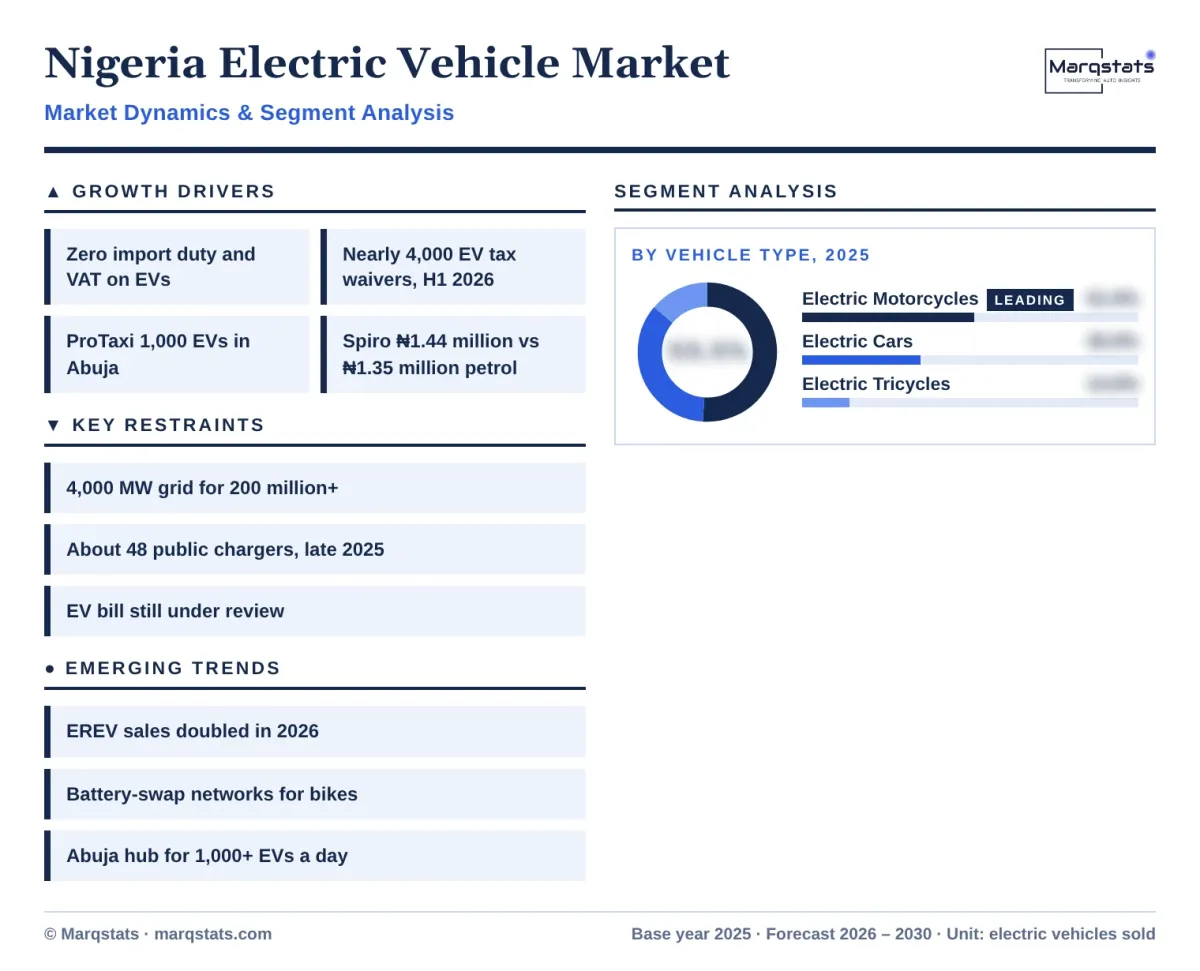
Policy has moved quickly. Nigeria exempted EVs from VAT in 2024 and cut import duty from 5% to zero in April 2026, and approved tax waivers for nearly 4,000 EVs in the first half of 2026, according to government data reviewed by Reuters. Fuel costs drive demand after the 2023 subsidy removal and the 2026 oil price shock, and Spiro has priced its Ekon motorcycle at about ₦1.44 million against ₦1.35 million for petrol bikes. EVs remain under 1% of the fleet, according to dealer estimates.
The forecast nearly doubles in 2026 on the duty cut, waivers and fleet launches, then slows to about 31% a year, reaching 26,028 in 2027, 34,061 in 2028 and 44,573 in 2029. Tricycles grow fastest, at a 60.69% CAGR, and two- and three-wheelers make up most units throughout. The forecast is a single most likely path; passage of the Electric Vehicle Transition and Green Mobility Bill or a grid improvement would accelerate it.
Market Dynamics
Key Drivers
- Fuel costs: The removal of the petrol subsidy in 2023 sharply raised fuel costs, and the 2026 oil price shock added to them. Electric motorcycles and tricycles cut operating costs by about two-thirds compared with petrol models, according to Donda X, and RMI finds electric motorcycles already have a lower total cost of ownership than petrol bikes. Electric cars' daily operating costs are about one-third of petrol vehicles, according to the Centre for Science and Environment.
- Tax incentives: Under the fiscal framework, battery electric vehicles and qualifying extended-range EVs are duty-free and VAT-free from 2026, while hybrids and luxury models remain taxed. The federal government waived duties on electric vehicles, mass transit buses and manufacturing machinery in April 2026 to ease cost pressures, and the waivers for nearly 4,000 EVs in six months show they are already being used. The zero duty is expected to start a price war among importers and assemblers.
- Fleet programmes: PromiseLand Innovations launched ProTaxi in Abuja on 1 October 2026 with 1,000 electric vehicles, and the first batch of EVs for federal civil servants was delivered in August 2026. Vice President Kashim Shettima announced in June 2026 that 10,000 electric tricycles would be rolled out from August through the North East Development Commission, which also plans over 10,000 EVs including taxis, minibuses and buses. The Ministry of Women Affairs plans 10,000 tricycles across 774 local government areas.
- Price parity: Electric motorcycles sold for as much as ₦3 million before Spiro's Ekon at about ₦1.44 million, within about 7% of the ₦1.35 million petrol average, and Spiro says riders save up to 40% on fuel and maintenance. Electric cars cost ₦12 million to ₦28 million against ₦6 million to ₦15 million for petrol cars, so for ride-hailing drivers covering long distances the operating saving quickly outweighs the higher price. Affordability matters more than range for short urban trips.
- Swap networks: Spiro, which launched in Ogun State in August 2024, delivered about 3,500 motorcycles by September 2025 with a backlog of 20,000 orders, and in November 2026 said it targets 50,000 sales in Nigeria by 2027. It planned to expand its swap network from 100 to 1,000 stations and raised US$100 million in October 2025, a US$50 million debt package from Afreximbank, Nithio and the Africa Go Green Fund in February 2026 and US$215 million in June 2026. Swapping removes the need for private charging.
Key Restraints
- Weak grid: Nigeria's grid provides about 4,000 MW for more than 200 million people, so many owners charge from household outlets or generators and operators rely on backup generators. When EVs are charged from diesel or petrol generators, conversion losses can make emissions per kilometre similar to an efficient petrol car, according to Automotive World. Unreliable power shapes vehicle choice towards swapping motorcycles and extended-range EVs.
- Few chargers: Nigeria had about 48 public charging stations in late 2025, mostly in Lagos and Abuja, which limits private car adoption outside those cities. Possible Electric Mobility is building an Abuja hub designed to charge more than 1,000 EVs a day, and NEV Electric planned 300 stations in Abuja and Lagos, while targets of this kind are often delivered late. Private buyers in Lagos still depend on access to home or office charging.
- Finance costs: High interest rates make it hard for riders and drivers to buy EVs outright, which is why Spiro, MAX and ProTaxi offer lease-to-own or driver programmes. Spiro's bikes carry GPS trackers and can be immobilised remotely, lowering credit risk, while development finance and state partnerships help fund fleets. Without such structures, most low-income commercial drivers cannot access EVs despite lower operating costs.
- Policy gaps: The Electric Vehicle Transition and Green Mobility Bill passed second reading on 5 November 2025 and remains under committee review; it would require licensed local assemblers, at least 30% local content and ₦500 million fines per shipment on unlicensed importers. Importers report that a 60-day approval from the inter-agency committee has stalled zero-duty imports, and local makers accused agencies in October 2026 of favouring foreign vehicles despite the Nigeria First policy.
Key Trends
- Extended-range EVs: Extended-range EVs, which carry a small petrol engine to recharge the battery, doubled their sales in 2026, according to Saglev, a Nigerian EV assembler affiliated with Dongfeng. They qualify for the duty and VAT exemptions and suit Nigeria's unreliable power, offering electric driving without full dependence on chargers. Their growth shows how buyers adapt EV technology to local infrastructure.
- Battery swapping: Swap stations replace home charging for motorcycles and can serve tricycles too. Spiro reported 160,000 electric motorcycles deployed across Africa and 60 million battery swaps in November 2026 and plans to expand into eight more Nigerian states over two years. Swap stations increasingly pair grid connections with solar panels, batteries or gas generators, and operators that secure reliable low-cost power gain a cost advantage.
- Fleet hubs: Possible Electric Mobility's Abuja hub, designed to charge more than 1,000 EVs a day, would be one of the largest in Africa, and local assemblers are adding charging to dealerships. Platforms such as MAX, which evolved from vehicle subscriptions and ride-hailing into an electric mobility platform for motorcycles and tricycles, bundle vehicles, financing, charging and work, removing the main barriers for low-income drivers.
- Local assembly: Innoson Vehicle Manufacturing Company launched its first electric cars in September 2024, the Electric Motor Vehicle Company (EMVC) sells electric cars, tricycles and motorcycles, and Saglev assembles Dongfeng-linked EVs. Nigeria's vehicle plants produce only about 14,000 cars a year against capacity of more than 600,000, according to RMI, leaving room for EV assembly. CNG competes with EVs for fleets after state governors agreed to use both from 1 October 2026.
Market Segmentation
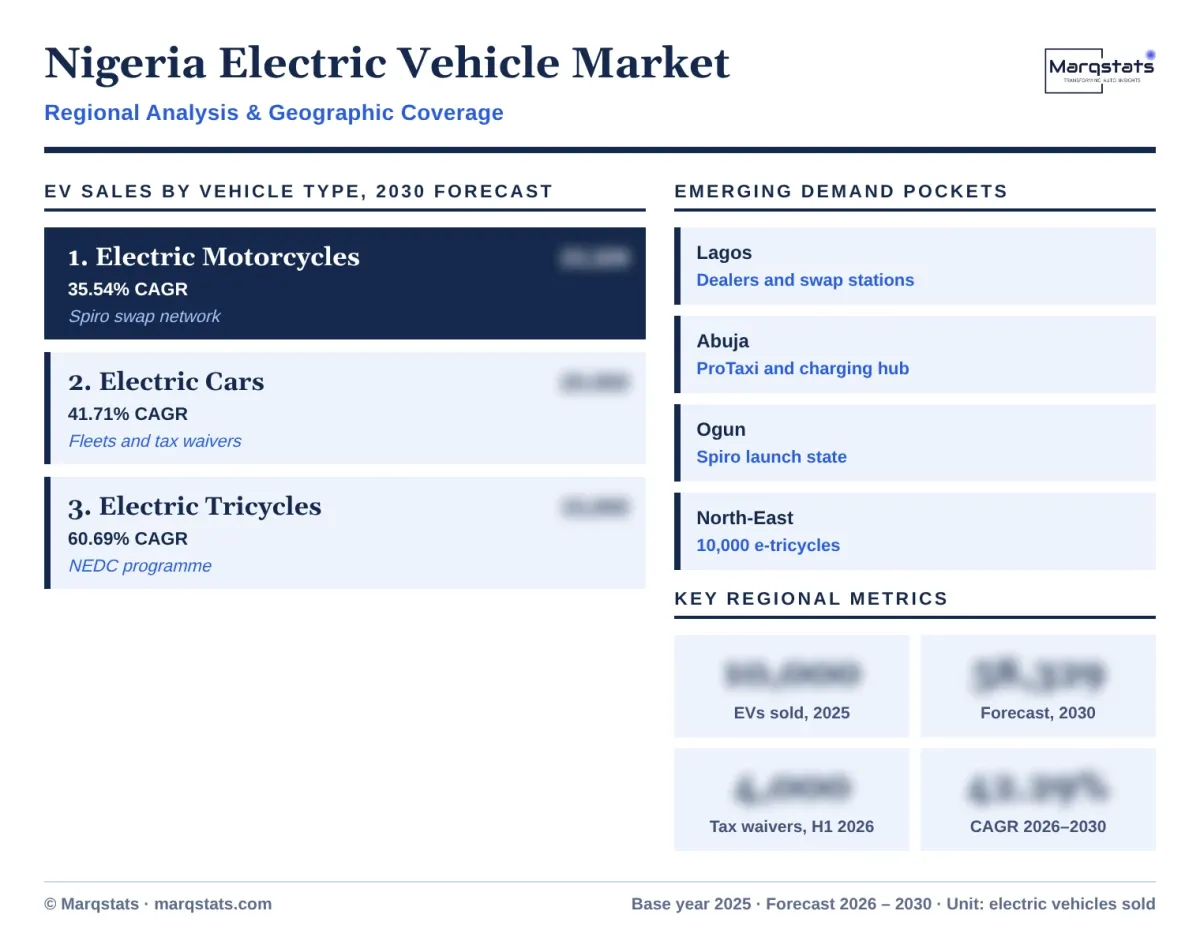
Electric motorcycles, 5,100 units or 51.00% in 2025, lead volumes on price parity and battery swapping. Nigeria has more than 15 million motorcycles, and commercial riders are highly sensitive to fuel costs. Marqstats forecasts 23,329 units in 2030, a 35.54% CAGR, with the share falling to 40.00% as tricycles grow faster; Spiro's 50,000-unit target is treated as upside.
Electric cars, 3,500 units or 35.00%, are boosted by tax waivers and fleet deployments such as ProTaxi. New cars come mainly from Chinese brands such as BYD and Geely through local partners, plus local assembly; Geely's partner Tim Motors says new-energy vehicles are about 2% of its sales. Marqstats forecasts 20,000 units in 2030, a 41.71% CAGR, as fleets and higher-income buyers with home charging adopt.
Electric tricycles, 1,400 units or 14.00%, grow fastest on the federal 10,000-unit programme and commercial keke demand, rising to 15,000 units and 25.72% in 2030, a 60.69% CAGR. Keke operators carry more passengers than motorcycle riders, so their fuel savings are larger. Programme deliveries come in batches, making annual volumes uneven.
Battery EVs dominate units, including all motorcycles and tricycles and most cars. They qualify for zero duty and VAT exemption. Swapping and fleet charging overcome the grid constraint for two- and three-wheelers, while BEV cars depend on home or fleet charging.
EREVs qualify for incentives and suit Nigeria's unreliable power, carrying a small petrol engine to recharge the battery. Their sales doubled in 2026, according to Saglev. They are a bridge technology for private car buyers until public charging improves.
Ride-hailing, delivery and public transport fleets buy most EVs, including ProTaxi, Spiro riders, MAX operators and government tricycle programmes. Their high daily mileage makes operating savings decisive. Fleets also run their own charging and swap networks, which is why commercial use leads the market.
Private buyers are a smaller, higher-income group, mainly in Lagos and Abuja, who can install home charging with solar or generator backup. Car prices range from about ₦12 million to over ₦150 million, according to Nairametrics, and compete with a large used-car market: 2025 passenger car imports were worth ₦1.58 trillion, up 24.64%. Private demand grows as prices fall under zero duty.
By Geography
Lagos
Lagos has the most EV dealers, a large share of Spiro's swap stations and the largest private EV market. High fuel costs, traffic and ride-hailing demand make it the natural first market for private buyers, although charging access remains the limit.
Federal Capital Territory (Abuja)
Abuja hosts ProTaxi's 1,000 EVs, Possible Electric Mobility's large charging hub and federal EV procurement for civil servants. Its planned layout and higher incomes make fleet charging easier to organise than in Lagos.
Ogun
Ogun State hosted Spiro's 2024 launch and received 1,000 more Spiro bikes in April 2026. It is the base of Nigeria's largest electric motorcycle operation and its swap network.
North-East
The North East Development Commission leads the 10,000-tricycle programme and plans electric taxis and buses with supporting charging and maintenance facilities. Delivery depends on public funding and security conditions, so volumes are less predictable than in Lagos or Abuja.
Other States
Niger State partnered with The Alternative Bank and Qoray on a 5,000-unit electric tricycle programme, and about 1,000 electric tricycles were rolled out in Ilorin, Kwara State. State partnerships give EV makers guaranteed early demand.
How Competition Is Evolving
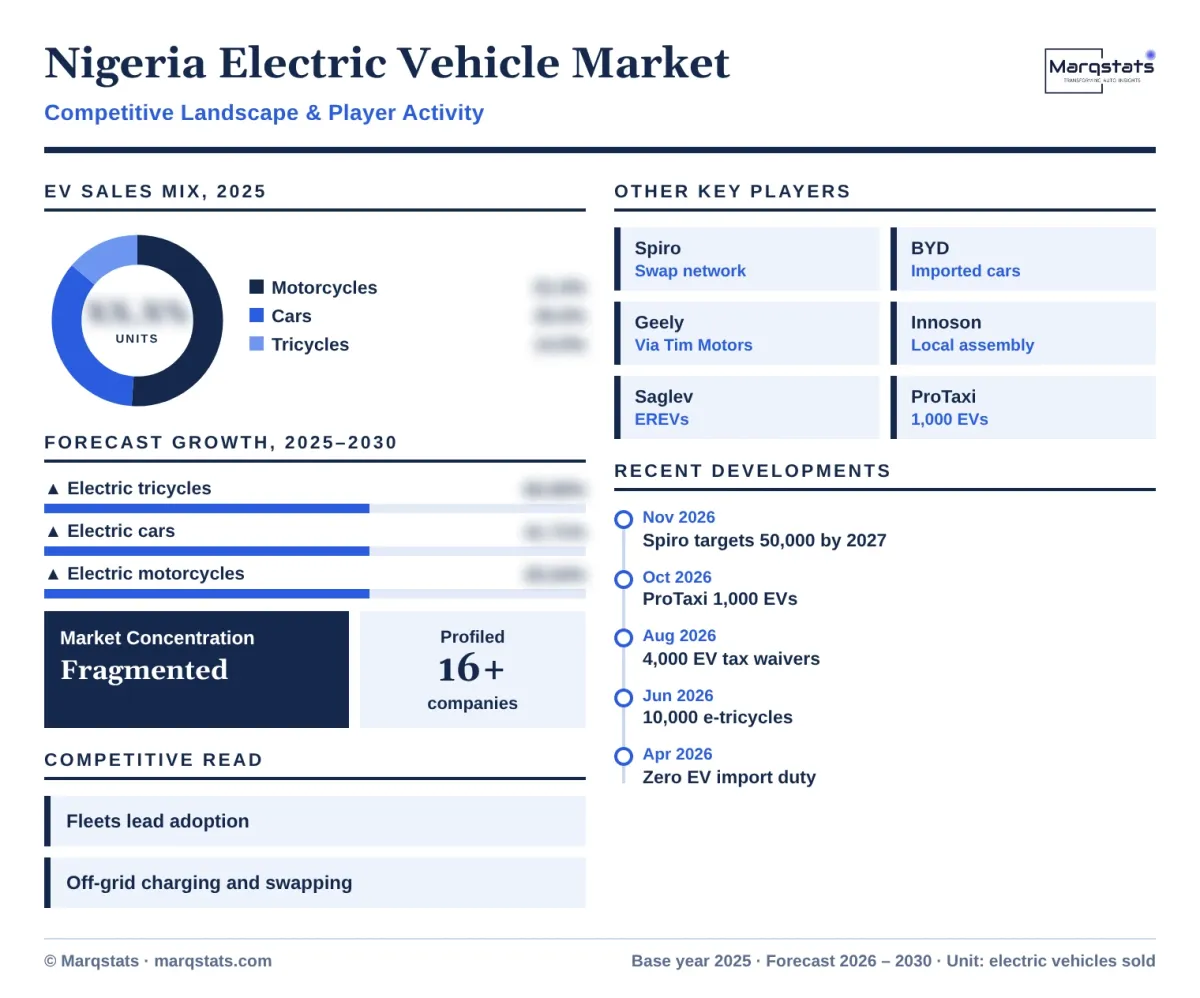
The Nigeria electric vehicle market is fragmented across motorcycles, cars and tricycles, with no player dominant across segments.
Spiro leads electric motorcycles with its battery-swap model; Chinese brands BYD and Geely lead imported cars through local partners.
Local assemblers Innoson, EMVC and Saglev compete on local content, which the pending EV bill would reward.
Fleet platforms such as ProTaxi and MAX are major buyers, giving them influence over vehicle choice.
Companies Covered
Companies covered in the report include:
Recent Market Activity
Table of Contents
Coverage & Segmentation
The study covers new electric vehicles sold in Nigeria by vehicle type, propulsion, end use and region. The base year is 2025, the historical period 2021 – 2025 and the forecast period 2026 – 2030. The unit is vehicles sold.
Three segments and five regions are covered, and 16 companies are profiled. Base and forecast are Marqstats constructions.
Known limits are stated plainly. No official EV sales register exists, and fleet announcements may be delivered in phases.
