Market Snapshot
The global automotive axial flux motor market, covering every axial motor fitted to production cars, stands at 18,000 automotive axial flux motors fitted to production vehicles in 2025 and is estimated at 35,000 motors in 2026. Marqstats forecasts it to reach 109,798 motors by 2030, a CAGR of 43.57% over 2026 – 2030 that adds 91,798 motors between 2025 and 2030.
Europe is the largest market, Battery Electric Performance Vehicles is the fastest growing and Engine-Integrated and Rear-Axle Motors is the dominant segment, in a market that is highly concentrated. The report covers 7 segments and 5 regions and profiles 15 companies, with 2025 as the base year, history from 2021 – 2025 and a forecast for 2026 – 2030.
Key Takeaways
Market Overview & Analysis
Report Summary
The global automotive axial flux motor market covers electric motors in which the magnetic flux runs parallel to the shaft, rather than radially as in conventional motors, used to drive road vehicles: traction motors in battery electric vehicles and the electric machines in plug-in hybrid and hybrid performance cars. The unit is the number of motors fitted to production vehicles. No supplier or industry body publishes a total, so Marqstats builds the figure from vehicle programmes and estimates 18,000 motors in 2025, 35,000 in 2026 and 109,798 by 2030, a CAGR of 43.57% over 2026 – 2030.
An axial flux motor is shaped like a disc. Its rotors sit beside the stator rather than around it, which gives a large lever arm for torque in a short axial length. YASA, whose name stands for yokeless and segmented architecture, uses a stator of separate segments with no iron yoke and two rotors either side, removing much of the iron and weight of a radial machine. The result is a motor much lighter and thinner than a radial motor of the same power, which suits hybrids where the motor must fit between engine and gearbox.
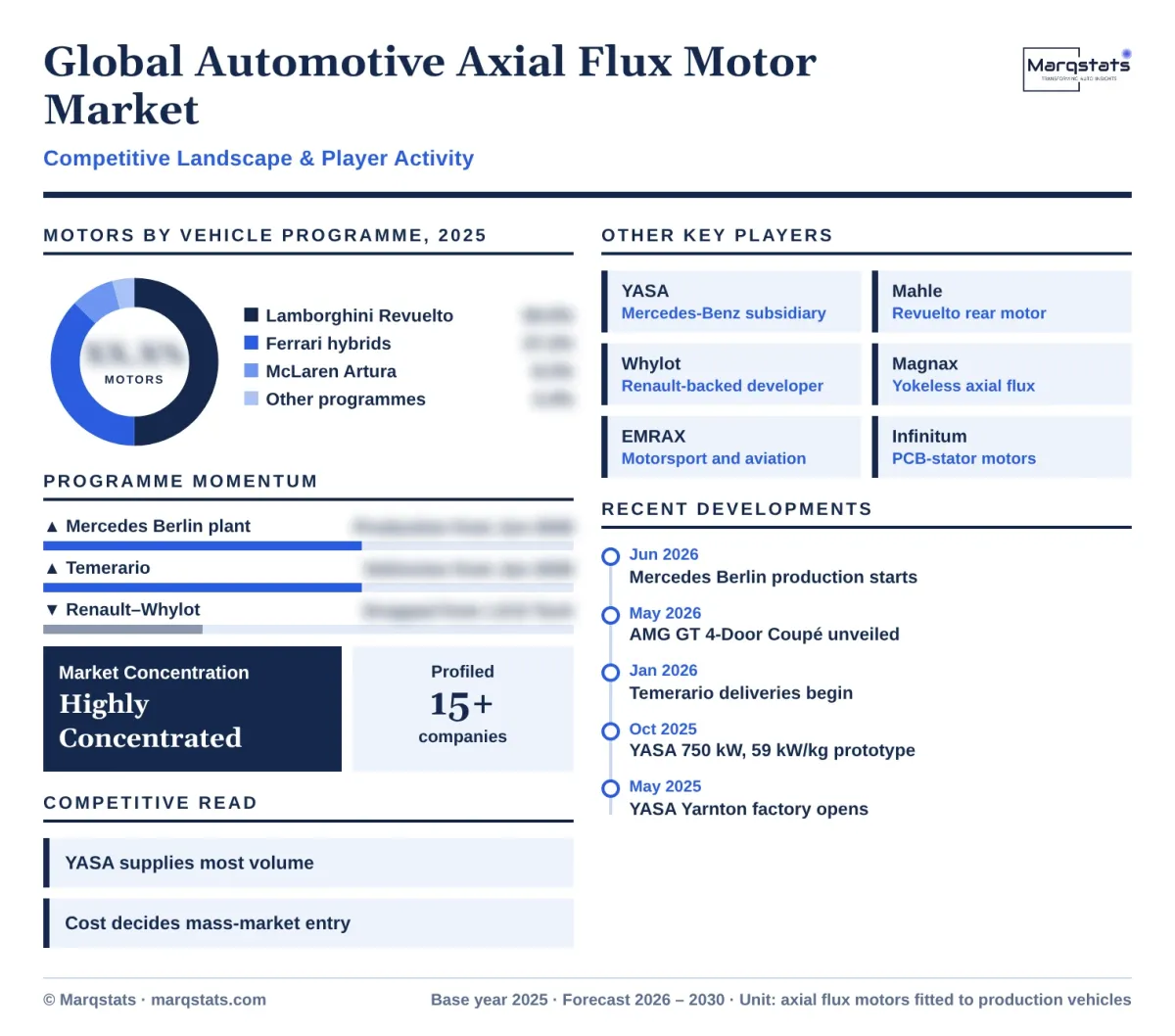
The 2025 market is almost entirely high-performance plug-in hybrids. Ferrari shipped 13,640 cars in 2025, and Marqstats estimates about 6,700 were hybrids with one YASA motor each; the Lamborghini Revuelto, with two YASA front motors and a Mahle rear motor, accounts for an estimated 9,000 motors; the McLaren Artura and specialist programmes add about 2,300. Ferrari shipments and Mercedes-Benz and YASA capacity are disclosed; Revuelto and Artura volumes are estimates.
Axial flux is growing by motors per car, not by mass-market adoption. About 11,600 vehicles carried axial flux motors in 2025, an average of about 1.55 each. The Lamborghini Temerario and the GT 55 and GT 63 versions of the electric Mercedes-AMG GT 4-Door Coupé each carry three, lifting the average toward three. Renault dropped its Whylot motor from the 1.8 E-Tech hybrid on cost grounds, so mass-market hybrids are excluded from the forecast before 2030.
Market Dynamics
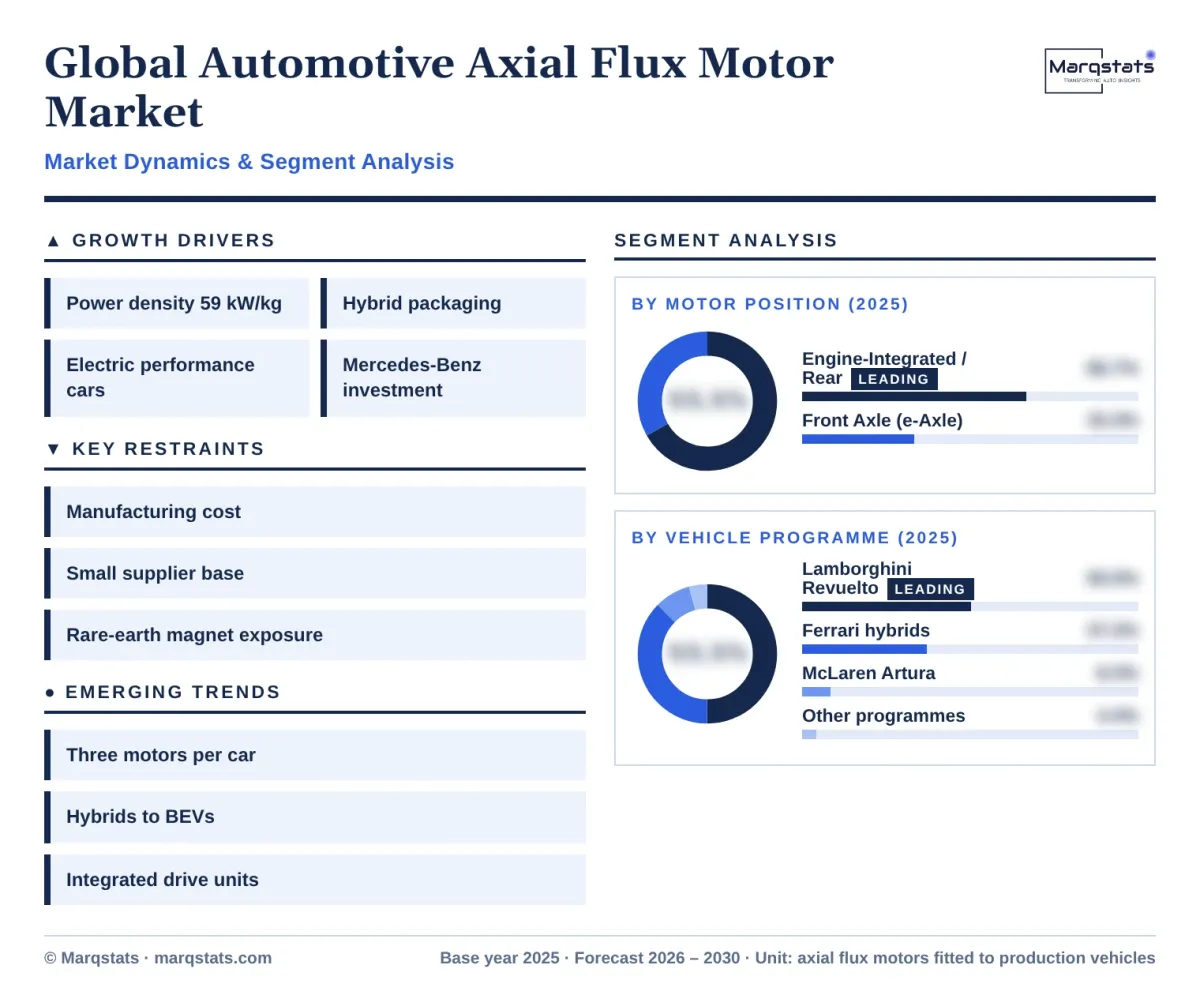
Key Drivers
- Power density: YASA set an unofficial record of 59 kW/kg in October 2025 with a 12.7 kg prototype producing 750 kW, up from 42 kW/kg in mid-2025, which matters most where weight and size are tight. The record motor can deliver an estimated 350 kW to 400 kW continuously, enough to let a single motor do the work of two in many performance cars. Saving weight in the motor allows a smaller battery or better handling, and a thin motor frees space in the drivetrain for gearboxes, cooling or crash structures.
- Performance hybrid packaging: A thin axial flux motor fits between the engine and the gearbox without raising the crankshaft, which is why Ferrari chose one for the SF90 and 296 families, its first volume application coming with the SF90 Stradale in 2019, and why Lamborghini uses them in the Revuelto and Temerario. The packaging advantage is worth the extra cost in supercars, where engine position, centre of gravity and weight distribution decide the car's character.
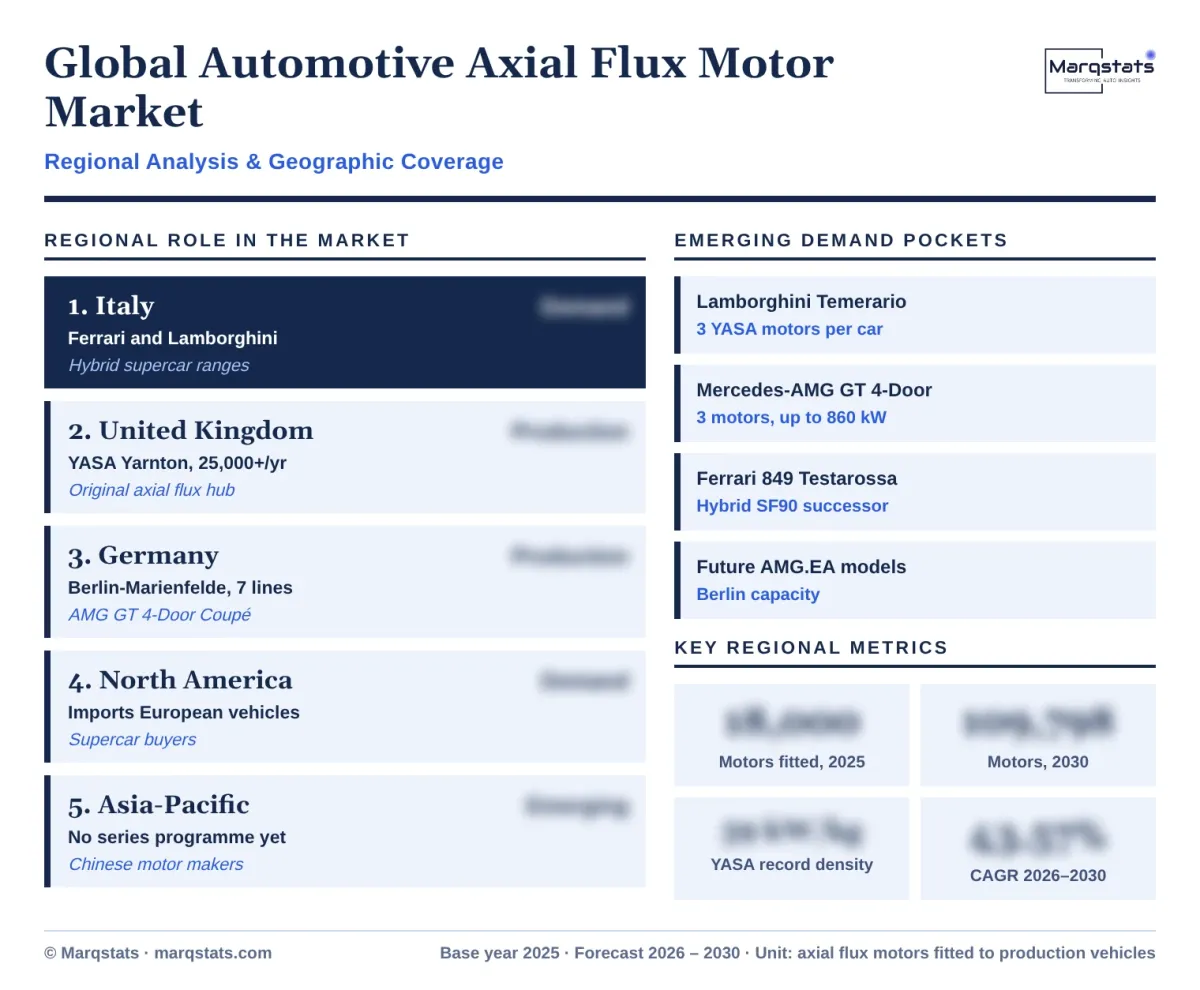
- Electric performance cars: The Mercedes-AMG GT 4-Door Coupé uses three axial flux motors to reach up to 860 kW and 0 to 100 km/h in 2.1 seconds, and Mercedes-AMG plans more models on its AMG.EA platform. The car moved axial flux motors from plug-in hybrid supercars to a battery electric performance car for the first time in 2026. Luxury performance cars are built in larger numbers than supercars, so a single model can need tens of thousands of motors over its life.
- Captive investment by Mercedes-Benz: Mercedes-Benz bought YASA in 2021 and started large-scale axial flux motor production at Berlin-Marienfelde in June 2026, on seven production lines across about 30,000 square metres in three halls. YASA opened an upgraded factory at Yarnton near Oxford in May 2025 after a £12 million investment, able to scale beyond 25,000 motors a year. The production process generated more than 30 patent applications, which Mercedes-Benz can use to defend its position.
- Hybridisation of supercar ranges: Lamborghini completed the hybridisation of its full range in 2025, and Ferrari plans about 40% hybrid and 20% electric models by 2030, keeping demand for compact, light electric machines high. Every new hybrid supercar programme is a candidate axial flux programme, because these cars are where the weight and packaging advantages are worth the extra cost. Lamborghini began Temerario deliveries in January 2026 with an order book covering about twelve months.
Key Restraints
- Manufacturing cost and complexity: Mercedes-Benz needed 98 process steps, 35 of them new worldwide, to industrialise its axial flux motor. The stator cannot be made from the stacked steel laminations used in radial machines, so producers had to develop materials such as soft magnetic composite cores. Renault dropped its Whylot motor because it was too costly to produce for a mass-market hybrid, partly because the Euro 7 emissions standard was relaxed, after taking a 21% stake in Whylot in 2021.
- Small supplier base: YASA supplies Ferrari, Lamborghini and McLaren and most of the automotive volume, Mahle supplies the rear motor of the Lamborghini Revuelto, and specialists such as Magnax, EMRAX, Whylot and Infinitum remain small in automotive volumes. This concentrates supply risk and limits price competition for carmakers outside Mercedes-Benz, which owns the main supplier. Rival carmakers may hesitate to depend on a competitor's subsidiary for a core powertrain component.
- Rare-earth magnet exposure: Most automotive axial flux motors use permanent magnets, so they share the supply and price risk of rare-earth magnets, although some designs use less magnet material because they run cooler. Whylot has said its design needs less rare-earth material for this reason. Export controls on rare-earth magnets since 2025 have made magnet supply a board-level issue for every motor maker, and the axial flux induction motor, which avoids rare earth magnets, remains at development stage.
- Limited volumes outside performance cars: Without a mass-market programme, unit volumes stay in the tens of thousands, which keeps tooling and material costs high. Radial flux motors are made in millions each year, so their suppliers benefit from scale that axial flux producers cannot yet match. Motor prices are not disclosed, and supercar motors include custom engineering, so the market is reported in units and value is treated qualitatively.
Key Trends
- Three motors per car: The Lamborghini Temerario and the Mercedes-AMG GT 4-Door Coupé each use three axial flux motors, so unit demand grows faster than the number of vehicles. A market that adds a few thousand vehicles a year adds tens of thousands of motors, which is why the forecast shows unit growth of 43%, 35%, 30% and 25% a year from 2027 to 2030 while performance car output grows only slowly. The pace of the AMG GT ramp-up and Temerario volume each move the 2030 figure by thousands of motors.
- From hybrids to battery electric vehicles: Axial flux motors moved from plug-in hybrid supercars to a battery electric performance car for the first time in 2026, with the AMG GT 4-Door Coupé, built at Sindelfingen with motors from Berlin. This opens battery electric performance cars as a second demand segment alongside hybrids. Further AMG.EA models and the motor choices in the next generation of Ferrari and McLaren hybrids are the main named programmes that decide growth to 2030.
- Integrated drive units: Mercedes-AMG combines each motor with a compact planetary gearbox in one housing, called a High Performance Electric Drive Unit, which simplifies vehicle integration. In the AMG GT 4-Door Coupé, the front motor is just under nine centimetres wide and each rear motor about eight centimetres. Integrated units reduce the engineering effort for carmakers adopting axial flux motors, which helps the technology spread beyond companies with in-house motor expertise.
- Adjacent markets building scale: Axial flux motors are also used in electric aircraft, boats, motorsport and industrial machinery, and several specialist suppliers earn most of their revenue there; Infinitum in North America works mainly on industrial designs. Volume from these markets helps suppliers spread development and tooling costs, which may eventually make automotive applications cheaper. These markets are excluded from the automotive totals, and no mass-market automotive programme has been announced for production before 2030.
Market Segmentation
Engine-integrated and rear-axle motors made up an estimated 12,000 motors, 66.67% of the 2025 market. They include the YASA motor between the engine and gearbox in hybrid Ferraris, the McLaren Artura motor and the rear motor of the Lamborghini Revuelto supplied by Mahle, and from 2026 the two rear motors of the AMG GT 4-Door Coupé. Almost all are axial flux permanent magnet designs. This position benefits most from the thin profile of the motor, since it must fit in the driveline without raising the engine, and it remains the largest segment through 2030.
Front axle motors made up an estimated 6,000 motors, 33.33% of the 2025 market, mainly the two YASA motors on the front axle of the Revuelto, each rated at 110 kW. They grow fastest in 2026 as the Temerario adds two front motors per car and the AMG GT adds one. Front axle motors give hybrid supercars all-wheel drive and torque vectoring without a mechanical driveshaft, which is why three-motor layouts with two front motors have become common in the latest performance hybrids.
Plug-in hybrid performance cars accounted for almost all axial flux motors in 2025, with Ferrari, Lamborghini and McLaren as the main users. They remain the largest powertrain segment through the forecast as supercar makers keep combustion engines alongside electric motors: Lamborghini now sells only hybrids, and Ferrari plans hybrids for about 40% of its range by 2030. The Temerario's three-motor layout lifts demand per hybrid car above the single motor of most Ferraris.
Battery electric vehicles entered the market in 2026 with the Mercedes-AMG GT 4-Door Coupé, the first series-production battery electric car with axial flux motors, and are the fastest-growing powertrain segment. It is the first production axial flux motor for EV traction at volume, and Mercedes-Benz's ownership of YASA gives the design a captive anchor customer. Future AMG.EA models and Ferrari's planned electric models, about 20% of its range by 2030, are the main sources of growth.
Supercars and hypercars from Ferrari, Lamborghini, McLaren and Koenigsegg made up the market in 2025, where cost is less important than weight, size and power. Ferrari shipped 13,640 cars in 2025, and Lamborghini delivered 3,347 cars in the Americas alone. This class adopted axial flux motors first because its buyers pay for performance, and it remains the base of the market as every new hybrid supercar programme considers the technology.
Luxury performance cars such as the Mercedes-AMG GT 4-Door Coupé bring higher volumes from 2026 and are the main growth segment to 2030. They are built in larger numbers than supercars, so a single model can need tens of thousands of motors over its life, and the GT 55 and GT 63 carry three motors each. Mercedes-AMG plans more models on its AMG.EA platform, and the Berlin plant gives the capacity to supply them.
Mass-market cars are not yet a market for axial flux motors after Renault dropped its Whylot motor from the 1.8 E-Tech hybrid on cost grounds. Whylot claimed its motor was 30% to 40% lighter and used 20% to 30% less energy than a comparable radial motor, so the case for mass-market use rests on bringing production cost down rather than on performance. A mass-market programme from any carmaker would raise the forecast sharply; none has been announced for production before 2030.
By Geography
United Kingdom
The United Kingdom is the original centre of automotive axial flux production. YASA began as a spinout from the University of Oxford in 2009, based on the doctoral research of its founder Tim Woolmer, and builds motors at its upgraded Yarnton factory near Oxford, which can scale beyond 25,000 a year. It employs more than 300 people across Oxford, Bicester and Welshpool. The government's Advanced Propulsion Centre helped fund the original Yarnton facility, and McLaren, an early user, is also based in the UK.
Germany
Germany becomes the largest production location from 2026, as Mercedes-Benz builds axial flux motors on seven lines at Berlin-Marienfelde for the AMG GT 4-Door Coupé assembled at Sindelfingen. It is the fastest-growing country for production through 2030. Mercedes-Benz describes the plant as a centre of excellence for high-performance electric motors, which positions it to supply future AMG models and other brands.
Italy
Italy is the largest market by vehicle demand in 2025, because Ferrari in Maranello and Lamborghini in Sant'Agata Bolognese account for most cars fitted with axial flux motors. The Temerario adds three motors per car from 2026. Ferrari plans hybrids for about 40% of its range by 2030, and Lamborghini now sells only hybrids, so Italian demand for compact electric machines remains strong through the forecast.
North America
North America is a large market for the vehicles that use axial flux motors, with the Americas taking 3,347 Lamborghini deliveries in 2025, and is home to motor developers such as Infinitum that work on axial flux designs mainly for industrial uses. No North American carmaker has announced a series-production axial flux traction motor, so the region imports motors inside European vehicles.
Asia-Pacific
Asia-Pacific buys performance cars with axial flux motors, and Chinese carmakers and motor suppliers are developing axial flux designs, however no series-production programme with disclosed volumes was identified for 2025. Marqstats treats the region as a demand market with limited production in the forecast. China dominates radial motor and magnet production, so a Chinese move into axial flux at scale would be the largest single risk to European suppliers after 2028.
How Competition Is Evolving
The automotive axial flux motor market is highly concentrated. YASA, a subsidiary of Mercedes-Benz Group AG since 2021, supplies most of the motors fitted to production vehicles, including those for Ferrari, Lamborghini and McLaren, and its technology is now produced at scale by Mercedes-Benz in Berlin. Mahle supplies the rear axial flux motor of the Lamborghini Revuelto. Supplier shares are not published, so Marqstats describes the market by named programmes and dated actions rather than ranking companies.
Mercedes-Benz controls the leading technology and uses it in two ways: as a captive advantage for Mercedes-AMG and as a supplier business through YASA. The Berlin-Marienfelde programme, with 98 process steps and more than 30 patent applications, shows how much manufacturing know-how is needed to make the motors in volume, which raises the barrier for new entrants. YASA also keeps its Yarnton factory focused on high-performance customers, so carmakers outside the group can still buy the technology, but they compete for capacity with Mercedes-AMG as its programmes grow.
Specialist developers compete for smaller programmes. Whylot, part-owned by Renault Group, developed an axial flux motor for mass-market hybrids that Renault has so far not put into production. Magnax develops yokeless axial flux motors, Beyond Motors develops axial flux motors for vehicles, EMRAX supplies axial flux motors for motorsport, aviation and specialist vehicles, Evolito focuses on aviation, and Infinitum makes air-core motors with printed circuit board stators for industrial uses. Koenigsegg has developed its own electric motors for its hypercars. Large tier-one suppliers such as Mahle hold the industrial base to scale quickly if a carmaker commits to a high-volume axial flux programme, which would change the competitive picture faster than any start-up could.
Competition will turn on cost. Axial flux motors already lead on power density; the open question is whether a supplier can bring the cost close enough to radial motors to win a mass-market programme before 2030. Until then, access to an anchor performance carmaker is the main competitive asset. Radial flux suppliers are also improving their designs, which narrows the performance gap for all but the most demanding applications.
Companies Covered
Companies covered in the report include:
Recent Market Activity
Table of Contents
Coverage & Segmentation
The study covers axial flux electric motors fitted to production road vehicles worldwide: traction motors in battery electric vehicles and electric machines in plug-in hybrid and hybrid vehicles. The base year is 2025, the historical period 2021 – 2025 and the forecast period 2026 – 2030. The unit is motors fitted. Aerospace, marine, industrial and off-road uses are noted as adjacent markets but excluded from the totals.
Seven segments across three dimensions and five regions are covered, and 15 companies are profiled. The 2025 figure is a Marqstats construction built from disclosed shipments of Ferrari, Lamborghini and other carmakers, disclosed motor counts per vehicle and estimated model volumes. The 2026 estimate and the 2027 to 2030 forecast are Marqstats constructions.
Known limits are stated plainly. Carmakers do not publish model-level volumes for the Lamborghini Revuelto or McLaren Artura; Ferrari disclosed a 49% hybrid share for the first quarter of 2025 but not for the full year; and supplier shares are not published. Value in US dollars is not sized because motor prices are not disclosed.
