Market Snapshot
The global solid-state battery market for EVs, covering every solid state battery EV application from the semi solid state battery to the all solid battery, stands at 6.00 GWh of solid-state batteries for electric vehicles in 2025 and is estimated at 10.00 GWh in 2026. Marqstats forecasts it to reach 94.63 GWh by 2030, a CAGR of 73.61% over 2026 – 2030 that adds 88.63 GWh between 2025 and 2030.
China is the largest market, All-Solid-State is the fastest growing and Semi-Solid-State is the dominant segment, in a market that is moderately concentrated. The report covers 9 segments and 5 regions and profiles 17 companies, with 2025 as the base year, history from 2021 – 2025 and a forecast for 2026 – 2030.
Key Takeaways
Market Overview & Analysis
Report Summary
The global solid-state battery market for EVs covers batteries that replace some or all of the liquid electrolyte in a lithium-ion cell with a solid material, used in electric cars, two-wheelers and other road vehicles. It includes semi-solid-state cells, which keep a small amount of liquid or gel electrolyte alongside a solid one, and all-solid-state cells, which contain no liquid. The unit is gigawatt-hours (GWh) shipped for vehicles. Global solid-state shipments rose from about 5.3 GWh in 2024 to about 8.0 GWh in 2025, up 51.9%, as reported by industry trackers; Marqstats estimates that about 75% went into vehicles, giving 6.00 GWh in 2025, then 10.00 GWh in 2026 and 94.63 GWh by 2030, a CAGR of 73.61% over 2026 – 2030.
Every solid-state battery in a car today is semi-solid. No all-solid-state cell shipped at commercial scale in 2025, and China's recommended standard GB/T 48093.1-2026, published on 28 August 2026 and effective from 1 January 2028, classes semi-solid cells as mixed solid-liquid batteries. Buyers comparing published figures should check whether semi-solid cells are included, since most solid-state totals today consist entirely of them. Marqstats reports both types separately throughout.
All-solid-state timelines cluster around 2027 to 2028: Samsung SDI plans sulfide cell production in Ulsan from the second half of 2027, Toyota targets 2027 to 2028, BYD plans trials in about 1,000 vehicles around 2027 and Nissan aims for its first EV in fiscal 2028. Greater Bay Technology, backed by GAC, began series production on 1 GWh of converted capacity in Guangzhou in October 2026. Even so, Marqstats expects all-solid-state cells to make up only about 10% of EV solid-state demand, around 9.46 GWh, in 2030.
The forecast assumes growth of 100%, 85%, 65% and 55% a year from 2027 to 2030 and sits deliberately below the most optimistic industry projections, because all-solid-state timelines have slipped repeatedly. It rests on announced lines and named vehicle programmes rather than capacity announcements. Value is not sized, since semi-solid prices are negotiated model by model and all-solid-state cells have no commercial price yet.
Market Dynamics
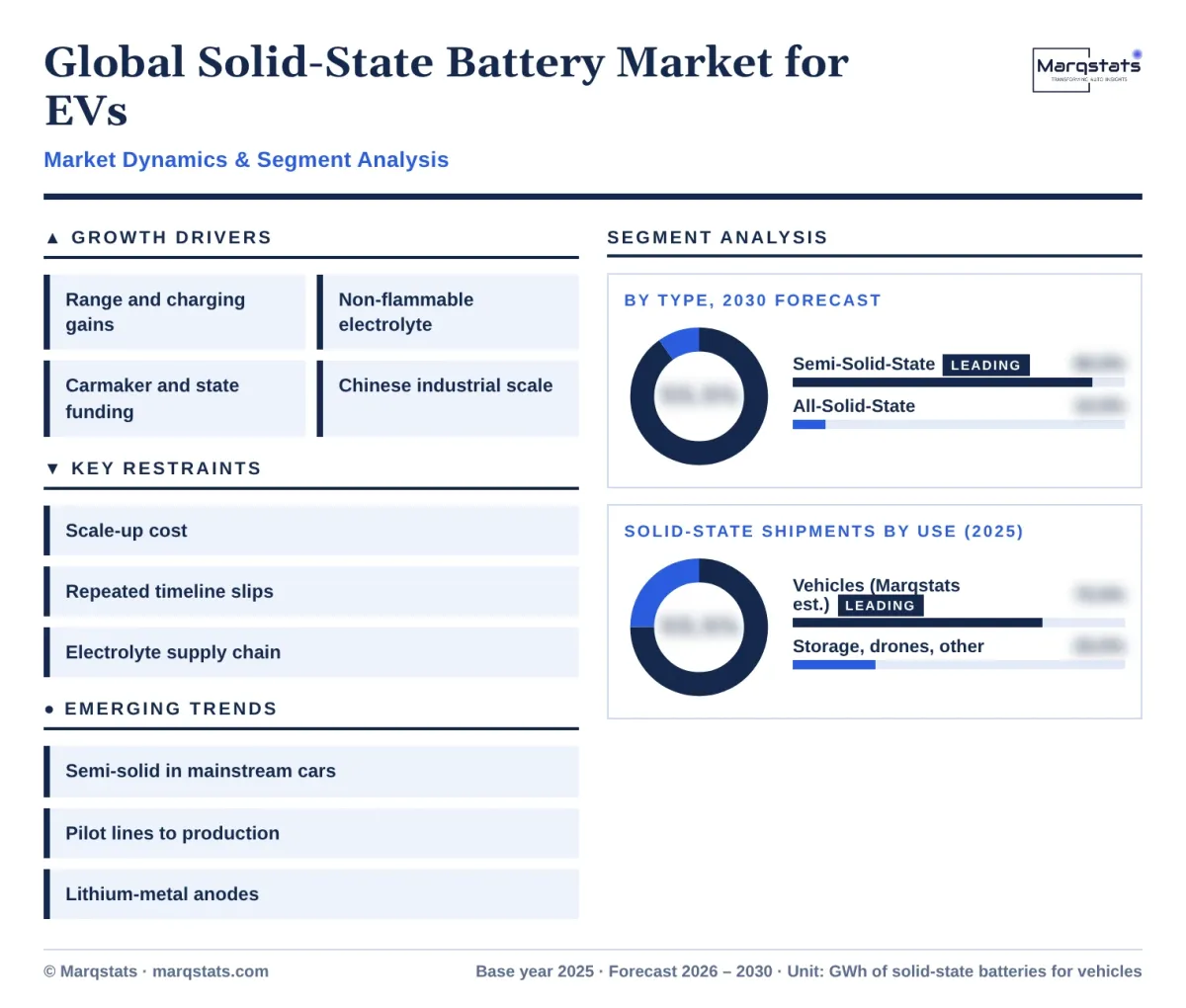
Key Drivers
- Range and charging gains: Solid-state cells promise higher energy density than liquid lithium-ion cells, and some designs allow lithium-metal or anode-free cells that store much more energy than a graphite anode. Nissan expects about twice the energy density of conventional lithium-ion cells, and Factorial's quasi-solid cells powered a modified Mercedes-Benz EQS for 1,205 km from Stuttgart to Malmö on one charge in August 2025. Semi-solid packs already deliver long range in production: WeLion's 150 kWh pack is offered in NIO cars, and premium carmakers use such packs where range justifies the cost premium.
- Safety: Solid electrolytes do not burn like liquid electrolytes, and Greater Bay Technology's A-sample cells survived nail-penetration and thermal-shock tests without fire. China's GB 38031-2025 traction battery safety standard raises the bar on thermal runaway, and solid electrolytes help carmakers meet it with less pack-level protection, while the new solid-state standard sets a 120°C mass-loss test. Lighter packs with fewer safety components also help offset part of the higher cell cost, which strengthens the business case beyond range alone.
- Carmaker and government funding: Stellantis, Mercedes-Benz, Hyundai and Kia back Factorial, Volkswagen's PowerCo works with QuantumScape, and GAC backs Greater Bay Technology. The European Union has approved two battery IPCEIs worth up to €6.1 billion across the value chain, and Korea's K-Battery plan targets 25% of the global battery market by 2030. Public money lowers the cost of pilot lines and gives start-ups time to reach carmaker validation before they need large private investment, while carmaker partnerships give them captive first customers.
- Chinese industrial scale: Chinese companies are commissioning GWh-level solid-state lines, including a 3.5 GWh Qingtao line in Taizhou and a planned Qingtao 5 billion yuan, 20 GWh project in Hohhot, which brings scale earlier than elsewhere. WeLion and Qingtao held nearly half of 2025 shipments, followed by ProLogium, Sunwoda, CATL, Ganfeng LiEnergy and TALENT, as reported. Chinese solid-state capacity announcements far exceed current demand, so production capacity is unlikely to limit adoption in the forecast period.
- Tax and standards support: China exempts qualifying solid-state batteries from a new battery consumption tax from 1 September 2026 to the end of 2028, and its new national standard creates a clear definition for all-solid-state products. The naming matters for marketing and tax treatment, so the standard rewards genuine all-solid-state products and removes the ambiguity that allowed semi-solid cells to be marketed as solid-state. Clear rules support investment in all-solid-state lines over the forecast period.
Key Restraints
- Manufacturing scale-up and cost: Solid electrolytes must keep close contact with the electrodes as they expand and contract, and sulfide electrolytes need dry-room production and new equipment. Sulfide precursors cost dozens of times more than conventional liquid electrolyte materials, as reported in coverage of BYD's programme, and sulfide materials can release hydrogen sulfide gas if exposed to moisture, which adds safety and handling requirements in the factory. Cost targets such as Gotion's 1 yuan per Wh by 2030 describe ambitions rather than market prices.
- Repeated timeline slips: Toyota first planned all-solid-state batteries for 2020, then 2023 and 2026, and now targets 2027 to 2028. QuantumScape aimed in 2020 for commercial production in 2024 and opened only its Eagle pilot line in San Jose in February 2026. Carmakers usually need two to three years of validation before a new cell enters a production model, so any delay at the cell level pushes vehicle launches back further and makes carmakers cautious about committing models.
- Electrolyte supply chain: Lithium sulfide and other solid electrolyte materials are still produced at pilot scale; Chinese lithium producers expect 50-tonne lithium sulfide pilot lines to be completed only by 2026. A thin materials supply chain raises costs and limits the speed at which all-solid-state lines can ramp up, even where cell makers have built equipment. Materials scale-up is therefore as important as cell manufacturing in deciding when all-solid-state volumes arrive.
- Competition from improving liquid cells: LFP and high-nickel liquid lithium-ion cells keep improving in density, charging speed and cost, and BYD's chief scientist expects liquid and all-solid-state batteries to coexist for 15 to 20 years. Each improvement in liquid cells narrows the advantage solid-state cells must deliver to justify their higher cost. A sharp fall in liquid lithium-ion costs would keep solid-state batteries in premium niches beyond 2030.
Key Trends
- Semi-solid cells in mainstream cars: SAIC brought semi-solid batteries to an affordable compact car with the MG4, and the MG 4X launched in May 2026 with a 53.9 kWh semi-solid battery and 510 km of range, moving the technology beyond premium models such as NIO. Dongfeng has said its solid-state battery will enter mass production in the second half of 2026. Volumes follow a small number of model programmes, and a single new model can add more than a GWh of demand in a year.
- Pilot lines becoming production lines: Greater Bay Technology went from A-sample cells in April 2026 to series production on 1 GWh of converted lithium-ion capacity in Guangzhou in October 2026, unusually fast against the usual A-, B- and C-sample cycle. Gotion announced its 400 Wh/kg Jinshi cell in May 2026, and Nissan opened an all-solid-state production line in Yokohama in January 2025. Early all-solid-state volumes go into premium or demonstration vehicles, as with BYD's planned trials in about 1,000 vehicles.
- Western road testing: Stellantis began road testing a Dodge Charger Daytona with Factorial's FEST cells in June 2026, the first automotive integration of the technology in North America, and Nissan stacked 23 cells into a working prototype pack in April 2026. Mercedes-Benz tested Factorial cells in an EQS. Western programmes are moving from laboratory cells to vehicle integration, although North American volumes before 2028 remain limited to test and demonstration fleets.
- Lithium-metal and anode-free designs: QuantumScape pairs a ceramic separator with an anode-free design, Factorial combines a lithium-metal anode with a quasi-solid electrolyte, and Greater Bay Technology plans lithium-metal generations on its new platform. These designs offer the largest density gains and are the hardest to manufacture reliably. Non-vehicle demand from energy storage, drones and consumer electronics helps manufacturers fill early lines, while competing with carmakers for early capacity.
Market Segmentation
Semi-solid-state cells accounted for all 6.00 GWh of the 2025 EV market. They use a solid or gel electrolyte with some liquid, can be built on modified lithium-ion lines and are offered in NIO, SAIC MG and other Chinese models, including WeLion's 150 kWh pack and Qingtao cells in the MG4. Marqstats expects them to remain about 90% of EV solid-state demand in 2030. Their cost premium over standard lithium-ion cells is falling as volumes grow, which helps their spread into mid-priced cars such as the MG 4X. China's new standard will class them as mixed solid-liquid batteries from 2028.
All-solid-state cells had no commercial-scale EV shipments in 2025 and are the fastest-growing segment from 2026, as Greater Bay Technology, Samsung SDI, Toyota, BYD and Nissan move into series production. Marqstats forecasts about 9.46 GWh in 2030, about 10% of the market. Each programme moves through A-, B- and C-sample cells before series production, and early volumes go into premium or demonstration vehicles. Faster yield gains at Chinese lines are the main upside to this segment, while further slips at Toyota or QuantumScape are the main downside.
Sulfide electrolytes offer the highest ionic conductivity and are the main route for Toyota, Samsung SDI, BYD and Nissan. Toyota works with Idemitsu Kosan on sulfide electrolytes, and Solid Power supplies sulfide electrolyte and cells in North America. The trade-offs are dry-room production, expensive lithium sulfide precursors and the risk of hydrogen sulfide release on contact with moisture. Most all-solid-state cells planned for 2027 to 2028 use sulfide electrolytes, which makes lithium sulfide supply the key constraint on this segment's growth.
Oxide electrolytes are stable and safe and are also brittle, which makes thin, defect-free layers hard to produce. They are used in ceramic separators such as QuantumScape's and in many semi-solid cells, where a small amount of liquid electrolyte helps maintain contact with the electrodes. Oxide-based designs therefore account for much of today's semi-solid volume and for QuantumScape's anode-free route, which Volkswagen's PowerCo is industrialising.
Polymer electrolytes are easier to process than ceramics and need higher operating temperatures for good conductivity, which limits their use in passenger cars. They are used in some semi-solid and early all-solid-state designs, and Bolloré's Bluebus already ran on solid lithium-metal-polymer batteries. Polymer routes suit applications such as buses, where operating temperature can be managed, more readily than mass-market cars.
Composite and halide electrolytes combine materials to balance conductivity, stability and manufacturability, as in Greater Bay Technology's organic-inorganic composite system. Greater Bay Technology's rapid move from A-samples in April 2026 to series production in October 2026 shows that composite routes can reach production on converted lithium-ion capacity. Halide electrolytes are at an earlier stage and are being developed by Chinese and other cell makers as an alternative to sulfides.
Graphite and silicon anodes are used in most semi-solid cells today, giving moderate density gains with familiar processes and equipment. This is why semi-solid cells can be made on modified lithium-ion lines and have reached production cars first. Silicon additions raise energy density while keeping the anode chemistry close to existing cells. This segment holds most of the market through 2030, in line with semi-solid cells' expected 90% share.
Lithium-metal anodes offer the largest density gains and are used in Factorial's FEST cells, which Stellantis began road testing in June 2026, and in planned later generations from Greater Bay Technology. Lithium metal can store much more energy than graphite and is prone to dendrite formation with liquid electrolytes, which solid electrolytes are designed to prevent. These cells are at the testing stage, so their volume contribution starts only late in the forecast.
Anode-free designs form the lithium anode during the first charge, as in QuantumScape's cells, removing anode material cost and demanding very stable separators. QuantumScape opened its Eagle pilot line in San Jose in February 2026 and works with Volkswagen's PowerCo on industrialisation. Anode-free designs offer the highest potential density, and they are also the hardest to manufacture reliably, so they remain a small, high-risk segment through 2030.
By Geography
China
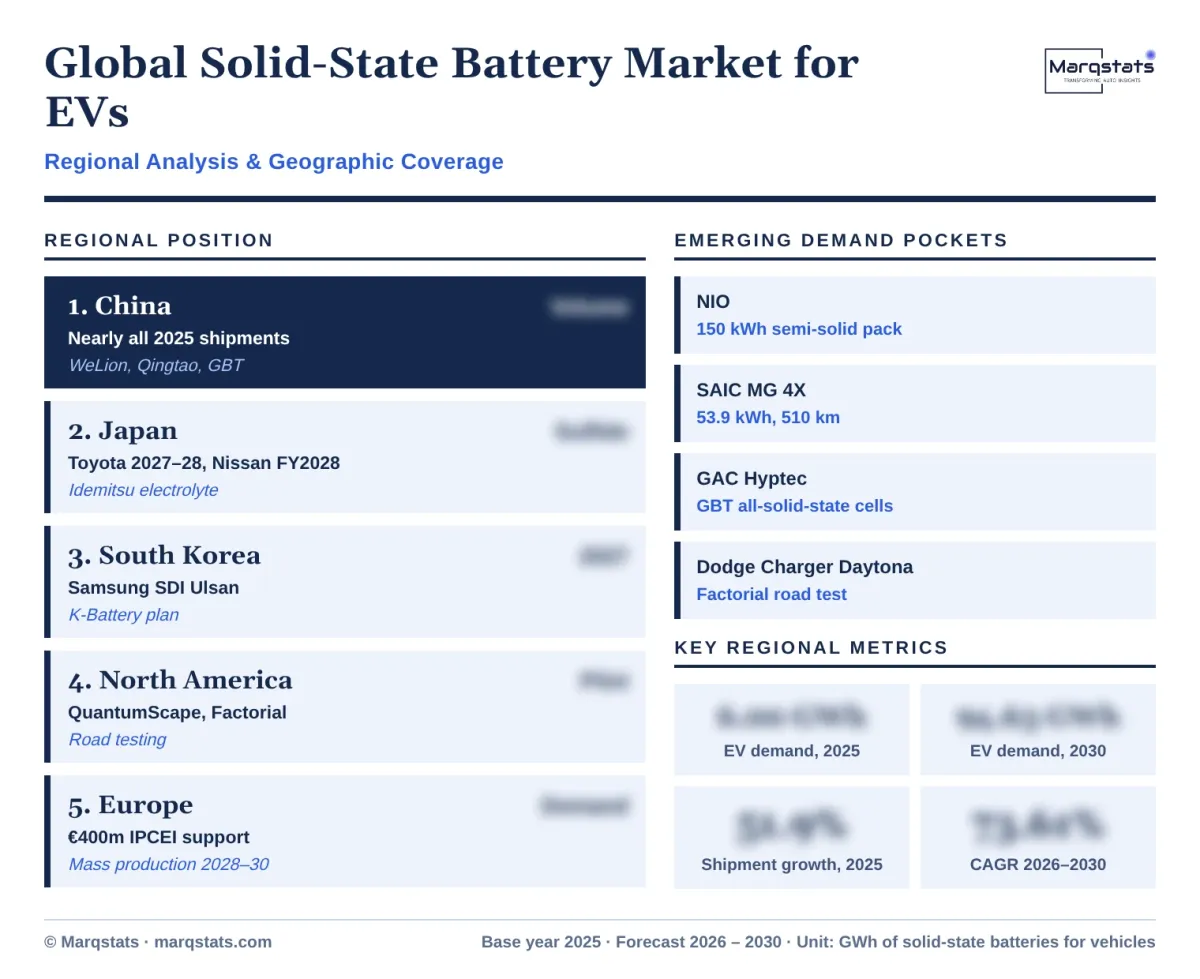
China is the largest market, with nearly all semi-solid EV shipments in 2025. WeLion and Qingtao led shipments, and Chinese carmakers including NIO, SAIC, GAC, Dongfeng and BYD are the main adopters. China also leads all-solid-state scale-up, with Greater Bay Technology in series production from 2026 and Gotion's 400 Wh/kg Jinshi cell announced in May 2026. Tax exemptions and the new national standard give Chinese makers policy support no other region matches.
Japan
Japan leads in sulfide all-solid-state technology. Toyota, working with Idemitsu Kosan on sulfide electrolytes, targets 2027 to 2028, and Nissan opened an all-solid-state production line in Yokohama in January 2025 and targets its first EV in fiscal 2028. Japanese demand stays small until these programmes start. Japan's strengths in sulfide electrolytes and precision manufacturing position it to become a major exporter of all-solid-state cells outside China after 2028.
South Korea
South Korea is home to Samsung SDI, which plans sulfide all-solid-state cell production in Ulsan from the second half of 2027, and to LG Energy Solution and SK On, which run solid-state programmes. The government's K-Battery plan, targeting 25% of the global battery market by 2030, supports the industry. Korean cell makers supply premium carmakers in Europe and North America, which makes them likely early suppliers of all-solid-state cells outside China.
North America
North America hosts the main start-ups. QuantumScape opened its Eagle pilot line in San Jose in February 2026, Factorial is road testing with Stellantis, and Solid Power supplies sulfide electrolyte and cells. US federal funding supported Factorial, Solid Power and others. North American volumes before 2028 remain limited to test and demonstration fleets, and the region's contribution to GWh demand comes late in the forecast.
Europe
Europe is a technology and demand market rather than a production hub. Mercedes-Benz tested Factorial cells in an EQS that drove 1,205 km on one charge, and the EU has approved two battery IPCEIs worth up to €6.1 billion across the value chain. European carmakers are likely to source their first all-solid-state cells from partners in Asia or the United States, as Volkswagen does through PowerCo's work with QuantumScape.
How Competition Is Evolving
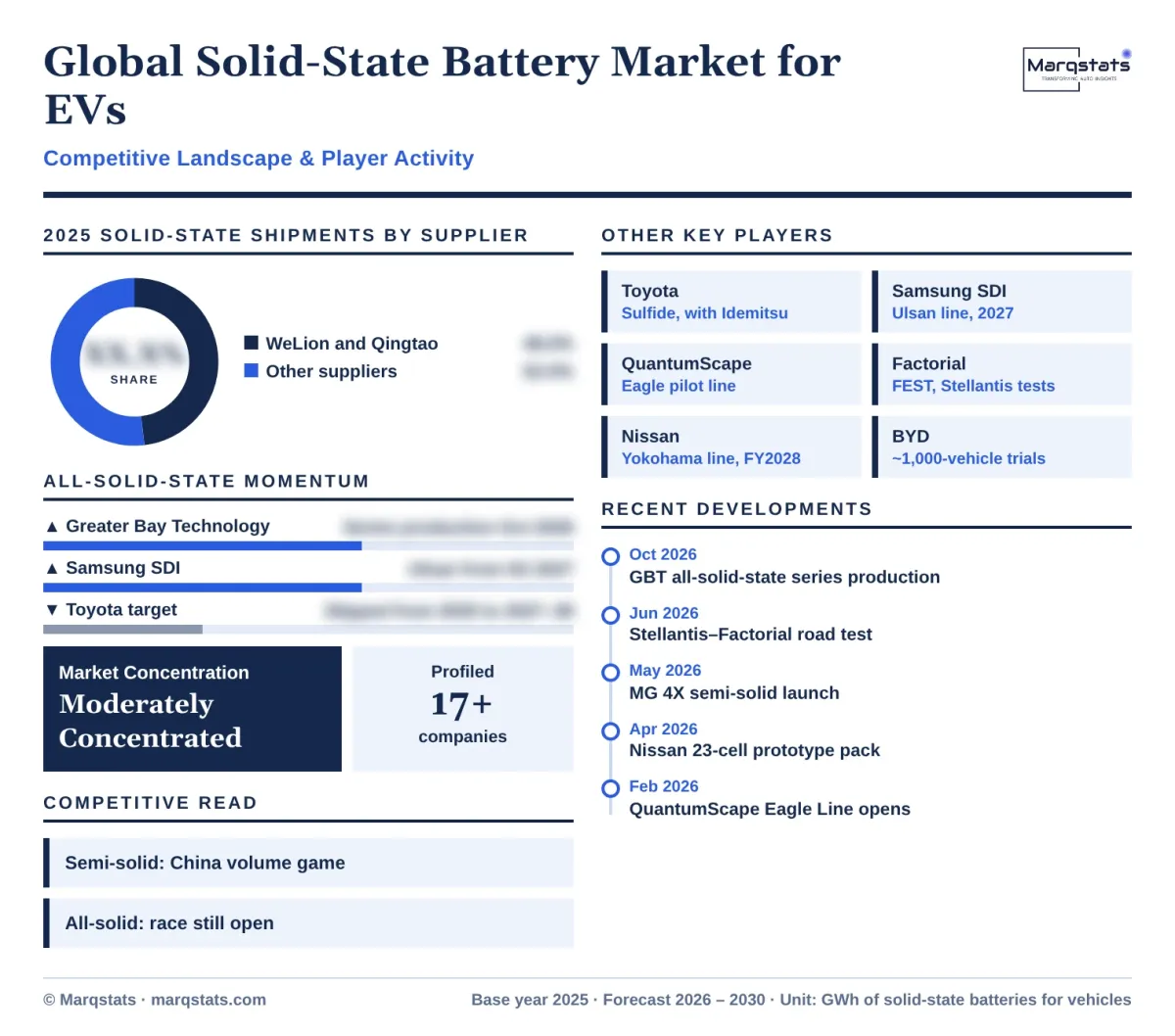
The solid-state battery market for EVs is moderately concentrated today and fragmented in development. In semi-solid cells, WeLion and Qingtao held nearly half of 2025 shipments, followed by ProLogium, Sunwoda, CATL, Ganfeng LiEnergy and TALENT, as reported. In all-solid-state cells there is no commercial volume yet, and dozens of companies compete in pilot lines and prototypes. Marqstats does not publish a market-share ranking because individual shares are not disclosed.
Carmaker partnerships define the race. Toyota develops its own cells with Idemitsu Kosan, Nissan builds its own in Yokohama, BYD develops sulfide cells in-house, GAC backs Greater Bay Technology, and Stellantis, Mercedes-Benz, Hyundai and Kia partner with Factorial. Volkswagen's PowerCo works with QuantumScape. These links mean the first all-solid-state cells will go into captive or partner vehicles, not the open market. The Toyota solid state battery car is planned for 2027-2028, Samsung solid state batteries are being developed by Samsung SDI for premium carmakers, the BYD solid state battery programme is in pilot production, and the QuantumScape solid state battery is being industrialised with Volkswagen's PowerCo.
Chinese firms are moving fastest from pilot to production. Greater Bay Technology began series production on 1 GWh of converted capacity in October 2026, Gotion announced a 400 Wh/kg all-solid-state cell and a cost target of 1 yuan per Wh by 2030, and several Chinese companies commissioned GWh-scale solid-state lines in 2026. Western and Japanese firms focus on higher-performance sulfide and lithium-metal designs with later timelines. The result is a two-speed market: China wins early volume with semi-solid and composite designs, while the highest-performance all-solid-state cells may come from Japan, Korea and the United States later in the decade.
Credibility is now a competitive asset. After repeated delays, carmakers and investors reward companies that show production lines, road tests and customer samples rather than laboratory claims. Public road tests, third-party safety tests and disclosed production yields are becoming the standard evidence carmakers ask for. Programmes with a named carmaker, a production site and a date, such as Samsung SDI in Ulsan, Greater Bay Technology in Guangzhou and Nissan in Yokohama, carry the most weight. Marqstats expects the field to narrow sharply by 2030, as companies without a carmaker partner or a funded production line struggle to raise capital for scale-up.
Companies Covered
Companies covered in the report include:
Recent Market Activity
Table of Contents
Coverage & Segmentation
The study covers solid-state batteries for road vehicles worldwide: semi-solid-state cells, which combine solid and liquid or gel electrolytes, and all-solid-state cells with sulfide, oxide, polymer, halide or composite electrolytes. The base year is 2025, the historical period 2021 – 2025 and the forecast period 2026 – 2030. The unit is GWh shipped for vehicles. Energy storage, consumer electronics and aviation uses are excluded from totals.
Nine segments across three dimensions and five regions are covered, and 17 companies are profiled. The 2025 figure is a Marqstats construction from reported total solid-state shipments and an estimated vehicle share. The 2026 estimate and the 2027 to 2030 forecast are Marqstats constructions.
Known limits are stated plainly. Total 2025 shipments of about 8.0 GWh are as reported by industry trackers and not independently verified; the 75% vehicle share is a Marqstats estimate; individual company shares are not published; and value in US dollars is not sized because cell prices are not disclosed consistently.
