Market Snapshot
The Brazil EV Battery (Bateria Carro Elétrico) Market stands at 5.94 GWh of traction battery capacity in new electrified light vehicles sold in Brazil (Marqstats construction) in 2025 and is estimated at 15.15 GWh in 2026. Marqstats forecasts it to reach 28.95 GWh by 2030, a CAGR of 37.27% over 2026 – 2030 that adds 23.01 GWh between 2025 and 2030.
Southeast is the largest market, Hybrid and Flex Hybrid (HEV) is the fastest growing and Battery Electric (BEV) is the dominant segment, in a market that is highly concentrated. The report covers 3 segments and 5 regions and profiles 16 companies, with 2025 as the base year, history from 2021 – 2025 and a forecast for 2026 – 2030.
Key Takeaways
Market Overview & Analysis
Report Summary
The Brazil EV battery market covers the traction battery capacity installed in new electrified light vehicles sold in Brazil, battery electric vehicles (BEV), plug-in hybrids (PHEV) and conventional and flex-fuel hybrids (HEV and HEV Flex), measured in GWh. No official battery series exists, so Marqstats multiplies 2025 sales by powertrain from the Associação Brasileira do Veículo Elétrico (ABVE) by average pack sizes: 80,178 BEVs at about 48 kWh, 101,364 PHEVs at about 20 kWh and 42,370 hybrids at about 1.4 kWh, giving about 5.94 GWh. Marqstats estimates 15.15 GWh in 2026 and 28.95 GWh by 2030, a CAGR of 37.27%. Mild hybrids, buses, trucks, two-wheelers and storage are excluded.
Brazil's battery demand is running ahead of its battery industry. Demand more than doubles in 2026 as electrified sales reach 436,095 in January to October, almost double the 223,912 of 2025, yet local activity stops at pack assembly, with BYD in Camaçari and Toyota in Sorocaba, while cells are imported. Brazil was the world's sixth-largest lithium producer in 2025, with 20,034 tonnes of lithium content, and still ran a lithium trade deficit of US$450.1 million because it exports spodumene concentrate.
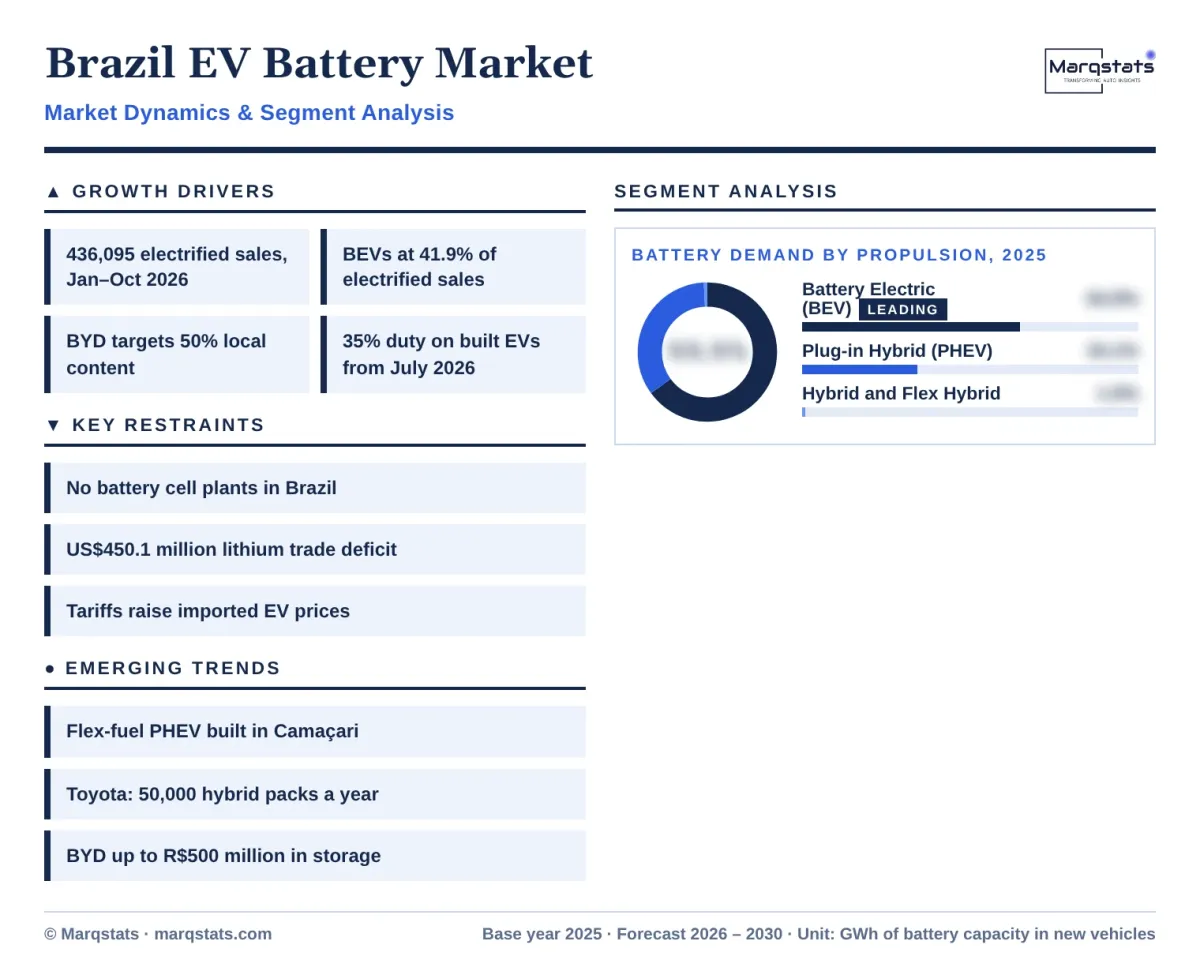
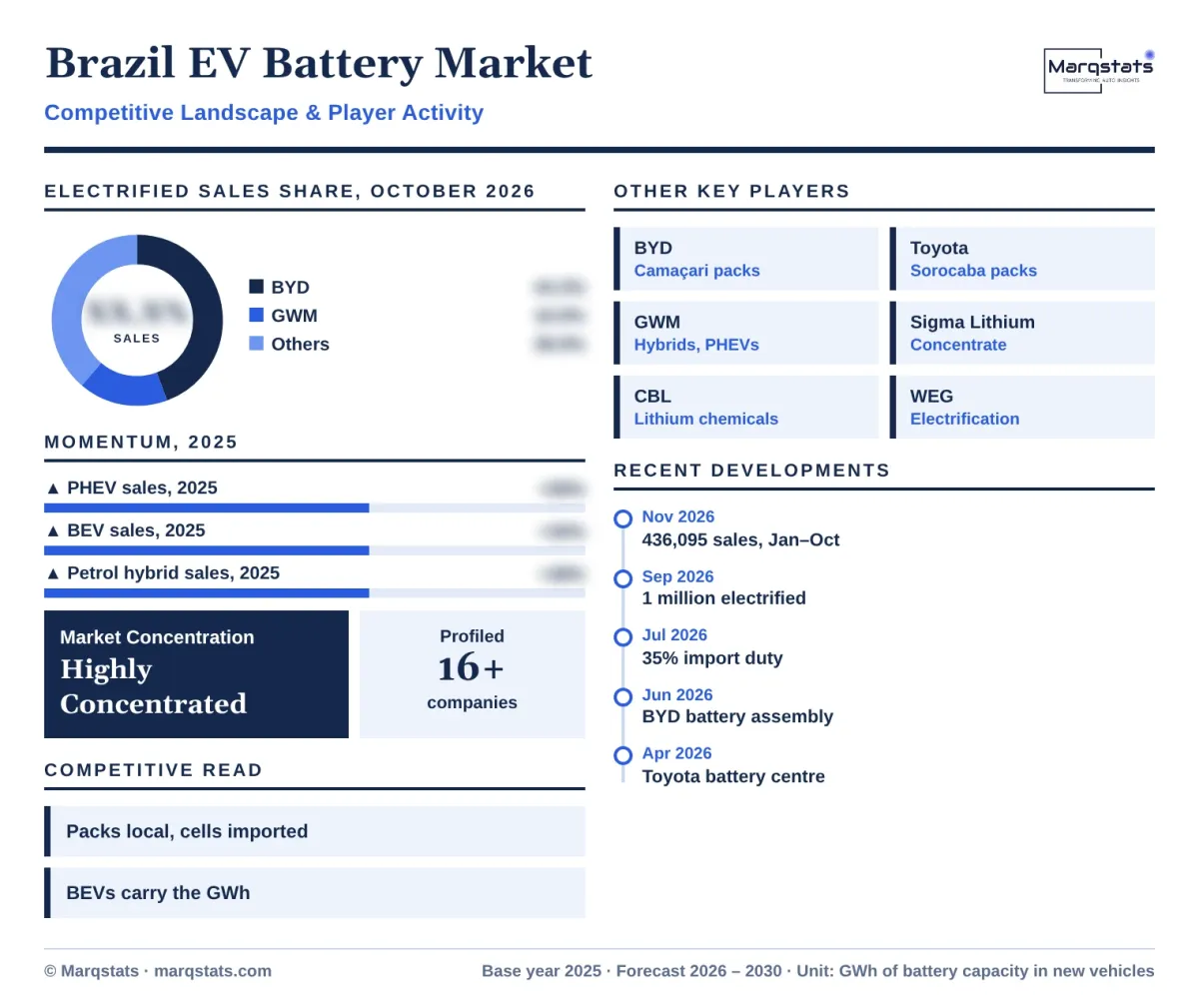
Plug-in hybrids led 2025 unit sales, while battery electric cars already account for 64.87% of battery capacity, because their packs are more than twice as large. The mix is shifting further: BEVs reached 41.9% of ABVE-counted electrified sales in September 2026 and the BYD Dolphin Mini sold 69,061 units in ten months. BYD held 44.26% of electrified sales in October 2026, and import duty on built electrified vehicles reached 35% on 1 July 2026, pushing carmakers to assemble vehicles and packs locally.
Marqstats forecasts 17.81 GWh in 2027, 20.94 GWh in 2028 and 24.62 GWh in 2029, with growth slowing to about 18% a year after 2026 because higher tariffs raise imported prices, local production takes time to scale and the 2026 surge included purchases brought forward. By 2030 BEVs reach 72.54% of capacity. The forecast is a single most likely path, sensitive mainly to pack size assumptions.
Market Dynamics
Key Drivers
- Sales surge: ABVE counted 223,912 electrified light vehicles in 2025, up 26%, and 436,095 in January to October 2026. The electrified share of light vehicle sales reached 19.8% in September 2026, against 9.2% a year earlier, or 23.1% including mild hybrids, and Brazil passed one million electrified vehicles sold in total on 24 September 2026. The number of electrified models on sale rose from 294 in the first half of 2025 to 350 in 2026, widening the buyer base.
- Mix shift: BEVs set a monthly record of 27,166 in August 2026, 47.3% of electrified sales, with plug-in vehicles together at 83.1%, and in September sold 22,246 against 20,202 PHEVs. Because BEV packs are more than twice the size of PHEV packs, each point of share shifting to BEVs adds disproportionately to GWh demand. Small cars such as the Dolphin Mini, at about 38 kWh, have brought BEV prices closer to combustion compacts.
- Local assembly: BYD's Camaçari complex in Bahia, inaugurated on 9 October 2025 in the former Ford plant, had produced more than 150,000 vehicles by November 2026, employed more than 9,500 people and received R$5.5 billion of investment. BYD said in June 2026 that it is expanding battery assembly there as it moves from SKD towards local production, and targets 50% local content by early 2027 and capacity of up to 300,000 vehicles a year by 2028.
- Tariffs: Brazil restored import duty on electrified vehicles from January 2024, with the BEV rate rising from 10% to 18% in July 2024, 25% in July 2025 and 35% on 1 July 2026; PHEVs and hybrids reached the same 35%. Completely knocked-down kits pay 14% until the end of 2026 and 35% from January 2027, and the Foreign Trade Chamber kept a zero-duty quota of US$463 million for kits to the end of 2026. Anfavea said it would challenge that quota.
- Mover programme: Brazil's Mover programme provides incentives for low-emission local vehicle production, complementing the tariff reset in pushing carmakers to build electrified models and packs in Brazil. Toyota is investing R$11.5 billion in Brazil to 2030 and plans flex hybrid versions of all its locally made models. As more Chinese brands assemble locally to avoid full tariffs, demand for locally assembled packs rises, building the base for supplier networks.
Key Restraints
- No cell plants: Brazil imports battery cells, the largest part of battery cost, so local activity is limited to pack assembly and the core technology value is captured abroad. Forecast demand near 29 GWh by 2030, before buses, trucks and storage, would be enough to support at least one mid-sized cell plant if carmakers commit volumes. Until then, local content in batteries remains well below vehicle assembly content.
- Lithium exported: Brazil produced 6.8% of world lithium output in 2025, according to the National Mining Agency, from three mines, with concentrate output in Minas Gerais rising to about 944,000 tonnes in 2024, almost four times 2023. The Vale do Lítio programme has attracted R$6.3 billion, and Sigma Lithium secured US$146 million of offtake-linked financing. Only Companhia Brasileira de Lítio runs a lithium chemical plant, so lithium does not reach Brazilian car batteries.
- Price sensitivity: The July 2026 tariff increase raises prices of imported electrified models, and Brazilian buyers are price-sensitive. Part of the 2026 sales surge reflected buyers bringing purchases forward ahead of higher duties, which is why Marqstats assumes slower growth from 2027. Traditional carmakers Volkswagen, General Motors, Stellantis and Renault still sell mostly combustion and flex-fuel cars, with a limited range of imported electrified models.
- Charging gaps: Brazil's public and semi-public network grew 76.9% to 29,866 points by August 2026, according to ABVE, while it remains concentrated in large cities. Charging coverage determines how quickly buyers shift from PHEVs to BEVs, which in turn sets battery demand per vehicle. Regions outside the Southeast and state capitals depend on PHEVs and flex hybrids, which use smaller packs.
Key Trends
- Flex-fuel PHEVs: BYD builds the Song Pro flex-fuel plug-in hybrid at Camaçari, described by BYD as the world's first flex-fuel PHEV, and is establishing a research centre near Rio de Janeiro to develop flex-fuel plug-in hybrids for Brazilian conditions. These vehicles carry larger packs than flex hybrids and raise PHEV GWh if they gain share. The Song Pro led PHEVs in 2025 with 22,536 registrations, followed by the Song Plus with 16,694.
- Hybrid packs: Toyota do Brasil opened a battery technical centre at Sorocaba in April 2026, the first in Brazil to assemble lithium-ion packs for hybrid passenger cars, with capacity of 50,000 packs a year, initially for the Yaris Cross Hybrid. Flex hybrids use packs of about 1 to 2 kWh, adding little GWh, while letting carmakers build battery assembly skills and supplier networks at low cost. Hybrid sales rose 114.5% to 10,678 in September 2026.
- Small BEVs: The BYD Dolphin Mini sold 69,061 units in January to October 2026, the top electrified model, and BYD had six models in the top ten in October. Small BEVs at about 38 kWh pull the BEV average pack below larger models such as the Dolphin and Yuan Pro; each 5 kWh change in the BEV average moves 2025 demand by about 0.4 GWh, making pack size the key sensitivity. LFP chemistry suits this low-cost segment.
- Storage batteries: BYD plans to invest up to R$500 million in stationary energy storage batteries linked to solar and wind, at a site still to be chosen, and allocates R$50 million to R$60 million to expand electric bus battery lines in Manaus. Brazil registered 636 electric buses in January to October 2025, up 145.6%. Shared cells, supply chains and skills between storage and vehicles help justify future cell investment, and end-of-life packs will create recycling demand later in the decade.
Market Segmentation
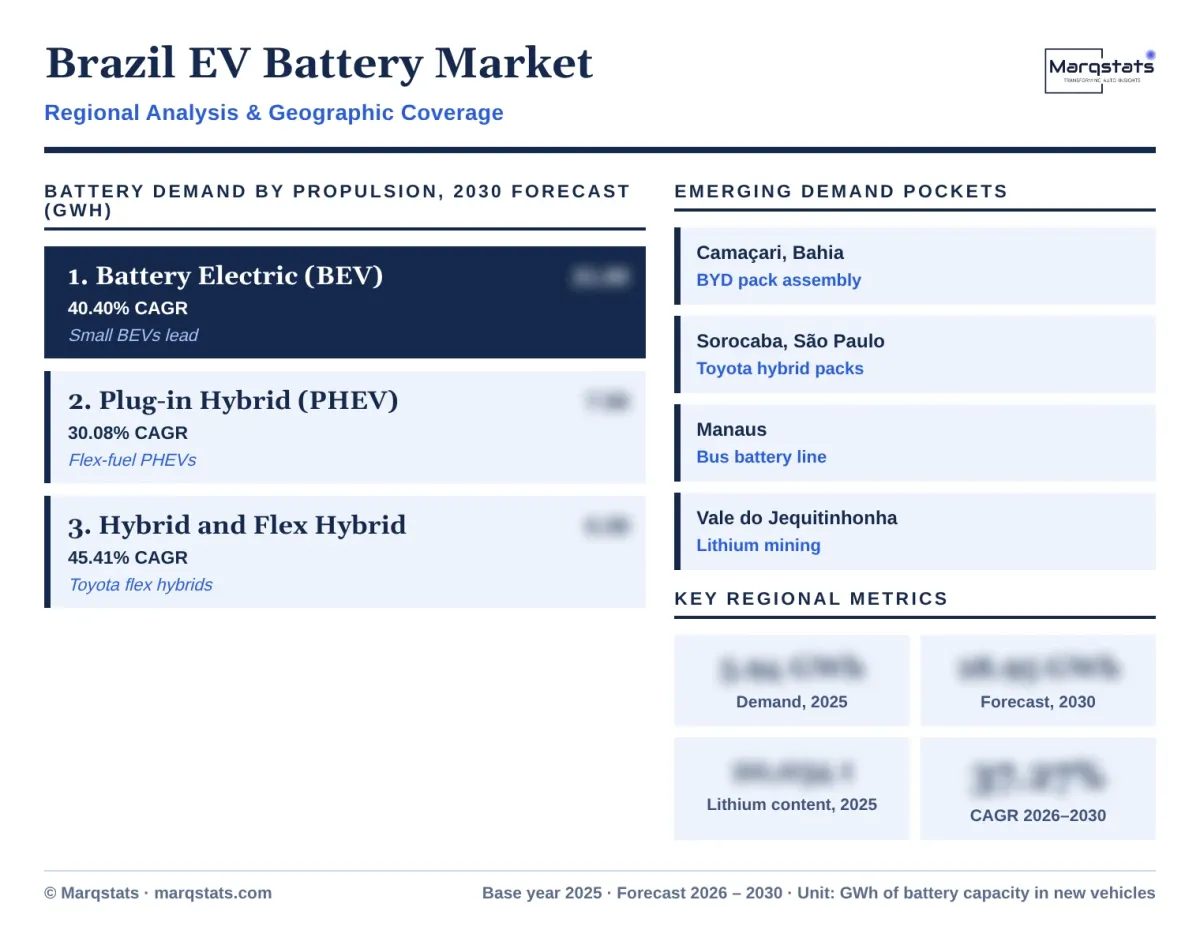
Battery electric vehicles used 3.85 GWh or 64.87% of 2025 demand, from 80,178 sales, up 30%. BYD's Dolphin Mini, Dolphin and Yuan Pro lead, alongside premium imports. Marqstats forecasts 21.00 GWh in 2030, a 40.40% CAGR, as BEV share of sales grows with cheaper models and wider charging.
Plug-in hybrids used 2.03 GWh or 34.13%, from 101,364 sales, up 58% and the largest unit category in 2025. The BYD Song Pro and Song Plus and GWM Haval H6 PHEV lead. Demand reaches 7.56 GWh in 2030, a 30.08% CAGR, while the share of capacity falls to 26.11%.
Hybrids and flex hybrids used 0.06 GWh or 1.00%, from 42,370 sales: 21,323 flex hybrids, up 5%, and 21,047 petrol hybrids, up 38%. They grow fastest, at a 45.41% CAGR, from a small base to 0.39 GWh in 2030. Toyota's flex hybrid strategy and São Paulo state benefits support this segment.
LFP dominates Chinese-brand vehicles, including BYD's Blade battery, and therefore most of Brazil's battery demand. It avoids nickel and cobalt, tolerates heat well and costs less, which suits Brazil's climate and price-sensitive buyers. Brazil's lithium resources fit LFP, making it the logical chemistry for any future local cell plant.
NMC packs appear mainly in premium European and Japanese imports, where higher energy density supports longer range. Their share is small and falls as Chinese LFP models dominate growth. Brazil's nickel resources would support nickel-based chemistries if a cathode industry develops.
Most packs arrive inside imported vehicles or kits from China and other producers. The July 2026 tariff reset raises the cost of this channel for built vehicles, while kits still benefit from lower rates until 2027. Imported packs remain the majority through most of the forecast because cells are not made in Brazil.
BYD Camaçari and Toyota Sorocaba assemble packs from imported cells, and BYD's bus battery lines operate in Manaus. Brazil's lithium battery supply chain remains mostly upstream, in mining rather than cells. Local pack assembly grows with BYD's localisation and Toyota's flex hybrid rollout, adding local content without the core cell technology.
By Geography
Southeast
São Paulo and the Southeast hold most electrified sales and Toyota's Sorocaba battery centre. Minas Gerais hosts Brazil's lithium mines and its only lithium chemical plant, and the Southeast has the densest charging network, supporting BEV demand.
Northeast
Bahia hosts BYD's Camaçari complex, Brazil's main EV and pack assembly site, which had built more than 150,000 vehicles by November 2026. BYD's presence lifts local electrified adoption and supplier activity.
South
The South has high EV adoption in Paraná, Santa Catarina and Rio Grande do Sul, particularly in capital cities. Strong incomes and growing charging coverage support BEV sales.
Center-West
Brasília and Goiás are growing EV markets with new fast charging. Adoption is concentrated in capitals, where charging availability supports larger-pack vehicles.
North
Manaus hosts BYD's electric bus battery line, expanding with R$50 million to R$60 million of investment. Light-vehicle electrified demand in the North remains small and depends mainly on hybrids.
How Competition Is Evolving
The Brazil EV battery market is highly concentrated: BYD's vehicles account for nearly half of electrified sales.
GWM, Toyota, Volvo, Renault and other carmakers supply most of the rest, mainly with imported packs.
Toyota and BYD lead local pack assembly; no cell manufacturing operates in Brazil yet.
Lithium producers such as Sigma Lithium and Companhia Brasileira de Lítio sit upstream but supply export markets.
Companies Covered
Companies covered in the report include:
Recent Market Activity
Table of Contents
Coverage & Segmentation
The study covers traction battery capacity in new electrified light vehicles sold in Brazil by propulsion type, chemistry, sourcing and region. The base year is 2025, the historical period 2021 – 2025 and the forecast period 2026 – 2030. The unit is GWh.
Three segments and five regions are covered, and 16 companies are profiled. Base and forecast are Marqstats constructions from ABVE sales and pack-size assumptions.
Known limits are stated plainly. Pack sizes are assumptions and ABVE does not publish battery capacity.
