Market Snapshot
Middle bar: base-year value × (1 + CAGR), rounded to two decimals. This is a calculated illustration, not a separately researched annual estimate.
The India used electric two-wheeler market size is estimated at USD 88.42 million in 2025 and is projected to reach USD 640.14 million by 2030, growing at a CAGR of 48.58% over 2026 – 2030. Formal resale transactions rise from about 142,450 vehicles to 952,000, a 46.22% annual rate, as the first large wave of electric scooters bought between 2021 and 2024 reaches the end of its first ownership cycle.
Marqstats defines the market as the transaction value of registered, high-speed electric scooters, mopeds and motorcycles that change ownership in India through private sales, used vehicle dealers, online marketplaces and manufacturer certified pre-owned programmes. In rupee terms the market grows from INR 769.23 crore in 2025 to INR 5,569.20 crore in 2030. Values are converted at INR 87.00 per US dollar. Low-speed models that do not need registration, electric three-wheelers, new vehicle sales and scrapped vehicles are excluded.
Electric scooters and mopeds account for an estimated 88.19% of 2025 value, fixed-battery vehicles for 87.33% and unorganised private sales for 76.05%. South India accounts for 38.00% of 2025 value and West India for 34.00%. The study segments the market by vehicle type, battery architecture, sales channel and region.
Key Takeaways
Market Overview & Analysis
Report Summary
Marqstats sizes the India used electric two-wheeler market as the value of formal ownership transfers of registered, high-speed electric two-wheelers. It covers private sales between individuals, sales by independent used vehicle dealers, sales through online marketplaces such as DriveX, BeepKart, CredR and Droom, and manufacturer certified pre-owned and buyback programmes. In 2025 about 142,450 vehicles changed hands at an average price of about INR 54,000, giving a market of INR 769.23 crore, or USD 88.42 million.
The market follows the new vehicle market with a lag of three to four years. New electric two-wheeler sales grew from about 2.3 lakh in 2021 to more than 12.8 lakh in 2025, led by TVS Motor, Bajaj Auto, Ather Energy, Ola Electric and Hero MotoCorp's Vida brand. Marqstats estimates about 2.79 million electric two-wheelers registered up to the end of 2024 were old enough to be resold in 2025, and about 5.1% of them changed owners during the year.
Used electric two-wheelers are priced differently from petrol models. A petrol scooter loses value gradually through mechanical wear that roadside mechanics can repair cheaply. An electric scooter keeps up to half its value in a sealed battery pack whose condition cannot be checked from registration papers or a test ride. Buyers in private sales assume the worst about battery health, which depresses prices for every vehicle that lacks a verified report.
The market is formalising. TVS Motor completed its acquisition of a majority stake in DriveX in December 2024, raising its holding to 87.38%. Ather Energy offers assured buyback of up to 60% of value after three years and 50% after four years, alongside battery subscription plans. Specialist lenders such as Revfin and Vidyut finance used electric two-wheelers using telematics and battery tracking, and start-ups such as Speedioo raised funds in 2026 to build certified pre-owned stores.
The market grew from INR 53.12 crore (USD 6.11 million) in 2021 to INR 108.29 crore in 2022, INR 231.36 crore in 2023 and INR 444.96 crore (USD 51.14 million) in 2024 as early electric scooters reached the resale market. Marqstats expects INR 1,336.16 crore (USD 153.58 million) in 2026 and INR 5,569.20 crore (USD 640.14 million) in 2030.
Battery condition divides used vehicles into clear price bands. Scooters with more than 90% battery health, usually under two years old and with less than 15,000 km, sell close to the top of the market and qualify for the best loans. Vehicles with 80% to 90% health, typical of two- to four-year-old scooters charged at home, sell at discounts of 10% to 15%. Vehicles with 70% to 80% health, often ex-fleet or heavily fast-charged, sell at discounts of 25% to 40% and are rarely financed. Below 70% health, a vehicle is valued mainly on its frame and parts plus the scrap value of the pack, about INR 12,000 to 18,000.
Brand matters more than for petrol models. Scooters from established manufacturers with national service networks, such as TVS, Bajaj and Ather, hold their value well because parts and battery service are available. Vehicles from small or defunct brands, or older lead-acid and uncertified lithium-ion models built before the AIS-156 battery safety rules, can fall below 25% of their original price within three years because replacement packs and electronics are hard to find.
India Used Electric Two-Wheeler Market Size and Forecast
The India used electric two-wheeler market grows from USD 88.42 million in 2025 to USD 640.14 million in 2030, a CAGR of 48.58%. In rupees the market grows from INR 769.23 crore to INR 5,569.20 crore. Marqstats expects INR 2,139.28 crore (USD 245.89 million) in 2027, INR 3,103.00 crore (USD 356.67 million) in 2028 and INR 4,236.96 crore (USD 487.01 million) in 2029.
Volume drives growth. Transactions rise from about 142,450 in 2025 to 238,600 in 2026, 374,000 in 2027, 535,000 in 2028, 728,000 in 2029 and 952,000 in 2030, a 46.22% annual rate, as vehicles sold in the record years from 2023 onwards complete three to four years of first ownership.
Prices rise only slightly. The average transaction price rises from about INR 41,500 in 2021 to INR 54,000 in 2025 and INR 58,500 in 2030. Better-built scooters with larger batteries reach the used market, but competition from new entry-level models priced at INR 85,000 to 95,000 with fresh batteries and full warranties limits how much buyers will pay for a three-year-old vehicle.
The resale rate is the key assumption. Marqstats estimates about 5.1% of eligible electric two-wheelers changed hands in 2025. Each percentage point change in this rate moves 2025 transactions by about 27,900 vehicles and market value by about INR 150 crore. Each INR 2,000 change in the average price moves the 2025 market by about INR 28 crore.
Marqstats tracks four indicators to monitor the forecast: monthly electric two-wheeler registrations, ownership transfers recorded on VAHAN, the share of sales made through certified and organised channels, and loan-to-value ratios offered by lenders on used electric two-wheelers.
The mix of sales shifts towards organised channels. Organised dealers, online marketplaces and certified programmes rise from 21.50% of transactions in 2025 to 38.00% in 2030, and from 23.95% to 41.34% of value, because their vehicles come with battery health reports, warranties and financing. Swappable-battery vehicles rise from 18.00% to 26.00% of transactions, and electric motorcycles from 8.50% to 11.80%.
Depreciation follows a steep curve after warranty expiry. Marqstats estimates a mainstream electric scooter falls from about 55% of its invoice price at 36 months to below 38% at 48 months, as standard three-year battery warranties end and the risk of a pack replacement passes to the next owner. A TVS iQube bought for about INR 1.14 lakh resells for about INR 65,000 after three years and INR 45,000 after five, while an Ather 450X bought for about INR 1.48 lakh resells for about INR 82,500 and INR 58,500. A Honda Activa bought for about INR 76,000 resells for about INR 47,000 and INR 36,000.
Lending shapes how fast the market grows. Banks and mainstream finance companies offer loan-to-value ratios of 75% to 85% on used petrol two-wheelers, but often cap used electric two-wheelers below 50% to 70%, so many buyers pay cash. Marqstats expects loan-to-value ratios on certified vehicles with battery health reports to move closer to petrol levels by 2030 as specialist lenders build repayment records and battery subscription plans spread, adding to transaction volumes in organised channels.
Market Dynamics
Key Drivers
Five forces are turning India's used electric two-wheeler trade into an organised market.
- A large fleet is reaching resale age. More than 12.8 lakh electric two-wheelers were sold in 2025, and H1 FY27 registrations passed 11 lakh, up 73% on the year before. Vehicles bought in the 2022 to 2025 boom will supply the used market through 2030.
- Manufacturers protect resale values. Ather Energy offers assured buyback of up to 60% of value after three years, TVS Motor owns DriveX, and other manufacturers run exchange programmes, because higher resale values make new scooters easier to sell.
- Specialist lenders finance used vehicles. Revfin, Vidyut, Ecofy and other non-bank lenders use telematics, remote immobilisers and battery tracking to lend against used electric two-wheelers that banks avoid.
- Delivery fleets release vehicles. Quick-commerce and delivery fleets replace scooters after 36 to 48 months and 60,000 to 80,000 km, sending refurbished vehicles into the used market.
- Running costs attract buyers. A used electric scooter costs much less to run per kilometre than a petrol scooter, appealing to commuters and gig workers who ride long distances.
Key Restraints
Four constraints hold back prices and liquidity for used electric two-wheelers in India.
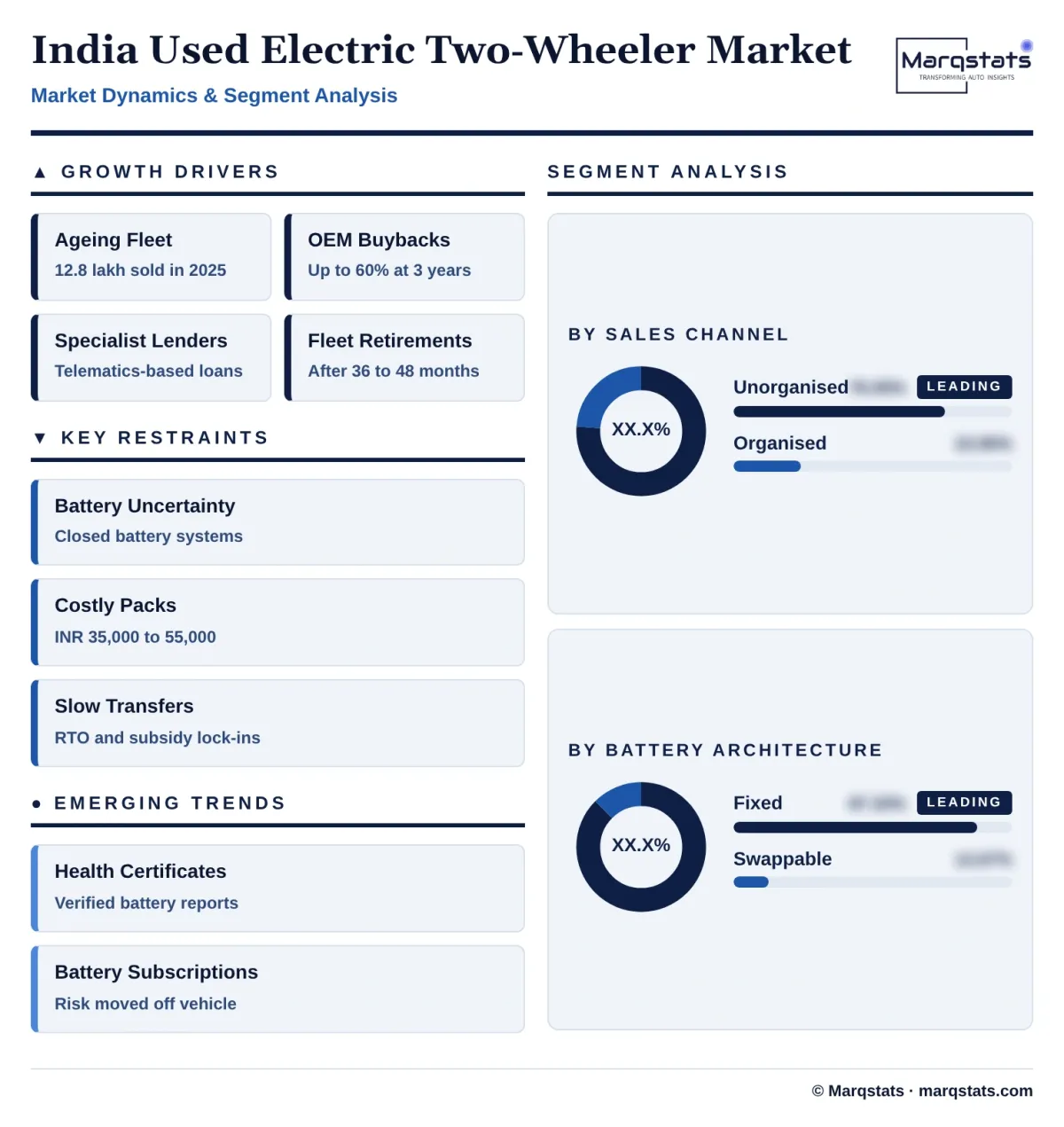
- Battery condition is hard to check. Most electric two-wheelers use closed battery management systems, so independent dealers and buyers cannot read battery health with standard tools, and buyers discount prices to allow for possible degradation.
- Replacement packs are expensive. A replacement battery costs INR 35,000 to 55,000, so vehicles approaching the end of their warranty lose value quickly.
- Ownership transfer is slow. Transfers need RTO paperwork, physical checks of chassis and motor numbers, insurance updates and, in some states, clearance of subsidy lock-in periods, encouraging informal sales without a transfer of title.
- Lending is limited. Banks cap loan-to-value ratios on used electric two-wheelers well below those for petrol models, leaving most buyers to pay cash or use higher-cost lenders.
Key Trends
Four shifts are changing how used electric two-wheelers are inspected, priced and financed.
- Battery health certificates. Organised dealers and manufacturers issue battery health reports with used vehicles, and Ather's battery health scoring supports its buyback programme.
- Battery subscriptions. Ather's battery-as-a-service plans and swapping networks such as those used by Bounce and Yulu separate the battery from the vehicle, making used scooters cheaper and lower risk.
- Refurbishment hubs. Platforms such as DriveX and lenders such as Revfin refurbish and recertify used scooters, including high-mileage fleet vehicles, before resale.
- Online pricing and inspection. DriveX launched AI-based pricing and discovery tools, and marketplaces use digital inspection scores to set prices and offer financing.
Strategic Implications
- For manufacturers, resale value supports new sales. Open battery health data in companion apps, certified pre-owned programmes and buyback guarantees protect brand value and reassure first-time buyers. Honda said in October 2026 that it is studying resale values and battery health before scaling its electric range.
- For used vehicle platforms, inspection is the business. Platforms that test batteries, refurbish packs and offer six- to twelve-month warranties can charge about 15% more than private sellers and reduce returns and disputes.
- For lenders, separating battery and vehicle risk opens volume. Combining telematics, remote immobilisers and battery subscriptions lets lenders offer higher loan-to-value ratios without taking on the full cost of a pack replacement.
- For fleet operators, planned retirement maximises value. Selling vehicles before batteries fall below 80% health, with full service and battery records, keeps them eligible for financing and certified resale.
- For regulators, standard battery health reporting would lift prices. Requiring a battery health readout at ownership transfer would reduce the discount buyers apply to uncertified vehicles and make lending easier.
- For investors, the organised channel is where value concentrates. Organised platforms and certified programmes grow from USD 21.18 million to USD 264.66 million between 2025 and 2030, and businesses that combine sourcing from fleets and dealers, battery refurbishment and point-of-sale financing will capture most of that growth.
- For insurers, battery-aware cover is a gap. Used electric two-wheeler buyers must transfer the five-year third-party policy within 14 days of purchase, and insurers often reassess own-damage cover and battery depreciation at that point, so policies that price on verified battery health can win business from organised platforms.
Market Segmentation
Electric scooters and mopeds account for 88.19% of 2025 value, INR 678.42 crore or USD 77.98 million from about 130,342 transactions, rising to USD 536.84 million by 2030, a 47.09% CAGR, while their share falls slightly to 83.86%. The TVS iQube, Bajaj Chetak, Ather 450 and Rizta, and Ola S1 make up most of the volume.
Electric motorcycles account for 11.81% of 2025 value, USD 10.44 million from about 12,108 transactions, and grow at 58.16% a year to USD 103.30 million and 16.14% of the market by 2030 as models from Revolt, Oben and Ultraviolette reach resale age.
Vehicles with fixed batteries charged on board account for 87.33% of 2025 value, USD 77.22 million, rising to USD 520.65 million by 2030, a 46.48% CAGR, and 81.33% of the market. Their resale value depends directly on battery health.
Vehicles with removable, swappable or subscription batteries account for 12.67% of 2025 value, USD 11.20 million, and grow at 60.56% a year to USD 119.49 million and 18.67% of the market by 2030. The vehicle is sold without the battery risk, so prices are lower and more stable.
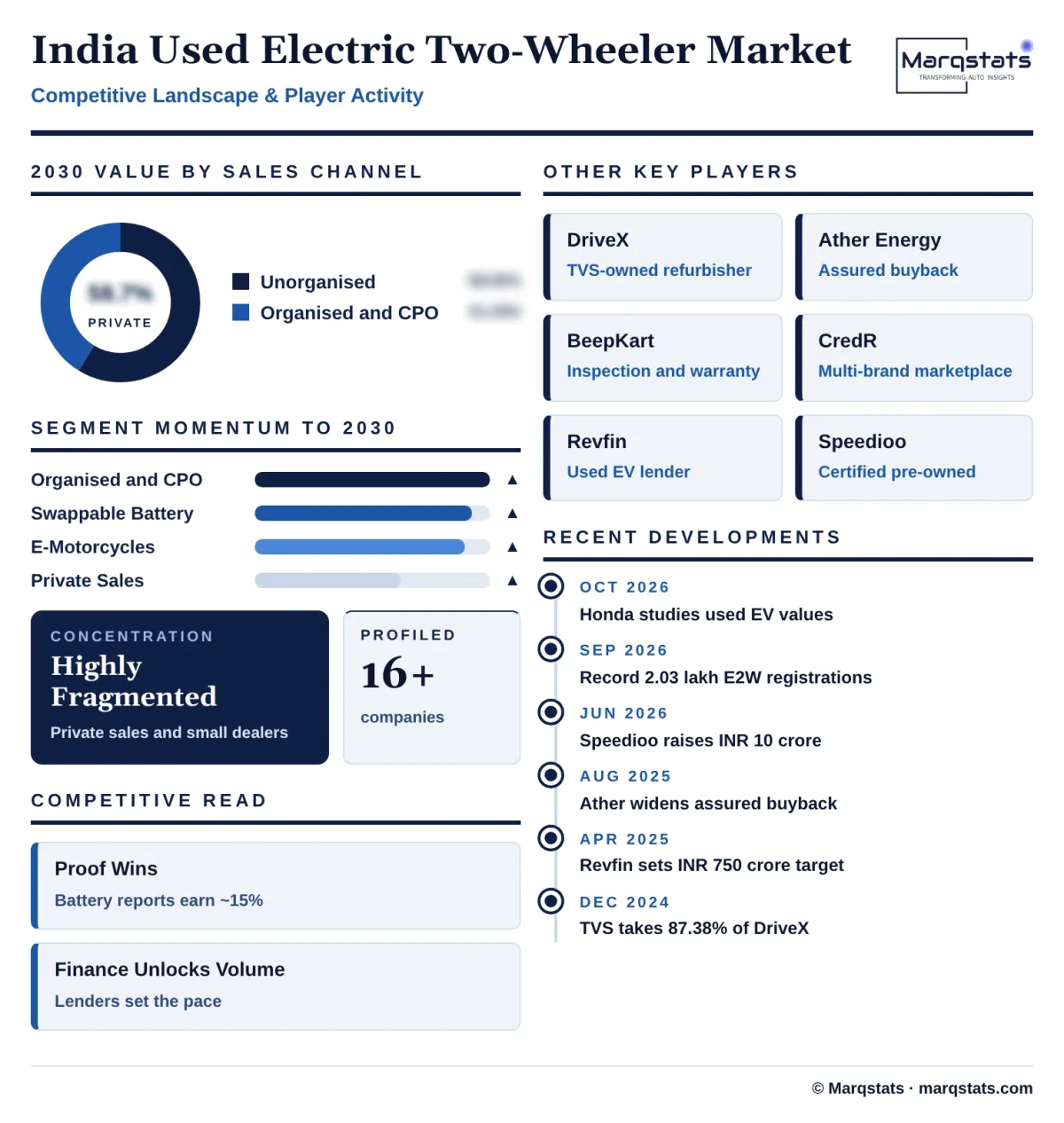
Private sales through classifieds such as OLX and Quikr, local dealers and mechanics account for 76.05% of 2025 value, USD 67.24 million from about 111,823 transactions, and grow at 41.06% a year to USD 375.48 million, while their share falls to 58.66%.
Organised marketplaces and manufacturer certified programmes such as DriveX, BeepKart, CredR and Ather account for 23.95% of 2025 value, USD 21.18 million from about 30,627 transactions, and grow at 65.71% a year to USD 264.66 million and 41.34% of the market by 2030.
By Geography
South India
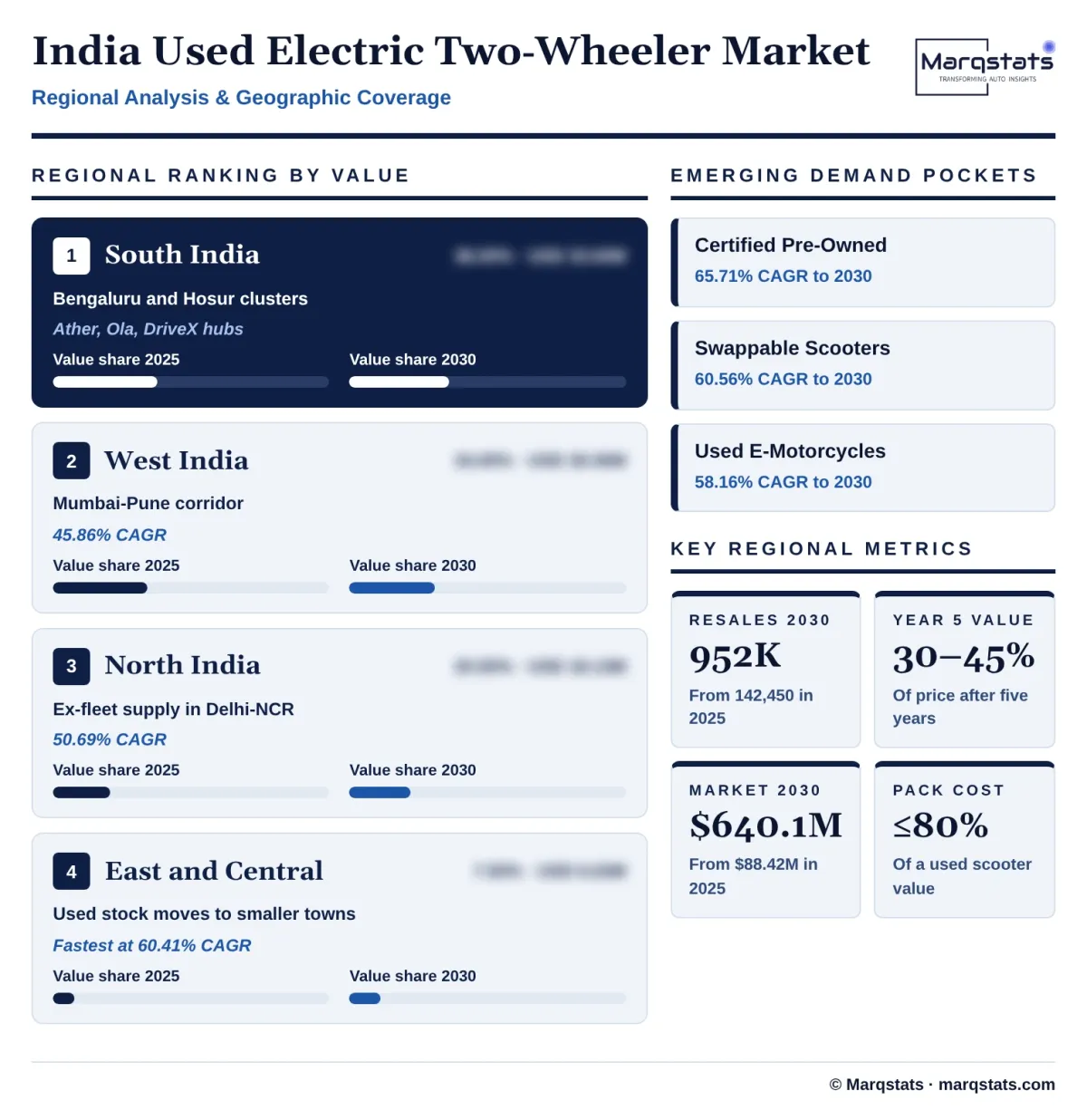
South India is the largest region, with an estimated 38.00% of 2025 value, INR 292.31 crore or USD 33.60 million, rising to USD 230.45 million by 2030, a 46.98% CAGR. Bengaluru is home to Ather, Ola, DriveX and BeepKart, Tamil Nadu has the TVS and Ather plants in Hosur and the Chennai cluster, and Kerala and Telangana have growing used EV dealer networks.
West India
West India accounts for an estimated 34.00% of 2025 value, USD 30.06 million, rising to USD 198.44 million by 2030, a 45.86% CAGR. Maharashtra, led by the Mumbai-Pune corridor and Bajaj Auto's home base, is the largest single state for used electric two-wheeler sales, and Gujarat and Rajasthan add demand in Surat, Ahmedabad and Jaipur.
North India
North India accounts for an estimated 20.50% of 2025 value, USD 18.13 million, and grows at 50.69% a year to USD 140.83 million and 22.00% of the market by 2030. Delhi-NCR and Uttar Pradesh receive many vehicles retired by quick-commerce and delivery fleets, but Delhi's subsidy lock-in rules slow transfers of recently subsidised vehicles.
East and Central India
East and Central India accounts for an estimated 7.50% of 2025 value, USD 6.63 million, and grows fastest, at 60.41% a year, to USD 70.42 million and 11.00% of the market by 2030, as used vehicles move into West Bengal, Odisha, Bihar and Madhya Pradesh and organised platforms open their first outlets.
How Competition Is Evolving
The India used electric two-wheeler market is highly fragmented. Private sales and thousands of small dealers account for about three-quarters of value. Organised platforms such as DriveX, BeepKart, CredR, Droom and Speedioo, and certified programmes run by manufacturers, account for the rest.
Manufacturers are entering the market directly. TVS Motor controls DriveX, Ather runs certified and assured buyback programmes, and Bajaj Auto, Hero MotoCorp and Ola Electric offer exchanges through their dealers and stores.
Lenders shape demand. Specialist lenders such as Revfin, Vidyut, Ecofy and Mufin Green Finance, and large lenders such as Bajaj Finance and Hero FinCorp, decide how many buyers can afford used electric two-wheelers and at what loan-to-value ratio.
Competition will be decided by inspection quality, warranty and finance. Platforms that can prove battery health, refurbish packs and arrange loans at the point of sale will take share from private sales.
Platforms compete on different models. DriveX buys, refurbishes and sells vehicles through company and franchise stores and runs a consumer-to-consumer platform, BeepKart and CredR combine online listings with inspection and warranty, Droom offers algorithm-based valuations, and classifieds such as OLX and Quikr connect private buyers and sellers without inspection. Lenders such as Revfin run their own refurbishment and recertification hubs for ex-fleet vehicles, and battery companies such as Lohum and Trontek provide pack testing and recycling.
Ownership transfer rules affect every channel. Sellers file Forms 29 and 30 to transfer ownership and Form 35 to remove a lender's lien, and the RTO checks the chassis and motor numbers before issuing a new registration certificate. Some states block transfers of recently subsidised vehicles until a lock-in period of 24 to 36 months ends or the subsidy is refunded, and corroded motor number plates on hub motors can delay inspections. Organised platforms that manage this paperwork for buyers and sellers reduce the time and risk of a sale, another reason they gain share.
Companies Covered
Companies covered in the report include:
Recent Market Activity
Table of Contents
Coverage & Segmentation
The study covers the India used electric two-wheeler market, with 2025 as the base year, 2021 – 2025 as the historical period and 2026 – 2030 as the forecast period. Values are in US dollars, converted from Indian rupees at INR 87.00 per US dollar. The market covers the transaction value of ownership transfers of registered, high-speed electric scooters, mopeds and motorcycles. It is segmented by vehicle type, battery architecture, sales channel and region.
Low-speed electric two-wheelers that do not need registration, electric three-wheelers, new vehicle sales, scrapped vehicles and battery replacement services are excluded. Segment and regional value splits are Marqstats estimates built on registration data, platform and manufacturer disclosures, and resale price benchmarks.