Market Snapshot
The India truck leasing market size is estimated at USD 293.01 million in 2025 and is projected to reach USD 769.45 million by 2030, growing at a CAGR of 21.30% over 2026 – 2030. The average leased goods-vehicle fleet grows from about 39,720 vehicles to 93,500, an 18.68% annual rate.
Marqstats defines the market as the annual lease rental revenue earned by lessors on goods vehicles above the three-wheeler class leased in India without a driver: full-service and dry operating leases, finance leases, and fixed-term electric vehicle subscriptions. Rentals are measured before GST and exclude fuel, electricity and driver costs. Loans and hire purchase, where the operator holds title, driver-supplied freight and per-tonne service contracts, buses, three-wheelers and passenger cars are excluded.
Medium and heavy commercial vehicles above 7.5 tonnes account for 50.46% of 2025 value and light and small commercial vehicles for 49.54%. Diesel and CNG vehicles account for 83.30% of 2025 value and electric vehicles for 16.70%, operating leases for 58.00% and West India for 36.00%. The study segments the market by vehicle class, powertrain, lease type and region.
Key Takeaways
Market Overview & Analysis
Report Summary
Marqstats sizes the India truck leasing market as the rental revenue earned in a year on goods vehicles that a lessor owns and an operator uses without a driver supplied by the lessor. In 2025 an average of about 39,720 goods vehicles were on lease and earned about INR 2,549.16 crore of rental before GST, or USD 293.01 million at the 2025 average rate of INR 87.00 per US dollar. Diesel and CNG light and small commercial vehicles contributed USD 114.76 million, electric light commercial vehicles USD 30.40 million, diesel and CNG medium and heavy trucks USD 129.31 million and electric medium and heavy trucks USD 18.54 million.
Most Indian trucks are bought, not leased. The Federation of Automobile Dealers Associations (FADA) reported 10,09,654 commercial vehicle retail sales in calendar 2025, up 6.71% from 9,46,190 in 2024, and Tata Motors Limited alone retailed 3,42,766. The great majority of these vehicles were bought by small fleet owners with loans or hire purchase from banks and non-banking financial companies (NBFCs), which leaves the operator holding title. Marqstats estimates that only about 14,800 goods vehicles, about 1.5% of 2025 retail sales, entered a lease. That share is consistent with ORIX India's statement in January 2025 that leasing accounts for only about 1% to 2% of vehicles sold in India, against 30% to 40% in the United States, Japan and China.
Electric vehicles are the exception. Vahan registration data compiled by EVreporter show 7,556 electric light goods vehicles in the N1 and N2 categories and 419 electric heavy goods vehicles in the N3 category registered from April to November 2025, and e-FAST India, the freight electrification initiative of NITI Aayog, estimates that only about 800 heavy-duty electric trucks were sold in 2025. Vahan counts 11,155 electric light goods vehicles for calendar 2025, and Marqstats estimates about 12,250 electric goods vehicles in all, of which about 2,600 went onto leases. Marqstats estimates that about 908,900 of the vehicles in FADA retail sales were goods carriers, of which about 896,650 were diesel or CNG, and about 12,200 of those were leased. The leased share of new sales was therefore about 1.4% for diesel and CNG goods vehicles and about 21% for electric goods vehicles.
The reason is risk transfer. An electric truck costs much more to buy than a diesel truck of the same class, its battery may need replacement within the vehicle's life and there is almost no second-hand market to set its value at the end of a lease. Vertelo, the electric fleet platform of Macquarie Asset Management, has said that residual value, not range, is emerging as the key risk for electric trucks. A small fleet owner who buys outright carries that risk alone, while a lessor can spread it across a portfolio and price it into the rental.
Lease rentals are set by vehicle class and powertrain. Isuzu Motors India launched a four-year lease for the D-Max S-CAB pickup in May 2026 at a starting rental of INR 38,999 a month with zero down payment, insurance, registration and service included. Marqstats benchmarks average 2025 rentals of about INR 32,000 a month for diesel and CNG small and light commercial vehicles, INR 38,000 for electric light commercial vehicles, INR 1,25,000 for diesel and CNG medium and heavy trucks and INR 3,20,000 for electric medium and heavy trucks, all before GST and excluding fuel and driver.
Tax rules favour leasing for registered businesses. Leasing a goods vehicle without an operator is taxed under GST at the rate that applies to the vehicle itself, and GST 2.0 cut the rate on motor vehicles for the transport of goods from 28% to 18% from 22 September 2025, while electric vehicles stay at 5%. Goods carriages are not on the list of blocked input tax credits, so a registered shipper or logistics company can recover the GST it pays on rentals. Indian Accounting Standard 116 (Ind AS 116) puts most leases longer than 12 months on the lessee's balance sheet, so companies now lease for maintenance, uptime and residual risk transfer rather than to keep debt off the balance sheet.
The market grew from about USD 163.51 million in 2021 to USD 247.89 million in 2024 and USD 293.01 million in 2025, a 15.70% annual rate, as e-commerce and quick-commerce carriers expanded urban delivery fleets and electric light commercial vehicles entered lease portfolios. Marqstats expects USD 358.01 million in 2026, with electric medium and heavy truck rentals more than doubling as the trucks ordered under PM E-DRIVE incentives and by cement, steel and port operators reach the road.
This study measures rental revenue, not vehicle sales. The separate Marqstats India Truck market study values new goods vehicles at the point of sale, and the live Marqstats India Electric Truck Market report values electric truck sales at USD 180.00 million in 2025. The leased trucks counted here are a subset of those vehicles valued as a stream of rentals, so the figures are not comparable and must not be added. Loans and hire purchase on trucks, which finance far more vehicles than leases, are a separate market and are excluded.
India Truck Leasing Market Size and Forecast
The India truck leasing market grows from USD 293.01 million in 2025 to USD 769.45 million in 2030, a CAGR of 21.30%. Marqstats expects USD 358.01 million in 2026, USD 435.88 million in 2027, USD 529.93 million in 2028 and USD 642.82 million in 2029, as the average leased fleet rises to about 46,800, 55,400, 65,800 and 78,800 vehicles.
Revenue grows faster than the fleet because the mix shifts to electric vehicles with higher rentals. The average leased fleet grows at 18.68% a year, from about 39,720 to 93,500 vehicles, while revenue grows at 21.30%. Electric vehicles rise from 15.66% of the leased fleet in 2025 to 50.27% in 2030, and from 16.70% to 52.95% of revenue.
Electric rentals fall as batteries get cheaper, but not fast enough to offset fleet growth. Marqstats expects the average rental for an electric medium or heavy truck to ease from about INR 3,20,000 a month in 2025 to INR 2,60,000 in 2030, and for an electric light commercial vehicle from INR 38,000 to INR 34,000. Diesel and CNG rentals rise by about 2% a year with vehicle prices, to about INR 35,500 for light vehicles and INR 1,38,000 for medium and heavy trucks.
Diesel and CNG leasing keeps growing, but slowly. Diesel and CNG lease revenue rises from USD 244.07 million to USD 362.00 million, an 8.20% CAGR, as corporate shippers and third-party logistics providers keep adding leased pickups and medium trucks for dedicated contracts. Electric lease revenue rises from USD 48.94 million to USD 407.45 million, a 52.79% CAGR, and overtakes diesel and CNG in 2030.
Three indicators decide the path. The first is the monthly Vahan count of electric N1, N2 and N3 registrations, which reached 13,973 electric light goods vehicles and 821 electric heavy goods vehicles from January to July 2026. The second is how quickly lessors such as Vertelo, Drivn and Alt Mobility convert funding into vehicles on the road. The third is whether resale prices for three- to five-year-old electric trucks emerge, which would let lessors cut the risk premium in rentals.
Each 10% change in the 2030 electric medium and heavy truck fleet moves 2030 market value by about USD 21.52 million. A faster rollout of the 5,643 trucks supported by PM E-DRIVE, larger leasing programmes linked to NITI Aayog's PACT platform or tighter urban emission rules would push value above the base path, while a weak resale market or higher borrowing costs for NBFC lessors would slow it.
Market Dynamics
Key Drivers
Six forces are pushing Indian fleet owners from owning trucks towards leasing them.
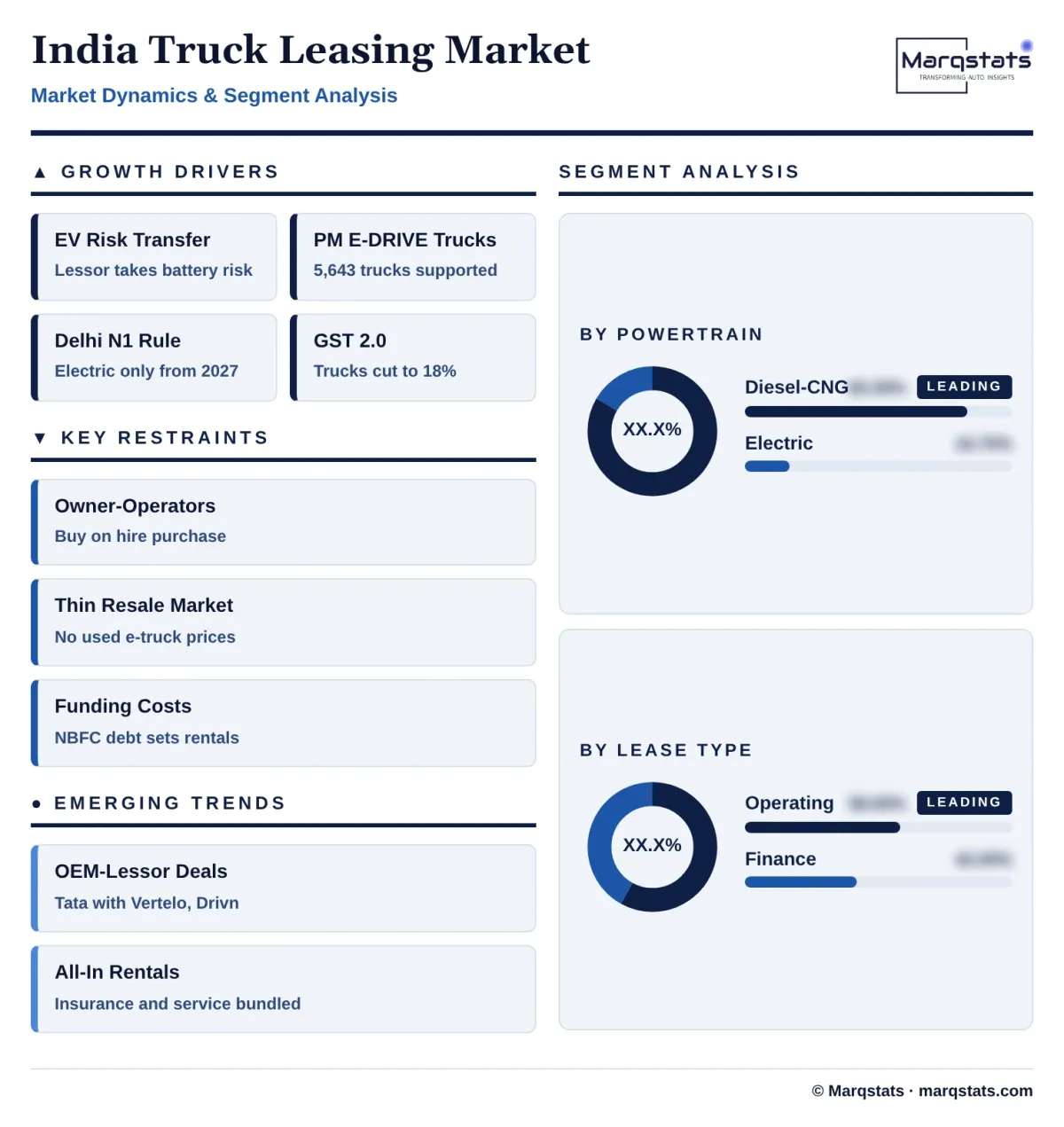
- Electric vehicle risk transfer. Electric goods vehicles cost far more to buy than diesel ones and have no established resale value, so operators prefer leases where the lessor takes battery and residual risk; about 21% of electric goods vehicles sold in 2025 were leased.
- PM E-DRIVE truck incentives. The Ministry of Heavy Industries notified INR 500 crore of incentives in July 2025 for 5,643 electric N2 and N3 trucks, up to INR 9.6 lakh a truck, and extended the scheme to 31 March 2028 for trucks and buses.
- Delhi registration rules. CAQM Direction No. 102 allows only electric N1 goods vehicles to be newly registered in Delhi from 1 January 2027 and only electric N2 vehicles from 1 January 2028, pushing urban carriers into electric fleets they often lease.
- Lower GST on trucks. GST 2.0 cut the rate on goods vehicles from 28% to 18% from 22 September 2025, which also cut the GST on diesel truck lease rentals because leasing without an operator follows the vehicle rate.
- Corporate decarbonisation. Shippers such as UltraTech Cement Limited, which plans more than 600 heavy-duty electric trucks by December 2026 is making electric freight a contract requirement for the carriers and OEMs that serve it.
- New lessor capital. Vertelo closed a USD 405 million raise in July 2025 and received an RBI NBFC licence in November 2025, and ORIX Corporation invested INR 300 crore of equity in ORIX India in March 2025.
Key Restraints
Five constraints keep leasing a small share of how India pays for its trucks.
- Owner-operator structure. Most Indian trucks are bought by small fleet owners on loans or hire purchase, who value holding title and lack the audited accounts that corporate lessors use to approve leases.
- Thin resale market for electric trucks. There is almost no second-hand market for three- to five-year-old electric trucks, so lessors add a risk premium to rentals and shorten lease terms.
- Funding costs. Lessors that are NBFCs borrow at higher rates than banks, and the cost of that debt passes straight into rentals in a market where operators compare the monthly lease with a hire-purchase instalment.
- Charging access on long routes. Electric heavy trucks remain concentrated on fixed routes around plants, ports and depots because highway charging is limited, which caps the number of contracts lessors can write.
- Low utilisation risk. Rentals are fixed while freight demand is not, so a lessee whose contract ends can be left paying for an idle vehicle, which makes small carriers reluctant to sign multi-year leases.
Key Trends
Five shifts are changing who leases trucks in India and on what terms.
- OEM-lessor partnerships. Tata Motors Limited signed leasing agreements with Vertelo in May 2025 and Drivn in August 2026 covering its full electric commercial vehicle range from 7 to 55 tonnes.
- All-inclusive monthly rentals. Leases increasingly bundle insurance, registration, maintenance and telematics into one monthly payment, as in Isuzu Motors India's four-year D-Max S-CAB lease from INR 38,999 a month.
- Corridor demand pooling. NITI Aayog's e-FAST India launched the Platform for Aggregating Clean Transport (PACT) and the Zero Emission Truck Marketplace in September 2026 to pool freight demand that financiers and lessors can underwrite.
- Usage-based service contracts alongside leasing. UltraTech's electric truck contracts with Tata Motors, Ashok Leyland, IPLTech, Energy in Motion and Sany show that large shippers can push electrification through service agreements without becoming lessees.
- Lessors specialising by powertrain. Electric-only lessors such as Vertelo, Alt Mobility and Drivn are building portfolios separate from the car-focused operating lessors, with their own depots and charging plans.
Strategic Implications
- For lessors, residual value management is the business. Building resale channels, battery health data and refurbishment partnerships for three- to five-year-old electric trucks will let lessors cut the risk premium that now keeps rentals high.
- For OEMs, leasing partnerships sell electric trucks. Tata Motors' agreements with Vertelo and Drivn show that a lessor on the order form shortens the sales cycle for vehicles whose price small fleet owners cannot fund.
- For NBFCs, operating leases defend the customer base. Lenders that only offer hire purchase risk losing corporate and electric fleet customers to lessors that bundle maintenance, insurance and residual risk.
- For shippers, contracts can drive electrification without ownership. UltraTech's service contracts show that a shipper can set electric requirements and leave the asset with a lessor or carrier.
- For policymakers, resale certainty unlocks capital. Standard battery health certification and transparent registration data for used electric trucks would lower lessor risk premiums more than further purchase incentives.
Market Segmentation
Leased goods vehicles above 7.5 tonnes account for 50.46% of 2025 value, USD 147.85 million from an average fleet of about 7,920 trucks, rising to USD 396.00 million and 51.47% of value by 2030, a 21.78% CAGR. Diesel and CNG trucks earn USD 129.31 million of the 2025 total and electric trucks USD 18.54 million. Rentals per truck are about four to eight times those for light vehicles, so a small number of contracts with cement, steel, port and container logistics operators generate half of the market. Most diesel trucks in this class are on finance leases from NBFCs, while electric trucks are on operating leases.
Leased goods vehicles up to 7.5 tonnes, including small commercial vehicles and pickups, account for 49.54% of 2025 value, USD 145.16 million from an average fleet of about 31,800 vehicles, and grow at 20.80% a year to USD 373.45 million by 2030. They account for about four in five leased vehicles because e-commerce, quick-commerce, FMCG and parcel carriers use them for urban delivery on dedicated contracts. Electric light vehicles grow from USD 30.40 million to USD 192.28 million as CAQM rules close Delhi registrations to non-electric N1 vehicles from 2027.
Diesel and CNG goods vehicles account for 83.30% of 2025 value, USD 244.07 million, and grow at 8.20% a year to USD 362.00 million, while their share falls to 47.05% by 2030. Corporate fleets keep leasing diesel and CNG pickups and medium trucks for long routes where charging is unavailable, but the leased share of new diesel and CNG goods vehicles stays at about 1% because owner-operators buy with loans.
Electric goods vehicles account for 16.70% of 2025 value, USD 48.94 million, and grow at 52.79% a year to USD 407.45 million and 52.95% of value by 2030, overtaking diesel and CNG. The leased electric fleet grows from about 6,220 to 47,000 vehicles. Electric light commercial vehicles such as the Tata Ace EV and Mahindra Zeo dominate units, while electric heavy trucks from Tata Motors, Energy in Motion, IPLTech Electric and Sany grow fastest in value.
Operating leases, full-service or dry, where the lessor keeps title and residual risk, account for 58.00% of 2025 value, USD 169.95 million, rising to USD 507.84 million and 66.00% of value by 2030, a 24.47% CAGR. Most electric vehicle leases and corporate light commercial vehicle leases from ORIX India, Ayvens India and Quiklyz are operating leases that bundle maintenance, insurance and registration. Their share rises because electric vehicle lessors almost always keep the battery and resale risk.
Finance leases, where most risks and rewards of ownership pass to the lessee and the vehicle is usually bought out at the end of the term, account for 42.00% of 2025 value, USD 123.06 million, and grow at 16.28% a year to USD 261.61 million. They are used mainly for diesel medium and heavy trucks by NBFCs and captive financiers that want leasing tax treatment for corporate customers, and they compete directly with hire purchase.
By Geography
West India
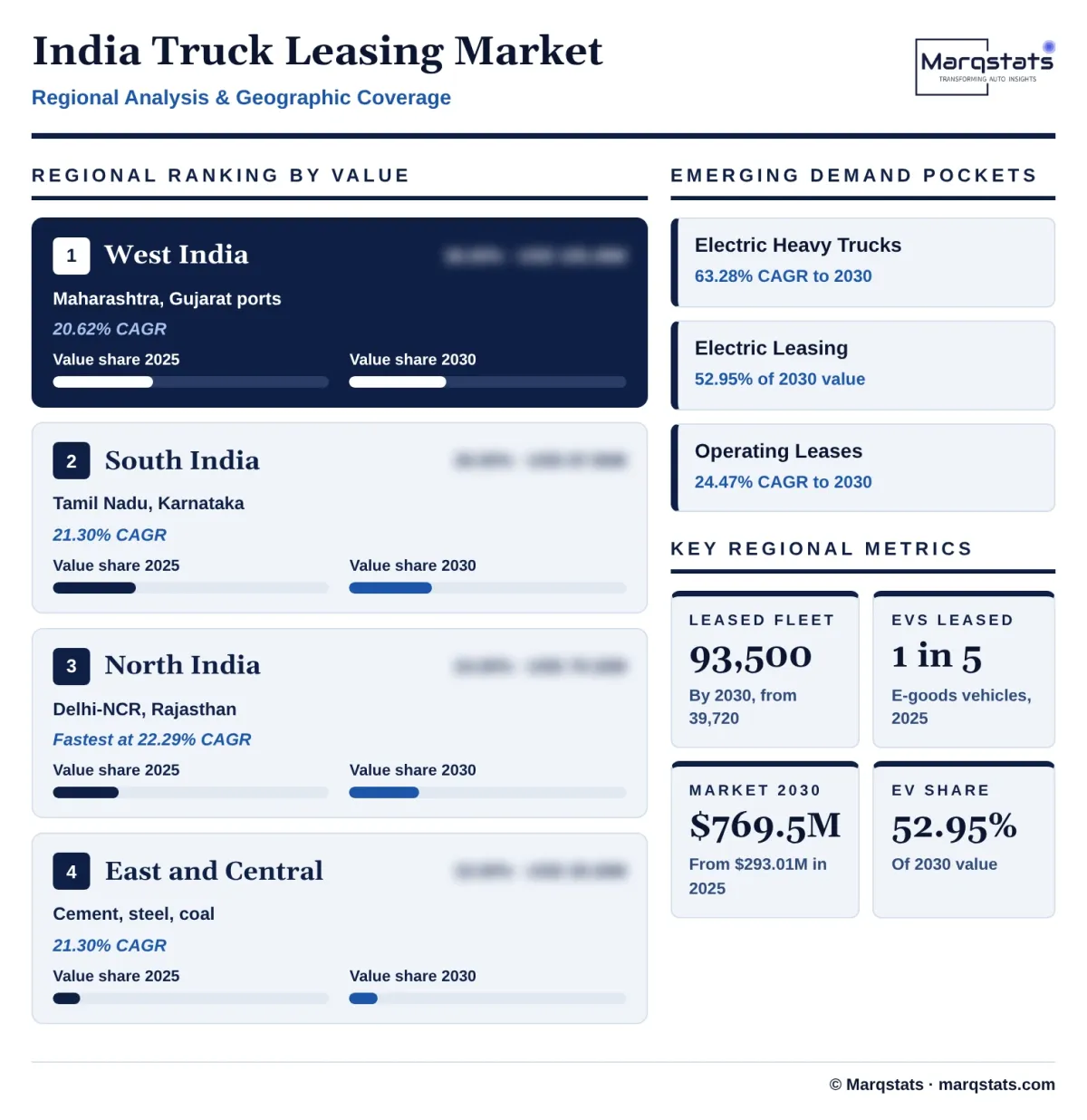
West India is the largest region, with 36.00% of 2025 value, USD 105.49 million, rising to USD 269.31 million by 2030, a 20.62% CAGR, while its share eases to 35.00%. Maharashtra and Gujarat combine the ports of Jawaharlal Nehru Port, Mundra and Hazira, the Pune and Aurangabad automotive belts and the largest warehousing clusters around Mumbai and Bhiwandi. Maharashtra registered 466 of the 821 electric heavy goods vehicles sold in India from January to July 2026, with Energy in Motion and Sany its largest suppliers, and many national lessors register pan-India fleets in the state, so West India's share of registrations overstates where the trucks actually run.
South India
South India accounts for 30.00% of 2025 value, USD 87.90 million, growing at 21.30% a year to USD 230.84 million by 2030. Tamil Nadu and Karnataka were among the top three states for electric small and light commercial vehicle sales from January to July 2025, alongside Maharashtra, and Chennai and Bengaluru host the largest e-commerce, automotive and electronics supply chains in the region. Vertelo runs depots in Chennai and Coimbatore, and corporate lessors are concentrated in Bengaluru, Chennai and Hyderabad.
North India
North India accounts for 24.00% of 2025 value, USD 70.32 million, and grows fastest, at 22.29% a year, to USD 192.36 million and 25.00% of value by 2030. Delhi-NCR is India's largest urban delivery market, and CAQM Direction No. 102 allows only electric N1 goods vehicles to be newly registered in Delhi from 1 January 2027, with Gurugram, Faridabad, Sonipat, Ghaziabad and Gautam Buddha Nagar following from 1 July 2027 and electric-only N2 registrations in Delhi from 1 January 2028. Rajasthan registered 1,678 electric light goods vehicles from January to July 2026, more than Delhi.
East and Central India
East and Central India account for 10.00% of 2025 value, USD 29.30 million, and grow at 21.30% a year to USD 76.94 million by 2030. Freight in Odisha, Jharkhand, Chhattisgarh, Madhya Pradesh and West Bengal is dominated by coal, iron ore, steel and cement, carried mostly by owner-operators who buy trucks on loans. UltraTech's electric truck programme includes Madhya Pradesh, Chhattisgarh and Odisha, which makes cement and steel plant logistics the main entry point for leased electric heavy trucks in the region.
How Competition Is Evolving
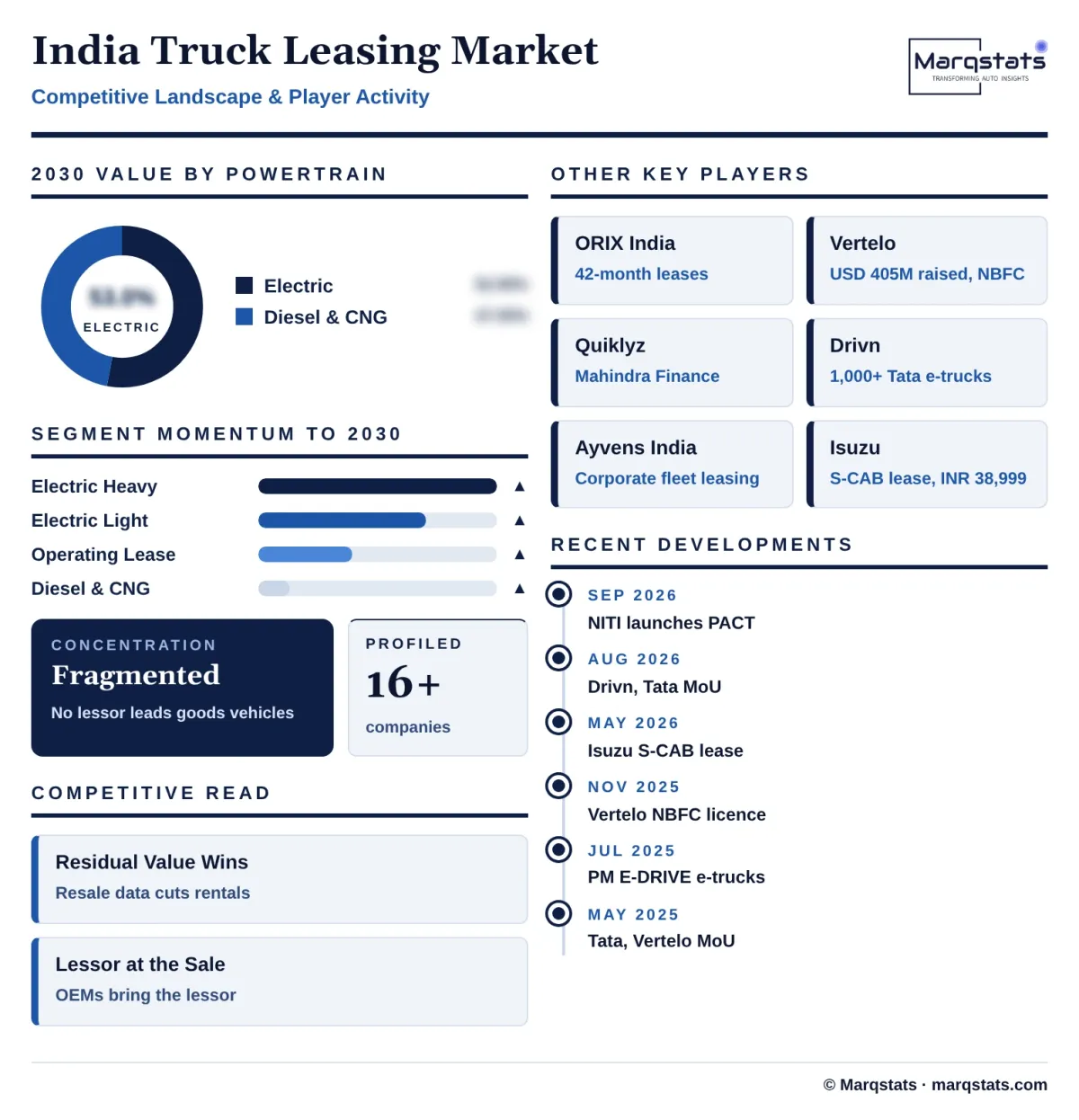
The India truck leasing market is fragmented. No lessor publishes a goods-vehicle fleet count, and the largest operating lessors, ORIX Corporation India Limited (formerly ORIX Auto Infrastructure Services) and Ayvens India, lease mainly passenger cars, with goods vehicles a minority of their fleets. Marqstats therefore describes competition by lessor type rather than by company share.
Multinational operating lessors serve corporate light commercial vehicle fleets. ORIX India, which marked 30 years in India in 2025 and received INR 300 crore of equity from ORIX Corporation in March 2025, offers operating leases with an average tenure of about 42 months. Ayvens India, formed from ALD Automotive and LeasePlan, leases vehicles for e-commerce and logistics companies alongside its car fleets.
NBFCs and captive financiers dominate finance leases. Mahindra and Mahindra Financial Services runs its leasing and subscription business under the Quiklyz brand, Tata Capital Limited offers commercial vehicle leasing to corporate customers, and Sundaram Finance Limited, SMAS Auto Leasing India and Hinduja Leyland Finance serve transport operators. Their main competition is their own hire-purchase products.
OEMs increasingly bring the lessor to the sale. Isuzu Motors India launched an all-inclusive D-Max S-CAB lease in May 2026, and Tata Motors Limited signed leasing agreements with Vertelo in May 2025 and Drivn in August 2026. VE Commercial Vehicles Limited and Ashok Leyland Limited sell electric trucks into service contracts such as UltraTech's.
Specialist electric lessors are the fastest-growing group. Vertelo raised USD 405 million in July 2025 and plans to deploy USD 1.5 billion to USD 2 billion over seven to ten years across electric cars, light commercial vehicles, buses and trucks. Alt Mobility leases electric light commercial vehicles to fleet operators and owner-drivers, and Drivn plans more than 1,000 Tata electric trucks over two years.
Competition will be decided by the cost of funds and the ability to price residual value. Lessors with low-cost long-term debt and data on battery health and resale prices can offer rentals below a hire-purchase instalment plus fuel and maintenance, which is what persuades a carrier to lease rather than buy.
Companies Covered
Companies covered in the report include:
Recent Market Activity
Table of Contents
Coverage & Segmentation
The study covers the India truck leasing market, with 2025 as the base year, 2021 – 2025 as the historical period and 2026 – 2030 as the forecast period. Value is the annual lease rental revenue earned by lessors on goods vehicles in the N1, N2 and N3 categories leased without a driver, measured before GST and excluding fuel, electricity and driver costs, in US dollars at INR 87.00 per US dollar, the 2025 average. Volume is the average number of goods vehicles on lease during the year. The market is segmented by vehicle class, powertrain, lease type and region.
Loans and hire purchase, rental of goods carriages with an operator, per-trip and per-tonne freight service contracts, buses, three-wheelers including electric L5 cargo vehicles and passenger cars are excluded. The Marqstats India Truck market study (new vehicle sales) and the live India Electric Truck Market report (electric truck sales of USD 180.00 million in 2025) value the same vehicles at the point of sale, so their values must not be added to lease revenue. Fleet, rental and split figures are Marqstats estimates built on registration data, lessor and OEM disclosures, and published lease offers.