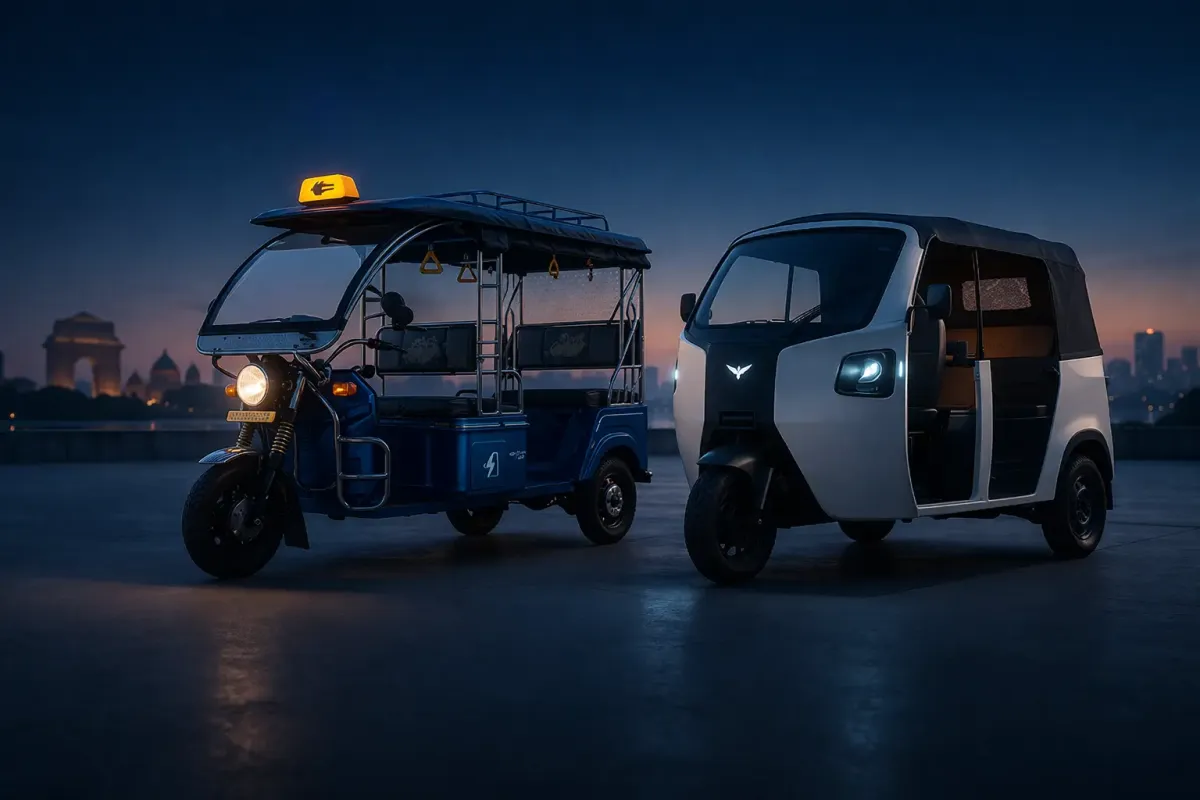
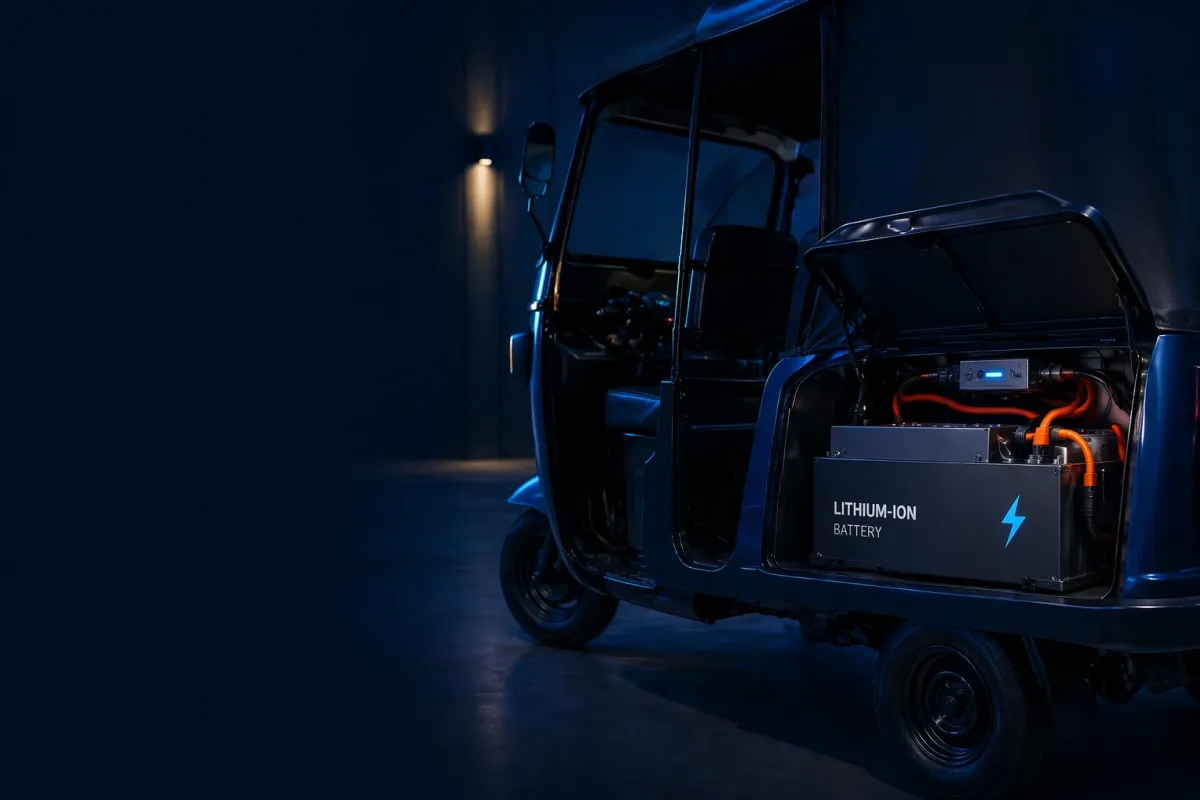
Market Snapshot
The India three-wheeler market size is estimated at USD 2,762.13 million in 2025 and is projected to reach USD 3,643.05 million by 2030, growing at a CAGR of 5.69% over 2026 – 2030. Registrations rise from 1,309,953 to 1,497,000 vehicles, and the electric share of units climbs from 60.90% to 64.80%.
Marqstats defines the market as the value of new three-wheelers registered in India in a calendar year, across all powertrains: L5 passenger auto-rickshaws and goods carriers running on CNG, diesel, petrol, LPG or batteries, low-speed L3 e-rickshaws and e-carts, and personal three-wheelers. Value is counted at ex-showroom prices excluding GST and before PM E-DRIVE demand incentives, road tax, registration and insurance. Exports, used vehicles and four-wheeled small commercial vehicles are excluded.
L5 passenger auto-rickshaws account for 59.83% of 2025 value, the L5 category as a whole for 74.00%, and North India for 30.00%. Electric L5 vehicles are the fastest-growing powertrain, at 13.53% a year, while the passenger e-rickshaw, which created India's electric three-wheeler headline, shrinks in value through 2030.
Key Takeaways
Market Overview & Analysis
Report Summary
Marqstats sizes the India three-wheeler market as the value of every new three-wheeled motor vehicle registered in the country in a calendar year. The market follows the Central Motor Vehicles Rules categories used by the VAHAN registration system: the L5 category of three-wheelers with a top speed above 25 km/h, split into passenger carriers and goods carriers, and the L3 class of battery-operated e-rickshaws and e-carts limited to 25 km/h. Personal three-wheelers registered for private use are also included. All powertrains are counted, so a CNG Bajaj RE, a diesel Piaggio Ape, a Mahindra Treo and a YC Electric e-rickshaw sit in one market.
The base is published. FADA reported 1,309,953 three-wheeler retail registrations in calendar 2025, up 7.21% from 1,221,886 in 2024. Of these, 615,216 were L5 passenger three-wheelers, up 10.8%, 476,936 were passenger e-rickshaws, down 1.00%, 132,919 were goods three-wheelers, up 6.32%, 83,403 were e-rickshaws with cart, up 41.52%, and 1,479 were personal three-wheelers. The five categories sum exactly to the total, so Marqstats uses them as its unit base without adjustment.
Powertrain data come from VAHAN. Electric three-wheelers reached 797,733 registrations in 2025, up 15.39% from 691,313 in 2024, and CNG three-wheelers 320,791, up 8%. Because every one of the 560,339 L3 e-rickshaws and e-carts is electric, the electric count inside the L5 category is 237,394, or 31.67% of L5 registrations. That matches the statement of the Ministry of Heavy Industries in January 2026 that L5 electric penetration had reached about 32%. The remaining 191,429 vehicles ran on diesel, petrol or LPG.
Two policy changes in late 2025 reset prices. The GST Council cut the tax on three-wheelers from 28% to 18% with effect from 22 September 2025, and Bajaj Auto passed on cuts of up to INR 24,000 a vehicle. Electric vehicles stay at 5% GST. Then, on 26 December 2025, the L5 incentive window under the PM E-DRIVE scheme closed after 288,508 vehicles had been supported against a target of 288,809. ICE autos became cheaper, and L5 electric autos lost a subsidy of up to INR 25,000 a vehicle, within the same quarter.
Three-wheelers are also a large export business, which this market excludes. The Society of Indian Automobile Manufacturers (SIAM) reported exports of 425,527 three-wheelers in 2025, up 43% from 298,235 in 2024, mostly Bajaj Auto and TVS Motor Company vehicles shipped to Africa, Latin America and Asia. Domestic three-wheeler sales reported by SIAM rose 8.2% in 2025 to the highest calendar-year total on record. At the 2025 average rate of INR 87.00 to the US dollar, the domestic market was worth about INR 240.31 billion.
India Three-Wheeler Market Size and Forecast
The India three-wheeler market grows from USD 2,762.13 million in 2025 to USD 3,643.05 million in 2030, a CAGR of 5.69%. Volume supplies about half of that growth: registrations rise at 2.71% a year, from 1,309,953 to 1,497,000, while the average value per vehicle rises at 2.91% a year, from about USD 2,109 to USD 2,434. The average rises because the mix moves away from low-cost e-rickshaws towards L5 electric autos and goods carriers.
The 2025 value is built bottom-up from FADA categories and VAHAN powertrains. Marqstats prices passenger e-rickshaws at about INR 1.10 lakh and e-carts at INR 1.20 lakh, L5 electric passenger autos at INR 3.10 lakh and L5 electric goods carriers at INR 3.50 lakh, and ICE passenger autos at INR 1.95 lakh and ICE goods carriers at INR 2.25 lakh, all ex-showroom excluding GST and before incentives. The ICE price is consistent with a Bajaj RE CNG listed at about INR 2.35 lakh, and the L5 electric price with a Piaggio Ape E Xtra at INR 3.12 lakh and the Bajaj WEGO range at INR 3.11 lakh to INR 4.48 lakh.
Marqstats expects about 1,362,500 registrations in 2026, up 4.01%, and a market value of USD 2,988.79 million. FADA data support that pace: three-wheeler retail rose 7.19% in April 2026 and 8.64% in August, and September 2026 retail reached 132,570 vehicles with an electric share of 64.89%. Electric three-wheelers sold 830,819 units in fiscal 2026, up 19%, but the L3 makers kept shrinking: YC Electric fell 18% and Saera Electric 19% in that year.
The electric share keeps rising, but its source changes. Marqstats expects 970,000 electric registrations in 2030, 64.80% of units, against 797,733 in 2025. L3 e-rickshaws and e-carts fall from 560,339 to 500,000, while L5 electric vehicles nearly double, from 237,394 to 470,000. The L5 electric share therefore rises from 31.67% to 47.14%, and electric vehicles of both categories rise from USD 1,577.92 million to USD 2,303.45 million, a 7.86% CAGR.
Marqstats tracks four indicators to monitor the forecast: monthly FADA retail data by category, especially the e-rickshaw passenger line; the VAHAN electric share inside L5; the price gap between CNG and electric L5 autos after the PM E-DRIVE L5 window closed in December 2025; and state permit decisions on new auto-rickshaws in large cities, which decide how many L5 vehicles can be registered.
Market Dynamics
Key Drivers
Five forces lift three-wheeler demand in India, and most of them favour the faster L5 category over the low-speed e-rickshaw.
- Lower GST makes ICE three-wheelers cheaper. The GST Council moved three-wheelers from the 28% slab to 18% from 22 September 2025, and Bajaj Auto cut prices by up to INR 24,000 a vehicle. FADA data show retail up 8.64% in August 2026, a sign that lower prices are still feeding demand nearly a year after the change.
- Electric autos cost less to run. A battery-electric L5 auto avoids CNG and diesel costs on routes of 100 to 200 km a day, and new models carry enough battery to cover a full shift: the Mahindra UDO has an 11.7 kWh pack and 200 km of real-world range, and the Bajaj WEGO P9018 a certified 296 km. Drivers who rent or finance their vehicles feel those savings every day.
- Parcel, grocery and trade logistics need small cargo vehicles. Goods three-wheelers rose 6.32% to 132,919 in 2025 and e-rickshaws with cart rose 41.52% to 83,403. A three-wheeler goods carrier costs far less than a four-wheeled small commercial vehicle and moves through narrow market lanes that four-wheelers cannot use.
- New L5 electric models widen choice. Mahindra Last Mile Mobility launched the UDO in February 2026 at an introductory INR 3,58,999, and Bajaj Auto launched the WEGO passenger and cargo range in April 2026 at INR 3.11 lakh to INR 4.48 lakh. TVS Motor Company, which barely sold electric three-wheelers in 2024, registered 21,005 in 2025 with its King EV range.
- Exports give the largest makers scale. SIAM reported 425,527 three-wheeler exports in 2025, up 43%, and that volume keeps Bajaj Auto and TVS Motor Company plants busy, which spreads engineering and tooling costs over more units and helps them hold domestic prices after the GST cut.
Key Restraints
Four constraints slow the market, and two of them fall hardest on the segment that built the electric headline.
- The L5 electric incentive has closed. The PM E-DRIVE window for L5 electric three-wheelers shut after 26 December 2025 once 288,508 vehicles had been supported against 288,809, ending incentives that had been INR 50,000 a vehicle in 2024-25 and INR 25,000 in 2025-26. A March 2026 amendment kept e-3W support running to 31 March 2028 with a price ceiling of INR 2.5 lakh, which excludes most new L5 electric autos priced above INR 3 lakh.
- The passenger e-rickshaw is saturating. Passenger e-rickshaw registrations fell 1.00% to 476,936 in 2025, and the main L3 makers lost volume in 2025 and again in fiscal 2026: YC Electric fell from 43,976 to 41,228, Saera Electric from 28,292 to 24,803 and Dilli Electric from 25,042 to 21,915. Many towns already have more e-rickshaws than their streets can absorb.
- Permits and city caps limit new L5 registrations. Auto-rickshaws used for hire need a contract carriage permit, and state transport departments cap or ration permits in many large cities. A driver who wants a new L5 auto often needs a permit before a dealer can deliver one, which slows replacement and keeps old CNG and diesel vehicles on the road.
- Electric autos still carry a price premium. A Bajaj RE CNG lists at about INR 2.35 lakh, against INR 3.11 lakh for the cheapest Bajaj WEGO and INR 3.59 lakh for the Mahindra UDO, and the GST cut lowered ICE prices while electric prices lost their L5 incentive. Drivers who borrow at high interest rates find the extra INR 75,000 to INR 1.25 lakh hard to finance.
Key Trends
Four shifts are changing which three-wheelers are built, financed and bought.
- Electrification moves from L3 to L5. L3 e-rickshaws supplied 70.24% of electric three-wheelers in 2025, but their volume is falling while L5 electric registrations rose: Mahindra Last Mile Mobility grew 41% to 95,907 electric units and Bajaj Auto 87% to 78,546. The electric share of all three-wheelers reached 64.89% in September 2026, up from 60.90% for 2025.
- CNG holds its ground in the city auto. CNG three-wheelers rose 8% to 320,791 in 2025 even as their share fell to about 25%, and Bajaj Auto still sells most of its three-wheelers with CNG engines. Where CNG stations are dense, such as Delhi, Mumbai and Gujarat, the cheaper CNG auto still wins new-permit buyers.
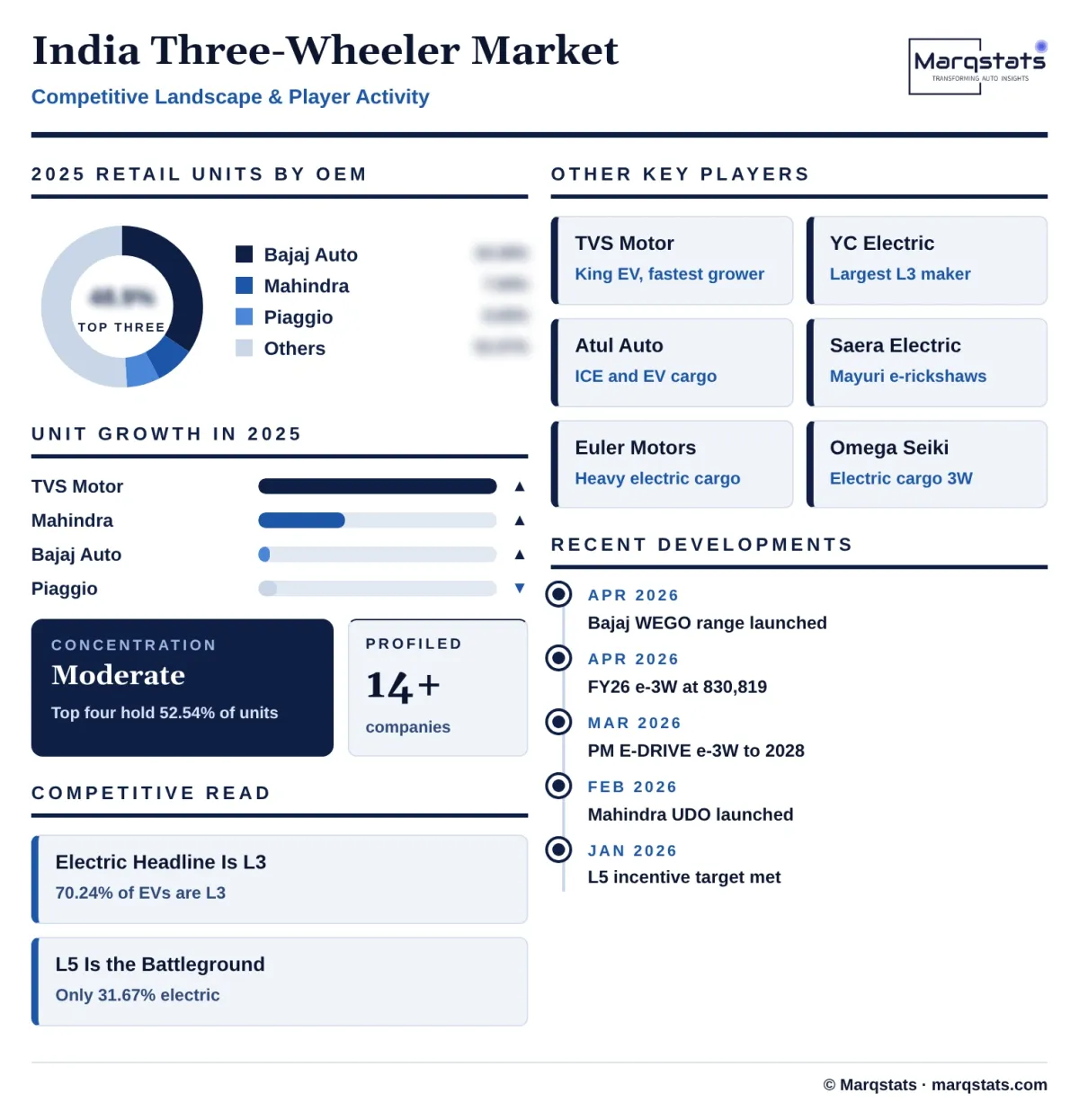
- The largest makers gain share. Bajaj Auto held 34.39% of 2025 registrations, and the four largest makers together held 52.54%, while regional L3 makers lost volume. In fiscal 2026 Mahindra Last Mile Mobility and Bajaj Auto alone sold 191,509 electric three-wheelers, 23.05% of the electric total.
- Cargo models get bigger batteries and payloads. The Bajaj WEGO C90 cargo range offers 149 km to 207 km of range, and Euler Motors and Omega Seiki Mobility sell heavy electric cargo three-wheelers to parcel and grocery fleets that need a full day of running on one charge.
Strategic Implications
- For OEMs, the profit pool is in L5, not L3. L3 e-rickshaws and e-carts are 42.78% of 2025 units but only 26.00% of value, and their volume falls to 2030, so makers with L3 lines should add L5 electric models or move into e-carts, the only L3 segment still growing.
- For incumbents in CNG and diesel, the next five years are a replacement contest. Electric L5 rises from 31.67% to 47.14% of the L5 category by 2030 on Marqstats estimates, so an auto maker that sells mainly CNG keeps volume only if it offers an electric model at a price close to its CNG model.
- For financiers, the INR 75,000 to INR 1.25 lakh gap between a CNG auto and an electric one is the real barrier, now that the L5 incentive has closed. Loans priced on lower running costs, battery leasing and buy-back of batteries open the market to drivers that banks turn away.
- For battery, motor and charger suppliers, demand follows L5. An L5 electric auto carries a lithium-ion pack of about 9 to 12 kWh, against small lead-acid or LFP packs in most e-rickshaws, so supplier volume grows faster than vehicle volume as the mix shifts.
- For fleet and logistics operators, goods three-wheelers outgrow passenger ones, and electric cargo models with 150 km to 200 km of range now cover a full delivery day, which makes electric the default choice for new parcel and grocery fleets in large cities.
Market Segmentation
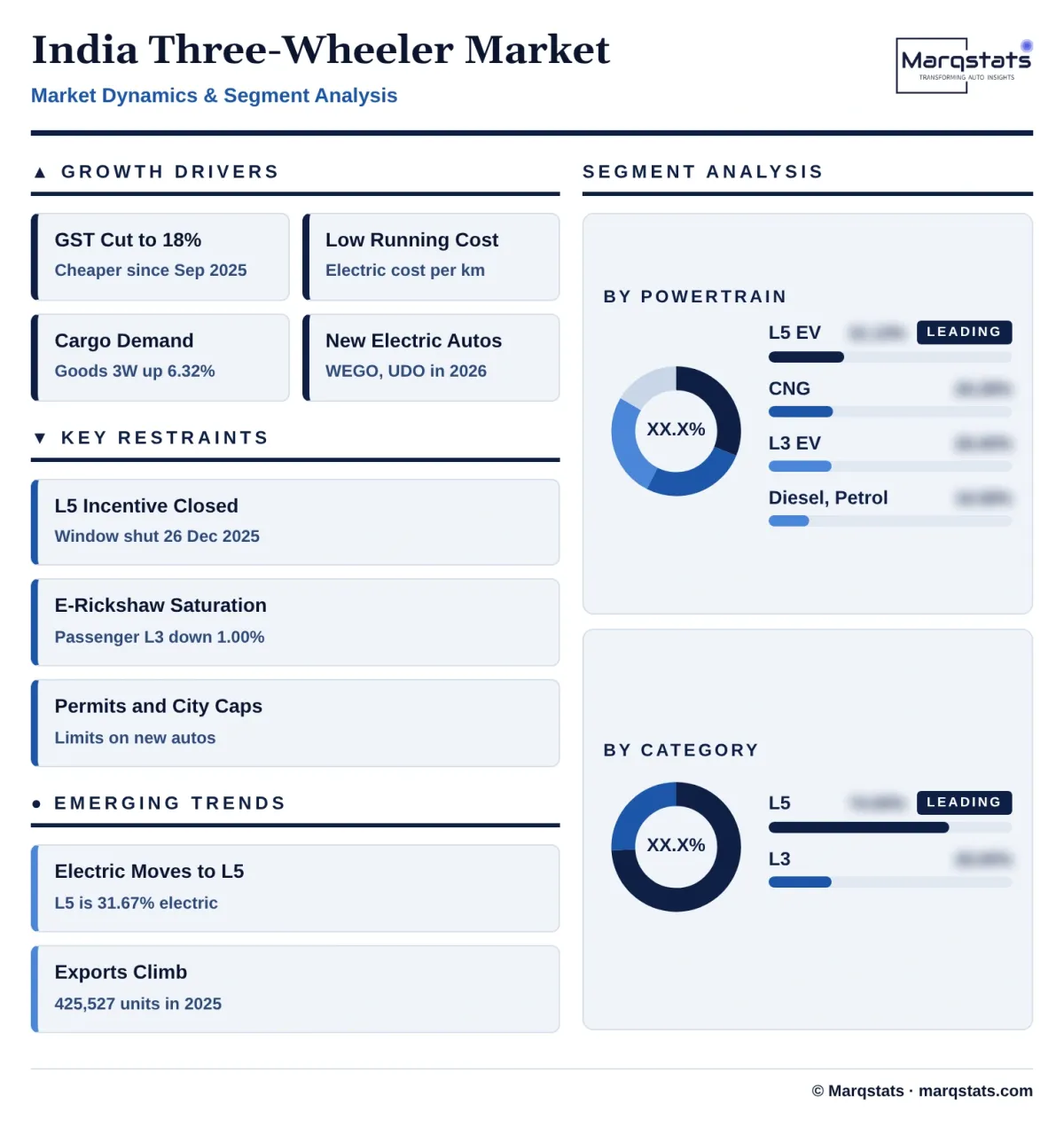
L5 passenger auto-rickshaws account for 59.83% of 2025 value, USD 1,652.58 million, from 615,216 registrations, and grow at 7.70% a year to USD 2,394.25 million and 65.73% of the market by 2030. This is the city auto that carries commuters for hire, led by the Bajaj RE, the Piaggio Ape and the Mahindra Treo. Marqstats estimates that about 207,011 of the 2025 vehicles were electric, 300,791 ran on CNG and the rest on diesel, petrol or LPG, and expects electric models to make up about 48.78% of 2030 registrations.
Passenger e-rickshaws account for 21.83% of 2025 value, USD 603.02 million, from 476,936 registrations, and are the only vehicle type that shrinks, falling at 3.59% a year to USD 502.30 million. Registrations fell 1.00% in 2025, and YC Electric and Saera Electric fell a further 18% and 19% in fiscal 2026. YC Electric, Saera Electric and Dilli Electric lead a field of many small assemblers, and Marqstats expects about 380,000 registrations in 2030 as towns limit new e-rickshaws and riders move to faster L5 autos.
L5 goods carriers account for 14.03% of 2025 value, USD 387.41 million, from 132,919 registrations, and grow at 7.69% a year to USD 561.21 million and 15.40% of value. Parcel, grocery, water and gas cylinder delivery and small traders use them, and Marqstats expects electric goods carriers to reach about 70,000 of the 175,000 registrations in 2030, with diesel still common on long rural runs, led by Mahindra, Bajaj Auto, Piaggio, Euler Motors and Omega Seiki Mobility.
E-rickshaws with cart account for 4.16% of 2025 value, USD 115.04 million, from 83,403 registrations, and grow at 9.28% a year to USD 179.31 million. They grow fastest among vehicle types and are the growth line within L3: registrations rose 41.52% in 2025, and the low price of about INR 1.20 lakh makes them the cheapest motorised goods vehicle in India for vegetable sellers, kirana suppliers and municipal waste collection.
Personal three-wheelers account for 0.15% of 2025 value, USD 4.08 million, from 1,479 registrations, and grow at 7.95% a year to USD 5.98 million. Registrations rose 54.87% in 2025 from a very small base; these are three-wheelers registered for private rather than commercial use, so they need no permit and sit outside the fleet economics that drive the rest of the market.
Electric L5 vehicles account for 31.13% of 2025 value, USD 859.86 million, from 237,394 registrations, and grow fastest, at 13.53% a year, to USD 1,621.84 million and 44.52% of the market. Mahindra Last Mile Mobility, Bajaj Auto, TVS Motor Company and Piaggio Vehicles lead, and Marqstats expects about 470,000 registrations in 2030 even without the PM E-DRIVE L5 incentive, because running costs and new long-range models carry the case.
Electric L3 vehicles, the e-rickshaws and e-carts, account for 26.00% of 2025 value, USD 718.06 million, from 560,339 registrations, and edge down at 1.04% a year to USD 681.61 million. Growth in e-carts does not offset the fall in passenger e-rickshaws, so the L3 share of value drops from 26.00% to 18.71%.
CNG three-wheelers account for 26.28% of 2025 value, USD 725.91 million, from 320,791 registrations, and grow at 4.96% a year to USD 924.71 million. Bajaj Auto dominates CNG autos, and CNG keeps growing slowly because the GST cut made the CNG auto cheaper and city permits favour the vehicle drivers already know.
Diesel, petrol and LPG three-wheelers account for 16.59% of 2025 value, USD 458.30 million, from 191,429 registrations, and decline at 1.97% a year to USD 414.89 million. Diesel goods carriers and passenger autos in towns without CNG are the main users, and electric cargo models take most of their replacement demand.
The L5 category accounts for 74.00% of 2025 value, USD 2,044.07 million, from 749,614 registrations, and grows at 7.70% a year to USD 2,961.44 million and 81.29% of the market. These are vehicles above 25 km/h that need type approval, a commercial licence and, for hire use, a permit, and only 31.67% of them were electric in 2025.
The L3 category accounts for 26.00% of 2025 value, USD 718.06 million, from 560,339 registrations, which is 42.78% of units. It declines at 1.04% a year to USD 681.61 million because low prices, about INR 1.10 lakh to INR 1.20 lakh, cannot offset falling passenger e-rickshaw volume.
By Geography
North India
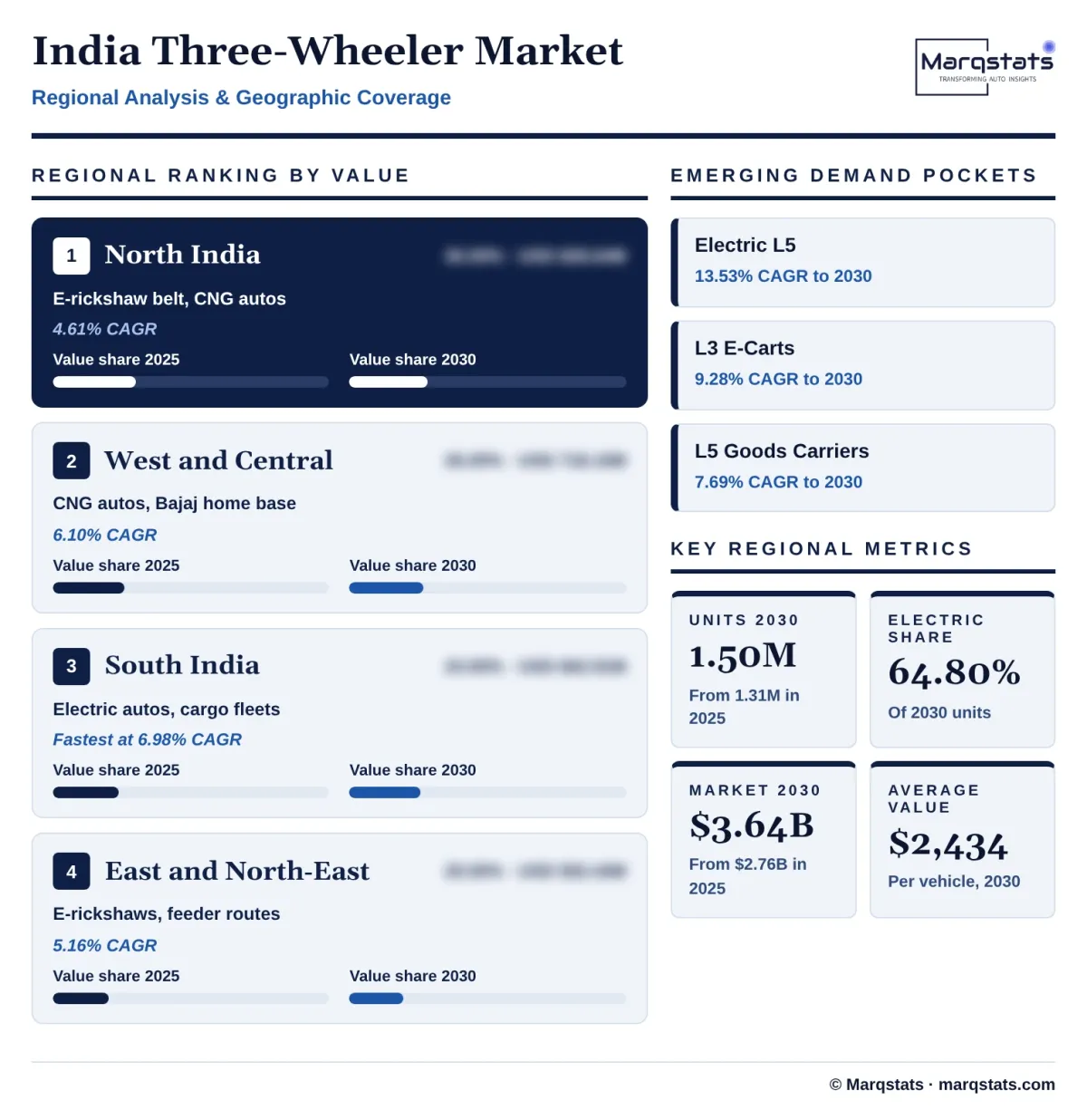
North India accounts for 30.00% of 2025 value, USD 828.64 million, and grows at 4.61% a year to USD 1,038.27 million and 28.50% by 2030. Uttar Pradesh, Delhi, Haryana, Punjab and Rajasthan form the largest e-rickshaw market in the country, and Delhi runs one of the densest CNG auto fleets. The region grows more slowly than the national market because so much of its volume sits in the shrinking passenger e-rickshaw line.
West and Central India
West and Central India accounts for 26.00% of 2025 value, USD 718.15 million, and grows at 6.10% a year to USD 965.41 million. Maharashtra, Gujarat and Madhya Pradesh hold large CNG auto fleets in Mumbai, Pune, Ahmedabad and Surat, and Bajaj Auto builds its three-wheelers at Waluj near Chhatrapati Sambhajinagar, so the region carries a high share of L5 value per vehicle.
South India
South India accounts for 24.00% of 2025 value, USD 662.91 million, and grows fastest, at 6.98% a year, to USD 928.98 million and 25.50% by 2030. Karnataka, Tamil Nadu, Telangana and Kerala buy few e-rickshaws and many L5 autos, and Bengaluru, Hyderabad and Chennai have moved early to electric autos and electric cargo fleets. Mahindra Last Mile Mobility builds electric three-wheelers at Zaheerabad in Telangana.
East and North-East India
East and North-East India accounts for 20.00% of 2025 value, USD 552.43 million, and grows at 5.16% a year to USD 710.39 million. Bihar, West Bengal, Assam and Odisha register many e-rickshaws for feeder trips in towns, which keeps value per vehicle low, while diesel goods carriers serve markets where CNG supply is thin.
How Competition Is Evolving
The market is moderately concentrated. FADA data show the four largest makers, Bajaj Auto, Mahindra, Piaggio and TVS Motor Company, held 52.54% of 2025 registrations, and the top three alone 48.93%, while the remaining 476,688 vehicles came from hundreds of makers, most of them L3 e-rickshaw assemblers. Concentration is high in L5, where a few makers hold type approvals, dealers and finance tie-ups, and low in L3, where entry costs are small.
Bajaj Auto leads with 450,544 registrations in 2025, 34.39% of the market, up 2.65% from 438,931. It dominates CNG autos and is now the second-largest electric three-wheeler maker, with 78,546 electric units in 2025, up 87%. Its overall share is under pressure as electric rivals gain, and its April 2026 WEGO range is its answer.
Mahindra and TVS Motor Company are the fastest-growing challengers. Mahindra registered 104,007 three-wheelers in 2025, up 36.05%, and its Mahindra Last Mile Mobility subsidiary led electric three-wheelers with 95,907 units in 2025 and 101,905 in fiscal 2026. TVS Motor Company doubled to 47,316 registrations, up 102.40%. Piaggio Vehicles fell 7.70% to 86,502 as its diesel and CNG Ape lines faced electric competition.
The L3 makers are losing ground. YC Electric remained the largest L3 maker with 41,228 registrations but fell from 43,976, and Saera Electric and Dilli Electric each lost about 12%. Atul Auto grew to 30,490 with ICE and electric cargo models, while ZeniaK Innovation rose to 13,398 and Mini Metro EV reached 13,062. Competition is moving from price per vehicle to range, finance and service networks, which favours the large L5 makers.
Companies Covered
Companies covered in the report include:
Recent Market Activity
Table of Contents
Coverage & Segmentation
The study covers the India three-wheeler market, with 2025 as the base year, 2021 – 2025 as the historical period and 2026 – 2030 as the forecast period. It covers new three-wheelers registered in India across all powertrains, segmented by vehicle type, powertrain, regulatory category and region. Values are ex-showroom prices excluding GST and before PM E-DRIVE incentives, in US dollars at the 2025 average of INR 87.00 per US dollar.
Exports, used vehicles, unregistered e-rickshaws, batteries, spares and service, and four-wheeled small commercial vehicles are excluded. The live Marqstats India Electric Three-Wheeler Market report sizes the electric slice at USD 1.30 billion in 2025 on its own basis, and the live India E-Cart Market report includes batteries and service; both overlap this market and should not be added to it. Segment, price and regional splits are Marqstats estimates built on FADA and VAHAN registration data.