Market Snapshot
The India EV motor controller market is an estimated USD 302.99 million (₹2,636.01 crore) in 2025 and is forecast to reach USD 1,070.96 million (₹9,317.35 crore) by 2030, a 28.73% CAGR. Controller units rise from 2,270,721 to 7,784,000, a 27.94% CAGR, led by electric two-wheelers and electric car traction inverters.
Marqstats sizes the market bottom-up. Calendar 2025 retail registrations by vehicle class, as recorded on the VAHAN registration system of the Ministry of Road Transport and Highways (MoRTH), are multiplied by one traction controller per vehicle and by an ex-factory controller price for each class. The value is the price a controller or inverter maker charges the vehicle manufacturer, excluding GST, converted at a constant ₹87.00 per US dollar. The input the total is most sensitive to is the electric car inverter price: a 10% change moves the 2025 value by USD 11.19 million, or 3.69%.
Volume and value sit in different places. Electric two- and three-wheelers account for 91.51% of 2025 controller units but 54.86% of value, because a 48 V to 72 V scooter or auto-rickshaw controller sells for an estimated ₹6,000 to ₹8,500, while a 300 V to 400 V car traction inverter sells for about ₹55,000. Electric passenger vehicles are 7.79% of units and 36.93% of value.
The policy map follows units, not value. The Phased Manufacturing Programme (PMP) attached to the PM Electric Drive Revolution in Innovative Vehicle Enhancement (PM E-DRIVE) scheme requires the traction motor controller, including the inverter and its printed circuit board assembly, to be made in India for subsidised two- and three-wheelers. Private electric cars, the largest value pool, receive no PM E-DRIVE purchase incentive, so their inverters face no PM E-DRIVE localisation test.
By 2029 the balance tips. High-voltage traction inverters for cars, buses and trucks grow from 45.14% of value in 2025 to 52.38% in 2030, overtaking low-voltage two- and three-wheeler controllers in 2029, even though they remain about one controller in nine.
Key Takeaways
Market Overview & Analysis
Report Summary
India now builds electric vehicles at a scale where the controller, the power electronics box that turns battery current into motor torque, becomes a volume component rather than an imported sub-assembly. Calendar 2025 registrations reached 1,280,216 electric two-wheelers, 797,727 electric three-wheelers, 176,980 electric passenger vehicles and 15,798 electric commercial vehicles. Every one of them carries a traction controller. What changed in 2025 and 2026 is who makes it: listed suppliers raised capital, global Tier-1s localised integrated drive units, and PM E-DRIVE tied subsidy eligibility to domestic controller assembly for two- and three-wheelers.
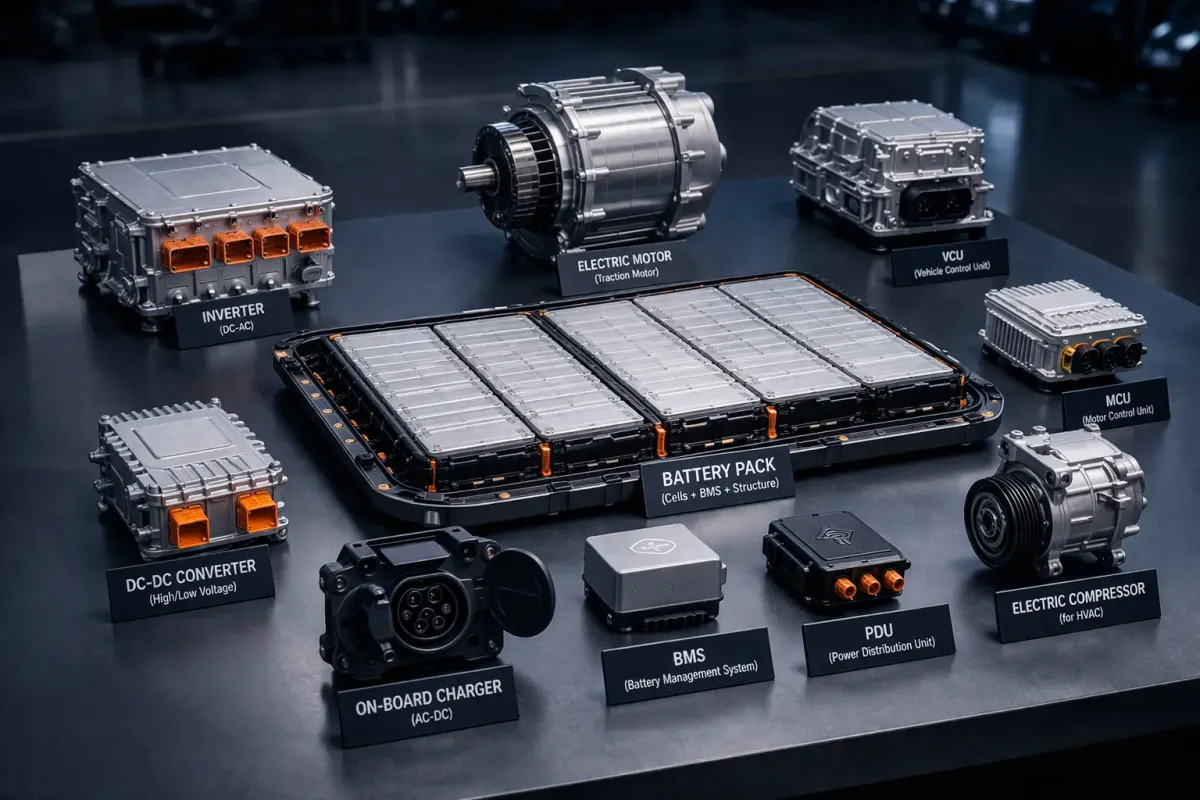
The measure is the ex-factory value of traction motor controllers and traction inverters fitted to newly registered electric vehicles in India, covering electric two-wheelers, electric three-wheelers (L3 e-rickshaws and e-carts plus L5 passenger and goods), electric passenger cars and utility vehicles, and electric buses and goods carriers. Where the inverter sits inside an integrated e-axle or electric drive unit, only the inverter value is counted. Traction motors, reduction gears, battery management systems, DC-DC converters, on-board chargers, vehicle control units, aftermarket replacements and exports are excluded. Those adjacent pools sit inside the Marqstats India EV Component Market (USD 7.80 billion in 2025), of which this market is 3.88%.
Four readers use the analysis. Controller and inverter makers use it to choose between the volume end of two-wheelers and the value end of car and bus inverters. Vehicle manufacturers use it to price make-or-buy decisions on in-house controllers against PMP compliance cost. Semiconductor and passive component suppliers use the unit series to size MOSFET, IGBT and silicon carbide demand by voltage class. Investors use the segment split to read the revenue mix behind listed names such as SEDEMAC Mechatronics Limited, Sterling Tools Limited and Minda Corporation Limited.
India EV Motor Controller Market Size and Forecast
Marqstats estimates the market at USD 35.78 million in 2021, USD 116.47 million in 2022, USD 190.12 million in 2023, USD 233.58 million in 2024 and USD 302.99 million in 2025. The jump from 2021 to 2022 follows electric vehicle registrations rising from about 0.32 million to about 1.0 million in calendar 2022, as reported by Autocar Professional. The 2023 to 2025 values rest on full-year VAHAN-basis registrations of 1,531,603 vehicles in 2023, 1,949,004 in 2024 and 2,270,721 in 2025.
The forecast reaches USD 419.53 million in 2026, USD 529.15 million in 2027, USD 668.41 million in 2028, USD 845.52 million in 2029 and USD 1,070.96 million in 2030, or ₹9,317.35 crore at the end of the period. The 2025 to 2030 CAGR is 28.73% and absolute growth is USD 767.97 million. 2026 sits above the smooth CAGR path of USD 390.04 million. Electric two-wheeler registrations reached 207,850 in September 2026 alone and more than 1.61 million from January to September 2026, so Marqstats sets calendar 2026 two-wheeler controller demand at 2,150,000 units before growth settles into a steadier slope.
The value build has four lines. Electric two-wheelers: 1,280,216 controllers at an estimated ₹6,000 each, USD 88.29 million. Electric three-wheelers: 797,727 controllers at a blended ₹8,500, USD 77.94 million, mixing an estimated 547,727 low-power e-rickshaw and e-cart units near ₹3,500 to ₹4,000 with about 250,000 L5 controllers that sell for roughly five times as much. Electric passenger vehicles: 176,980 traction inverters at about ₹55,000, USD 111.88 million. Electric commercial vehicles: 15,798 inverters at a blended ₹1,37,000, USD 24.88 million, where a 250 kW city-bus inverter costs several times a light goods carrier unit.
Value grows slightly faster than units, 28.73% against 27.94%, because mix outweighs price. Marqstats assumes the two-wheeler controller price falls from ₹6,000 to ₹5,400 by 2030 as field-oriented control boards standardise and volumes pass five million a year, and the car inverter price falls from ₹55,000 to ₹48,000 as local inverter assembly scales. Mix works the other way: cars and commercial vehicles rise from 8.49% of units to 11.56%, and each of them carries far more controller value than a scooter. The three-wheeler price rises to about ₹9,900 because L5 vehicles gain share against e-rickshaws.
This is a Marqstats construction, built from registration counts and controller price bands. Registration counts are published; controller prices are estimated from supplier disclosures, product price lists and bill-of-materials teardown ranges. The main cross-check is the Marqstats India EV Component Market, which places traction motors and controllers together at 30% to 40% localisation; the controller value here equals 3.88% of that page's USD 7.80 billion component total, consistent with controllers being a small, electronics-heavy share of per-vehicle component value.
Localisation Rules Bind the Low-Value Controllers First
PM E-DRIVE puts its domestic-content test where controller value is lowest. The Ministry of Heavy Industries (MHI) amended the PMP in March 2025 to require domestic manufacture of the traction motor controller, including the inverter and the integration of the assembled printed circuit board, for two- and three-wheelers claiming the incentive. The same amendment gave suppliers a 12-month window for board-level electronic assembly. That rule covers the 2,077,943 two- and three-wheeler controllers of 2025, which carry USD 166.23 million of value.
Electric cars sit outside that mechanism. PM E-DRIVE funds electric two-wheelers, three-wheelers, ambulances, trucks and buses, but not privately bought electric cars, so the 176,980 car inverters of 2025, worth USD 111.88 million, face no PM E-DRIVE localisation test at all. Car inverters reach India through global Tier-1 supply, imported e-axles and OEM in-house designs, and their localisation is driven by OEM cost programmes rather than subsidy rules.
The result is a policy that is strict on units and light on value. Two- and three-wheeler controllers are 91.51% of units and 54.86% of value; car inverters are 7.79% of units and 36.93% of value, and they contribute 42.91% of the growth to 2030. Assembly is also not the same as content: a PMP-compliant controller can still use imported MOSFETs, gate drivers and microcontrollers, because the rule tests where the board is assembled, not where the silicon is made. Marqstats reads PMP compliance as a measure of assembly capacity, not of semiconductor value added.
High-Voltage Inverters Overtake Low-Voltage Controllers in 2029
The market changes voltage class within the forecast. Low-voltage controllers for 48 V to 96 V two- and three-wheeler systems are USD 166.23 million in 2025, 54.86% of value; high-voltage traction inverters for cars, buses and trucks are USD 136.76 million, 45.14%. The order reverses in 2029, when high-voltage inverters reach USD 423.83 million against USD 421.69 million, and by 2030 they stand at USD 560.92 million (52.38%) against USD 510.04 million (47.62%) for low-voltage controllers.
Volume does not explain this. High-voltage units remain a small minority, 192,778 of 2,270,721 controllers in 2025 and 900,000 of 7,784,000 in 2030. The shift comes from the price gap: one car inverter is worth about nine two-wheeler controllers, and one bus inverter more than twenty. Every electric car that replaces an internal combustion car adds more controller value than nine electric scooters.
That matters for suppliers' capability choices. Low-voltage controllers use MOSFET bridges on a single board and compete on cost and firmware. High-voltage inverters use IGBT or silicon carbide power modules, liquid cooling, functional-safety software and isolation testing, and they are increasingly integrated into the drive unit. Valeo commissioned a 3-in-1 e-axle line with an integrated inverter in Pune in March 2026 for Mahindra and Mahindra Limited, and Uno Minda Limited approved a ₹550 crore plant for four-wheeler electric drive units in May 2026. Suppliers that stay only in low-voltage boards will hold the unit lead and lose the value lead.
Market Dynamics
Key Drivers
Four forces lift controller demand in India.
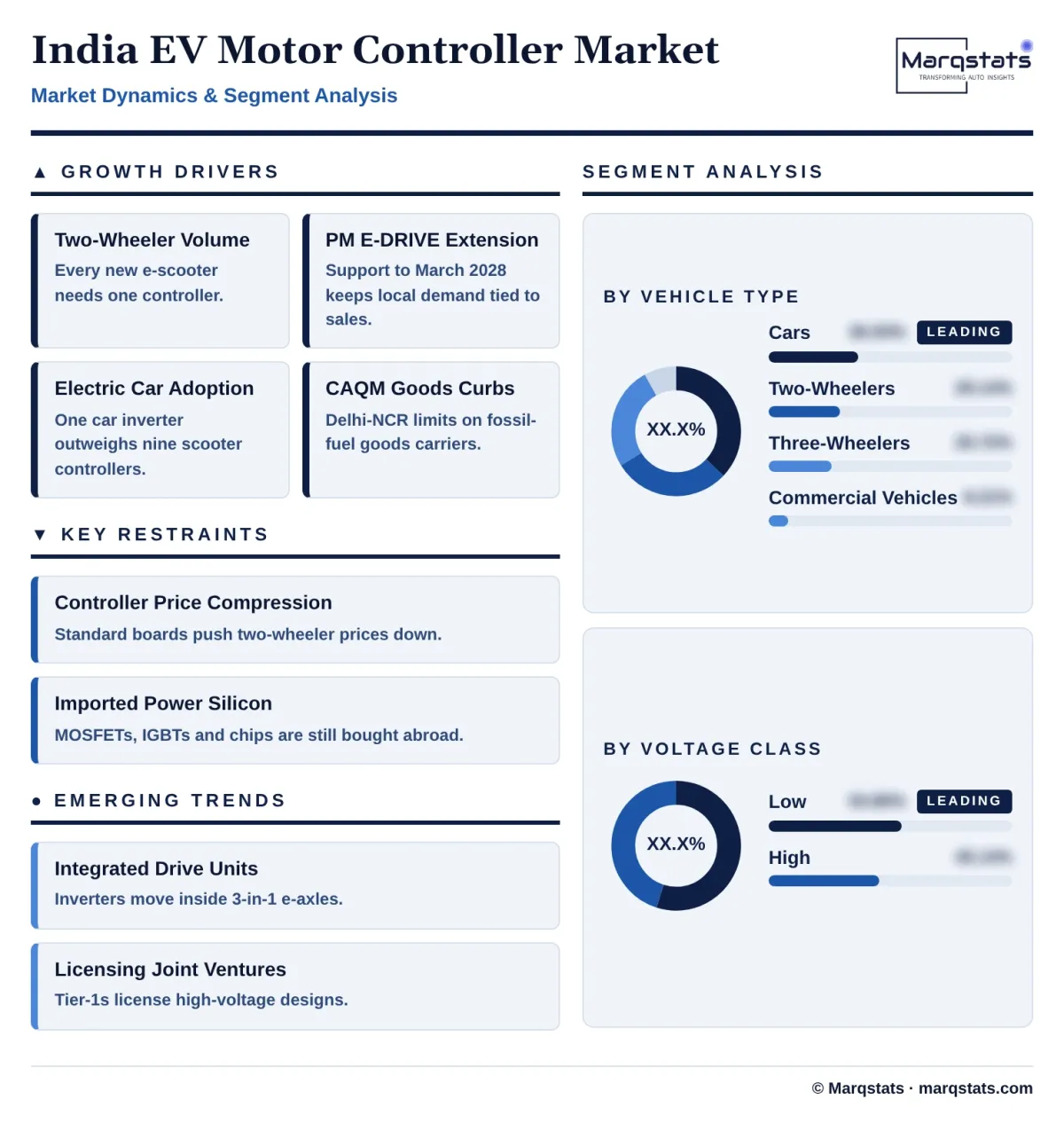
- Electric two-wheeler volume: retail registrations reached 1,280,216 in calendar 2025, up 11%, and 207,850 in September 2026 alone, up 89% year on year. Each scooter or motorcycle needs one controller, so two-wheeler controller value grows from USD 88.29 million to USD 327.97 million by 2030.
- PM E-DRIVE extension: MHI raised the scheme outlay from ₹10,900 crore to ₹11,900 crore in its gazette of 10 August 2026 and extended electric two-wheeler support to 31 March 2028, with the two-wheeler allocation raised to ₹2,767 crore. Subsidised vehicles must carry a domestically manufactured controller, so the extension keeps local controller demand tied to registrations.
- Electric car adoption: electric passenger vehicle registrations rose 77% to 176,980 in calendar 2025. At about ₹55,000 per inverter, each additional electric car adds more controller value than nine electric scooters, which is why cars contribute 42.91% of value growth to 2030.
- Goods vehicle registration curbs: the Commission for Air Quality Management in NCR and Adjoining Areas (CAQM) approved on 18 August 2026 a phased ban on new petrol, diesel and CNG N1 goods vehicle registrations, from 1 January 2027 in Delhi. Light electric goods carriers each add a traction inverter, lifting commercial vehicle controller value at a 36.88% CAGR.
Key Restraints
Three constraints hold controller value below the volume curve.
- Price compression on two-wheeler controllers: Marqstats expects the average two-wheeler controller price to fall from ₹6,000 in 2025 to ₹5,400 by 2030 as board designs standardise and annual volume passes five million units. Suppliers grow revenue more slowly than units, at 30.01% against 32.78% for the segment.
- Imported power semiconductors: PMP compliance tests board assembly, not silicon. MOSFETs, IGBT modules, gate drivers and microcontrollers are still bought abroad, so a weaker rupee raises controller cost before OEM contracts reset, at a fixed ₹87.00 per US dollar baseline in 2025.
- Rare-earth magnet supply: MHI extended the window for importing rare-earth traction motors for electric trucks and buses to 31 August 2026, the second extension, citing supply constraints. Where the motor cannot be sourced, the inverter is not fitted either, which slows commercial vehicle controller demand in the short run.
Key Trends
Three trends change what a controller supplier sells.
- Integration into drive units: Valeo commissioned a 3-in-1 e-axle line, combining motor, inverter and transmission, in Pune in March 2026 for Mahindra Born Electric models. In cars and buses the inverter is increasingly bought as part of a drive unit, which shifts the purchasing decision from the controller maker to the e-axle supplier.
- Listed Tier-1s scale capacity: SEDEMAC Mechatronics Limited opened a ₹1,087.45 crore initial public offering on 4 March 2026 and reported 1,108,301 ECUs and controllers sold in the June 2026 quarter, up 37.1%. Kinetic Communications Limited opened an automated controller line in Pune in July 2025 with capacity of 180,000 units a year.
- Technology licensing joint ventures: Minda Corporation Limited formed a joint venture with Turntide Technologies in March 2026, with Minda holding 49% and Turntide 51%, to make high- and low-voltage motor controllers and motors in India. Licensing gives domestic suppliers inverter software and power-stage designs faster than in-house development.
Strategic Implications
- For entrants: compete in high-voltage inverters for light electric goods carriers and buses rather than in two-wheeler boards. Commercial vehicle controllers grow at a 36.88% CAGR, CAQM curbs give a dated demand trigger from January 2027, and buyers pay for validated power stages rather than lowest unit cost.
- For incumbents in two- and three-wheeler controllers: price will fall about 10% by 2030, so margin must come from scale and design-to-cost. Volume leadership is secure only while PMP rules keep board assembly local; the March 2025 amendment already sets that requirement, and the 2028 PM E-DRIVE horizon is when it will be renegotiated.
- For vehicle manufacturers: electric car inverters are 36.93% of 2025 value and will be 41.21% by 2030, yet no PM E-DRIVE rule forces their localisation. A make-or-buy decision taken now on inverters, or on integrated drive units such as the Valeo and Uno Minda programmes, fixes cost for a full model cycle.
- For semiconductor and component suppliers: the 7,784,000 controllers expected in 2030 need power switches, gate drivers and microcontrollers that PMP rules allow to be imported. Local power-module packaging and board assembly near Pune, Hosur and the NCR captures the step that PMP already counts as domestic.
Market Segmentation
Electric passenger vehicles are the largest value segment at an estimated USD 111.88 million, 36.93% of 2025 value, rising to USD 441.38 million and 41.21% by 2030, a 31.59% CAGR. The segment wins on price, not volume: 176,980 traction inverters at about ₹55,000 each, mostly 300 V to 400 V IGBT designs, with silicon carbide entering premium models. Units grow from 176,980 to an estimated 800,000, a 35.22% CAGR, while the average inverter price falls to about ₹48,000 as local assembly scales. Tata Motors Limited lost share in 2025, with its electric passenger vehicle share falling to 40% from 62% as JSW MG Motor India Private Limited and Mahindra and Mahindra Limited gained ground, which spreads inverter sourcing across more supply chains.
Electric two-wheelers are an estimated USD 88.29 million, 29.14% of 2025 value, rising to USD 327.97 million and 30.62% by 2030, a 30.01% CAGR. Units rise from 1,280,216 to 5,284,000, a 32.78% CAGR, the same unit path Marqstats uses for its electric scooter and motorcycle pages. The average controller price is about ₹6,000 for a 48 V to 72 V, 2 kW to 6 kW controller, falling to about ₹5,400 by 2030. TVS Motor Company Limited (298,867 retail units in 2025), Bajaj Auto Limited (269,836), Ather Energy Limited (200,785) and Ola Electric Mobility Limited (199,316) set most controller demand, and their make-or-buy choices decide how much of the segment reaches merchant suppliers.
Electric three-wheelers are an estimated USD 77.94 million, 25.72% of 2025 value, rising to USD 182.07 million and 17.00% by 2030, an 18.49% CAGR. Registrations reached 797,727 in calendar 2025, about 60% of all three-wheeler sales, and Marqstats expects 1,600,000 by 2030, about 700,000 of them L5. The blended price of ₹8,500 mixes e-rickshaw controllers with L5 passenger and goods units; as L5 models from Mahindra Last Mile Mobility Limited (95,907 units in 2025) and Bajaj Auto Limited (78,546) gain share, the blend rises to about ₹9,900. The segment grows slowest because three-wheeler electrification is already advanced.
Electric commercial vehicles are the smallest and fastest-growing segment, an estimated USD 24.88 million, 8.21% of 2025 value, rising to USD 119.54 million and 11.16% by 2030, a 36.88% CAGR. The 15,798 vehicles of 2025 included 4,395 electric buses and 11,324 electric goods carriers. A bus inverter rated near 250 kW sells for several times a light goods carrier inverter, so the blended price of ₹1,37,000 falls to about ₹1,04,000 by 2030 as light goods carriers take a larger share of an estimated 100,000 units, about 20,000 of them buses.
Low-voltage controllers for two- and three-wheelers are an estimated USD 166.23 million, 54.86% of 2025 value, rising to USD 510.04 million and 47.62% by 2030, a 25.14% CAGR. They account for 2,077,943 units in 2025 and 6,884,000 in 2030. These are MOSFET-based boards running field-oriented or trapezoidal control, made by OEMs in-house and by suppliers such as SEDEMAC Mechatronics Limited, Sterling Tools Limited and Kinetic Communications Limited. PMP rules require their board assembly in India for subsidised vehicles.
High-voltage traction inverters for cars, buses and trucks are an estimated USD 136.76 million, 45.14% of 2025 value, rising to USD 560.92 million and 52.38% by 2030, a 32.61% CAGR. They are 192,778 units in 2025 and 900,000 in 2030, about one controller in nine, yet they overtake low-voltage controllers on value in 2029. IGBT power modules dominate today; silicon carbide is used in higher-voltage premium car platforms, and integration into e-axles is the main architecture change.
By Geography
South India
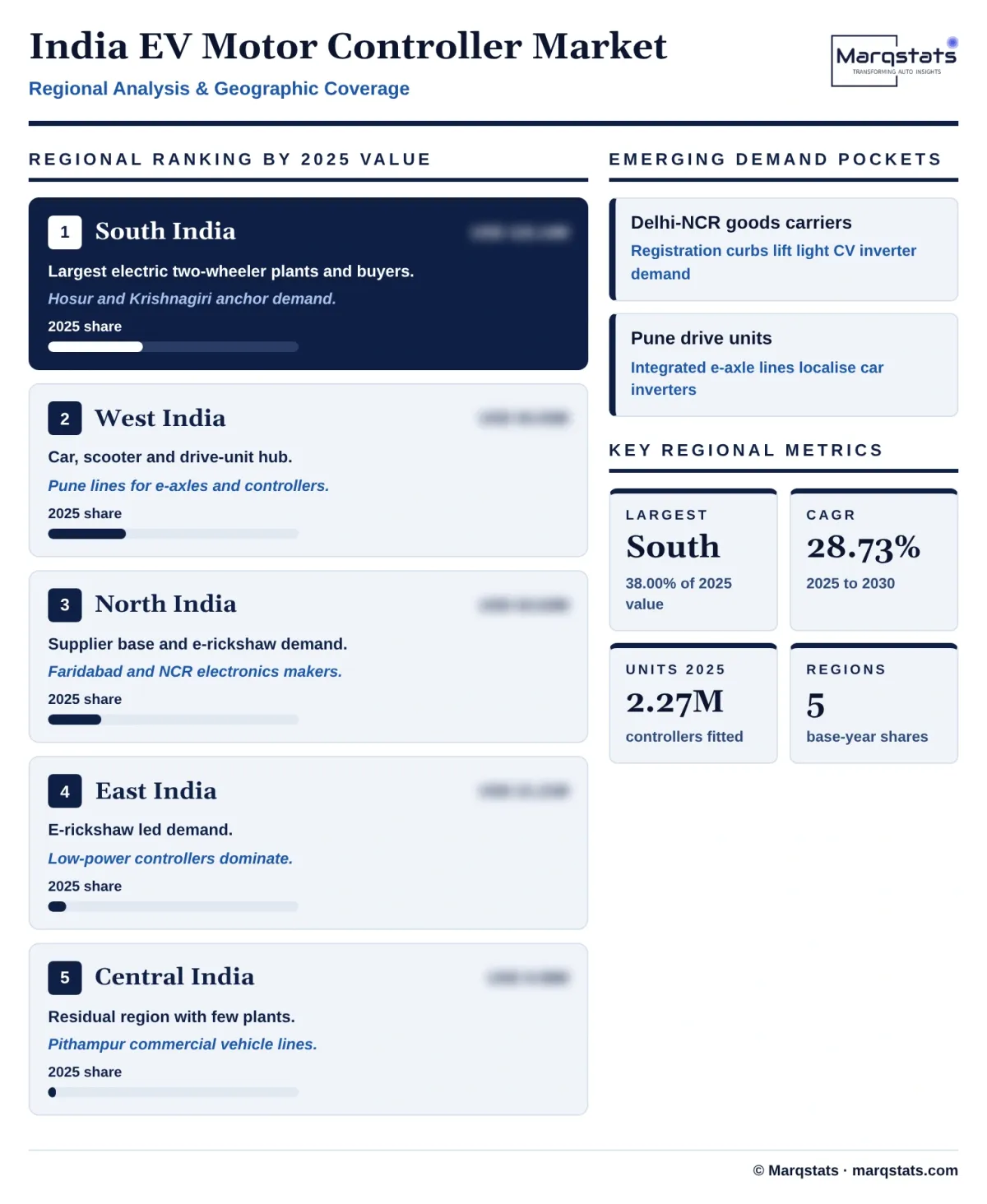
South India is the largest region at an estimated USD 115.14 million, 38.00% of 2025 value. Tamil Nadu and Karnataka host the largest electric two-wheeler plants, including TVS Motor Company Limited at Hosur, Ather Energy Limited at Hosur and Ola Electric Mobility Limited at Krishnagiri, and the zone also bought the most electric two-wheelers in 2025, 440,773 units. Controller demand and controller assembly sit close together here.
West India
West India accounts for an estimated USD 93.93 million, 31.00% of 2025 value. Pune and Chakan host Bajaj Auto Limited, Tata Motors Limited, Mahindra and Mahindra Limited and Tata AutoComp Systems Limited, and Valeo commissioned its Pune e-axle line in March 2026. Kinetic Communications Limited opened its automated controller line in Pune in July 2025, and Uno Minda Limited is building its four-wheeler electric drive unit plant at Chhatrapati Sambhajinagar.
North India
North India accounts for an estimated USD 63.63 million, 21.00% of 2025 value. Sterling Tools Limited runs its electric mobility campus at Faridabad, Minda Corporation Limited is headquartered in the NCR, and Uttar Pradesh is the largest e-rickshaw market. The CAQM curbs on fossil-fuel goods carriers from January 2027 make Delhi-NCR the first dated demand pocket for commercial vehicle inverters.
East India
East India accounts for an estimated USD 21.21 million, 7.00% of 2025 value. Demand is concentrated in e-rickshaws in Bihar, West Bengal and Assam, served mainly by low-power controllers assembled locally or brought in from northern clusters.
Central India
Central India is the residual region at an estimated USD 9.08 million, 3.00% of 2025 value. Commercial vehicle lines at Pithampur in Madhya Pradesh and rising e-rickshaw demand form the base, but few controller makers operate plants in the region.
How Competition Is Evolving
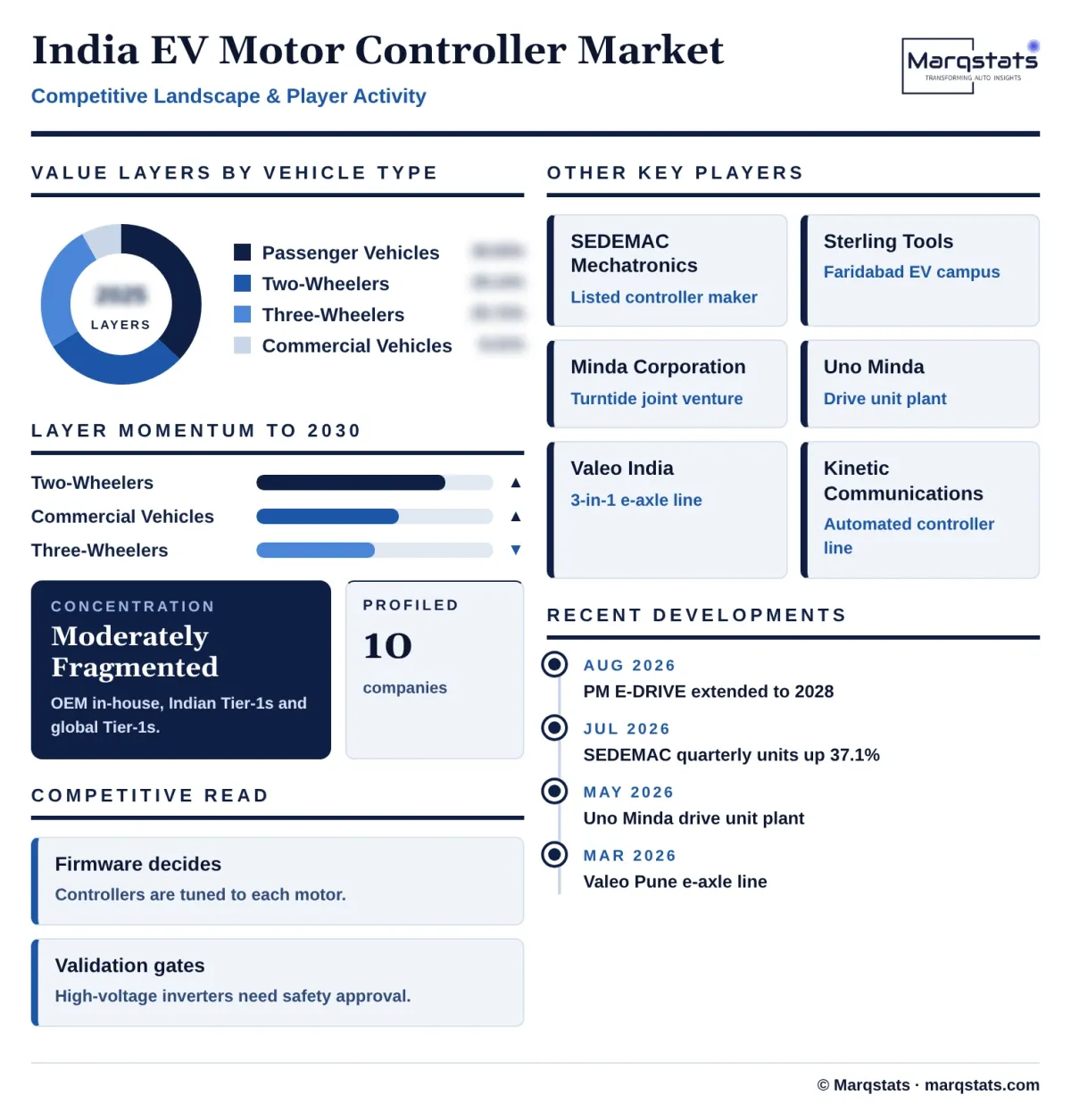
Supply splits into three groups. The first is vehicle makers that design controllers in-house for their own electric two-wheelers and cars, which keeps a large part of two-wheeler controller value outside the merchant market. The second is Indian Tier-1 electronics suppliers that sell low-voltage controllers to two- and three-wheeler makers, including SEDEMAC Mechatronics Limited, Sterling Tools Limited through Sterling E-Mobility Solutions Limited, Minda Corporation Limited, Kinetic Communications Limited and Lucas TVS Limited. The third is global Tier-1s and their Indian units that supply high-voltage inverters or integrated drive units, including Valeo India Private Limited, Uno Minda Limited with its electric drive unit programme and Tata AutoComp Systems Limited, while Sona BLW Precision Forgings Limited supplies traction motors and motor control units across both voltage classes.
Companies compete on firmware, cost and qualification. In two-wheelers the controller is tuned to a specific motor and battery, so a supplier that wins a platform usually keeps it until the next model change. In cars and buses the inverter must pass functional-safety and isolation validation, which favours suppliers with a global design base. Licensing is the common shortcut: Sterling Gtake E-Mobility Limited licenses technology from China and the United Kingdom, and the Minda Corporation and Turntide Technologies joint venture, formed in March 2026, gives Minda access to high-voltage controller designs.
Marqstats does not publish company market shares for this market, because no registration authority or industry body reports controller supply by maker. The public view shows value layers by vehicle type; the full analysis builds supplier positions from company filings, offer documents and OEM sourcing disclosures. SEDEMAC Mechatronics Limited is the most transparent supplier, reporting 1,108,301 ECUs and controllers in the June 2026 quarter and 4,200,939 in the twelve months to June 2026, a count that also includes integrated starter-generator and engine control units.
Companies Covered
Companies covered in the report include:
Recent Market Activity
Table of Contents
Coverage & Segmentation
Included: traction motor controllers and traction inverters fitted to newly registered electric two-wheelers, electric three-wheelers (L3 and L5), electric passenger cars and utility vehicles, and electric buses and goods carriers in India, valued at ex-factory price to the vehicle manufacturer, excluding GST, in US dollars at a constant ₹87.00 per US dollar. One controller per vehicle is assumed. Where the inverter is part of an integrated e-axle or drive unit, only the inverter value is counted. History covers 2021 to 2025, the base year is 2025 and the forecast runs from 2026 to 2030.
Excluded: traction motors, reducers and gearboxes; battery packs and battery management systems; DC-DC converters, on-board chargers and vehicle control units; auxiliary pump and fan controllers; replacement controllers sold in the aftermarket; low-speed electric two-wheelers that are not registered; controllers for tractors, off-road and industrial machines; and controller exports.
Do not add: the India EV Component Market (USD 7.80 billion in 2025, USD 28.50 billion in 2030) includes this controller value inside its traction motors and controllers pool; this market equals 3.88% of that total in 2025. The India Two Three Wheeler Motor Market (USD 0.82 billion in 2025) sizes traction motors; where it counts integrated motor-controller assemblies, the controller portion is the same value measured here. Adding either page to this one double counts.