Market Snapshot
The global wheel loader repair and maintenance services market is valued at USD 17.06 billion in 2025 and is forecast to reach USD 22.40 billion by 2030, a CAGR of 5.60%. The active wheel loader parc grows from 1.85 million to 2.10 million machines, a 2.57% CAGR, and spend per machine rises from USD 9,222 to USD 10,667.
Marqstats sizes the market as active wheel loader parc multiplied by annual service spend per machine, region by region, because no manufacturer, dealer or trade body publishes a wheel-loader service total. The parc and the regional spend levels are Marqstats constructions, built on the same model and the same definitions as the Marqstats Global Construction Equipment Repair and Maintenance Services Market, which values all construction machinery service at USD 124.60 billion in 2025. Wheel loaders are 13.69% of that total and 24.45% of its USD 69.78 billion earthmoving segment. The input that moves the total most is spend per machine in North America, where a 5% change shifts the 2025 value by USD 0.25 billion.
Wheel loaders grow more slowly than construction machinery service as a whole, 5.60% against 6.22%, and the reason is China. The China Construction Machinery Association reported 128,067 loader sales in 2025, and on the Marqstats China Electric Wheel Loader Market basis 43.70% of domestic loader sales were battery-electric. An electric five-tonne loader costs about RMB 15,300 a year to maintain against RMB 30,400 for diesel, so the largest wheel loader parc in the world is shedding service spend per machine just as it modernises.
Everywhere else the parc is ageing and the work is moving into dealer bays. New financed wheel loader sales in the United States fell 12.8% in the year to June 2026 while used sales rose 4.8%, and the average used machine was 7.4 to 8.1 years old. Older machines need more transmission, axle and hydraulic work, and that is where franchised dealers hold the tooling.
Key Takeaways
Market Overview & Analysis
Report Summary
A wheel loader earns its keep on repetition. It digs into a stockpile, lifts, reverses and dumps, hundreds of times a shift, and every cycle loads the torque converter, the axles, the articulation joint and the hydraulic pumps. That duty cycle makes wheel loaders one of the heaviest service categories in construction machinery, and it makes the service bill a decision in its own right for quarry operators, aggregate producers, waste handlers, ports and contractors. The question for 2026 to 2030 is where the spend grows, because the two largest forces in the market push in opposite directions: ageing diesel fleets in North America and Europe need more work, while China is replacing diesel loaders with battery-electric machines that need much less.
The measure is invoiced repair and maintenance value on in-service wheel loaders: scheduled maintenance, unscheduled repair, component overhaul and remanufactured-component installation, condition-monitoring services, and the parts and fluids fitted during those jobs. In-house fleet workshops are valued at the cost of the work they perform. The market is a sub-slice of the Marqstats Global Construction Equipment Repair and Maintenance Services Market and uses identical definitions; it excludes new and used loader sales, rental revenue, over-the-counter parts sold without installation, tyres sold as a standalone purchase, agricultural loaders, skid-steer, backhoe and compact track loaders, and loaders in dedicated mine fleets.
The analysis serves four decision makers. Manufacturers and dealer groups deciding how to price customer value agreements for loaders past warranty need the size of the post-warranty pool. Independent rebuild shops and component remanufacturers need the overhaul pool and how fast it grows. Investors weighing Chinese electric loader makers need to know how much service revenue electrification removes. Quarry, waste and port operators setting maintenance budgets need a benchmark for spend per machine by region.
Global Wheel Loader Repair and Maintenance Services Market Size and Forecast
The market rises from USD 14.20 billion in 2021 to USD 14.95 billion in 2022, USD 15.70 billion in 2023, USD 16.38 billion in 2024 and USD 17.06 billion in 2025, a 4.69% compound rate over the history period. Marqstats forecasts USD 18.01 billion in 2026, USD 19.02 billion in 2027, USD 20.09 billion in 2028, USD 21.21 billion in 2029 and USD 22.40 billion in 2030, a 5.60% CAGR and USD 5.34 billion of added annual spend. The 2026 to 2029 values sit on that compound path.
The build multiplies two series. The active parc is a Marqstats construction from cumulative deliveries less retirements: 1.72 million wheel loaders in 2021, 1.85 million in 2025 and 2.10 million in 2030. It is consistent with the Marqstats Global Earthmoving Equipment Market, which counts 214,067 new wheel loaders delivered worldwide in 2025, 128,067 of them Chinese-brand, rising to 248,000 in 2030; deliveries of that size against a parc growing by about 50,000 a year imply retirements of roughly 165,000 to 190,000 loaders a year, an average working life near nine years once short-lived Chinese machines are included. Service spend of USD 17.06 billion equals about 74% of the USD 22.98 billion that Marqstats puts on new wheel loader sales in 2025. Spend per machine averages USD 9,222 in 2025 and USD 10,667 in 2030, a 2.95% CAGR, but the average hides a wide regional spread. A loader in North America costs about USD 19,000 a year to keep working, a loader in Europe about USD 12,515, and a loader in Asia-Pacific about USD 5,600, because labour rates, machine size and the share of electric machines all differ. Each regional spend level is a Marqstats construction, calibrated against dealer product support disclosures.
History grew more slowly than the forecast because the Chinese domestic diesel loader market contracted. On the Marqstats China Electric Wheel Loader Market basis, domestic diesel loader sales fell from about 106,500 in 2021 to 37,343 in 2025, so the Chinese parc aged without growing. The forecast is faster because the North American and European parcs keep ageing, emissions and electronic content rises, and growth in the Gulf and Latin America adds machines that work long hours.
Wheel loaders sit inside the construction equipment service total, not beside it. The Marqstats Global Construction Equipment Repair and Maintenance Services Market is USD 124.60 billion in 2025 and USD 168.45 billion in 2030; wheel loaders are 13.69% of it in 2025 and 13.30% in 2030. The share falls because the wheel loader rate of 5.60% trails the 6.22% for all construction machinery, a gap that comes almost entirely from Chinese electrification.
China Is Electrifying the Largest Wheel Loader Parc
Wheel loaders are the earthmoving class where the biggest parc is changing powertrain fastest. The China Construction Machinery Association reported 128,067 loader sales in 2025, up 18.4%, with 66,330 sold at home and 61,737 exported. On the Marqstats China Electric Wheel Loader Market basis, 29,771 of those loaders were battery-electric, 43.70% of domestic sales, and the domestic electric share reached 57% in the first half of 2026.
Electric loaders cut the service bill in half. The same page puts annual maintenance on a five-tonne loader at about RMB 30,400 for diesel and RMB 15,300 for electric, a saving of RMB 15,100, or USD 2,103 at RMB 7.18 per US dollar. The comparison comes from five-tonne deployments and is not independently verified for larger or smaller classes, so Marqstats applies it only to the Chinese medium-loader fleet. Engine oil, fuel filters, injectors, turbochargers and exhaust aftertreatment leave the schedule, and the powershift transmission and torque converter give way to a simpler electric drive.
Marqstats estimates about 320,000 battery-electric loaders in Chinese service by 2030, built from electric sales of 29,771 in 2025 rising towards 101,550 in 2030 less the export share. At USD 2,103 a machine, that fleet removes about USD 0.67 billion of annual service spend that diesel loaders would have generated. This is why Asia-Pacific, the largest region, grows only 4.11% a year and its spend per machine rises just from USD 5,600 to USD 6,284.
The money does not vanish evenly. Battery inspection, thermal-loop service and high-voltage diagnostics replace engine work, and they stay with the manufacturer and its dealers. Independent workshops in China lose the oil changes and injector jobs that made up much of their loader business, so electrification moves share towards dealers even as it shrinks the pool.
The Western Parc Is Ageing Into Overhaul
Outside China the wheel loader parc is getting older, and older loaders need heavier work. Equipment World reported on 16 September 2026, using Fusable equipment data, that about 11,200 new financed wheel loaders were sold in the United States in the year to June 2026, down 12.8%, while about 7,500 used loaders changed hands, up 4.8%. The average used machine on the market was 7.4 to 8.1 years old, and used prices peaked at an average of USD 158,049 in the first quarter of 2026.
Buyers who choose a used loader or keep the old one push the machine past its first transmission and axle rebuild. Marqstats sets the component-overhaul share of wheel loader spend at 22.0% in 2025, above the 19.0% for all construction machinery, because loader drivelines take more shock than excavator undercarriages, and raises it to 22.5% by 2030 as the North American and European parcs age.
Dealers are building capacity for that work. Finning International Inc. grew 2025 product support revenue 8.3% to CAD 5.934 billion, about USD 4.25 billion at CAD 1.3978, equal to 56.0% of its revenue. Toromont Industries Ltd. grew Equipment Group product support 4% for the year and 9% in the fourth quarter. Komatsu Ltd. agreed in February 2026 to buy the remanufacturing business of SRC of Lexington, Inc., adding exchange capacity for transmissions and hydraulic components.
Right-to-Repair Law Leaves Wheel Loaders With the Dealer
Much commentary treats Colorado as the state that opened heavy equipment repair. The statutes say the opposite for wheel loaders. Colorado HB23-1011, signed on 25 April 2023 and effective 1 January 2024, is titled Consumer Right to Repair Agricultural Equipment and applies only to agricultural machinery. Colorado HB24-1121, signed on 28 May 2024 and effective 1 January 2026, extends repair access to digital electronic equipment and bars parts pairing on equipment first sold from that date, but section 6-1-1503(5)(e) expressly exempts industrial, utility, construction, compact construction, mining, forestry and road-building equipment.
Europe adds obligations rather than access. Regulation (EU) 2023/1230 on machinery entered into force on 19 July 2023 and applies from 20 January 2027, replacing Directive 2006/42/EC. A person who makes a substantial modification to a machine takes on the obligations of a manufacturer, and the essential safety requirements include protection against corruption of control software. Routine like-for-like repair is not a substantial modification, but reprogramming a loader control system or changing its stability or performance envelope can be.
For 2026 to 2030 the legal balance therefore favours authorized dealers. Marqstats models dealer share of wheel loader service rising from 56.0% to 57.5%. A future statute naming construction machinery would change the split between dealers and independents, but not the total, because the work still has to be done.
Market Dynamics
Key Drivers
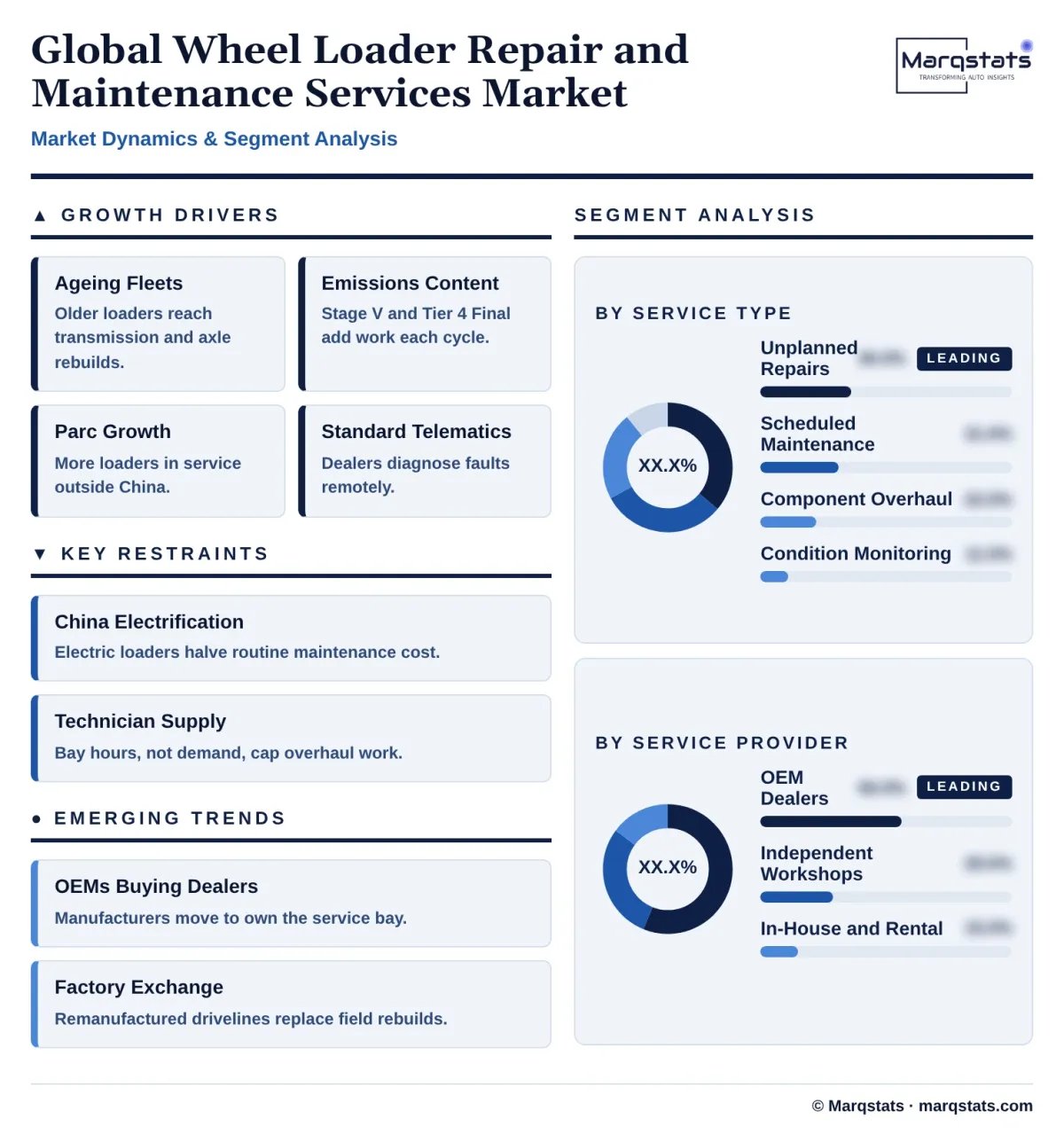
Four drivers carry the forecast, each tied to a dated figure or named instrument.
- Ageing North American and European fleets: new financed United States wheel loader sales fell 12.8% in the year to June 2026 while used sales rose 4.8%, so machines run longer and reach transmission, axle and hydraulic rebuilds.
- Emissions and electronic content: US EPA Tier 4 Final and Regulation (EU) 2016/1628 Stage V put particulate filters, urea dosing and electronic engine control on diesel loaders, adding cleaning, sensor and calibration work to each service cycle.
- Parc growth outside China: the global parc rises from 1.85 million to 2.10 million wheel loaders by 2030 on Marqstats estimates, with the fastest additions in the Middle East and Africa, where the parc grows from 120,000 to 170,000.
- Telematics as standard equipment: LiuGong made iLink telematics standard on diesel loaders above 100 horsepower and on all electric loaders in its T Series, giving dealers remote diagnostic access, and condition-monitoring services grow 8.29% a year.
Key Restraints
Three constraints hold wheel loader service growth below the construction machinery average.
- Electrification in China: an electric five-tonne loader costs about RMB 15,300 a year to maintain against RMB 30,400 for diesel, and Marqstats estimates the electric fleet removes about USD 0.67 billion of annual spend by 2030.
- Technician supply: dealers in North America and Europe cannot hire heavy-equipment technicians fast enough, so bay hours, not demand, cap how much overhaul work they can bill in any year to 2030.
- Utilization risk: loader service tracks operating hours, and aggregate and quarry output follows construction activity, so a downturn in building materials demand cuts wear and defers repairs within a quarter.
Key Trends
Three trends change how wheel loader service is sold and delivered.
- Manufacturers buy the service channel: Volvo Construction Equipment completed its SEK 7 billion purchase of the dealer Swecon on 1 February 2026, and Caterpillar Inc. agreed on 29 September 2026 to buy the 37-location Fabick Cat dealership.
- Factory exchange replaces field rebuild: Komatsu Ltd. agreed on 5 February 2026 to buy the remanufacturing business of SRC of Lexington, Inc., and certified rebuild programmes let fleets reset a loader for a second life.
- Serviceability is designed in: new loaders launched in 2026, such as the LiuGong T Series and the Volvo L150, L180 and L220, carry auto-lubrication, ground-level daily checks and telematics that move routine work into scheduled windows.
Strategic Implications
- For manufacturers: price service plans for the second life of a loader, not the first. The overhaul pool of USD 3.75 billion in 2025 grows 6.09% a year, faster than scheduled maintenance, and a certified rebuild package bundled with remanufactured drivelines keeps an ageing machine in the dealer system.
- For Chinese electric loader makers: the service revenue an electric loader does not generate has to be replaced by battery health, thermal-loop and high-voltage diagnostic contracts. Makers that build those contracts into the sale capture the margin that diesel engine work used to provide.
- For independent workshops and rebuilders: the USD 4.95 billion independent layer grows 4.84% a year, slower than dealers. Focus on mechanical work on pre-Stage V and pre-Tier 4 Final loaders, such as articulation joints, axles, cylinders and bucket and boom repair, where diagnostics are not a barrier.
- For quarry, waste and port operators: spend per loader rises 2.95% a year to USD 10,667 by 2030 on the global average, and far more in North America. Logging every intervention, running oil analysis and comparing dealer and independent quotes for mechanical work is the cheapest way to control the largest cost after fuel.
Market Segmentation
Unscheduled repairs are the largest service type at USD 6.14 billion, 36.0% of 2025 spend, rising to USD 7.62 billion and 34.0% by 2030 at a 4.41% CAGR. Hose bursts, cooling failures, electrical faults and aftertreatment derates stop a loader mid-shift, and the cost of an idle crusher or ship berth makes these jobs price-inelastic. Share falls because telematics turns more failures into planned work.
Scheduled maintenance, the 250-, 500-, 1,000- and 2,000-hour services with fluid changes, filters, greasing and inspection, is worth USD 5.29 billion, 31.0% of 2025 spend, and reaches USD 6.94 billion in 2030 at 5.58%, holding 31.0%. It grows with the parc and with price, less the oil and filter work that electric loaders no longer need.
Component overhaul and remanufactured-component installation is worth USD 3.75 billion, 22.0% of 2025 spend, rising to USD 5.04 billion and 22.5% by 2030 at 6.09%. Transmissions, torque converters, axles, final drives, hydraulic pumps and engines reach overhaul as the Western parc ages, and factory exchange units shorten downtime compared with field rebuilds.
Condition-monitoring services, meaning telematics health monitoring, remote diagnostics and oil-analysis programmes billed as a service, are worth USD 1.88 billion, 11.0% of 2025 spend, and reach USD 2.80 billion and 12.5% by 2030. At an 8.29% CAGR this is the fastest-growing service type. Work carried out under a customer value agreement is counted in the service type it covers, so the dimension does not double count.
Medium wheel loaders of 8 to 30 tonnes operating weight, including the Chinese five-tonne-payload class, account for USD 9.89 billion, 58.0% of 2025 spend, and USD 12.66 billion, 56.5%, in 2030 at 5.06%. They are the general-purpose machines of aggregates, construction and material handling. Share falls because most Chinese electric loaders sit in this class.
Large wheel loaders above 30 tonnes in quarries, aggregate plants and port bulk handling account for USD 3.67 billion, 21.5% of 2025 spend, rising to USD 5.04 billion and 22.5% in 2030 at 6.55%. They work long shifts, carry expensive drivelines and tyres, and justify field technicians on site. Loaders in dedicated mine fleets are excluded, consistent with the parent construction equipment service definition.
Compact wheel loaders under 8 tonnes account for USD 3.50 billion, 20.5% of 2025 spend, and USD 4.70 billion, 21.0%, in 2030 at 6.07%. Europe is the core market for the class, used by landscapers, municipalities and farm-adjacent contractors, and its parc keeps growing as compact loaders replace backhoes on urban sites.
OEM-authorized franchised dealers hold USD 9.55 billion, 56.0% of 2025 spend, rising to USD 12.88 billion and 57.5% by 2030 at 6.17%. Warranty work, customer value agreements, remanufactured exchange and proprietary transmission, emissions and electric-drive diagnostics route through the dealer bay. The share is two points below the 58.0% Marqstats sets for all construction machinery because older, simpler Chinese diesel loaders are serviced heavily outside dealer networks.
Independent workshops, mobile mechanics and rebuild shops hold USD 4.95 billion, 29.0% of 2025 spend, and USD 6.27 billion, 28.0%, in 2030 at 4.84%. They win mechanical work on older and multi-brand fleets on price and response time, and lose engine work as Chinese loaders electrify.
Contractor, quarry and port in-house workshops and rental-company service operations hold USD 2.56 billion, 15.0% of 2025 spend, and USD 3.25 billion, 14.5%, in 2030 at 4.89%. Large aggregate producers keep their own loader mechanics, and rental fleets maintain their machines at cost; recovery of that cost inside rental rates belongs to the rental market.
By Geography
Asia-Pacific
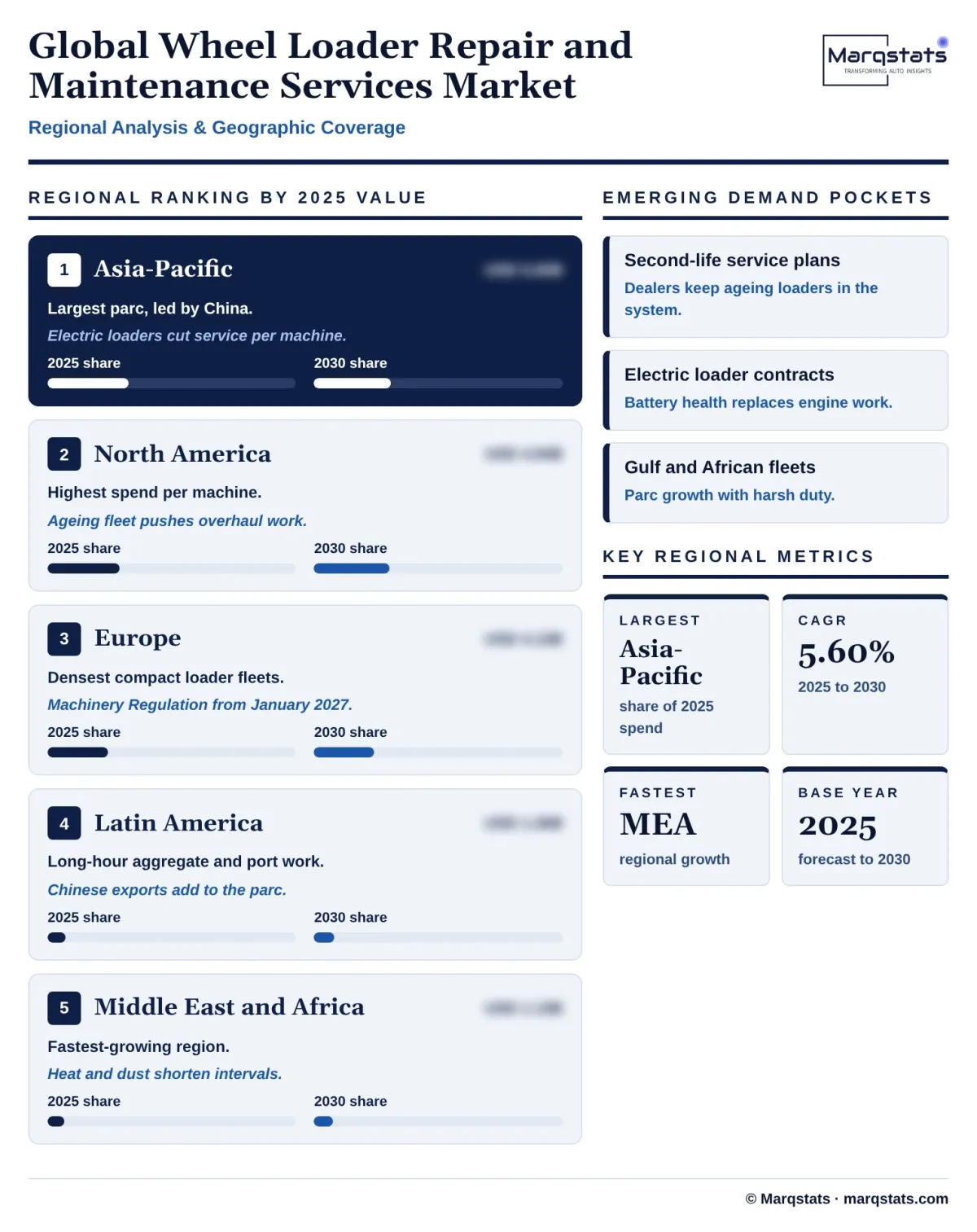
Asia-Pacific is the largest region at USD 5.60 billion, 32.83% of 2025 spend, but the slowest growing, reaching USD 6.85 billion and 30.58% by 2030 at a 4.11% CAGR. It holds 1.00 million of the 1.85 million loaders in the global parc, most of them in China, where labour is cheap and an average loader costs about USD 5,600 a year to maintain. Chinese electrification removes engine and transmission work from the fastest-renewing part of the fleet, while Japan, Australia, India and Southeast Asia keep diesel fleets growing. Asia-Pacific remains the largest region in 2030, by USD 0.07 billion.
North America
North America accounts for USD 4.94 billion, 28.96% of 2025 spend, and USD 6.78 billion, 30.27%, in 2030 at 6.54%. A parc of 260,000 loaders costs about USD 19,000 each a year, the highest of any region, because shop rates are high, machines are large and customer value agreements bundle telematics and parts. The United States fleet is ageing as used sales rise and new financed sales fall, and Caterpillar Inc. agreed on 29 September 2026 to buy the Fabick Cat dealership, a sign of how manufacturers value the dealer bay.
Europe
Europe accounts for USD 4.13 billion, 24.21% of 2025 spend, and USD 5.35 billion, 23.88%, in 2030 at 5.31%. Wheel loaders are a larger share of the European service pool than of the global one because Germany, France and the Nordic countries run the densest compact loader fleets in the world. Stage V aftertreatment and Regulation (EU) 2023/1230, which applies from 20 January 2027, keep control-system and safety-related work in dealer bays, and Volvo Construction Equipment ownership of Swecon puts the manufacturer directly into Swedish, German and Baltic loader service.
Latin America
Latin America accounts for USD 1.26 billion, 7.39% of 2025 spend, and USD 1.78 billion, 7.95%, in 2030 at 7.15%. Aggregate, cement and port operations in Brazil, Chile and Peru run loaders long hours, and Finning International Inc. operates the Cat dealership across Chile, Argentina and Bolivia. Chinese loader exports are adding to the parc fastest here, which adds parts and mechanical work for independent shops.
Middle East and Africa
Middle East and Africa is the smallest region at USD 1.13 billion, 6.62% of 2025 spend, and the fastest growing, reaching USD 1.64 billion and 7.32% by 2030 at a 7.73% CAGR. The parc rises from 120,000 to 170,000 loaders on Gulf construction and southern African aggregates, and heat and dust shorten filter and cooling intervals. Babcock launched the new-generation Volvo L150, L180 and L220 loaders in South Africa in February 2026, backed by CareTrack telematics and national parts coverage.
How Competition Is Evolving
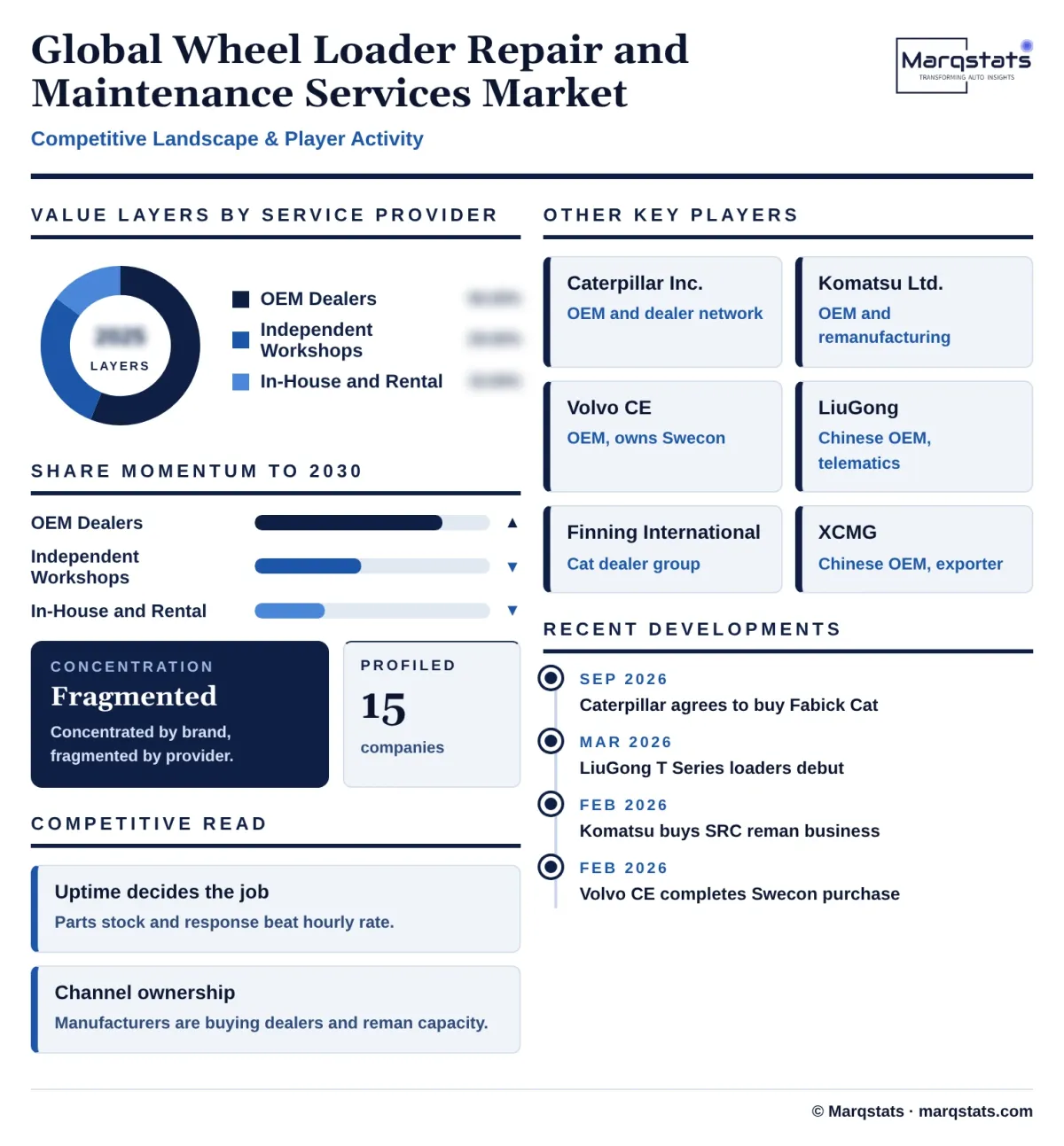
The market is fragmented by service provider and concentrated by brand. OEM-authorized dealers hold 56.0% of 2025 spend, independent workshops 29.0% and in-house and rental fleets 15.0%. Within the dealer layer the Caterpillar network is the largest single system, and Caterpillar reported USD 24 billion of services revenue across all its businesses in 2025 with a goal of USD 30 billion by 2030. No regulator or trade body publishes company shares of wheel loader service, so Marqstats describes competition by layer and by dated actions.
Loader service is won on uptime. An aggregate plant or port that loses its only large loader stops loading trucks, so parts availability, exchange stock, field-truck coverage and remote diagnostics decide the job before hourly rate does. Dealers win drivetrain, emissions and electric-drive work; independents win mechanical repair on older loaders and on price for routine service; quarry and port operators keep daily and weekly maintenance in-house.
Two structural shifts run through the forecast. Manufacturers are moving into the channel, as the Swecon purchase, the Fabick Cat agreement and the SRC of Lexington remanufacturing deal show. Chinese manufacturers such as Guangxi LiuGong Machinery Co., Ltd., XCMG Construction Machinery Co., Ltd. and Shandong Lingong Construction Machinery Co., Ltd. are exporting loaders in volume, 61,737 in 2025, and building dealer service networks abroad to support them, which brings new brands into every regional service pool.
Companies Covered
Companies covered in the report include:
Recent Market Activity
Table of Contents
Coverage & Segmentation
Coverage is invoiced repair and maintenance value on in-service wheel loaders worldwide, 2021 to 2030, base year 2025, in nominal US dollars. Included: scheduled maintenance, unscheduled repair, component overhaul and remanufactured-component installation, condition-monitoring services, and the parts and fluids fitted during those jobs, whether performed by dealers, independent workshops, rental companies or in-house fleet workshops. Wheel loaders means articulated and rigid-frame wheeled front-end loaders of all sizes, including compact loaders. Excluded: new and used loader sales, rental revenue, financing, over-the-counter parts sold without installation, standalone tyre sales, skid-steer, compact track and backhoe loaders, agricultural loaders and loaders in dedicated mine fleets.
Parent and sibling boundaries. This market is a sub-slice of the Marqstats Global Construction Equipment Repair and Maintenance Services Market (USD 124.60 billion in 2025, USD 168.45 billion in 2030) and sits inside its earthmoving machinery segment (USD 69.78 billion in 2025); do not add the two, since wheel loader service is already counted there. The Marqstats Global Construction Equipment Market (USD 246.60 billion in 2025) sizes new machine sales and excludes aftermarket service; do not add. The Marqstats China Electric Wheel Loader Market sizes electric loader sales, not their service. The Marqstats Global Construction Equipment Rental Market includes the cost of maintaining rental fleets inside rental rates; do not add rental-fleet maintenance from this page to that figure.
Regional and segment values are Marqstats estimates reconciled to the total. Company figures are quoted as reported and converted at fixed 2025 average rates of CAD 1.3978, SEK 9.8191 and RMB 7.18 per US dollar.