Market Snapshot
The US EV battery plant conversion to energy storage market, covering cells for BESS (battery energy storage system) and other battery storage made on converted EV lines, stands at about 18.0 GWh a year of battery energy storage system (BESS) cell capacity on US lines built or planned for EV batteries in 2025 and is estimated at 67.0 GWh a year in 2026. Marqstats forecasts it to reach 150.0 GWh a year by 2030, a CAGR of 52.81% over 2026 – 2030 that adds 132.0 GWh a year between 2025 and 2030.
Michigan is the largest market, Other States (Indiana, Tennessee, Georgia, Kentucky, Ohio) is the fastest growing and LFP Cells is the dominant segment, in a market that is highly concentrated. The report covers 2 segments and 2 regions and profiles 16 companies, with 2025 as the base year, history from 2021 – 2025 and a forecast for 2026 – 2030.
Key Takeaways
Market Overview & Analysis
Report Summary
The US EV battery plant conversion to energy storage market covers US cell production capacity built or planned for EV batteries and converted, fully or partly, to make cells for stationary battery energy storage systems (BESS), measured as year-end annual ESS cell capacity in GWh on those lines; purpose-built ESS plants such as Tesla's Nevada LFP lines are excluded. Marqstats estimates about 18.0 GWh at the end of 2025: about 16.5 GWh of LFP at LG Energy Solution's Holland, Michigan plant and about 1.5 GWh of nickel-based ESS output at StarPlus Energy in Kokomo, Indiana. Marqstats estimates 67.0 GWh in 2026 and 150.0 GWh by 2030, a CAGR of 52.81%.
America's new battery energy storage cell industry is being built inside its EV battery plants. The US made no ESS cells before 2025, added about 20 GWh that year and is expected to reach about 96 GWh by the end of 2026, according to the US Energy Storage Coalition. Marqstats estimates about 67 GWh of that, roughly 70%, sits on lines that GM, Ford, Stellantis and their Korean partners built for EV batteries. Converting idle EV lines is faster and cheaper than building new ESS plants.
US grid storage supply therefore depends on EV demand staying weak enough to leave those lines free. A strong EV recovery would force carmakers to choose between their own vehicles and multi-year storage contracts with utilities, developers and Tesla running to 2030. Demand is strong: the Solar Energy Industries Association raised its forecast of cumulative US storage through 2030 by 11.5% to 683 GWh, and tariffs push developers towards US-made cells.
Marqstats forecasts 82.0 GWh in 2027, 100.2 GWh in 2028 and 122.6 GWh in 2029, from LG Energy Solution's Lansing and Spring Hill lines, Samsung SDI's Kokomo conversion, SK On's Georgia plant and Ford's Kentucky plant. Capacity runs ahead of contracts that mostly start in 2027 or 2028, keeping pressure on prices. The forecast is a single most likely path; a faster EV recovery would reduce converted capacity, while stronger storage demand or tighter tariffs would raise it.
Market Dynamics
Key Drivers
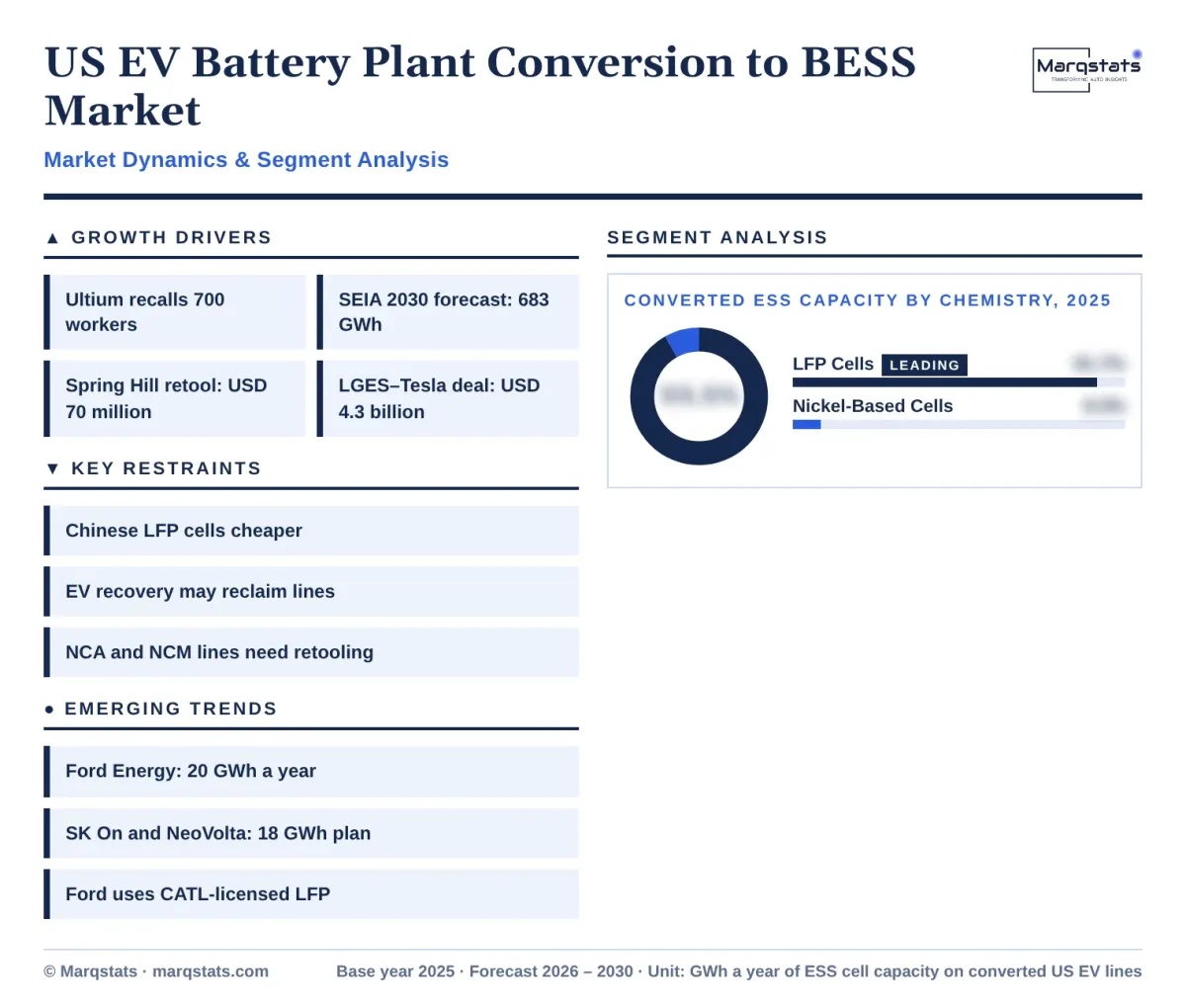
- Idle EV lines: Battery makers struggled to keep US plants busy as EV demand slowed, so ESS contracts raise utilisation and spread fixed costs. Ultium Cells, the GM–LG Energy Solution joint venture, invested USD 70 million in March 2026 to retool part of its Spring Hill, Tennessee plant from nickel-based EV cells to LFP cells for LG Energy Solution Vertech, starting mass production in the second quarter of 2026 and recalling the 700 employees furloughed in January. Conversions protect jobs tied to state incentives.
- Storage demand: More than 10% of all US storage capacity installed came online in the second quarter of 2026, driven by data centres, renewable integration and grid reliability. LG Energy Solution won about 90 GWh of new ESS orders in 2025 and aims to exceed that in 2026, targeting more than 60 GWh of global ESS cell capacity by the end of 2026, 50 GWh in North America; it says it makes about 80% of North American ESS batteries.
- Tariffs: US tariffs on Chinese batteries and limits on Chinese content in tax-credit-eligible projects push developers towards US cells. Tesla has said tariffs have an outsized effect on its energy business because it sources LFP cells from China, which is why it signed with LG Energy Solution. Converted plants that meet domestic content rules can command higher prices from developers seeking credits.
- Low conversion cost: Spring Hill's USD 70 million retooling cost far less than a new cell plant because buildings, utilities, dry rooms and workers already existed. LG Energy Solution planned to cut 2026 capital spending by more than 40%, favouring conversion over new plants. Holland began large-scale LFP production at about 16.5 GWh and targets about 30 GWh by the end of 2026.
- Long contracts: The US government confirmed in March 2026 a USD 4.3 billion LG Energy Solution–Tesla agreement for LFP prismatic cells for Megapack 3, assembled in Houston, with dedicated Lansing lines supplying from August 2027 to July 2030. DTE Energy will use Lansing-made batteries, and LG Energy Solution has cited orders linked to Google projects. Samsung SDI signed a KRW 1.5 trillion, about USD 1 billion, deal with an unnamed US energy company running to 2029.
Key Restraints
- Chinese LFP cost: Chinese LFP cells cost less than US-made cells, and Chinese system integrators remain strong in global storage. US cells compete on tariff exposure, domestic content and supply security rather than price. Capacity running ahead of contracted demand in 2026 and early 2027 adds price pressure on converted lines.
- EV recovery risk: If US EV demand recovers, lines will be needed again for EV cells, and carmakers sharing plants with cell makers must agree how lines are split. Lansing also makes NCM cells for Toyota's Kentucky EVs, and LG Energy Solution's L-H Battery joint venture with Honda in Ohio is part of the ESS network. Panasonic Energy has not converted its Nevada and Kansas lines, while it remains a potential converter.
- Tax credit changes: Changes to US clean energy tax credits and domestic content rules affect the value of US-made cells. Ford Energy's LFP cells use technology licensed from CATL, which lets Ford enter storage quickly while possibly facing scrutiny under rules on foreign entities of concern. Questions over ownership of the StarPlus plant in Kokomo also affect how much of it stays with storage.
- Retooling: EV lines were built mainly for nickel-based NCM and NCA cells, while storage customers prefer LFP for safety, cycle life and cost, so conversions need new electrode equipment, cell formats and cooling. Samsung SDI is modifying part of StarPlus Plant 1's high-nickel NCA lines, initially estimated at 34 GWh, for prismatic LFP from October 2026. Grid connection queues can also delay storage deliveries.
Key Trends
- Carmaker storage units: Ford launched Ford Energy to supply US-assembled BESS to utilities, data centres and industrial customers, investing about USD 2 billion centred on its Glendale, Kentucky plant, taken over when Ford and SK On ended BlueOval SK in May 2026. Its DC Block, a 20-foot container of 512 Ah LFP cells offered as the two-hour FE-250 and four-hour FE-450, targets at least 20 GWh a year with first deliveries in late 2027. Selling systems captures more value than cells.
- Licensed technology: Ford's use of CATL-licensed LFP shows how carmakers enter storage quickly without developing chemistry in-house. LG Energy Solution has developed system-level technologies and new cooling for grid storage, and Samsung SDI sells containerised systems, with supplier Hanjung America building an ESS facility in Huntington, Indiana. LFP's thermal stability eases permitting under strict fire codes.
- Tolling deals: SK On signed a deal to supply 9 GWh of LFP pouch cells to NeoVolta Power from 2027 to 2031 from its Georgia plant, worth an estimated KRW 1.5 trillion, about USD 1.09 billion, and plans another 9 GWh under a tolling arrangement, taking cooperation to 18 GWh. SK On has about 100 GWh of US capacity across Georgia, Tennessee and a Hyundai joint plant, and its first ESS contract with Flatiron Energy covered 1 GWh with options to 7.2 GWh.
- Data-centre demand: Ford Energy targets data centres alongside utilities, and AI data-centre growth adds demand for on-site and grid storage from buyers who value supply security and US manufacturing. EDF power solutions North America signed in May 2026 to buy up to 4 GWh a year, up to 20 GWh, from Ford Energy from 2028. Samsung SDI signed 1 GWh with Alpha Omega Power in October 2026 and expects US ESS demand to exceed its production.
Market Segmentation
LFP cells, 16.5 GWh or 91.67% in 2025, grow at a 53.37% CAGR to 140.0 GWh and 93.33% by 2030. LFP suits BESS because cost, safety and cycle life matter more than energy density. Nearly all conversions at Holland, Lansing, Spring Hill, Kokomo, Georgia and Kentucky switch to LFP.
Nickel-based ESS cells, 1.5 GWh or 8.33%, grow at 46.14% to 10.0 GWh by 2030. Samsung SDI's NCA cells in its Battery Box 1.7 are the main example. They remain a niche where existing nickel lines serve storage without full retooling.
Holland, Lansing and Spring Hill lead converted capacity. LG Energy Solution took full ownership of Lansing, built as Ultium Cells' third EV plant, in May 2025 when construction was 98% complete; production started on 18 August 2026 towards more than 35 GWh, with more than USD 2 billion invested and about 900 staff rising to 1,700. LG Energy Solution makes ESS batteries at five hubs, four in the US.
Kokomo, Georgia and Kentucky add capacity from 2026. Samsung SDI aimed for 30 GWh of US BESS capacity by the end of 2026, SK On fills Georgia with NeoVolta and Flatiron contracts, and Ford Energy targets 20 GWh from late 2027. Hyundai and Toyota partners may follow with further conversions.
DTE Energy and EDF power solutions buy US-made storage, valuing domestic content and supply security. Utility contracts run five years or more. Grid connection timing sets when deliveries are needed.
Tesla Megapack 3 and NeoVolta take converted cells, and data centres buy complete systems from Ford Energy and LG Energy Solution Vertech. Integrators shifting away from Chinese cells because of tariffs are the largest new customers.
By Geography
Michigan
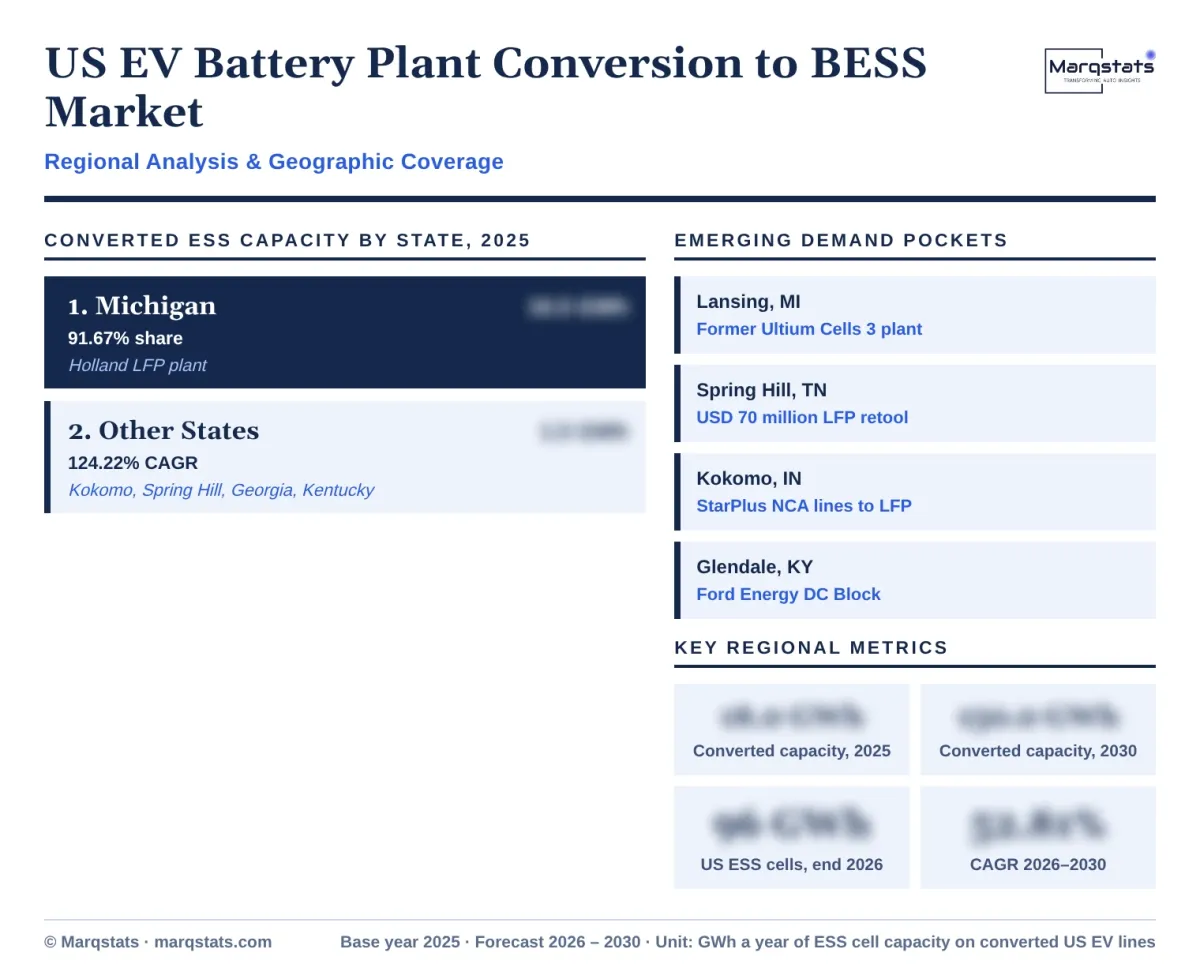
Michigan held 91.67% of converted capacity in 2025, all at Holland, growing at a 31.55% CAGR to 65.0 GWh by 2030 as Lansing ramps and Holland expands. Michigan incentives tied to employment support continued conversion.
Other States (Indiana, Tennessee, Georgia, Kentucky, Ohio)
Other states held 8.33% in 2025, about 1.5 GWh, and grow fastest at 124.22% to 85.0 GWh and 56.67% by 2030. Kokomo, Spring Hill, SK On's Georgia plant, Ford's Kentucky plant and the L-H Battery plant in Ohio add ESS lines.
How Competition Is Evolving
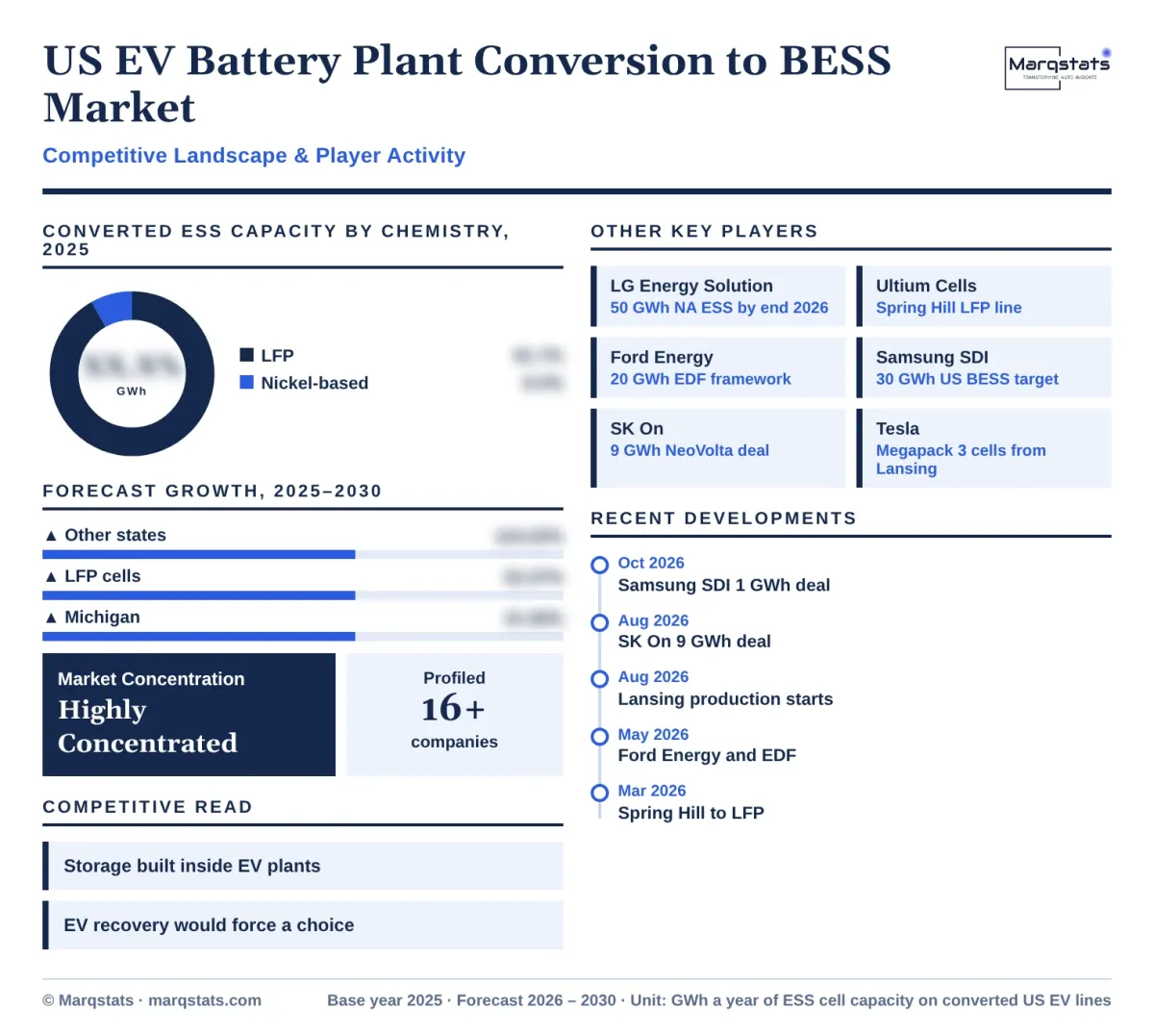
Converted US ESS cell capacity is highly concentrated: LG Energy Solution and its joint ventures hold most of it, followed by Samsung SDI, SK On and Ford Energy.
Carmakers participate through joint ventures with cell makers, as with GM at Ultium Cells and Stellantis at StarPlus Energy, or directly, as with Ford Energy.
Tesla is both a buyer of converted capacity and a builder of its own LFP lines.
Utilities, developers and integrators such as DTE Energy, EDF power solutions and NeoVolta Power secure supply through multi-year contracts.
Companies Covered
Companies covered in the report include:
Recent Market Activity
Table of Contents
Coverage & Segmentation
The study covers US battery cell production capacity built or planned for EV batteries and converted to stationary energy storage cells, by chemistry, company, customer and state. The base year is 2025, the historical period 2021 – 2025 and the forecast period 2026 – 2030. The unit is GWh of annual ESS cell capacity at year end.
Two chemistry segments and two state groups are covered, and 16 companies are profiled. Purpose-built ESS plants and second-life batteries are excluded.
Known limits are stated plainly. Companies rarely disclose how much of each plant is converted, so allocations are Marqstats constructions.
