Market Snapshot
Middle bar: base-year value × (1 + CAGR), rounded to two decimals. This is a calculated illustration, not a separately researched annual estimate.
The global 4x4 electric winch market size is estimated at USD 384.00 million in 2025 and is projected to reach USD 490.00 million by 2030, growing at a CAGR of 5.00% over 2026 – 2030. Annual sales rise from about 1.02 million winches to 1.21 million, a 3.48% annual rate, while the average manufacturer selling price climbs from about USD 376 to USD 405 per winch as buyers move to synthetic rope, sealed premium units and integrated mounting systems.
Marqstats defines the market as the manufacturer selling value of 12-volt and 24-volt DC electric recovery winches rated at 5,000 lb and above, sold for pickups, SUVs, 4x4 utility vehicles and light commercial recovery vehicles. It covers the winch with its motor, gearbox, drum, brake, contactor or control pack, rope, fairlead and remote, whether sold through retail stores, online, vehicle dealers, OEM accessory programmes or fleet contracts. ATV and UTV winches below 5,000 lb, hydraulic and PTO winches, tow-truck and industrial winches, and bumpers or mounting plates sold separately are excluded.
Winches rated from 9,500 lb to 12,500 lb account for 63.00% of 2025 value, synthetic-rope winches for 52.00% and the aftermarket retail and online channel for 84.00%. North America accounts for 46.00% of 2025 value and Asia-Pacific for 27.00%. The study segments the market by price tier, pulling capacity, rope type, sales channel and region.
Key Takeaways
Market Overview & Analysis
Report Summary
Marqstats sizes the 4x4 electric winch market as the selling value of DC electric recovery winches rated at 5,000 lb and above, built for pickups, SUVs, 4x4 utility vehicles and light commercial recovery rigs. In 2025 about 1.02 million such winches were sold worldwide, worth an estimated USD 384.00 million at an average manufacturer selling price of about USD 376. At retail prices, once distributor and dealer margins are added, consumers and fleets spent roughly USD 650 to 700 million on these winches.
A recovery winch is an electric motor driving a drum through a gear train, usually a three-stage planetary gearbox on modern 4x4 winches and a worm gear on some commercial units. A sealed contactor or solid-state control pack switches the high current, an automatic brake holds the load when the motor stops, and a fairlead guides the rope onto the drum. Winches run off the vehicle battery and draw several hundred amps at full load on a 12-volt system, so they are rated for short, intermittent pulls rather than continuous duty.
Winch ratings refer to the first layer of rope on the drum. Pulling power falls as each layer of rope increases the effective drum diameter, so a winch rated at 12,000 lb delivers well under that figure when the drum is nearly full. Buyers therefore choose a winch with a rated pull of about 1.5 times the gross weight of the vehicle, which is why 9,500 lb to 12,500 lb units dominate demand on mid-size and full-size pickups and SUVs.
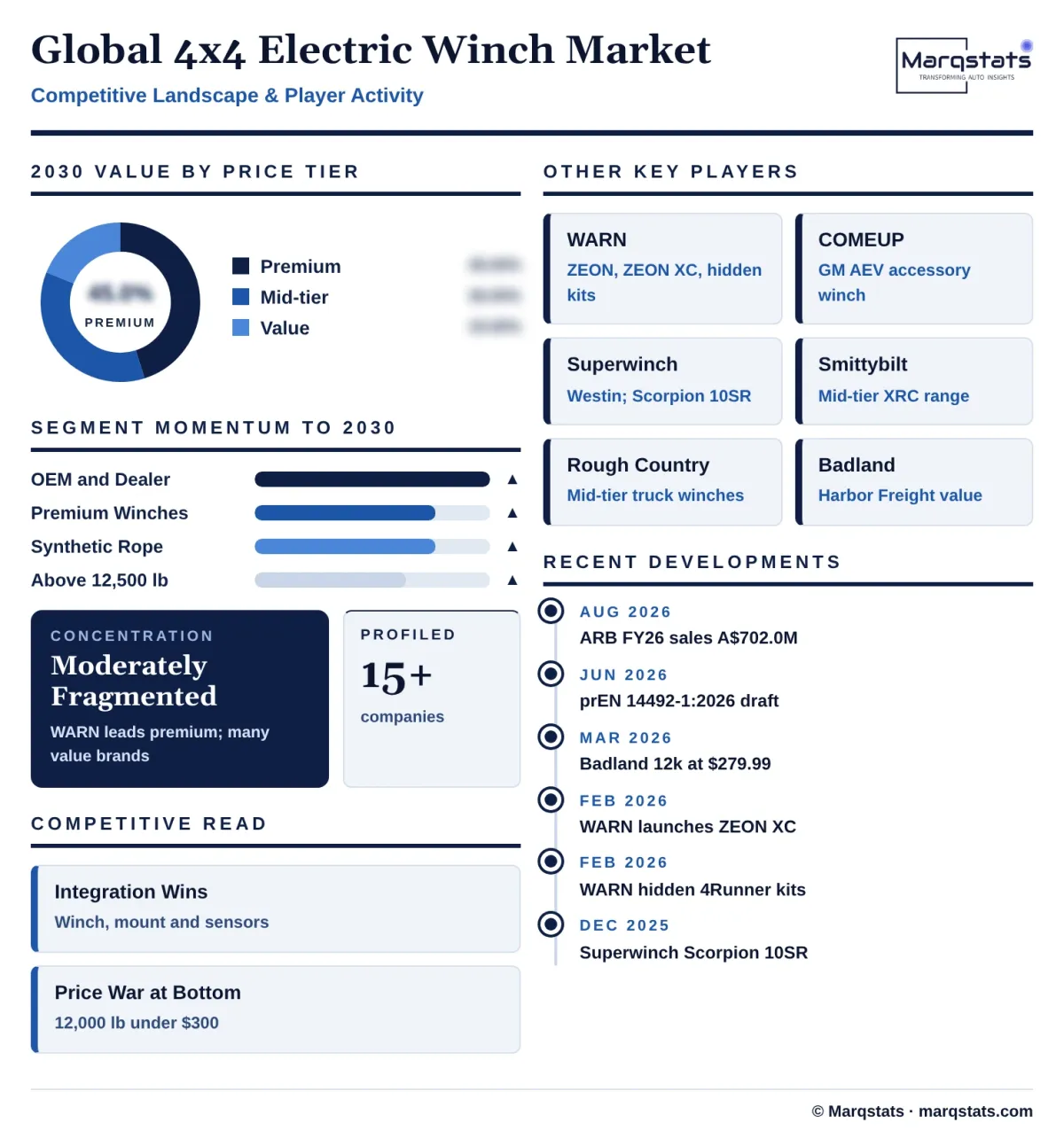
Three product tiers serve different buyers. Value winches, sold mainly through tool chains and online marketplaces at USD 250 to 450, account for about half of units. Mid-tier winches from brands such as Smittybilt, Rough Country, Runva, T-Max, Bushranger, Superwinch and COMEUP sell at USD 450 to 1,000. Premium and integrated winches, led by the WARN ZEON range, COMEUP premium models and OEM accessory winches, sell above USD 1,000 and add sealing to IP68 or IP69K, longer warranties and engineered mounting kits.
The market grew from about 930,000 winches worth USD 330.00 million in 2021 to 975,000 worth USD 352.00 million in 2022, as the overlanding boom lifted spending on 4x4 accessories. Growth slowed in 2023 and 2024, to USD 362.00 million and USD 368.00 million, as higher interest rates cooled vehicle accessory spending, before recovering to USD 384.00 million in 2025 on strong US sales of off-road trucks and SUVs.
Mounting is becoming as important as the winch. On older trucks a winch bolted to a plate behind the bumper or onto a steel bull bar. New pickups and SUVs carry front radar for adaptive cruise control and emergency braking, parking sensors and cameras in the grille and bumper, and crush structures designed for pedestrian protection, so a winch mount must avoid blocking sensors and must not change how the front end behaves in a crash. Hidden mounts that place the winch behind the factory bumper, and complete winch-ready bumpers engineered with sensor brackets, are the answer, but they cost far more than a bolt-on plate.
Regulation is light but growing. In North America winch ratings follow the voluntary SAE J706 practice, and product safety depends mainly on manufacturer testing. In Europe winches fall under machinery safety law and the EN 14492-1 standard for power-driven winches, which covers brakes, load limiting and controls, and a revised draft, prEN 14492-1:2026, was published in June 2026. Vehicle frontal protection rules in Europe and Australia also limit what can be mounted on the front of a road vehicle.
Global 4x4 Electric Winch Market Size and Forecast
The global 4x4 electric winch market grows from USD 384.00 million in 2025 to USD 490.00 million in 2030, a CAGR of 5.00%. Marqstats expects the market to reach USD 400.20 million in 2026, USD 419.30 million in 2027, USD 440.00 million in 2028 and USD 463.80 million in 2029, with growth accelerating slightly as new-generation trucks reach the used market and owners add recovery equipment.
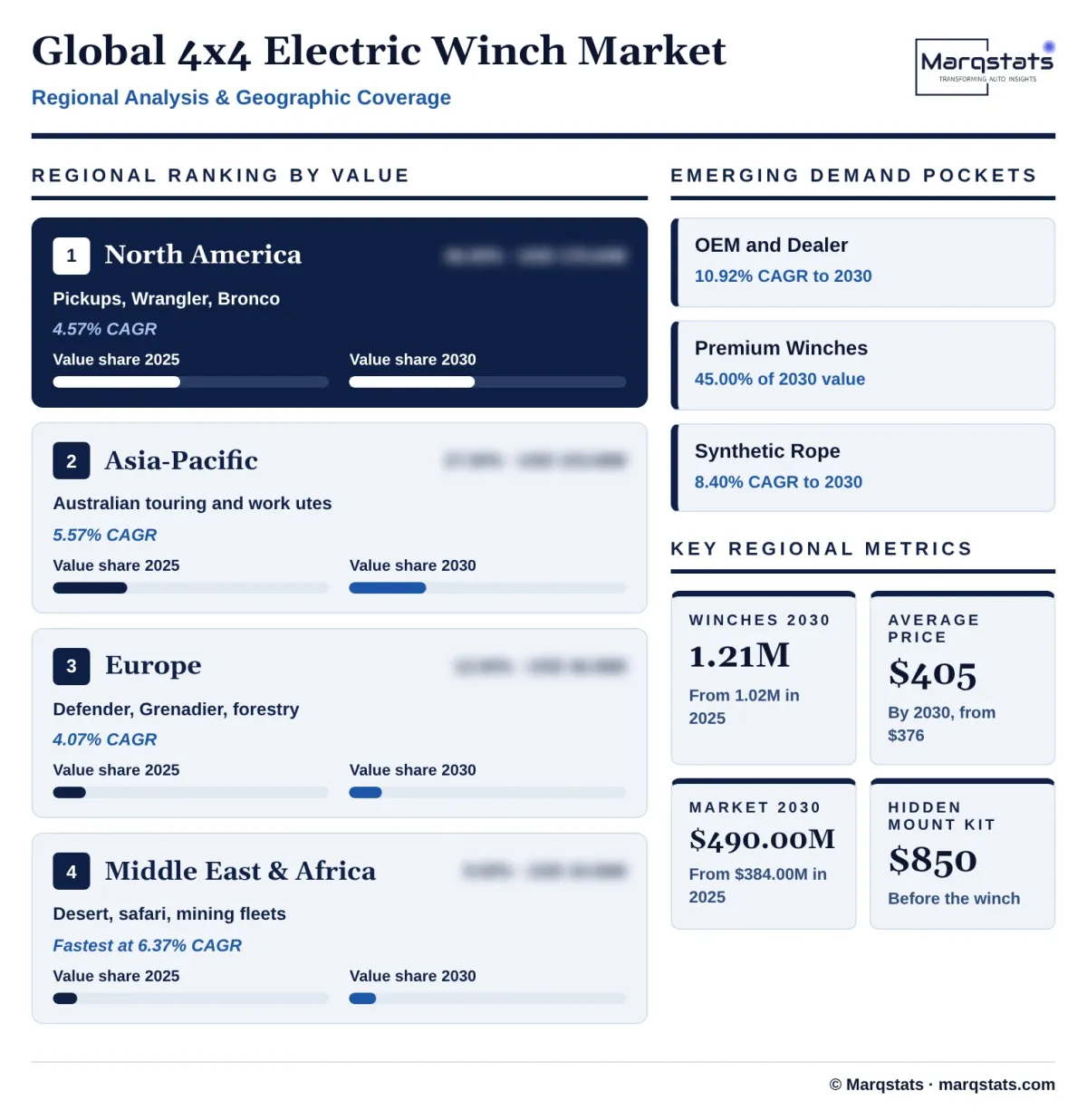
Volume grows more slowly than value. Annual sales rise from about 1.02 million winches in 2025 to 1.21 million in 2030, a 3.48% annual rate, while the average manufacturer selling price rises from about USD 376 to USD 405. The price gain comes from mix rather than list-price inflation: more synthetic rope, more sealed premium winches, more hidden and integrated mounts and more OEM accessory sales.
The vehicle base supports steady demand. In the United States the Ford F-Series sold 801,525 units in 2025, GM sold 925,656 full-size Chevrolet Silverado and GMC Sierra pickups, Toyota Tacoma sales rose 42.4%, Jeep Wrangler sales reached 167,322 and Ford Bronco sales rose 33.7% to 146,007. In Australia the Ford Ranger sold 53,694 units and the Toyota HiLux 45,839, with strong sales of the Ford Everest, Toyota Prado, BYD Shark and LandCruiser 70 and 300 Series.
Most winches go onto vehicles already on the road. Marqstats estimates that only about 3% of new pickups and 4x4 SUVs leave the dealer with a winch, and that most winches are fitted one to five years after purchase, when owners add a bull bar or steel bumper, lift the suspension and start touring or working off road. Demand therefore follows the size of the off-road vehicle fleet and consumer spending on accessories more than new-vehicle sales in any one year.
Marqstats tracks four indicators to monitor the forecast: US sales of off-road trim pickups and SUVs, Australian 4x4 ute and wagon sales, results of listed accessory groups such as ARB Corporation, and landed import prices of Chinese-built winches after tariffs. The forecast assumes no change in tariff rates after 2026 and stable consumer credit conditions.
The mix of the market shifts over the forecast. Premium and integrated winches rise from 38.28% to 45.00% of value, synthetic-rope winches from 52.00% to 61.00%, and OEM and dealer accessory sales from 9.50% to 12.50%. North America remains the largest region but its share edges down from 46.00% to 45.07%, while the Middle East and Africa rise from 9.00% to 9.60%.
Retail spending is larger than the manufacturer value. Distributors, specialist retailers and dealers add margins of roughly 35% to 45% to manufacturer prices, so Marqstats estimates that end buyers spent about USD 650 to 700 million on 4x4 electric winches in 2025, before fitting labour, mounting kits and bumpers, which can double the total cost of a winch installation on a modern truck.
Market Dynamics
Key Drivers
Five forces keep demand for vehicle recovery winches growing on pickups, SUVs and 4x4s.
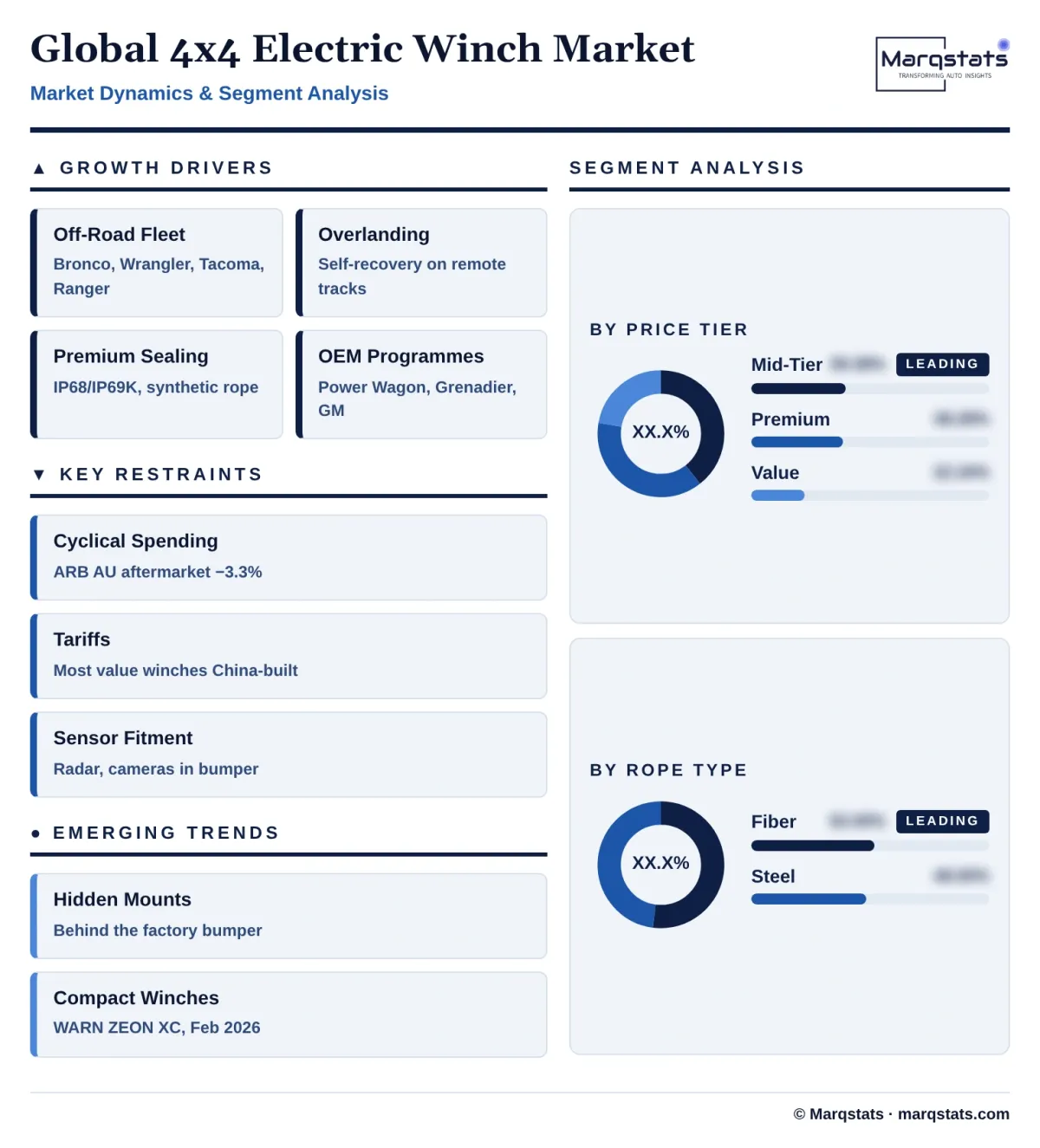
- Growing fleet of off-road trucks and SUVs. Strong sales of the Ford Bronco, Jeep Wrangler, Toyota Tacoma and 4Runner, Ford Ranger and Toyota HiLux enlarge the pool of vehicles that owners equip for recovery, with most winches fitted in the first years of ownership.
- Overlanding and remote touring. Owners travelling remote tracks in Australia, North America, southern Africa and the Middle East carry a winch as basic self-recovery equipment, alongside recovery boards, shackles and air compressors.
- Synthetic rope and premium sealing. Lighter, safer synthetic rope, IP68 and IP69K sealing and longer warranties persuade buyers to pay USD 1,000 or more for a winch, raising the average selling price.
- Factory and dealer accessory programmes. Vehicle makers offer winches as standard or optional equipment, as on the Ram 2500 Power Wagon and INEOS Grenadier, or as dealer accessories, as with COMEUP winches for Chevrolet and GMC AEV bumpers, adding a new channel for premium units.
- Commercial and fleet recovery. Mining, utilities, emergency services, forestry and agriculture fleets specify winches on 4x4 utility vehicles, often 24-volt units for longer duty cycles.
Key Restraints
Four constraints slow how fast winch demand and prices can rise.
- Cyclical accessory spending. Winches are discretionary purchases, and ARB Corporation's 3.3% fall in Australian aftermarket sales in FY2026 shows how quickly demand softens when vehicle sales and household budgets tighten.
- Tariffs and import costs. Most value-tier winches are built in China, so US tariffs on Chinese imports raise landed costs and compress margins for importers and tool chains.
- Fitting complexity on new vehicles. Front radar, parking sensors, cameras, pedestrian protection rules and crash structures make it harder and more expensive to mount a winch on new trucks, delaying fitment for some owners.
- Price competition at the bottom. Low-cost winches with 12,000 lb ratings sell for under USD 300 on promotion, limiting pricing power for mid-tier brands and pushing them to compete on warranty, sealing and service.
Key Trends
Four shifts are changing how 4x4 winches are designed, mounted and sold.
- Hidden and integrated mounts. Kits such as WARN's fully hidden and semi-hidden mounts for the 2025–2026 Toyota 4Runner place the winch behind the factory bumper so sensors and cruise control keep working.
- Compact, reconfigurable winches. WARN's ZEON XC range, launched in February 2026, uses a low-profile design with a rotatable motor and a gearbox that can be clocked in five positions to fit tight mounting spaces.
- Wireless control and monitoring. Premium winches add wireless remotes, app control and motor temperature warnings to reduce overheating during long pulls.
- Updated safety standards in Europe. CEN has issued a revised draft of EN 14492-1 for power-driven winches, prEN 14492-1:2026, published by DIN in June 2026, keeping attention on load limiting, brakes and remote control safety for winches sold in Europe.
Strategic Implications
- For winch makers, mounting is now part of the product. Brands that design winches together with vehicle-specific hidden mounts, bumpers and wiring can sell complete systems at two to eight times the price of a basic winch.
- For mid-tier brands, warranty and sealing decide competition. With 12,000 lb ratings available below USD 300, mid-tier brands win on waterproofing, brake quality, service networks and long warranties rather than on rated pull.
- For vehicle makers and dealers, factory-style winches add accessory revenue. Programmes such as Chevrolet and GMC's COMEUP winch for AEV bumpers show how dealers can capture a share of the aftermarket while keeping sensor and warranty integrity.
- For importers and retailers, supply diversification reduces tariff exposure. Sourcing from more than one country and holding US or Australian assembly lowers the risk of sudden landed-cost increases.
- For fleet buyers, 24-volt systems and duty cycle matter more than rated pull. Commercial users should specify winches for repeated pulls, thermal protection and serviceability rather than headline capacity.
- For investors, accessory groups are exposed to consumer cycles but benefit from premiumisation. Results from listed groups such as ARB Corporation show that export growth, particularly in the United States, can offset weaker home-market demand, while higher-value integrated systems support margins.
Market Segmentation
Winches retailing at about USD 450 to 1,000 account for 39.38% of 2025 value, USD 151.22 million and about 360,000 units, and grow at 3.13% a year to USD 176.40 million and 36.00% of 2030 value. Smittybilt, Rough Country, Runva, T-Max, Bushranger, Superwinch, COMEUP and WARN's VR EVO range compete here on sealing, warranties and synthetic rope options.
Winches retailing above USD 1,000, including OEM accessory winches and units sold with vehicle-specific hidden mounts, account for 38.28% of 2025 value, USD 147.00 million, from only about 140,000 units, and grow fastest, at 8.45% a year, to USD 220.50 million and 45.00% of 2030 value. WARN's ZEON and ZEON XC ranges lead this tier.
Winches retailing below about USD 450 account for 22.34% of 2025 value, USD 85.79 million, but about 520,000 units, half of all sales, and grow at 1.65% a year to USD 93.10 million. Tool-chain brands such as Harbor Freight's Badland and online sellers dominate, with 12,000 lb winches promoted at under USD 300.
Winches rated from 9,500 lb to 12,500 lb account for 63.00% of 2025 value, USD 241.92 million, and grow at 5.33% a year to USD 313.60 million and 64.00% of 2030 value. They match the 1.5 times vehicle weight rule for mid-size and full-size pickups and SUVs, and include the most popular 10,000 lb and 12,000 lb models.
Winches rated from 5,000 lb to below 9,500 lb account for 22.00% of 2025 value, USD 84.48 million, and grow at 2.49% a year to USD 95.55 million, serving compact SUVs, lighter 4x4s and trailer and utility use.
Winches rated above 12,500 lb account for 15.00% of 2025 value, USD 57.60 million, and grow at 7.02% a year to USD 80.85 million, as heavier full-size trucks, heavy-duty pickups and commercial recovery vehicles need higher capacity.
Winches sold with synthetic rope account for 52.00% of 2025 value, USD 199.68 million, and grow at 8.40% a year to USD 298.90 million and 61.00% of 2030 value. Synthetic rope weighs far less than steel, floats, is easier to handle and stores less energy if it breaks, though it needs abrasion sleeves, a hawse fairlead and protection from UV light.
Winches sold with steel wire rope account for 48.00% of 2025 value, USD 184.32 million, and grow at 0.73% a year to USD 191.10 million. Steel remains common on value winches and on commercial units used in abrasive or high-heat conditions.
Specialist 4x4 stores, auto parts chains, tool chains and online retailers account for 84.00% of 2025 value, USD 322.56 million, and grow at 4.11% a year to USD 394.45 million and 80.50% of 2030 value.
Factory-fitted winches and winches sold through vehicle dealers as accessories account for 9.50% of 2025 value, USD 36.48 million, and grow fastest, at 10.92% a year, to USD 61.25 million and 12.50% of 2030 value, led by Ram, Chevrolet and GMC, and INEOS programmes.
Mining, utility, emergency service, agricultural and government fleets account for 6.50% of 2025 value, USD 24.96 million, and grow at 6.56% a year to USD 34.30 million, with a higher share of 24-volt winches.
By Geography
North America
North America is the largest market, with 46.00% of 2025 value, USD 176.64 million, rising to USD 220.83 million by 2030, a 4.57% CAGR, while its share edges down to 45.07%. The United States has the largest fleet of full-size and mid-size pickups and off-road SUVs, and strong 2025 sales of the Ford Bronco, Jeep Wrangler and Toyota Tacoma support demand. WARN, Smittybilt, Rough Country, Superwinch and Harbor Freight's Badland lead retail sales, while Ram, Chevrolet and GMC sell factory and dealer winches.
Asia-Pacific
Asia-Pacific accounts for 27.00% of 2025 value, USD 103.68 million, and grows at 5.57% a year to USD 135.94 million and 27.74% of the market by 2030. Australia is the core market, with high winch fitment on Ford Rangers, Toyota HiLuxes, Prados and LandCruisers used for remote touring and work, and a dense network of 4x4 specialist stores. China, Taiwan and Thailand are the main manufacturing bases, and New Zealand, Thailand and Japan add smaller demand.
Europe
Europe accounts for 12.00% of 2025 value, USD 46.08 million, and grows at 4.07% a year to USD 56.25 million. Demand comes from Land Rover Defender, INEOS Grenadier, Toyota and Ford pickup owners, forestry and agriculture users and off-road clubs, with buyers paying attention to CE marking and the EN 14492-1 safety standard for power-driven winches.
Middle East and Africa
The Middle East and Africa account for 9.00% of 2025 value, USD 34.56 million, and grow fastest, at 6.37% a year, to USD 47.06 million and 9.60% of 2030 value. Desert recreation in the Gulf states, safari and tourism fleets in southern and eastern Africa, and mining fleets drive demand, mostly for heavy-duty LandCruiser and pickup applications.
Latin America
Latin America accounts for 6.00% of 2025 value, USD 23.04 million, and grows at 5.37% a year to USD 29.92 million. Pickups built in Argentina, Brazil and Mexico, such as the Toyota HiLux and Ford Ranger, and mining, agricultural and energy fleets support steady demand.
How Competition Is Evolving
The 4x4 electric winch market is moderately fragmented. WARN Industries leads the premium tier in North America and holds strong positions in Australia and Europe, while COMEUP, Superwinch, Ramsey, Mile Marker and RED Winches compete in premium and commercial niches. Mid-tier brands such as Smittybilt, Rough Country, Runva, T-Max and Bushranger, and value brands such as Harbor Freight's Badland and Champion, together sell most units.
Two competitive models coexist. Premium brands invest in engineering, sealing, long warranties and vehicle-specific mounting systems, and sell through specialist stores, dealers and OEM programmes. Value brands buy from contract manufacturers, mostly in China, and compete on price, rated pull and online visibility.
Distribution and fitting capability matter as much as the winch. Groups such as ARB Corporation in Australia sell winches alongside bull bars, bumpers, lights and suspension through company stores and fitting centres, while US brands rely on 4x4 specialists, auto parts chains and online retailers.
Competition will be decided by integration, durability and cost. Brands that combine sealed, reliable winches with hidden mounts for sensor-equipped trucks, wide dealer and installer networks, and tariff-resilient sourcing will capture the fastest-growing value.
Product launches show where competition is heading. WARN's February 2026 ZEON XC range targets compact mounting spaces on new trucks and SUVs, its hidden 4Runner kits avoid sensor interference, Superwinch showed the Scorpion 10SR synthetic-rope winch at SEMA 2025, and value brands continue to cut promotional prices on 12,000 lb winches.
Companies Covered
Companies covered in the report include:
Recent Market Activity
Table of Contents
Coverage & Segmentation
The study covers the global 4x4 electric winch market, with 2025 as the base year, 2021 – 2025 as the historical period and 2026 – 2030 as the forecast period. Values are in US dollars at manufacturer selling prices, and volumes are annual winch sales. Australian dollar figures are converted at USD 0.6451 per AUD, the 2025 annual average. The market includes 12-volt and 24-volt DC electric winches rated at 5,000 lb and above for pickups, SUVs, 4x4 utility vehicles and light commercial recovery vehicles, sold through aftermarket, OEM, dealer and fleet channels.
ATV and UTV winches below 5,000 lb, hydraulic and PTO-driven winches, tow-truck and wrecker winches, industrial and marine winches, and bumpers, mounting plates and recovery accessories sold separately are excluded. Winches are part of the broader 4x4 accessories market covered in Marqstats reports on Australia 4x4 accessories and UAE car modification and off-road accessories; their winch revenue is included in those totals and should not be added to this market. Segment and regional splits are Marqstats estimates.