Market Snapshot
Middle bar: base-year value × (1 + CAGR), rounded to two decimals. This is a calculated illustration, not a separately researched annual estimate.
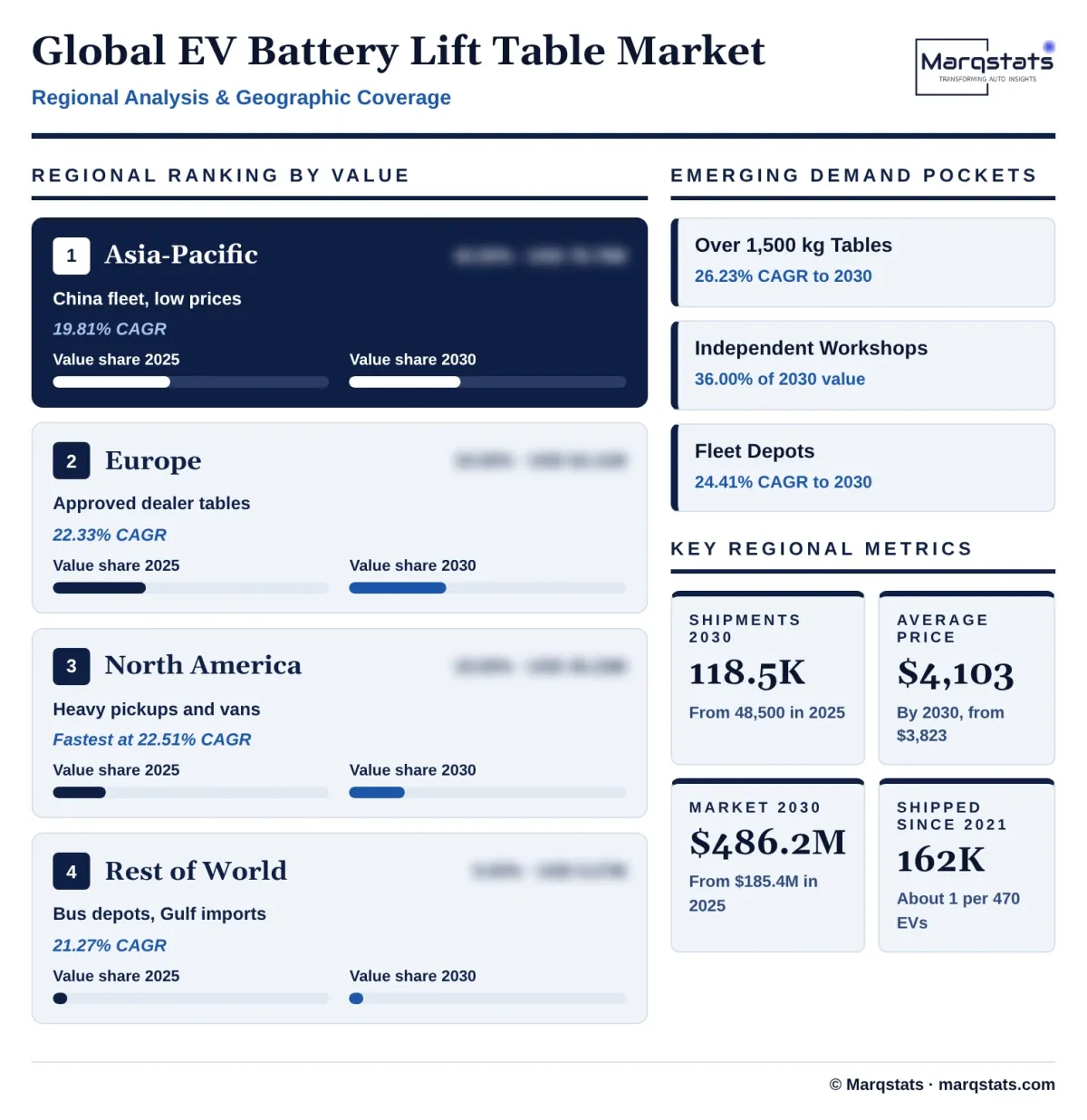
The global EV battery lift table market size is estimated at USD 185.40 million in 2025 and is projected to reach USD 486.20 million by 2030, growing at a CAGR of 21.27% over 2026 – 2030. Annual shipments rise from about 48,500 tables to 118,500, a 19.56% annual rate, while the average selling price rises from about USD 3,823 to USD 4,103 per table.
Marqstats defines the market as sales of mobile scissor and spindle lifting tables built to lower, carry and refit high-voltage traction battery packs from under a raised electric vehicle. These tables carry multi-axis fine adjustment for pitch, roll and position, controlled lowering, mechanical locks, insulating deck pads and fixture grids for carmaker-specific adapters. Whole-vehicle lifts, transmission jacks, generic pallet and industrial scissor tables, and fixed factory assembly equipment are excluded.
Electro-hydraulic tables account for 64.50% of 2025 value, tables rated 1,000 to 1,500 kg for 54.00% and franchised dealers for 52.00%. Asia-Pacific accounts for 42.50% of 2025 value and Europe for 33.50%. The study segments the market by drive mechanism, load capacity, end-user channel and region.
Key Takeaways
Market Overview & Analysis
Report Summary
Marqstats sizes the EV battery lift table market as the value of mobile lifting tables sold to workshops for removing, carrying and refitting high-voltage traction batteries. In 2025 about 48,500 such tables were shipped worldwide, worth an estimated USD 185.40 million at an average price of about USD 3,823.
A traction battery is the heaviest single component on an electric vehicle. Packs on compact cars weigh a few hundred kilograms, packs on mid-size cars and crossovers typically weigh 400 to 700 kg, and packs on full-size electric pickups and large SUVs can weigh well over 1,000 kg. The pack is usually bolted flat under the floor, so it can only be removed from below, with the vehicle raised on a two-post or four-post lift and a table rolled underneath to take the weight.
A general-purpose scissor table is not enough for this job. The weight inside a pack is not spread evenly, because cooling plates, junction boxes and structural cross-members sit in different places, so the deck has to stay stable under an off-centre load. Locating pins and bolt holes on the vehicle often leave very small clearances, so the deck must tilt and slide in small steps while fully loaded. The pack must also be lowered smoothly, because sudden drops and jolts can damage cells, welds and seals. Dedicated tables therefore combine double scissor frames or spindle drives, fine pitch and roll adjustment, controlled lowering, mechanical locks at several heights and decks drilled in a grid so carmaker adapters can be fixed in place.
Carmakers set the specification for their dealers. Volkswagen's VAS 6131 family of lifting tables, supplied through its special tools programme, is one example: the VAS 6131A version is rated at 1,200 kg, tilts by up to 60 mm and is used for both battery and engine and gearbox work, with model-specific adapter sets added for newer platforms. Other carmakers specify approved tables or adapter kits for their dealer networks, which makes dealers the largest buyers today.
The market grew from an estimated USD 74.20 million in 2021, when about 18,200 tables were shipped, to USD 124.80 million in 2023 and USD 152.30 million in 2024, a 25.73% CAGR over 2021 – 2025. Marqstats estimates about 162,000 tables were shipped between 2021 and 2025, roughly one for every 470 electric vehicles on the road at the end of 2025, and expects about 58,200 tables worth USD 228.60 million to be shipped in 2026.
Standards differ by region but point in the same direction. In Europe, lifting tables are designed to EN 1570-1, while vehicle lifts follow EN 1493, and both currently sit under the Machinery Directive 2006/42/EC, which Regulation (EU) 2023/1230 replaces from 20 January 2027. In the United States, portable automotive service equipment such as battery tables is commonly built to ASME PASE-2019, while vehicle lifts are certified under the Automotive Lift Institute programme. Workshop buyers increasingly ask for third-party certification, mechanical locks that hold the load if hydraulic pressure is lost and insulating deck pads, which favours established suppliers over low-cost generic tables.
Global EV Battery Lift Table Market Size and Forecast
The global EV battery lift table market grows from USD 185.40 million in 2025 to USD 486.20 million in 2030, a CAGR of 21.27%. Marqstats expects the market to reach USD 228.60 million in 2026, USD 281.40 million in 2027, USD 342.10 million in 2028 and USD 410.80 million in 2029, with shipments of about 70,500 tables in 2027, 84,600 in 2028 and 100,700 in 2029.
The forecast is built from workshop demand. Marqstats estimates the global fleet of battery electric cars, plug-in hybrids and electric vans at about 76 million vehicles at the end of 2025, consistent with electric car sales of more than 20 million in 2025 reported by the International Energy Agency. Each new electric model entering a dealer network, each independent workshop that decides to repair high-voltage systems, and each bus or delivery depot that brings maintenance in-house creates demand for at least one table, while tables already in service need replacement after seven to ten years.
Prices rise slowly. Marqstats estimates the average selling price at about USD 3,823 in 2025, rising to USD 4,103 in 2030, a 1.42% annual rate. Basic electro-hydraulic tables built in China sell for about USD 1,200 to 2,000, while carmaker-approved and heavy-duty tables in Europe and North America sell for USD 3,500 to more than USD 10,000. The mix moves toward heavier, battery-powered and finely adjustable tables, which lifts the average even as Chinese competition holds down prices for basic models.
Shipments grow more slowly in the later years. Annual growth in value eases from about 23% in 2026 to about 18% in 2030, because dealer networks in Europe and China complete their first round of equipment, leaving growth increasingly to independent workshops, fleet depots and replacements.
Marqstats tracks four indicators to monitor the forecast: electric vehicle sales and fleet age by region, the number of independent workshops trained for high-voltage work, carmaker essential tool lists for new platforms, and the share of new models with batteries that can be removed and repaired rather than replaced as a sealed unit.
Market Dynamics
Key Drivers
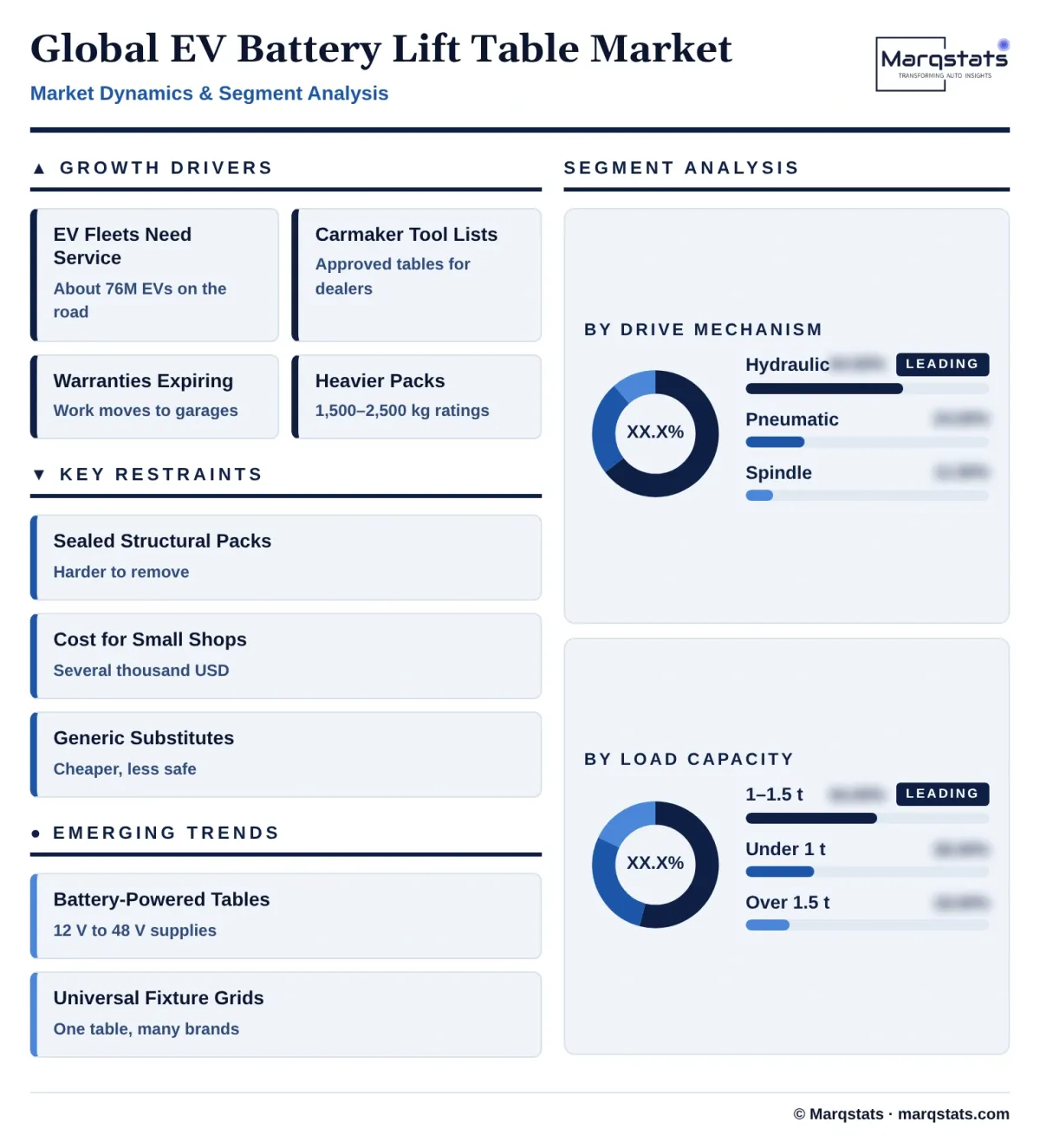
Five forces are making a dedicated battery lift table a standard piece of equipment in EV workshops.
- Growing electric fleets need battery service. With more than 20 million electric cars sold in 2025 and an estimated 76 million electric vehicles on the road, battery removal for repair, sealing, cooling system work and collision damage is becoming routine in workshops.
- Carmaker tooling requirements. Dealers must buy the lifting equipment and adapters specified by each carmaker for high-voltage battery work, such as Volkswagen's VAS 6131 family of tables, before they can service new electric models.
- Batteries leaving warranty. Electric cars sold in large numbers from 2017 onward are reaching the end of typical eight-year battery warranties, moving module repairs, resealing and coolant work to independent workshops that need their own tables.
- Heavier packs on larger vehicles. Electric pickups, large SUVs, vans and buses carry packs that exceed the rating of older 1,000 to 1,200 kg tables, driving purchases of 1,500 to 2,500 kg models.
- Workplace safety rules. Employers must provide suitable lifting aids for heavy loads, and machinery and lifting table standards such as EN 1570-1 in Europe and ASME PASE in the United States make dedicated, certified tables the safe option.
Key Restraints
Four constraints limit how fast EV battery lift table sales can grow.
- Sealed and structural packs. Cell-to-pack and cell-to-body designs that bond the battery into the vehicle structure are harder to remove and repair in a workshop, which may move some battery work to central carmaker facilities.
- High cost for small workshops. A carmaker-approved table with adapters can cost several thousand dollars, a large outlay for independent garages that see only a few electric vehicles a week.
- Low-cost substitutes. Some workshops use generic industrial scissor tables or transmission jacks, which are cheaper but lack fine adjustment and battery-specific safety features.
- Shortage of trained technicians. Workshops cannot carry out high-voltage battery work without qualified staff, so slow technician training delays equipment purchases.
Key Trends
Four shifts are changing how battery lift tables are designed, powered and sold.
- Battery-powered tables. Suppliers are moving from mains cables to on-board batteries, such as the 12 V supply on the Hofmann and John Bean BT 1800 and the 48 V lithium supply on Unite's U-DP7E, removing trailing cables from busy bays.
- Heavier ratings. New tables are rated at 1,800 to 2,500 kg, such as the BT 1800 at 1,800 kg, the Stertil-Koni HDLT-20 at 2,000 kg and Celette's BATPRO at 2,500 kg, to handle the largest packs.
- Universal fixture grids. Decks drilled in regular grids, such as 100 mm by 100 mm patterns, accept adapters for many brands, letting one table serve a multi-brand workshop.
- Finer positioning. Screw-jack and sliding-deck systems allow pitch, roll and yaw adjustment under full load, so packs can be lined up with locating pins without damage.
Strategic Implications
- For equipment makers, battery power, heavy ratings and fine adjustment are now the main points of difference. Suppliers that also offer adapter kits for many vehicle brands can sell one table to a multi-brand workshop instead of several.
- For dealers, buying one adaptable table rather than a different table for each model controls cost. Older 1,000 kg tables should be checked against the weight of the packs on new models coming into the workshop.
- For independent workshops, a 1,200 to 1,500 kg battery-powered table with a universal fixture grid is the entry point to high-voltage battery work on out-of-warranty electric vehicles.
- For fleet and bus operators, heavy-duty tables rated at 2,000 kg or more allow battery work to be done in the depot, reducing vehicle downtime and dependence on dealers.
- For suppliers selling into Europe, technical files, instructions and safety assessments must be updated to meet Regulation (EU) 2023/1230 before it applies on 20 January 2027.
Market Segmentation
Electro-hydraulic tables account for 64.50% of 2025 value, USD 119.58 million, and grow at 22.56% a year to USD 330.62 million and 68.00% of the market by 2030. An electric motor drives a hydraulic pump and one or two cylinders. Suppliers are replacing mains-powered units with tables that run from on-board 12 V, 24 V or 48 V batteries, so technicians can move the table under a raised vehicle without a cable across the floor.
Pneumatic-hydraulic tables account for 24.00% of 2025 value, USD 44.50 million, and grow at 16.33% a year to USD 94.81 million, while their share falls to 19.50% by 2030. They run on workshop compressed air and contain no electric motor, which suits body shops and paint areas, but they offer less precise speed control than electric designs.
Mechanical spindle tables account for 11.50% of 2025 value, USD 21.32 million, and grow at 23.30% a year to USD 60.77 million and 12.50% by 2030. Electric screw drives raise the deck without hydraulic fluid, so the deck does not drift under load, which suits precise work on large packs, although these tables cost more to build.
Tables rated below 1,000 kg account for 28.00% of 2025 value, USD 51.91 million, and grow at 15.56% a year to USD 106.96 million, while their share falls to 22.00% by 2030. They serve small cars, plug-in hybrids and component work, but new packs are getting heavier.
Tables rated 1,000 to 1,500 kg account for 54.00% of 2025 value, USD 100.12 million, and grow at 22.15% a year to USD 272.28 million and 56.00% by 2030. This band covers most passenger car, crossover and light van packs and includes most carmaker-approved dealer tables.
Tables rated above 1,500 kg account for 18.00% of 2025 value, USD 33.37 million, and grow fastest, at 26.23% a year, to USD 106.96 million and 22.00% by 2030. Electric pickups, large SUVs, delivery vans, trucks and buses need tables rated at 1,800 to 2,500 kg.
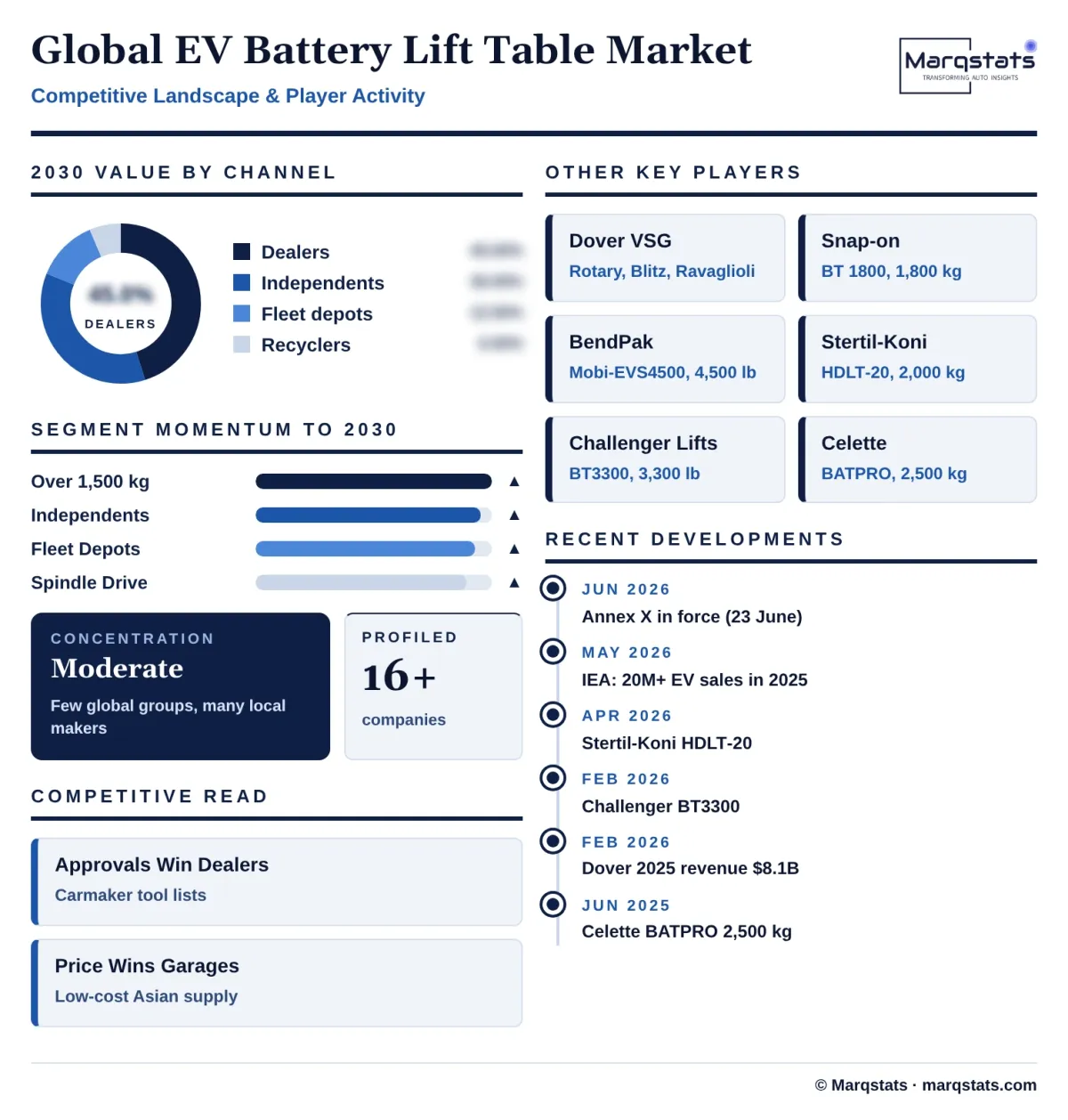
Franchised dealers account for 52.00% of 2025 value, USD 96.41 million, and grow at 17.81% a year to USD 218.79 million, while their share falls to 45.00% by 2030. Carmaker tooling requirements make them the first buyers of approved tables when new models launch.
Independent garages, multi-brand chains and collision repairers account for 31.00% of 2025 value, USD 57.47 million, and grow at 24.95% a year to USD 175.03 million and 36.00% by 2030, as out-of-warranty electric vehicles come to them for battery work.
Bus, truck and delivery fleet depots account for 11.00% of 2025 value, USD 20.39 million, and grow at 24.41% a year to USD 60.78 million and 12.50% by 2030, as operators bring battery maintenance of electric buses and vans in-house.
Battery repair, dismantling and recycling centres account for 6.00% of 2025 value, USD 11.13 million, and grow at 23.21% a year to USD 31.60 million and 6.50% by 2030, handling packs removed for remanufacturing, second-life use or recycling.
By Geography
Asia-Pacific
Asia-Pacific is the largest market, with 42.50% of 2025 value, USD 78.79 million, rising to an estimated USD 194.48 million by 2030, a 19.81% CAGR, while its share eases to 40.00%. China has the world's largest electric vehicle fleet and a large base of workshop equipment makers, which supply low-priced tables to domestic repairers and export to other regions. Lower average prices mean Asia-Pacific's share of value is smaller than its share of units.
Europe
Europe accounts for 33.50% of 2025 value, USD 62.11 million, and grows at an estimated 22.33% a year to USD 170.17 million and 35.00% of the market by 2030. Prices are higher than elsewhere because dealers buy carmaker-approved tables, and machinery rules are strict. Germany, the UK, France, the Netherlands and the Nordic countries lead demand. The updated Annex X to Regulation (EU) 2018/858, in force since 23 June 2026, and Regulation (EU) 2023/1230, applying from 20 January 2027, both shape equipment buying.
North America
North America accounts for 19.00% of 2025 value, USD 35.23 million, and grows fastest, at an estimated 22.51% a year, to USD 97.24 million and 20.00% by 2030. Electric pickups, large SUVs and delivery vans need tables rated above 4,000 lb, and suppliers such as BendPak, Challenger Lifts and Rotary design for these weights. Tables are commonly built to the ASME PASE standard for portable automotive service equipment.
Rest of World
The rest of the world accounts for 5.00% of 2025 value, USD 9.27 million, and grows at an estimated 21.27% a year to USD 24.31 million by 2030, keeping a 5.00% share. Demand comes from electric bus depots, premium electric car imports in the Gulf states and local vehicle assembly in Latin America.
How Competition Is Evolving
The EV battery lift table market is moderately concentrated. A small group of international workshop equipment groups supplies most carmaker-approved tables to dealers, while many smaller makers, especially in China, supply lower-priced tables to independent workshops and private-label distributors.
International equipment groups lead the premium end. Dover's Vehicle Service Group, which includes Rotary, Blitz and Ravaglioli, supplies approved lifting tables to European carmaker networks. Snap-on sells the BT 1800 under its Hofmann and John Bean brands, rated at 1,800 kg with a 2,000 mm rise, a 12 V supply and a deck that tilts by up to 45 mm, and a 1,200 kg battery lift under its SUN, John Bean and Hofmann brands. BendPak, Challenger Lifts and Stertil-Koni cover heavy-duty North American and commercial vehicle demand.
Asian and regional makers compete on price. Unite Automotive lists tables from 1 to 1.5 tonnes, including the cordless 48 V U-DP7E, and European tool brands such as Laser Tools and Celette sell tables to independent and collision workshops.
Competition will be decided by approvals, adapters and service. Suppliers with carmaker approvals, broad adapter libraries, battery-powered designs and local service networks will win dealer and fleet contracts, while price will decide most independent workshop sales.
Companies Covered
Companies covered in the report include:
Recent Market Activity
Table of Contents
Coverage & Segmentation
The study covers the global EV battery lift table market, with 2025 as the base year, 2021 – 2025 as the historical period and 2026 – 2030 as the forecast period. Values are in US dollars at supplier selling prices, and volumes are tables shipped. The market is segmented by drive mechanism, load capacity, end-user channel and region.
Whole-vehicle lifts, transmission and engine jacks, generic pallet and industrial scissor tables, fixed factory assembly skids, stand-alone adapter kits sold without tables, and insulated hand tools and high-voltage test equipment are excluded. Insulated tools and diagnostic kits are covered in a separate Marqstats study and must not be added to this market. Segment splits, 2030 regional values and the shipment and price forecasts are Marqstats estimates built on electric fleet data, carmaker tooling requirements, supplier specifications and price benchmarks.