Market Snapshot
The Global Electric Agriculture UTV Market is valued at USD 218.38 million in 2025 and is forecast to reach USD 489.90 million by 2030, a CAGR of 17.54%. Unit sales rise from 14,750 to 35,300 vehicles, a 19.07% CAGR. The market is small against the side-by-side industry it sits in: 14,750 units equal 2.57% of the 575,000 side-by-sides that Polaris Inc. estimates were retailed worldwide in 2025.
These are Marqstats estimates, built bottom-up from units multiplied by average transaction price in three platform tiers. The unit anchors are the worldwide and North American side-by-side retail estimates in the Polaris Inc. Form 10-K for fiscal 2025, launch and current list prices of named electric models, and dated farm-equipment incentive schemes. The value is most sensitive to the high-voltage tier, where 2,550 vehicles at an assumed USD 30,500 carry 35.62% of 2025 value.
Electric farm UTV demand is far less North American than the side-by-side industry. North America took 525,000 of the 575,000 side-by-sides retailed worldwide in 2025, or 91.30%, yet Marqstats places only 5,900 of 14,750 electric agricultural UTVs there, or 40.00%. Europe and Asia-Pacific buy electric farm utility vehicles out of proportion to their side-by-side base.
Public money is thinner than the purchase case assumes. The California Air Resources Board Clean Off-Road Equipment Voucher Incentive Project (CORE) manual for fiscal 2026-27, released on 15 July 2026, states that agricultural equipment does not include ATVs or UTVs. The one dedicated farm UTV grant we found, run by the San Joaquin Valley Air Pollution Control District, suspended intake on 16 January 2026 for lack of funds.
Growth through 2030 therefore rests on operating economics and product supply rather than vouchers. New lithium iron phosphate platforms from Chinese manufacturers, the SDLG U203HEV shown to US buyers in July 2026 and a Massimo Group electric UTV due in 2026 widen the price ladder below the Polaris RANGER XP Kinetic.
Key Takeaways
Market Overview & Analysis
Report Summary
The electric farm UTV has moved from a golf-car derivative to a working vehicle. Polaris Inc. put a 110 hp, 29.8 kWh RANGER XP Kinetic on sale in December 2021 and homologated it in Europe as a T1a and T1b tractor in February 2024. Chinese lithium iron phosphate platforms now sell below USD 10,000. That spread of price points matters more than any subsidy, because the main US voucher programme excludes UTVs and the main dedicated farm UTV grant ran out of money in January 2026. The market is growing on the work case, and the work case differs sharply by farm type and region.
Marqstats counts new battery-electric side-by-side utility task vehicles sold for agricultural primary production: livestock and dairy, orchards and vineyards, protected horticulture, arable and mixed-farm support, and ranch and estate work. Value is the average transaction price before purchase grants and sales taxes, excluding separately sold chargers, attachments and accessories. Electric ATVs, recreational sport side-by-sides, golf and turf utility vehicles, campus and industrial utility carts, electric tractors and aftermarket conversions are excluded. The wider Global Electric ATV and UTV Market, sized by Marqstats at USD 1.80 billion in 2025, contains this market in full.
Four readers use the analysis. Powersports and farm-machinery OEMs deciding whether to build a high-voltage platform or source a lithium iron phosphate vehicle from Asia need the tier economics. Agricultural equipment dealers choosing which electric line to stock need the regional and application splits. Battery, motor and controller suppliers need the 2030 unit volumes by tier. Investors and policy teams weighing incentive design need the evidence on how far grants, rather than operating cost, move the purchase.
Global Electric Agriculture UTV Market Size and Forecast
Value rose from USD 89.68 million in 2021 to USD 126.48 million in 2022, USD 166.44 million in 2023, USD 189.23 million in 2024 and USD 218.38 million in 2025. Units moved from 7,600 to 9,300, 11,400, 12,700 and 14,750 over the same years. The forecast path runs through USD 256.68 million in 2026, USD 301.70 million in 2027, USD 354.61 million in 2028 and USD 416.80 million in 2029 to USD 489.90 million in 2030, with units at 17,563, 20,911, 24,899, 29,647 and 35,300. History grew faster, at 24.92% a year in value, because the high-voltage tier entered from a standing start in 2022 and lifted the blended price from about USD 11,800 to USD 14,805.
The build is units multiplied by price, tier by tier. In 2025 the high-voltage tier sells 2,550 units at USD 30,500 (USD 77.78 million), the mid-voltage branded lithium tier 6,300 units at USD 15,200 (USD 95.76 million) and the value lithium iron phosphate tier 5,900 units at USD 7,600 (USD 44.84 million). In 2030 the same tiers reach 6,900 units at USD 27,800 (USD 191.82 million), 13,800 units at USD 14,300 (USD 197.34 million) and 14,600 units at USD 6,900 (USD 100.74 million).
Units are the primary series and value is derived. Value grows more slowly than units, 17.54% against 19.07%, because every tier loses price as battery costs fall and because the value tier holds about 41% of units in 2030. The mix toward high-voltage vehicles partly offsets that, which is why the blended price slips only from USD 14,805 to USD 13,878. This is a Marqstats construction. The unit total is cross-checked against the 575,000 worldwide side-by-side retail estimate in the Polaris Inc. fiscal 2025 Form 10-K; much of the value tier is sold outside the dealer channels that estimate tracks, so the 2.57% ratio is a scale check rather than a penetration rate.
Electric Farm UTV Demand Is Less North American Than the Side-by-Side Industry
Electric farm UTV demand is the part of the side-by-side business that North America does not dominate. The Polaris Inc. Form 10-K for fiscal 2025 estimates North American side-by-side retail at 525,000 units and worldwide retail at 575,000, so only 50,000 side-by-sides, or 8.70%, were retailed outside North America. Marqstats places 8,850 of the 14,750 electric agricultural UTVs, or 60.00%, outside North America in 2025.
Three things explain the gap. Europe treats a working UTV as a tractor: Polaris homologated the RANGER XP Kinetic as a T1a and T1b tractor and under the German ZUG/LOF scheme, which lets it use public roads between fields. Asia-Pacific buys on price, and lithium iron phosphate platforms below USD 10,000 compete with small trucks and tricycles rather than with gasoline side-by-sides. North American farms already own large gasoline and diesel fleets that are cheap to keep running.
The implication is that an OEM sizing electric farm demand off its North American side-by-side share will under-build for Europe and Asia-Pacific. The test is the 2030 split: North America falls from 40.00% to 35.69% of units even as it stays the largest value region.
Vouchers Are Not Carrying the Purchase Case
Public incentives for electric farm UTVs are smaller and less reliable than commonly assumed. The CORE fiscal 2026-27 Implementation Manual, released on 15 July 2026, states that agricultural equipment does not include All Terrain Vehicles or Utility Terrain Vehicles, and its agricultural base voucher applies to equipment rated at 19 kW or more. Funding in the CORE pool for agricultural and construction equipment across fiscal 2025-26 and 2026-27 is USD 14 million.
The dedicated San Joaquin Valley Air Pollution Control District programme for zero-emission agricultural UTVs pays up to 75% of eligible cost, capped at USD 13,500, against scrappage of an old ATV, UTV or tractor. It suspended application intake at 5:00 p.m. on 16 January 2026 because it was out of funding. In the United Kingdom, the Farming Equipment and Technology Fund 2026 opened on 17 March and closed on 12 May with a GBP 50 million budget (USD 66.00 million), spread across productivity, slurry and animal-welfare items.
We therefore model no voucher-driven step change. The 17.54% value CAGR assumes buyers pay close to full price, which favours the mid-voltage and value tiers in regions where diesel and gasoline cost more than grid or solar electricity.
Value Concentrates in the High-Voltage Tier
The value ladder is steeper than the unit ladder. The high-voltage tier is 17.29% of 2025 units but 35.62% of value; the value tier is 40.00% of units but 20.53% of value. A single platform change in the high-voltage tier moves the market more than a doubling of Chinese export shipments.
Polaris launched the RANGER XP Kinetic on 1 December 2021 at USD 24,999 for the 14.9 kWh Premium and USD 29,999 for the 29.8 kWh Ultimate, with a powertrain developed with Zero Motorcycles. Current list prices sit above those launch levels, and Marqstats uses an average transaction price of USD 30,500 for the tier in 2025, easing to USD 27,800 by 2030 as rivals enter. SDLG showed a 24 kWh, 20 kW U203HEV to US buyers on 2 July 2026, which points to a mid-priced high-capacity class forming between the two existing tiers.
Market Dynamics
Key Drivers
Demand is driven by operating cost, indoor working conditions and a widening product ladder, each with a dated anchor.
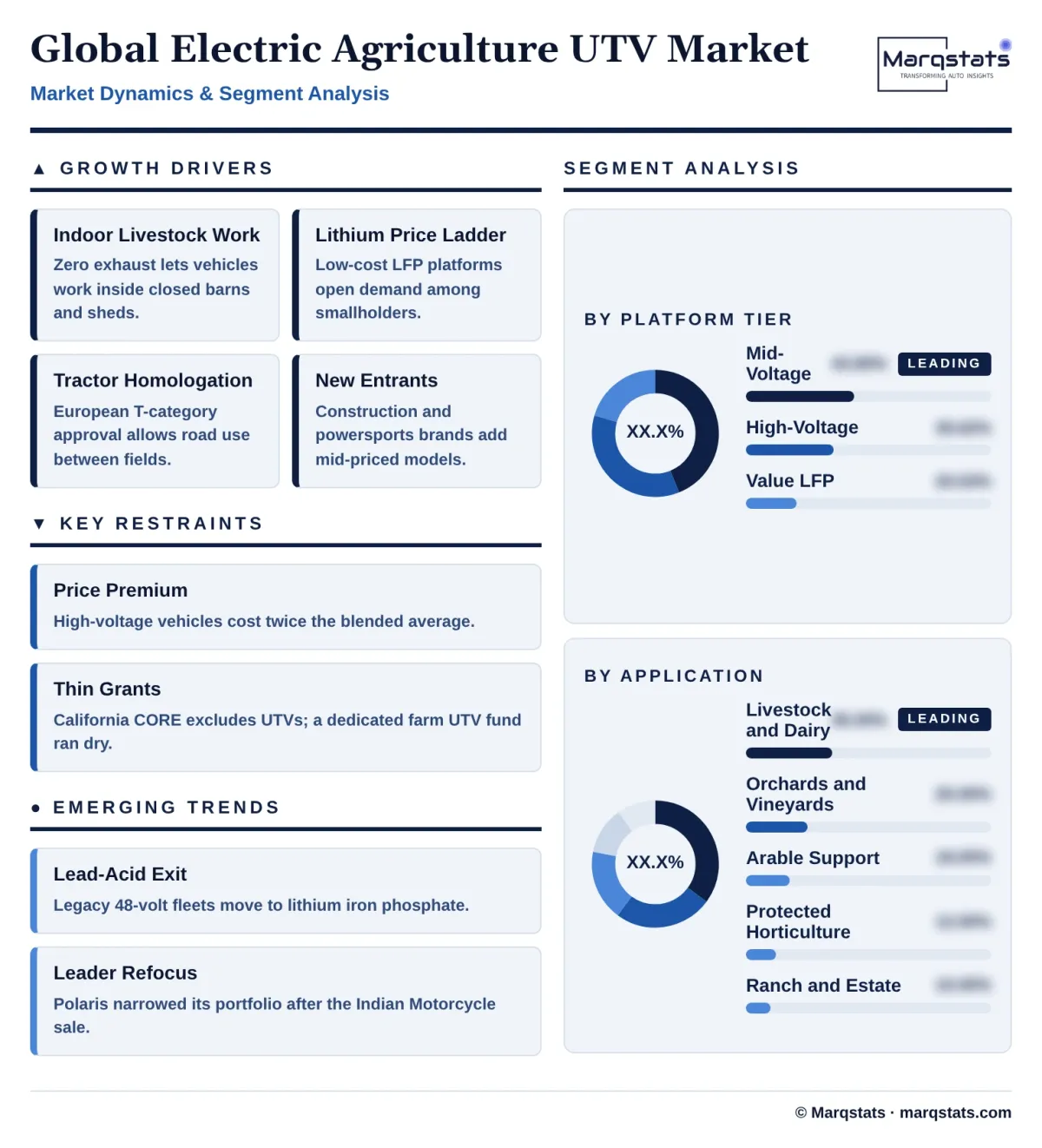
- Indoor livestock work: dairy, pig and poultry units run vehicles inside closed buildings daily, and zero exhaust removes ventilation and air-quality constraints; Marqstats puts livestock and dairy at USD 76.43 million, 35.00% of 2025 value.
- Lithium price ladder: lithium-ion packs power 88.14% of 2025 units, and value-tier platforms at about USD 7,600 bring electric UTVs within reach of smallholders across Asia-Pacific, Latin America and Africa.
- European road homologation: the RANGER XP Kinetic is homologated as a T1a and T1b tractor and under ZUG/LOF since its 2 February 2024 European launch, letting farms drive between fields on public roads with one vehicle.
- California engine rules: the California Air Resources Board requires most new small off-road engines below 25 hp to be zero emission from 2024 under Assembly Bill 1346, pushing California farms and dealers toward electric light utility vehicles.
- New entrants: the Massimo Group electric UTV announced on 18 September 2025 (72V, 200Ah lithium, 15 kW) and the SDLG U203HEV shown on 2 July 2026 add mid-priced options below the high-voltage tier.
Key Restraints
Restraints are concentrated in price, funding and rural charging, and each sets a ceiling on the forecast.
- Price premium: the high-voltage tier averages USD 30,500 in 2025, more than twice the USD 14,805 blended price, and launch MSRPs of USD 24,999 to 29,999 in 2021 have since risen.
- Thin and unstable grants: CORE excludes UTVs in its fiscal 2026-27 manual, and the San Joaquin Valley farm UTV programme stopped taking applications on 16 January 2026 for lack of funds.
- Range under load: the RANGER XP Kinetic Premium carries a 14.9 kWh pack rated for up to 45 miles, which limits all-day use on large ranches and arable farms without depot charging.
- Diesel incumbency: Kubota Corporation added a diesel RTV-X Long Bed with a 1,212 lb bed, announced on 23 October 2025 and at dealers from November 2025, keeping a strong combustion alternative in front of fleet buyers.
Key Trends
Three trends reshape the product and the route to market through 2030.
- Lead-acid exit: lead-acid value falls from USD 17.38 million in 2025 to USD 7.90 million in 2030, a -14.59% CAGR, as 48-volt fleets are replaced by lithium iron phosphate packs.
- Construction OEMs enter farm UTVs: SDLG, sold by Volvo Construction Equipment to Lingong in 2025, brought a 24 kWh electric UTV to the US market in July 2026, bringing construction-equipment dealer networks into the category.
- Portfolio refocus at the leader: Polaris Inc. completed the separation of Indian Motorcycle and the majority-stake sale to Carolwood LP on 2 February 2026, narrowing its business toward off-road vehicles, snowmobiles and boats.
Strategic Implications
- For entrants: the open position is the gap between USD 7,600 and USD 30,500. A 20 to 25 kWh lithium iron phosphate UTV with tractor homologation for Europe addresses the fastest-growing unit pool without fighting the RANGER XP Kinetic on performance.
- For incumbents: powersports and farm-machinery OEMs should plan electric capacity on a regional mix in which North America is 35.69% of 2030 units, not on their combustion side-by-side mix, which is overwhelmingly North American.
- For suppliers and investors: 2030 demand of 35,300 vehicles at roughly 15 to 30 kWh each is a niche battery market. The value lies in sealed, washdown-resistant packs and motors for barn and greenhouse duty, not in cell volume.
Market Segmentation
Mid-voltage branded lithium vehicles are the largest tier at USD 95.76 million in 2025, 43.85% of value, on 6,300 units at USD 15,200. They reach USD 197.34 million and 40.28% of value in 2030 on 13,800 units, a 15.56% CAGR. This tier covers 48-volt to 72-volt lithium vehicles from established brands, including the Hisun Sector E1, the American Landmaster EV range and European electric utility vehicles such as Goupil and Alke models. It is the default choice for dairy and orchard buyers who need a working bed and towing without paying for 110 hp.
The high-voltage full-size tier is worth USD 77.78 million in 2025, 35.62% of value, on 2,550 units at USD 30,500. It rises to USD 191.82 million, 39.15% of value, on 6,900 units in 2030, the fastest tier at a 19.79% CAGR. The RANGER XP Kinetic defines it with 110 hp, 140 lb-ft, a 2,500 lb towing rating and packs of 14.9 or 29.8 kWh. The tier grows fastest because it is the only class that replaces a full-size diesel UTV on large farms.
Value-tier lithium iron phosphate platforms are worth USD 44.84 million in 2025, 20.53% of value, on 5,900 units at USD 7,600. They reach USD 100.74 million, 20.56% of value, on 14,600 units in 2030, a 17.57% CAGR. These vehicles are mostly built in China and sold into Asia-Pacific plantations, Latin American estates, African farms and European smallholdings. Price per unit falls to USD 6,900, so the tier gains units faster than value.
Livestock and dairy is the largest application at USD 76.43 million in 2025, 35.00% of value, rising to USD 168.00 million and 34.29% in 2030, a 17.06% CAGR. Feeding, bedding and stock checks inside closed sheds are where zero exhaust and low noise give a direct operating gain. The share eases slightly because other applications grow faster from smaller bases.
Orchards and vineyards account for USD 54.60 million, 25.00% of 2025 value, growing to USD 125.00 million and 25.52% in 2030, an 18.02% CAGR. Narrow rows and low-speed spraying and picking runs suit electric drive, and the segment is strongest in Europe and in Asia-Pacific fruit regions.
Arable and mixed-farm support is worth USD 39.31 million, 18.00% of 2025 value, reaching USD 89.00 million and 18.17% in 2030, a 17.75% CAGR. Field scouting, irrigation checks and service runs to tractors and combines need range more than payload, which ties this segment to the 29.8 kWh class.
Protected horticulture accounts for USD 26.21 million, 12.00% of 2025 value, growing to USD 61.00 million and 12.45% in 2030, the fastest application at an 18.41% CAGR. Glasshouses cannot tolerate combustion exhaust inside a sealed growing environment, so electric is the default rather than an option.
Ranch, estate and other farm uses are worth USD 21.83 million, 10.00% of 2025 value, reaching USD 46.90 million and 9.57% in 2030, a 16.53% CAGR. Fencing, boundary and woodland work on estates sits here, along with farm-based equestrian use.
Lithium-ion vehicles, covering both lithium iron phosphate and nickel-based packs, are worth USD 201.00 million in 2025, 92.04% of value, on 13,000 units. They reach USD 482.00 million, 98.39% of value, on 34,400 units in 2030, a 19.12% CAGR. Every new platform launched in 2025 and 2026 that we tracked uses lithium chemistry.
Lead-acid vehicles are worth USD 17.38 million in 2025, 7.96% of value, on 1,750 units, and shrink to USD 7.90 million, 1.61% of value, on 900 units in 2030, a -14.59% CAGR. The remaining demand is replacement buying by farms with 48-volt fleets and existing chargers.
By Geography
North America
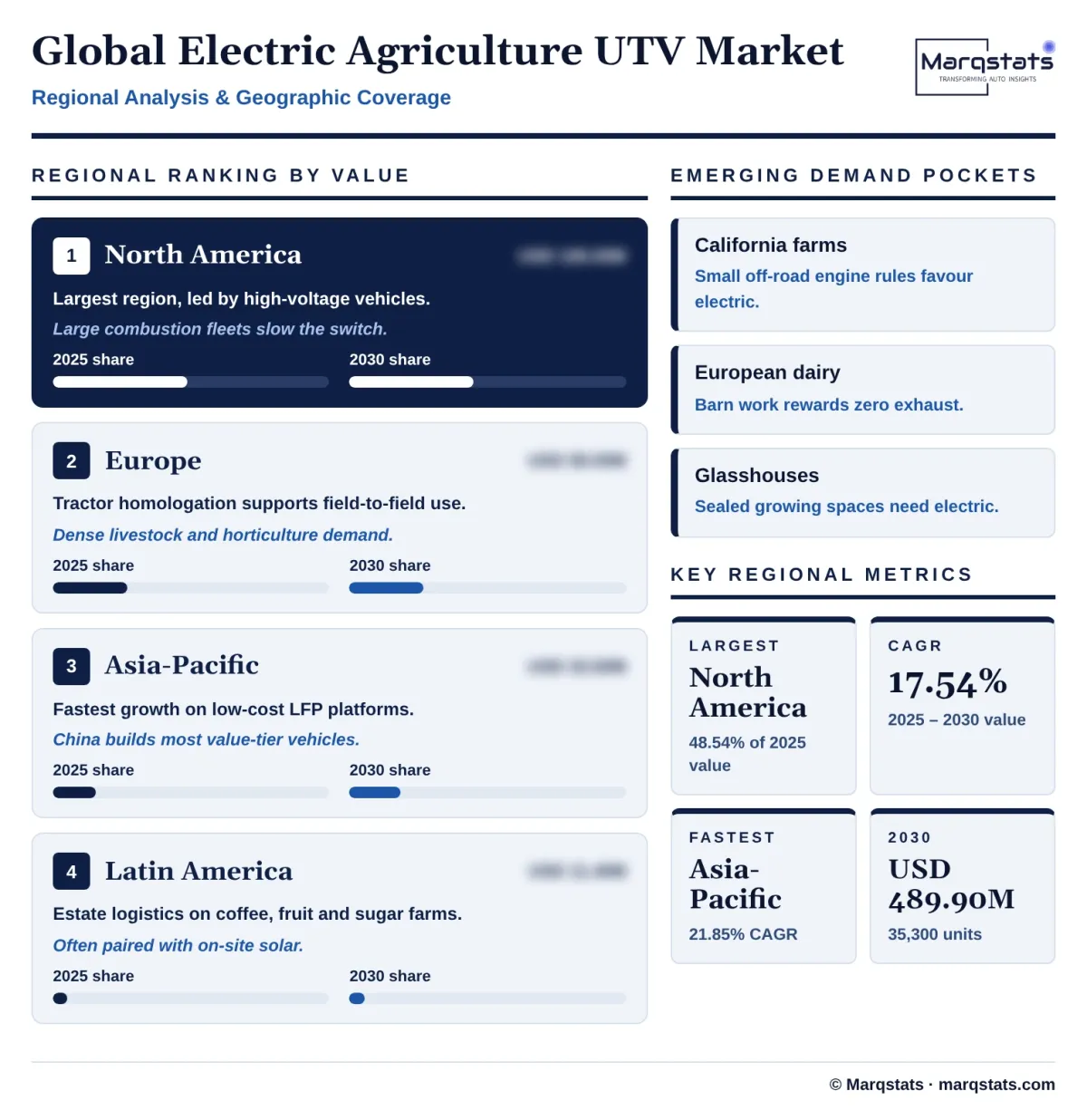
North America is the largest region at USD 106.00 million in 2025, 48.54% of value, on 5,900 units, and reaches USD 220.00 million, 44.91% of value, on 12,600 units in 2030, a 15.72% CAGR. It leads on value because the high-voltage tier sells mainly here, at an average near USD 17,966 per unit. It grows slowest because farms already own large combustion fleets and the main California voucher excludes UTVs. California is the strongest state market, driven by the zero-emission small off-road engine rule and the San Joaquin Valley farm UTV programme.
Europe
Europe is worth USD 59.00 million in 2025, 27.02% of value, on 3,950 units, rising to USD 132.00 million, 26.94% of value, on 9,300 units in 2030, a 17.47% CAGR. Tractor homologation under Regulation (EU) No 167/2013 lets a working UTV use public roads between fields, and dense livestock and horticulture sectors in the Netherlands, Germany, France and the United Kingdom add demand. The UK Farming Equipment and Technology Fund 2026 had a GBP 50 million budget across its three themes.
Asia-Pacific
Asia-Pacific is the fastest-growing region, from USD 33.50 million in 2025, 15.34% of value, on 3,600 units to USD 90.00 million, 18.37% of value, on 10,200 units in 2030, a 21.85% CAGR. China supplies and consumes most value-tier units at about USD 9,300 each across the region, while Australia and New Zealand buy higher-specification vehicles for pastoral and horticultural work.
Latin America
Latin America is worth USD 11.40 million in 2025, 5.22% of value, on 760 units, rising to USD 28.00 million, 5.72% of value, on 1,900 units in 2030, a 19.69% CAGR. Coffee, fruit and sugar estates in Brazil, Mexico and Chile buy electric UTVs for estate logistics, often paired with on-site solar.
Middle East and Africa
The Middle East and Africa are worth USD 8.48 million in 2025, 3.88% of value, on 540 units, reaching USD 19.90 million, 4.06% of value, on 1,300 units in 2030, an 18.60% CAGR. Demand comes from commercial estates and greenhouse projects in the Gulf states, South Africa and Kenya, where imported fuel is costly.
How Competition Is Evolving
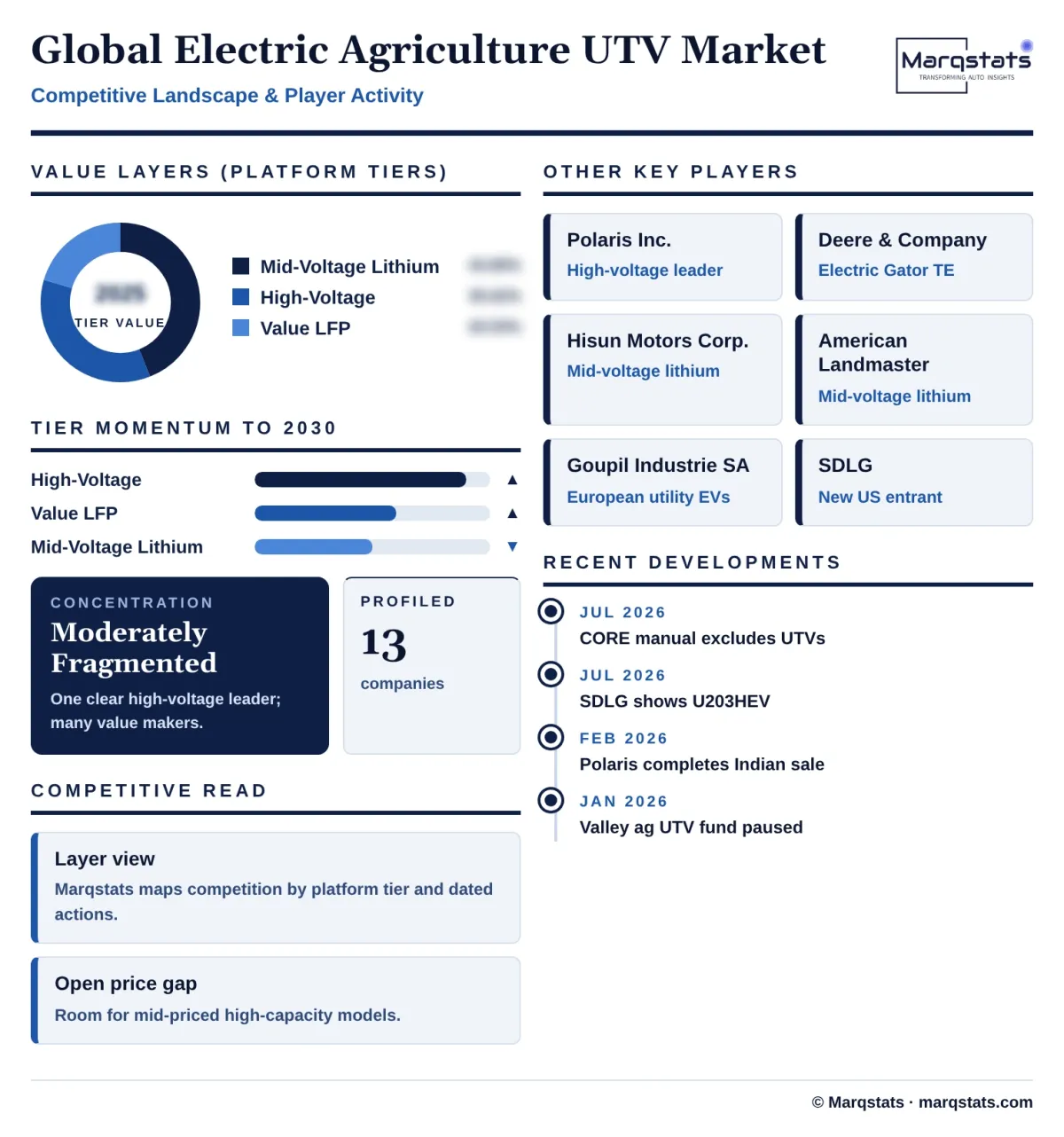
Competition is organised in three layers rather than around a single leader. Marqstats does not publish company market shares for this market because no official registry or filing separates agricultural electric UTV sales by maker. The high-voltage layer is led by Polaris Inc., whose RANGER XP Kinetic remains the reference for power and towing. The mid-voltage layer is a mix of powersports and utility-vehicle brands, including Hisun Motors Corp., American Landmaster, Deere & Company with its electric Gator TE, and European specialists such as Goupil Industrie SA, a Polaris subsidiary, and Alke S.r.l. The value layer is dominated by Chinese manufacturers selling lithium iron phosphate platforms into more than one continent.
Entry and exit both shaped 2025 and 2026. Volcon Inc. sunset its Stag UTV in October 2024 and renamed itself Empery Digital Inc. in July 2025 to pursue a bitcoin treasury strategy, removing one high-voltage contender. Massimo Group announced an electric UTV for 2026, and SDLG showed the U203HEV in the United States in July 2026. Kubota Corporation, a leading maker of diesel farm UTVs, extended its RTV-X range with a diesel Long Bed in late 2025 rather than an electric model.
The market is moderately fragmented. Polaris holds the clearest position in high-voltage vehicles, but in units the market is spread across dozens of manufacturers. The decisive assets are dealer reach into farms, European tractor homologation and the ability to sell a 20 to 30 kWh vehicle below USD 20,000.
Companies Covered
Companies covered in the report include:
Recent Market Activity
Table of Contents
Coverage & Segmentation
Included: new battery-electric side-by-side utility task vehicles sold for agricultural primary production in livestock and dairy, orchards and vineyards, protected horticulture, arable and mixed-farm support, and ranch and estate work, across North America, Europe, Asia-Pacific, Latin America and the Middle East and Africa. Value is the average transaction price before purchase grants and sales taxes. History covers 2021 to 2025, the base year is 2025 and the forecast runs 2026 to 2030.
Excluded: single-rider electric ATVs, recreational and sport side-by-sides, golf-course and turf-care utility vehicles, campus and industrial utility carts, electric tractors, used vehicles, aftermarket conversions, separately sold chargers, attachments and accessories.
Boundaries with Marqstats reports: this market is a strict subset of the Global Electric ATV and UTV Market (USD 1.80 billion in 2025), so do not add the two. Electric tractors are covered by the Electric Tractor Market (USD 55.63 million in 2025), with no overlap. Utility turf vehicles sold to golf, landscape and municipal buyers sit in the North America Electric Turf Equipment Market and are excluded here; do not add. The Off Highway Electric Vehicle Market covers construction, mining and agricultural machines and does not size UTVs separately.