Market Snapshot
The global commercial vehicle depot charging market was worth USD 6.23 billion in 2025 and is forecast to reach USD 16.51 billion by 2030, a CAGR of 21.52% that adds USD 10.28 billion of annual spend. Demand comes from the roughly 900,000 electric trucks, buses and vans sold worldwide in 2025, per the International Energy Agency (IEA). The distinguishing fact is where the money lands: value follows the cost of a grid connection, not the count of vehicles.
Marqstats sizes this market bottom-up as annual capital and software spend at private and captive fleet depots: charging hardware, behind-the-meter transformers, switchgear and civil works, depot battery storage, and depot energy management software with commissioning services. Vehicle additions by region and category come from the IEA Global EV Outlook 2026; installed cost per vehicle by region is a Marqstats estimate checked against named site disclosures. The panel is most sensitive to the North American installed cost per heavy truck, which sets more than a quarter of the global total.
North America bought about 20,000 of the more than 400,000 medium and heavy electric trucks sold worldwide in 2025, roughly 5%, yet it accounts for 28.09% of global depot charging value. China sold over 90% of those trucks and accounts for 26.00%. Two forces drive the gap. A Chinese megawatt-class site costs a fraction of a North American one, and North American fleets build depot capacity ahead of vehicle deliveries because utility connections take years.
Trucks now carry the market. Medium and heavy trucks hold 51.37% of 2025 value and rise to 59.06% by 2030, while buses, the pioneer depot segment, slip from 25.68% to 20.35% as city bus electrification in China nears saturation.
Megawatt-class depot charging above 350 kW is the fastest-growing power band, from USD 0.45 billion to USD 3.45 billion, a 50.29% CAGR, after the Megawatt Charging System (MCS) was standardised for North America as SAE J3271 in 2025.
Key Takeaways
Market Overview & Analysis
Report Summary
Commercial vehicle depot charging is the private, behind-the-fence infrastructure that fleets use to recharge trucks, buses and vans between duty cycles. It is a capital goods market measured in transformers, switchgear, chargers and software, and it is distinct from public corridor charging, which regulators debate more and fleets use less. Marqstats values the 2025 market at USD 6.23 billion, with a forecast of USD 16.51 billion by 2030 at a 21.52% CAGR.
The most important conclusion is that the market is priced by grid scarcity. Where a medium-voltage connection takes two years or more and costs millions, as across the United States and much of Western Europe, fleets spend more per vehicle on transformers, storage buffers and load management than on the chargers themselves. Where connections are fast and equipment is cheap, as in China, the same truck carries a much smaller depot bill. That single variable explains why North America holds 28.09% of global value on about 5% of global electric truck sales.
The forecast rests on a published vehicle base. The IEA records more than 400,000 medium and heavy electric trucks, almost 70,000 electric buses and over 430,000 electric light commercial vehicles sold in 2025. Marqstats applies regional installed cost per vehicle to these additions, then checks the regional totals against live Marqstats pages for the United States, India and Saudi Arabia, and against the Europe fleet depot total. Every regional slice in the panel is reconciled to those pages, with any scope difference stated in the Study Scope.
Global Commercial Vehicle Depot Charging Market Size and Forecast
The market grew from USD 1.42 billion in 2021 to USD 2.15 billion in 2022, USD 3.15 billion in 2023, USD 4.48 billion in 2024 and USD 6.23 billion in 2025, a historical CAGR of 44.73%. That pace came from a low base: European bus depots and Chinese city bus depots dominated spend in 2021, and medium and heavy truck depots only became material after 2023. Growth then decelerates to 21.52% over the forecast, with the market reaching USD 7.57 billion in 2026, USD 9.20 billion in 2027, USD 11.18 billion in 2028, USD 13.59 billion in 2029 and USD 16.51 billion in 2030.
The slowdown is arithmetic, not weakness. Absolute annual additions rise every year, from about USD 1.34 billion of new spend in 2026 to USD 2.92 billion in 2030. Two forces hold the rate below the historical pace. Hardware prices keep falling, led by Chinese DC power cabinets, and the shift of China from rapid build-out to replacement and densification brings its growth down to 15.01%. Against that, North America grows at 26.86% a year and Europe at 19.94% as truck electrification moves from pilots to fleet rollouts.
Volume context matters for reading the value line. The IEA counts electric truck sales of more than 400,000 in 2025, about double 2024, with heavy freight trucks almost tripling to a record 230,000 and medium freight trucks up 65% to 210,000. Electric buses reached almost 70,000, up 12%, and electric light commercial vehicles topped 430,000. Battery swap-capable trucks were around 15% of Chinese electric truck sales; swap stations are outside this market, so that share of the Chinese fleet adds no depot charging value.
Depot Charging Value Follows Grid Cost, Not Vehicle Count
The signature finding of this market is an inversion between where electric commercial vehicles are sold and where depot charging money is spent. China sold over 90% of the world's medium and heavy electric trucks in 2025, according to the IEA, yet it accounts for 26.00% of global depot charging value at USD 1.62 billion. North America sold about 20,000 electric trucks, close to 5% of the global total, and accounts for 28.09% at USD 1.75 billion.
Three mechanisms produce the inversion. First, unit cost. A 100 MW heavy truck charging station built on Huawei Digital Power technology and operated by Sichuan Yuanqi Xingguang Digital Energy Technology Co., Ltd. opened in Beichuan, Sichuan, in August 2025, with 18 megawatt-class bays at 1.44 MW and 108 liquid-cooled bays at 600 kW, for a reported investment of CNY 150 million, about USD 20.89 million at CNY 7.18 per USD. That is roughly USD 0.17 million per bay as a whole-site average including storage and a solar carport. It is a public truck hub rather than a private depot, so Marqstats uses it only as an indicator of Chinese equipment and civil cost levels, not as a like-for-like comparison with Western depot projects.
Second, build-ahead. North American depot projects are sized for the fleet a site will run in five years because a second utility upgrade repeats much of the cost and the wait of the first. The live Marqstats US Fleet Depot Charging page records depot projects of USD 7.9 million for a small site to USD 15.4 million for a medium one. Capacity installed today therefore carries vehicles that have not yet been delivered, which inflates value per vehicle sold in the base year.
Third, the grid-side share of spend. In markets where connection queues run two years or more, fleets buy behind-the-meter battery buffers and load management software to start operating on a smaller connection. Those layers are a minor line item at a Chinese logistics park and a major one at a California drayage yard. The practical conclusion for suppliers is that the profit pool sits where grid capacity is scarce, which is the opposite of where vehicle volumes are largest.
The Megawatt Transition Happens in Stages Inside the Depot
Megawatt charging is the fastest-growing power band, at 50.29% a year, but the first depot deployments show it arriving incrementally. Evergreen Mobility, a Paris-based heavy-duty charge point operator, announced a partnership with Kempower Oyj on 21 October 2026 covering France's first Kempower megawatt installations, including a depot at Kimmel Transport in Thal-Drulingen. Each site pairs one Mega Satellite live at 250 kW and upgradable to 1.2 MW with four 300 kW satellites for overnight charging.
The pattern repeats in Norway. ASKO Norge, which runs about 700 trucks and expected around 200 to be electric by the end of 2025, uses roughly 190 CCS points and two MCS points across 13 depots, about 25 MW in total, with its Vestby depot at 2.4 MW. Most energy still flows through CCS at a few hundred kilowatts. Megawatt points serve the minority of trucks that turn around inside a shift.
The conclusion for the forecast is that megawatt value grows faster than megawatt energy. Depots buy MCS-ready power cabinets and dispensers now and raise output later, so hardware value is booked years before the full power is used. That is why the megawatt band reaches 20.90% of value by 2030 while overnight and mid-power DC charging still deliver most of the kilowatt-hours.
Market Dynamics
Key Drivers
Four forces lift depot charging spend faster than vehicle sales in Europe and North America and keep it rising in Asia.
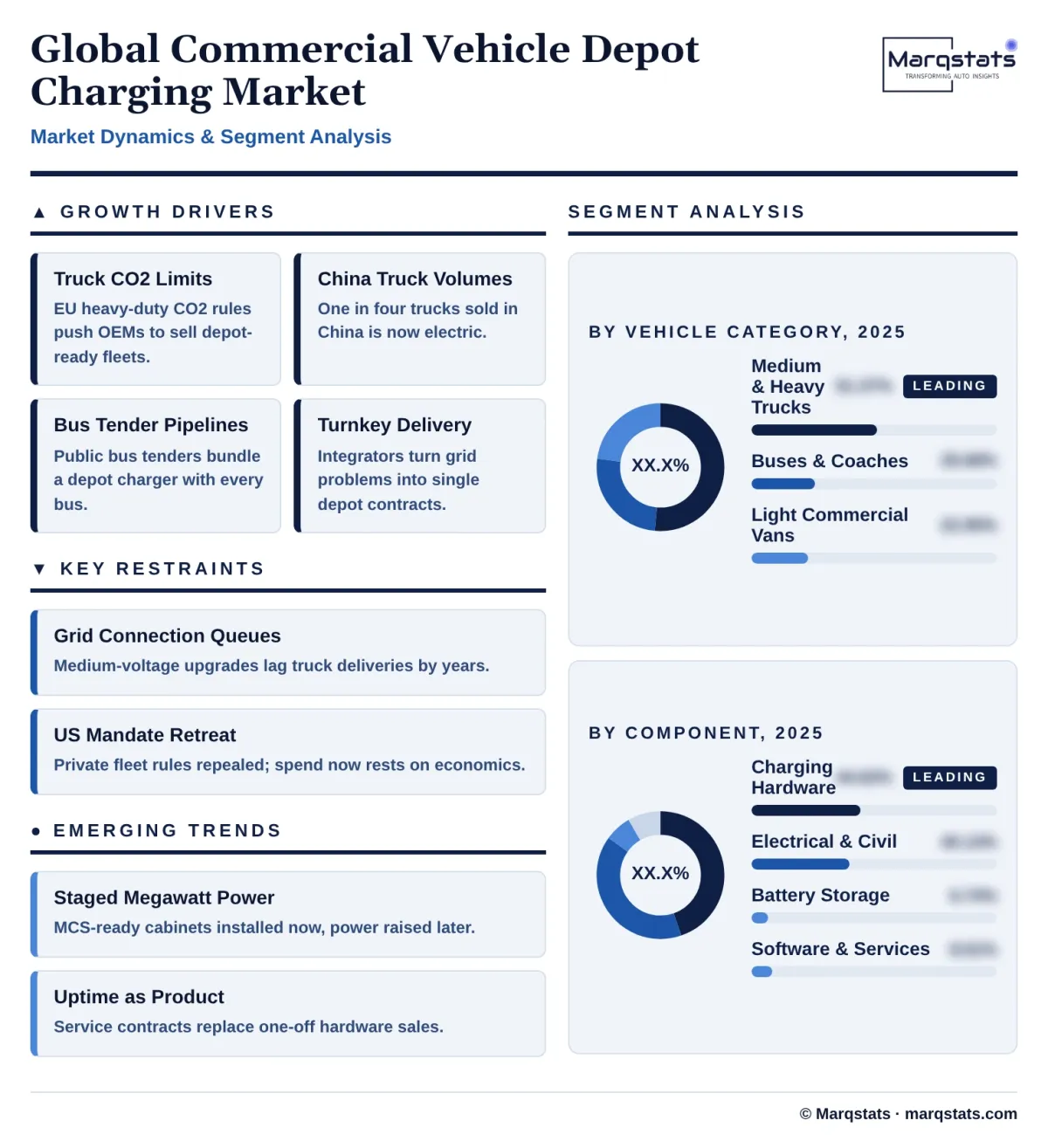
- Truck CO2 standards in Europe: Regulation (EU) 2024/1610 requires a 45% cut in heavy-duty vehicle CO2 emissions from 2030, 65% from 2035 and 90% from 2040 against the 2019 baseline, and the IEA records European electric medium and heavy truck sales up 40% to nearly 17,000 in 2025. OEMs cannot meet those limits without fleets that can charge at home, so depot capacity is now a sales tool for truck makers.
- Electric truck economics in China: the IEA reports that one in four trucks sold in China in 2025 was electric and that electric heavy freight trucks reached 28% of heavy truck sales. Even at Chinese cost levels, that volume makes China the largest single country in depot charging value at USD 1.62 billion in 2025.
- Public bus procurement programmes: India's Convergence Energy Services Limited (CESL) tendered 6,230 electric buses in January 2026 under PM E-DRIVE and the Delhi gross cost contract programme, and PM-eBus Sewa funds depot and behind-the-meter infrastructure in full for 10,000 buses. Every tendered bus needs a depot charger before it enters service.
- Grid-constrained operation as a product: ABB E-mobility and Elexon GmbH launched a single-point depot offering for Germany and Austria at IAA Transportation on 14 September 2026, bundling ABB DC hardware with Elexon planning, installation, energy and load management. Turnkey delivery turns a fleet's grid problem into a contract, which widens the buyer base to small and mid-sized operators.
Key Restraints
Three frictions slow conversion of vehicle demand into installed depot capacity.
- Utility connection lead times: medium-voltage connections above 1 MW can take two years or more in Germany, the United Kingdom and California, while electric trucks can be delivered in months. Fleets either over-provision storage or delay vehicles, and both choices defer part of the depot spend.
- Regulatory retreat in the United States: the California Air Resources Board (CARB) approved amendments in September 2025 repealing the Advanced Clean Fleets requirements for high priority and drayage fleets, and released further modified text on 1 June 2026 that keeps state and local government fleets in scope. Private fleet depot spending in California now rests on economics and incentives rather than a mandate.
- Small fleet capital access: the live Marqstats US Fleet Depot Charging page notes that 44% of on-road commercial vehicles sit in fleets of 10 or fewer vehicles. These operators cannot fund a USD 7.9 million depot, so their electrification depends on shared depots and charging-as-a-service offers that are still scaling.
Key Trends
Three shifts are changing what a depot charging contract contains.
- Service contracts replace hardware sales: ABB E-mobility took over monitoring, maintenance and support of ASKO's truck charging infrastructure in September 2026, covering more than 60 high-power ABB chargers in seven Norwegian cities that had delivered over 20 GWh. Uptime is becoming the product fleets buy.
- Chargers move into loading docks: Bidfood UK opened its first electrified truck depot at Slough in October 2026 with four overhead gantry bays fed by one 600 kW Kempower power unit, each bay delivering up to 160 kW during 45-minute to two-hour loading stops. Depot charging is merging with dock operations rather than sitting in a separate yard.
- Trucks become grid assets: the SPIRIT-E consortium, led by the Technical University of Munich with MAN Truck & Bus SE and TenneT, fed up to 325 kW from a 480 kWh MAN eTGX back into the grid in April 2026, with users estimated to save around 10% to 20% on electricity. Bidirectional depot hardware is a forecast-period upgrade cycle.
Strategic Implications
- For entrants: compete on connection time, not charger price. A provider that can energise a depot on an existing connection with storage and load management wins the fleet before the utility upgrade arrives, and it can then sell the larger installation once the grid catches up.
- For incumbents: protect installed bases through service. ABB E-mobility at ASKO and Kempower with Erinion at Bidfood show that hardware share is now defended through monitoring, uptime commitments and staged power upgrades sold into the same site.
- For suppliers and investors: follow grid scarcity. The USD 6.10 billion electrical and civil works pool and the USD 1.95 billion storage pool in 2030 together exceed charging hardware, and both concentrate in Europe and North America where connections are slow and expensive.
Market Segmentation
Medium and heavy trucks are the dominant and fastest-growing vehicle segment, worth USD 3.20 billion in 2025, or 51.37% of the market, and forecast at USD 9.75 billion by 2030, a 24.96% CAGR. Their share rises to 59.06% by 2030.
The segment is large because a heavy truck depot needs the most power per vehicle and the most grid work per site. The IEA records a record 230,000 electric heavy freight trucks sold globally in 2025 and 210,000 medium freight trucks. In Europe, the Vestby depot of ASKO Norge runs at 2.4 MW for a fleet of heavy distribution trucks. Truck depots are where megawatt equipment, storage buffers and medium-voltage substations converge, so value per vehicle is highest here.
Buses and coaches account for USD 1.60 billion in 2025, 25.68% of value, rising to USD 3.36 billion by 2030 at 16.00% a year, the slowest of the three categories.
Buses were the first depot charging market and remain the most predictable. The IEA reports almost 70,000 electric buses sold in 2025, with China at around 60% of global sales and city bus sales in China nearly 100% electric. That saturation is why the segment slows. Growth shifts to Europe, where battery electric city buses exceeded 55% of EU city bus sales in 2025, and to India and Latin America, where Chile alone bought nearly 2,000 electric buses.
Light commercial vans are worth USD 1.43 billion in 2025, 22.95% of value, and reach USD 3.40 billion by 2030 at 18.91% a year.
Vans sell in the largest numbers but carry the smallest depot bill per vehicle. Electric light commercial vehicle sales topped 430,000 in 2025, per the IEA, with almost 200,000 in Europe and around 140,000 in China. Most vans charge overnight on 11 kW to 22 kW AC points, so the segment is driven by port count and load management rather than by power electronics. Its share eases because truck depots grow faster.
Mid-power DC is the largest power band in 2025 at USD 2.55 billion, 40.94% of value, growing to USD 5.05 billion by 2030 at 14.64% a year. It serves overnight bus charging, medium trucks and mixed fleets, and its share falls to 30.59% as fleets specify more power for heavy trucks.
High-power DC is worth USD 2.18 billion in 2025 and becomes the largest band by 2030 at USD 6.06 billion, 36.70% of value, a 22.69% CAGR. This is the workhorse of heavy truck depots: Kempower satellites at 300 kW peak and the 160 kW to 400 kW points at ASKO and Bidfood sit here.
Megawatt-class depot charging is the fastest-growing band, from USD 0.45 billion in 2025, 7.22% of value, to USD 3.45 billion by 2030, 20.90%, a 50.29% CAGR. Tesla, Inc. opened its first public Megacharger for Semi fleet customers in Ontario, California, in March 2026, limited to 750 kW, which shows that megawatt-rated hardware usually runs below its rating in early operation.
AC charging up to 22 kW accounts for USD 1.05 billion in 2025, 16.85% of value, rising to USD 1.95 billion by 2030 at 13.18% a year. It is the cheapest port and the default for vans with long overnight dwell times. Its value share is small relative to its port count because each point costs a fraction of a DC unit.
Charging hardware, meaning power cabinets, dispensers, satellites, pantographs and connectors, is the largest component at USD 2.78 billion in 2025, 44.62% of value. It grows to USD 6.60 billion by 2030 at 18.88% a year, the slowest of the four components, because unit prices fall faster than in any other layer.
Transformers, switchgear, cabling, trenching, canopies and commissioning account for USD 2.50 billion in 2025, 40.13%, rising to USD 6.10 billion by 2030. This layer is close to hardware in size and larger than hardware in Europe and North America, where a depot transformer and its civil works often cost more than the chargers they feed.
Behind-the-meter battery storage at depots is the fastest-growing component, from USD 0.42 billion in 2025 to USD 1.95 billion by 2030, a 35.94% CAGR. Storage lets a depot run high-power chargers on a smaller connection, and it is the main reason value per vehicle stays high in grid-constrained regions.
Depot energy management software, charge point management and service contracts account for USD 0.53 billion in 2025 and USD 1.86 billion by 2030, a 28.54% CAGR. The ABB E-mobility service takeover at ASKO and the Elexon load management bundle show service revenue moving from an add-on to the core of the contract.
By Geography
Asia-Pacific
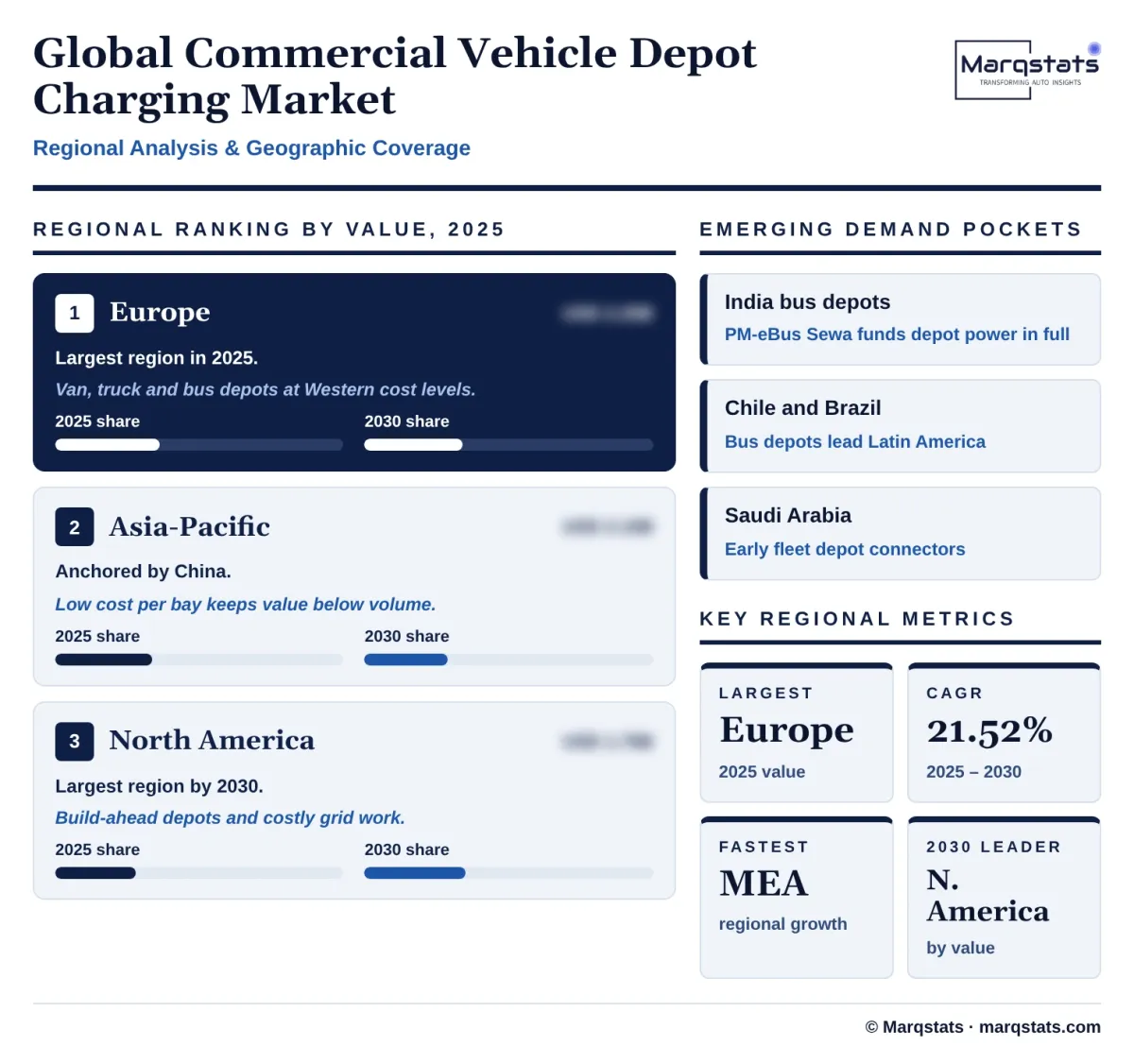
Asia-Pacific is the second-largest region in 2025 at USD 2.10 billion, 33.71% of global value, and grows to USD 4.73 billion by 2030 at 17.63% a year, the slowest of the five regions. Its share falls to 28.65% by 2030.
China contributes USD 1.62 billion in 2025, rising to USD 3.26 billion by 2030 at 15.01%. China has the world's largest electric truck fleet and nearly all-electric city bus sales, but its cost per bay is low and its city bus depots are largely built. India contributes USD 0.24 billion in 2025 and USD 0.85 billion by 2030, a 28.78% CAGR, led by bus depots under PM-eBus Sewa and PM E-DRIVE; the IEA records Indian electric bus sales above 4,000 for the first time in 2025. The rest of Asia-Pacific, led by Korea, Japan and Australia, adds USD 0.24 billion in 2025 and USD 0.62 billion by 2030.
The India slice is a whole-country figure that already contains the bus depot charging infrastructure measured on the live Marqstats India Electric Bus Depot Charging Infrastructure page and the captive depot portion of India electric truck charging. Those pages measure subsets and wider grid layers; their values are not to be added to the India slice.
Europe
Europe is the largest region in 2025 at USD 2.25 billion (USD 2,250.30 million), 36.12% of global value, and reaches USD 5.59 billion (USD 5,586.63 million) by 2030, a 19.94% CAGR, ending the forecast second at 33.86%. The European slice, covering the EU27, EFTA and the United Kingdom, equals the Marqstats Europe fleet depot charging total on the same scope, including depot-integrated battery storage and excluding front-of-the-meter grid reinforcement.
Europe leads in 2025 because it combines volume with Western cost levels. Marqstats counts about 208,000 electric vans, 17,000 electric trucks and 13,100 electric buses registered across the EU, EFTA and the United Kingdom in 2025, built from European Automobile Manufacturers Association (ACEA) and Society of Motor Manufacturers and Traders (SMMT) data. Its growth rate is lower than North America's because van depots, the largest European category by count, need cheap AC points, and because the European Commission proposed in December 2025 to ease the 2030 van CO2 target from 50% to 40%. Truck depots remain the growth engine, backed by Germany's toll exemption for zero-emission trucks to 30 June 2031 and the GBP 170 million added to the UK Depot Charging Scheme in March 2026.
European truck demand is concentrated: the IEA counts Germany at 4,400 electric trucks in 2025, the United Kingdom above 3,000, France at 1,900 and Sweden at 1,000. Lidl Nederland completed a network of truck charging at six Dutch distribution centres in September 2026, and plans to supply all 440 Dutch stores with electric trucks from 2027. Depot projects of that type, where a retailer electrifies its own logistics, define the European market.
North America
North America accounts for USD 1.75 billion in 2025, 28.09% of global value, and grows to USD 5.75 billion by 2030 at 26.86% a year, which makes it the largest region by 2030 at 34.82%. The United States contributes USD 1.60 billion in 2025 and USD 5.25 billion by 2030, Canada USD 0.12 billion and USD 0.38 billion, and Mexico USD 0.03 billion and USD 0.12 billion.
The US slice is consistent with the live Marqstats US Fleet Depot Charging Infrastructure page, which measures a wider envelope of USD 2.87 billion in 2025 and USD 9.42 billion in 2030. That page includes utility front-of-the-meter make-ready and interconnection, depot solar and microgrid generation, and charging-as-a-service structures. Removing those layers to match the global scope gives the US core of USD 1.60 billion and USD 5.25 billion; the bridge of USD 1.27 billion in 2025 and USD 4.17 billion in 2030 is a Marqstats estimate and both pages grow at about 26.8% a year.
North America is the clearest case of value without volume. The IEA records US electric truck sales up 25% to 17,000 in 2025 and Canada at 2,700, while US electric van sales fell to almost 6,000. Yet depot projects are large: Tesla opened its first public Megacharger for Semi fleet customers in March 2026, and port and logistics depots in California run at 9 MW and more.
Latin America
Latin America is worth USD 0.09 billion in 2025, 1.44% of global value, rising to USD 0.28 billion by 2030 at 25.48% a year. Bus depots dominate. The IEA reports regional electric bus sales more than tripling to exceed 3,000 in 2025, with nearly 2,000 in Chile and around 850 in Brazil, so Santiago and Brazilian state capitals hold most of the installed depot base.
Middle East and Africa
The Middle East and Africa is the smallest region at USD 0.04 billion in 2025, 0.64% of value, and the fastest-growing at 31.95% a year to USD 0.16 billion by 2030. Saudi Arabia is part of this slice; the live Marqstats Saudi Arabia Fleet Depot Charging page values its dedicated fleet depot connectors at USD 2.73 million in 2025 and USD 9.90 million in 2030, a 29.39% CAGR, and that figure is contained within the regional total, not added to it.
How Competition Is Evolving
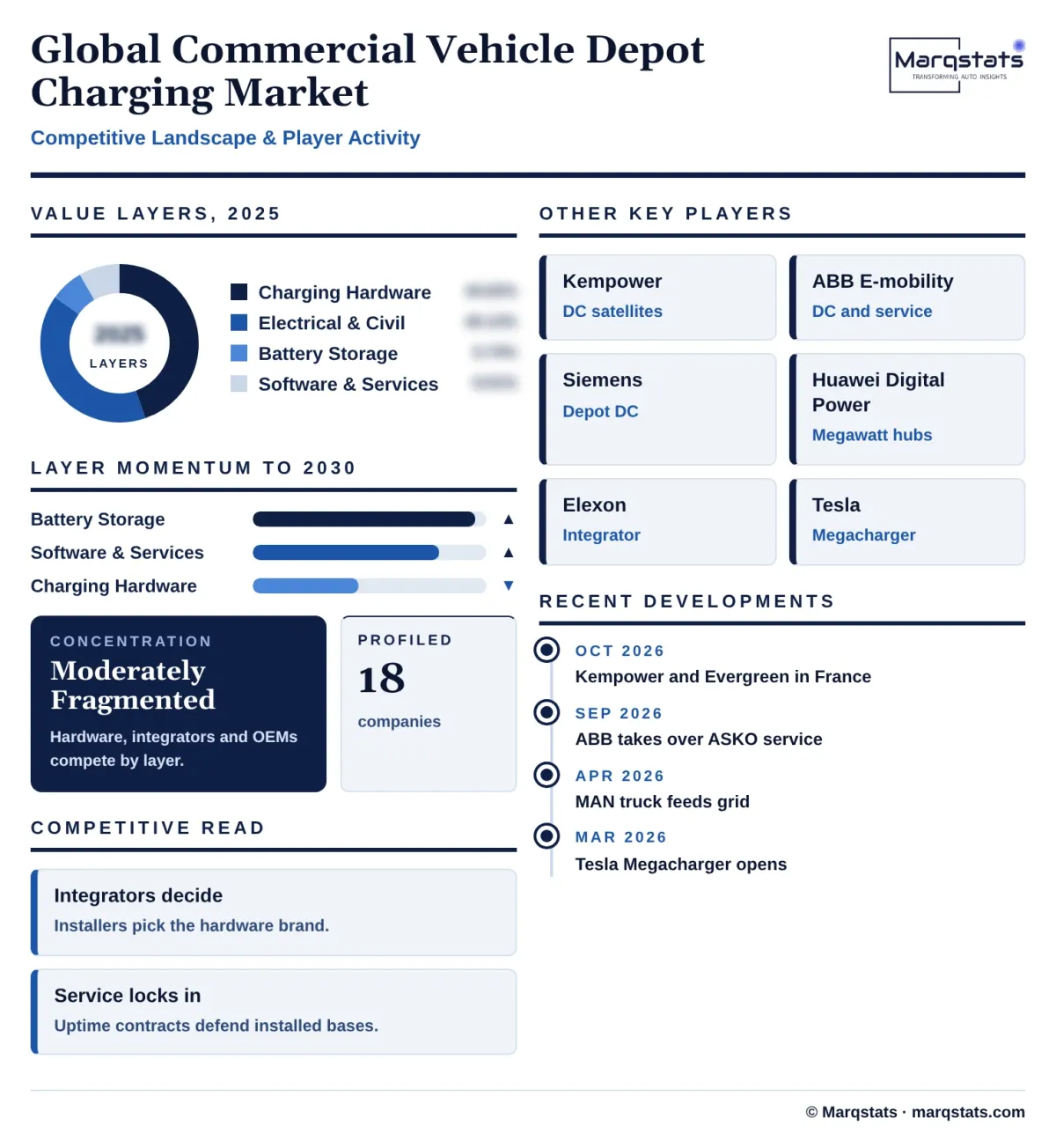
The market is moderately fragmented and organised in layers rather than around a single leader. Charging hardware is contested by power electronics specialists such as Kempower Oyj, alpitronic GmbH and Delta Electronics, Inc., by electrical majors such as ABB Ltd, Siemens AG, Schneider Electric SE and Eaton Corporation plc, and in China by Huawei Digital Power Technologies Co., Ltd. and TELD New Energy Co., Ltd. Marqstats does not publish company market shares for this market because no registry or regulator reports depot charger deliveries by supplier; competition is described by layer and by dated actions.
The decisive layer is the integrator. Elexon GmbH in Germany and Austria, Erinion AB within the Scania group, Evergreen Mobility in France and Forum Mobility in California turn hardware into energised depots, and they choose which hardware brand goes in. Hardware makers are responding by certifying integrators and taking on service, as ABB E-mobility did with Elexon in September 2026 and at ASKO the same month.
Truck makers are the third force. Tesla, Inc. builds its own Megacharger network for Semi customers, MAN Truck & Bus SE tests bidirectional depot charging, and Scania supports Erinion as a captive depot builder. OEM involvement matters because a fleet buying 50 trucks increasingly buys the depot in the same negotiation.
Companies Covered
Companies covered in the report include:
Recent Market Activity
Table of Contents
Coverage & Segmentation
Inclusions: charging hardware (AC and DC chargers, power cabinets, dispensers, satellites, pantographs, MCS connectors), behind-the-meter electrical works (transformers, switchgear, cabling), civil works and commissioning, depot battery storage, and depot energy management and charge point management software with service contracts, at private, captive and fleet-dedicated depots for UNECE category N1, N2 and N3 trucks and vans and M2 and M3 buses and coaches. Value is annual spend in USD at 2025 average exchange rates (EUR 1 = USD 1.13; GBP 1 = USD 1.32; CNY 7.18 and INR 87.00 per USD).
Exclusions: public corridor and en-route charging hubs, utility front-of-the-meter make-ready and interconnection, on-site solar generation, battery swapping stations, hydrogen refuelling, electricity sold, passenger car and two- and three-wheeler charging, and the vehicles themselves.
Sibling boundaries: the Europe slice equals the Marqstats Europe fleet depot charging total on the same scope, including depot battery storage. The North America slice reconciles to the live US Fleet Depot Charging Infrastructure page, whose USD 2.87 billion (2025) includes front-of-the-meter make-ready, solar and microgrid layers excluded here; do not add the US page to the global total. The India Electric Bus Depot Charging Infrastructure page, India electric truck charging and the Saudi Arabia Fleet Depot Charging page are subsets of the Asia-Pacific and Middle East and Africa slices; do not add them.