Market Snapshot
The France passenger car market, measured as immatriculations in France of new passenger cars (France car sales), stands at 1,632,154 new passenger car registrations (PFA) in 2025 and is estimated at 1,704,000 registrations in 2026. Marqstats forecasts it to reach 1,810,000 registrations by 2030, a CAGR of 2.09% over 2026 – 2030 that adds 177,846 registrations between 2025 and 2030. Immatriculations, France's official registration count, are published monthly by the PFA.
Renault Group (26.4%) is the largest market, Battery electric (BEV) is the fastest growing and Petrol (incl. LPG and E85) is the dominant segment, in a market that is moderately fragmented. The report covers 10 segments and 5 regions and profiles 16 companies, with 2025 as the base year, history from 2021 – 2025 and a forecast for 2026 – 2030.
Key Takeaways
Market Overview & Analysis
Report Summary
The France passenger car market covers new passenger cars (voitures particulières) registered in France, measured by monthly registrations (immatriculations) published by the Plateforme automobile (PFA) from AAA Data, across all powertrains, brands and buyer types. France registered 1,632,154 new passenger cars in 2025, down 5.0% from 1,718,416 in 2024 and about 580,000 below the more than 2.2 million of 2019. Marqstats estimates 1,704,000 in 2026, after registrations rose 4.37% to 1,384,293 in the first ten months, and 1,810,000 by 2030, a CAGR of 2.09% over 2026 – 2030.
France's new car market is recovering on electric cars and state aid, not on underlying demand. Battery electric cars rose from 20.03% of registrations in 2025 to 41.5% in October 2026, when 61,958 were registered, up 81.7%, while total volume grew only modestly. The PFA itself says the market depends on purchase aid and social leasing, which offers electric cars for under €200 a month; the 2026 edition opened on 16 July with a €401 million budget for at least 50,000 households.
Two French groups lead: Renault Group took 26.4% of 2025 registrations and Stellantis 25.8%, and nine of the ten top-selling models came from their brands, led by the Renault Clio with 100,101. French brands are winning the electric transition at home: 27% of electric cars sold in France in 2025 were assembled in France, against 16% of combustion cars, according to Transport & Environment. Chinese brands are the main challenge, reaching 8% of September 2026 registrations against 3.4% over the first nine months.
The forecast is a single most likely path: 1,730,000 in 2027, 1,760,000 in 2028, 1,785,000 in 2029 and 1,810,000 in 2030, still well below 2019. It assumes continued electric growth supported by aid and fleet rules, with high prices keeping many households in the used market, which took 77% of passenger car purchases in 2025. Any cut to social leasing or the bonus would hit volumes directly.
Market Dynamics
Key Drivers
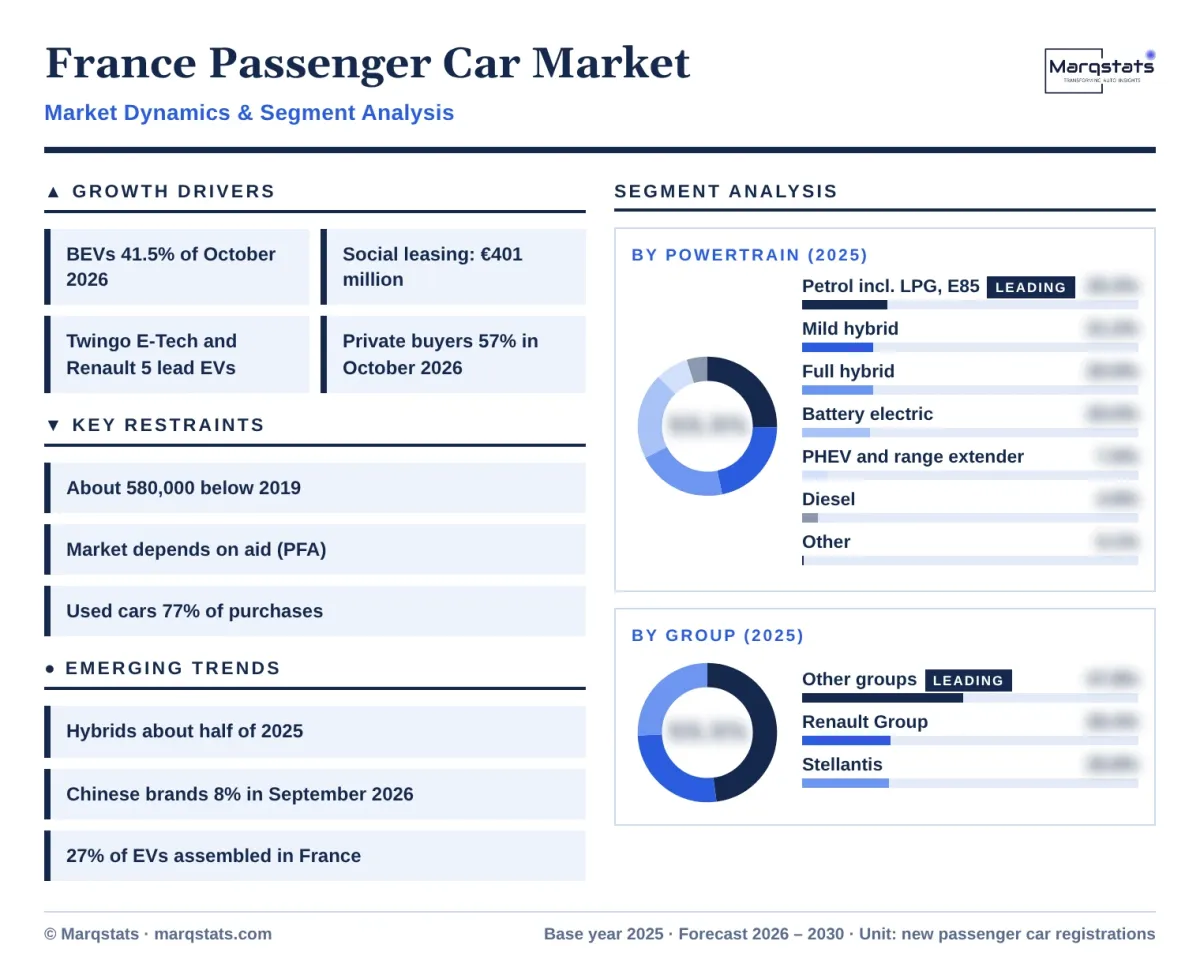
- Electric car growth: Battery electric registrations rose 12.5% to 326,923 in 2025 and 81.7% in October 2026 to 41.5% of the market. The September 2026 share reached 42%, or 48% including plug-in hybrids, as the market rose 11.6% to 156,629. The Renault brand registered 14,610 battery electric cars in October 2026, up 69.6%, 56.3% of its monthly volume, and Transport & Environment found that more French-built EVs such as the Renault 5 and Peugeot e-208 gained share.
- Social leasing: The 2026 edition opened on 16 July with €401 million for at least 50,000 households, and the 2025 edition boosted electric registrations at the end of 2025. Because deliveries are concentrated in a few months, monthly electric shares swing sharply, with shares passing 40% from late summer 2026. Social leasing brought lower-income households into new cars at all, and the PFA said the market would probably not be as good without these aids.
- Affordable French EVs: The Renault Twingo E-Tech led electric sales in October 2026 with 4,747 units and the Renault 5 followed with 4,666. In 2025 the Renault 5 E-Tech was the top electric model with nearly 38,000, ahead of the Peugeot e-208 with more than 32,000 and the Citroën ë-C3 with about 28,000. Small, affordable electric cars such as these and the electric Fiat Panda are the industry's answer to high prices, and their success shows how sensitive demand is to monthly costs.
- Private buyer return: Sales to private buyers rose about 18% in October 2026 and reached 57% of the market, according to AAA Data figures reported by Auto Infos. October 2026 had one working day fewer than a year earlier, so the 7.04% raw increase to 149,341 understates underlying demand. The Dacia Sandero has long been the top-selling car among private buyers, and private buyers favour cheaper models such as the Clio, 208 and Sandero.
- Fleet taxation: Company fleets drove electric growth in 2025, with taxes on company cars and a new tax on fleets of 100 or more vehicles encouraging electrification, and companies reduced plug-in hybrid purchases as tax rules changed, according to Transport & Environment. SDES data show electric cars and plug-in hybrids together reached 26.5% of new car sales in 2025, against 25.2% in 2024. Fleet rules support electric demand independently of household budgets.
Key Restraints
- Low volumes: 2025 registrations were about 580,000 below 2019, and SDES, using a slightly different scope, reported 1.665 million new passenger cars, 26.3% below 2019. Higher new car prices, weak household purchasing power and tighter bonus conditions have kept many buyers out of the new car market since 2019. Light commercial vehicle registrations fell 13.01% in October 2026, a sign that business investment remained weak even as private demand recovered.
- Aid dependence: The PFA says the market depends on purchase aid and social leasing. Any reduction in the €401 million social leasing envelope or the bonus would hit volumes directly, which is why the level of public aid in future budgets is the main forecast uncertainty. Marqstats does not present scenarios because no fixed decision date covers the full period, and assumes aid continues at roughly current levels.
- Strict bonus rules: The electric car bonus requires a minimum environmental score, a purchase price of €47,000 or less and a weight under 2,400 kg. The environmental score excludes most cars built in China and favours European-built models. These rules shape which electric cars sell, favouring small and mid-sized European models and limiting the reach of larger or imported models among aid-dependent buyers.
- Used car preference: SDES counted 5.534 million used passenger car sales in 2025, up 0.9%, so used cars took 77% of passenger car purchases. With new car prices high, many households buy used cars instead, and the gap between used and new volumes is the clearest measure of how far the new car market remains below its potential. A growing supply of used electric cars may further reduce some private demand for new cars.
Key Trends
- Hybrid dominance: Hybrids of all types were about half of 2025 registrations. Mild hybrids led with 346,065, up 44.5%, ahead of pure petrol at 345,233, down 32%, and full hybrids at 341,944, up 10.1%. Peugeot was the leader in hybrid sales, and its SUVs, the 2008, 3008 and 5008, led their segments with 54,634, 38,603 and 17,264 registrations. Hybrids give combustion buyers a lower-emission option without charging.
- Chinese brands: Chinese brands took 8% of all registrations in September 2026 and 7% of the electric segment, with BYD and XPENG among the entrants named by the PFA, and Stellantis's partner brand Leapmotor passed 3,500 sales in 2025. Chinese brands bring affordable electric and plug-in models to a market where price is the main barrier, although the environmental score limits their access to the bonus.
- Made in France EVs: 27% of EVs sold in 2025 were assembled in France, and INSEE reports that French production of battery electric cars rose 74.0% between 2021 and 2025 while petrol and diesel car production fell 11.8% to 469,000. The five French brands raised their share to 39.31% in 2025 from 37.38%, with 641,769 registrations, and the Toyota Yaris, the only foreign model in the top ten with 33,437, is also built in France.
- Diesel and PHEV decline: Diesel fell 36.5% to 79,397 in 2025 and plug-in hybrids 26% to 108,029, making France an outlier in plug-in hybrids, which rose strongly elsewhere in Europe. Transport & Environment calculated that combustion car sales fell by about 127,000 units and plug-in hybrids by about 40,000 in 2025, together explaining the market decline. The EU market grew 1.8% to 10.82 million in 2025, according to ACEA.
Market Segmentation
Petrol cars, including LPG and E85, totalled 412,147 in 2025, 25.26% of registrations, while pure petrol fell 32% to 345,233. Many petrol models now come as mild hybrids, which moves volume into that category. Petrol remains common in small cars and entry models bought by private buyers, and its share falls further as electric cars gain under aid and fleet rules.
Mild hybrids reached 346,065, 21.20%, up 44.5%, the largest single powertrain in 2025. Carmakers fit mild hybrid systems to petrol models to cut emissions at low cost, which lets combustion buyers move to a lower-emission option. Mild hybrids grow as pure petrol versions are withdrawn, although they do not qualify for electric car aid.
Full hybrids reached 341,944, 20.95%, up 10.1%. Toyota, Renault and Peugeot sell full hybrids across popular models, and the new Renault Clio adds hybrid versions in 2026. Full hybrids suit drivers who want lower fuel use without charging, especially in rural regions where long distances and limited charging favour them.
Battery electric cars reached 326,923, 20.03%, up 12.5%, and rose to 41.5% in October 2026, the fastest-growing powertrain. The Renault 5, Twingo E-Tech, Peugeot e-208, Citroën ë-C3 and Tesla Model Y are the main models. Social leasing, the bonus and fleet taxation drive growth, and the battery electric share rose from about 17% in 2024.
Plug-in hybrids and range extenders reached 124,201, 7.61%, with plug-in hybrids down 26% to 108,029 and range extenders at 16,172. Changes to company car taxation reduced fleet demand for plug-in hybrids in France, unlike in the rest of Europe. Range-extender models offer an alternative for drivers who want electric driving with a fuel backup.
Diesel fell 36.5% to 79,397, 4.86% of registrations, continuing a long decline as emissions rules, city restrictions and fleet taxation discourage diesel cars. Diesel survives mainly in larger cars and high-mileage use, and its share falls further through 2030.
Other and unclassified registrations were 1,477, 0.09%, a Marqstats residual from the powertrain totals. This category includes small volumes of other fuels such as hydrogen and registrations without a reported powertrain, and remains negligible through the forecast.
All other groups, including Volkswagen Group, Toyota, Hyundai–Kia, BMW, Mercedes-Benz, Tesla and Chinese brands, took 47.81%, about 780,398 cars. Volkswagen fell 7.11% to 110,960 and fifth place, and Volkswagen Group fell 14.89% in October 2026, while Tesla fell 37.5% in 2025 to about 25,400 before recovering, with October 2026 up 35.24%. Chinese brands are the fastest-growing part of this group.
Renault Group (Renault, Dacia, Alpine) led with 26.4%, about 430,889 cars, regaining leadership during 2025 with 26.6% in November. The Renault brand rose 3% to 285,531 and 17.5%, its strongest since 2017, and the Clio was France's top-selling car. Renault leads the electric shift, although Dacia fell 23.8% in October 2026, pulling group registrations down 4.1% to 34,730.
Stellantis (Peugeot, Citroën, Fiat, DS, Opel, Jeep and others) took 25.79%, 420,867 cars, down 7%, as Fiat, Opel and Peugeot declined while Citroën grew 3.6% to 115,576. Peugeot leads hybrids with its SUV range and the 208, France's second top-selling car with 73,092. Stellantis rose 2.78% to 36,901 in October 2026 and remains stronger when light commercial vehicles are included.
By Geography
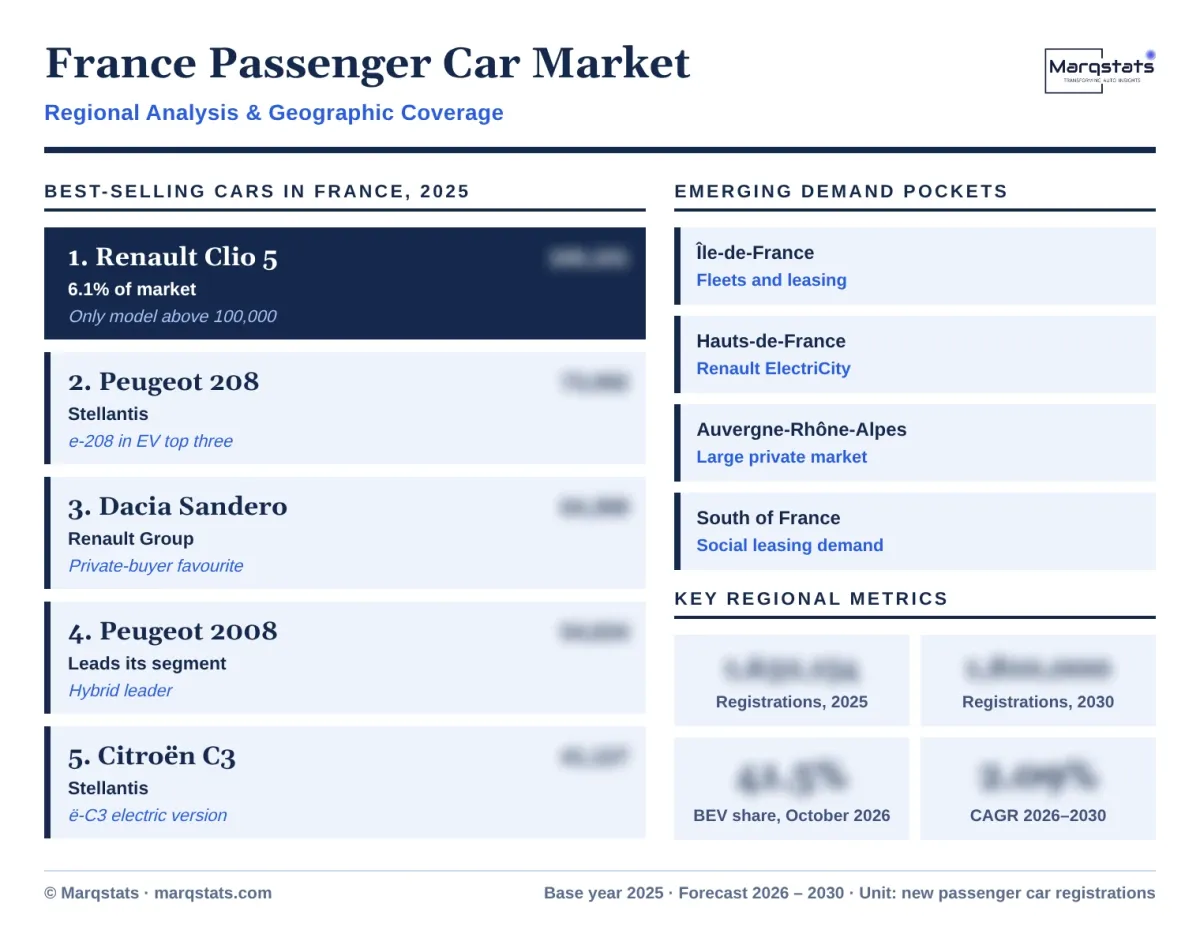
Île-de-France
Île-de-France concentrates head offices, leasing companies and fleets, which register a large share of company cars, and has the densest charging network for electric cars. Fleet taxation and charging access make it a front-runner for electric registrations. Regional registration data are not used here, so analysis is qualitative.
Auvergne-Rhône-Alpes
Auvergne-Rhône-Alpes is a large private car market with strong demand for hybrids and SUVs and a growing electric share around Lyon and Grenoble. Its mix of cities and mountain areas supports both electric cars in urban areas and full hybrids for longer distances.
Hauts-de-France
Hauts-de-France hosts Renault's ElectriCity plants in Douai and Maubeuge, which build the Renault 5 and other electric models sold in France, and Toyota's Onnaing plant, which builds the Yaris. Local production of top-selling models links the region's economy closely to the national market's shift to electric cars.
Provence-Alpes-Côte d'Azur and Occitanie
The south is a large private market with older cars and strong interest in social leasing among lower-income households. Sunny conditions support home solar and electric car charging, and the region's private buyers respond strongly to monthly cost offers.
Other regions
Rural regions depend more on private cars and used vehicles, and full hybrids suit their longer driving distances. Social leasing targets lower-income households who drive long distances to work, which brings electric cars to areas where they were previously rare.
How Competition Is Evolving
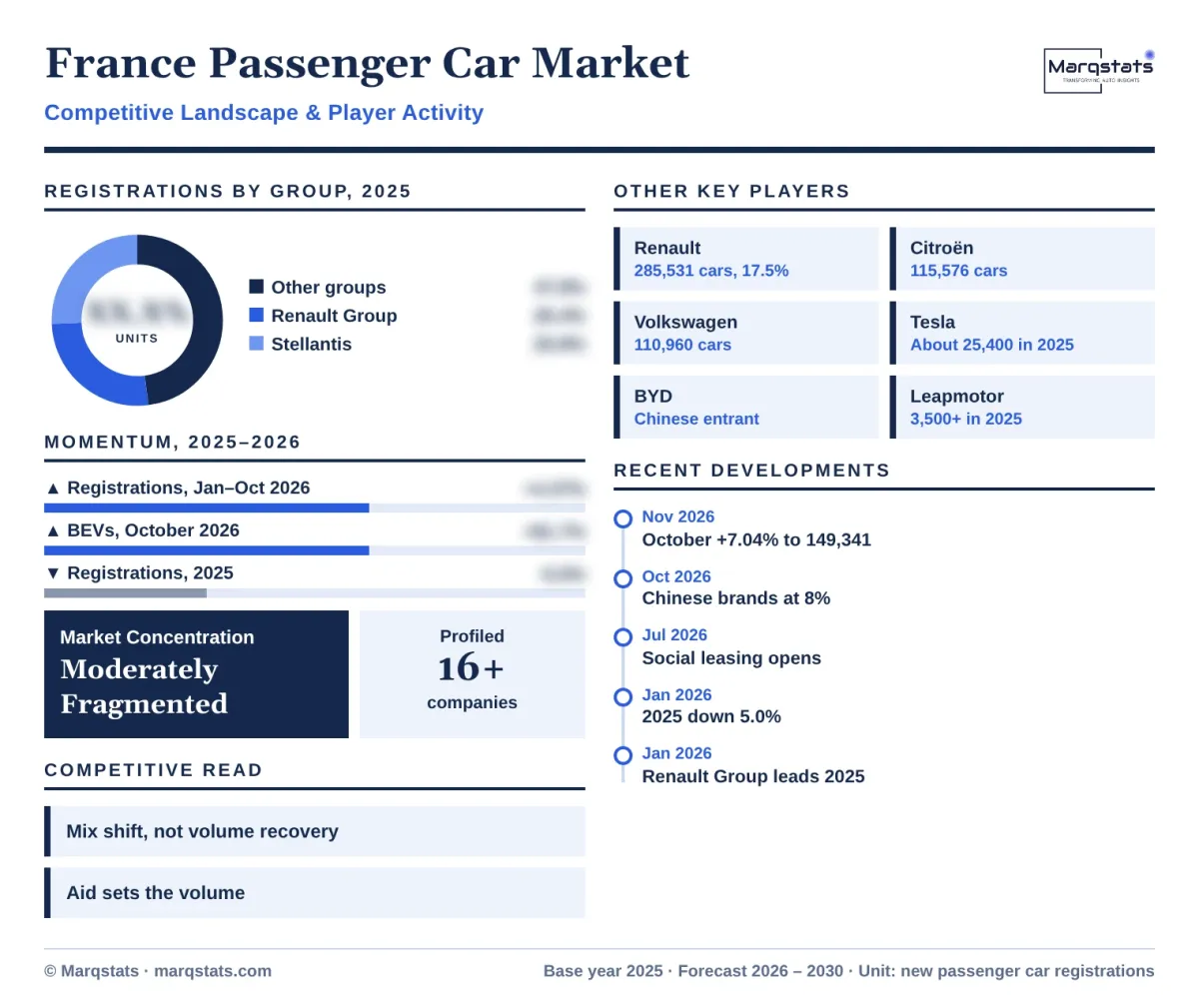
The France passenger car market is moderately fragmented: Renault Group (26.4%) and Stellantis (25.8%) hold just over half of registrations, and dozens of other brands share the rest. The marché automobile France has become a two-group contest at the top.
Renault leads the electric shift with the Twingo E-Tech and Renault 5, while Stellantis leads hybrids through Peugeot's 2008, 3008 and 5008.
Volkswagen Group, Toyota, Hyundai–Kia, BMW and Mercedes-Benz are the main foreign groups; Volkswagen held fifth place in 2025 with 6.8%.
Tesla, BYD, MG, Leapmotor and XPENG compete in electric cars; Chinese brands rose to 8% of September 2026 registrations.
Companies Covered
Companies covered in the report include:
Recent Market Activity
Table of Contents
Coverage & Segmentation
The study covers new passenger car registrations in France by powertrain and manufacturer group, with qualitative analysis of buyer types, regions and brands. The base year is 2025, the historical period 2021 – 2025 and the forecast period 2026 – 2030. The unit is new registrations.
Ten segments across two dimensions and five regions are covered, and 16 companies are profiled. Registration data are from PFA and AAA Data; the group units, the residuals, the 2026 estimate and the forecast are Marqstats constructions.
Known limits are stated plainly. PFA and SDES totals differ by scope, group shares are rounded, and 2026 data run through October.
