Market Snapshot
The US Pickup Truck Market stands at 3,145,880 units sold in 2025 and is estimated at 3,120,713 units in 2026. Marqstats forecasts it to reach 3,286,182 units by 2030, a CAGR of 0.88% over 2026 – 2030 that adds 140,302 units between 2025 and 2030. US pickup truck sales are the largest single segment of the light vehicle market.
Full-Size Pickups is the largest market, Mid-Size Pickups is the fastest growing and Full-Size Pickups is the dominant segment, in a market that is highly concentrated. The report covers 6 segments and 3 regions and profiles 12 companies, with 2025 as the base year, history from 2021 – 2025 and a forecast for 2026 – 2030.
Key Takeaways
Market Overview & Analysis
Report Summary
The US pickup truck market is measured as new pickup sales in the United States as reported by manufacturers, covering compact, mid-size and full-size pickups, including heavy-duty 2500 and 3500 models. Medium-duty chassis cabs of class 4 and above are excluded where makers report them separately. US pickup truck sales reached 3,145,880 units in 2025, 19.42% of the 16.2 million new light vehicles sold. Marqstats estimates 3,120,713 units in 2026 and forecasts 3,286,182 units by 2030, a CAGR of 0.88% over 2026 – 2030.
Structurally, the market is a two-company duopoly at the top with a competitive mid-size tier. General Motors and Ford Motor Company together sold 2,135,773 pickups in 2025, 67.89% of the market, while Stellantis N.V. and Toyota Motor Corporation followed with 13.70% and 13.42%. Full-size pickups account for 73.27% of sales. Buyers split between retail customers who buy on capability, brand loyalty and monthly payment, and fleets and contractors who buy heavy-duty trucks as working capital. Pickups are the largest single profit pool for the Detroit makers.
Three conditions frame the forecast. Price is the first: new full-size pickups regularly exceed USD 60,000 in mid trims, so interest rates decide how many retail buyers can sign. Trade policy is the second, since US tariffs on imported vehicles and parts raise costs for Mexico-built nameplates and push assembly into the United States. Powertrain is the third: battery-electric pickups fell to about 79,494 units in 2025, 2.53% of sales, while hybrids grew, so gasoline, diesel and hybrid pickups carry the forecast.
The 2026 dip reflects a model-cycle year rather than a demand collapse. Ford F-Series sales fell 9.5% in January to September 2026, while Ram sales rose 33.7% in the third quarter after the Hemi V8 returned. Growth of about 1.3% a year from 2027 rests on new full-size generations from GM and Ram, continued mid-size demand and the replacement cycle of about 55.3 million light-duty pickups in operation.
Market Dynamics
Key Drivers
- Heavy-duty work trucks selling at the limit of production: GM said it would run Flint Assembly six days a week from June 2026 to meet demand for heavy-duty Silverado and Sierra pickups, after selling 206,184 heavy-duty Silverados, up 12%, and 118,066 heavy-duty Sierras, up 9%, in 2025. Flint already builds about 1,100 heavy-duty trucks a day. Contractors, utilities and fleets buy these trucks as working capital for towing and payload, which makes demand less sensitive to retail financing costs. Heavy-duty models also carry the highest margins in the segment, so production capacity rather than demand is the near-term limit.
- Mid-size and compact trucks bringing new buyers into the segment: The mid-size segment grew 24.4% in 2025 to 660,412 units, and the Ford Maverick sold a record 155,051 units, about 470,000 since launch. Starting under USD 30,000, the Maverick attracts buyers priced out of full-size trucks, and two-thirds of its 2026 sales through September were hybrids. The redesigned Toyota Tacoma rose 42.4% to 274,638 units, and the Ford Ranger and Jeep Gladiator also grew strongly. Smaller trucks widen the buyer base at a time when full-size affordability is under pressure.
- Hybrid pickups lowering running costs without range anxiety: Ford sold a record 84,934 F-150 Hybrids in 2025, up 15.0%, and 81,034 Maverick Hybrids, up 17.9%, while the Toyota Tacoma i-FORCE MAX hybrid sold 22,985 units through September 2026. Ford's two hybrid pickups together sold about 166,000 units, roughly twice all battery-electric pickups combined. Hybrids let buyers keep towing capability while cutting fuel use, and they avoid the charging and range concerns that held back electric pickups, making them the main electrification path for the segment through 2030.
- New generations from Ram and GM resetting the full-size cycle: Ram pickup sales rose 33.7% in the third quarter of 2026 after the Hemi V8 engine returned, and GM's redesigned 2027 Silverado 1500 arrives in late 2026. Model changes reset pricing and incentives and pull forward replacement demand from owners waiting for new designs. The full-size segment grew 4% in the third quarter of 2026 to 596,383 units even as F-Series volume fell, which shows that model timing rather than underlying demand explains most of the 2026 movement.
- Large installed base sustaining replacement demand: There were 55.3 million light-duty pickups on US roads in the third quarter of 2025, 20.10% of vehicles in operation, and 34% of US households with a vehicle owned at least one. Texas has the most pickups by raw registrations, which is one reason Toyota chose San Antonio for its Tacoma line. Owners of working trucks replace them on mileage and condition rather than on fashion, so replacement demand from this base supports about 3 million new pickup sales a year and is less sensitive to the economic cycle than first-time purchases.
Key Restraints
- High prices and interest rates limiting retail demand: Ford brand transaction prices averaged USD 56,109 in August 2025, and new full-size pickups regularly exceed USD 60,000 in mid trims. With auto loan rates well above pre-2022 levels, the monthly payment on a full-size pickup excludes a growing share of retail buyers. That pressure pushes demand toward compact and mid-size trucks, toward leasing and toward used pickups, and it is sharpest for mid-trim full-size crew cabs, the core volume configuration for the Detroit makers.
- Tariffs raising costs for Mexico-built trucks and imported parts: The Ford Maverick is assembled in Hermosillo and the Toyota Tacoma in Mexico, and Ram heavy-duty and part of Silverado output come from Saltillo and Silao. Tariffs on vehicles and parts that do not meet trade-agreement content rules raise costs that makers must either absorb or pass on, and they slow plant decisions while renegotiation of the North American trade agreement continues. Nameplates assembled only in Mexico accounted for 13.66% of 2025 sales, making tariff exposure a direct margin issue for Ford and Toyota.
- Electric pickups failing to find a mass market: Electric pickup sales fell to about 79,494 units in 2025 as the F-150 Lightning fell 18.5% to 27,307 and the Tesla Cybertruck 48.1% to 20,237. Ford ended production of the F-150 Lightning in its current form, and GM idled Factory Zero, which builds the Silverado EV and Hummer EV, from 16 March to 13 April 2026, temporarily laying off 1,300 workers, before suspending its next-generation electric truck refresh. Makers that invested in electric pickups now carry under-used capacity that weighs on returns.
- Quality issues affecting brand loyalty: Toyota Tundra sales fell 7.5% in 2025 to 147,610 units, with V6 engine recall issues cited as a factor in buyer confidence. A recall or investigation by the National Highway Traffic Safety Administration (NHTSA) on a high-volume pickup can move several points of segment share in a quarter. Pickup buyers are among the most brand-loyal in the US market, so a quality problem that pushes an owner to switch brands costs the maker that buyer's next two or three purchases, not only the current sale.
Key Trends
- Production moving back to the United States: Toyota announced on 6 July 2026 a USD 3.6 billion investment to add a second line in San Antonio, Texas, creating about 2,000 jobs and 150,000 units of annual capacity, and will shift Tacoma production from Baja California over four years while its Guanajuato plant keeps building Tacomas in the meantime. GM's ability to rebalance Silverado and Sierra output between Fort Wayne, Flint, Silao and Oshawa shows the value of multi-plant sourcing under tariffs. Ford has not announced a US line for the Maverick, which leaves it with the largest single tariff question in the compact class.
- Hybrids replacing electric pickups as the electrification path: Ford's hybrid F-150 and Maverick sold about 166,000 units in 2025, and Toyota sells the Tacoma and Tundra with i-FORCE MAX hybrid systems. Ram, GM and Toyota are adding or expanding hybrid and extended-range options rather than new battery-electric trucks. Marqstats expects hybrids and extended-range trucks, not battery-electric pickups, to carry most electrified pickup growth through 2030, which shifts supplier demand toward hybrid powertrain components rather than large battery packs.
- Compact class consolidating around one truck: Hyundai is ending the Santa Cruz after sales fell 20% in 2025 to 25,499 units, and plans a body-on-frame mid-size pickup around 2029. The Maverick sold six times as many units and now has the compact class to itself. New entrants target the affordable end: Slate Auto is developing a low-cost electric pickup and Scout Motors, part of the Volkswagen Group, is preparing electric and extended-range pickups built in South Carolina, although neither sold trucks in 2025.
- Premiumisation at the top and simplification at the bottom: Luxury trims of the F-150, Silverado, Sierra Denali and Ram 1500 carry features such as hands-free driving systems and massaging seats and sell well above USD 70,000, while the Maverick and work-truck trims compete on price. The middle of the market, mid-trim full-size crew cabs, is where affordability pressure is sharpest, and mid-size trucks such as the Tacoma, Ranger and Frontier win conquest sales from buyers stepping down from full-size models.
Market Segmentation
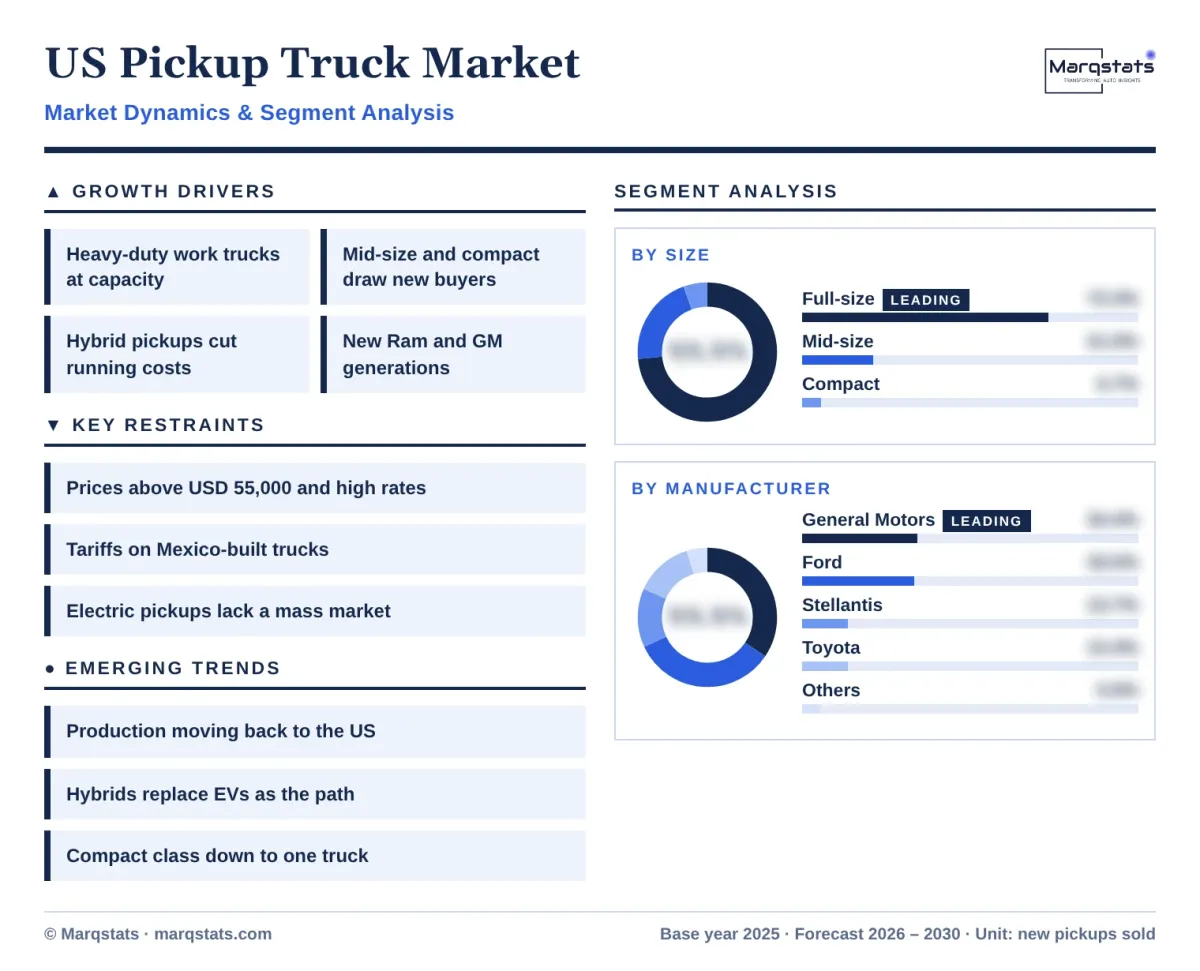
Full-size pickups are the dominant segment with 2,304,918 units in 2025, 73.27% of the US pickup truck market, after growth of 4.7%. The Ford F-Series (828,832), Chevrolet Silverado, GMC Sierra, Ram and Toyota Tundra (147,610) make up almost all of it, and the F-Series has been America's top-selling truck for 49 consecutive years. Heavy-duty 2500 and 3500 models are a profitable minority, with GM alone selling 324,250 heavy-duty Silverados and Sierras in 2025, and most diesel pickups for sale in the United States are heavy-duty versions of these trucks. The segment grew 4% in the third quarter of 2026 to 596,383 units, supported by the Hemi V8 return at Ram and GM's 2027 Silverado 1500, while affordability limits retail demand for mid-trim crew cabs.
Mid-size pickups sold 660,412 units in 2025, 20.99% of the market, after growth of 24.4%, making this the fastest-growing size segment. The Toyota Tacoma dominates with 274,638 units, up 42.4% after its redesign, followed by the Chevrolet Colorado (107,867), Ford Ranger (70,960, up 53.6%), Nissan Frontier (65,232), Jeep Gladiator (56,790, up 35%), Honda Ridgeline (48,448) and GMC Canyon (36,477). Third-quarter 2026 volume rose another 4.6% to 173,875 trucks. Mid-size trucks win buyers who need bed and towing capability without the price of a full-size crew cab, and they are the main conquest battleground between Toyota, GM, Ford and Stellantis.
Compact pickups sold 180,550 units in 2025, 5.74% of the market: 155,051 Ford Mavericks and 25,499 Hyundai Santa Cruz. With the Santa Cruz being discontinued, the segment is effectively the Maverick. Maverick sales rose 20.4% in the third quarter of 2026, and its hybrid version set a quarterly record of 27,793 units. The segment brings first-time truck buyers into the market at a starting price under USD 30,000, which makes it the most effective entry point for younger and urban buyers. Its main risk is tariff exposure, since the Maverick is assembled only in Hermosillo, Mexico.
General Motors sold 1,080,930 pickups in 2025, 34.36% of the market, across the Chevrolet Silverado, GMC Sierra, Chevrolet Colorado and GMC Canyon. GM reported 936,586 full-size Silverado and Sierra sales excluding medium-duty trucks, and has sold more full-size pickups than Ford for six consecutive years when the two brands are combined. Full-size trucks were 53% of GM's US deliveries in the third quarter of 2026, and heavy-duty demand is strong enough for a sixth production day at Flint. GM's redesigned 2027 Silverado 1500 arrives in late 2026, while its electric truck programme is on hold after the Factory Zero idling.
Ford Motor Company sold 1,054,843 pickups in 2025, 33.53% of the market: 828,832 F-Series, 155,051 Maverick and 70,960 Ranger. Ford sold 1,268,749 trucks and vans in total, up 9.5%, and leads the hybrid pickup market with record F-150 Hybrid and Maverick Hybrid sales. Ford's 226,011 Ranger and Maverick sales cut GM's overall pickup lead to 26,087 units, under one percentage point of the market. F-Series volume fell 9.5% in January to September 2026, and the end of F-150 Lightning production in its current form shifts Ford's electrification strategy toward hybrids.
Stellantis sold 430,849 pickups in 2025, 13.70% of the market, through Ram (374,059, flat on 2024) and the Jeep Gladiator (56,790, up 35%). Ram is the strongest grower in 2026, with third-quarter sales up 33.7% after the Hemi V8 returned, which shows how much powertrain choice matters to full-size buyers. Ram heavy-duty output from Saltillo carries tariff exposure, while Ram 1500 production in Sterling Heights does not. A new full-size generation from Ram is one of the conditions behind Marqstats' growth assumption from 2027.
Toyota sold 422,248 pickups in 2025, 13.42% of the market. Tacoma growth of 42.4% to 274,638 units offset a 7.5% fall in the Tundra to 147,610 units, where V6 engine recall issues weighed on buyer confidence. Toyota is the only Japanese maker with both mid-size and full-size pickups in the US, and sells both with i-FORCE MAX hybrid systems. Its USD 3.6 billion San Antonio expansion will move Tacoma production from Baja California to Texas over four years, cutting tariff exposure on its highest-volume pickup.
Nissan (Frontier, 65,232), Honda (Ridgeline, 48,448), Hyundai (Santa Cruz, 25,499) and other full-size nameplates (17,831) together hold 4.99% of the market. Nissan's Frontier rose 39.6% in January to September 2026, the strongest growth among these makers. Hyundai is ending the Santa Cruz and plans a body-on-frame mid-size pickup around 2029, while new entrants Slate Auto and Scout Motors target affordable electric and extended-range pickups later in the forecast period. These makers compete mainly in the mid-size and compact tiers rather than in full-size trucks.
By Geography
US-Assembled Nameplates
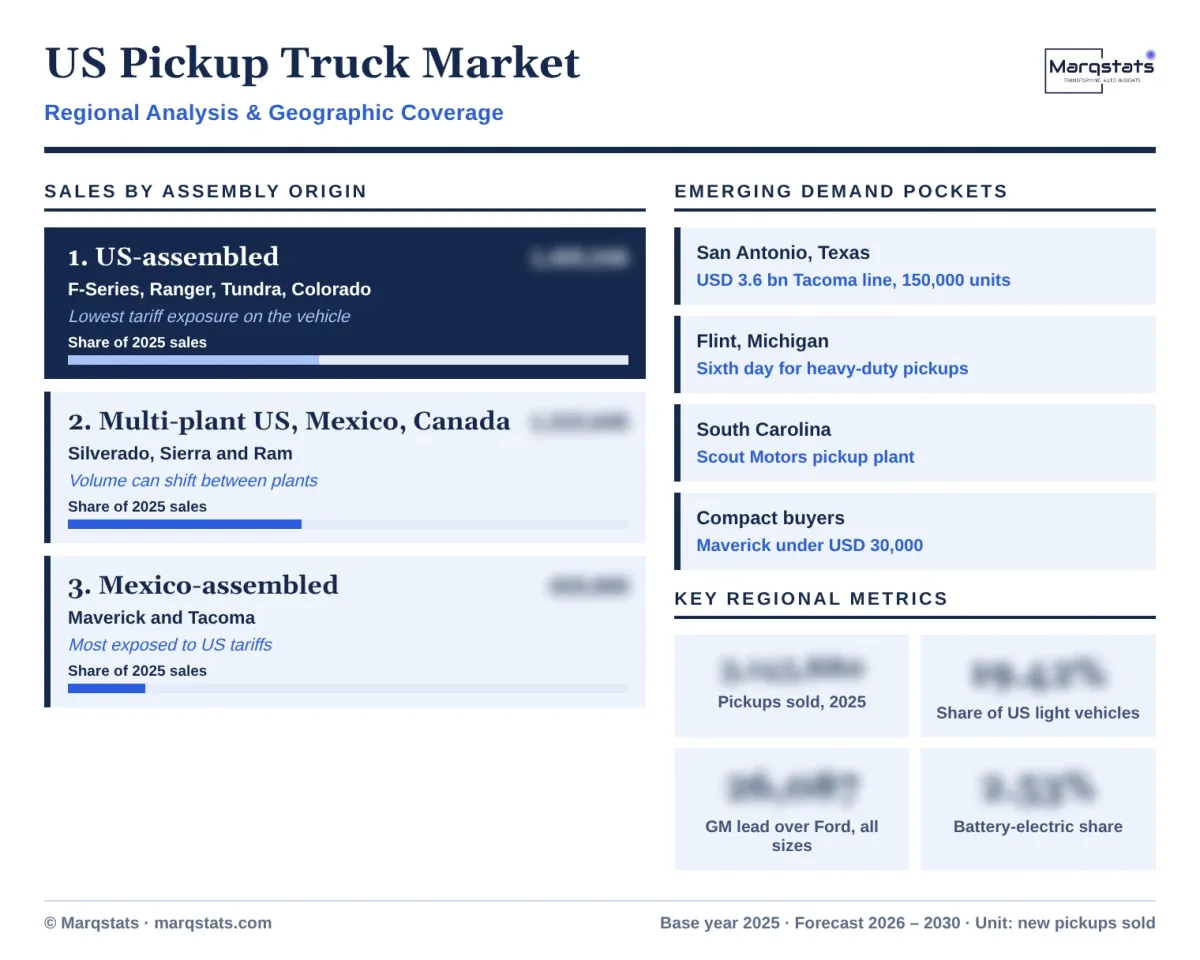
Nameplates assembled only in the United States sold 1,405,546 units in 2025, 44.68% of the market. They include the Ford F-Series (Dearborn, Kansas City, Kentucky and Ohio), Ford Ranger (Michigan), Toyota Tundra (Texas), Chevrolet Colorado and GMC Canyon (Missouri), Jeep Gladiator (Ohio), Nissan Frontier (Mississippi), Honda Ridgeline and Hyundai Santa Cruz (Alabama). These trucks carry the least tariff exposure on the finished vehicle, although imported parts still add cost. This group gains share through 2030 as Toyota moves Tacoma output to San Antonio, and its plants anchor the frame, axle and towing system supply base in the Midwest and South.
Multi-Plant US, Mexico and Canada Sourcing
Nameplates built across plants in the United States, Mexico and Canada sold 1,310,645 units, 41.66% of the market. Silverado and Sierra are built in Fort Wayne, Flint, Silao and Oshawa, and Ram pickups in Sterling Heights and Saltillo. Makers can shift volume between plants, and GM added a sixth production day at Flint in 2026 to meet heavy-duty pickup demand. This group has the most flexibility under tariffs, since a maker can rebalance production between plants within weeks, while a single-plant nameplate needs years and a new line to move.
Mexico-Assembled Nameplates
Nameplates assembled only in Mexico sold 429,689 units, 13.66% of the market: the Ford Maverick from Hermosillo and the Toyota Tacoma from Baja California and Guanajuato. These are the trucks most exposed to US tariffs on vehicles that do not meet trade-agreement content rules. Toyota's San Antonio expansion will move part of Tacoma output to Texas by about 2030, while Ford has not announced a US line for the Maverick, so its exposure remains the largest single tariff question in the compact class. Marqstats expects the Mexico-only share to fall from its 2025 level by the end of the forecast period.
How Competition Is Evolving
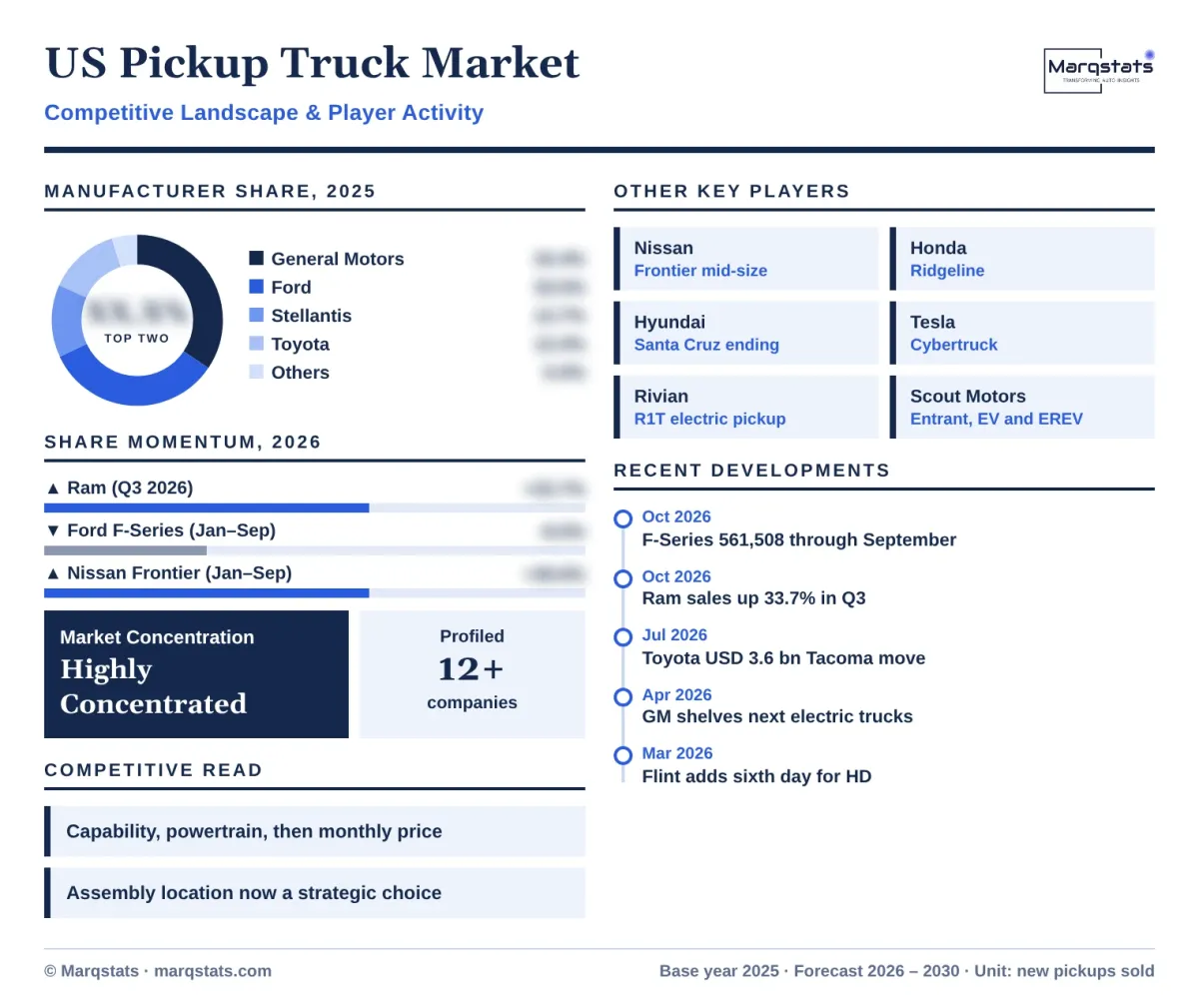
The US pickup market is highly concentrated. General Motors (34.36%) and Ford (33.53%) held a combined 67.89% of 2025 sales, and Stellantis and Toyota bring the top four to 95.01%. The order at the top is contested: GM leads on combined full-size trucks, Ford leads on the single best-selling nameplate, and the gap across all sizes is only 26,087 units.
Makers compete on capability, powertrain choice and price per month. Towing, payload and cab configuration decide the heavy-duty sale; hybrid systems and fuel economy now decide many light-duty sales; and incentives and financing decide the rest. In 2026 Ram's return to a V8, GM's new Silverado generation and Ford's hybrid lead are the main competitive moves.
The structural contest is over where trucks are built. Ford builds all F-Series pickups in the United States, while the Maverick and Tacoma come from Mexico and GM and Ram split output across the border. Tariffs reward US assembly, and Toyota's USD 3.6 billion Texas investment is the clearest response so far. New entrants Scout Motors and Slate Auto have not yet sold trucks and are not part of the 2025 share base.
Fleet and commercial demand gives the market a floor that retail data hides. Contractors, utilities, rental companies and government buyers take a large share of heavy-duty and regular-cab trucks, and GM's decision to add a Saturday shift at Flint for heavy-duty pickups shows that work-truck demand stayed firm through 2026 even as retail buyers faced high payments. Makers with large commercial channels, such as Ford Pro, can hold volume when retail incentives tighten. That is also why the heavy-duty segment is the most profitable part of the pickup business: work trucks are bought on capability and uptime, and buyers pay for diesel engines, high towing ratings and upfit-ready chassis.
Companies Covered
Companies covered in the report include:
Recent Market Activity
Table of Contents
Coverage & Segmentation
The study covers new pickup truck sales in the United States: compact, mid-size and full-size pickups, including heavy-duty 2500 and 3500 models, across gasoline, diesel, hybrid and battery-electric powertrains. Medium-duty chassis cabs are excluded where reported separately. The base year is 2025, the historical period 2021 – 2025 and the forecast period 2026 – 2030. The unit is new vehicles sold, as reported by manufacturers.
Three size classes and five manufacturer groups are covered, and sales are split by assembly origin into three groups. Twelve companies are profiled, including two announced entrants. Manufacturer-reported model sales are the primary series; the 2026 estimate and the 2027-2030 forecast are Marqstats constructions. The assembly-origin grouping replaces a geographic regional split, because the trade-exposure question matters more to pickup makers and suppliers than state-level demand, and manufacturers do not publish new pickup sales by state.
Two counting choices affect the published figures. Ford's F-Series total covers the F-150 through the F-450 and includes the F-150 Lightning, while GM reports the Silverado and Sierra as separate nameplates whose combined total is 944,927 including medium-duty and electric versions, or 936,586 excluding medium-duty trucks. Marqstats uses the higher, full-size-compiled figure so that the segment total and the brand figures sum on one basis. Electric pickup counts are model-level manufacturer figures; the Hummer EV pickup is estimated as one-third of combined Hummer EV pickup and SUV sales, because the maker does not split the two.
