Market Snapshot
The Japan passenger car market, the domestic Japan car market for new registered and kei passenger cars, stands at 3,836,380 new passenger cars sold in Japan in 2025 and is estimated at 3,913,100 units in 2026. Marqstats forecasts it to reach 3,758,620 units by 2030, a CAGR of -0.41% over 2026 – 2030 that adds -77,760 units between 2025 and 2030. Japan car sales are reported by JADA and the Japan Light Motor Vehicle and Motorcycle Association.
Kanto (Greater Tokyo) is the largest market, Battery Electric Vehicles is the fastest growing and Registered Passenger Cars is the dominant segment, in a market that is highly concentrated. The report covers 9 segments and 4 regions and profiles 15 companies, with 2025 as the base year, history from 2021 – 2025 and a forecast for 2026 – 2030.
Key Takeaways
Market Overview & Analysis
Report Summary
The Japan passenger car market covers new passenger cars sold in Japan, including registered cars above the kei class and kei passenger cars, which are limited to 660 cc engines and small dimensions; trucks, buses and kei commercial vehicles are excluded. Japan car sales of passenger cars reached 3,836,380 units in 2025, up 3.0%, including 1,302,857 kei passenger cars, according to the Japan Automobile Dealers Association (JADA) and the Japan Light Motor Vehicle and Motorcycle Association. Marqstats estimates 3,913,100 units in 2026 and forecasts 3,758,620 by 2030, a CAGR of -0.41% over 2026 – 2030, a decline of 77,760 units from 2025.
The market splits into two different segments. Registered passenger cars, about 2,533,523 units or 66.04%, are dominated by Toyota and are mostly hybrids. Kei passenger cars, 33.96%, are dominated by Suzuki, Daihatsu and Honda and sold mainly outside the big cities, where about 76% of kei car sales took place in fiscal 2025. Kei cars carried 2025 growth, rising 8.4% as Daihatsu recovered 46.2% from its 2024 certification scandal, while registered car sales were broadly flat.
2026 has been stronger: total new vehicle sales rose 1.8% in the first half to 2,387,189, and by September the market had grown year on year for six consecutive months, supported by vehicle tax cuts, order backlogs and new launches. Japan's EV boom is a subsidy boom: EV sales rose 2.5 times to 70,273 in April to September 2026, about 3.7% of passenger car sales, before the ¥110 billion programme closed on 20 November 2026 ahead of a 40% cut in the base maximum EV subsidy from January 2027.
Marqstats forecasts -2.0% in 2027 as the subsidy cut pulls EV demand into 2026, then -1.0%, -0.5% and -0.5% a year. Japan's population is shrinking and ageing, younger urban residents are less likely to own cars and vehicles are kept longer; new models, kei EVs and replacement demand slow the decline without reversing it. This report uses calendar years; on a fiscal basis, new vehicle sales fell 0.9% to 4,533,782 in the year to March 2026.
Market Dynamics
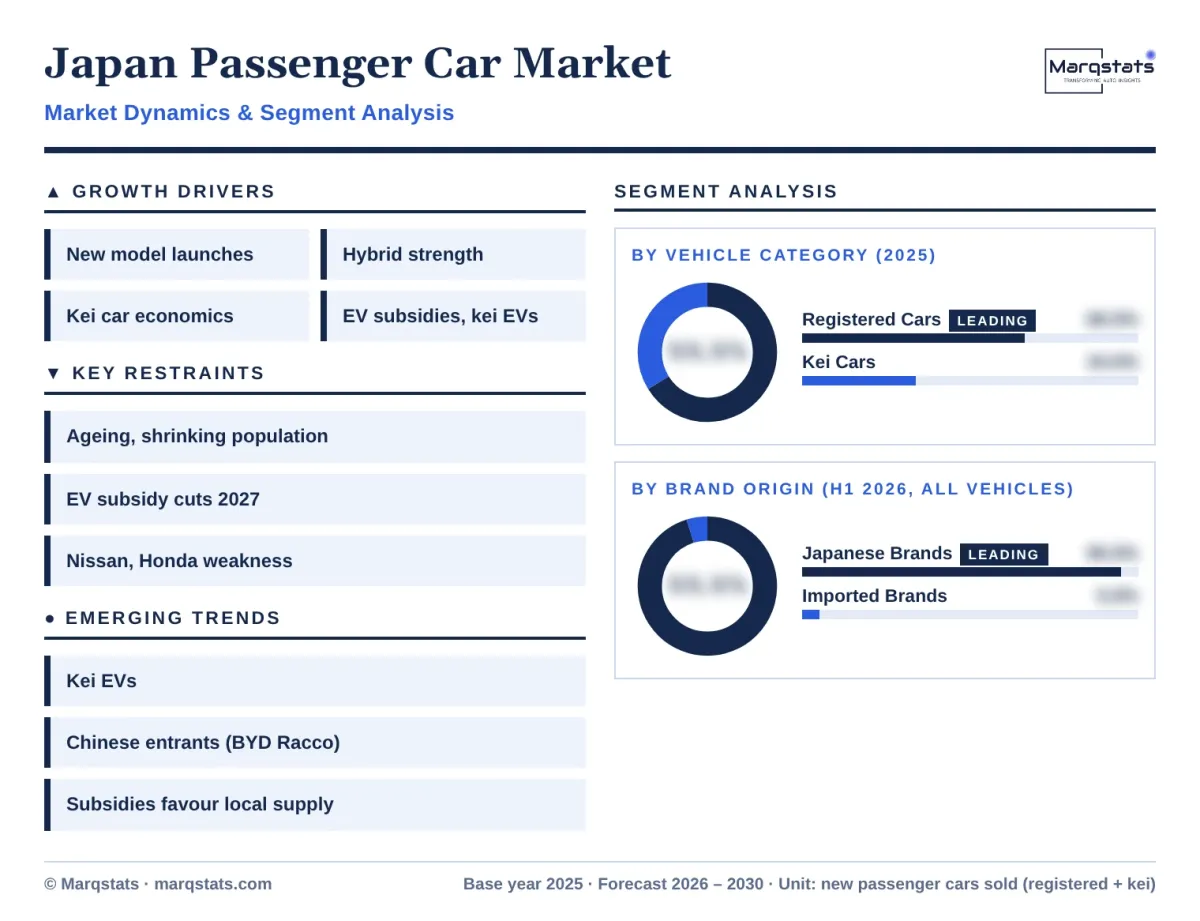
Key Drivers
- New model launches: Japanese buyers respond quickly to new models and full model changes, so a single popular launch can lift a brand by tens of thousands of units, as the new Daihatsu Move did in 2025. New kei models from Daihatsu and Suzuki lifted 2025 and 2026 sales, and first-half 2026 sales rose 1.8% on new model demand, with sales up 9.1% in April and 6.8% in July. Years with few major launches can look weak even when underlying demand is stable, so model cycles drive much of the annual variation.
- Hybrid strength: Hybrids took about 35.6% of passenger car registrations in 2024 and about 33.8% in the first half of 2025, keeping Japanese brands dominant and giving buyers fuel savings without charging. Toyota supplied the five top-selling registered models in the first half of 2026, led by the Yaris and Sienta. Hybrid prices are close to those of comparable petrol cars, which removes the main barrier to adoption, and hybrid content supports a weighted average new passenger car price of about ¥3.29 million in the first half of 2025.
- Kei car economics: Kei passenger cars rose 8.4% in 2025 to 1,302,857 because of low taxes, insurance and running costs, and remain essential in regional areas with poor public transport. Including kei commercial vehicles, kei sales were 1,667,360 in 2025, up 7.0%, about 37% of all new vehicles. The Honda N-Box was Japan's top-selling vehicle for the 11th year in a row in 2025, with 201,354 units, showing how central kei cars are to the market.
- EV subsidies and new kei EVs: After a revision tied to the US-Japan trade agreement, METI raised the EV subsidy ceiling to up to ¥1.3 million and scored models on supply stability, servicing and charging support, helping EV sales rise 2.5 times in April to September 2026. Kei EVs such as the Nissan Sakura, Honda N-ONE e: and BYD Racco widen the choice. BYD launched the Racco at ¥2.145 million in July 2026 and drew more than 1,000 orders in two weeks, against a target of 10,000 by year-end.
- Tax changes: Vehicle tax cuts supported sales in 2026, and the government abolished the environmental performance levy on car purchases on 31 March 2026 and plans a system based on weight and environmental performance. A lighter tax burden at purchase supports sales of registered cars in particular, where taxes are higher than for kei cars. Japan's large, efficient used car market also supports trade-in values, making it easier for buyers to replace cars.
Key Restraints
- Ageing and shrinking population: Japan's population decline reduces the number of new drivers and households, older drivers often give up their cars and younger urban residents are less likely to own one. Japanese owners also keep their vehicles longer than in the past, which lowers replacement demand each year. These structural factors are the main reason Marqstats forecasts a decline from 2027, with the fastest contraction in regional areas where ageing is most advanced.
- EV subsidy cuts: From January 2027 the maximum subsidy for battery electric cars falls from ¥1.25 million to ¥750,000, for kei EVs from ¥550,000 to ¥440,000 and for plug-in hybrids from ¥800,000 to ¥480,000. The ¥110 billion programme closed to applications on 20 November 2026. The pattern mirrors the US in 2025, when the end of tax credits pulled EV demand forward and then cut it; Japan's cut is smaller, so Marqstats expects EV growth to stall in 2027 rather than collapse.
- Weakness at Nissan and Honda: Nissan's domestic sales fell 15.2% in 2025 during restructuring and Honda's fell 7.3% on weak demand for its passenger cars, reducing model supply and dealer activity at two major brands. Weak line-ups at two of the largest brands leave fewer fresh models to attract buyers, which slows the overall market. Toyota's 4.1% growth in 2025 offset part of the decline and increased concentration.
- Charging infrastructure and housing constraints: Many urban residents live in apartments without private parking or chargers, which kept battery electric vehicles at 1.6% of registered passenger cars in 2025. Surveys show high EV scepticism among Japanese consumers, with charging time, battery durability and range as the main concerns. Without wider charging access in cities, EV adoption depends on kei EVs in regional homes with private parking rather than on urban buyers.
Key Trends
- Kei EVs: The Nissan Sakura, Japan's top-selling EV with 14,093 deliveries in 2025, now competes with the Honda N-ONE e: and the BYD Racco, which BYD calls the first electric kei car from an overseas brand designed for Japan. Suzuki plans a kei EV in fiscal 2026 and Honda plans an N-BOX EV in 2028. Short daily trips and home charging in houses with private parking match kei EV range well, making the kei class the most promising entry point for battery electric vehicles.
- Chinese and Korean entrants: BYD entered the kei segment with the Racco in July 2026, after selling just over 7,400 vehicles in Japan from 2023 to 2025, and Hyundai continues to sell EVs online. About 40% of BYD's stores are in the Tokyo metropolitan area. Chinese and Korean brands together still hold well under 1% of the market, so their impact is on pricing and product expectations rather than volume.
- Subsidy policy favouring established supply chains: Revised rules in 2026 scored supply stability, servicing and charging support, giving the Toyota bZ4X, Honda EVs and Tesla models up to ¥1.3 million while BYD's Atto 3, Seal and Dolphin were cut to ¥150,000. The policy favours brands with domestic service networks and has slowed BYD's registered-car sales, pushing it toward the kei segment where its price point competes directly with domestic models.
- Shift in EV leadership: Toyota overtook Nissan as Japan's top-selling EV brand in the fourth quarter of 2025, ending Nissan's lead of nearly 15 years, as the bZ4X sold well. Honda's N-ONE e: kei EV also contributed to rising EV sales in late 2025. Domestic carmakers are now competing actively for EV buyers, although hybrids remain their main electrified offer, and 2027 sees unusual swings in the powertrain mix as kei EV launches meet a reduced subsidy.
Market Segmentation
Registered passenger cars, above the kei class, sold about 2,533,523 units in 2025, 66.04% of the market, broadly flat on 2024. Toyota leads, with the Yaris, Sienta and Corolla among the top sellers, and most are hybrids. Registered cars carry higher purchase and ownership taxes than kei cars, so they benefit most from the abolition of the environmental performance levy in March 2026. Urban buyers, imported brands and most EVs sit in this category, and Nissan's and Honda's weakness in 2025 was concentrated here.
Kei passenger cars sold 1,302,857 units in 2025, 33.96% of the market, up 8.4%. Suzuki, Daihatsu and Honda hold about 80% of the segment, and the Honda N-Box is the top-selling model. Kei cars must be shorter than 3.4 metres, narrower than 1.48 metres and have engines of no more than 660 cc, and in return they pay lower taxes and face simpler parking rules. They are the first car for many young and rural buyers, and kei EVs are a growing niche.
Petrol cars, mostly kei cars and small registered cars, remain a large share and have been falling as hybrids grow; internal combustion models fell below half of registered passenger cars in 2023. Petrol keeps its strongest position in the kei segment, where low purchase price matters more than fuel savings and hybrid systems add proportionally more cost. As kei EVs and mild hybrids spread, petrol's share continues to decline through 2030.
Hybrids are the largest electrified segment, with about 35.6% of passenger car registrations in 2024 and about 33.8% in the first half of 2025, led by Toyota. They save fuel without changing driving habits and cost little more than petrol cars, which is why Japan's carmakers built their strategy on them. Hybrid systems, along with safety equipment and higher material costs, push average prices up, and they remain the default electrified choice after the 2027 EV subsidy cut.
Battery electric vehicles were 1.6% of registered passenger cars in 2025 and are the fastest-growing segment in 2026, with sales of 70,273 in April to September, 2.5 times the previous year, helped by higher subsidies and new kei EVs. The Nissan Sakura, Toyota bZ4X, Honda N-ONE e: and BYD Racco are the main models. Marqstats expects EV growth to stall in 2027 as base subsidies fall by 40%, with kei EVs holding up better than registered EVs.
Plug-in hybrids, fuel cell vehicles and diesels make up a small share of the market. Plug-in hybrid subsidies fall from ¥800,000 to ¥480,000 from January 2027, which weakens their price position against conventional hybrids. Diesel survives mainly in larger SUVs and some imported models, and fuel cell vehicles remain a niche tied to limited hydrogen refuelling. This group is unlikely to gain share before 2030.
Japanese brands hold about 95% of the market, led by Toyota, Suzuki, Honda and Daihatsu. Their dealer networks, largely brand-exclusive, reach every region, and their hybrid and kei line-ups match local tax rules and buyer preferences closely. Toyota, including Lexus, is the largest brand by a wide margin and gained share in 2025, while its subsidiary Daihatsu added kei volume to the group. Nissan, Mazda, Subaru and Mitsubishi Motors are smaller.
Imported brands, led by Mercedes-Benz, BMW and Volkswagen, made up almost 5% of total vehicle sales in the first half of 2026, with sales down 3.5% to 117,989. Their buyers are concentrated in the Tokyo area and other large cities, where premium imports compete with Lexus. Imported brands benefit less from kei-focused tax structures, and their share has been broadly stable as domestic hybrids dominate the mass market.
BYD and Hyundai are small and growing, together holding well under 1% of the market. BYD targets 10,000 Racco orders by the end of 2026, while subsidy rules that cut support for its registered models to ¥150,000 have limited its other sales. Hyundai sells EVs online. These brands influence pricing and product expectations, particularly in kei EVs, more than they add volume in the forecast period.
By Geography
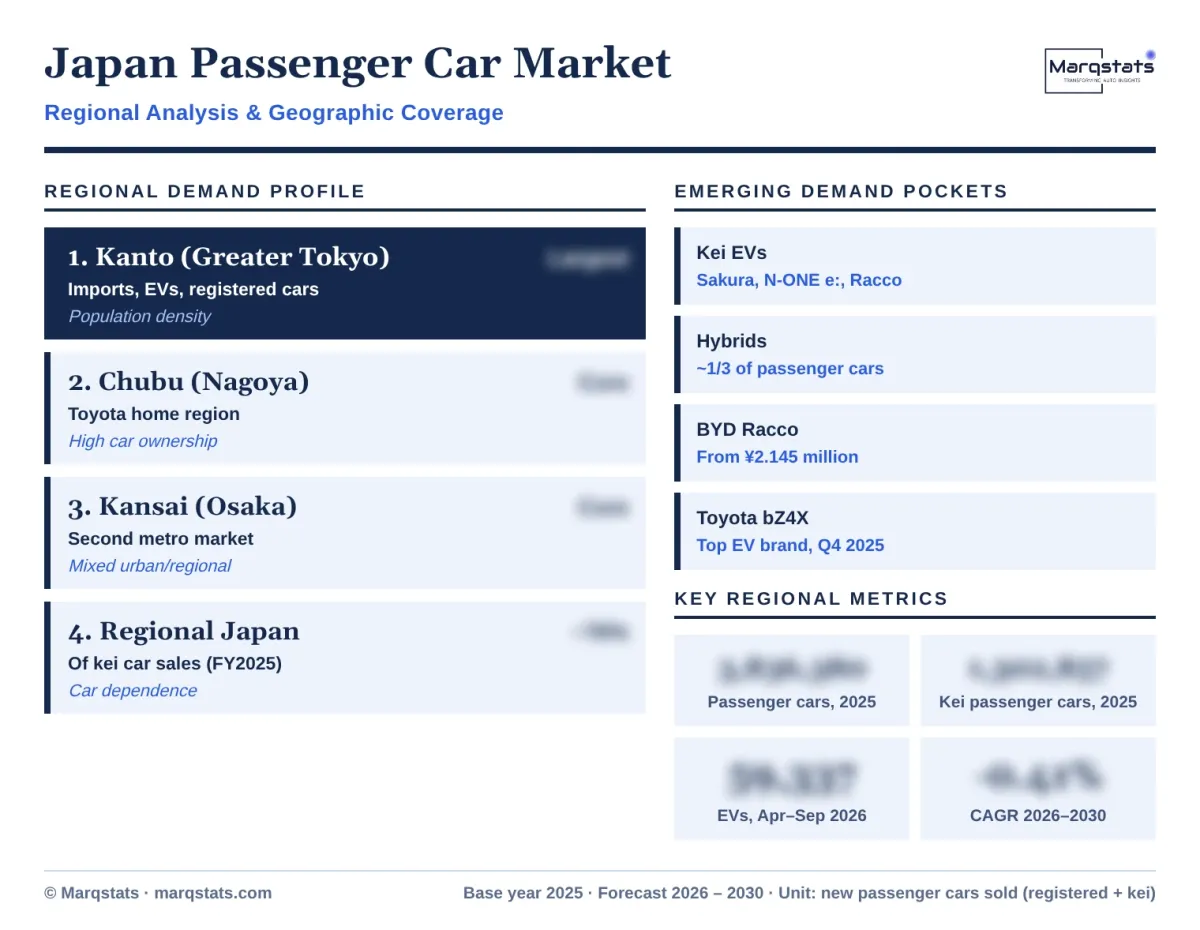
Kanto (Greater Tokyo)
Kanto is the largest market by volume, with the biggest population and the highest share of registered cars, imported brands and EVs. About 40% of BYD's stores are in the Tokyo metropolitan area. Car ownership per household is lower than elsewhere because of public transport and parking costs, and car sharing and subscription services are most developed in Tokyo, which further reduces private ownership among younger residents. Apartment living limits home charging and EV adoption.
Chubu (Nagoya)
Chubu, home to Toyota, has high car ownership and strong demand for both registered and kei cars, supported by manufacturing employment and limited public transport outside Nagoya. Toyota's dense dealer network and its hybrid line-up give it a particularly strong position in the region. Households often own more than one vehicle, and replacement demand is supported by stable industrial incomes.
Kansai (Osaka)
Kansai is the second-largest metropolitan market, with a mix similar to Kanto in Osaka, Kyoto and Kobe, while its surrounding prefectures behave more like regional markets with higher kei shares. Imported brands and registered hybrids sell well in the cities, and kei cars dominate in rural parts of the region. Kansai's trend follows the national pattern of slow decline offset by model launches.
Regional Japan
Regional areas outside the big cities account for about 76% of kei car sales and have the highest car dependence, with households often owning two or more vehicles. Ageing and population decline are fastest here, which makes regional demand the main source of the long-term decline. Regional dealers rely heavily on kei cars and older customers and are consolidating. Kei EVs suit these areas, where most households have private parking for a charger and daily trips are short.
How Competition Is Evolving
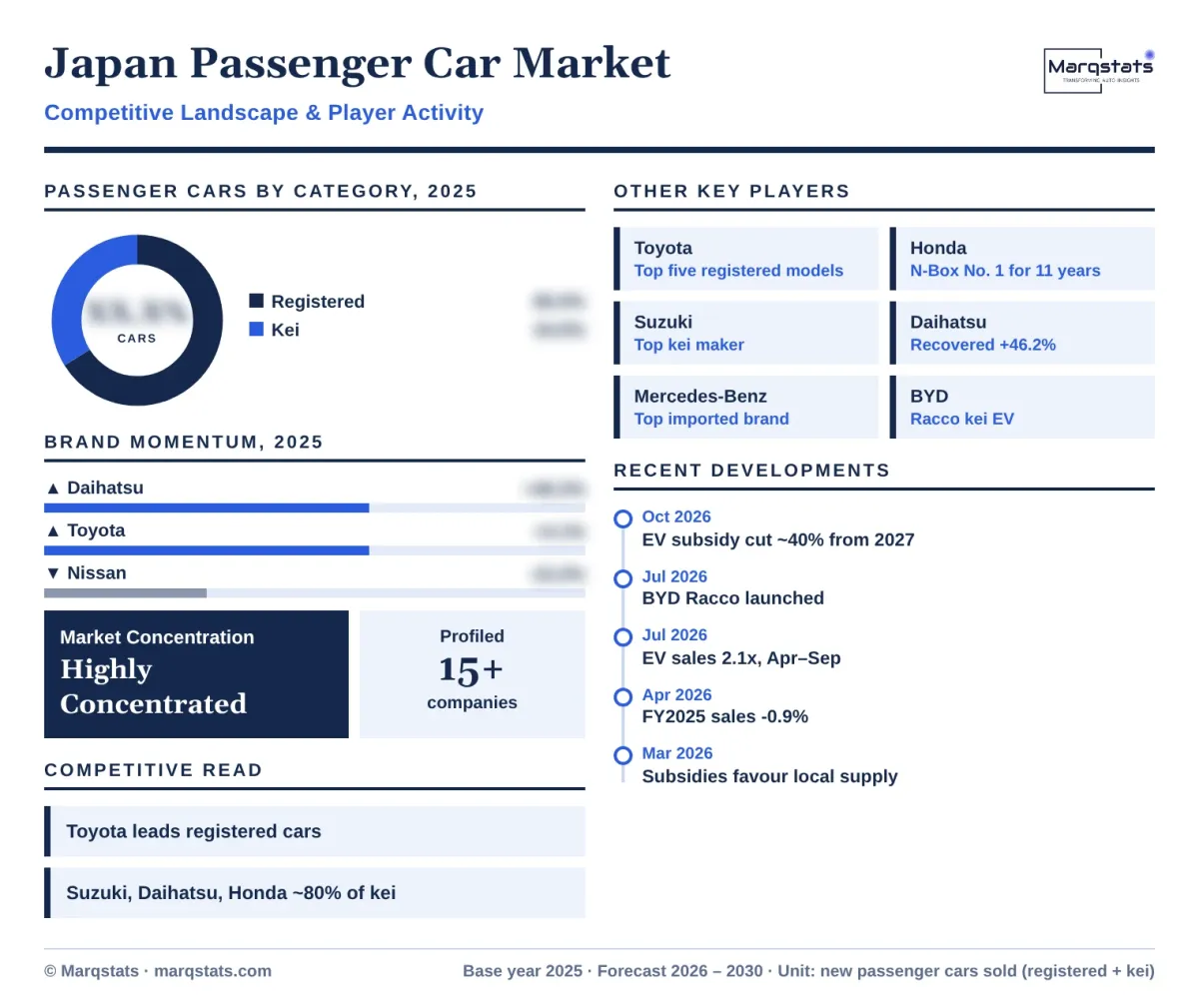
The Japan passenger car market is highly concentrated. Toyota, including Lexus, is the largest brand by a wide margin and gained share in 2025, followed by Suzuki, Honda and Daihatsu, with Nissan, Mazda, Subaru and Mitsubishi Motors smaller. In kei cars, Suzuki, Daihatsu and Honda hold about 80% of the segment. Marqstats does not publish brand shares on the page because brand totals mix passenger and commercial vehicles.
Toyota's lead rests on hybrids and breadth. It supplied the five best-selling registered models in the first half of 2026, led by the Yaris and Sienta, and overtook Nissan as the top EV brand in the fourth quarter of 2025. Its subsidiary Daihatsu recovered strongly in 2025 after its certification scandal, adding kei volume to the group. Car prices in Japan have risen with hybrid content and safety equipment, which favours makers with the widest model ranges.
Nissan and Honda are under pressure. Nissan's domestic sales fell 15.2% in 2025 during restructuring, and its EV sales fell as the Leaf and Sakura weakened late in the year. Honda fell 7.3% on weak passenger car demand, though the N-Box remained the best-selling vehicle. Both rely heavily on kei cars at home. Nissan's EV pioneer status, built on the Leaf and the Sakura, did not protect it in 2025, as rivals launched new EVs and its domestic line-up aged.
Imports and new entrants compete at the margins. Mercedes-Benz is the best-selling imported brand, followed by BMW, while Volkswagen sales fell by about a fifth in the first half of 2026. BYD is the most active new entrant, with the Racco kei EV and the Atto 3, but subsidy rules that score supply stability and servicing limit its price advantage.
Competition in the next five years will centre on three battlegrounds: kei EVs, where Nissan, Honda, Suzuki and BYD will compete directly; compact hybrids, where Toyota defends its lead against Honda and Nissan; and premium imports, where German brands face falling volumes and new Chinese entrants. A shrinking market means share gains will come mainly at the expense of rivals rather than from market growth.
Companies Covered
Companies covered in the report include:
Recent Market Activity
Table of Contents
Coverage & Segmentation
The study covers new passenger cars sold in Japan, including registered passenger cars and kei passenger cars. The base year is 2025 (calendar year), the historical period 2021 – 2025 and the forecast period 2026 – 2030. The unit is new passenger cars sold or registered. Trucks, buses and kei commercial vehicles are excluded.
Nine segments across three dimensions and four regions are covered, and 15 companies are profiled. The 2025 figure comes from JADA and the Japan Light Motor Vehicle and Motorcycle Association data as reported. The 2026 estimate and the 2027 to 2030 forecast are Marqstats constructions.
Known limits are stated plainly. Powertrain shares are taken from the latest published periods, 2024 and the first half of 2025, rather than full-year 2025; regional figures are qualitative except for the kei regional share; and brand shares are not shown because brand totals include commercial vehicles.
