Market Snapshot
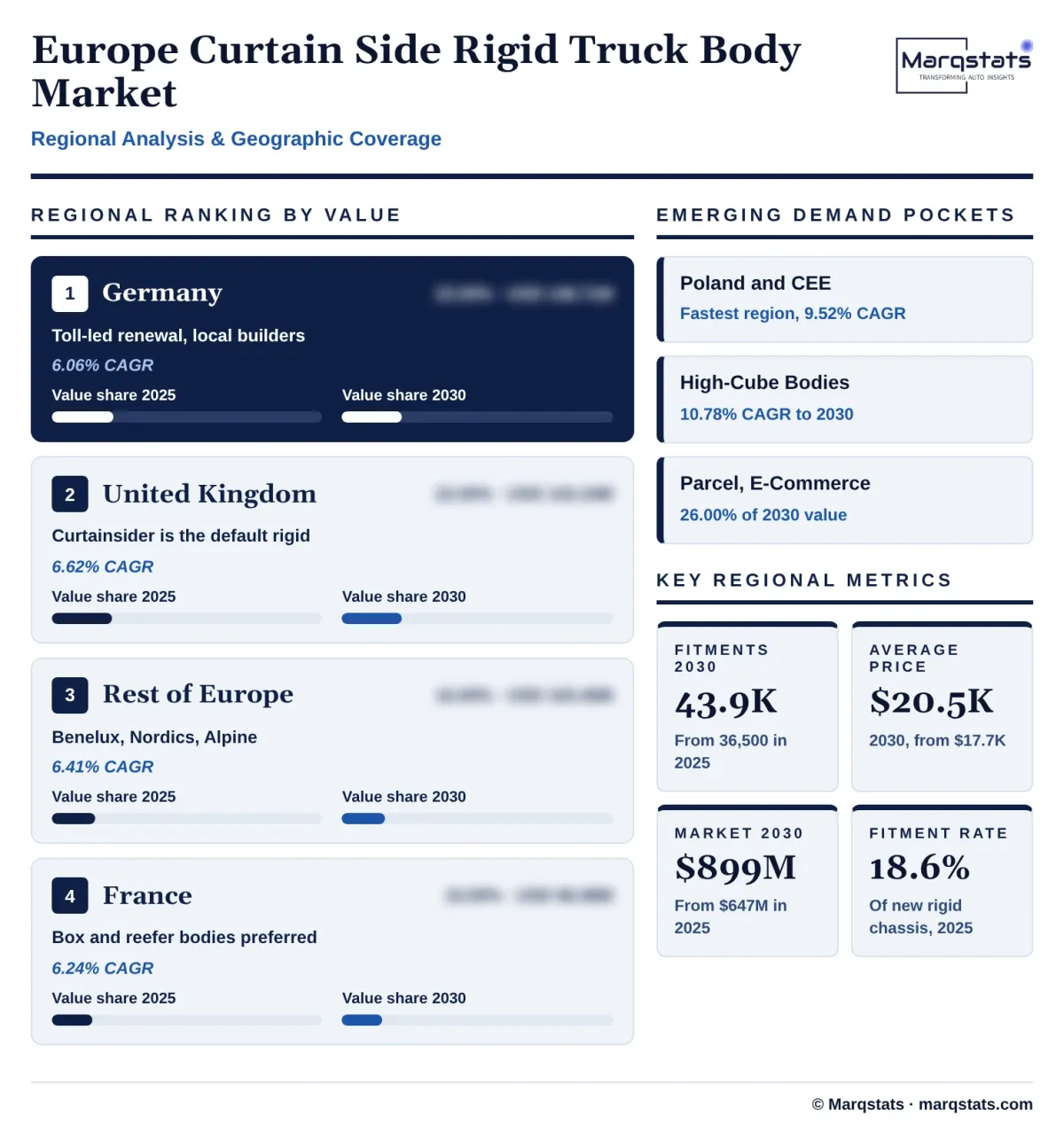
The Europe curtain side rigid truck body market size is estimated at USD 646.54 million in 2025 and is projected to reach USD 898.91 million by 2030, growing at a CAGR of 6.81% over 2026 – 2030. Annual fitments rise from about 36,500 to 43,900 bodies, a 3.76% annual rate, while the average ex-factory price per body climbs from about USD 17,713 to USD 20,476 as lighter, certified and high-cube specifications gain share.
Marqstats defines the market as the ex-factory value of new curtain-side bodies mounted on new rigid truck chassis above 3.5 tonnes gross vehicle weight in the 27 European Union member states, the United Kingdom, Norway, Switzerland and Iceland. A body has fixed front and rear structure, sliding side curtains on roof rails and a roof that is fixed, sliding or lifting. Curtain-sided trailers, box and refrigerated bodies, flatbeds with tarpaulins, bodies for vans up to 3.5 tonnes and aftermarket curtain replacement are excluded.
Heavy rigid bodies for chassis above 16 tonnes account for 77.48% of 2025 value, standard curtain-side designs for 74.00% and retail, grocery and FMCG distribution for 36.00%. Germany accounts for 23.00% of value, while Poland and Central and Eastern Europe grow fastest at 9.52% a year as Central European hauliers and bodybuilders expand.
Key Takeaways
Market Overview & Analysis
Report Summary
Marqstats sizes the Europe curtain side rigid truck body market as the ex-factory value of new curtain-side bodies fitted to new rigid truck chassis above 3.5 tonnes. It counts bodies for medium chassis of 3.5 to 16 tonnes, such as the Mercedes-Benz Atego, MAN TGL and TGM and DAF LF, and for heavy chassis above 16 tonnes, such as the DAF CF and XF rigids, Volvo FE and FM, Scania P and G series and Mercedes-Benz Actros rigids. Value is counted at the bodybuilder gate in US dollars at EUR 1 = USD 1.13, before chassis cost, dealer margin and value-added tax.
The market sits between three larger pools of demand. Chassis demand is set by registrations of trucks above 3.5 tonnes: ACEA reported 307,460 new trucks in the European Union in 2025, down 6.2%, with heavy trucks down 5.4% and medium trucks down 9.9%, and the Society of Motor Manufacturers and Traders (SMMT) reported 40,504 new heavy goods vehicles in the United Kingdom, down 10% from 44,988. Marqstats estimates about 372,000 trucks above 3.5 tonnes were registered across the EU, the United Kingdom and EFTA in 2025, of which about 196,000, or 52.69%, were rigid chassis.
Rigid trucks fell harder than tractors in 2025. SMMT reported United Kingdom rigid registrations down 14.1%, against articulated vehicles down 4.3%, with rigids above 16 tonnes down 12.4% and rigids of 6 to 16 tonnes down 17.3%. In Germany, the Kraftfahrt-Bundesamt (KBA) recorded 15,812 new trucks of 6 to 16 tonnes and 53,145 above 16 tonnes in 2025, and total commercial vehicle registrations of 350,122. Marqstats estimates curtain-side fitments fell 7.83% to 36,500 bodies in 2025, and market value fell 8.28% to USD 646.54 million.
The market grew from an estimated USD 574.08 million in 2021, on 36,800 bodies, to USD 580.80 million in 2022, when chassis shortages held back fitments but body prices rose with steel and aluminium. It peaked at USD 715.75 million in 2023, when delayed chassis deliveries cleared, then eased to USD 704.88 million in 2024 and USD 646.54 million in 2025. Value in 2025 was 12.62% above 2021 on 0.82% fewer bodies, because the average price per body rose from about USD 15,600 to USD 17,713.
This study covers one body type on one chassis class and must not be added to other Marqstats studies. The Global Curtain Sider Trailer Market covers curtain-sided semi-trailers and drawbar trailers and excludes rigid bodies. The Europe LCV Body Conversion Market covers conversions of vehicles up to 3.5 tonnes, and the Europe Electric Medium and Heavy-Duty Truck Market sizes electric trucks above 3.5 tonnes in the EU27 as vehicles, not bodies. Chassis-cab value is outside the scope.
Europe Curtain Side Rigid Truck Body Market Size and Forecast
The Europe curtain side rigid truck body market grows from USD 646.54 million in 2025 to USD 898.91 million in 2030, a CAGR of 6.81%, equal to EUR 572.16 million rising to EUR 795.50 million at EUR 1 = USD 1.13. Volume contributes 3.76% a year, from about 36,500 to 43,900 bodies, and the average price per body contributes 2.94% a year, from about USD 17,713 to USD 20,476.
The 2025 value is built bottom-up from chassis, fitment rates and body prices. Marqstats estimates about 76,000 medium rigid chassis of 3.5 to 16 tonnes and 120,000 heavy rigid chassis above 16 tonnes were registered in 2025. Curtain-side bodies were fitted to 14.74% of medium chassis, 11,200 units, and 21.08% of heavy chassis, 25,300 units. The ex-factory price is about USD 13,000 (EUR 11,504) for a medium body and USD 19,800 (EUR 17,522) for a heavy body with a sliding roof and Code XL structure, which is about 60% of the EUR 28,400 to EUR 29,200 list price of a standard 13.6 metre curtainsider semi-trailer advertised in Poland in 2026.
The forecast follows chassis demand with a lag. Marqstats expects fitments to rise 3.42% in 2026 to 37,750, then 3.84% in 2027, 4.08% in 2028, 3.80% in 2029 and 3.66% in 2030, because medium rigid registrations were still weak in the first nine months of 2026 and replacement of the 2021 to 2023 bodies builds from 2027. Market value reaches USD 689.08 million in 2026, USD 736.30 million in 2027, USD 788.55 million in 2028 and USD 842.49 million in 2029.
Price growth is gradual. The average price per body rises 2.94% a year as lighter aluminium and composite structures, Code XL certified side walls, lifting roofs and body telematics take a larger share. Medium bodies are expected to rise from USD 13,000 to USD 14,900 and heavy bodies from USD 19,800 to USD 22,900. A decline in the 2025 average price of 0.49% reflects discounting by makers into weak order books and a heavier mix of medium bodies in the lost volume.
Marqstats tracks four indicators to monitor the forecast: monthly registrations of rigid trucks of 6 to 16 tonnes and above 16 tonnes in Germany, the United Kingdom, France, Spain and Italy; order intake and margins of the largest bodybuilders and trailer groups; the share of electric chassis in medium rigid registrations; and steel and aluminium prices that move body costs.
Market Dynamics
Key Drivers
Five forces support orders for curtain-side bodies as fleets renew after two weak years.
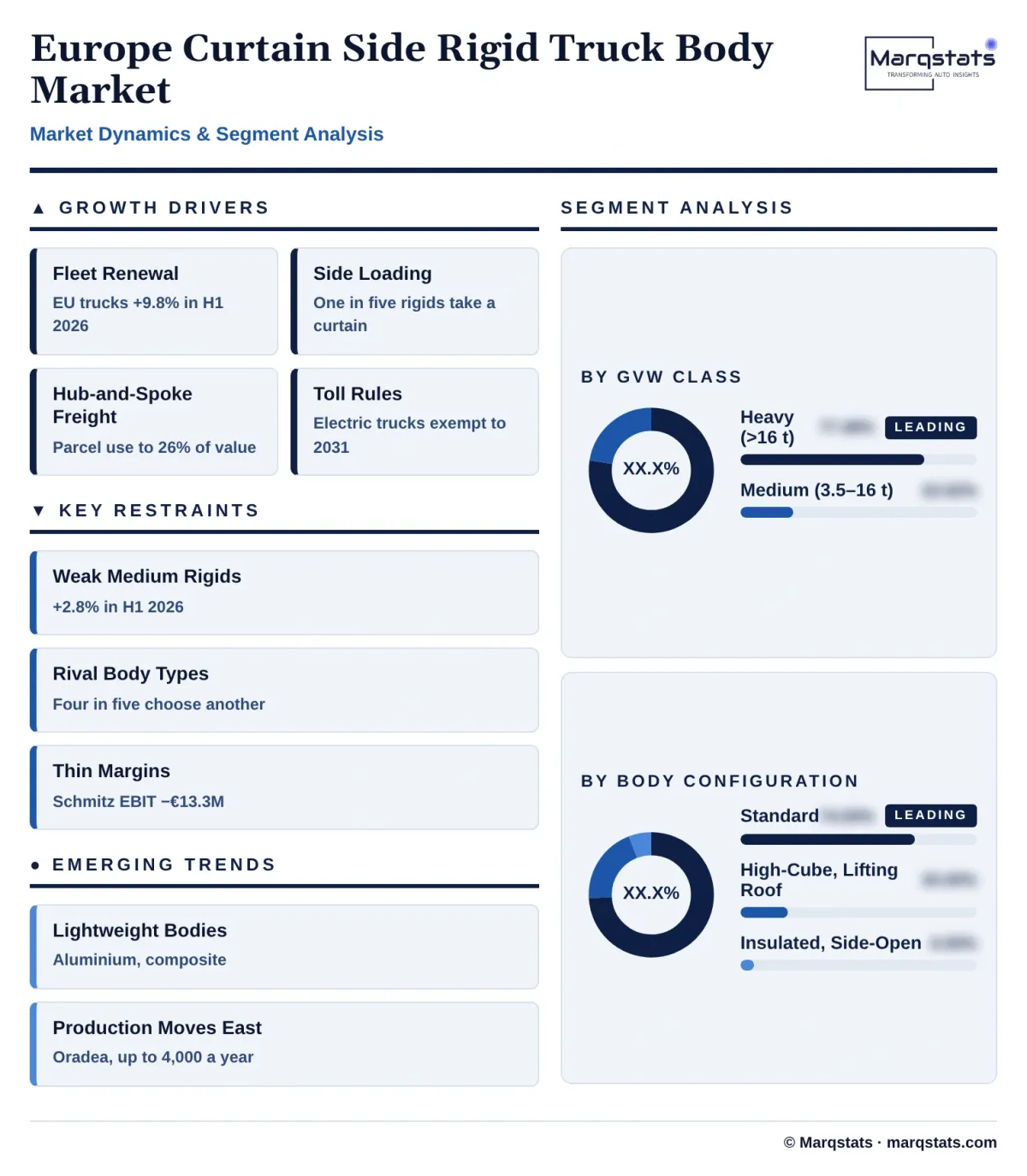
- Distribution fleets are due for renewal. EU truck registrations fell 6.2% in 2025 after a peak in 2023, and rose 9.8% in the first half of 2026 according to ACEA, so many rigid trucks bought in 2019 to 2021 now reach the end of a typical six-to-eight-year body cycle and are replaced with new chassis and bodies.
- Side loading saves time on every stop. A curtain-side body lets a forklift reach pallets along the full length of the load bed and a crane load from above, which is why grocery, beverage and building-material fleets specify it for multi-drop rounds, and why Marqstats estimates it takes about one in five new rigid chassis.
- Regional hub-and-spoke freight favours rigids. Retailers and parcel networks supply stores from regional hubs with 7.5 to 26 tonne rigids, and Marqstats expects parcel, e-commerce and other uses to rise from 22.00% to 26.00% of value by 2030, the fastest end use.
- Tolls and carbon rules reward lighter trucks. Germany exempted battery-electric trucks from the federal motorway toll until 30 June 2031 and charges diesel trucks more than 30 cents per kilometre, and electrically-chargeable trucks reached a 4.8% share of EU registrations in the first half of 2026, so fleets want lighter bodies that protect payload on heavier electric chassis.
- Bodybuilders are adding capacity near the demand. Schmitz Cargobull began production of curtainsiders and tippers at Oradea in Romania in early 2026 with planned capacity of up to 4,000 vehicles a year, Wielton raised revenue 19.4% in the first half of 2026 and Krone took over its Polish distributor Pozkrone, which together shorten delivery times in Central Europe.
Key Restraints
Four constraints keep growth below the pace of the wider truck market.
- Medium rigids are recovering slowly. ACEA reported medium truck registrations down 9.9% in 2025 and up only 2.8% in the first half of 2026, and the KBA recorded German registrations of 6 to 16 tonnes down 10% in January to September 2026, which holds back the urban distribution bodies that were expected to lead the rebound.
- Other body types compete for the same chassis. Box bodies, refrigerated bodies, flatbeds with tarpaulins, tippers and swap-body carriers take about four of every five rigid chassis, and a haulier choosing a box body for security or a swap body for flexibility removes the order from this market.
- Bodybuilders earn thin margins. Schmitz Cargobull reported earnings before interest and tax of minus EUR 13.3 million for 2025/26 and Wielton a net loss of PLN 43.6 million in the first half of 2026, so makers hold prices tight, delay investment and cut capacity in Western Europe, which limits the pace of price increases.
- Electric chassis need new interfaces. Battery packs add weight and take frame space, and body mounting points, wiring and curtain controls must be redesigned for each new electric chassis, so bodybuilders wait for chassis makers to publish body-builder data before accepting orders, which delays fitments in the segment growing fastest on the chassis side.
Key Trends
Four shifts are changing how curtain-side bodies are built, sold and fitted.
- Lightweight structures replace steel. Aluminium subframes, composite panels and thinner roof rails cut tare weight, and fleets running heavier electric chassis place a premium on every kilogram of payload, which supports the rise in the average price per body.
- Production moves east. Schmitz Cargobull opened Oradea, Wielton extends its automated lines in Poland and Krone strengthens its Polish network, so Central European plants supply more bodies for Western European trucks at lower labour cost.
- Makers buy their routes to market. Krone completed the takeover of Pozkrone, its Polish distributor of about 32 years, at the end of November 2025, and Wielton grew its United Kingdom registrations by 73.7% to 1,805 vehicles in the first half of 2026 through Lawrence David, Wielton and Langendorf, which shifts share toward groups with their own sales and service networks.
- Bodies carry data. Load-monitoring sensors, door and curtain status alerts and telematics connected to the truck now ship on new high-specification bodies, which adds cost per body and ties the body supplier to the fleet software chosen by large hauliers.
Strategic Implications
- For bodybuilders, order books depend on rigid chassis allocation, not on total truck demand. Building long-term supply agreements with chassis dealers and fleet buyers in Germany and the United Kingdom, where curtain-side rigids are the standard distribution truck, protects volume while medium rigid registrations stay weak.
- For chassis makers and dealers, delivery time for a finished truck is set by the body. Chassis makers that publish body-builder data for electric models early and dealers that hold stocks of standard curtain-side bodies can cut handover time and win fleet orders from competitors that sell chassis first and source bodies later.
- For fleets and logistics operators, a lighter body is worth paying for. On a heavy electric chassis, each kilogram saved raises payload, and tolls that favour zero-emission trucks until mid-2031 make electric rigids a growing choice, so specifying aluminium subframes and lifting roofs at order stage lowers operating cost over a six-to-eight-year body cycle.
- For component suppliers, curtain systems, roof rails, tail lifts and load-monitoring sensors sell through a few large bodybuilders. Suppliers that qualify their curtains and rails to the EN 12642 Code XL standard and offer sensors that fit several body brands can follow the shift toward higher-specification bodies.
- For investors, the body market is fragmented and margins are thin. Consolidation of regional bodybuilders into groups with Central European plants and dealer networks, as shown by Krone in Poland, creates the more resilient business, while independent builders face price pressure from groups with scale.
Market Segmentation
Bodies for medium rigid chassis of 3.5 to 16 tonnes account for 22.52% of 2025 value, USD 145.60 million, and grow at 6.36% a year to USD 198.17 million. Marqstats estimates 11,200 units in 2025, fitted to chassis such as the Mercedes-Benz Atego, MAN TGL and TGM, DAF LF and Iveco Eurocargo and used for retail replenishment, drinks rounds and city distribution. Registrations of this class fell 9.9% in the EU in 2025, which makes it the weakest class near term, but electric medium chassis and low-emission zones support recovery from 2027.
Bodies for heavy rigid chassis above 16 tonnes account for 77.48% of 2025 value, USD 500.94 million, and grow faster, at 6.94% a year, to USD 700.74 million and 77.95% of the market. Marqstats estimates 25,300 units in 2025 on two-axle and three-axle chassis from DAF, Volvo, Scania, Mercedes-Benz and MAN, used for beverage, grocery and building-material distribution and, in the United Kingdom and Nordic countries, for rigid-plus-drawbar combinations whose trailers are covered by the Global Curtain Sider Trailer study.
Standard curtain-side bodies, with a fixed or sliding roof and a payload height of about 2.5 metres, account for 74.00% of 2025 value, USD 478.44 million, and grow at 5.33% a year to USD 620.25 million, while their share eases to 69.00%. They are the default for general palletised cargo, and Code XL certification of side walls and rear doors reduces the lashing needed for form-locked loads.
High-cube and lifting-roof bodies, with internal heights up to about 3 metres and roofs that lift for crane loading, account for 20.00% of 2025 value, USD 129.31 million, and grow fastest, at 10.78% a year, to USD 215.74 million and 24.00% of the market. Packaging, automotive parts, white goods and parcel freight fill volume before weight, so shippers pay more for extra cube.
Insulated curtain-side and side-opening bodies account for 6.00% of 2025 value, USD 38.79 million, and grow at 10.16% a year to USD 62.92 million and 7.00% of the market. They serve temperature-sensitive drinks, produce and pharmaceutical rounds that need partial thermal protection with side access, mainly in Nordic, French and Alpine markets, and exclude full refrigerated box bodies.
Retail, grocery and FMCG distribution accounts for 36.00% of 2025 value, USD 232.75 million, and grows at 5.91% a year to USD 310.12 million, while its share eases to 34.50%. Supermarket chains and wholesalers use 18 to 26 tonne curtain-side rigids for store replenishment from regional hubs.
Beverage and drinks distribution accounts for 18.00% of 2025 value, USD 116.38 million, and grows at 4.97% a year to USD 148.32 million. Curtain-sided rigids carry palletised crates and kegs from breweries and bottlers to wholesalers and the hospitality trade, with strong demand in Germany, the United Kingdom, Belgium and Poland.
Building materials and industrial goods account for 24.00% of 2025 value, USD 155.17 million, and grow at 5.91% a year to USD 206.75 million. Merchants deliver bricks, boards, insulation and packaged products on rigids with crane mounts or tail lifts, and the segment follows housing starts, which are slow to recover.
Parcel, e-commerce and other uses account for 22.00% of 2025 value, USD 142.24 million, and grow fastest, at 10.44% a year, to USD 233.72 million and 26.00% of the market. Regional hubs of parcel carriers and online retailers use high-cube bodies on medium and heavy rigids to feed delivery depots.
By Geography
Germany
Germany accounts for 23.00% of 2025 value, USD 148.71 million, and grows at 6.06% a year to USD 199.56 million. Reported registrations of trucks above 3.5 tonnes in Germany were 77,431 in 2025, and the KBA recorded 15,812 of 6 to 16 tonnes and 53,145 above 16 tonnes, with registrations of 6 to 16 tonnes down 10% in January to September 2026 while those above 16 tonnes rose 4%. Local bodybuilders such as Spier and SAXAS and trailer groups Schmitz Cargobull and Krone supply German fleets, and the toll exemption for electric trucks to mid-2031 shapes new orders.
United Kingdom
The United Kingdom accounts for 22.00% of 2025 value, USD 142.24 million, and grows at 6.62% a year to USD 195.96 million. SMMT reported 40,504 new heavy goods vehicles in 2025, down 10%, with rigids down 14.1%, and reported registrations of United Kingdom trucks of at least 16 tonnes fell 2.3% to 25,449 in January to September 2026. Rigid curtainsiders are a standard British distribution truck, which gives the country a high value share for its registrations, and builders such as Gray and Adams and Don-Bur compete with Wielton, whose British registrations rose 73.7% in the first half of 2026.
France
France accounts for 15.00% of 2025 value, USD 96.98 million, and grows at 6.24% a year to USD 131.24 million. Reported registrations of trucks above 3.5 tonnes in France were 46,079 in 2025, and those of trucks of at least 16 tonnes fell 1.0% to 27,389 in January to September 2026. French buyers prefer box and refrigerated bodies from Lamberet and Chereau, so curtain-side fitment is lower than in Germany or the United Kingdom.
Spain and Italy
Spain and Italy account for 12.00% of 2025 value, USD 77.58 million, and grow at 6.99% a year to USD 108.77 million. Spain registered 30,989 trucks above 3.5 tonnes in 2025 and Italy 27,709, and Spanish registrations of trucks of at least 16 tonnes rose 13.4% to 19,884 in January to September 2026. Most heavy trucks in the two countries are tractors, and rigid curtain bodies serve Mediterranean produce, beverage and building-material rounds.
Poland and Central and Eastern Europe
Poland and Central and Eastern Europe account for 12.00% of 2025 value, USD 77.58 million, and grow fastest, at 9.52% a year, to USD 122.25 million and 13.60% by 2030. Poland registered 29,946 trucks above 3.5 tonnes in 2025, and its registrations of trucks of at least 16 tonnes rose 19.5% to 23,549 in January to September 2026, while Romania registered 8,703 and Hungary 5,353 in 2025. Most of these are tractors for international freight, so the body market is smaller than registrations suggest, but domestic distribution fleets and local plants such as Wielton and Oradea support rapid growth.
Rest of Europe
The rest of Europe, covering the Benelux countries, the Nordic countries, Austria, Switzerland, Ireland, Portugal and the smaller EU markets, accounts for 16.00% of 2025 value, USD 103.45 million, and grows at 6.41% a year to USD 141.13 million. Nordic and Alpine fleets prefer side-opening and insulated curtain bodies for winter use, and Finnish builder Ekeri serves short-haul distribution.
How Competition Is Evolving
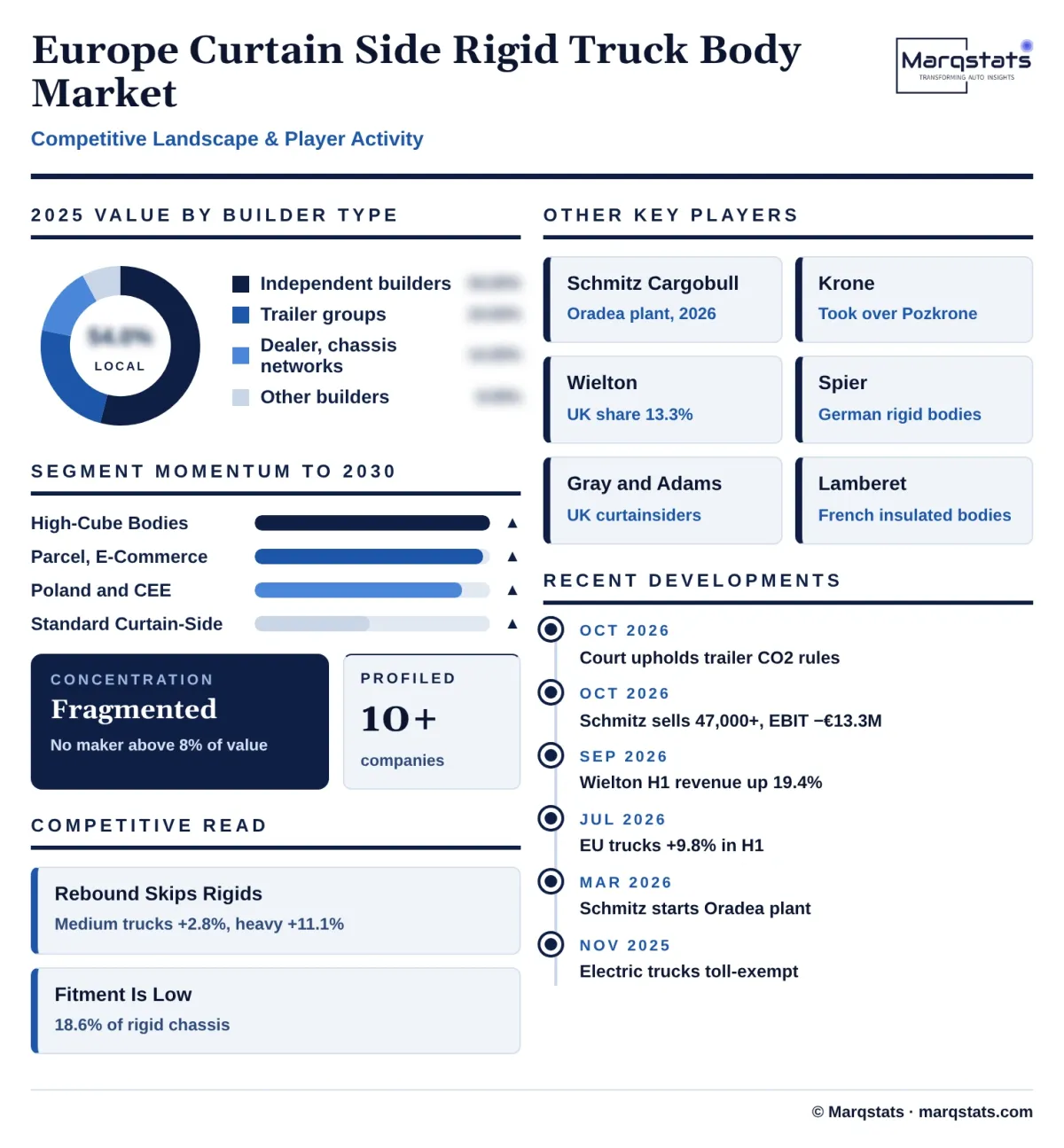
The market is fragmented. Marqstats estimates that independent regional bodybuilders supplied about 54.00% of 2025 value, trailer groups such as Schmitz Cargobull, Krone and Wielton about 24.00%, dealer and chassis-network builders about 14.00% and other builders about 8.00%. No single maker is estimated above 8.00% of value, because bodies are made to the chassis, axle layout and length of each order, and local type approval, service and delivery time favour nearby builders.
Trailer groups are gaining ground. Schmitz Cargobull sold more than 47,000 vehicles in 2025/26 against 42,620, with sales of about EUR 2.25 billion against EUR 2.16 billion, but its earnings before interest and tax were minus EUR 13.3 million, and it began production at Oradea in early 2026. Krone, with group revenue of about EUR 2.3 billion in 2024/25, completed the takeover of Pozkrone in Poland, and Wielton sold 8,577 vehicles in the first half of 2026 with revenue of PLN 1,180.3 million.
Competition rests on delivery time, weight and certification. Builders that supply a finished body within weeks of chassis delivery, offer Code XL certified structures at low tare weight, and provide service and parts near the customer win repeat fleet orders, while price decides smaller owner-operator purchases in Central and Eastern Europe.
Competition from trailers shapes the market. Where a haulier can choose between a rigid with a curtain body and a tractor with a curtain semi-trailer, the trailer's lower cost per cubic metre can win, which is why the groups that sell both, such as Schmitz Cargobull and Krone, can steer customers between the two and hold share against rigid-only builders.
Companies Covered
Companies covered in the report include:
Recent Market Activity
Table of Contents
Coverage & Segmentation
The study covers the Europe curtain side rigid truck body market, with 2025 as the base year, 2021 – 2025 as the historical period and 2026 – 2030 as the forecast period. It covers new curtain-side bodies fitted to new rigid truck chassis above 3.5 tonnes gross vehicle weight in the 27 EU member states, the United Kingdom, Norway, Switzerland and Iceland, segmented by GVW class, body configuration, end use and country group. Values are ex-factory values at the bodybuilder gate in US dollars at the 2025 average of EUR 1 = USD 1.13, before chassis cost, value-added tax and dealer margin.
Curtain-sided semi-trailers and drawbar trailers, box and refrigerated bodies, flatbeds with tarpaulins, tippers, swap bodies, bodies for vans and chassis cabs up to 3.5 tonnes, chassis-cab value, used bodies and aftermarket curtain and roof replacement are excluded. The Global Curtain Sider Trailer Market covers trailers and the Europe LCV Body Conversion Market covers vehicles up to 3.5 tonnes, so neither should be added to this market. Segment and country splits are Marqstats estimates built on registration data, maker disclosures and price benchmarks.
