Market Snapshot
The Africa electric motorcycle battery swapping market is valued at USD 38.72 million in 2025 and is forecast to reach USD 517.63 million by 2030, a CAGR of 67.96%. Swap volume rises faster, from 19.86 million swaps to 285.98 million, a 70.48% CAGR, as the active swappable fleet grows from 84,800 to 984,600 motorcycles. Kenya is the largest market at 33.99% of 2025 revenue. The distinguishing fact is scale of recurrence: every motorcycle sold keeps paying swap fees for years, so the service layer compounds faster than vehicle sales.
Marqstats sizes this market on swap transactions, since no African regulator or industry body publishes battery-swapping turnover. The build multiplies the year-average active swappable fleet by swaps per motorcycle and by a blended fee per swap. Fleet additions come from the International Energy Agency (IEA) count of around 70,000 African electric two-wheeler sales in 2025, of which Marqstats treats 80% as swappable. The value is most sensitive to swaps per motorcycle: each 10-swap change moves 2025 revenue by USD 1.14 million.
Operator disclosures run well ahead of the official record. Spiro reported more than 50,000 electric motorcycles in October 2025, 80,000 in February 2026 and more than 100,000 by 1 June 2026, with over 2,500 swap stations across seven markets. That is roughly 50,000 motorcycles added in about seven months, more than two-thirds of the entire continent's 2025 sales.
Price is set in local currency and anchored in Kenya. A Kenyan rider pays about KES 290 for a swap covering 80 to 100 km, or USD 2.24 at the KES 129.25 2025 average rate. Marqstats applies a blended continental fee of USD 1.95 in 2025, lower than the Kenyan anchor because Rwanda, Uganda and West African networks price below Nairobi, and lets it drift to USD 1.81 by 2030 as open networks add price competition.
The market is a recurring energy-and-battery service, not a hardware market. Vehicle sales, rider loan repayments and swap-cabinet sales sit outside the headline, which keeps the figure comparable with the vehicle-value series Marqstats publishes separately.
Key Takeaways
Market Overview & Analysis
Report Summary
African battery swapping crossed from pilot to infrastructure between October 2025 and June 2026. In that window Spiro raised USD 100 million of equity, USD 50 million of debt and a further USD 215 million of equity, doubled its disclosed fleet to more than 100,000 motorcycles and passed 2,500 swap stations. ARC Ride closed USD 33.3 million in September 2026, Dodai Group raised USD 13 million in April 2026, and the first open multi-brand network opened in Kenya in August 2026. The thesis of the page is that the swap fee, collected 340 times a year per motorcycle, is now the economic core of African two-wheeler electrification, and that capital is flowing to whoever controls the battery pool.
The measure is swap-service turnover: the tax-inclusive fees riders pay at stations, cabinets and hubs to exchange a depleted pack for a charged one, in USD at 2025 average exchange rates. Counted vehicles are battery-electric motorcycles and mopeds with removable packs in commercial and private use. Excluded are motorcycle hardware sales (USD 108.5 million in 2025 on the live Marqstats Africa electric two-wheeler page), rider loan principal and interest, swap-cabinet and battery hardware sold to operators, lead-acid scooters, electric three-wheelers and fixed-battery plug-in charging.
Four reader types use the analysis. A development finance institution sizing a battery-pool debt facility needs swap volume per motorcycle and fee trajectory by country. An original equipment manufacturer choosing between building its own network and joining an open one needs the proprietary-versus-open split. A fuel retailer weighing forecourt cabinets needs station economics in Kenya and Nigeria. A rider financier pricing a 24-month plan needs to know what share of the daily payment is energy and what share is battery capital.
Africa Electric Motorcycle Battery Swapping Market Size and Forecast
Revenue rose from USD 1.73 million in 2021 to USD 4.13 million in 2022, USD 8.64 million in 2023, USD 16.25 million in 2024 and USD 38.72 million in 2025. Marqstats forecasts USD 80.55 million in 2026, USD 139.08 million in 2027, USD 222.62 million in 2028, USD 343.03 million in 2029 and USD 517.63 million in 2030. The 2025 jump of 138% follows the year in which Kenya more than tripled electric two-wheeler sales and Uganda passed 30,000 units, both reported by the IEA in Global EV Outlook 2026.
The build is a three-step chain. First, the active swappable fleet: 32,000 motorcycles at end-2024, plus 56,000 swappable additions in 2025 (80% of around 70,000 sales), less 10% attrition from defaults, repossessions and retirements, gives 84,800 at end-2025 and a year-average of 58,400. Second, throughput: 340 swaps per active motorcycle in 2025 yields 19.86 million swaps. Third, price: a blended USD 1.95 per swap yields USD 38.72 million. Spiro disclosures cross-check the throughput assumption; its cumulative counter moved from more than 23 million swaps in October 2025 to more than 30 million in February 2026, about 7 million swaps in four months on a fleet averaging roughly 65,000 motorcycles, close to 320 swaps per motorcycle a year.
Fleet growth is the primary series and value is derived. The forecast takes annual African electric two-wheeler sales from 70,000 in 2025 to 500,000 in 2030 (48.17% CAGR), the same path as the live Marqstats Africa electric two-wheeler page, holds the swappable share at 80% and keeps attrition at 10% of the opening fleet. That produces 159,300 motorcycles at end-2026, 266,300 at end-2027, 421,800 at end-2028, 649,600 at end-2029 and 984,600 at end-2030. Swaps per motorcycle rise from 340 to 350 as station density cuts detours, and the blended fee eases from USD 1.95 to USD 1.81.
Value grows slower than swap volume, 67.96% against 70.48%, because the fee per swap falls 1.48% a year. Old motorcycles keep swapping. Volume grows faster than sales because each year's buyers join a fleet that is still riding. That stock effect is why a 48.17% sales CAGR becomes a 63.29% fleet CAGR and a 67.96% revenue CAGR. Constant 2025 exchange rates are used throughout; a weaker shilling or naira would lower USD-translated revenue without changing swap counts.
The Battery Pool Is Overtaking the Bike as the Revenue Engine
Swap revenue is converging on vehicle revenue, and that changes who earns the most from African electrification. At USD 38.72 million in 2025, swap turnover equals 35.69% of the USD 108.5 million Marqstats estimates for African electric two-wheeler vehicle sales. By 2030, at USD 517.63 million against USD 625.0 million, the ratio is 82.82%. The two series sit at different levels of the stack and are never added. The comparison shows where cash accumulates.
The mechanism is simple. A motorcycle is sold once, at a blended price Marqstats puts near USD 1,550 in 2025. Its battery service is paid roughly 340 times a year. Every year. At USD 1.95 a swap that is about USD 663 a year, so two to three years of swaps match the price of the frame. Spiro, Ampersand and ARC Ride all sell or lease the motorcycle and keep the battery, which is why their fundraising since October 2025 has been framed around stations and battery inventory rather than factories.
The implication is that battery-pool financing, not vehicle financing, becomes the scarce capital. A lender that funds packs and cabinets is underwriting a stream that scales with the whole operating fleet, while a lender funding vehicles is underwriting one-off sales. Our conclusion: the operator with the deepest battery pool and the most stations per square kilometre will hold pricing power, whatever its share of new motorcycle sales.
Electricity Is the Smallest Line in a Swap Fee
Grid electricity is a minor cost in a Kenyan swap, so price competition will be fought on battery utilisation and station density. Kenya Power billed 8.43 GWh on its dedicated e-mobility tariff in 2025, up 188% from 2.92 GWh in 2024, and reached 331 tariff customers by June 2026. At the KES 16 peak rate, that electricity is worth at most KES 134.88 million, or USD 1.04 million, which is 7.93% of the USD 13.16 million Marqstats estimates for Kenyan swap revenue in 2025. The meter base also serves buses and cars, so the true two-wheeler share is lower still.
Seen per swap, KES 290 buys 18.1 kWh of grid electricity at the peak rate and 36.3 kWh off-peak, many times what a single motorcycle pack holds. The rest is capital. It pays for battery depreciation, the spare-pack ratio, station rent, staff, theft losses and financing. That cost structure explains why operators chase utilisation. A cabinet that turns its packs more often spreads fixed battery capital over more fees.
For operators, the conclusion is that cheaper electricity will not move the market much; denser networks and higher pack turnover will. For regulators, it means tariff relief alone has limited pass-through to the rider, and interoperability rules that let packs circulate across brands carry more potential to lower fees.
Disclosed Fleets Outrun the Statistical Record
The continent's swap fleet is growing faster than any official series can track, so planning must rely on operator disclosures cross-checked against sales. IEA reports around 70,000 African electric two-wheeler sales in 2025, up from less than 1,000 in 2020, and its Uganda figure of more than 30,000 sits beside Kenya's 25,277. Yet Spiro alone reported 50,000 motorcycles in October 2025 and more than 100,000 by June 2026. That is roughly 50,000 motorcycles in about seven months. The record lags.
Marqstats reads this as evidence that 2026 sales are running well above 2025, consistent with the 103,700 units modelled for 2026, and not as a contradiction. Company counts are reported, not independently verified, and include motorcycles in markets such as Togo, Benin and Nigeria where no registration series is published. The analysis treats them as upper-bound anchors and holds the fleet model to the IEA sales path.
Market Dynamics
Key Drivers
Four forces lift swap volume faster than motorcycle sales.
- Fuel-cost gap for taxi riders: a Kenyan rider pays about KES 290 for a swap covering 80 to 100 km, and IEA attributes Kenya's 2025 tripling to over 25,000 sales to riders cutting fuel costs. Lower running cost per kilometre is what makes a rider plan of about KES 530 a day affordable.
- Development finance at scale: Spiro raised USD 100 million in October 2025 led by USD 75 million from the Fund for Export Development in Africa, USD 50 million of debt in February 2026 and USD 215 million of equity on 1 June 2026. ARC Ride added USD 33.3 million in September 2026. Capital on this scale funds battery pools ahead of demand.
- Policy that targets motorcycle taxis: Kigali stopped registering new petrol motorcycle taxis from January 2025, Kenya launched its National Electric Mobility Policy on 3 February 2026, and African Union ministers endorsed a Continental Framework on Electric Mobility on 30 April 2026. Each points commercial riders toward swappable fleets.
- Embedded rider finance: M-KOPA has financed more than 5,000 electric motorcycles in Kenya through Ampersand, Spiro and Roam, and its loans lock riders into a network for 24 months, which converts each sale into two years of predictable swaps.
Key Restraints
Three constraints limit how fast swap revenue can compound.
- Thin statistical base: Kenya's Ministry of Roads and Transport counts 39,324 cumulative electric vehicles at end-2025 while the Energy and Petroleum Regulatory Authority counted 5,294 in December 2024. Lenders price this uncertainty into battery-pool debt.
- Import duty and currency exposure: Uganda reinstated a 25% duty on finished electric motorcycles in mid-2024, and fees collected in shillings, francs and naira must service USD-denominated debt. Any depreciation lowers the USD value of each swap.
- Closed-network lock-in: before August 2026 almost every swap ran on a single-brand network, with 98.99% of 2025 revenue on proprietary systems. Riders tied to one operator face station gaps outside Nairobi, Kampala and Kigali, which caps utilisation in secondary towns.
Key Trends
Three shifts are reshaping how swapping is delivered.
- Open networks arrive: Ampersand opened its network to Wylex Mobility in December 2025, Autopax and Kofa launched the Cheche with 12 Nairobi stations in April 2026, and SUN Mobility with Vivo Energy opened 35 multi-brand stations on 24 August 2026.
- Automation of the swap: ARC Ride runs 183 automated cabinets and 13 hubs in Nairobi and Nakuru with swaps under 60 seconds, while Spiro's Westlands hub charges more than 200 batteries at once. Faster swaps raise the daily ceiling per station.
- Expansion beyond East Africa: Spiro operates in Togo, Benin, Nigeria and Cameroon and plans entry into the Democratic Republic of the Congo and Ethiopia; ARC Ride is entering Ghana, South Africa, Tanzania and Uganda; Dodai Group targets 1,000 stations in Addis Ababa within three years.
Strategic Implications
- For entrants: compete on density, not chassis. With electricity at under 8% of the Kenyan fee, the winning cost lever is packs per station and swaps per pack; joining an open network such as SUN Mobility or Kofa avoids building a station grid from zero.
- For incumbents: protect utilisation. Spiro's more than 450 Kenyan stations and Ampersand's more than 20,000 daily swaps are moats only while riders cannot cheaply switch; expect fee pressure once interoperable stations reach secondary towns.
- For suppliers and investors: underwrite the battery pool. Swap revenue reaches 82.82% of vehicle sales value by 2030, so cabinet makers, cell suppliers and lenders gain more from fleet-wide throughput than from new-bike volumes.
Market Segmentation
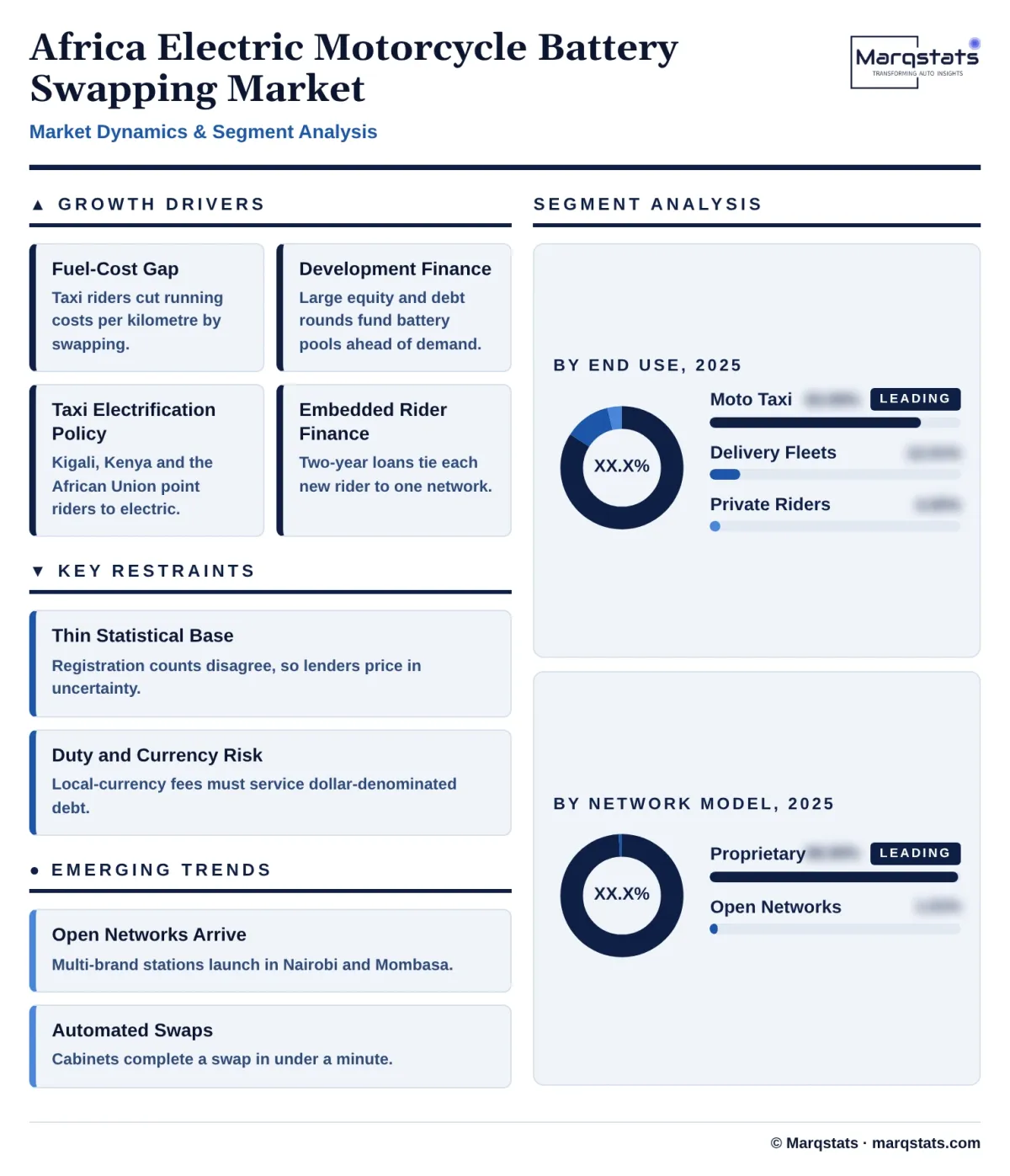
Motorcycle taxis hold USD 32.52 million in 2025 (83.99%) and reach USD 372.69 million by 2030 (72.00%), a 62.87% CAGR. Boda boda, okada and zemidjan riders cover long daily distances, so they swap more than once a day and carry the market. IEA links Uganda's 2025 surge past 30,000 sales directly to financing programmes and an expanding swap network.
Taxis do not slow. Share falls because other uses grow faster. Kigali's January 2025 halt on new petrol taxi registrations keeps this segment the anchor of every network plan.
Delivery and logistics fleets account for USD 4.65 million in 2025 (12.01%) and USD 113.88 million by 2030 (22.00%), the fastest end-use CAGR at 89.58%. Fleet contracts give operators guaranteed daily swaps; Dodai Group supplies corporate fleets in Addis Ababa, and ARC Ride is entering South African delivery corridors after its September 2026 raise. Marqstats expects corporate fleets to become the preferred anchor tenant for new stations.
Private and institutional riders contribute USD 1.55 million in 2025 (4.00%) and USD 31.06 million by 2030 (6.00%), an 82.13% CAGR. Lower daily mileage means fewer swaps, and many private buyers charge at home, as with Roam, which assembles the Roam Air at a 50,000-unit-a-year plant in Nairobi and offers battery rental with swaps priced by the hour.
Proprietary networks, where the operator builds the motorcycle, owns the pack and runs the stations, earn USD 38.33 million in 2025 (98.99%) and USD 393.40 million by 2030 (76.00%), a 59.32% CAGR. Spiro, Ampersand, ARC Ride, Zembo, GOGO Electric and Dodai Group all run this model. Its advantage is control of pack quality and rider data; its weakness is that every new city needs a full station grid.
Open networks earn USD 0.39 million in 2025 (1.01%) and USD 124.23 million by 2030 (24.00%), a 216.69% CAGR from a small base. Kofa handled more than 200 swaps a day in May 2025; SUN Mobility and Vivo Energy launched 35 stations serving more than ten vehicle makers on 24 August 2026. Marqstats expects open networks to win secondary towns where no single operator can justify its own grid.
By Geography
Kenya
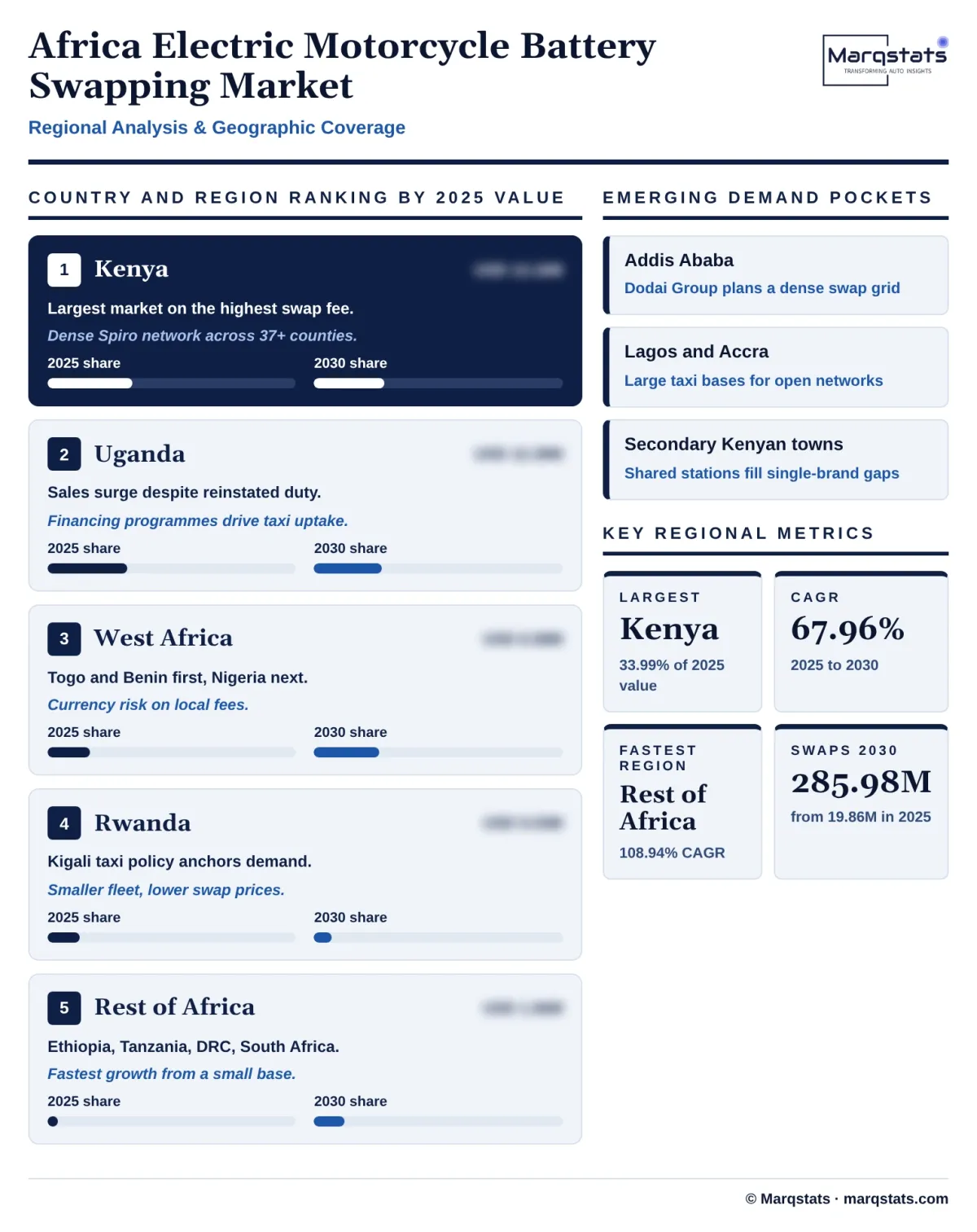
Kenya is the largest market at USD 13.16 million in 2025 (33.99%), reaching USD 144.94 million by 2030 (28.00%), a 61.58% CAGR. Kenya sold 25,277 electric motorcycles in 2025, 15.02% of 168,286 new motorcycle registrations, and Spiro alone reported more than 450 stations in more than 37 counties and more than 28,000 motorcycles by August 2026. The highest fee in the region, about KES 290 a swap, lifts value per swap. Share eases as other markets scale, not because Kenya slows.
Uganda
Uganda holds USD 12.39 million in 2025 (32.00%) and USD 139.76 million by 2030 (27.00%), a 62.35% CAGR. IEA counts more than 30,000 electric two-wheeler sales in 2025, rising sharply from a low base in 2024 on Spiro-led financing and swap expansion, despite a 25% import duty reinstated in mid-2024. Lower fees than Kenya keep revenue per motorcycle below the Kenyan level.
Rwanda
Rwanda contributes USD 5.03 million in 2025 (12.99%) and USD 36.23 million by 2030 (7.00%), a 48.42% CAGR. Kigali stopped registering new petrol motorcycle taxis from January 2025, and Ampersand reports more than 20,000 swaps a day across Rwanda and Kenya. A small national fleet and lower swap prices limit growth relative to larger markets.
West Africa
West Africa, covering Togo, Benin, Nigeria, Ghana and Cameroon, holds USD 6.58 million in 2025 (16.99%) and USD 134.58 million by 2030 (26.00%), an 82.87% CAGR. Togo and Benin were Spiro's earliest markets, Nigeria adds the continent's largest motorcycle-taxi base, and Kofa runs swaps in Ghana. Currency risk on fees collected in naira and CFA francs is the main constraint on USD value.
Rest of Africa
Rest of Africa, led by Ethiopia, Tanzania, the Democratic Republic of the Congo and South Africa, accounts for USD 1.56 million in 2025 (4.03%) and USD 62.12 million by 2030 (12.00%), the fastest regional CAGR at 108.94%. Dodai Group has deployed more than 2,000 motorbikes in Addis Ababa, Spiro plans entry into the Democratic Republic of the Congo and Ethiopia, and ARC Ride is entering South Africa and Tanzania.
How Competition Is Evolving
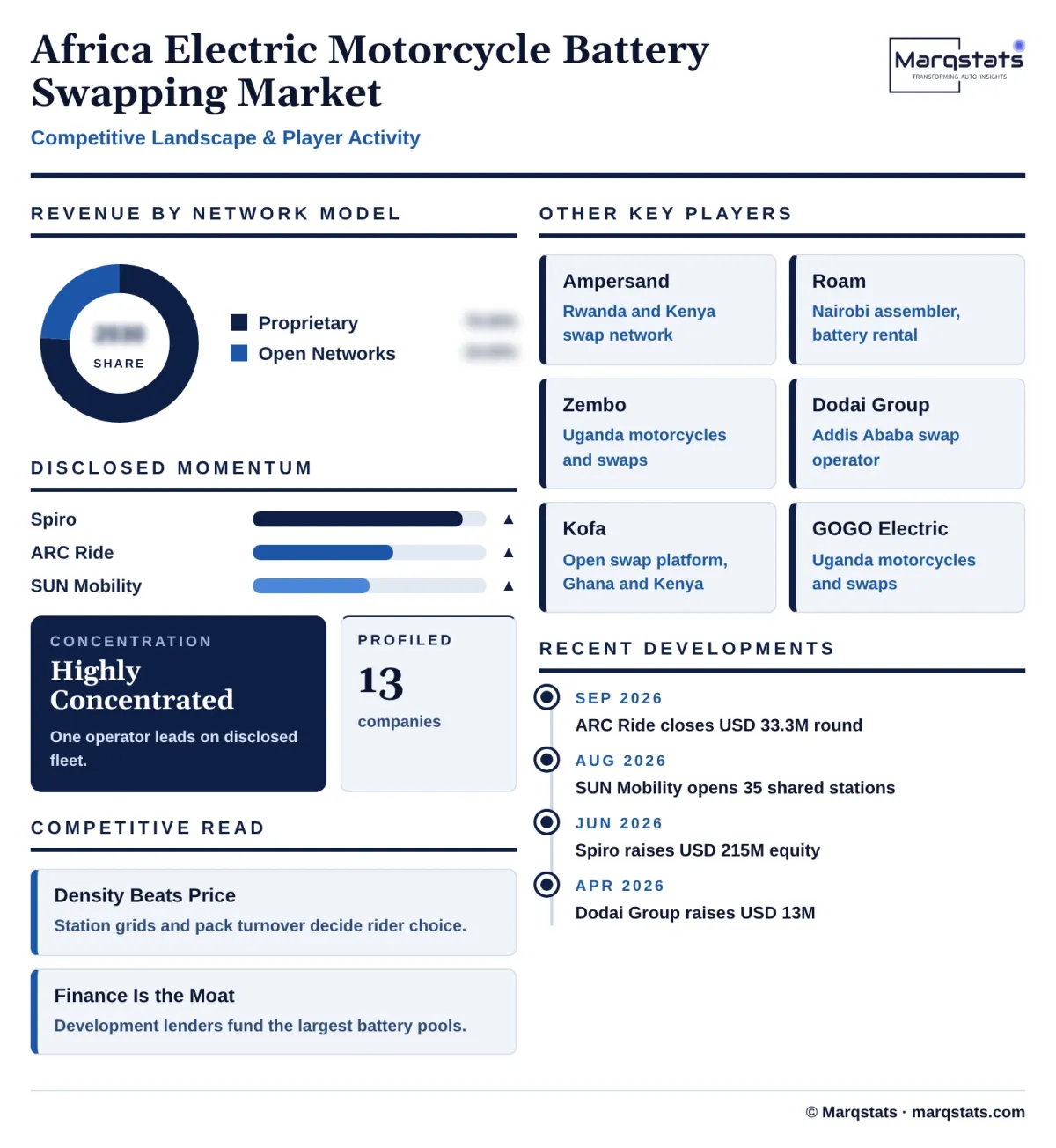
The market is highly concentrated around one operator, and the order is settled for now but not beyond 2027. Spiro reports more than 100,000 motorcycles and more than 2,500 stations across seven markets, several times the next disclosed fleet. No regulator publishes operator-level swap counts, so Marqstats does not assign revenue shares; on disclosed fleets alone, Spiro, Ampersand and ARC Ride together operate the large majority of active swappable motorcycles.
Operators compete on station density, swap speed, rider financing and pack availability, more than on headline price. ARC Ride sells sub-60-second automated swaps, Ampersand sells pack reliability and has opened its network to third-party makers, and Spiro sells reach across 37 Kenyan counties and seven countries. Rider finance through M-KOPA and others decides which network a new rider joins for the next 24 months.
Structural position depends on access to development finance and on local assembly. Spiro, Ampersand, ARC Ride and Dodai Group are all funded by development finance institutions including the Fund for Export Development in Africa, Impact Fund Denmark, IFC, British International Investment and Proparco. Open-network entrants such as SUN Mobility and Kofa rely on partnerships with fuel retailers and vehicle assemblers rather than their own fleets, which lets them scale stations faster than motorcycles.
Companies Covered
Companies covered in the report include:
Recent Market Activity
Table of Contents
Coverage & Segmentation
Coverage spans swap-service revenue from battery-electric motorcycles and mopeds with removable packs across Africa, in commercial taxi, delivery, private and institutional use, for 2021 to 2030 with 2025 as base year. Value is tax-inclusive swap fees in USD at 2025 average exchange rates (KES 129.25 per USD for Kenya). Excluded: motorcycle hardware sales, rider loan repayments, swap-cabinet and battery hardware sold to operators, lead-acid scooters, electric three-wheelers, cars and buses, and home or depot plug-in charging.
Boundaries with sibling pages: the live Africa Electric Two Wheeler Market page sizes vehicle sales at USD 108.5 million in 2025 and USD 625.0 million in 2030 on 70,000 and 500,000 units; this page shares that unit path but measures a different level of the stack, so the two values are not additive. The Battery Swapping Commercial Electric Vehicle Market page covers heavy-duty swapping and station hardware, and the India EV Battery Swapping Market page covers India only; neither overlaps African two-wheeler swap fees. Do not add.