From adoption to inflection
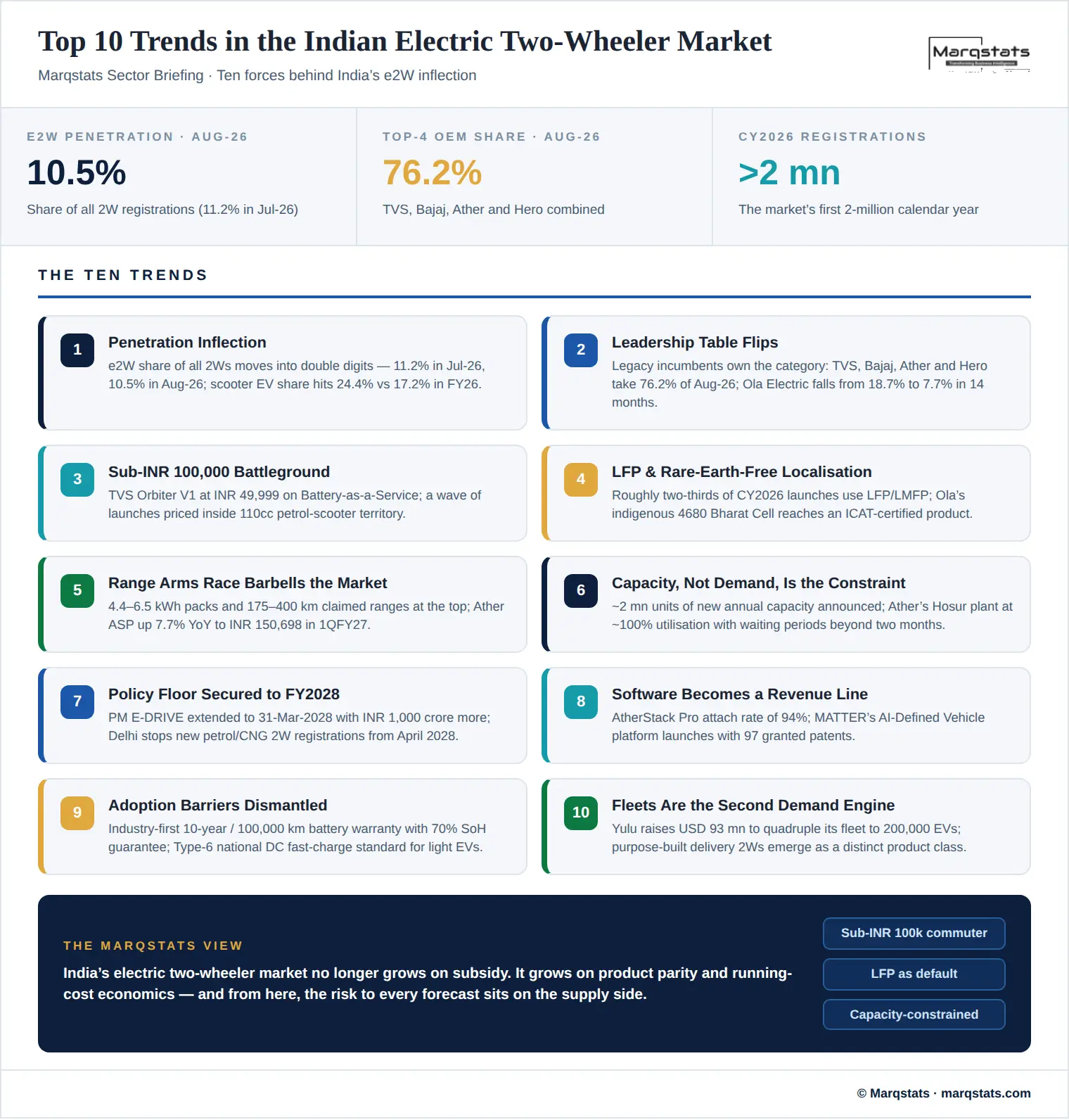
India's electric two-wheeler (e2W) market crossed from adoption to inflection during CY2026. Monthly registrations moved from a 105,000–125,000 band in late CY2025 to a 180,000–205,000 band by mid-CY2026, and electric penetration of the total two-wheeler market moved into double digits (11.2% in Jul-26, 10.5% in Aug-26) for the first time. Within scooters — the segment where the technology actually competes — penetration reached 24.4% in Jun-26 against 17.2% for FY2026 as a whole. Marqstats identifies the ten India electric two-wheeler market trends that define 2026 and set the base for the years beyond.
The composition of that growth is as important as its rate. Legacy ICE incumbents now own the category: TVS, Bajaj, Ather and Hero together took 76.2% of August 2026 registrations, while Ola Electric — the volume leader as recently as mid-CY2025 — fell to 7.7%. Competition has shifted decisively to the sub-INR 100,000 price band that petrol 110cc scooters occupy, aided by lower-cost LFP chemistry, indigenous cell manufacturing and battery-as-a-service pricing. Simultaneously, a premium tail has emerged with 4.5–6.5 kWh packs and 175–400 km claimed ranges, pushing industry average selling prices up rather than down.
Supply, not demand, is now the binding constraint. Ather reported 236,000 monthly enquiries and 50,000 monthly bookings against a Hosur plant running at close to 100% utilisation; Hero tripled EV capacity within one fiscal year; and close to 2 million units of new annual e2W capacity were announced during CY2026. Policy risk has also been substantially retired: PM E-DRIVE support for e2Ws was extended to 31 March 2028 with an additional INR 1,000 crore, and Delhi's 2026 policy sets an April 2028 stop on new petrol and CNG two-wheeler registrations.
Each trend below is built bottom-up from three independent evidence streams: a coded log of 48 India e2W product launches, plant announcements, funding rounds and policy notifications from January to September 2026; sell-side equity research published in August 2026 that carries Vahan-derived monthly volume and share series, penetration forecasts to FY30/FY31 and OEM-level unit economics; and independent verification against Vahan registration prints, Ministry of Heavy Industries notifications and state policy documents. Every claim is tied to a number or a named event rather than to a general market narrative, and where a figure is a company claim (for example IDC-certified range) rather than an independently measured value, it is described as such.
India's electric two-wheeler market no longer grows on subsidy. It grows on product parity and running-cost economics — and from here, the risk to every forecast sits on the supply side.
— Marqstats Analyst Team
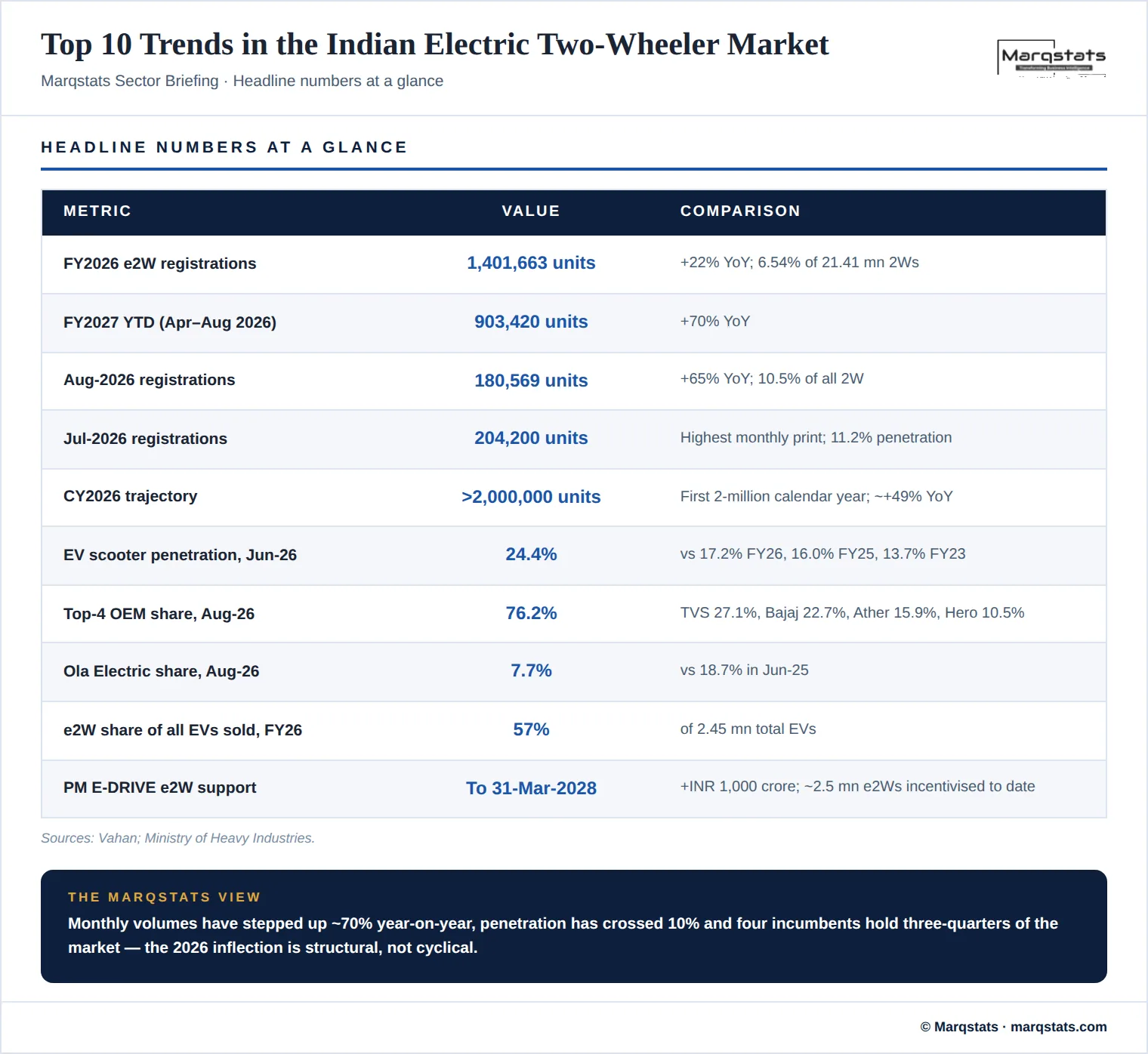
Headline numbers at a glance
Sources: Vahan via Autocar Professional / Autocar India / Business Standard; sell-side research (Aug-26); Ministry of Heavy Industries.
1. Penetration Inflection: e2W Moved Into Double Digits and Scooter EV Share Is Now a Quarter of the Segment
From a 6–8% curiosity to a 10–11% mainstream category in twelve months.
What is happening
Through FY2024–FY2026 electric penetration of the Indian two-wheeler market crept up roughly 50–100 basis points a year. That pattern broke in CY2026. Monthly volumes stepped up by about 70% year-on-year and penetration crossed 10% for the first time. Sell-side coverage of the sector explicitly re-characterised the market as being at an inflection point rather than on a linear adoption curve, and penetration forecasts were raised as a result.
The numbers
FY2026 e2W registrations: 1,401,663 units, +22% YoY, equal to 6.54% of the 21.41 mn two-wheelers registered (FY2025: 6.09%).
Aug-2026: 180,569 units, +65% YoY, 10.5% penetration. Jul-2026: 204,200 units, 11.2% penetration — the highest monthly print on record.
FY2027 first five months (Apr–Aug 2026): 903,420 units, +70% YoY.
CY2026 Jan–May alone was 801,277 units, +49% YoY and already 60% of full-year CY2025; the run-rate of 160,000+/month puts CY2026 above 2 million units for the first time.
Scooter-only EV penetration: 24.4% in Jun-26 (193,855 of 794,535 scooters) versus 17.2% in FY26, 16.0% in FY25 and 13.7% in FY23 — a 720 bps step-up inside one year.
Sell-side forecast (Aug-26): 2W EVs of 2.129 mn in FY27F (8.9% of industry), 2.883 mn FY28F (11.3%), 4.102 mn FY29F (15.1%) and 5.700 mn FY30F (19.6%).
A second sell-side view models an EV 2W industry CAGR of 32% over FY26–31, driven by 20% penetration by FY31 (versus 7% in FY26).
Management-cited drivers (Ather 1QFY27 call): total cost of ownership, E20 ethanol-blend concerns among petrol users, rising fuel prices, and concern over long-run fossil-fuel accessibility.
Why it matters
The inflection resets the base for every downstream forecast. A 2 million-unit CY2026 and a 24% scooter EV share mean the market has passed the point where growth depends on subsidy; it is now driven by product parity and running-cost economics. The FY23–FY26 CAGR is no longer a valid extrapolation base — the FY26–FY28 slope is roughly twice as steep, and the risk to volume numbers now sits on the supply side.
2. The Leadership Table Has Flipped: Legacy ICE Incumbents Own the Category and the Market Is Consolidating
Top-4 share of 76.2% in Aug-26; Ola Electric down from 18.7% to 7.7% in fourteen months.
What is happening
The pure-play EV start-ups defined the category between 2021 and 2024. In CY2026 the incumbent two-wheeler manufacturers — TVS, Bajaj and Hero — converted their distribution, service and financing footprints into share, and Ola Electric's decline accelerated. Ather is the one venture-born OEM holding a durable top-four position, and it did so by shifting from a premium niche to a platform strategy. Below the top five, a long tail of 217 manufacturers now shares only 16% of volumes.
The numbers
Aug-2026 share: TVS 27.1% (48,873 units, +91% YoY), Bajaj 22.7% (41,018, +236%), Ather 15.9% (28,707, +49%), Hero 10.5% (18,977, +38%), Ola 7.7% (13,849, -29%). Top four combined: 76.2%.
Ola Electric trajectory: 18.7% share and 20,700 units in Jun-25, peaking at 46,700 units in Oct-25, down to 4,200 units and 3.5% share in Feb-26 and 13,849 units in Aug-26.
FY2026 league table: TVS 341,471 (+44%), Bajaj 289,323 (+25%), Ather 239,124 (+82%), Ola 164,294 (-52%), Hero 144,313 (+196%), Greaves 61,651 (+51%). Top five = 84% of volumes; 217 other OEMs share the remaining 16%.
FY27 YTD (5 months): TVS 235,302 (+92%), Bajaj 204,551 (+106%), Ather 148,023 (+82%), Hero 99,023 (+114%), Ola 72,036 (-26%).
Ola's unit economics illustrate the pressure: 4QFY26 net sales fell 56.6% YoY to INR 2.65 bn on Vahan volumes of 58,397, with an EBITDA margin of -106% and negative gross profit per vehicle.
Sell-side models have Ather's share expanding from 17% in FY26 to 23% by FY31 — consolidation is expected to continue rather than reverse.
Why it matters
Competitive analysis of this market can no longer be framed as "EV start-ups versus ICE incumbents". The correct frame is a four-way contest between TVS, Bajaj, Ather and Hero, in which distribution density, service network and retail finance availability are the decisive assets. For component suppliers, this consolidation means the addressable customer set for e2W platforms is now effectively five accounts, not fifty.
3. The Battleground Has Moved to the Sub-INR 100,000 Mass Segment, With Battery-as-a-Service Breaking the Price Barrier
Entry e2W pricing now starts at INR 49,999 with leased batteries — inside 110cc petrol scooter territory.
What is happening
For most of the category's history the credible e2W started above INR 100,000 while the volume petrol scooter sold between INR 70,000 and INR 90,000. CY2026 closed that gap from both directions: cheaper LFP chemistry and platform re-engineering pulled hardware costs down, and battery-as-a-service pricing removed the battery from the purchase price altogether. Almost every serious OEM launched or announced an explicit "ICE-replacement" product during the year.
The numbers
TVS Orbiter V1 (Mar-26): INR 49,999 with Battery-as-a-Service including PM E-DRIVE, versus INR 84,500 bought outright; BaaS plans from about INR 862/month with unlimited usage, extended across the full TVS EV portfolio.
Ampere Reo VYB (Jun-26) at INR 69,499; Zelo Knight+ Rani (Mar-26) at INR 69,990; Ola S1Z (Aug-26) from INR 79,999; Bajaj Chetak C25 (Jan-26) at INR 91,399; BGauss Oowah EX at INR 94,990; Ampere Magnus G Max at INR 94,999; OSM Vextra at INR 99,900.
Ather entered the segment directly: Konarc S 100 at INR 100,000 on the new EL platform, which sell-side analysis estimates carries a 10–12% lower bill of materials than the Rizta series; the discount to existing models was larger than the market expected.
Greaves has positioned the Ampere 6th Gen (FY27) explicitly as an "ICE breaker" for the sub-INR 100,000 petrol scooter segment; E3 Electric.AI positions the Trion as a mass-market alternative to 110cc petrol scooters.
Simple Energy entered "India's largest scooter segment" with the Wave family from INR 110,000 (Sep-26), and Honda's QC3 (3 kWh, 151 km IDC) targets the same family-commuter buyer.
The GST structure widens the gap: EVs attract 5% GST versus 18% on ICE two-wheelers up to 350cc (cut from 28% in Sep-2025), a differential that is a material contributor to price competitiveness — and a policy risk if the rates converge.
Why it matters
The volume pool being attacked is roughly 13–14 million petrol scooters and commuter motorcycles a year. Once an electric option is available at INR 50,000–95,000 with a lower running cost, penetration ceases to be a function of subsidy and becomes a function of production capacity and finance availability. Expect price-led share shifts, aggressive variant proliferation and, in the sell-side risk case, the possibility that ICE OEMs respond with discounting that caps the EV price premium.
4. Powertrain Localisation: LFP Is Now the Default Chemistry and Rare-Earth-Free Motors Are Entering Commercial Production
Roughly two-thirds of CY2026 launches used LFP or LMFP; Ola put an indigenous 4680 Bharat Cell into a certified product.
What is happening
Two supply-chain shifts ran in parallel through CY2026. On cells, the industry moved decisively from NMC to lithium iron phosphate and its manganese variant — cheaper, safer, longer-cycle-life and less exposed to cobalt and nickel pricing — while the first indigenously developed cells reached certified, saleable products. On motors, the 2025–26 rare-earth magnet supply squeeze pushed OEMs to commercialise heavy-rare-earth-free designs. Sell-side coverage lists rare-earth magnet procurement as an explicit downside risk to Ather production and margins.
The numbers
LFP / LMFP launches in CY2026 include: BGauss C12 MaxR (3.8 kWh LFP), BGauss Oowah Max (3.0 kWh LFP), Kinetic DX/DX+ (3.1 kWh LFP), Ola S1Z (Bharat Cell LFP), Jindal Mobilitric R.40/R.20 (3.66 / 2.66 kWh prismatic LFP), Ampere Magnus G Max (3.0 kWh LFP), Ampere Reo VYB (LFP), Ampere Nexus (LFP), Suzuki e-ACCESS (LFP), Zelo Knight+ (1.8 kWh LFP), OSM Vextra (3.45 kWh LMFP). Keeway's Hypevolt-R (dual 5 kWh NMC) was among the few NMC launches.
Ola Electric received ICAT certification under CMVR for the 5.2 kWh 4680 Bharat Cell pack in May-26, then launched the S1Z on Bharat Cell LFP in Aug-26, manufactured at its Tamil Nadu Gigafactory and developed at its Battery Innovation Centre.
Simple Energy states it is the first Indian OEM to commercially manufacture heavy rare-earth-free electric motors; Greaves Cotton's INR 5–7 bn capex plan explicitly covers rare-earth-free motors.
Kinetic Watts & Volts reports about 99% of Kinetic DX components locally tooled and sourced, supported by a Maharashtra EV Policy entitlement of about INR 420 mn over 10 years against about INR 700 mn of investment.
Indian EV OEMs remain highly dependent on China and Korea for battery cells, though sell-side coverage does not expect availability constraints in the medium term; commodity inflation of 5.6% in 1QFY27 and a 500–600 bps rise in the commodity index were flagged.
Ather's fifth-generation Bedrock battery raises cell-balancing capability 5x and extends the point at which the pack falls to 70% state of health from 80,000–100,000 km to 100,000–120,000 km.
Why it matters
Chemistry choice is now a competitive variable rather than a technical footnote: LFP is what makes the sub-INR 100,000 price points viable, and it changes the cell supply chain that component suppliers need to map. For India-localisation work, the relevant question has shifted from "will cells be made in India" to "at what share of pack cost, and with what motor magnet strategy". Rare-earth exposure is a live, quantifiable risk in any e2W supplier assessment.
Related reportIndia Two-Wheeler and Three-Wheeler Motor Market Report 2026–20305. The kWh and Range Arms Race Is Pushing ASPs Up, Not Down — the Market Is Barbelling
Packs of 4.4–6.5 kWh and claimed ranges of 175–400 km became normal at the top while entry prices fell.
What is happening
While one half of the market pushed price down, the other half pushed capacity up. Pack sizes that were unusual in 2024 became standard in 2026, and several OEMs launched dual-battery architectures. The effect on realisations is measurable: Ather's average selling price rose despite the company simultaneously preparing a mass-segment entry, which indicates the premium tail is expanding rather than being cannibalised.
The numbers
Large-pack launches in CY2026: Simple Ultra 6.5 kWh / 400 km IDC (INR 235,000); Ola S1 X+ 5.2 kWh 4680 / 320 km IDC (INR 130,000); Ola S1Z 5.1 kWh / 301 km IDC; Keeway Hypevolt-R dual 5 kWh / 180 km IDC; Simple Wave+ 5.0 kWh / 243 km IDC; TVS iQube S 4.7 kWh / 175 km IDC; VIDA Evooter VX2 Plus dual 2.2 kWh (4.4 kWh) / 187 km IDC.
Ather realisations: ASP of INR 150,698 in 1QFY27, +7.7% YoY and +7.0% QoQ; management reported ASP rising from INR 153k in May-26 to INR 161k in Jun-26, an increase of about INR 11k from price rises and mix.
Sell-side models put Ather ASP (including subsidy) at INR 140,399 in FY26 rising to INR 148,993 by FY29F, with volumes rising from 261,524 to 896,241 over the same period — volume growth without price erosion.
Performance products are scaling: Yamaha Aerox E at INR 281,000 (9.4 kW, 95.5 km/h); Keeway Hypevolt-R at INR 199,000 (12 kW, 115 km/h, 0–40 km/h in 2.3s); Ultraviolette registered 694 units in July 2026, +406% YoY, and expanded to 19 European markets.
Feature content is escalating in parallel: 5–7 inch TFT/touchscreen dashboards, traction control, dual-channel ABS, blind-spot detection and reverse cameras appeared on 2026 launches that would have shipped with an LCD cluster two years earlier.
Ather has seen no meaningful change in customer profile despite higher ASPs, and retail finance is helping customers absorb higher purchase prices.
Why it matters
The market is separating into two distinct products with different economics: a sub-INR 100,000 ICE-replacement commuter, and a INR 130,000–280,000 feature-rich personal vehicle. Blended-average market sizing will increasingly mislead. Segmented modelling by battery capacity band — under 2.5 kWh, 2.5–3.5 kWh, 3.5–5 kWh and above 5 kWh — is now the right structure for both demand forecasting and component TAM work.
6. Capacity, Not Demand, Is the Binding Constraint — an Unprecedented Plant Build-Out Is Underway
Close to 2 million units of new annual e2W capacity announced in CY2026; waiting periods have exceeded two months.
What is happening
The clearest signal that this is a genuine inflection rather than a subsidy-driven spike is that OEMs are short of product. Dealers are turning away pre-orders, inventory has compressed to days, and every major player announced capacity expansion during the year. Sell-side coverage states plainly that current demand is much higher than supply.
The numbers
Ather: 236,000 enquiries and 50,000 bookings per month; monthly pre-orders crossed 50,000 units; dealers in some states stopped accepting pre-orders as waiting periods exceeded two months; unrealised retail potential estimated at 13,000–15,000 units per month; dealer inventory down from 14 days to 3 days.
Ather capacity: Hosur at 35,000/month (420,000/yr) running at almost 100% utilisation, with a possible +18,000/month; AURIC Factory 3.0 Phase 1 adds 500,000/yr from Q3 FY27, taking total capacity to about 920,000 by 3QFY27E and to 1.42 mn on completion of both phases. Even 920,000 may prove insufficient.
Hero MotoCorp: EV capacity from 15,000/month at FY26-end to 30,000/month by early Aug-26, targeting 45,000/month before FY27-end — a tripling within one fiscal year.
Ultraviolette: new BIGGA Factory at SIPCOT Hosur ramping to 250,000/yr and designed to scale to 500,000/yr, with about 2,000 jobs in phase one.
Zelio E-Mobility: fourth plant at Coimbatore (60,000/yr) lifts total installed capacity from 180,000 to 240,000/yr; Supertech EV added 12,000 e2W/yr in Karnataka; OSM has 25,000/yr for the Vextra at Faridabad; Simple Energy is at about 3,000/month and expanding its battery line.
Sell-side FY27F/FY28F/FY29F volume estimates for Ather were raised to 389,212 / 699,589 / 896,241 units (+49% / +80% / +28% YoY), an upgrade driven by capacity availability rather than demand assumptions.
Why it matters
Near-term volume forecasts are now a function of commissioning schedules, not demand elasticity. Share in FY27–FY28 will be allocated by who has line capacity when the festive and post-festive demand arrives — which favours TVS, Bajaj and Hero in the immediate term and Ather from Q3 FY27 once AURIC ramps. It also creates a two-to-three-year window of firm order visibility for tier-1 component suppliers.
7. The Policy Floor Is Secured to FY2028, and State-Level ICE Phase-Outs Have Become the Swing Variable
PM E-DRIVE extended to 31-Mar-2028 with INR 1,000 crore more; Delhi to stop new petrol/CNG 2W registrations from April 2028.
What is happening
The single largest uncertainty hanging over the category — whether central demand incentives would lapse in mid-2026 — was resolved in August 2026. At the same time, the centre of policy gravity moved to the states, where subsidies are larger, tapering is explicit and, in Delhi's case, an outright registration ban on new ICE two-wheelers has been placed on the calendar.
The numbers
PM E-DRIVE: e2W incentives extended from the original 31-Jul-2026 deadline to 31 March 2028, with an additional INR 1,000 crore allocated; incentive capped at INR 5,000 per approved e2W; about 2.5 million e2Ws have been incentivised to date; stated objective is to raise penetration from about 7.6% to 9–10%.
Delhi EV Policy 2026 (1-Jul-2026 to 31-Mar-2030): INR 10,000/kWh up to INR 30,000 in year one, tapering to INR 20,000 (year two) and INR 10,000 (year three); INR 10,000 scrappage bonus for BS-IV or older petrol two-wheelers; eligibility capped at ex-showroom INR 225,000; 30,000+ public charging points planned; new petrol and CNG two-wheeler registrations to stop from April 2028.
Maharashtra: Kinetic Watts & Volts approved for about INR 420 mn of benefits over 10 years against about INR 700 mn of investment, tied to robotics-led manufacturing, in-house battery assembly and deeper localisation.
Ather management (Aug-26) expects the Delhi EV policy to largely go through with some changes, and reports that other states are also showing strong consumer support for EVs.
Tax structure remains a subsidy in itself: 5% GST on EVs versus 18% on ICE two-wheelers up to 350cc and 40% above; ICE 2W GST was cut from 28% to 18% in Sep-2025 without derailing electrification.
Sell-side coverage flags policy as the principal downside risk — regulatory and subsidy volatility, given Ather benefits from PM E-DRIVE on almost all its scooters, and a potential near-term GST increase for EVs.
Why it matters
Central demand support is now a known quantity through FY28, which removes the cliff-edge risk from FY27 forecasts but also sets a visible taper. The forecasting focus shifts to state policies and to the ICE phase-out calendar: a Delhi-style registration stop, if replicated in two or three more large states, would do more for penetration after FY28 than any purchase incentive. Tracking state EV policy renewals is now a higher-value activity than tracking central outlays.
8. From Software-Defined to AI-Defined Vehicles — and Software Is Becoming a Monetisable Revenue Line
AtherStack Pro attach rate of 94%; MATTER launches an AI-Defined Vehicle platform with 97 granted patents.
What is happening
Connectivity in Indian e2Ws moved past the feature-checklist stage in CY2026. Several OEMs now treat the software stack as a separate product with its own attach rate and pricing, and at least two have declared architectures in which intelligence, not hardware, is the organising layer of the vehicle. Sell-side estimates explicitly identify software attach as a source of upside.
The numbers
Ather: AtherStack Pro attach rate of 94% in 1QFY27; management expects attach rates of at least 75% on the new EL platform, with upside from the new features introduced with Konarc.
MATTER Motor (Jan-26): AI-Defined Vehicles (AIDV) platform with a 36–48 month, five-segment roadmap on a common AI-defined hardware, software, compute and data backbone; motors that adapt torque in real time, self-protecting battery ageing logic and adaptive thermal management; 400 technology innovations and 97 granted patents; its AERA is described as an SDV 1.0 platform.
Greaves Electric Mobility: Ampere 6th Gen (FY27) announced as a software-defined scooter with OTA updates, AI/ML-enabled connectivity and remote diagnostics and prognostics.
E3 Electric.AI raised INR 1 bn (Jul-26) on a "Modular + AI + Human" architecture with a patented AI stack for preventive maintenance and smart routing, backed by a 100+ member R&D team and 18+ patents.
Ola runs MoveOS 5 across the S1Z with OTA updates, geo/time/mode fencing, ride statistics and energy insights; Ather added MagicKey keyless entry, AutoPop remote boot opening, AirWalk motor-assisted manoeuvring and AeBS software-driven braking.
Ather True Health generates a health score out of five from connected-vehicle data — kilometres ridden, riding behaviour, component condition, battery status and service history — and produces an estimated resale value.
Why it matters
Software attach converts a one-time hardware sale into recurring revenue and materially changes OEM gross margin profiles — Ather already reports gross margins above ICE peers. For component and Tier-1 suppliers the implication is a shift in value from mechanical content to compute, connectivity modules and BMS intelligence. In competitive benchmarking, attach rate and OTA cadence now sit alongside price and range as tracked metrics.
Related reportIndia Software-Defined Vehicle & Zonal E/E Architecture Market Size, Share & Forecast 2026 – 20309. The Industry Is Systematically Dismantling the Residual-Value, Battery-Life and Charging Barriers
Industry-first 10-year / 100,000 km battery warranty with a 70% state-of-health guarantee; a national DC fast-charge standard for light EVs.
What is happening
The defining feature of Ather's Community Day 2026 was that the announcements addressed the fundamental barriers to mass EV adoption — charging infrastructure, battery life and safety, resale value and total cost of ownership — rather than adding product features. That characterisation applies to the industry as a whole in CY2026: warranties lengthened, state-of-health was made contractual, resale value was made measurable, and charging moved from a coverage problem to an engineering and standards problem.
The numbers
Ather Bedrock (5th-gen): 10-year / 100,000 km battery warranty with a guaranteed minimum 70% state of health — an industry first; 5x higher cell-balancing capability; 70% SoH reached at 100,000–120,000 km versus 80,000–100,000 km previously; BreachSense detects microscopic damage and moisture ingress within hours of a high-impact accident.
Resale and buyback: Ather True Health provides an estimated resale value per vehicle; Ather operates an assured buyback of 60% of value at 36 months and 50% at 48 months (uptake has been very low to date, and residual-value provisioning is a longer-term risk).
Other warranty moves: Simple Energy offers a lifetime warranty on motor and battery; Ampere Reo VYB claims battery life of up to 100,000 km; Suzuki e-ACCESS ships a drive belt rated for 7 years / 70,000 km.
Charging standardisation: Type-6, codified as IS 17017 (Part 2 / Section 6) and IEC 62196-6, is India's national DC standard for light EVs. Ultraviolette and Bolt.Earth are rolling out an interoperable network — 3 kW DC delivering 0–80% in about 2.5 hours, already live across seven states, with Bolt.Earth targeting 2,000 fast chargers over 24 months in 3 kW, 6 kW and 12 kW configurations.
Home and apartment charging: AtherNode manages up to 1,000 chargers within a single residential or commercial complex through a central gateway, dynamically distributing power, pausing charging near the building's sanctioned load limit and enabling individual billing — a hardware, installation and service revenue stream for Ather beyond vehicle sales. Konarc adds a 450 W onboard charger with combined charging up to 900 W, halving home charging time.
Battery-as-a-service transfers residual risk entirely: TVS separates vehicle and battery pricing across its EV portfolio, with plans from about INR 862/month and unlimited usage over the chosen tenure.
Removable-battery architectures proliferated for indoor charging: BGauss Oowah (2.3 / 3.0 kWh), VIDA Evooter VX2 Plus (dual 2.2 kWh), Yamaha Aerox E (dual 1.5 kWh, rideable on one pack), Keeway Hypevolt-R (dual 5 kWh).
Why it matters
These moves attack the second-hand market, which is the real long-run constraint on two-wheeler adoption in India — a large share of buyers depend on a functioning resale market to make the first purchase affordable. Contractual state-of-health guarantees and data-backed health scores are what allow financiers and used-vehicle platforms to underwrite an electric two-wheeler. Expect residual-value modelling, battery health certification and EV-specific retail finance to become distinct service markets.
Related reportIndia Electric Scooter Battery Replacement and Warranty Services Market Report, 2026–203010. B2B Fleets and Quick Commerce Are the Second Demand Engine — and Capital Has Returned to Fund It
Yulu raised USD 93 mn to quadruple its fleet to 200,000 EVs; purpose-built delivery two-wheelers are now a distinct product class.
What is happening
Alongside the personal-mobility market, a structurally different demand pool matured in CY2026: hyperlocal delivery. Fleet operators buy on cost per kilometre and uptime rather than on features, and their duty cycles suit electric powertrains far better than personal use does. Vehicles are now being designed for this buyer from a blank sheet rather than adapted from consumer scooters, and the funding round sizes reflect investor conviction in the segment.
The numbers
Yulu (Aug-26): USD 93 mn raised — USD 63 mn equity led by GEF Capital Partners plus USD 30 mn debt — to quadruple its active fleet to 200,000 EVs within two years; launching Yulu Express, a high-payload scooter for e-commerce logistics, bike taxis and parcel delivery, expected to account for about a third of the planned fleet.
Bounce (Mar-26): USD 3.9 mn led by Accel, B Capital and Qualcomm Ventures, shifting focus from bike-sharing and manufacturing to a full-stack B2B EV rental ecosystem for gig workers.
Pluto Mobility (Feb-26): USD 2 mn seed led by Version One Ventures for a scooter-sized, fully covered delivery EV designed to carry up to twice the orders per trip; CollarEV launched 'Moon' (Mar-26) from INR 80,000, a purpose-built B2B delivery two-wheeler with fleet telematics; Ola has signalled commercial EVs for gig workers.
Market context (Redseer): about 160,000 low-speed e2Ws are in active rental use, growing at about 21% CAGR over the past two years; hyperlocal shipments of 3–4 billion in FY25 are projected to reach about 10 billion by FY30, having grown about 39% YoY over three years; delivery gig workers grew about 21% annually and are projected at 18–23% CAGR over the next five years.
Capital is also flowing into manufacturing and listed equity: E3 Electric.AI raised INR 1 bn; Kinetic Engineering received a INR 400 mn promoter infusion taking promoter holding to 65%; Motilal Oswal bought 1.65% of Zelio at INR 280/share (INR 98 mn) after Zelio's INR 783.4 mn SME IPO; Greaves Electric Mobility is planning a INR 10 bn primary IPO issue.
Public-market re-rating: Ather traded at INR 1,273 on 3-Aug-26, +266.5% over twelve months with a market capitalisation of USD 5.26 bn; sell-side target prices were raised to INR 1,714 (5.5x EV/Sales) and INR 1,850 (35x FY31E EV/EBITDA).
Why it matters
Fleet demand behaves differently from retail. It is price-inelastic in the conventional sense but highly sensitive to cost per kilometre, battery swap or fast-charge availability and vehicle uptime, and it favours low-speed and purpose-built formats that barely appear in consumer share tables. The fleet channel is best sized through hyperlocal shipment volumes and gig-worker counts rather than through household vehicle-ownership models.
Risks and watch items
The trends above are well supported, but six specific factors could change the trajectory within the next four to six quarters. Each is drawn from the risk sections of sell-side coverage and corroborated by the CY2026 news log.
The 2030 picture
Looking four years out, the most likely structure is the following. Electric penetration of the two-wheeler industry moves toward 20% by FY30–FY31, with scooters electrifying far faster than motorcycles. Four OEMs — TVS, Bajaj, Ather and Hero — hold three-quarters or more of volume, with a long tail of specialist and low-speed manufacturers serving fleet and rural niches. LFP is the default chemistry, an increasing share of cells is made in India, and rare-earth-free motors move from differentiator to standard. The product line splits into a sub-INR 100,000 commuter and a premium personal vehicle above INR 130,000, with software attach and battery-as-a-service pricing as recurring revenue lines on both. Central incentives have tapered out, state-level ICE registration stops carry the policy load, and purpose-built fleet two-wheelers form a distinct product class sized by hyperlocal shipment volumes rather than household ownership.
Bottom line
The connective tissue across all ten trends is that India's electric two-wheeler market has stopped being a subsidy story. Product parity at petrol-scooter price points, incumbent distribution muscle, localised LFP cells and a secured policy floor through FY28 have shifted the constraint from demand to capacity — and the plant build-out now underway is the industry's answer.
The 2026 inflection is structural, not cyclical. The OEMs that hold line capacity through the FY27–FY28 demand wave, control their cell and magnet supply chains, and convert software and battery services into recurring revenue will set the terms of the market at 20% penetration.
Annexure A — Monthly registrations and OEM volumes
Units in thousands. Jun-25 to Jul-26 from Vahan as carried in sell-side research; Aug-26 from Vahan as reported by Autocar Professional. The final column is electric share of total two-wheeler registrations. Others = total registrations less Hero, Ather, TVS, Bajaj and Ola; in Aug-26 this residual is corroborated by reported volumes for Greaves (8,614), River Mobility (5,134) and BGauss (4,844).
Data-integrity note: the 'Others' series is derived as total minus the five named OEMs, which produces an internally consistent and smoothly trending residual.
Market share trend (%)
Source: Vahan (Jun-25 to Jul-26); Autocar Professional (Aug-26). Named-OEM shares are as published; Others is derived so that each row sums to 100%.
Annexure B — OEM league tables
FY2026 (April 2025 – March 2026)
Source: Vahan via Autocar Professional. Total e2W FY2026: 1,401,663 units, 6.54% of 21.41 mn two-wheelers, 57% of the 2.45 mn EVs sold in India.
FY2027 year-to-date (April – August 2026)
Source: Vahan via Autocar Professional, September 2026.
EV scooter penetration
Source: SIAM, Vahan, sell-side research.
Two-wheeler EV penetration forecast
Source: sell-side estimates (Aug-2026). A second sell-side view separately forecasts 20% penetration by FY31 and a 32% industry CAGR over FY26–31.
Annexure C — CY2026 price and specification ladder
Compiled from the CY2026 launch log. Prices are ex-showroom as announced, in INR. Ranges are manufacturer-claimed (IDC or ARAI as stated).
* TVS Orbiter V1 at INR 49,999 is the Battery-as-a-Service price including PM E-DRIVE; the same vehicle with the battery owned outright is INR 84,500.
Annexure D — Capacity announcements, CY2026
Source: company announcements in the CY2026 news log; Ather figures corroborated by sell-side research (3-Aug-2026).
Annexure E — CY2026 India e2W news log
48 developments, January to September 2026, in reverse chronological order. This is the primary evidence set from which the trends above were coded.
Sources
Vahan (Ministry of Road Transport and Highways) registration data as reported by Autocar Professional, Autocar India and Business Standard. vahan.parivahan.gov.in
Ministry of Heavy Industries — PM E-DRIVE scheme notifications and the August 2026 extension of e2W incentives to 31 March 2028. heavyindustries.gov.in
Government of NCT of Delhi — Delhi EV Policy 2026 (effective 1 July 2026 to 31 March 2030). transport.delhi.gov.in
International Centre for Automotive Technology (ICAT) — CMVR certification of the Ola 4680 Bharat Cell pack, May 2026. icat.in
Society of Indian Automobile Manufacturers (SIAM) — scooter and two-wheeler despatch series. siam.in
Redseer — "Wheels of the last-mile: How E2W rentals are powering India's hyperlocal logistics boom", 2026.
Autocar Professional — "Electric two-wheeler registrations rise 65% in August 2026" (September 2026) and "Record 1.4 million electric 2Ws sold in FY2026, command 57% share of India EV market" (April 2026). autocarpro.in
Autocar India — "Electric two-wheelers set to cross 2 million sales in 2026", June 2026. autocarindia.com
Business Standard — "Govt extends PM E-DRIVE subsidy for e2Ws till FY28, allocates Rs 1,000 cr more" (11 August 2026) and "Electric two-wheeler sales cross 1 million in record seven months for 2026" (31 July 2026). business-standard.com
Sell-side equity research on Ather Energy Limited published 3 August 2026 and 31 August 2026 — Vahan-derived monthly volume and share series, penetration forecasts, unit economics and management commentary from the 1QFY27 earnings call and Community Day 2026.
Company announcements, press releases and launch communications from TVS Motor, Bajaj Auto, Ather Energy, Hero MotoCorp (VIDA), Ola Electric, Greaves Electric Mobility (Ampere), Simple Energy, Ultraviolette, BGauss, Kinetic Watts & Volts, Zelio E-Mobility, Omega Seiki Mobility, MATTER Motor, E3 Electric.AI, Yulu, Bounce, Pluto Mobility, CollarEV, Honda Motorcycle & Scooter India, Suzuki Motorcycle India, Yamaha Motor India, Keeway, Jindal Mobilitric, Supertech EV and Bolt.Earth, January to September 2026.
─── END OF INSIGHT ───