A digital twin caught the problem weeks before the check engine light would have. That's worth $500 a month.
A dashboard warning light feels like an early warning. In a genuine sense, it isn't - by the time a Diagnostic Trouble Code fires, the underlying problem has already happened. Commercial fleet deployment data shows there's a real, quantifiable window before that light turns on where a different kind of system can already see trouble coming.
Why a warning light is actually a lagging indicator
A standard onboard diagnostic system, the kind that triggers your dashboard check engine light, works on a simple, reactive logic: internal firmware compares electrical measurements against fixed thresholds. When a sensor voltage goes out of range, or an engine misfire count crosses a defined limit, the system logs a fault code. That's useful information, but it's fundamentally after-the-fact. The threshold has already been crossed. Something has already gone wrong, or is already actively going wrong, by the time that code fires.
What a digital twin sees instead
A digital twin, deployed by companies including Intangles Lab Pvt. Ltd. across more than 40,000 commercial vehicles in 10 countries, works differently. Rather than watching for a single value to cross a fixed line, it continuously compares live sensor data against a calibrated model of how the vehicle should behave when everything is functioning normally, tracking things like the relationship between heat dissipation and current draw, or subtle torque fluctuations across individual engine cylinders. When those relationships start drifting from the expected pattern, even before any single measurement crosses a hard threshold, the digital twin flags it.
The warning light tells you something broke. The digital twin tells you something is about to.
— Marqstats Analyst Team
What that early window is actually worth
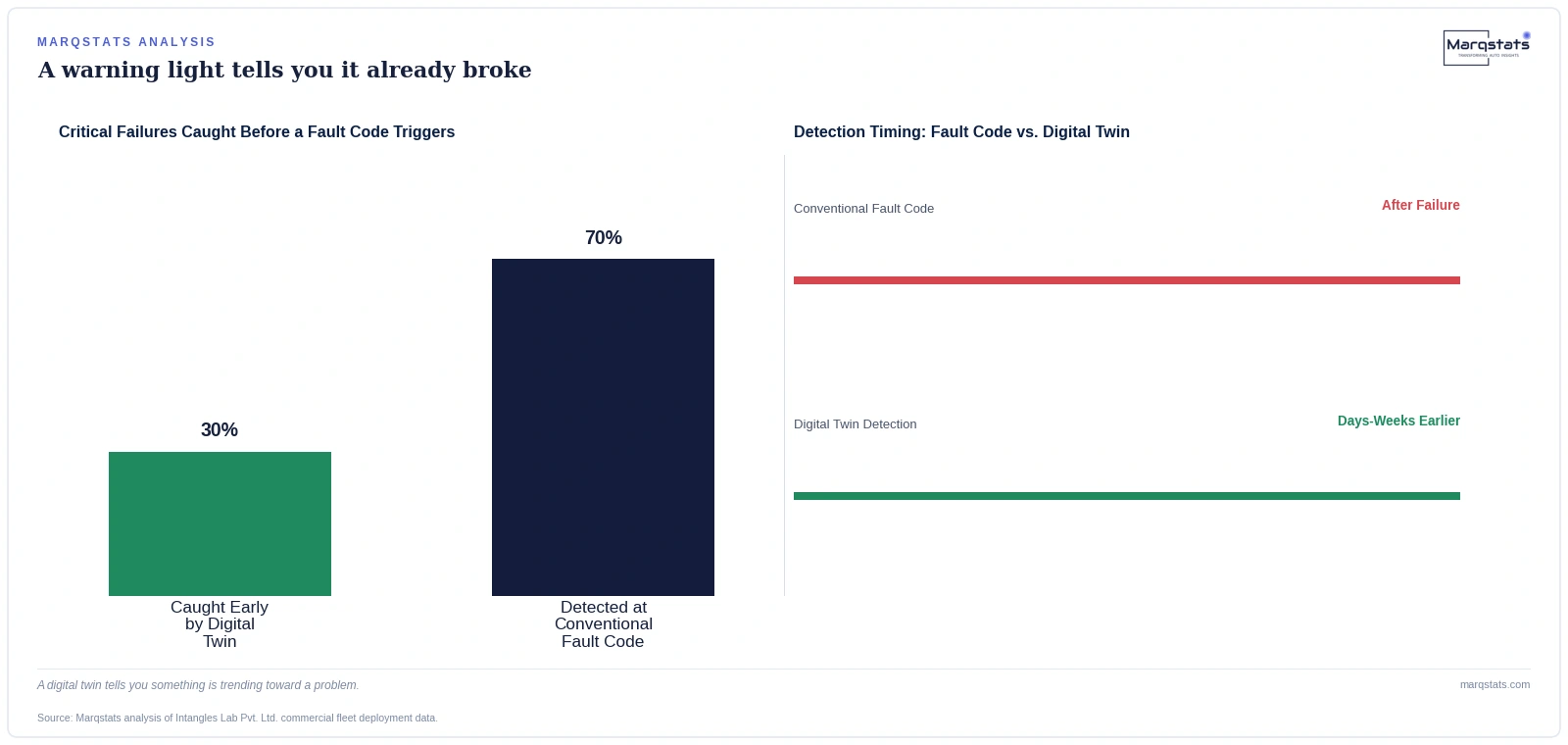
Deployment data quantifies both how often this early detection happens and what it's worth commercially. In 30% of critical mechanical and electrical failures across the analyzed fleet, the digital twin identified the developing problem days to weeks before a conventional onboard system would have triggered a fault code at all. That head start translates into an average savings of $500 per vehicle per month in prevented breakdowns and reduced maintenance overhead, since a problem caught early can typically be addressed during scheduled maintenance rather than as an emergency roadside repair, avoiding towing costs, driver downtime and the secondary freight delays that follow a commercial vehicle breakdown.

Why this specific gap matters more for commercial fleets than for individual drivers
The economics here land differently for a commercial fleet than for an individual vehicle owner, which is part of why digital twin adoption has concentrated so heavily in commercial and heavy-duty vehicle segments specifically. A single vehicle owner facing an unexpected repair experiences inconvenience and cost, but a commercial fleet vehicle breaking down mid-route creates cascading costs: a delayed delivery, a driver sitting idle, potential contractual penalties for late freight, and the cost of arranging alternate transport for whatever cargo that vehicle was carrying. The $500 monthly figure captures direct prevented-breakdown costs specifically - the broader value of avoiding those cascading commercial consequences is likely meaningfully larger still.
The counter-argument: does a 30% catch rate mean 70% of failures still go undetected until it's too late?
A fair reading of this statistic is that if a digital twin only catches 30% of critical failures ahead of a conventional fault code, the majority of failures, 70%, are apparently not being caught early at all, which could suggest the technology's practical impact is more limited than the headline savings figure implies. This is a reasonable question to raise. What it likely reflects, though, is that different failure modes have fundamentally different signatures: some mechanical or electrical failures genuinely do occur suddenly, with little or no detectable precursor pattern in the sensor data, regardless of how sophisticated the monitoring system is, while others develop gradually in ways a digital twin's multi-physics model can meaningfully track. The 30% figure represents the specific subset of failures where gradual degradation patterns exist and are detectable, not a ceiling on the technology's overall value, since even partial early detection across a large fleet compounds into the documented $500 average monthly savings.
What this means for fleet operators evaluating digital twin investment
- Fleet operators should evaluate digital twin platforms specifically on documented early-detection rates and per-vehicle savings data, rather than general predictive maintenance marketing claims.
- Maintenance planning teams should build workflows that act on digital twin alerts as scheduled maintenance opportunities, capturing the cost advantage over emergency roadside repairs that the early-detection window creates.
- Fleet operators should recognize that documented savings figures like $500 per vehicle monthly likely understate total value, since they typically capture direct prevented-breakdown costs without fully accounting for avoided cascading delivery and logistics disruption.
The full market picture
Marqstats' complete global digital twin vehicle diagnostics market analysis, including the full commercial deployment landscape across fleet operators, is available in the linked report below.
Related reportGlobal Digital Twin Vehicle Diagnostics Market Size, Share & Forecast 2026 – 2030