Market Snapshot
The US electric truck market was worth USD 1.55 billion in 2025 and is forecast to reach USD 3.32 billion by 2030, a CAGR of 16.46%. Volumes rise from 17,000 to 33,600 trucks, a 14.60% unit CAGR. Heavy delivery vans carry the market today; medium-duty and Class 8 trucks carry the growth.
Marqstats sizes the market bottom-up as new electric trucks above 3.5 tonnes gross vehicle weight sold in the United States, multiplied by the average net transaction price of each weight class, before incentives and excluding the 12% federal excise tax, charging equipment and service. The unit anchor is the International Energy Agency (IEA) Global EV Outlook 2026, which counts 17,000 electric medium and heavy freight trucks sold in the United States in 2025, up 25%. The Class 4 to 8 split comes from International Council on Clean Transportation (ICCT) registration data. The input the forecast is most sensitive to is the Class 8 ramp after Tesla, Inc. moved the Semi into volume production in the third quarter of 2026.
The headline hides a split market. Class 2b and 3 delivery vans above 3.5 tonnes made up 15,522 of the 17,000 units and 73.06% of 2025 value, led by Rivian Automotive, Inc., which the IEA says sold nearly 10,000 electric medium freight trucks in 2025 through its Amazon partnership. Class 4 to 8 trucks were only 1,478 registrations, worth USD 417.77 million.
Heavy trucks went backwards in 2025. ICCT counted 875 zero-emission Class 7 and 8 registrations, down 20.7% from 1,103 in 2024, and 287 of them were Orange EV yard tractors that work inside terminals. Medium-duty trucks moved the other way, up 61.7% to 603 registrations, as Harbinger Motors Inc. reported 733 commercial electric vehicles sold in the year.
Policy support was withdrawn across 2025 and early 2026: Congress revoked the California Advanced Clean Trucks waiver in June 2025, the Section 45W commercial clean vehicle credit ended on 30 September 2025, and the Environmental Protection Agency (EPA) rescinded all vehicle greenhouse gas standards in February 2026. Marqstats therefore expects a 2026 trough at USD 1.30 billion before fleet orders placed in late 2026 lift deliveries from 2027.
Key Takeaways
Market Overview & Analysis
Report Summary
An electric truck in this market is any new battery-electric or fuel cell freight vehicle above 3.5 tonnes gross vehicle weight, the threshold the IEA uses for medium and heavy freight trucks. In US terms that reaches down into heavier Class 2b and Class 3 delivery vans, through Class 4 to 6 step vans and box trucks, to Class 7 and 8 tractors, refuse trucks and yard tractors. Buses are outside the scope. The market is measured as vehicle value at net transaction price, so it can be read beside OEM revenue and fleet capital budgets.
The central conclusion is that the US market grew in 2025 for reasons unrelated to the heavy-duty mandates that dominated the policy debate. The IEA records US electric truck sales up 25% to 17,000, and it attributes the upward revision to Rivian delivery vans above 3.5 tonnes. At the same time ICCT counted zero-emission Class 7 and 8 registrations falling 20.7%. Growth came from parcel vans bought on contract by Amazon.com, Inc., and from medium-duty trucks that are close to diesel on purchase price, while the Class 8 tractor that regulators targeted lost ground.
The forecast follows that logic. Marqstats expects 33,600 electric trucks and USD 3.32 billion of sales in 2030. Vans grow slowly at 8.65% a year in value because prices fall and the largest buyer is already electrified at scale. Medium-duty value grows at 43.27% on fleet orders sized to operating cost, and Class 7 and 8 value grows at 26.35% from a low 2026 base as Tesla, Inc. and the legacy heavy-truck makers deliver against shipper-led programmes rather than state mandates.
US Electric Truck Market Size and Forecast
The US electric truck market grew from USD 135.10 million in 2021 to USD 550.00 million in 2022, USD 1,096.00 million in 2023, USD 1,419.75 million in 2024 and USD 1,550.88 million in 2025. Units rose from 1,175 to 5,400, 10,060, 13,600 and 17,000. The 2024 and 2025 unit totals reproduce the IEA series, which puts 2025 sales 25% above 2024; the 2021 to 2023 values are Marqstats estimates built from the start of Rivian van deliveries in 2022 and ICCT heavy-truck shares of 0.02%, 0.07% and 0.27% for those years. The 84.07% historical value CAGR reflects a market that started from almost nothing, so it says little about the forecast.
Marqstats forecasts USD 1,300.70 million in 2026, USD 1,641.60 million in 2027, USD 2,116.25 million in 2028, USD 2,648.50 million in 2029 and USD 3,316.00 million in 2030, with units of 15,220, 18,600, 23,000, 27,800 and 33,600. The path is not smooth. 2026 falls about 16% in value because the second half of 2025 pulled demand forward ahead of the 30 September expiry of the Section 45W credit, worth up to USD 7,500 for vehicles under 14,000 lb and up to USD 40,000 above it. Catalyst Mobility, the organisation formerly called CALSTART, counted 12,996 zero-emission truck deployments in the second half of 2025 against 6,526 in the first half, a pattern consistent with buyers racing the deadline.
Growth from 2027 rests on orders already signed, not on regulation. Harbinger Motors Inc. holds a 2,000-truck FedEx Corporation order with deliveries from the end of 2027, and the ZET SCALE shipper alliance has placed 2,500 battery-electric Class 8 trucks with Tesla, Inc. as primary supplier. Average prices decline throughout: Marqstats takes the van average from USD 73,000 in 2025 to USD 66,000 in 2030, Class 4 to 6 from USD 150,000 to USD 130,000, and the Class 7 and 8 blend from about USD 374,000 to USD 310,000 as the Tesla Semi, quoted at around USD 290,000 in long-range form, takes a larger share. Units therefore grow at 14.60% while value grows at 16.46%, and the mix shift toward heavier trucks is what keeps value growth above unit growth.
The Class 4 to 8 sub-market, the definition most regulators use for medium and heavy-duty trucks, was 1,478 units and USD 417.77 million in 2025 and reaches 7,600 units and USD 1,600.00 million in 2030, a 30.81% CAGR. That is the faster-growing half of the market and the half whose economics are most exposed to depot charging cost.
The 2025 US Electric Truck Market Was Built on Vans, Not Tractors
The signature finding is that the US electric truck market in 2025 was a van market. Of 17,000 electric trucks above 3.5 tonnes sold, 15,522, or 91.31%, were Class 2b and 3 delivery vans. The IEA states plainly that over 95% of US electric truck sales in 2025 were medium freight trucks and that Rivian sold nearly 10,000 of them. Heavy freight trucks were a rounding error by comparison.
The Class 8 picture is thinner still once the yard is removed. ICCT counted 875 zero-emission Class 7 and 8 registrations in 2025, a 0.34% share of new heavy-duty registrations. Of those, 287 were Orange EV yard tractors, which shuttle trailers inside distribution centres and ports and rarely touch a public road. That leaves about 588 on-road heavy electric trucks, including refuse and other vocational chassis. Harbinger Motors Inc. alone reported selling 733 medium-duty electric trucks in 2025.
The data sources disagree on purpose, and reading them together is the point. The IEA counts sales by weight in tonnes, which captures heavy vans. ICCT counts Class 4 to 8 registrations, which excludes them. Catalyst Mobility counts deployments from Class 2b upward and reached about 19,522 in 2025, higher than the IEA because it includes vans just under 3.5 tonnes. Marqstats publishes the IEA total as the headline and both sub-totals inside it, so a fleet buyer comparing a Class 8 forecast with a parcel van forecast is not comparing the same truck.
The implication is that policy aimed at Class 8 tractors has had little to do with the market so far. The revocation of the Advanced Clean Trucks waiver and the end of the Section 45W credit hit heavy trucks hardest because heavy trucks depended most on them. Vans, bought on long-term contract by Amazon.com, Inc., kept moving.
Medium-Duty Trucks Are Where Electric Economics Already Work
Medium-duty trucks are the one class where electric purchase price is close enough to diesel for fleets to buy without a subsidy. Harbinger Motors Inc. reported about USD 87 million of vehicle revenue on 733 trucks in 2025, an average near USD 119,000, and told trade press that its quarterly sales roughly doubled in the fourth quarter after federal incentives ended. Its CEO puts fuel savings at roughly USD 14,000 per vehicle per year.
The FedEx Corporation order announced on 30 September 2026 covers 2,000 Class 5 and 6 trucks for more than USD 300 million, about USD 150,000 per truck, with deliveries starting at the end of 2027. A single order of that size is more than three times the 603 Class 4 to 6 zero-emission registrations ICCT counted for the whole country in 2025. Marqstats takes Class 4 to 6 units to 4,200 by 2030, a 47.43% unit CAGR.
Competition in the class is thinning at the same time. General Motors Company ended BrightDrop production at CAMI Assembly in Ingersoll, Ontario in October 2025 after selling fewer than 5,000 vans in the first nine months against a 50,000 target. Step van and box truck buyers now choose among a short list of purpose-built electric chassis, which supports pricing for the survivors.
Market Dynamics
Key Drivers
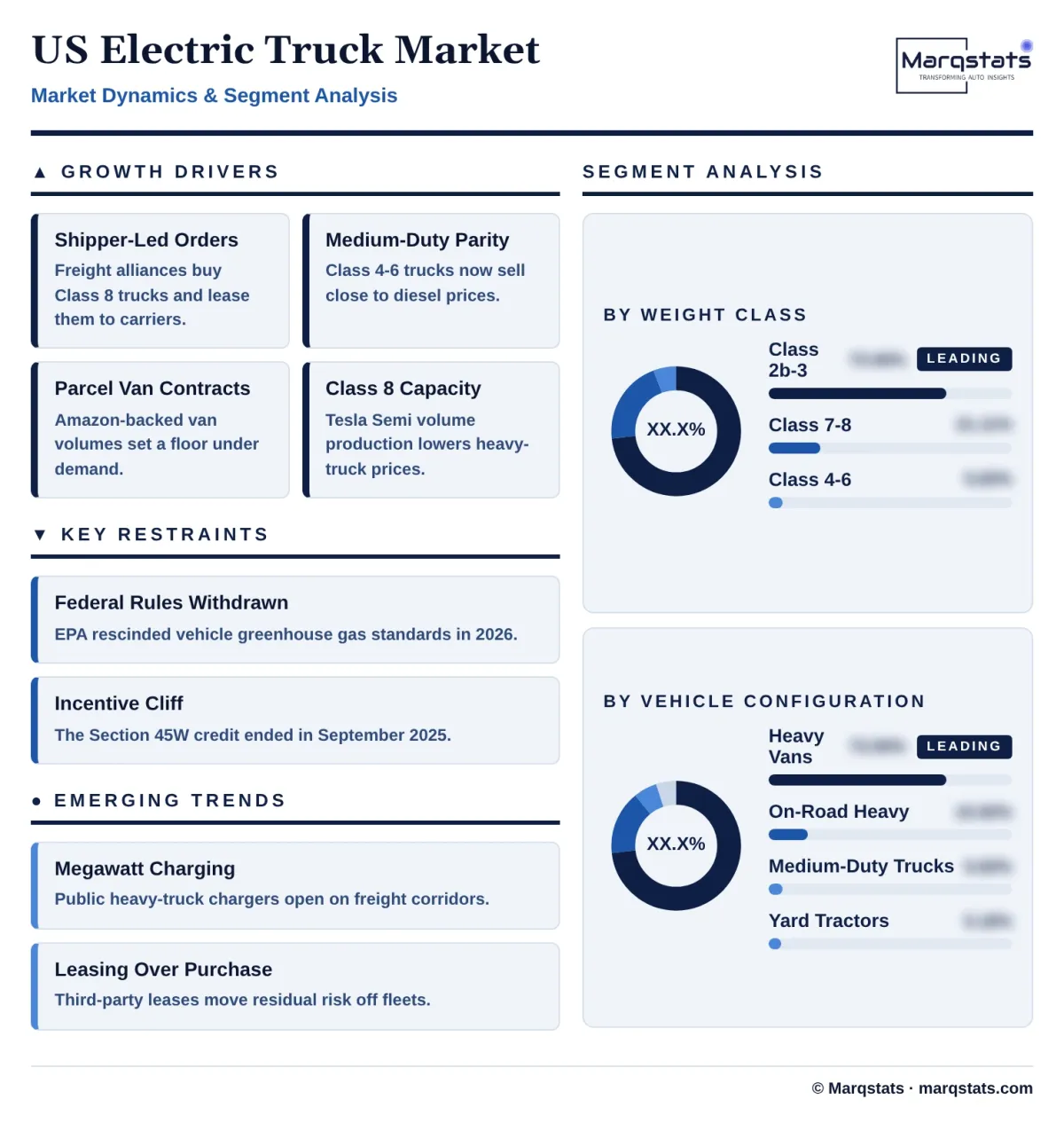
Four forces carry US electric truck demand through 2030, and none of them is a federal mandate.
- Shipper-led procurement: the ZET SCALE alliance launched by Catalyst Mobility and the Smart Freight Centre, with founding shippers including Microsoft Corporation and PepsiCo, Inc., placed 2,500 battery-electric Class 8 trucks in September 2026 through ZET Financial, moving purchase risk from carriers to a leasing vehicle.
- Medium-duty cost parity: Harbinger Motors Inc. sold 733 electric trucks in 2025 at an average near USD 119,000 and secured a 2,000-truck FedEx Corporation order worth more than USD 300 million, evidence that Class 4 to 6 buyers now purchase on operating cost.
- Parcel van contracts: Rivian Automotive, Inc. sold nearly 10,000 electric delivery vans above 3.5 tonnes in 2025, according to the IEA, under its Amazon.com, Inc. partnership, giving the market a volume floor that does not depend on incentives.
- Class 8 production capacity: Tesla, Inc. confirmed on 21 October 2026 that the Semi entered volume production in Nevada during the third quarter, with installed capacity of 25,000 trucks a year reported by FreightWaves, enough to change average Class 8 pricing.
Key Restraints
The restraints are regulatory withdrawal and the cost of heavy-truck charging, and both bite hardest on Class 8.
- Federal standards withdrawn: the EPA rescinded the 2009 Endangerment Finding and all motor vehicle greenhouse gas standards in a final rule published in the Federal Register on 18 February 2026, removing the Phase 3 heavy-duty targets that had underpinned OEM electric truck plans.
- Incentive cliff: Public Law 119-21, signed on 4 July 2025, ended the Section 45W commercial clean vehicle credit for vehicles acquired after 30 September 2025, removing up to USD 40,000 per heavy truck and pulling 2025 demand forward.
- State mandate retreat: President Trump signed Congressional Review Act resolutions on 12 June 2025 revoking the EPA waiver for the California Advanced Clean Trucks rule, and the California Air Resources Board repealed the high-priority and drayage fleet requirements of Advanced Clean Fleets in September 2025.
Key Trends
Three trends change how electric trucks are bought and charged in the United States.
- Megawatt charging enters service: Tesla, Inc. opened its first public Megacharger in Ontario, California on 8 March 2026 at 750 kW, giving long-range Class 8 trucks a route charging option beyond the depot.
- Leasing replaces outright purchase for Class 8: ZET Financial issues purchase orders and runs a lease that takes residual-value risk off fleet balance sheets, so carriers pay per month rather than buying a USD 300,000-plus asset.
- Fuel cell trucks retreat: Nikola Corporation filed for Chapter 11 protection in February 2025, removing the largest US hydrogen truck programme and leaving battery-electric drive as the default for US freight.
Strategic Implications
- For entrants: the open door is Class 4 to 6. General Motors Company has left the electric van segment, legacy truck makers have slowed medium-duty programmes, and buyers such as FedEx Corporation have shown they will place four-figure orders with a new manufacturer whose price is close to diesel.
- For incumbents: Daimler Truck North America LLC, PACCAR Inc, AB Volvo and International Motors, LLC face a Class 8 market where Tesla, Inc. wins RFPs on price and capacity. Matching a long-range tractor quoted near USD 290,000 matters more than adding range, because shipper alliances buy on total cost per mile.
- For suppliers and investors: value is shifting from vans to heavier trucks, with Class 4 to 8 rising from 26.94% to 48.25% of market value by 2030. Battery, e-axle and charging suppliers should size capacity to that mix rather than to unit counts, which vans will dominate until the end of the decade.
Market Segmentation
Delivery vans are the largest class, worth USD 1,133.11 million in 2025, 73.06% of value, on 15,522 units. Marqstats derives the unit figure as the IEA US total less ICCT Class 4 to 8 registrations. Value grows only 8.65% a year to USD 1,716.00 million in 2030, 51.75% of value, because the average price falls from USD 73,000 to USD 66,000 and the largest buyer, Amazon.com, Inc., already runs a large Rivian fleet. Ford Motor Company supplies the E-Transit; General Motors Company exited in October 2025.
Medium-duty trucks are the fastest-growing class, from USD 90.45 million in 2025, 5.83% of value, to USD 546.00 million in 2030, 16.47%, a 43.27% CAGR. ICCT counted 603 registrations in 2025, up 61.7%. Step vans and box trucks run fixed urban routes that suit 150 to 250 kWh batteries, and Harbinger Motors Inc. says its trucks are close to cost parity with equivalent diesel models, including Freightliner.
Heavy trucks were worth USD 327.32 million in 2025, 21.11% of value, on 875 registrations, and reach USD 1,054.00 million in 2030, 31.79%, a 26.35% CAGR. The class falls to USD 189.80 million in 2026 after a 60% first-quarter drop, then rebuilds on the ZET SCALE order and Tesla Semi volume production. Live Marqstats coverage of Class 8 and of port drayage sits inside this class and is not additive.
Parcel and service vans above 3.5 tonnes: USD 1,133.11 million in 2025 (73.06%) and USD 1,716.00 million in 2030 (51.75%). The configuration matches the Class 2b-3 class exactly; it is listed again so the configuration dimension partitions on its own.
Step vans, box trucks and light vocational chassis in Class 4 to 6: USD 90.45 million in 2025 (5.83%) and USD 546.00 million in 2030 (16.47%).
Class 7 and 8 tractors, refuse trucks and other vocational trucks licensed for public roads: about 588 units and USD 246.96 million in 2025 (15.92%), valued at about USD 420,000 each, rising to about 2,700 units and USD 893.00 million in 2030 (26.93%), a 29.31% CAGR. This is the configuration Tesla, Inc. and the ZET SCALE programme target.
Off-road terminal tractors registered as Class 8: 287 Orange EV units in 2025 at about USD 280,000, USD 80.36 million (5.18%), rising to about 700 units and USD 161.00 million in 2030 (4.86%). Yard tractors electrify early because duty cycles are short and charging sits next to the dock, but their share of value slips as on-road trucks scale.
By Geography
California
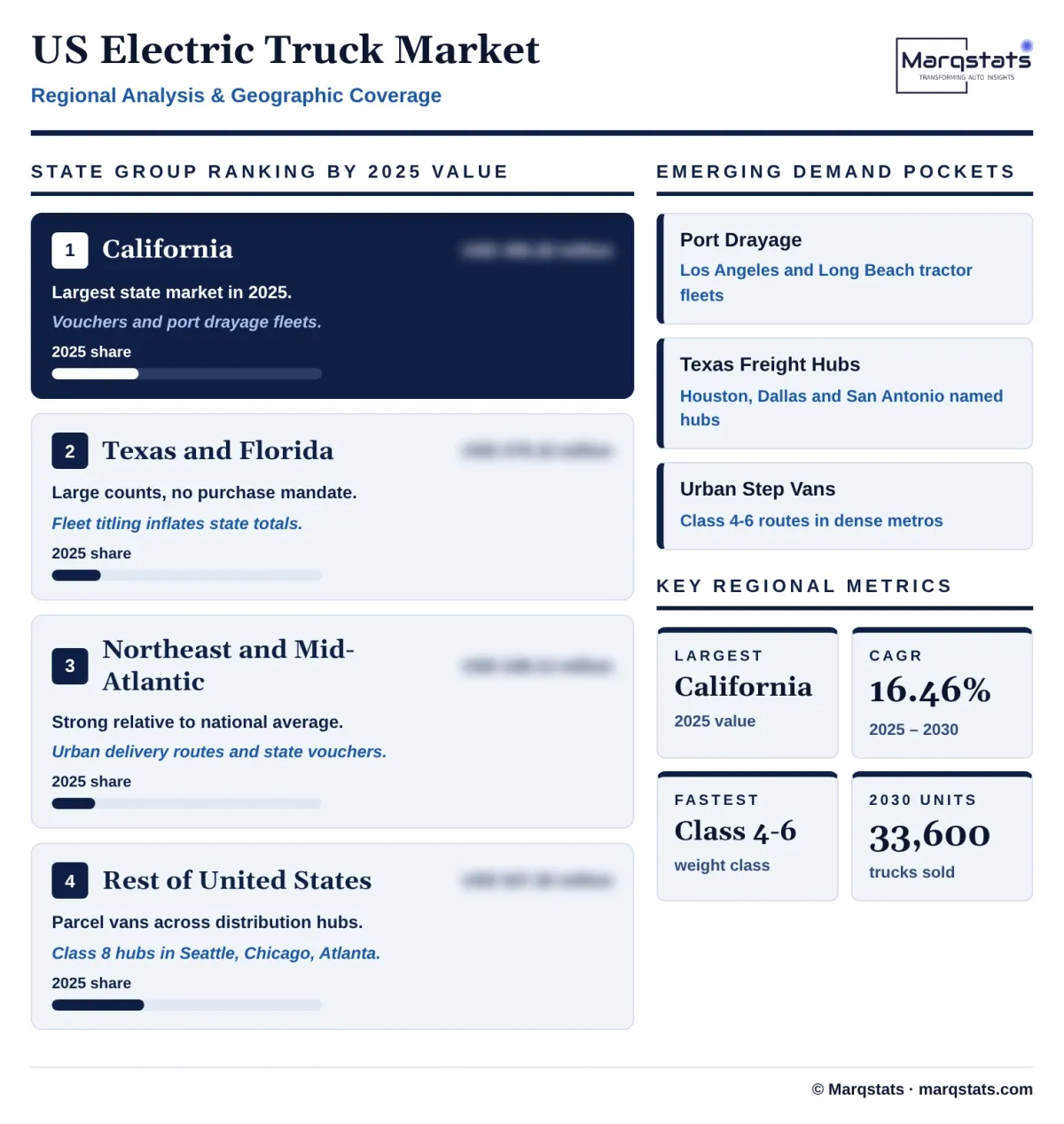
California is the largest state market, with an estimated 32% of 2025 value, USD 496.28 million. Catalyst Mobility ranks California first on cumulative deployments and on deployments relative to the national average. The Hybrid and Zero-Emission Truck and Bus Voucher Incentive Project, port drayage fleets at Los Angeles and Long Beach, and the first public Tesla Megacharger in Ontario keep heavy-truck demand concentrated there even after the Advanced Clean Trucks waiver was revoked in June 2025.
Texas and Florida
Texas and Florida together hold an estimated 18% of 2025 value, USD 279.16 million. Catalyst Mobility places both states among the top three for cumulative deployments, yet neither has a purchase mandate. Much of that volume reflects where national parcel fleets and leasing companies title their vans rather than where the trucks operate, so state counts overstate local charging demand. Houston, Dallas and San Antonio are nonetheless named ZET SCALE deployment hubs.
Northeast and Mid-Atlantic
New York, New Jersey, Pennsylvania and neighbouring states hold an estimated 16% of 2025 value, USD 248.14 million. Catalyst Mobility ranks New York and Pennsylvania with California among the best performers relative to the national average, supported by the New York Truck Voucher Incentive Program and dense urban delivery routes around the Port of New York and New Jersey.
Rest of United States
The remaining states hold 34.00% of 2025 value, USD 527.30 million, mostly parcel vans spread across distribution hubs, with Class 8 activity around Seattle and Tacoma, Chicago and Atlanta, all ZET SCALE hubs. State shares are Marqstats estimates built from Catalyst Mobility rankings and fleet domicile patterns; the forecast is held at national level because state rules remain in litigation.
How Competition Is Evolving
Competition is organised by weight class, and each class has a different leader. In vans, Rivian Automotive, Inc. is the volume supplier through its Amazon.com, Inc. contract, with Ford Motor Company the main alternative after General Motors Company ended BrightDrop. In Class 4 to 6, Harbinger Motors Inc. has the largest disclosed order book, competing with Freightliner models from Daimler Truck North America LLC and with medium-duty chassis from International Motors, LLC. In Class 8, Daimler Truck North America LLC (Freightliner eCascadia), PACCAR Inc (Kenworth and Peterbilt), AB Volvo (Volvo VNR Electric and Mack) and International Motors, LLC hold the dealer networks, while Tesla, Inc. holds the newest capacity.
Marqstats does not publish company market shares because no registry discloses electric truck registrations by manufacturer for the United States as a whole. The competitive read comes from dated actions instead. Tesla, Inc. won the primary slot in the 2,500-truck ZET SCALE programme through a competitive request for proposals, with Kenworth, Volvo and RIDE named as secondary suppliers, and moved the Semi into volume production in the third quarter of 2026. Orange EV LLC supplied 287 of the 875 zero-emission Class 7 and 8 registrations in 2025, a third of the heavy segment, from a niche most fleet buyers never see.
The heavy end is moderately concentrated; the van end is concentrated around one buyer and one supplier. The structural risk for incumbents is that shipper alliances now run the procurement, choose on price per mile and lease the trucks through a third party. That removes the dealer relationship that protected legacy Class 8 brands in diesel.
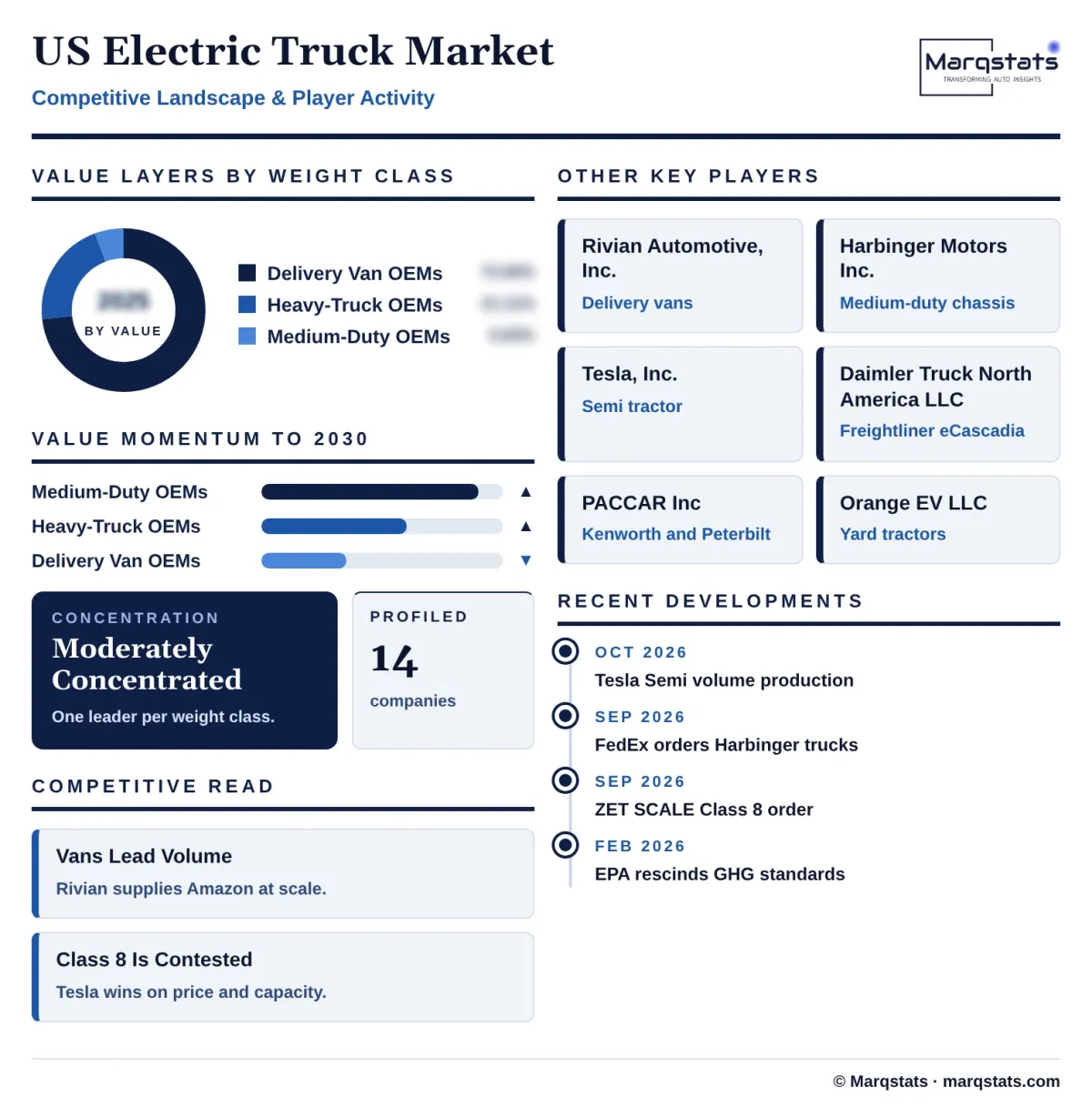
Companies Covered
Companies covered in the report include:
Recent Market Activity
Table of Contents
Coverage & Segmentation
Included: new battery-electric and hydrogen fuel cell trucks above 3.5 tonnes gross vehicle weight sold in the United States, covering heavier Class 2b and Class 3 delivery vans, Class 4 to 6 medium-duty trucks and Class 7 and 8 tractors, vocational trucks and yard tractors, valued at average net transaction price before incentives. Excluded: electric buses and coaches, electric light commercial vehicles at or below 3.5 tonnes, the 12% federal excise tax, charging equipment, electricity, service, telematics and used trucks. Base year 2025; history 2021 to 2025; forecast 2026 to 2030.
Boundaries with other Marqstats coverage: the US Class 8 Electric Truck Market and the US Electric Drayage Truck Market are sub-slices of the Class 7 and 8 class here and are valued on their own bases; do not add them to this market. The global Electric Truck Market contains the United States as one country. Depot and public charging for these trucks is covered separately by Marqstats charging reports and is not part of vehicle value.