Market Snapshot
The Philippines modern PUV market size is estimated at USD 126.37 million in 2025 and is projected to reach USD 273.30 million by 2030, growing at a CAGR of 16.68% over 2026 – 2030. Annual deliveries rise from about 2,850 to 6,300 vehicles, a 17.19% annual rate, while the average price per vehicle eases from about PHP 2.55 million to PHP 2.49 million as smaller Class 1 vehicles and locally built electric models take a larger share.
Marqstats defines the market as the value of new modern public utility vehicles (modern PUVs) that meet Philippine National Standards (PNS) 2126 and 2131, Classes 1 to 4, delivered to consolidated transport cooperatives, corporations and other franchised operators under the Public Transport Modernization Program (PTMP). It covers diesel and electric vehicles, whether built locally on imported chassis or imported complete, and values them at the delivered price paid by the operator in Philippine pesos converted at PHP 57.50 per US dollar. Traditional jeepneys, UV Express vans that do not meet PUV standards, full-size buses, tricycles and used vehicles are excluded.
Class 2 vehicles, the direct replacement for the traditional jeepney, account for 70.75% of 2025 value, diesel vehicles for 95.97% and vehicles with locally built bodies for 80.66%. Rest of Luzon accounts for 36.00% of value, while electric modern PUVs, bought by franchised operators, grow fastest at 66.94% a year from a very small base.
Key Takeaways
Market Overview & Analysis
Report Summary
Marqstats sizes the Philippines modern PUV market as the delivered value of new vehicles that meet the Philippine National Standards for modern public utility vehicles and are bought by consolidated transport service entities. The standards are PNS 2126:2017 and PNS 2131:2018, which define Classes 1 to 4 by seating, standing room, doors, emergency exits and safety equipment. About 2,850 vehicles were delivered in 2025, worth an estimated PHP 7.27 billion, or USD 126.37 million, at an average price of about PHP 2.55 million.
The traditional jeepney is built on a reconditioned truck chassis with side-facing benches, an open rear entrance and no air conditioning. The Public Transport Modernization Program, formerly the Public Utility Vehicle Modernization Program, was launched under the Omnibus Franchising Guidelines of the Department of Transportation (Department Order 2017-011). It replaces these vehicles with air-conditioned vehicles that carry GPS tracking, CCTV and automated fare collection, and it requires individual franchise holders to join cooperatives or corporations that hold the franchise and buy vehicles in fleets.
Consolidation is nearly complete. The LTFRB reported in January 2026 that about 90% of operators had consolidated, up from 73% in early 2024 and a rate of only 40% for the National Capital Region at the first deadline. Regional gaps remain: the Davao region was reported at 88% consolidation while the National Capital Region lagged. Consolidation does not itself buy a vehicle. Each cooperative must also obtain an approved Local Public Transport Route Plan (LPTRP) from its local government, and banks lend against approved routes.
Financing is the bottleneck. Cooperatives borrow from the Land Bank of the Philippines through its SPEED PUV loan facility and from the Development Bank of the Philippines through its PASADA window, with a government equity subsidy per vehicle that the DOTr said it would raise to PHP 400,000 for 2026. Transport Secretary Vince Dizon told reporters in June 2025 that the program was not viable in its current state but would continue, the Development Bank of the Philippines was reported to have halted lending to some cooperatives, and in March 2026 transport groups asked the government to freeze modern jeepney loan payments.
Rescue measures arrived in September 2026. The DOTr and the LTFRB began paying qualified cooperatives PHP 20,000 per vehicle per month for three months, and the LTFRB released a first tranche of about PHP 9 million. Marqstats treats this as relief for existing loans, not as a new source of demand, which is why its forecast of 17.19% a year for deliveries is well below the pace needed to replace the fleet.
The market grew from an estimated 1,450 vehicles and USD 56.74 million in 2021 to 2,550 vehicles and USD 110.87 million in 2024 at the constant 2025 rate, then rose 13.98% to USD 126.37 million in 2025. Marqstats compares the 2025 volume with 6,783 light-duty trucks and buses in Category III of the 2025 Chamber of Automotive Manufacturers of the Philippines, Inc. (CAMPI) and Truck Manufacturers Association (TMA) sales report, which includes the chassis that become Class 1 to Class 3 modern PUVs, and estimates that modern PUV deliveries equal about 42.02% of that category.
Philippines Modern PUV Market Size and Forecast
The Philippines modern PUV market grows from USD 126.37 million in 2025 to USD 273.30 million in 2030, a CAGR of 16.68%. Volume contributes most of the growth: deliveries rise at 17.19% a year, from about 2,850 to 6,300 vehicles, while the average price eases at 0.44% a year, from about PHP 2.55 million to PHP 2.49 million, because the mix shifts toward cheaper Class 1 and locally built electric models.
The 2025 value is built bottom-up from classes and prices. Marqstats estimates 430 Class 1 vehicles at about PHP 1.50 million each, 1,940 Class 2 vehicles at PHP 2.65 million, 400 Class 3 vehicles at PHP 3.05 million and 80 Class 4 vehicles at PHP 3.25 million. Prices are the delivered price paid by the operator, taken from the mid-point of the 2025 price bands for each class: PHP 1.20 million to PHP 1.80 million for Class 1, PHP 2.40 million to PHP 2.90 million for Class 2, PHP 2.80 million to PHP 3.30 million for Class 3 and PHP 3.00 million to PHP 3.50 million for Class 4.
The forecast follows credit, not demand. Marqstats expects deliveries of 3,150 vehicles in 2026, 3,700 in 2027, 4,500 in 2028 and 5,400 in 2029, worth USD 138.75 million, USD 162.21 million, USD 196.67 million and USD 235.37 million. Growth accelerates after 2027 as approved route plans clear the loan queue, the 2026 equity subsidy of PHP 400,000 reaches more cooperatives, the DTI E-Transport Loan Program of PHP 2 billion lends to electric buyers and the Toyota Tamaraw adds an affordable Class 1 option.
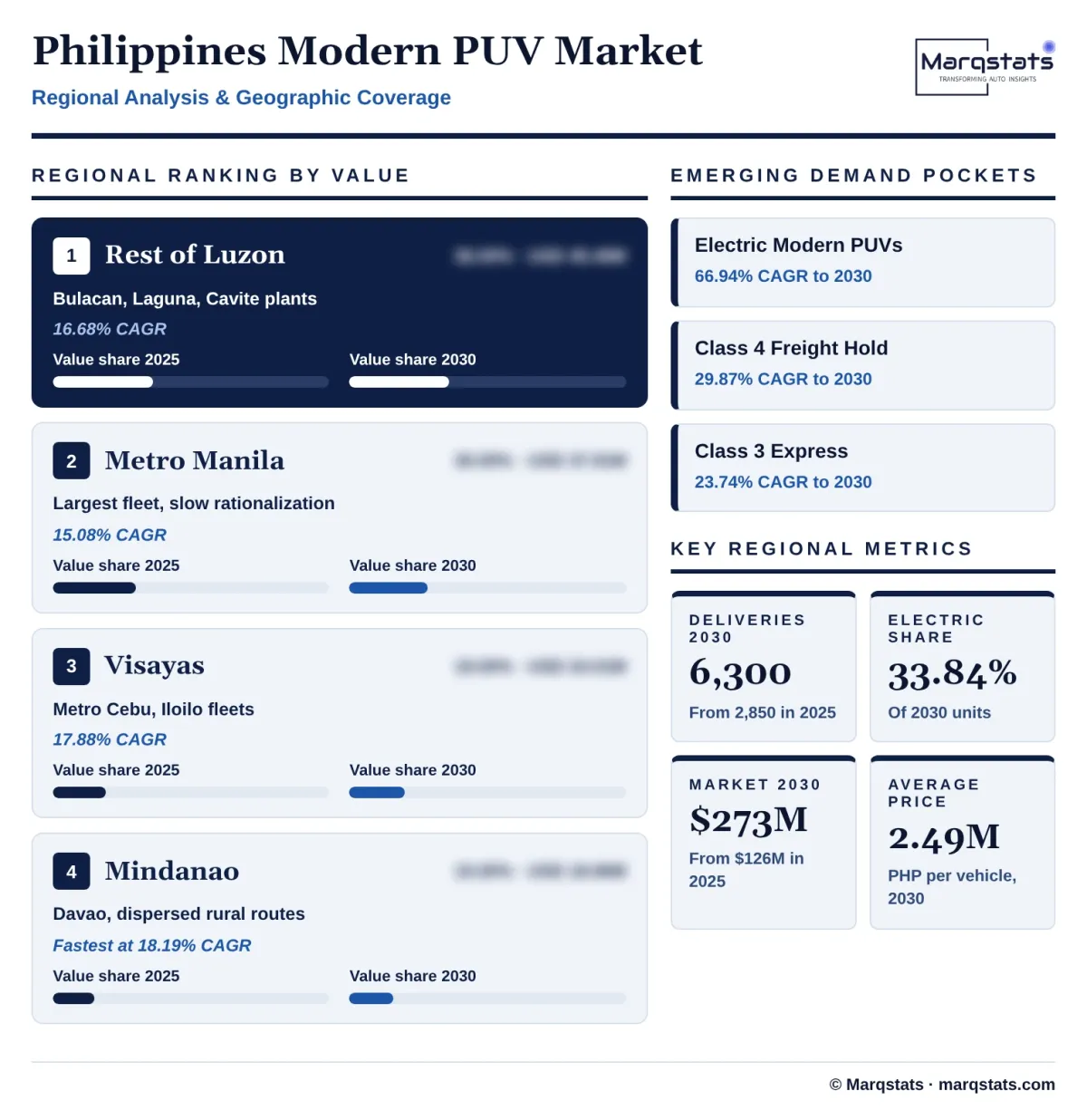
Electric vehicles are sized consistently with the Marqstats electric jeepney analysis. Franchised electric modern PUVs rise from 139 vehicles and USD 5.09 million in 2025 to 2,132 vehicles and USD 66.00 million in 2030, which lifts their share of units from 4.88% to 33.84%. The average price of an electric vehicle falls from about PHP 2.11 million to PHP 1.78 million as locally assembled models replace imports, while the average diesel price rises from about PHP 2.57 million to PHP 2.86 million.
Marqstats tracks four indicators to monitor the forecast: the number of approved route plans, quarterly releases of equity subsidies and monthly amortization aid, the share of cooperative loans past due at the Land Bank of the Philippines and the Development Bank of the Philippines, and the monthly CAMPI and TMA sales of Category III and Category IV light and medium trucks and buses.
Market Dynamics
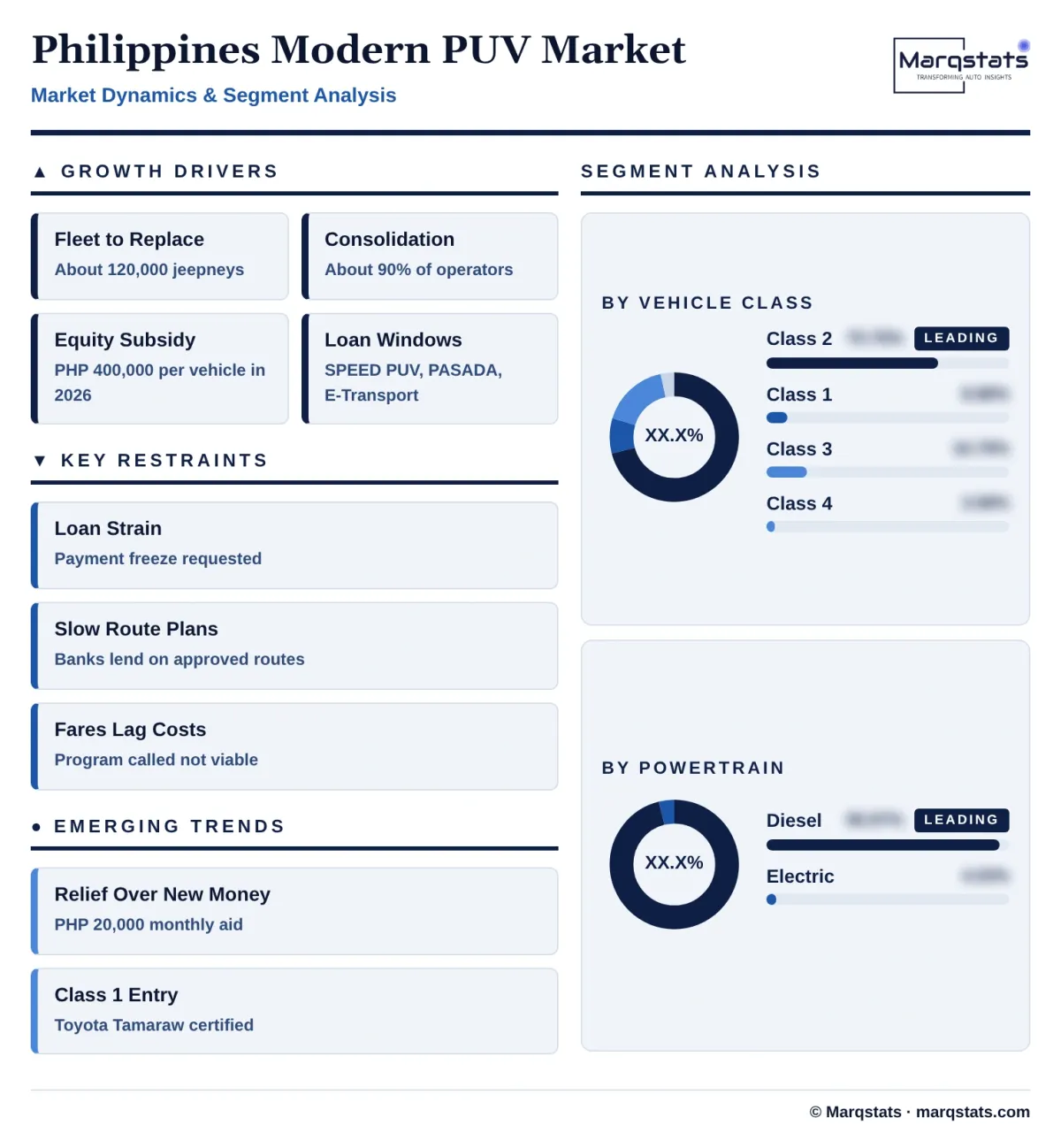
Key Drivers
Five forces keep demand for modern public utility vehicles alive even as the cooperatives that buy them struggle to pay for them.
- A large fleet must still be replaced. The LTFRB puts the national jeepney fleet at about 120,000 vehicles, and the program bars the old vehicles from franchised routes once cooperatives hold consolidated franchises, so every approved route plan creates a firm order for new PNS-compliant vehicles.
- Consolidation has reached about 90%. The LTFRB said in January 2026 that about 90% of operators had consolidated, so almost every franchise holder is now inside a cooperative or corporation that can borrow and buy in fleets.
- Equity subsidies lower the entry cost. The DOTr raised the per-vehicle equity subsidy in successive steps, to PHP 280,000 in 2023 and, it said in November 2025, to PHP 400,000 for 2026, which covers more than 14% of a PHP 2.8 million Class 2 vehicle before any loan is drawn.
- State banks and a new loan window finance the vehicles. The Land Bank of the Philippines runs the SPEED PUV facility, the Development Bank of the Philippines runs PASADA, and in April 2026 the Department of Trade and Industry (DTI) launched a PHP 2 billion E-Transport Loan Program through the Small Business Corporation that lends up to PHP 1.5 million per vehicle.
- Local manufacturing is expanding. Executive Order No. 121, signed in July 2026, created the Electric Vehicle Incentive Strategy with up to PHP 60 billion of tax payment certificates and up to PHP 15 billion per model, which supports local builders such as Francisco Motors and LCS-EMON, and Toyota Motor Philippines has brought the Tamaraw into the Class 1 segment.
Key Restraints
Four constraints hold annual deliveries far below what a full replacement of the jeepney fleet would need.
- Cooperative loans are under strain. The Development Bank of the Philippines was reported to have halted lending to some cooperatives, transport groups asked in March 2026 for a freeze on modern jeepney payments, and the DOTr began paying PHP 20,000 per vehicle per month in September 2026 to stop defaults, which shows that existing loans absorb attention before new ones.
- Route plans are slow. Banks lend against approved routes, but many local governments had not completed their Local Public Transport Route Plans when the DOTr set an end-2026 deadline, so cooperatives with a consolidated franchise cannot yet order vehicles.
- Operating costs outrun fares. The Transport Secretary said in June 2025 that the program was not viable in its current state, and fuel costs, fixed fares and the cost of drivers on wages, depots and telematics squeeze the daily margin from which a loan must be paid.
- Cheaper complete vehicles compete with local builders. Imported Chinese minibuses are sold at lower prices than locally built vehicles, and the Automotive Body Manufacturers Association of the Philippines (ABMAP) has asked the government to favour local bodybuilding in procurement, which shows how exposed domestic coachbuilders are to price competition.
Key Trends
Four shifts are changing which vehicles are built, financed and delivered under the modernization program.
- Relief replaces new money. Monthly amortization aid of PHP 20,000 per vehicle for three months, announced in September 2026, shows the government now spends on keeping existing vehicles in service before expanding the fleet.
- Class 1 is the new entry point. Toyota Motor Philippines gained DOTr certification for the Tamaraw as a modern PUV in 2026, and its Class 1 price band of PHP 1.20 million to PHP 1.80 million puts a branded vehicle within reach of feeder-route cooperatives.
- Electric models move from pilots to cooperatives. The LTFRB counted fewer than 1,000 electric jeepneys on the road in June 2026, but local builders and the DTI loan window are shifting the first fleet orders from local government pilots to franchised cooperatives.
- Private fleet leasing enters the debate. Congressional and DOTr discussion of institutional ownership would move the vehicle off the cooperative balance sheet and let a lessor charge a per-kilometre fee, which would change who places the order.
Strategic Implications
- For chassis makers and importers, the credit queue decides volume. Isuzu, Hyundai, Hino and Fuso gain most from approved route plans in Luzon, so dealer finance packages that match the Land Bank of the Philippines term of seven years win more orders than a lower list price.
- For local coachbuilders, price competition from complete imports is the main risk. Builders that offer a 50% local content body, a warranty and parts supply in the Visayas and Mindanao can defend share where imported minibuses have a service gap.
- For banks, route plan approval is the best credit filter. Lending only against approved routes, with telematics and automated fare data feeding monthly loan monitoring, protects balance sheets while deliveries stay far below the pace needed to replace the fleet.
- For electric vehicle builders, the Class 1 and Class 2 locally built segment is the opening. Prices near PHP 1.78 million by 2030 and the DTI loan window make electric vehicles competitive with diesel for cooperatives that own a depot.
- For policymakers, the number to watch is deliveries as a share of the fleet. Moving from 2.38% to 5% of the fleet a year would need about 6,000 vehicles, more than double the 2025 level, a rate Marqstats expects to be reached only between 2029 and 2030.
Market Segmentation
Class 1 vehicles are compact, with 9 to 12 seats and no standing, built for rural feeder lines and narrow barangay roads. They account for 8.88% of 2025 value, USD 11.22 million, and grow at 21.74% a year to USD 30.00 million and 10.98% of the market. Marqstats estimates 430 units in 2025 rising to 1,150 in 2030, helped by the Toyota Tamaraw, the Suzuki Carry and Mahindra utility-based models.
Class 2 vehicles carry 22 to 26 passengers with standing room of at least 1,750 millimetres and a kerbside power door. They account for 70.75% of 2025 value, USD 89.41 million, and grow at 13.04% a year to USD 165.03 million, although their share falls to 60.38%. About 1,940 units were delivered in 2025, mostly on Isuzu NLR, Fuso Canter, Hino 200 and Hyundai chassis for dense urban corridors.
Class 3 vehicles have all forward-facing seats for peri-urban and inter-municipal routes. They account for 16.79% of 2025 value, USD 21.22 million, and grow at 23.74% a year to USD 61.57 million and 22.53% of the market. About 400 units were delivered in 2025, rising to 1,200 in 2030 as express routes are approved.
Class 4 vehicles add a freight hold for inter-provincial routes that move farm cargo to cities, and PNS 2131 sets their standard. They account for 3.58% of 2025 value, USD 4.52 million, and grow fastest among classes, at 29.87% a year, to USD 16.70 million from a very small base of 80 vehicles.
Euro 4 and Euro 5 common-rail diesel vehicles account for 95.97% of 2025 value, USD 121.28 million, and grow at 11.32% a year to USD 207.30 million, while their share falls to 75.85%. Isuzu, Hyundai, Hino and Fuso supply most of the chassis, and a nationwide parts network and 16 to 18 hour duty cycles keep diesel ahead of electric.
Electric modern PUVs bought by franchised operators account for 4.03% of 2025 value, USD 5.09 million, and grow at 66.94% a year to USD 66.00 million and 24.15% of the market. About 139 vehicles were delivered in 2025 and Marqstats expects 2,132 in 2030, led by locally built Class 1 and Class 2 models. Non-franchised electric shuttles and local government circulators are outside this market.
Vehicles with a body built in the Philippines on an imported chassis account for 80.66% of 2025 value, USD 101.93 million, and grow at 15.04% a year to USD 205.40 million. Centro Manufacturing, Almazora Motors, Del Monte Motor Works and local electric builders supply cabins, air conditioning and telematics fitment on Japanese and Korean chassis.
Fully built imported minibuses, mostly from China, account for 19.34% of 2025 value, USD 24.44 million, and grow faster, at 22.67% a year, to USD 67.90 million and 24.84% of the market. Marqstats prices them at about 85% of a locally built vehicle, which is the main reason cooperatives with weak credit choose them.
By Geography
Rest of Luzon
Rest of Luzon, led by CALABARZON and Central Luzon, accounts for 36.00% of 2025 value, USD 45.49 million, and grows at 16.68% a year to USD 98.39 million. Industrial zones, peri-urban routes and higher consolidation rates than the capital mean more cooperatives here hold approved route plans, and most chassis assemblers and bodybuilders sit in Bulacan, Laguna and Cavite.
Metro Manila
Metro Manila accounts for 30.00% of 2025 value, USD 37.91 million, and grows at 15.08% a year to USD 76.52 million, while its share falls to 28.00%. The region held the largest jeepney fleet but reached only 40% consolidation at the first deadline, and the cost of depot land and union opposition slow route rationalization on overlapping arterial roads.
Visayas
The Visayas account for 19.00% of 2025 value, USD 24.01 million, and grow at 17.88% a year to USD 54.66 million. Metro Cebu and Iloilo carry large jeepney fleets, and the LTFRB has had to manage waits for modern vehicle deliveries in Central Visayas.
Mindanao
Mindanao accounts for 15.00% of 2025 value, USD 18.96 million, and grows fastest, at 18.19% a year, to USD 43.73 million and 16.00% of the market. Davao was reported at 88% consolidation and dealers have delivered Hyundai vehicles to cooperatives in Mindanao, but dispersed rural routes and local bank underwriting limit early volume.
How Competition Is Evolving
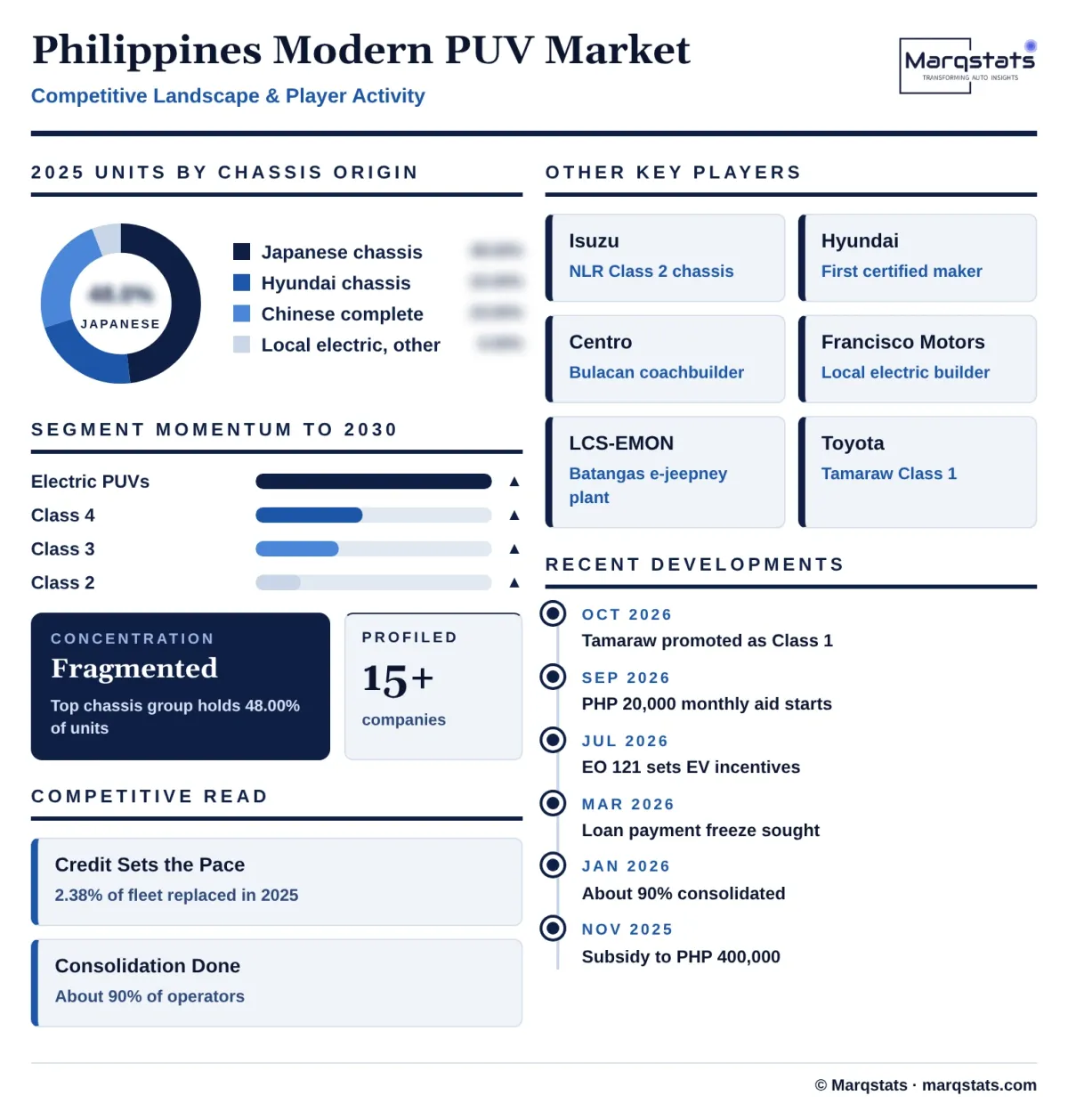
The market is fragmented and chassis-led. Marqstats estimates that Japanese chassis from Isuzu, Hino, Mitsubishi Fuso and Toyota carried about 48.00% of 2025 units, Hyundai chassis about 22.00%, Chinese complete vehicles from Foton, BAIC, King Long and others about 24.00%, and Philippine-built electric and other models about 6.00%. These are Marqstats estimates built from CAMPI and TMA brand totals, cooperative announcements and the DOTr list of certified vehicles.
Japanese and Korean makers win on service. In 2025 the Chamber of Automotive Manufacturers of the Philippines and the Truck Manufacturers Association reported 17,237 sales for Isuzu, 10,475 for Hyundai, 2,126 for Hino and 1,461 for Mitsubishi Fuso across all models, and Hyundai Asia Resources, Inc. was the first automaker to complete the DOTr modern PUV certification. Cooperatives choose these brands because dealers handle warranty work, parts and bank documentation.
Local coachbuilders compete on content and delivery. Centro Manufacturing Corporation, Almazora Motors Corporation and Del Monte Motor Works build the body, cabin, air conditioning and safety systems on imported chassis, and ABMAP has asked the DOTr to set a 50% local value threshold in government procurement so that imported complete vehicles do not take their orders.
Electric builders compete on price and finance. Francisco Motors Corporation, LCS-EMON e-Jeepney Manufacturing Corp., Tojo Motors Corp. and Sarao Motors target the Class 1 and Class 2 segments with locally assembled models at about PHP 1.20 million to PHP 2.40 million, supported by the DTI E-Transport Loan Program, while Foton Motor Philippines sells imported models.
Competition is shifting from vehicle price to financing access. A builder that can place a cooperative into the Land Bank of the Philippines or the Development Bank of the Philippines queue with an approved route plan, telematics and a service contract wins the order, and Toyota Motor Philippines entered in 2026 with a branded Class 1 vehicle to compete in that queue.
Companies Covered
Companies covered in the report include:
Recent Market Activity
Table of Contents
Coverage & Segmentation
The study covers the Philippines modern PUV market, with 2025 as the base year, 2021 – 2025 as the historical period and 2026 – 2030 as the forecast period. It covers new vehicles that meet PNS 2126:2017 and PNS 2131:2018, Classes 1 to 4, delivered to consolidated transport cooperatives, corporations and other franchised operators, segmented by vehicle class, powertrain, build origin and region. Values are the delivered price paid by the operator, converted at PHP 57.50 per US dollar, the Marqstats 2025 average rate, and held constant across the forecast. Peso values are shown where they help.
Traditional public utility jeepneys, UV Express vans that do not meet modern PUV standards, full-size buses and coaches, tricycles, used vehicles, spare parts, charging equipment and financing fees are excluded. Electric modern PUVs sold to non-franchised buyers such as local government circulators and industrial park shuttles are outside this market. The Marqstats Philippines Electric Vehicle Market report is a broader parent, and the franchised electric vehicles counted here are part of its public transport layer, so the two values must not be added. Splits and the forecast are Marqstats estimates built on LTFRB, DOTr and DTI statements, CAMPI and TMA sales, builder disclosures and price benchmarks.
