Market Snapshot
The India EV battery cell manufacturing market was worth USD 32.61 million (INR 283.71 crore) in 2025 and is forecast to reach USD 2,394.00 million (INR 20,827.80 crore) by 2030, a CAGR of 136.13%. Domestic EV cell output rises from about 0.35 GWh to 36.0 GWh over the same window, a volume CAGR of 152.61%. The market is tiny today because India still imports almost every cell that goes into its electric vehicles.
Marqstats sizes this market bottom-up as domestic cell output for electric vehicle traction, in GWh, multiplied by an ex-factory cell price by chemistry. Output is built plant by plant from capacity and commissioning disclosures made by Ola Cell Technologies, Exide Energy Solutions, Agratas, Amara Raja and Reliance New Energy, and from the Ministry of Heavy Industries replies to Parliament. Prices are Marqstats estimates checked against Chinese spot cell quotes and the cell prices used on sibling Marqstats pages. The forecast is most sensitive to one input: the date each announced line moves from installation to qualified commercial output.
Demand is not the constraint. Marqstats estimates Indian EV pack demand at about 16 GWh in 2025, built from VAHAN registrations multiplied by average pack capacity, and values that pack market at USD 2.78 billion on its dedicated India EV battery pack page. Domestic cells covered about 2.2% of that demand by energy, which leaves roughly 97.8% of cells imported.
The capacity pipeline is real but slow. The Ministry of Heavy Industries told the Lok Sabha on 21 July 2026 that 40 GWh had been awarded under the Advanced Chemistry Cell PLI scheme, that only 1 GWh had been commissioned, and that no beneficiary had yet claimed an incentive despite INR 5,180 crore of investment. Exide Energy Solutions then commissioned a 6 GWh Phase I plant in Bengaluru on 23 September 2026, the first large non-PLI cell plant to start.
Key Takeaways
Market Overview & Analysis
Report Summary
India has spent five years building policy for cell manufacturing and only now has factories to show for it. The National Programme on Advanced Chemistry Cell Battery Storage was approved in May 2021 with an outlay of INR 18,100 crore (USD 2.08 billion) for 50 GWh, yet through 2025 almost the whole domestic EV cell output came from one Ola Electric line in Krishnagiri. The change in 2026 is that capacity outside the scheme has begun to arrive: Exide Energy Solutions commissioned 6 GWh in September 2026, Ola is lifting its gigafactory from 2.5 GWh to 6 GWh, and Agratas and Amara Raja have dated their first lines to 2027. The market is moving from announcements to output, and the gap between the two is the whole story.
The measure is the ex-factory value of lithium-ion and sodium-ion cells physically manufactured in India and used in electric vehicle traction batteries. Captive cells, such as Ola cells fitted to Ola scooters, are valued at the same merchant price as cells sold to third parties. Excluded are cells made for stationary storage, telecom or consumer electronics; imported cells assembled into packs in India; pack assembly value, battery management systems and casings; and upstream materials such as cathode, anode, electrolyte and separator. The adjacent pack market is larger by two orders of magnitude, at USD 2.78 billion in 2025 on the Marqstats India EV battery pack page, and is shown only as context.
The analysis is built for four decisions. Vehicle OEM sourcing heads deciding when to sign multi-year domestic cell contracts. Cell makers and their financiers weighing the next phase of capacity against PLI value-addition rules. Chemical and materials suppliers choosing which midstream product to localise first. Policy teams in state governments and the Ministry of Heavy Industries judging whether the remaining 10 GWh of unallocated PLI capacity needs a different design.
India EV Battery Cell Manufacturing Market Size and Forecast
Marqstats values the market at USD 5.28 million in 2021, USD 8.28 million in 2022, USD 11.80 million in 2023, USD 18.18 million in 2024 and USD 32.61 million in 2025. The forecast runs to USD 165.30 million in 2026, USD 421.20 million in 2027, USD 874.00 million in 2028, USD 1,548.00 million in 2029 and USD 2,394.00 million in 2030. The matching output series is 0.04, 0.06, 0.10, 0.18 and 0.35 GWh for 2021 to 2025, then 1.90, 5.20, 11.50, 21.50 and 36.00 GWh for 2026 to 2030. All values convert at INR 87.00 per US dollar.
The volume series is primary and the value series is derived from it. Output is built plant by plant: nameplate capacity by line, the month each line was commissioned or is scheduled to be, a ramp curve that holds first-year utilisation low, and the share of each plant that serves EV traction rather than stationary storage. Value is then output multiplied by an ex-factory price per kWh by chemistry. Marqstats sets the 2025 price at USD 96 per kWh for NMC, USD 82 for LFP and USD 95 for sodium-ion and other chemistries, falling to USD 80, USD 64 and USD 45 respectively by 2030. The NMC figure sits next to the roughly USD 95 per kWh that the Marqstats India electric two-wheeler battery page cites for locally produced NMC cells in early 2026, and the sodium-ion path matches the INR 7,900 to 9,600 per kWh (2025) and INR 3,300 to 4,150 per kWh (2030) range on the Marqstats sodium-ion two-wheeler battery page.
Value grows more slowly than volume, at 136.13% against 152.61%, and the mechanism is price and mix together. The blended price falls from USD 93.17 per kWh in 2025 to USD 66.50 in 2030 because LFP, the cheaper chemistry, takes most of the new capacity and because yields improve as lines leave their first year. The absolute gain is USD 2,361.39 million, or about USD 2.36 billion. A forecast this steep is a property of the base rather than of demand. The base is tiny. Adding 35.65 GWh of output to a 0.35 GWh base cannot produce a modest rate.
The path is an S-curve, not a smooth compound line. Output steps up in 2026 as Ola reaches 6 GWh of installed equipment and Exide starts its first 6 GWh phase, then accelerates in 2028 and 2029 as Agratas, Amara Raja and Reliance lines move from pilot to commercial volumes. The 2026 value of USD 165.30 million therefore sits below a straight compound path, and the 2029 value sits above it.
Imported Cells Fill About 98% of Indian EV Battery Demand
Demand for EV battery energy in India is already far larger than domestic cell output. Marqstats builds 2025 pack demand at about 16 GWh from VAHAN registrations: 1,280,216 electric two-wheelers at around 3.1 kWh each, 196,724 electric cars reported by EVreporter from VAHAN at close to 38 kWh each, plus three-wheelers, buses and goods vehicles. Against that, domestic EV cell output was about 0.35 GWh. That is about 2.2% by energy. The 16 GWh figure is a Marqstats construction, built from registrations rather than reported pack shipments. India imports the rest.
The value view tells the same story. Marqstats treats cells as about 70% of pack value, so the USD 2.78 billion pack market of 2025 contained about USD 1.95 billion of cells, of which USD 32.61 million, or about 1.7%, was made in India. By 2030 the Marqstats pack page reaches USD 16.32 billion, with roughly USD 11.42 billion of cell content, and domestic output of USD 2,394.00 million covers about 21% of it.
The conclusion is uncomfortable for policy. Even if every plant dated for 2027 arrives on time, four in five EV cells by value are still imported in 2030. Factories, not buyers, set the pace. The binding constraint on this market is factory execution, and the pack market will keep growing whether or not Indian lines are ready.
Forty GWh Awarded, One GWh Commissioned
The PLI scheme has allocated capacity faster than it has produced cells. In its written reply to the Lok Sabha on 21 July 2026, the Ministry of Heavy Industries listed four awards: ACC Energy Storage Private Limited with 5 GWh in Karnataka, Ola Cell Technologies Private Limited with 20 GWh in Tamil Nadu, Reliance New Energy Battery Storage Limited with 5 GWh in Gujarat and Reliance New Energy Battery Limited with 10 GWh in Gujarat. Only 1 GWh, at the Ola plant, had been commissioned as of February 2026. Cumulative investment stood at INR 5,180 crore as of 31 May 2026, with 1,277 direct jobs, and no incentive had been claimed.
The scheme rules explain much of the stall. Beneficiaries must reach 25% domestic value addition within two years and 60% within five, and commit a minimum investment of INR 225 crore (USD 25.86 million) per GWh. A plant that imports its cathode, anode, separator and electrolyte salt struggles to reach the first threshold, because those materials carry most of the cost of a cell. The commissioning and investment figures are the ministry figures as reported, not independently verified at plant level. Marqstats reads the absence of claims as a value-addition problem first and a commissioning problem second.
Ola Electric shows the gap between installed and commissioned. The company told shareholders on 21 May 2026 that its gigafactory was operating at 2.5 GWh and that installation for 6 GWh was largely complete. The Marqstats India electric two-wheeler battery page refers to about 6 GWh of Ola cell manufacturing; that is installed equipment, while the ministry figure of 1 GWh is capacity commissioned under scheme verification. Both are accurate on their own definitions, and Marqstats output for 2025 sits below either, because a line produces less than its nameplate in its first year.
The First Wave of Non-PLI Plants Decides 2027 Output
Capacity outside the scheme is arriving first. Exide moved before every PLI beneficiary except Ola. Exide Energy Solutions Limited commissioned Phase I of its Devanahalli plant near Bengaluru on 23 September 2026, with 6 GWh of capacity. Its first LFP cells replace imported cells at the Exide pack plant in Gujarat that supplies electric three-wheeler packs, and NMC cells for vehicle OEMs are expected by the end of FY2027. Exide is not a PLI beneficiary, so its ramp follows customer qualification rather than value-addition audits.
Agratas and Amara Raja follow in 2027. A Business Today report of 4 August 2026 said Agratas is building an LFP pilot line at Sanand with its own technology and expects NMC cells there by early 2027 under a licence from Automotive Energy Supply Corporation. Amara Raja Energy and Mobility said on 26 May 2026 that its 2 GWh Phase 1 cell factory at Divitipally should start operations in the second quarter of calendar 2027, within a plan for 16 GWh by FY2030.
Marqstats therefore models 2027 output at 5.20 GWh, dominated by Ola and Exide, and holds Agratas, Amara Raja and Reliance to low first-year utilisation. A one-quarter slip at any two of these plants moves 2028 output by more than a gigawatt-hour, which is why plant dates, not vehicle sales, drive the forecast.
Domestic LFP Costs About Twice the Chinese Spot Price
Indian cells start expensive. Very expensive. Shanghai Metals Market reported mainstream 100 Ah LFP cells in China at about 0.315 yuan per Wh in the week of 30 April 2025, which is USD 43.87 per kWh at CNY 7.18 per US dollar. Marqstats sets the 2025 ex-factory price of Indian LFP cells at USD 82 per kWh, close to 1.9 times that benchmark.
The premium comes from three sources that Marqstats estimates rather than observes directly: imported active materials carrying freight and working-capital cost, depreciation on new imported equipment spread over low first-year output, and higher scrap during ramp-up. Marqstats does not publish a line-item cost stack against China, because no Indian maker discloses one. The direction is clear. The size of the premium is a Marqstats estimate.
Policy is now moving upstream to attack that premium. The Union Cabinet approved the National Critical Mineral Mission in January 2025 with INR 34,300 crore (USD 3.94 billion) over seven years, made up of INR 16,300 crore of government outlay and INR 18,000 crore of expected investment by public sector undertakings, to fund exploration, overseas assets through Khanij Bidesh India Limited, processing and recycling. The Battery Waste Management Rules, 2022 add a rising requirement for domestically recycled material in new batteries. Neither moves cell prices before 2028, but both widen the domestic value addition that PLI beneficiaries can count.
The implication is that domestic cells win on supply security and localisation rules before they win on price. Buyers who sign Indian contracts in 2026 and 2027 are paying for qualification and supply assurance. The price gap narrows as Indian LFP falls to USD 64 per kWh by 2030 in the Marqstats path.
Market Dynamics
Key Drivers
Four forces pull EV cell output into India, and each carries a date or a rupee figure.
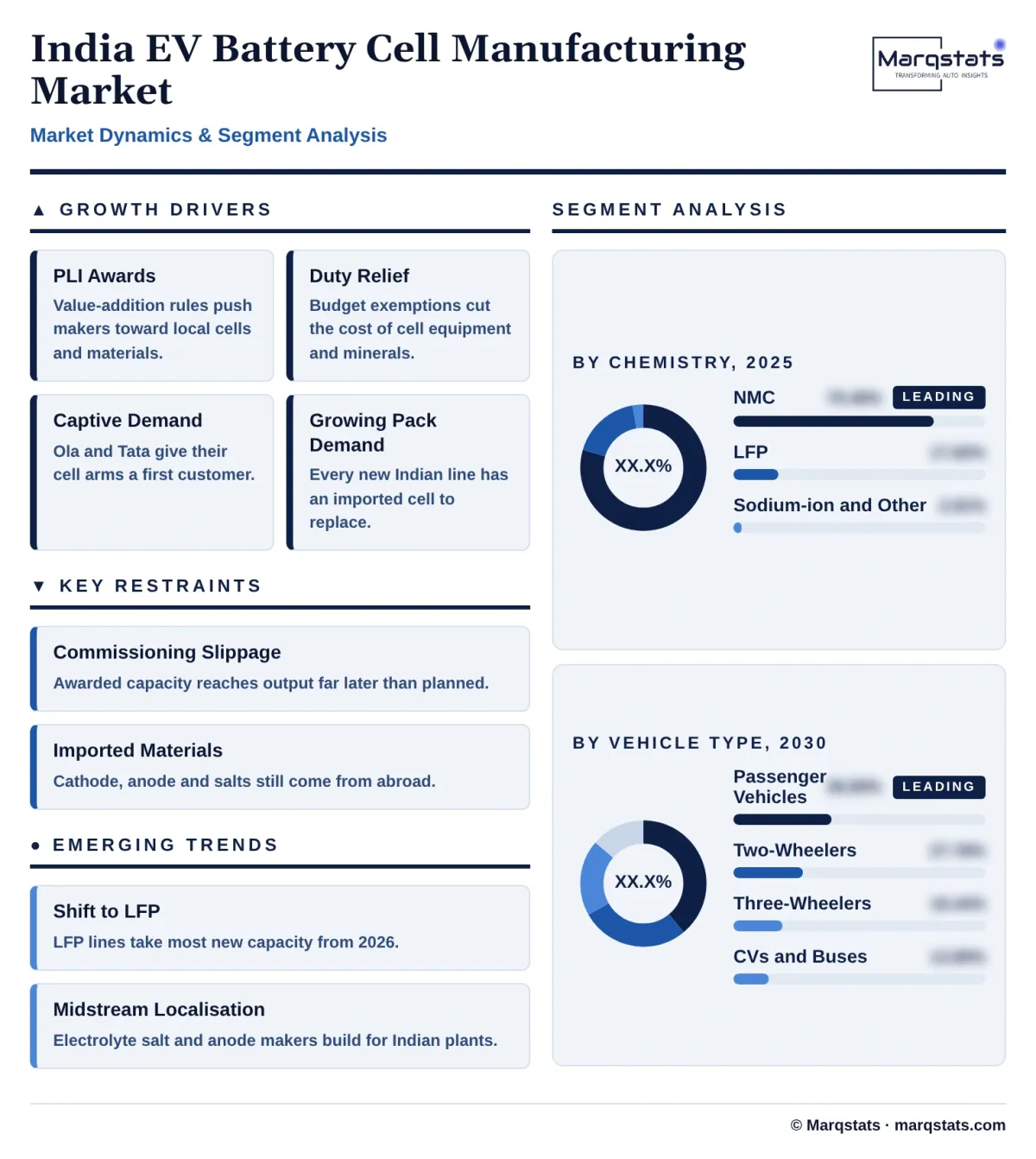
- PLI awards and value-addition rules: the INR 18,100 crore Advanced Chemistry Cell scheme, approved in May 2021, has awarded 40 GWh of its 50 GWh target, and its 25% to 60% domestic value-addition rules push beneficiaries toward local materials as well as local cells.
- Capital goods and materials duty relief: the Union Budget of 1 February 2025 exempted 35 additional capital goods for EV battery manufacturing from basic customs duty, along with lithium-ion battery scrap, cobalt powder and 12 further critical minerals, lowering the cost of building and feeding a cell line.
- Captive demand from vehicle groups: Ola Electric targets a full switch to in-house cells across its scooter range by September 2026, and Agratas is the cell arm of the Tata Group, giving both a guaranteed first customer that merchant entrants lack.
- A pack market that keeps growing: India sold 2.3 million EVs in calendar 2025, and the Marqstats pack page forecasts pack value rising from USD 2.78 billion in 2025 to USD 16.32 billion in 2030, so every new Indian line has an import cell to replace.
Key Restraints
Three constraints hold output below announced capacity, and none of them is demand.
- Commissioning slippage: 1 GWh of 40 GWh awarded under PLI was commissioned as of February 2026, and ACC Energy Storage has not commissioned its 5 GWh Karnataka plant, per the 21 July 2026 Lok Sabha reply.
- Upstream import dependence: cathode, anode, separator and electrolyte salt are still largely imported in 2026, which caps domestic value addition and delays PLI claims; INR 5,180 crore had been invested with no incentive claimed by 31 May 2026.
- Technology access: Agratas moved to in-house LFP technology after concluding a Chinese licence was unlikely under export controls, per the 4 August 2026 Business Today report, which adds time and cost to the ramp.
Key Trends
Three trends change what Indian cell plants make and who buys from them.
- From NMC to LFP: Ola announced its 46100 LFP cell on 7 April 2026 and Exide started with LFP in September 2026, pushing LFP from 17.60% of value in 2025 to 69.51% in 2030.
- Larger cylindrical formats: Ola moved from the 4680 Bharat Cell to the larger 46100 LFP format in 2026, keeping cylindrical cells relevant for two-wheelers while prismatic cells take cars and buses.
- Midstream localisation: Neogen Ionics and Morita Investment signed an 80:20 joint venture on 31 August 2025 to make solid LiPF6 electrolyte salt in India, the first sign that suppliers are building for domestic cell plants.
Strategic Implications
- For vehicle OEMs: domestic cells will cost more than Chinese imports through at least 2028, so the case for signing is supply security and localisation credit; contracts signed in 2026 should tie volume to qualification milestones and plant commissioning dates.
- For cell makers: the first plant to reach stable yield on LFP prismatic cells for three-wheelers and cars captures merchant demand that Ola and Agratas cannot serve from captive lines, and the 2030 merchant share of 58.33% is the prize.
- For materials suppliers and investors: domestic value addition is the gate for PLI money, so electrolyte salt, anode graphite and cathode precursors are the products where Indian capacity carries a policy premium; 36.0 GWh of 2030 output needs local materials to qualify.
Market Segmentation
NMC carried USD 25.92 million, or 79.48% of value, in 2025, almost all of it Ola 4680 Bharat Cells fitted to Ola scooters. Output was about 0.27 GWh at USD 96 per kWh.
By 2030 NMC reaches USD 640.00 million and 26.73% of value, a CAGR of 89.89%, on 8.0 GWh at USD 80 per kWh. NMC stays relevant for premium cars, performance two-wheelers and Agratas lines licensed from Automotive Energy Supply Corporation, but loses its lead. The chemistry that started the market is not the one that scales it.
LFP was worth USD 5.74 million and 17.60% of value in 2025, from about 0.07 GWh of pilot and qualification output at USD 82 per kWh.
It becomes the dominant chemistry, reaching USD 1,664.00 million and 69.51% of value by 2030, a CAGR of 210.78%, on 26.0 GWh at USD 64 per kWh. Exide started with LFP, Ola has launched a 46100 LFP cell, and Agratas and Amara Raja both plan LFP lines. LFP suits Indian heat and three-wheeler duty cycles, and it is where Indian makers compete on cost with imports.
Sodium-ion and other chemistries were worth USD 0.95 million and 2.91% of value in 2025, from pilot output of about 0.01 GWh at USD 95 per kWh.
The segment reaches USD 90.00 million and 3.76% of value by 2030, a CAGR of 148.49%, on 2.0 GWh at USD 45 per kWh. Reliance holds sodium-ion technology through Faradion. The Marqstats sodium-ion two-wheeler battery page sizes sodium-ion packs fitted to two-wheelers at 1.79 GWh in 2030; this segment counts cells made in India across all vehicle classes and is a different level of the stack, so the two should not be added.
Two-wheelers took USD 27.02 million and 82.86% of value in 2025, because the only commercial-scale line, Ola Krishnagiri, feeds Ola scooters. Ola sold 199,316 electric two-wheelers in calendar 2025.
By 2030 the segment reaches USD 665.00 million and 27.78% of value, a CAGR of 89.77%, on about 10.0 GWh. Two-wheelers remain the largest single customer base by vehicle count but lose share as car and three-wheeler lines start.
Three-wheelers took USD 3.73 million and 11.43% of value in 2025 on about 0.04 GWh.
They reach USD 465.50 million and 19.44% of value by 2030, a CAGR of 162.57%, on 7.0 GWh. Exide aimed its first LFP cells at its own three-wheeler pack plant in Gujarat, and LFP prismatic cells suit the high daily mileage of passenger and cargo three-wheelers.
Passenger vehicles took USD 0.93 million and 2.86% of value in 2025, almost entirely qualification cells.
They become the largest segment by 2030, at USD 931.00 million and 38.89% of value, a CAGR of 298.19%, on 14.0 GWh. The Agratas Sanand plant is built around Tata Group demand, and electric car sales of 196,724 units in 2025 already need about 7.5 GWh of packs a year.
Commercial vehicles and buses took USD 0.93 million and 2.86% of value in 2025.
They reach USD 332.50 million and 13.89% of value by 2030, a CAGR of 224.09%, on 5.0 GWh. Large prismatic LFP packs for buses and trucks are the natural market for Reliance and Exide, and public bus tenders give predictable volume.
Captive lines, which make cells mainly for a parent vehicle group, held USD 25.16 million and 77.14% of value in 2025, almost all from Ola.
They reach USD 997.50 million and 41.67% of value by 2030, a CAGR of 108.76%, as Agratas adds Tata Group volume. Captive lines remove the qualification risk but tie utilisation to one brand of vehicle sales.
Merchant lines, which sell cells to unrelated OEMs and pack makers, held USD 7.45 million and 22.86% of value in 2025.
They reach USD 1,396.50 million and 58.33% of value by 2030, a CAGR of 184.82%, led by Exide, Amara Raja and Reliance. Merchant makers depend on winning OEM qualification, and that process, more than capacity, sets their ramp.
By Geography
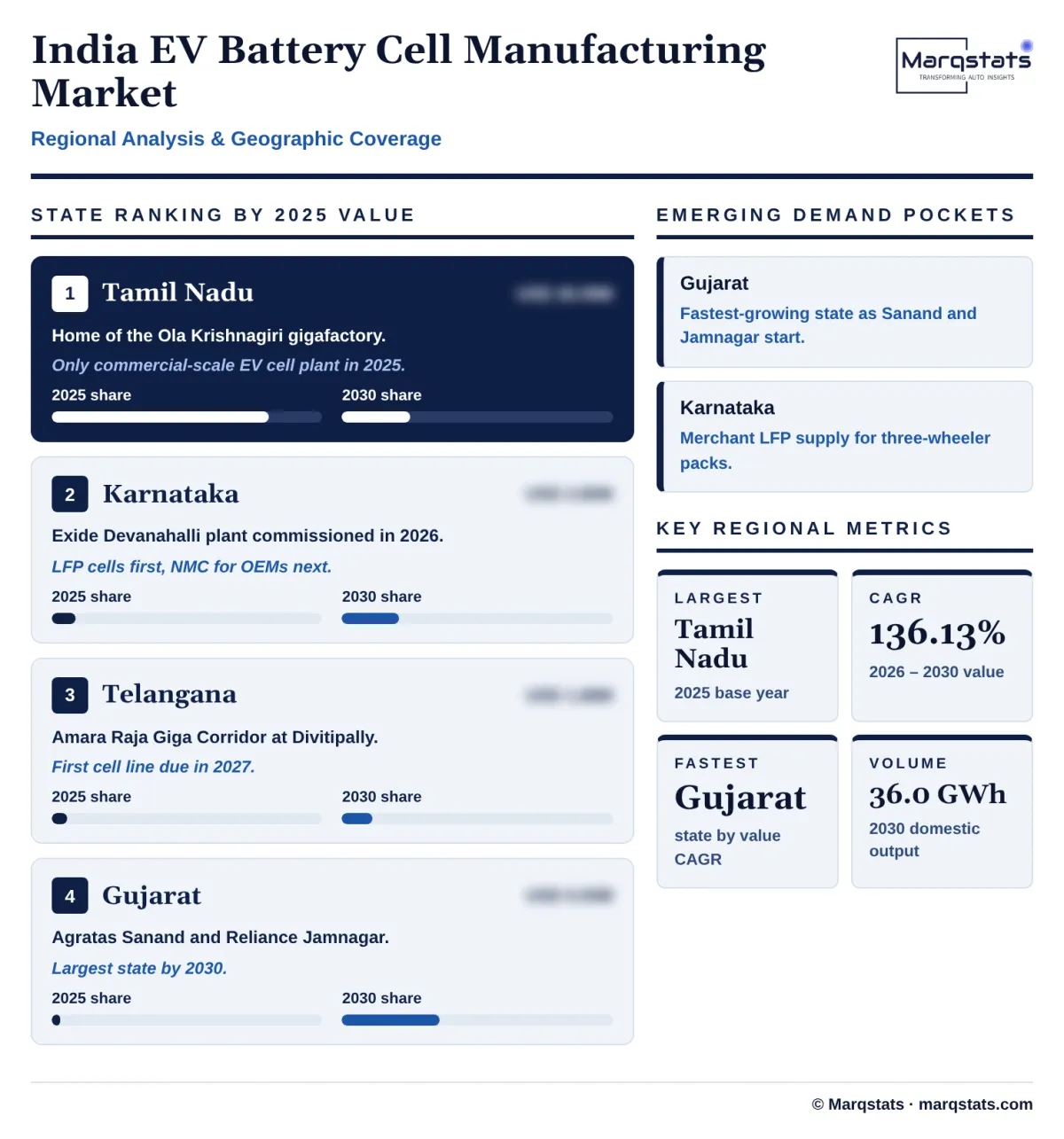
Tamil Nadu
Tamil Nadu was the largest cell state in 2025, with USD 26.09 million and 80.00% of value, because the Ola gigafactory at Krishnagiri was the only commercial-scale EV cell plant. Output was about 0.28 GWh.
By 2030 Tamil Nadu reaches USD 598.50 million and 25.00% of value, a CAGR of 87.12%, on 9.0 GWh. Its share falls because Ola expansion beyond 6 GWh depends on a capital raise at the cell subsidiary, announced in March 2026 at up to INR 2,000 crore.
Gujarat
Gujarat held USD 0.93 million and 2.86% of value in 2025, from pilot lines only.
It becomes the largest state by 2030, at USD 864.50 million and 36.11% of value, a CAGR of 292.33%, on 13.0 GWh. Two projects drive it: the Agratas plant at Sanand and the Reliance complex at Jamnagar, which holds 15 GWh of PLI awards across two Reliance entities. Gujarat also hosts the Dahej chemical belt, where Neogen makes electrolyte and salts.
Karnataka
Karnataka held USD 2.80 million and 8.57% of value in 2025, from trial production ahead of commissioning.
It reaches USD 498.75 million and 20.83% of value by 2030, a CAGR of 181.93%, on 7.5 GWh, led by the Exide Devanahalli plant that commissioned 6 GWh on 23 September 2026. The 5 GWh ACC Energy Storage award in Karnataka had not been commissioned as of the July 2026 ministry reply, so Marqstats assigns it little output.
Telangana
Telangana held USD 1.86 million and 5.71% of value in 2025, from the Amara Raja qualification facility at Divitipally.
It reaches USD 266.00 million and 11.11% of value by 2030, a CAGR of 169.82%, on 4.0 GWh. The foundation stone for Amara Raja Giga Factory-1 was laid on 8 March 2025, and the company now expects about two-thirds of long-term output to serve EVs, with the rest going to stationary storage.
Rest of India
The rest of India held USD 0.93 million and 2.86% of value in 2025.
It reaches USD 166.25 million and 6.94% of value by 2030, a CAGR of 182.13%, on 2.5 GWh from smaller cell makers, sodium-ion entrants and plants yet to be sited. Maharashtra, with its Pune and Chakan vehicle base, is the most likely host.
How Competition Is Evolving
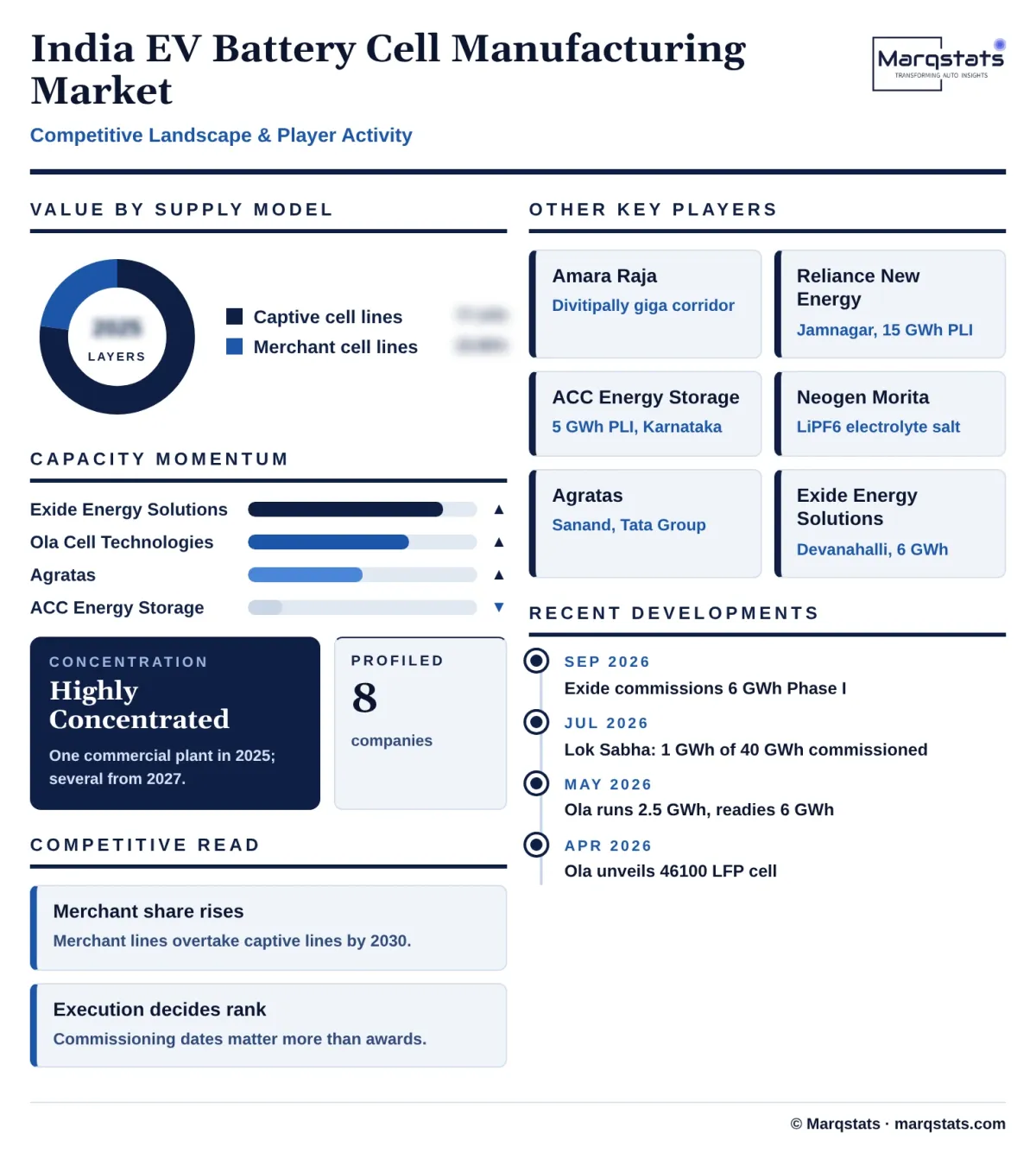
Competition in 2025 was a field of one. Ola had the only line. Ola Cell Technologies produced nearly all domestic EV cell output, and no other plant had reached commercial EV volume. Marqstats does not publish company shares, because no registry or regulator reports cell output by maker; the structure is better read through capacity layers and dated actions.
Three layers are forming. Captive vehicle-group makers, Ola Cell Technologies and Agratas, build cells for their own vehicles first. Incumbent lead-acid battery groups, Exide Energy Solutions and Amara Raja Advanced Cell Technologies, bring OEM relationships and aftermarket distribution to a merchant model. Conglomerate entrants, Reliance New Energy Battery Storage and Reliance New Energy Battery, hold 15 GWh of PLI awards and are building at Jamnagar with an eye on storage as well as vehicles.
The structure moves from highly concentrated to moderately concentrated between 2026 and 2028 as Exide, Agratas and Amara Raja begin output. Technology sourcing separates the players: Ola developed its cells in-house, Agratas licenses NMC from Automotive Energy Supply Corporation and develops LFP itself, and Reliance owns Faradion for sodium-ion. A further layer of materials suppliers, including Neogen Chemicals and its joint venture with Morita Investment, competes on domestic value addition rather than on cells.
Companies Covered
Companies covered in the report include:
Recent Market Activity
Table of Contents
Coverage & Segmentation
Inclusions: lithium-ion (NMC and LFP) and sodium-ion cells physically manufactured in India and used in traction batteries for electric two-wheelers, three-wheelers, passenger vehicles, commercial vehicles and buses, valued ex-factory, with captive cells valued at the merchant price. Base year 2025, history 2021 to 2025, forecast 2026 to 2030, INR 87.00 per US dollar.
Exclusions: cells for stationary storage, telecom backup and consumer electronics; imported cells, even when assembled into packs in India; pack assembly, battery management systems and enclosures; cathode, anode, electrolyte, separator and other materials; recycling. Reliance and Amara Raja output is counted only for its EV share.
Sibling boundaries, do not add: the Marqstats India EV battery pack page (USD 2.78 billion in 2025, USD 16.32 billion in 2030) measures finished EV packs and already contains the value of these cells along with imported cells. The India electric two-wheeler battery page measures two-wheeler pack value, the India sodium-ion electric two-wheeler battery page measures sodium-ion two-wheeler packs, and the India EV battery casing page measures enclosures. Each is a different level of the stack; none should be summed with this market.