Market Snapshot
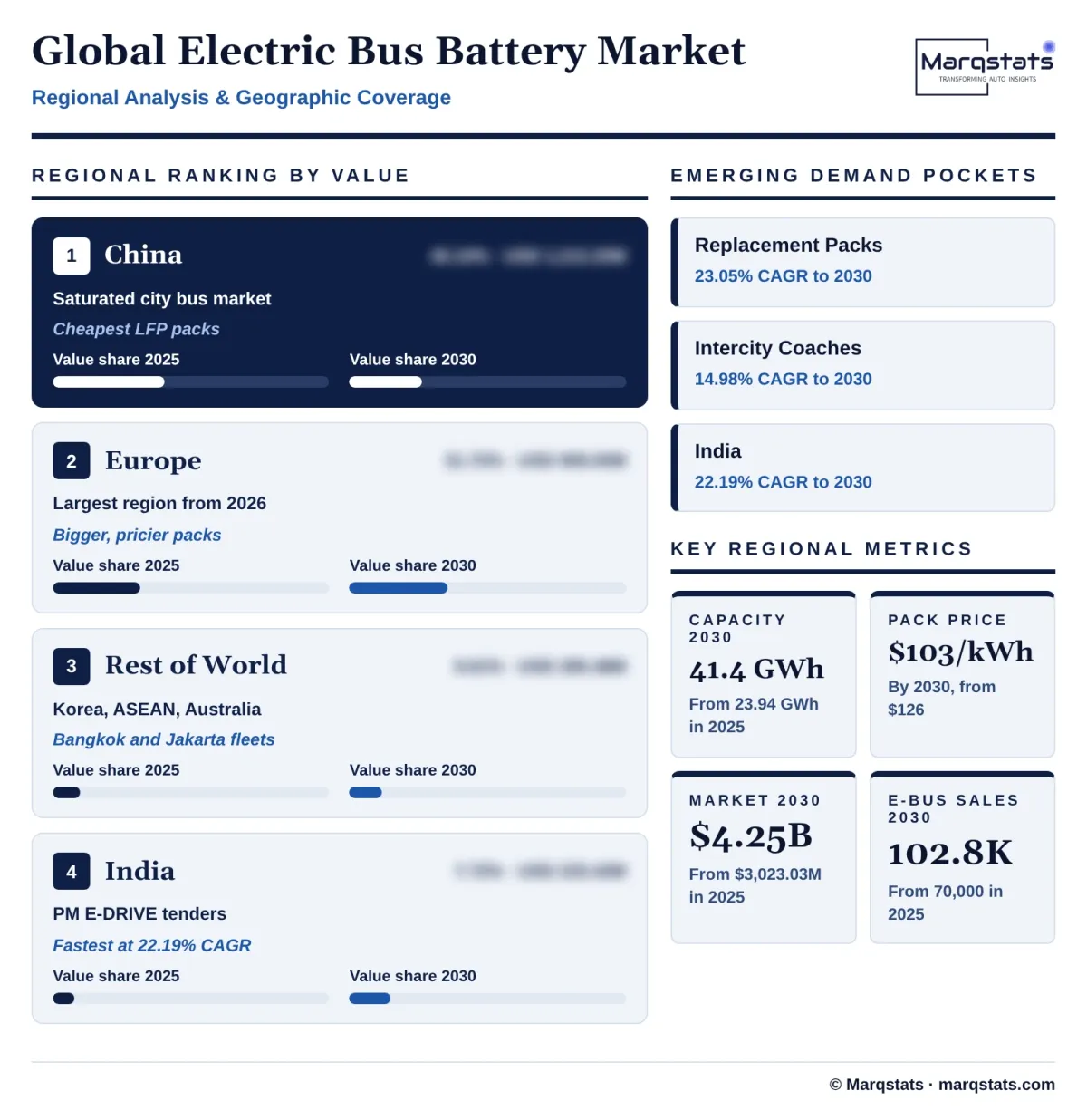
The global electric bus battery market size is estimated at USD 3,023.03 million in 2025 and is projected to reach USD 4,250.23 million by 2030, growing at a CAGR of 7.05% over 2026 – 2030. Installed capacity rises from 23.94 GWh to 41.44 GWh while the average pack price falls from USD 126.28 to USD 102.56 per kWh.
Marqstats defines the market as the ex-factory value of lithium-based traction battery systems (cells, modules, battery management system, thermal management and enclosure) fitted to new battery-electric and plug-in hybrid buses of class M2 and M3, plus replacement traction packs bought for buses already in service. Chargers, fuel cell stacks, auxiliary 24-volt batteries, battery leasing fees and second-life storage are excluded.
Lithium iron phosphate (LFP) holds 75.67% of 2025 value and standard 10 to 13 metre city buses 66.15%. China accounts for 40.10% of value and Europe for 31.72%. The study segments the market by cell chemistry, bus length, demand type and region.
Key Takeaways
Market Overview & Analysis
Report Summary
Marqstats sizes the electric bus battery market from the bus outward: electric bus sales by region, multiplied by the average traction pack size, multiplied by the ex-factory price per kWh in that region, plus replacement packs. The International Energy Agency (IEA) Global EV Outlook 2026 reports that sales of electric buses reached almost 70,000 in 2025, 12% more than in 2024, and that battery-electric models were 98% of them. Marqstats places 70,000 buses and 23.94 GWh of traction battery capacity in the 2025 base, worth USD 3,023.03 million at an average USD 126.28 per kWh.
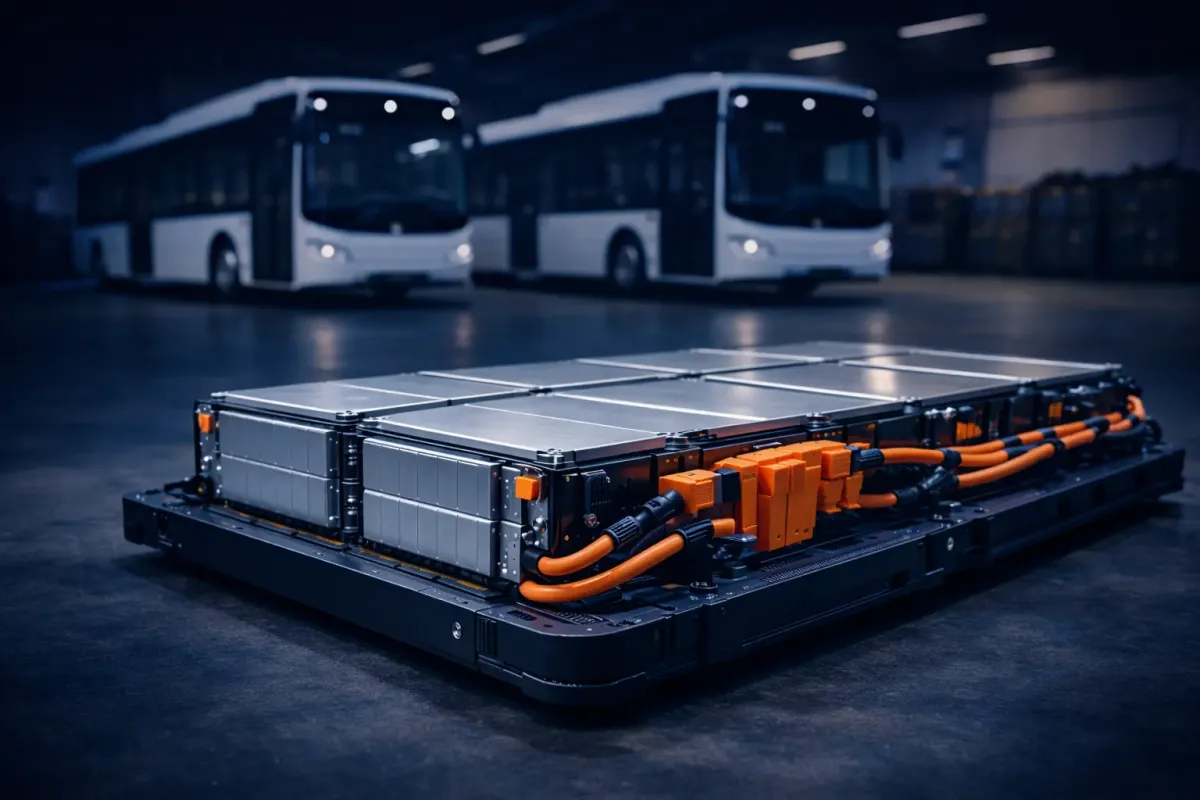
An electric bus battery is a different product from a car battery. A 12 m city bus carries 250 to 650 kWh in roof-mounted or rear-tower packs, is expected to run 12 to 15 years and 60,000 to 80,000 km a year, and must survive depot charging every night and, in many cities, pantograph charging at the end of each route. Packs therefore use liquid cooling, ruggedised steel or aluminium enclosures, high-voltage safety disconnects and battery management systems built for 4,000 to 6,000 full cycles. Yutong Bus Co., Ltd. marketed its EV Long-life technology in January 2026 on a battery life of 15 years or 1.5 million km, which shows where competition is moving.
The market splits into two economies. China builds most of the world's electric buses and almost all of its bus cells, and its packs are cheap: Marqstats estimates about USD 95 per kWh (about CNY 682) ex-factory for an LFP bus pack in 2025. Europe, North America and Korea buy bigger packs from smaller production runs, often with NMC cells, liquid thermal plates designed for one bus platform and local assembly, at an estimated USD 175 to 230 per kWh. India sits between the two at about USD 134.77 per kWh (INR 11,725), in line with the LFP pack range published on the Marqstats India Electric Bus Battery Pack page.
The global e-bus market has changed shape. The IEA says China's share of electric bus sales fell from nearly 100% in 2018 to about 60% in 2025, even though more than 60% of all buses sold in China and nearly all city buses are now electric. Europe sold more than 12,000 electric buses in 2025, 28% more than in 2024, India more than 4,000, and Latin America more than 3,000, while sales in the United States fell 40%. Each of those markets buys bigger, more expensive packs than China, which is why battery value is spreading out of China faster than bus production is.
Marqstats expects about 77,700 electric bus sales and 27.69 GWh of battery demand worth USD 3,397.40 million in 2026. The 2024 base implied by the IEA growth rate is about 62,500 buses. The live Marqstats Global Electric Bus Market page refers to 2024 sales above 70,000; this analysis follows the later IEA Global EV Outlook 2026 series, in which almost 70,000 is the 2025 figure.
Regulation shapes where battery value goes. In the EU, Regulation (EU) 2024/1610 on heavy-duty vehicle CO2 standards sets the 90% and 100% zero-emission targets for new urban buses in 2030 and 2035, the Clean Vehicles Directive sets procurement quotas for public authorities, and the EU Battery Regulation (EU) 2023/1542 adds carbon-footprint declarations and battery passports for industrial and electric vehicle batteries over 2 kWh from February 2027. In India, PM E-DRIVE and the PM-eBus Sewa scheme fund buses under gross cost contracts in which operators, not cities, buy the battery. In the United States, Federal Transit Administration grants carry Buy America conditions that push pack assembly onshore.
Global Electric Bus Battery Market Size and Forecast
The global electric bus battery market grows from USD 3,023.03 million in 2025 to USD 4,250.23 million in 2030, a CAGR of 7.05%. Marqstats expects USD 3,397.40 million in 2026, USD 3,632.02 million in 2027, USD 3,834.39 million in 2028 and USD 4,049.28 million in 2029. Electric bus sales rise from 70,000 to 83,870 in 2027 and 102,800 in 2030.
Capacity grows about 1.6 times as fast as value. Installed battery capacity rises from 23.94 GWh to 41.44 GWh, a 11.60% annual rate, because Europe, India and Rest of World add buses with large packs. The average price per kWh falls from USD 126.28 to USD 102.56, so each additional GWh adds less revenue than the last.
China is the drag on value. Chinese electric bus sales are close to their ceiling, at an estimated 42,000 buses in 2025 and 44,000 in 2030, and the Chinese pack price falls from about USD 95 to USD 72 per kWh as cell prices fall. Chinese battery value therefore declines from USD 1,212.20 million to USD 1,123.20 million, a -1.51% CAGR, even though replacement packs for its ageing fleet more than double.
Europe carries the growth. Regulation (EU) 2024/1610 requires 90% of new urban buses sold in the EU to be zero-emission from 2030 and 100% from 2035, and the Clean Vehicles Directive (EU) 2019/1161 already sets public procurement quotas. Marqstats expects European electric bus sales to double from 12,000 to 24,000 and European battery value to grow from USD 959.00 million to USD 1,515.00 million, a 9.58% CAGR, even as the European pack price falls from about USD 175 to USD 125 per kWh.
Marqstats tracks four indicators against the forecast: quarterly European registrations, published in August 2026 at 8,141 battery-electric buses for the first half; Indian VAHAN registrations, at 2,944 electric buses in the first half of 2026; the ex-factory price of LFP bus packs in China; and replacement orders from Chinese operators whose fleets date from 2017 to 2022. A sustained break in any one of them would move the forecast.
The mix changes over the forecast. LFP rises from 81.67% to 85.41% of capacity, intercity coaches from 10.32% to 14.76% of value and replacement packs from 4.06% to 8.15%. China's share of value falls from 40.10% to 26.43%, while Europe rises from 31.72% to 35.64% and India from 7.72% to 14.96%.
Market Dynamics
Key Drivers
Five forces keep electric bus battery demand growing even as China's city bus market reaches saturation.
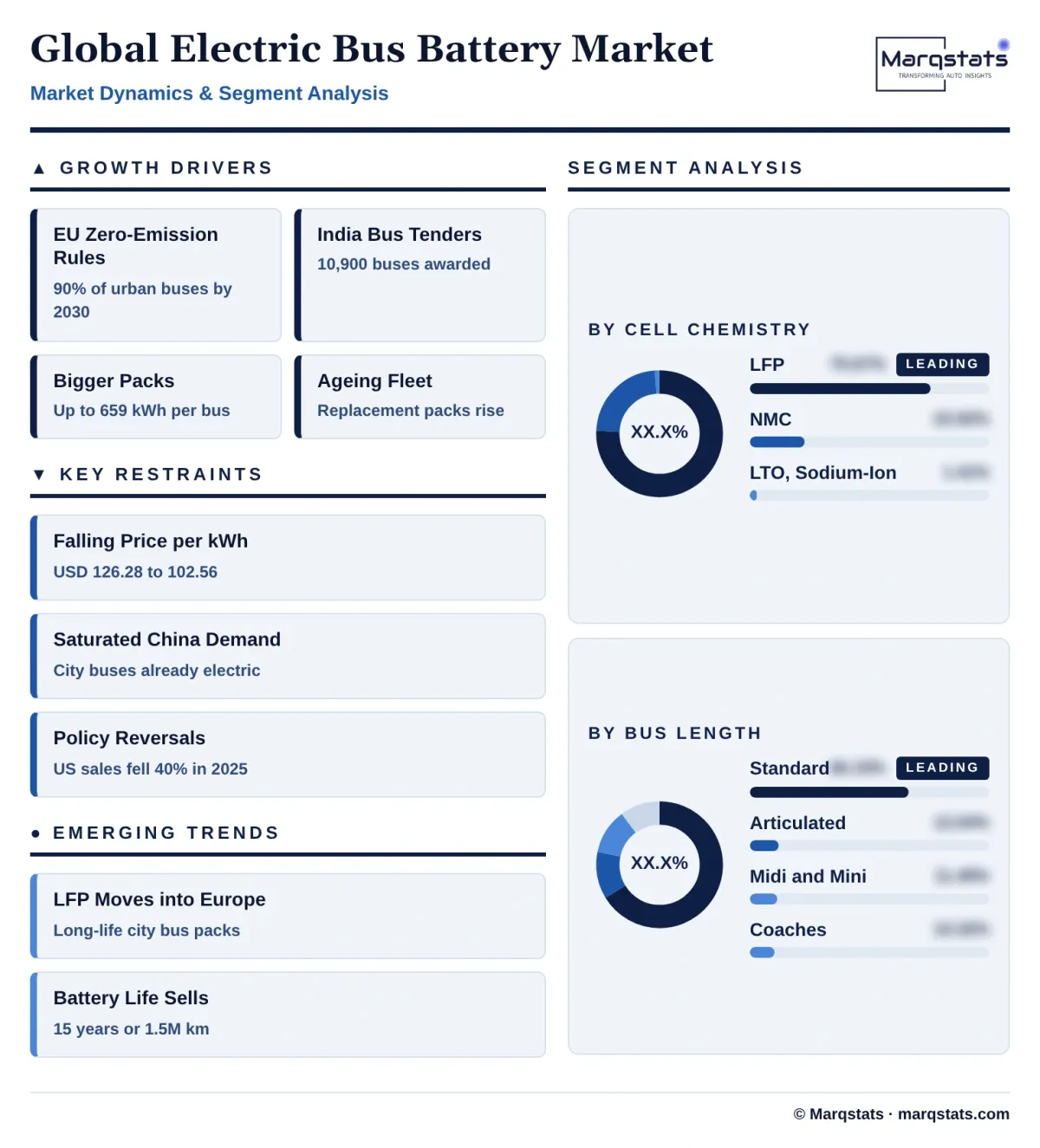
- European zero-emission rules. Regulation (EU) 2024/1610 sets a 90% zero-emission share for new urban buses from 2030 and 100% from 2035, and battery-electric buses already reached 61.2% of European city bus registrations in the first half of 2026. Each European bus adds about 450 kWh of battery demand.
- India's public tenders. The PM E-DRIVE scheme, extended to 31 March 2028, funds 14,028 electric buses, and CESL concluded tenders for 10,900 buses for Bengaluru, Delhi, Hyderabad, Ahmedabad and Surat in December 2025. Indian registrations rose 19% to 4,441 in 2025 and about 40% in the first half of 2026.
- Bigger packs for longer routes. Operators now ask for a full day of service without opportunity charging, so 12 m packs of 500 to 659 kWh, such as the Forsee Power ZEN 55 LFP system ordered for Bozankaya buses in March 2026, are replacing the 250 to 350 kWh packs of earlier fleets.
- Large city programmes outside China. Bangkok's 1,520-bus lease signed on 29 January 2026, São Paulo's 2,009 electric buses in service on 30 September 2026, and Hanoi's plan to make all buses green by 2030 create volumes that local and Chinese suppliers compete for.
- An ageing installed base. China's installed electric bus fleet exceeds 680,000 vehicles, and buses bought in 2017 to 2022 are reaching the end of eight-year battery warranties, creating replacement demand estimated at 1.00 GWh in China in 2025.
Key Restraints
Four constraints slow the growth of battery value faster than they slow the growth of bus numbers.
- Falling price per kWh. The average pack price falls from USD 126.28 to USD 102.56 per kWh over the forecast, so a 11.60% annual rise in capacity becomes a 7.05% rise in value.
- Saturated Chinese city bus demand. Nearly all city buses sold in China are already electric, so Chinese sales grow only through coaches and replacements; BYD Company Limited reported 2025 bus sales of 4,923 units, 11.77% fewer than in 2024.
- Policy reversals in some markets. US electric bus sales fell 40% in 2025, and in September 2026 the Queensland government in Australia announced 630 new diesel buses and dropped its electric bus plans.
- Weak economics for non-Chinese pack makers. Forsee Power reported 2025 revenue of EUR 120.5 million, 20.6% lower than in 2024, and a net loss of EUR 28.0 million, after two long-standing heavy-vehicle customers cut orders; European suppliers struggle to match Chinese cell costs.
Key Trends
Four shifts are changing what an electric bus battery is, who builds it and where the value sits.
- LFP replaces NMC in Europe. European bus packs are moving from NMC to LFP for longer life and lower cost, as in the Forsee Power ZEN 55 LFP system of up to 659 kWh, made in Chasseneuil-du-Poitou, France.
- Battery life becomes the selling point. Yutong's EV Long-life technology, launched with its 2025 results in January 2026, is marketed on 15 years or 1.5 million km, matching the bus life to the battery life and reducing mid-life pack replacement.
- Sodium-ion enters commercial vehicles. Contemporary Amperex Technology Co., Limited (CATL) unveiled its Tectrans II series for light commercial vehicles in January 2026, with a mass-produced 45 kWh sodium-ion version, and said sodium batteries would move into large-scale use across commercial vehicles in 2026.
- Chinese bus makers assemble abroad. Yutong, BYD and Chinese component suppliers supply packs for locally assembled buses, such as CRRC components for Bangkok's 1,520 buses built by Absolute Assembly in Chachoengsao, moving pack integration closer to the buyer.
Strategic Implications
- For cell makers, the bus segment is a value play, not a volume play. At 24 GWh it is a small share of global battery output, but European and North American buyers pay well above Chinese pack prices, so suppliers that offer LFP cells with European or local pack assembly can win margin that the Chinese domestic market no longer offers.
- For bus manufacturers, pack design is now the main source of differentiation. With LFP at 81.67% of capacity and cell prices converging, buyers compare usable energy, warranty length and kerb weight; manufacturers that can guarantee 12 to 15 years of battery life remove the mid-life replacement from the operator's cost.
- For European pack integrators, the window is the next five years. European battery value rises to USD 1,515.00 million by 2030, but Yutong and BYD together held 26.7% of European electric bus registrations in 2025, so integrators that depend on European bus makers must follow them into LFP and higher volumes or lose share with them.
- For operators and financiers, replacement packs are a planning item, not a contingency. Marqstats estimates replacement demand at USD 346.34 million a year by 2030, so contracts should fix pack replacement prices, warranty terms and state-of-health tests at the time the bus is bought.
- For India's emerging cell makers, bus tenders offer an anchor customer. Indian bus value nearly triples by 2030 and the live India Electric Bus Battery Pack page shows LFP packs at INR 10,000 to 12,000 per kWh, so a domestic cell plant that can meet that price point gains a large, predictable public buyer.
- For policy makers, the battery is where local content is won or lost. A bus assembled locally from an imported pack keeps most of the battery value abroad, so content rules that count cell and pack assembly, as India's PM E-DRIVE localisation conditions do, decide how much of the market stays in the country.
Market Segmentation
LFP accounts for 75.67% of 2025 value, USD 2,287.61 million, and an estimated 81.67% of installed capacity, rising to USD 3,524.59 million and 82.93% of value by 2030, a 9.03% CAGR. Almost every Chinese, Indian and Latin American bus pack uses LFP, and the share in Europe rises from about 55% to 75% of capacity as Forsee Power, Solaris and others standardise on LFP for long-life city buses. LFP leads because buses value cycle life and thermal stability more than energy density.
NMC accounts for 22.92% of 2025 value, USD 692.87 million, and falls to USD 604.49 million and 14.22% of value by 2030, a -2.69% CAGR. NMC survives where weight and roof space are tight, mainly in North American transit buses, some European 12 m and articulated models and intercity coaches, and its share falls as LFP cell-to-pack designs close the energy-density gap.
Lithium titanate (LTO) and sodium-ion cells account for 1.41% of 2025 value, USD 42.55 million, mainly LTO packs in opportunity-charged buses in China, Japan and Korea, and grow at 23.28% a year to USD 121.15 million as CATL moves sodium-ion cells into commercial vehicles for cold climates.
Midibuses and minibuses under 10 m account for 11.49% of 2025 value, USD 347.38 million, with about 15,400 buses and packs averaging 170 kWh, and grow at 3.78% a year to USD 418.11 million. India's 9 m tender buses and Chinese community buses dominate this segment.
Standard 10 to 13 m city buses account for 66.15% of 2025 value, USD 1,999.47 million, with about 44,100 buses and an average pack of about 342 kWh, and grow at 5.78% a year to USD 2,647.48 million. This is the core of every public tender, from CESL in India to European transport authorities.
Articulated and double-deck buses account for 12.04% of 2025 value, USD 364.10 million, with about 4,900 buses and packs averaging 560 kWh, and grow at 8.89% a year to USD 557.48 million as London, Italian and Polish operators electrify 18 m and double-deck routes.
Intercity coaches account for 10.32% of 2025 value, USD 312.08 million, with about 5,600 coaches and packs averaging 420 kWh, and grow fastest, at 14.98% a year, to USD 627.16 million. The IEA reports zero-emission coaches at around 10% of Chinese coach sales in 2025, and Yutong tested its IC12E battery-electric intercity bus over 1,200 km in four Nordic countries.
Packs fitted to new buses account for 95.94% of 2025 value, USD 2,900.28 million, and grow at 6.12% a year to USD 3,903.89 million. Bus makers either build packs in-house, as BYD and Yutong do, or buy them from integrators such as Forsee Power and cell makers such as CATL.
Replacement traction packs account for 4.06% of 2025 value, USD 122.75 million and 1.16 GWh, of which USD 95.00 million is in China, and grow fastest at 23.05% a year to USD 346.34 million and 3.82 GWh by 2030 as buses bought in 2017 to 2022 in China, Europe and Korea reach the end of their battery warranties. These are Marqstats estimates built from fleet age cohorts and typical eight-year battery warranties.
By Geography
China
China remains the largest region but is losing share. It accounts for 40.10% of 2025 value, USD 1,212.20 million, with about 42,000 new electric buses (60.01% of global sales, in line with the IEA estimate of about 60%), 12.76 GWh including replacements and an average pack price of about USD 95 per kWh. Its value falls to USD 1,123.20 million and 26.43% of the market by 2030, a -1.51% CAGR, because city bus demand is saturated and pack prices fall faster than pack sizes rise. Yutong delivered 49,518 vehicles in 2025, 5.54% more than in 2024, while BYD's bus sales fell 11.77% to 4,923.
Europe
Europe is the second-largest region in 2025 and the largest from 2026. It accounts for 31.72% of 2025 value, USD 959.00 million, from about 12,000 buses (17.14% of units) with an average pack of about 450 kWh at USD 175 per kWh. Registrations of battery-electric buses above 8 t rose 48% to 11,607 in 2025 (later revised to 11,819) and 49% to 8,141 in the first half of 2026, led by Yutong (1,636), Iveco and Heuliez (1,156) and Solaris (1,022). Value reaches USD 1,515.00 million and 35.64% of the market by 2030, a 9.58% CAGR.
Rest of World
Rest of World, covering South Korea, Japan, Southeast Asia, Australia and New Zealand, the Middle East, Africa, Türkiye and Central Asia, accounts for 9.61% of 2025 value, USD 290.48 million, from about 6,359 buses at about USD 140 per kWh. South Korea is the largest market in this group with 2,893 battery-electric bus registrations in 2025. Bangkok's 1,520-bus lease, Jakarta's plan for about 10,047 electric buses by 2030 and Hanoi's switch to green buses lift value to USD 495.60 million by 2030, a 11.28% CAGR.
India
India is the fastest-growing region. It accounts for 7.72% of 2025 value, USD 233.42 million, matching the live Marqstats India Electric Bus Battery Pack page, from 4,441 registered electric buses with an average pack of about 390 kWh and a pack price of about INR 11,725 per kWh. Value grows at 22.19% a year to USD 635.73 million by 2030 as sales reach about 12,300 buses. PMI Electro Mobility Solutions, Olectra Greentech, Switch Mobility and JBM Auto led 2025 registrations, and EKA Mobility won 915 buses in Hyderabad in March 2026 with GreenCell Mobility.
North America
North America accounts for 6.59% of 2025 value, USD 199.18 million, from about 2,200 transit and school buses with the highest pack price of any region, about USD 230 per kWh, because Buy America rules favour domestic pack assembly in small volumes. US sales fell 40% in 2025 according to the IEA, so the region grows only at 5.96% a year to USD 266.00 million.
Latin America
Latin America accounts for 4.26% of 2025 value, USD 128.75 million, from about 3,000 buses, after the IEA reported that regional sales more than tripled to exceed 3,000 in 2025, with Chile at nearly 2,000 and Brazil at about 850. São Paulo had 2,009 electric buses in service on 30 September 2026. The live Marqstats Latin America Electric Bus page counts 2,600 transit-spec BEV deliveries; the difference is minibuses and coaches. Value grows at 10.77% a year to USD 214.70 million.
How Competition Is Evolving
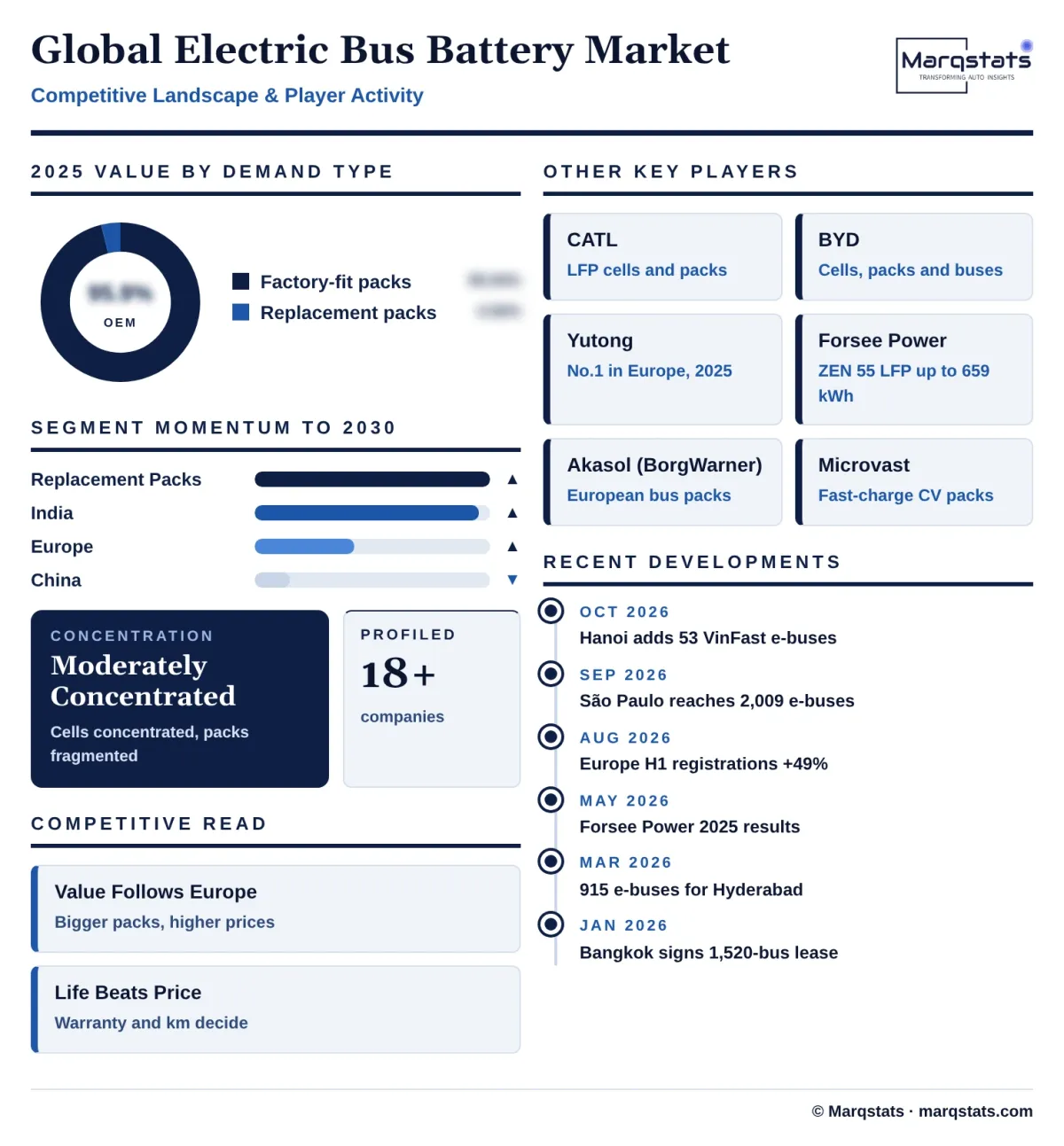
The electric bus battery market is moderately concentrated at the cell level and fragmented at the pack level. Chinese cell makers, led by Contemporary Amperex Technology Co., Limited (CATL) and BYD Company Limited through its FinDreams battery unit, supply most bus cells worldwide, while pack integration is split between bus makers that build their own packs and independent integrators.
Three supply models compete. Vertically integrated bus makers, BYD above all and increasingly Yutong, make cells or packs and the bus. European and North American bus makers, including Daimler Buses, MAN Truck & Bus, Solaris Bus & Coach and the Volvo Group, design packs around bought-in cells or buy complete systems. Independent integrators such as Forsee Power, Akasol (part of BorgWarner Inc.) and Microvast Holdings, Inc. sell packs to bus makers that lack in-house capacity, and Indian suppliers such as Tata AutoComp Gotion, Exide Energy Solutions and Octillion Power Systems serve local bus makers.
Chinese bus makers are taking the European market directly. Yutong was the largest seller of battery-electric buses in Europe in 2025 with 1,801 registrations and 15.5% of the market, and BYD more than tripled to 1,305, so 26.7% of European electric bus registrations, and the battery value that comes with them, went to Chinese brands with Chinese packs. Marqstats describes competition by supply model and named actions rather than by supplier share, because cell sourcing varies by bus model and contract.
Independent European integrators are under pressure. Forsee Power reported 2025 heavy-vehicle revenue of EUR 106.2 million, 22% lower than in 2024, and a net loss of EUR 28.0 million, and its RePower27 plan targets a return to growth from 2027 with a refocus on bus, off-highway, mining and rail. The company says more than 5,500 buses carry its batteries.
Competition is moving to warranty and life. Yutong's 15-year, 1.5 million km battery claim, CATL's 1 million km claim for its Tectrans II commercial vehicle battery and Forsee Power's move to LFP all compete on lifetime cost per km rather than price per kWh, which favours suppliers with long field data and large balance sheets.
Local assembly is spreading. Chinese suppliers increasingly ship cells and modules for packs assembled near the bus plant: CRRC supplies components for Bangkok's 1,520 buses built by Absolute Assembly, the VKTR plant in Magelang, Indonesia, opened in April 2026, and Indian bus makers source packs from local assemblers using imported cells while Exide Energy Solutions and others build domestic cell capacity.
Companies Covered
Companies covered in the report include:
Recent Market Activity
Table of Contents
Coverage & Segmentation
The study covers the global electric bus battery market, with 2025 as the base year, 2021 – 2025 as the historical period and 2026 – 2030 as the forecast period. Values are in US dollars at ex-factory prices of complete traction battery systems, and volumes are electric bus sales and installed battery capacity in GWh. The market is segmented by cell chemistry, bus length, demand type and region (China, Europe, India, North America, Latin America and Rest of World).
Chargers and depot equipment, fuel cell stacks, auxiliary low-voltage batteries, battery leasing and swapping fees, and second-life storage are excluded. The battery value sits inside the vehicle value of the live Marqstats Global Electric Bus Market page and must not be added to it; the India slice equals the live India Electric Bus Battery Pack page. Exchange rates are 2025 averages: USD 1 = CNY 7.18 and INR 87.00, EUR 1 = USD 1.13.