Market Snapshot
The Global Automotive Memory Chip (DRAM & NAND) Market stands at US$8.10 billion in automotive memory chip revenue (DRAM, NAND, NOR flash and EEPROM) in 2025 and is estimated at US$17.50 billion in 2026. Marqstats forecasts it to reach US$28.00 billion by 2030, a CAGR of 28.15% over 2026 – 2030 that adds US$19.90 billion between 2025 and 2030. Each memory chip shortage, as in 2021, shows how exposed carmakers are to this supply.
China is the largest market, ADAS and Autonomous Driving is the fastest growing and DRAM is the dominant segment, in a market that is highly concentrated. The report covers 8 segments and 5 regions and profiles 16 companies, with 2025 as the base year, history from 2021 – 2025 and a forecast for 2026 – 2030.
Key Takeaways
Market Overview & Analysis
Report Summary
The global automotive memory chip market covers memory semiconductors designed and qualified for vehicles: DRAM (LPDDR4, LPDDR5, LPDDR5X, DDR4 and DDR5), NAND flash in the form of UFS, eMMC and automotive SSDs, NOR flash and EEPROM. Automotive memory must pass AEC-Q100 qualification, which can take up to two years, so carmakers cannot switch quickly to untested sources. Marqstats estimates the market at US$8.10 billion in 2025, triangulated from supplier disclosures, vendor-share analyses and vehicle production, and estimates US$17.50 billion in 2026 and US$28.00 billion by 2030, a CAGR of 28.15% over 2026 – 2030.
The 2026 memory chip shortage makes this a price market, not a volume market. Global vehicle production grew only 3.9% to 96.4 million in 2025, according to the International Organization of Motor Vehicle Manufacturers (OICA), yet automotive DRAM prices rose about 70% from December 2025 and automotive memory contract prices jumped as much as 180% in three months. Samsung Electronics, SK hynix and Micron Technology have shifted wafer capacity to high-bandwidth memory (HBM) for AI data centres, squeezing older automotive generations such as DDR4 and LPDDR4 hardest.
Marqstats separates price effects from content effects. Price explains most of the 2026 and 2027 increase, when value roughly doubles while vehicles built change little; content per vehicle explains most of the growth from 2028 to 2030. Micron says the average vehicle carries about 16 GB of DRAM today, Level 2+ vehicles more than five times the memory and storage of an average car, and Level 4 autonomy more than 300 GB.
The forecast assumes US$22.00 billion in 2027, when supply is tightest, US$23.50 billion in 2028 as new capacity from Micron and CXMT eases prices, US$25.50 billion in 2029 and US$28.00 billion in 2030. It is a single most likely path assuming no collapse in AI memory demand and gradual price normalisation after 2027. No supplier reports automotive memory revenue separately, so the base, the splits and the forecast are Marqstats constructions.
Market Dynamics
Key Drivers
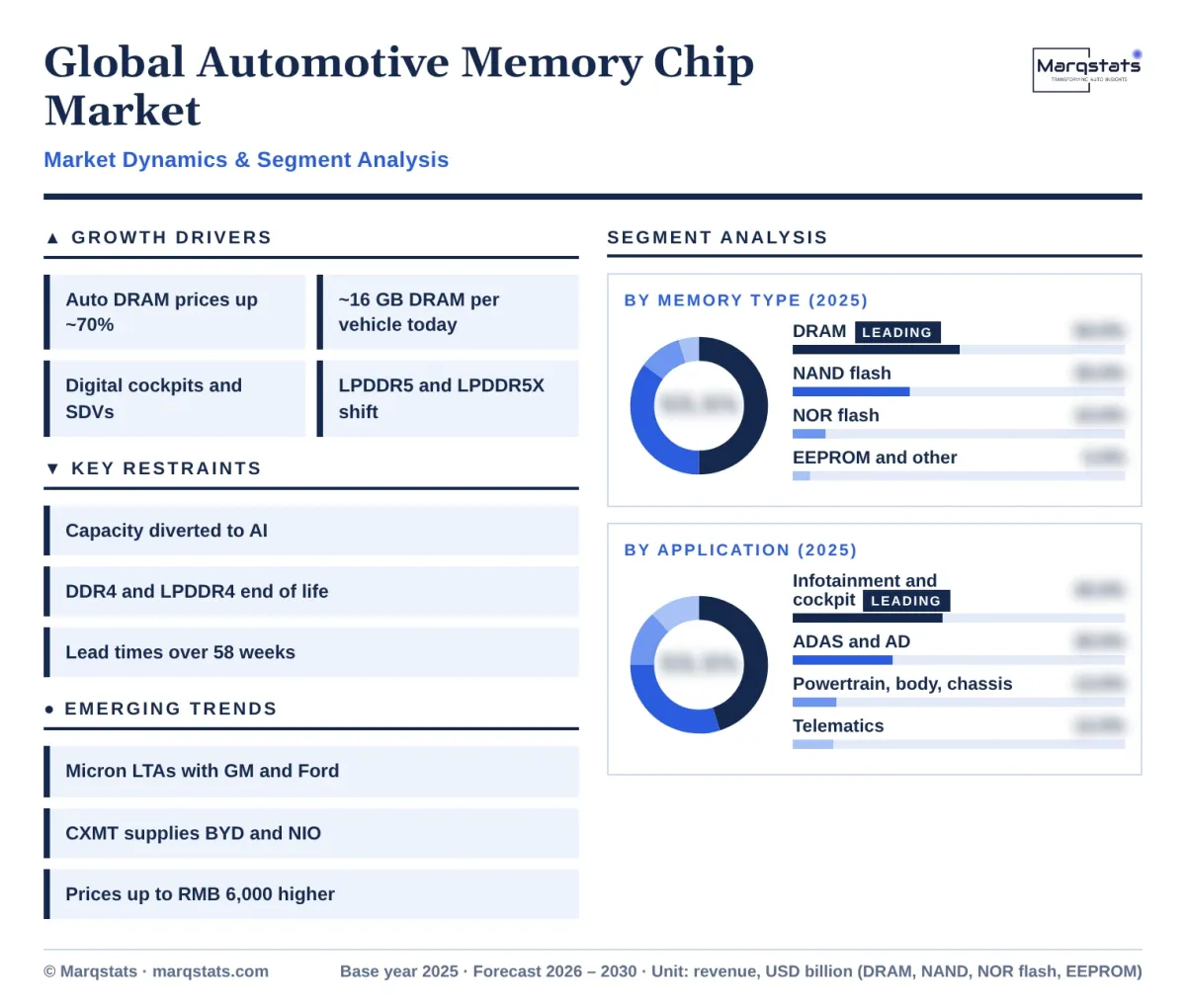
- Price inflation from the shortage: Automotive DRAM prices rose about 70% from December 2025, as reported by Reuters and The Korea Herald, contract prices rose about 180% in the three months to June 2026, according to CarNewsChina, and Korea's Financial News reported in July 2026 that automotive DRAM prices had risen sixfold over the past year. Micron's Automotive and Embedded Business Unit, which also serves industrial and consumer embedded markets, reported US$6.82 billion in its fiscal fourth quarter to September 2026, up 376%, and about US$15.89 billion across fiscal 2026.
- Rising memory content per vehicle: Micron expects Level 2+ vehicles to exceed 20% of sales in 2026 and 40% by 2030, and each carries more than five times the memory and storage of an average car. Even if prices fall back from their 2027 peak, the move from about 16 GB of DRAM per vehicle toward the 64 GB or more used in premium driving computers keeps revenue rising through 2030. ADAS and autonomous driving are therefore the fastest-growing application in the forecast.
- Digital cockpits and software-defined vehicles: Multi-screen cockpits and centralised computers need large DRAM and UFS storage, and memory is concentrating in fewer, much larger devices as vehicles move to software-defined architectures. The Korea Herald reported that BMW's new iX3 uses 16 to 24 GB of DRAM for cockpit computing and Mercedes-Benz MB.OS infotainment 4 to 12 GB. Storage needs also grow with maps, software updates, data recording and in-car apps.
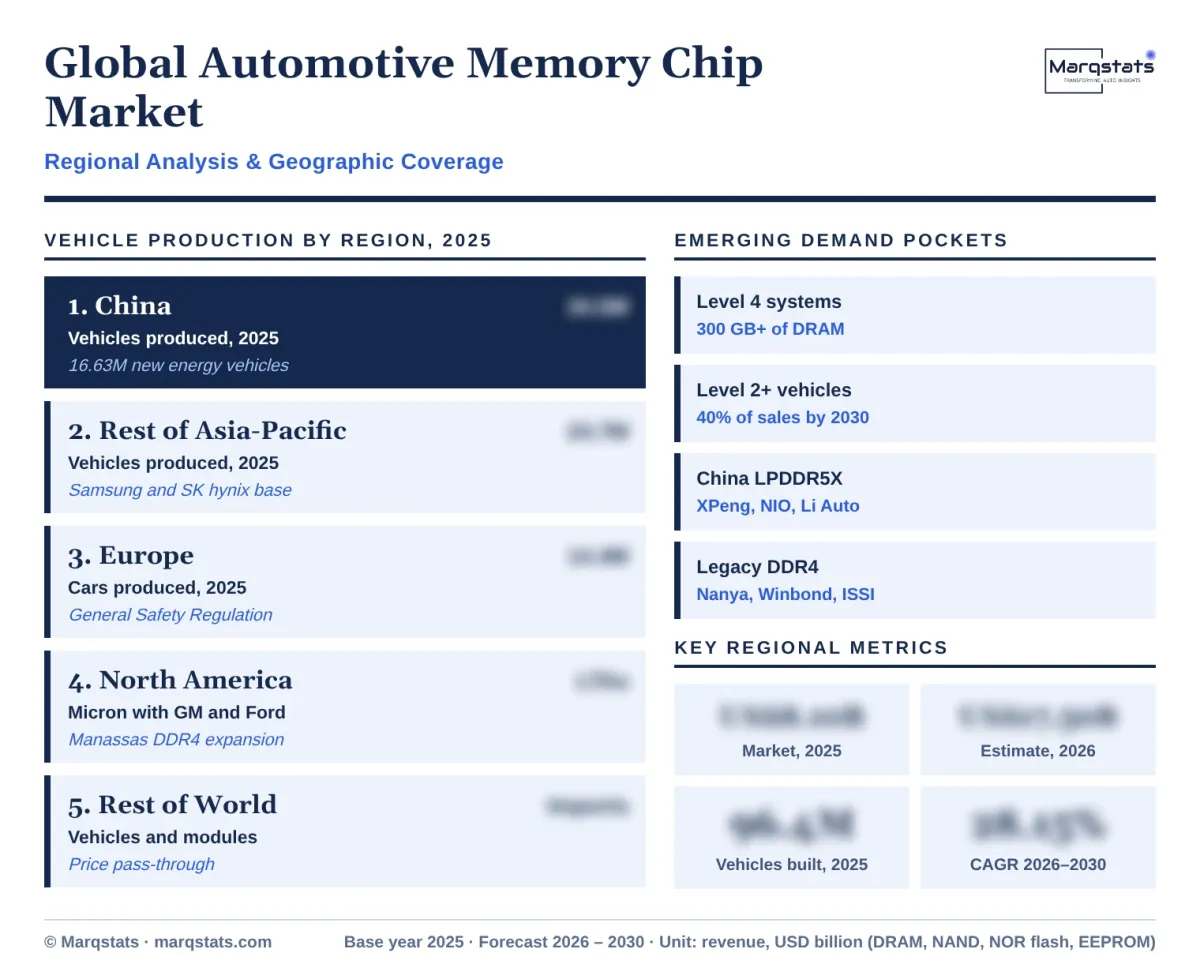
- Electric vehicle growth: China produced 34.5 million vehicles in 2025, including 16.63 million new energy vehicles, up 29%, and electric platforms carry more electronics and memory than combustion vehicles. Asia-Pacific produced 59.2 million vehicles, more than 61% of the total. Electric vehicle growth adds NOR flash and EEPROM demand in battery management and power electronics as well as DRAM in cockpit and driving computers.
- Shift to LPDDR5 and LPDDR5X: Newer, higher-value memory types are replacing LPDDR4 in driving and cockpit computers, raising average selling prices per vehicle. Chinese electric vehicle start-ups have adopted LPDDR5X as the main DRAM for Level 3 and Level 4 computers, including XPeng's Turing chip, NIO's NX9031 and Li Auto's M100. Moving to newer memory types is also the main way carmakers escape the tightest DDR4 and LPDDR4 supply, although re-qualifying designs takes time.
Key Restraints
- Capacity diverted to AI: Samsung Electronics, SK hynix and Micron are prioritising HBM and data-centre DRAM, which earn far higher margins than automotive parts and leave less wafer capacity for vehicles. Micron's total fiscal 2026 revenue reached US$133.19 billion against US$37.38 billion in fiscal 2025, showing where demand is concentrated. Micron expects memory supply to remain constrained beyond 2027, and SK hynix's chief executive has called 2027 the worst supply year in the industry's history.
- End of life for DDR4 and LPDDR4: Suppliers are reducing legacy lines that many vehicle platforms still use and will be built for years. SK hynix has extended DDR4 only through 2026, while Micron is investing more than US$2 billion at its Manassas, Virginia fab to bring its 1-alpha DRAM node online and quadruple DDR4 output for long-lifecycle customers. Smaller suppliers such as Nanya, Winbond and Integrated Silicon Solution (ISSI) are gaining legacy business as the leaders exit.
- Production risk for carmakers: Li Auto's supply chain vice president, Meng Qingpeng, warned that the industry's memory fulfilment rate was at risk of falling below 50% in 2026, and lead times for automotive memory have exceeded 58 weeks. In the United States, the Alliance for Automotive Innovation joined other trade groups in warning federal officials that shortages threatened vehicle production. Some carmakers are postponing memory-heavy features to control cost.
- Long qualification cycles: AEC-Q100 qualification can take up to two years, which slows switching to new suppliers such as CXMT and to newer memory types. Carmakers and tier-one suppliers are reviewing how much DRAM each feature truly needs and consolidating functions on fewer computers. Qualification delays keep carmakers dependent on incumbent suppliers through the tightest years of the shortage.
Key Trends
- Long-term supply agreements: Micron signed long-term supply agreements with General Motors on 1 July 2026 and Ford on 6 July 2026, as reported by The Korea Herald, alongside agreements with tier-one suppliers, while BMW buys through its suppliers' agreements. Some carmakers are dealing directly with chipmakers for the first time. Pricing power has shifted decisively to memory makers: Micron's unit gross margin rose from 31% to 84% in twelve months, and multi-year contracts give memory makers a revenue floor.
- New Chinese supply: ChangXin Memory Technologies (CXMT) is in mass production of automotive LPDDR4X and LPDDR5X, which NIO is validating, and began mass production of its fifth-generation DRAM platform in September 2026; it aims for a 35% share of China's automotive memory market by the end of 2026, according to CarNewsChina, and reported a gross margin of 89.53% in the third quarter of 2026. Yangtze Memory Technologies (YMTC) is expanding NAND capacity, giving Chinese carmakers a domestic alternative.
- Next-generation automotive memory: SK hynix showed automotive LPDDR6, Auto UFS 3.1 and vehicle SSDs in March 2026, and its automotive LPDDR5X gained ASIL-D certification from TÜV SÜD in January 2026. Samsung gained ground with low-power DRAM and UFS sold to Chinese electric vehicle platforms and overtook Micron in automotive memory in 2025 for the first time since entering the segment in 2015, as reported by The Korea Herald. Newer products carry higher prices and longer supply commitments.
- Price pass-through to buyers: Chinese electric vehicle makers adjusted prices by up to RMB 6,000 as memory costs surged, according to China Automotive News, and BYD raised prices for its God's Eye B driver-assistance package by about 21%, according to Tom's Hardware. Ford and General Motors flagged higher 2026 material costs, and Stellantis is planning higher procurement for 2026 and 2027. Pass-through shows that memory has become a visible cost item in vehicle pricing.
Market Segmentation
DRAM accounted for an estimated 50% of 2025 revenue, about US$4.05 billion, mostly LPDDR4, LPDDR5 and DDR4 in cockpit and driving computers. It is the type most affected by the shortage and price increases, because automotive grades compete for the same wafers as AI servers and phones. Samsung, Micron and SK hynix supply most automotive DRAM, with CXMT emerging in China. The move to LPDDR5X and growing content per vehicle keep DRAM the largest segment through 2030.
NAND flash, mainly UFS and eMMC with a growing share of automotive SSDs, accounted for about 35%, US$2.83 billion. Storage needs grow with maps, software updates, data recording and in-car apps. Kioxia, Sandisk, Samsung and Micron are the main suppliers, and YMTC is expanding capacity in China. A NAND shortage hits cockpit and ADAS storage first, because qualifying alternative parts takes many months.
NOR flash accounted for about 10%, US$0.81 billion, storing boot code for electronic control units, instrument clusters and driver-assistance cameras. Winbond, Macronix, Infineon and GigaDevice are the main suppliers. NOR flash demand grows with the number of control units and cameras, including those required by Europe's General Safety Regulation, and is less exposed to AI capacity diversion than DRAM.
EEPROM and other memory accounted for about 5%, US$0.41 billion, storing calibration and configuration data in many small control units across the vehicle. STMicroelectronics and Microchip are among the main suppliers. Automotive EEPROM is a small, critical part of every ECU, so a shortage of low-cost parts can halt production as effectively as a shortage of high-value DRAM.
Infotainment and digital cockpit systems accounted for an estimated 45% of revenue, about US$3.65 billion, the largest application, because multi-screen cockpits need large DRAM and UFS storage. BMW's iX3 cockpit uses 16 to 24 GB of DRAM. Centralised cockpit computers concentrate memory in fewer devices, and this application remains the largest through 2030 as screens and in-car software expand.
ADAS and autonomous driving accounted for about 30%, US$2.43 billion, and is the fastest-growing application as Level 2+ systems spread; Level 4 systems need more than 300 GB of DRAM. Chinese carmakers use LPDDR5X in driving computers such as XPeng's Turing, NIO's NX9031 and Li Auto's M100. Rising Level 2+ penetration, from more than 20% of sales in 2026 to 40% by 2030, drives content growth.
Powertrain, body and chassis accounted for about 13%, US$1.05 billion, mostly NOR flash and EEPROM in control units, including battery management in electric vehicles. This application grows with vehicle production and electrification rather than with software features. Its parts are low in value per unit, although their long lifecycles make them vulnerable to supplier exits from legacy products.
Telematics and connectivity accounted for about 12%, US$0.97 billion, including connectivity modules, gateways and over-the-air update systems. Over-the-air updates require storage for software images and fallback versions, which raises NAND content in gateways. Connected services and regulatory requirements for emergency calling and data recording keep this application growing.
By Geography
China
China is the largest market, with vehicle production of 34.5 million in 2025, including 16.63 million new energy vehicles. Chinese electric vehicle makers lead adoption of LPDDR5X and continue to add memory-heavy driver-assistance features, and NIO is validating memory from domestic supplier CXMT. Domestic supply from CXMT and YMTC reduces China's exposure to Korean and US suppliers, while price pass-through has already reached Chinese buyers.
Rest of Asia-Pacific
The rest of Asia-Pacific, led by Japan, India and South Korea, produced about 24.7 million vehicles in 2025, derived from Asia-Pacific production of 59.2 million less China. South Korea is home to Samsung Electronics and SK hynix, and India produced 6.49 million vehicles. Japanese carmakers rely heavily on long-term supplier arrangements, while Indian demand grows from a low content base as features spread to mass-market cars.
Europe
Europe produced about 14.4 million cars in 2025, and the General Safety Regulation's requirements for intelligent speed assistance and emergency braking add cameras, processors and memory to every new vehicle. Premium carmakers such as BMW and Mercedes-Benz fit some of the highest memory content per vehicle. European carmakers buy largely through tier-one suppliers' long-term agreements, which shapes how quickly price increases reach them.
North America
North America depends on long-term agreements to secure memory: Micron signed agreements with General Motors and Ford in July 2026, and Micron's Manassas, Virginia fab is expanding DDR4 output for long-lifecycle customers. Ford and General Motors flagged higher material costs in 2026. Domestic DDR4 capacity at Manassas gives North American carmakers a more secure supply of legacy memory after 2027.
Rest of World
South America, the Middle East and Africa account for a small share of demand, mainly through imported vehicles and electronic modules. Their content per vehicle is lower than in China, Europe or North America, although it rises as imported Chinese electric vehicles with advanced cockpits spread. These markets are most exposed to price pass-through from carmakers.
How Competition Is Evolving
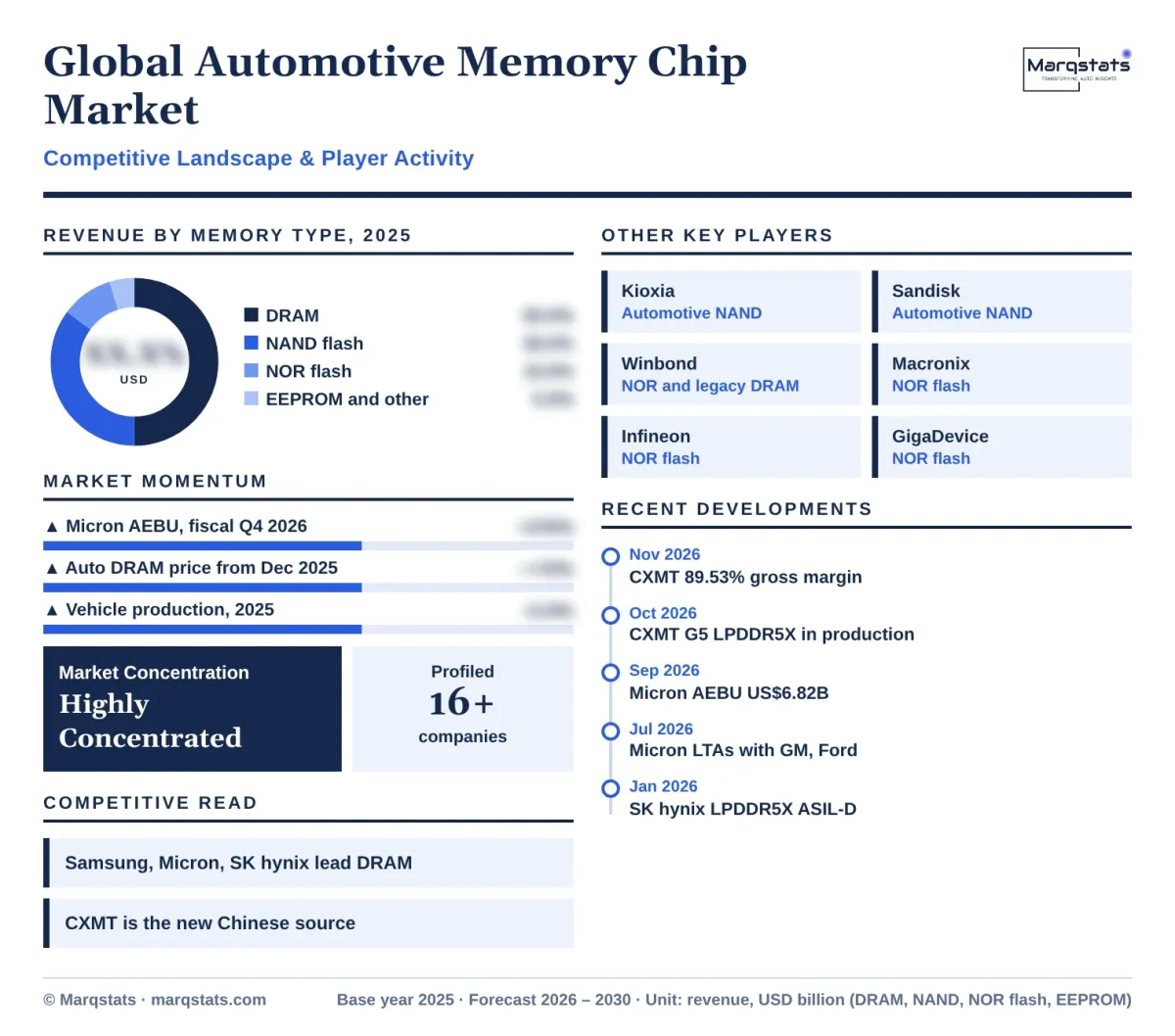
The global automotive memory chip market is highly concentrated. Samsung Electronics, Micron Technology and SK hynix supply most automotive DRAM, and The Korea Herald reported that Samsung overtook Micron in automotive memory in 2025, helped by sales of low-power DRAM and UFS to Chinese electric vehicle platforms. Kioxia, Sandisk, Samsung and Micron lead automotive NAND, while NOR flash and EEPROM are supplied by a wider group including Winbond, Macronix, Infineon, GigaDevice, STMicroelectronics and Microchip.
Micron has built the most visible automotive strategy, with long-term agreements with General Motors and Ford and with tier-one suppliers, and investment at Manassas to extend DDR4 production. Its Automotive and Embedded Business Unit revenue rose to US$6.82 billion in fiscal Q4 2026, up 376%, with gross margin of 84%.
SK hynix is moving up the technology curve with automotive LPDDR5X certified to ASIL-D and automotive LPDDR6, Auto UFS 3.1 and vehicle SSDs shown in March 2026, while selectively extending DDR4. Samsung is focusing on LPDDR5X and UFS for high-end cockpit and driving computers.
Chinese suppliers are the main new competitors. CXMT, whose automotive memory NIO is validating, reported a gross margin of 89.53% in the third quarter of 2026, while planning long-term supply agreements and LPDDR6. Smaller DRAM makers including Nanya, Winbond and ISSI are winning legacy automotive business as the leaders exit older generations.
Companies Covered
Companies covered in the report include:
Recent Market Activity
Table of Contents
Coverage & Segmentation
The study covers memory semiconductors sold for use in vehicles: DRAM (LPDDR4, LPDDR5, LPDDR5X, DDR4 and DDR5), NAND flash (UFS, eMMC and automotive SSDs), NOR flash and EEPROM, across passenger and commercial vehicles. Memory sold for non-automotive embedded uses is excluded. The base year is 2025, the historical period 2021 – 2025 and the forecast period 2026 – 2030. The unit is revenue in US dollars.
Eight segments across two dimensions and five regions are covered, and 16 companies are profiled. The 2025 base of US$8.10 billion, the memory-type and application splits, the 2026 estimate and the 2027 to 2030 forecast are Marqstats constructions. Supplier revenue is as reported by the companies; price changes are as reported by named media.
Known limits are stated plainly. No supplier discloses automotive memory revenue on its own, so the base is triangulated from supplier business-unit results, vendor-share analyses and vehicle production. Regional sections use vehicle production as the main indicator because memory sales by region are not published.
