A USD 7.84 Million Market Nobody Talks About
Ask most people when Vietnam's electric vehicle maintenance industry began, and they'll point to VinFast's passenger car ramp-up — 97,399 global deliveries in 2024, nearly doubling to 196,919 in 2025. That's the visible story. It's also not where the industry actually started.
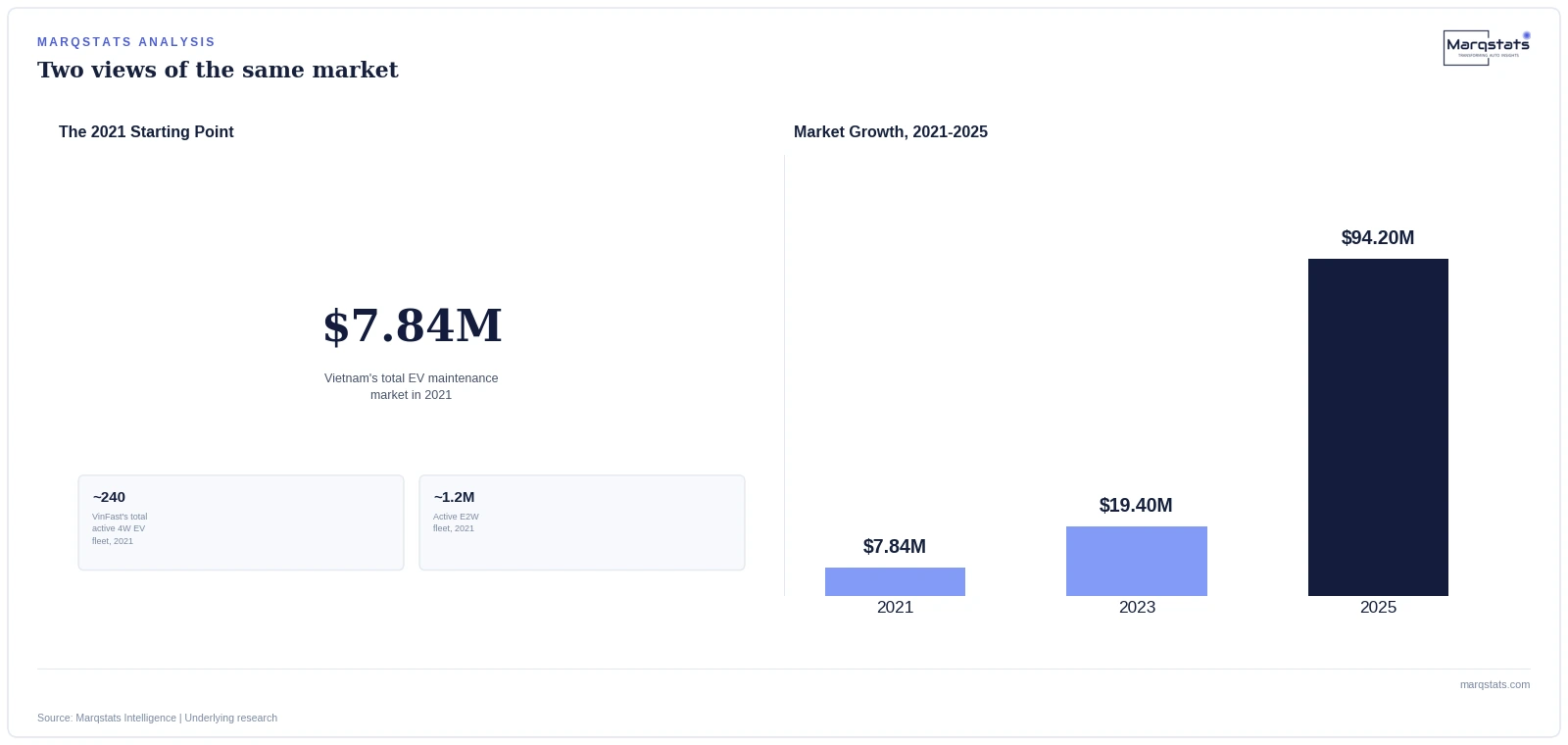
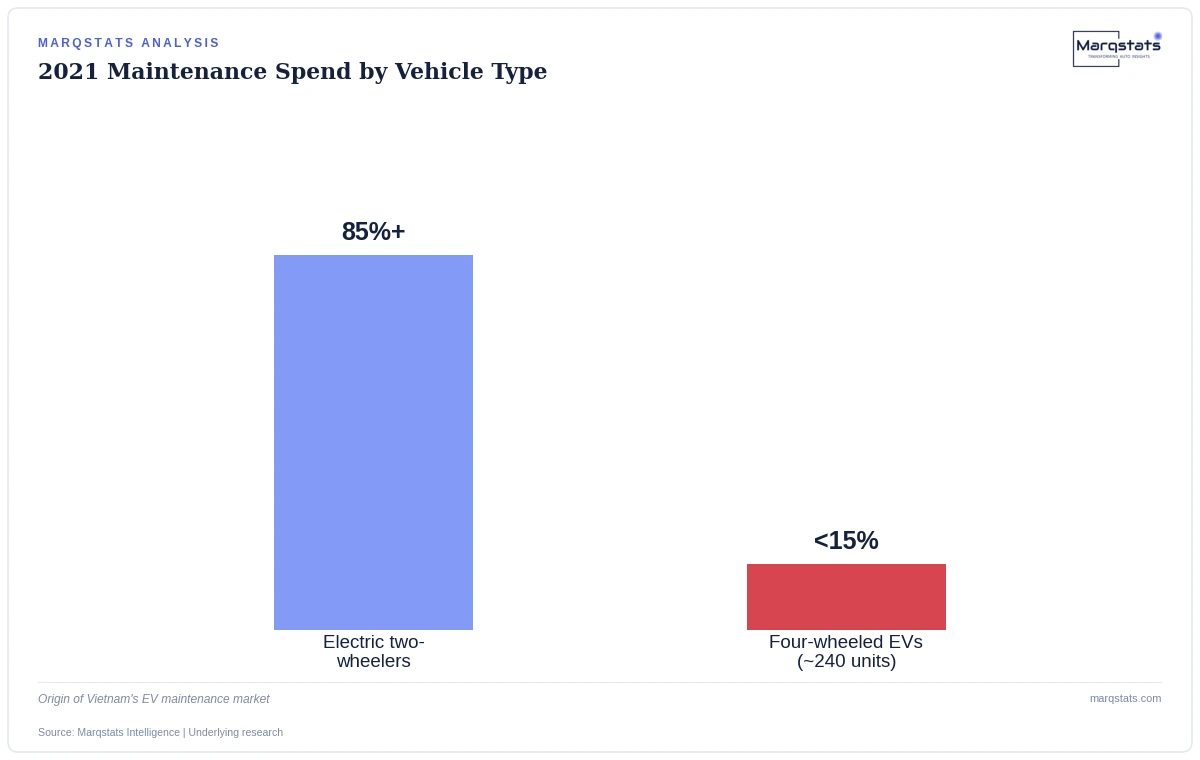
In 2021, Vietnam's total EV maintenance market was already generating USD 7.84 million in expenditure. VinFast's entire active four-wheeled fleet that year numbered roughly 240 vehicles nationwide. So where did the other USD 7.8 million-plus come from?
The Answer: Electric Scooters
Over 85% of that 2021 market came from lead-acid battery replacements and mechanical repairs on electric two-wheelers — a segment that gets a fraction of the industry attention passenger EVs receive today, despite having quietly built the technical and commercial foundation the whole industry now stands on.
Why This Ordering Matters
This isn't just a historical curiosity. The technicians, parts distributors and component suppliers who built Vietnam's earliest EV repair capability cut their teeth on two-wheeler battery packs and hub motors — not passenger car high-voltage systems. That's a genuinely different technical starting point than markets where passenger EVs arrived first, and it shapes which companies and which specific competencies are best positioned as the industry scales into its now-larger, now-more-valuable passenger car segment.
A Named Comparison: How This Differs From Markets That Started With Cars
Markets where passenger EVs led the electrification curve typically built high-voltage diagnostic and battery-management expertise first, with two-wheeler service capability developing later as a simpler, lower-stakes offshoot. Vietnam's sequence ran in reverse — mass-market lead-acid and lithium battery service experience came first, at genuine commercial scale, well before passenger car high-voltage systems arrived in volume.
Where the Real Inflection Point Actually Was
The passenger segment's own genuine growth story starts later and looks different too: annual expenditure jumped from USD 11.20 million in 2022 to USD 19.40 million in 2023, and the underlying research's own driver attribution is specific — this was Green and Smart Mobility's (GSM) electric taxi fleet deployment and scaling, not organic private consumer adoption. GSM's own cumulative car allocations grew from roughly 20,000 in 2023 to 98,741 by year-end 2025.
The Scale This Actually Represents
It's worth putting real numbers against this: Vietnam's electric two-wheeler fleet reached 2.45 million units by 2025, versus roughly 311,000 four-wheeled EVs — nearly an eight-to-one ratio. Even as passenger car value now exceeds two-wheeler value in absolute dollar terms, the sheer unit volume of two-wheelers means the segment remains a genuinely massive service opportunity in its own right, not a historical footnote that stopped mattering once passenger EVs arrived.
What This Means for Anyone Entering This Market
The practical takeaway: a supplier, investor or workshop operator sizing up Vietnam's EV aftermarket opportunity should weight commercial fleet deployment decisions and electric two-wheeler dynamics as seriously as passenger car headlines, since both have historically driven this market's real growth more than private consumer EV adoption alone.