
A Joint Venture Built to Share the Risk of a New Kind of Platform
Flexis SAS launched in 2024 as a genuinely three-way bet: Renault Group, Volvo Group and CMA CGM came together to build a dedicated software-defined electric commercial van platform, a native 800-volt skateboard chassis with a centralized SDV electronic backbone developed by Renault's Ampere unit. The logic was straightforward. Electrifying commercial vans is expensive and technically harder than electrifying passenger cars, so splitting the cost and risk across an automaker, a truck manufacturer and a shipping and logistics group made the platform's economics work for all three.
The Numbers That Changed the Calculation
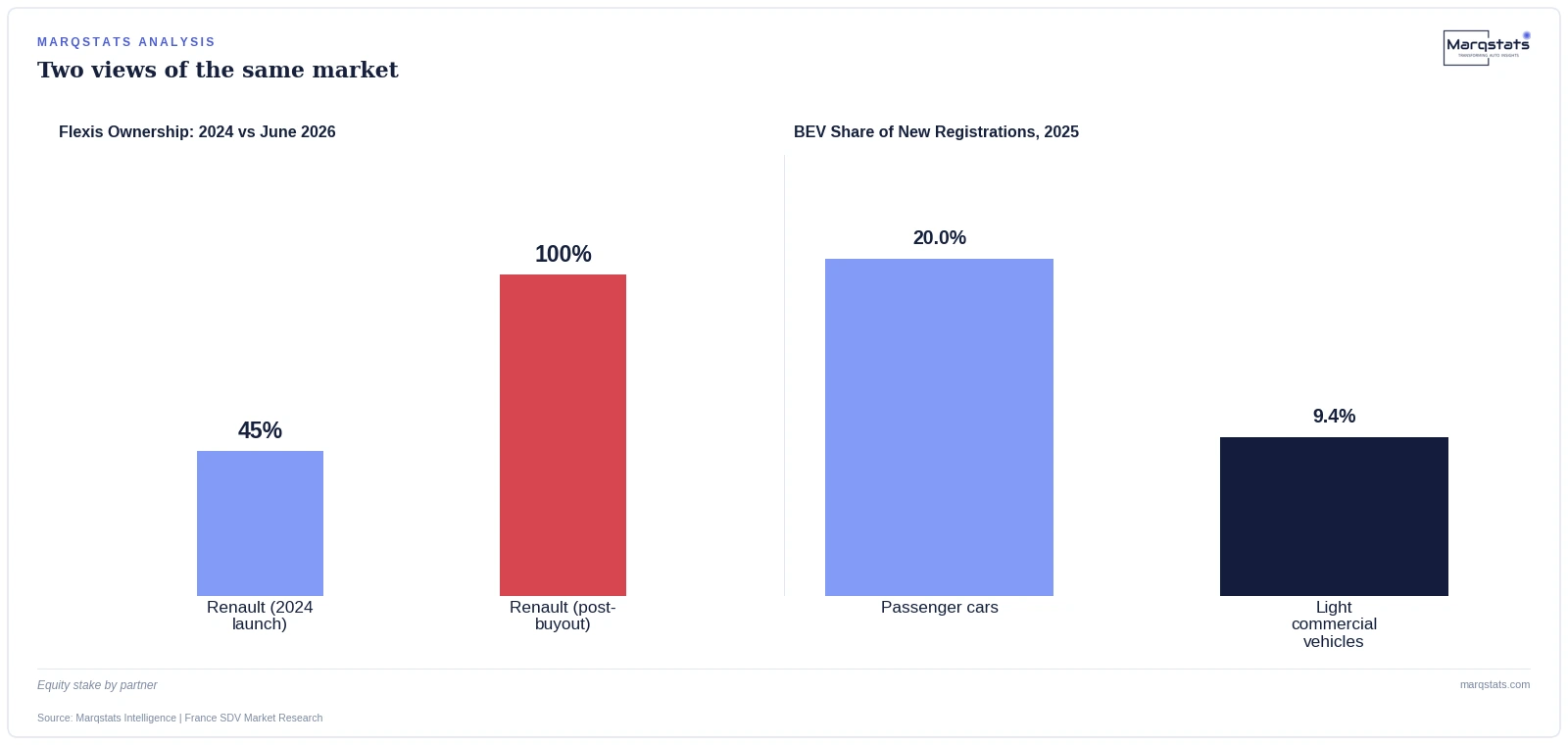
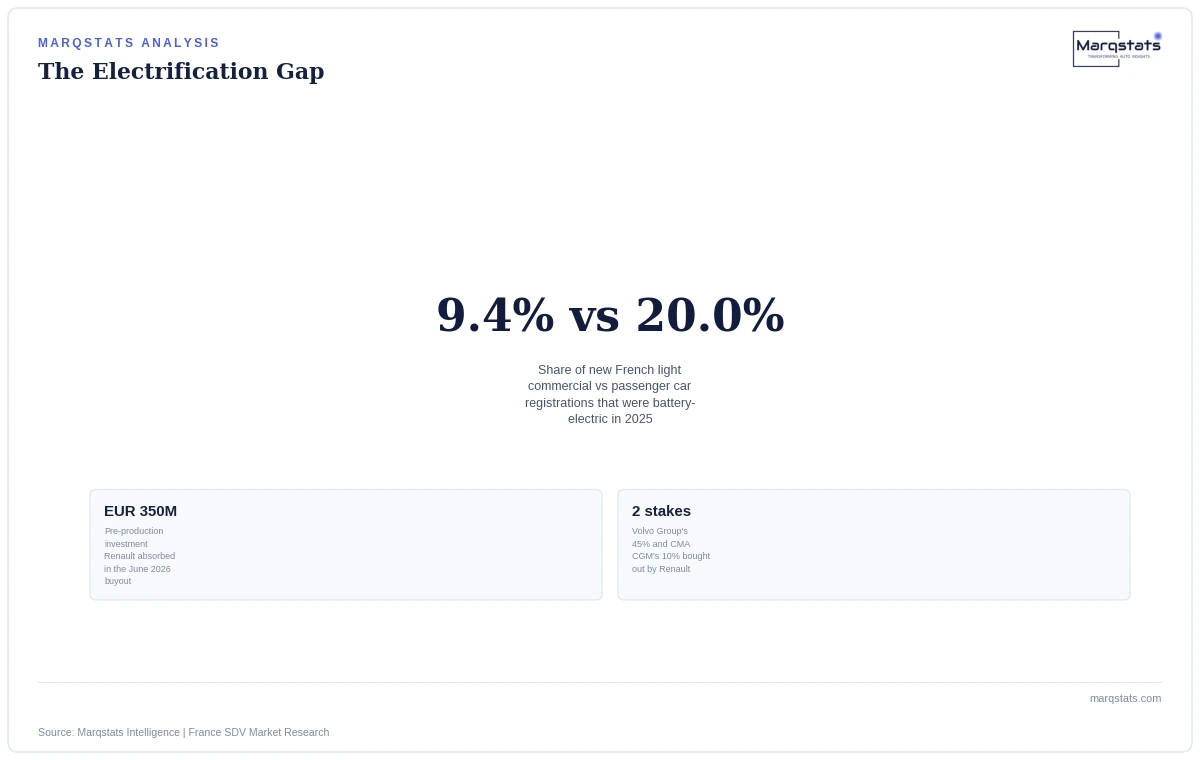
Throughout 2025, commercial-vehicle electrification in France lagged passenger cars significantly: battery-electric vehicles reached 20.0% of new passenger car registrations but only 9.4% of light commercial registrations. That gap mattered specifically for Flexis, because the venture's entire commercial case depended on fleet operators adopting electric vans fast enough to justify a dedicated, purpose-built platform rather than a converted combustion-engine van. A slower-than-planned commercial EV ramp put real strain on a joint venture built around fast electrification.
Why Renault Bought Out Its Own Partners
In June 2026, Renault Group completed a full buyout of Flexis, purchasing Volvo Group's 45% stake and CMA CGM's 10% stake and absorbing the roughly EUR 350 million in pre-production investment already committed. That is a specific, deliberate choice, not a routine restructuring. Of the three original partners, only Renault had a direct industrial reason to see the platform through: series production of the first model, the Trafic Van E-Tech Electric, is scheduled for late 2026 at Renault's own Sandouville complex in Normandy, and Renault's Ampere unit built the platform's core electronic backbone in the first place. Volvo Group retains its role, its Renault Trucks distribution network will still carry the vehicle to market from 2027, just without the equity stake.
What This Signals for Other Multi-Party SDV Ventures
The pattern worth watching: a joint venture spreads the capital risk of building software-defined architecture across multiple partners, but when the underlying commercial timeline, in this case, commercial EV adoption, runs slower than the original business case assumed, the partner with the deepest industrial stake, the one with a factory, an internal software unit, and a production date already on the calendar, ends up carrying the platform alone. Watch for the same dynamic wherever else a multi-OEM or cross-industry SDV joint venture gets announced across Europe over the next few years: the venture structure that looks like shared risk at launch often resolves into single-owner control once the platform actually needs to ship.