
A Tax Difference Small Enough to Miss, Large Enough to Matter
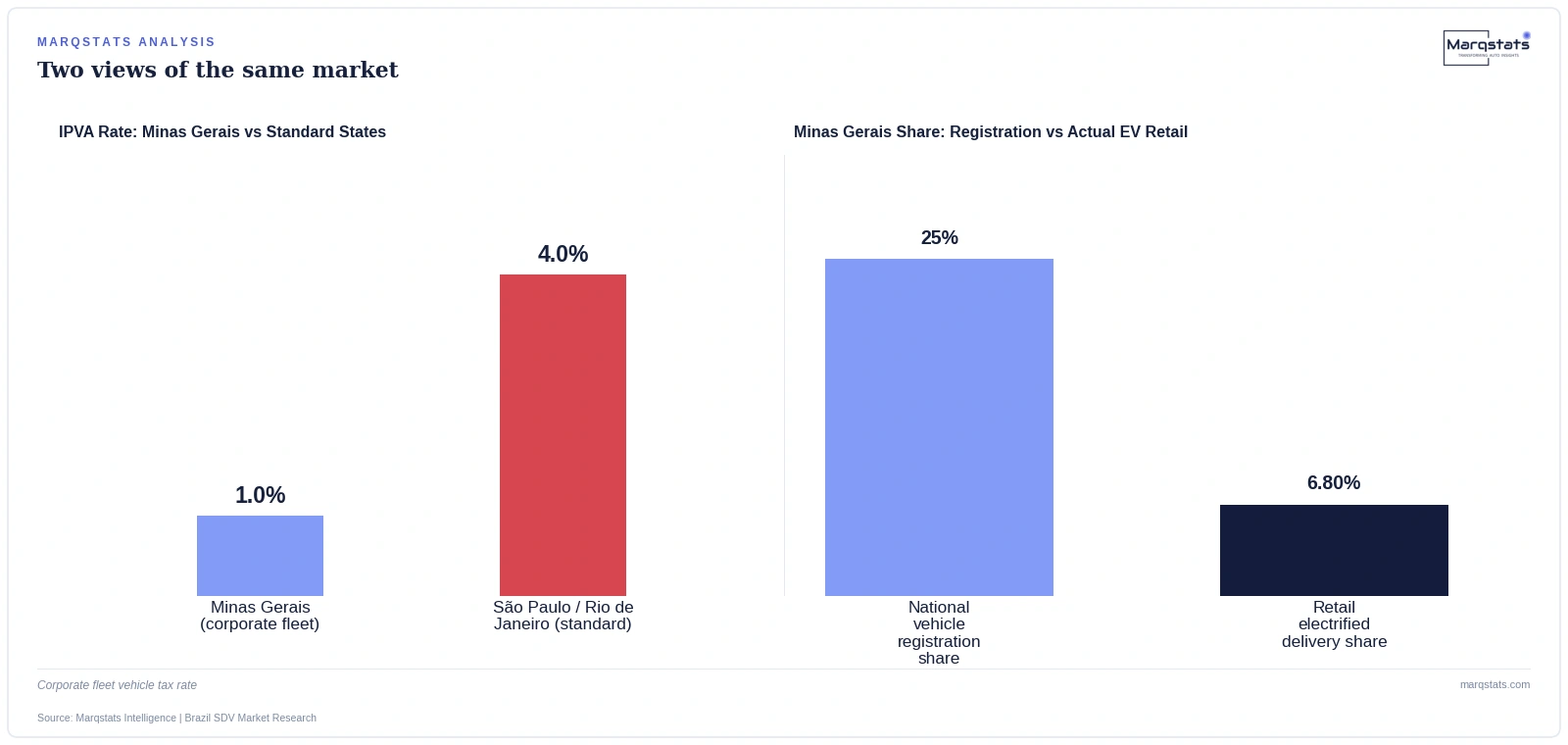
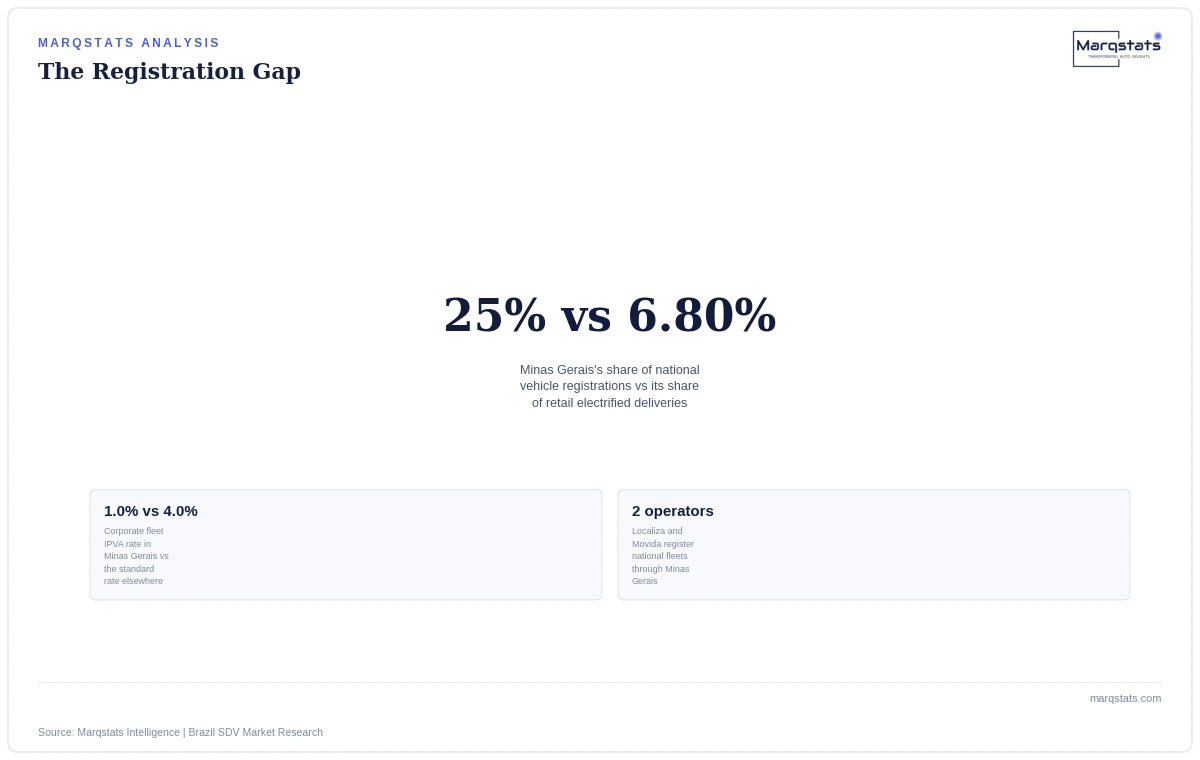
Three percentage points doesn't sound like much. Minas Gerais levies a 1.0% IPVA (vehicle property tax) rate on vehicles owned by corporate rental and leasing companies, against a standard 4.0% rate assessed on private passenger vehicles in São Paulo and Rio de Janeiro. For a single vehicle, that gap is a rounding error. Multiplied across a national fleet of hundreds of thousands of vehicles, it is a material line item on a balance sheet, and Brazil's largest fleet operators have responded to it exactly as the incentive predicts.
What the Number Actually Reveals
Localiza Rent a Car and Movida Locação de Veículos, Brazil's largest fleet rental and vehicle subscription operators, register their nationally-operating fleets through administrative subsidiaries in Minas Gerais. The result: the state captures roughly 25% of all national new vehicle registrations, despite representing only 6.80% of end-user retail electrified deliveries. That 18-point gap is not a measure of Minas Gerais's actual automotive market. It is a measure of where corporate treasury departments decided to domicile paperwork.
Why This Isn't Just a Tax Story
The consequence reaches well past tax administration. Because these vehicles are registered in one state but physically operate across the entire country, on ride-hailing platforms, corporate leases and subscription rentals moving through dozens of cities and regions, telematics providers serving this fleet segment cannot design connectivity around localized regional cellular networks. They have to build for multi-operator national roaming from the start, treating every vehicle as if it could be anywhere in Brazil at any time, because operationally, it usually is.
What This Means for Reading Brazil's Regional Data
The practical takeaway: any analysis of Brazil's automotive or connected-vehicle market that uses state-level registration data as a proxy for regional operational activity will systematically overstate Minas Gerais and understate wherever these fleet vehicles are actually being driven. This isn't a data-quality problem to be fixed; it's a structural feature of how Brazil's fleet-leasing tax incentives work, and it will keep showing up in registration statistics for as long as the 3-point IPVA gap exists. Anyone building a market model, a distribution strategy, or a telematics coverage plan around Brazilian state-level vehicle data should treat Minas Gerais's registration share as an administrative artifact, not an operational one.