
A Network Shutdown That Was Announced Years in Advance
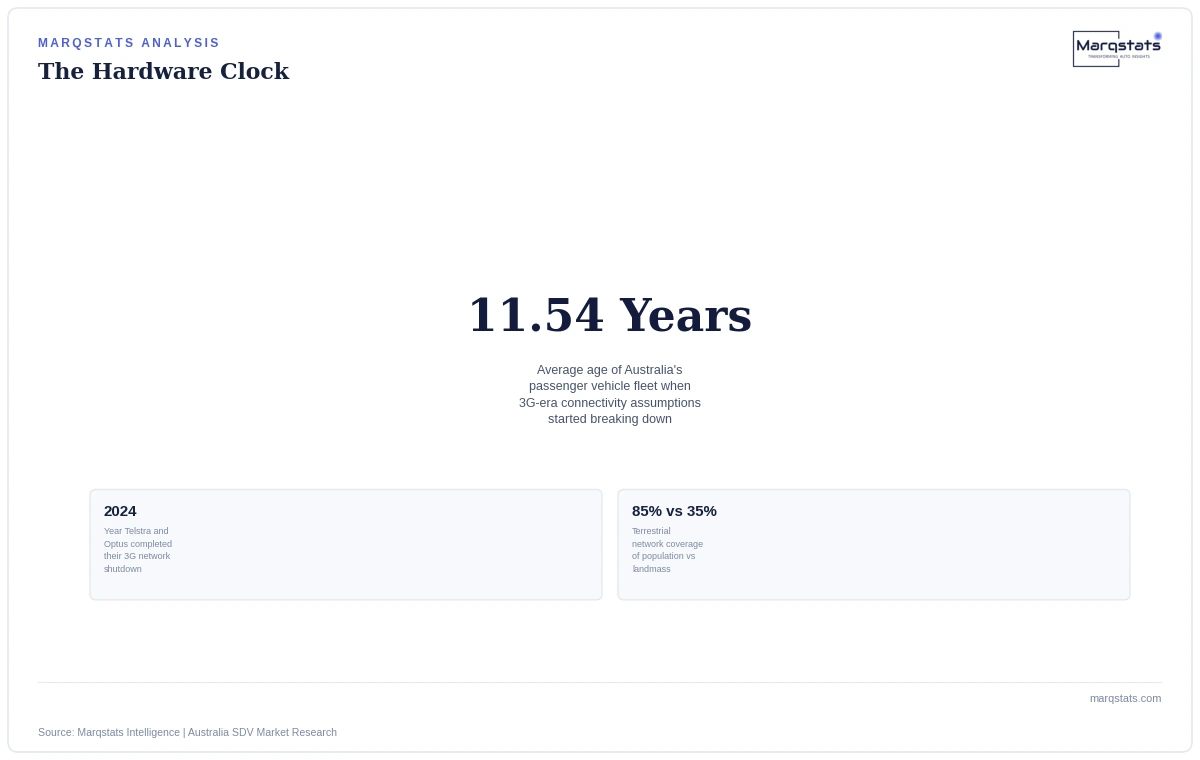
Telstra and Optus shut down their 3G networks in late 2024, a closure that had been publicly flagged years ahead of time to free up spectrum for 5G expansion. For most consumers, the transition was invisible: phones had long since moved to 4G and 5G. For a specific slice of Australia's vehicle fleet, it was not invisible at all.
What Actually Broke
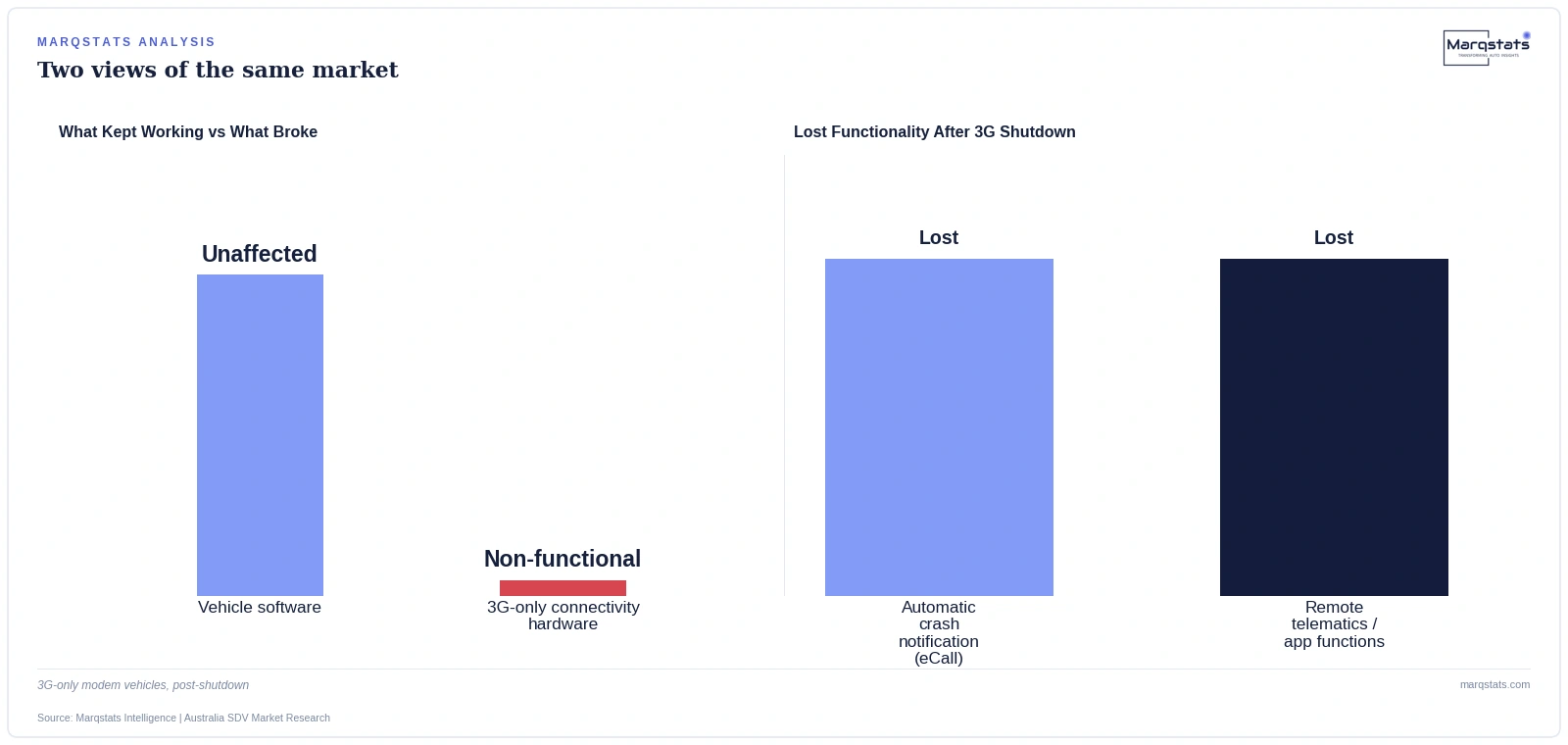
Thousands of older connected vehicles, fitted with 3G-only telematics modems at the factory, lost automatic emergency crash notification, remote app functionality and telematics links the moment the 3G networks went dark. These were not vehicles with a software problem. Their software was, in most cases, working exactly as designed. The hardware that connected that software to the outside world simply had no network left to talk to.
Why This Matters More as Vehicles Get More Software-Defined
The uncomfortable structural fact this exposes: a vehicle's software can, in principle, be updated indefinitely over its operational life. Its connectivity hardware cannot outlive the network standard it was built for, and vehicles stay on Australian roads for a long time, the national fleet averaged 11.54 years old at the close of 2025. A car sold in 2018 with a 3G-only modem was engineered to a network assumption that had an expiry date the buyer had no visibility into at purchase. As SDV architecture pushes more vehicle functionality, not just convenience features but safety-relevant capability like eCall and remote diagnostics, onto continuous cloud connectivity, this same failure mode gets more consequential with each hardware generation, not less.
The Part of SDV Architecture Nobody Markets
Manufacturers market over-the-air updates as proof that a modern vehicle keeps improving after purchase. The 3G shutdown is a reminder that OTA capability only extends as far as the physical connectivity layer underneath it, and that layer has its own, separate depreciation clock running on a timeline set by telecommunications carriers, not automakers. A vehicle can have flawless software and still go effectively silent the day its modem's network standard gets retired.
What This Means for Buyers, Fleets and Regulators
The practical takeaway: a connected vehicle's safety-relevant telematics should be evaluated on connectivity-hardware longevity, not just current-generation network compatibility, and buyers, fleet operators and regulators alike would benefit from manufacturers disclosing the expected operational life of embedded modems at the point of sale, the same way a phone's software-support window is now commonly disclosed. As Australia's SDV architecture increasingly depends on continuous connectivity for core safety functions, not just convenience, this is a gap worth closing before the next network generation gets retired.