
America leads the world in one kind of motor oil ingredient. It imports most of the kind it actually needs now.
The United States is the world's leading producer of API Group II base oils, the mid-tier building block behind a large share of conventional and semi-synthetic motor oil. But the industry has moved on. Modern engine oil specifications increasingly demand a different, higher-performance ingredient, and America doesn't make nearly enough of it.
Why Group III became the ingredient that matters
Formulating motor oils to meet ILSAC GF-7A, GF-7B and API SQ specifications, the standards that took effect 31 March 2025, requires base stocks with high viscosity index ratings, low volatility and minimal sulfur content. Conventional API Group I or standard Group II base stocks simply can't meet those chemical constraints for mainstream passenger car applications anymore. The market has shifted decisively toward high-purity Group II+ cuts, Group III and Group III+ hydrocracked stocks, and synthetic Polyalphaolefins.
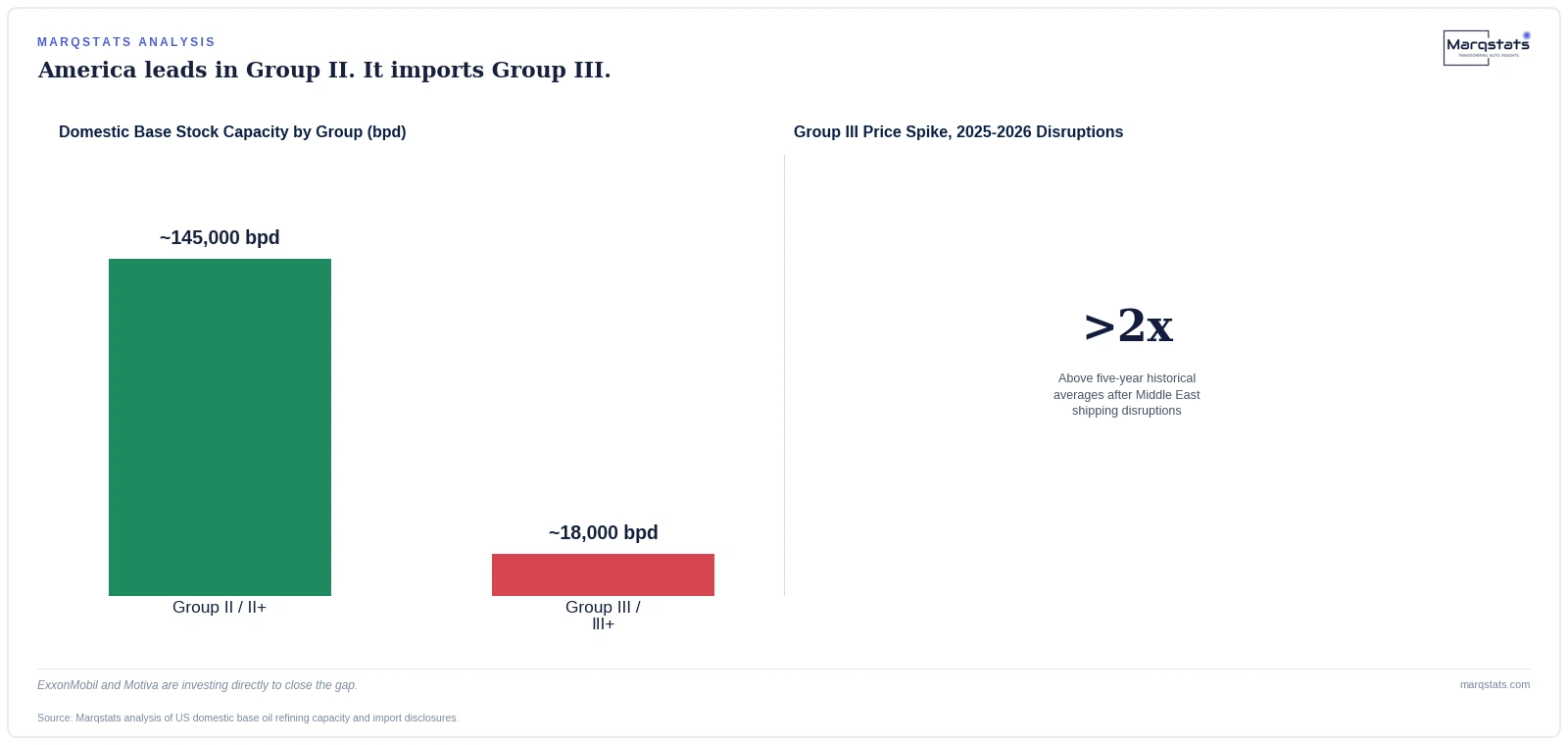
The industry standardized around an ingredient America barely makes.
— Marqstats Analyst Team
Where the supply actually comes from instead
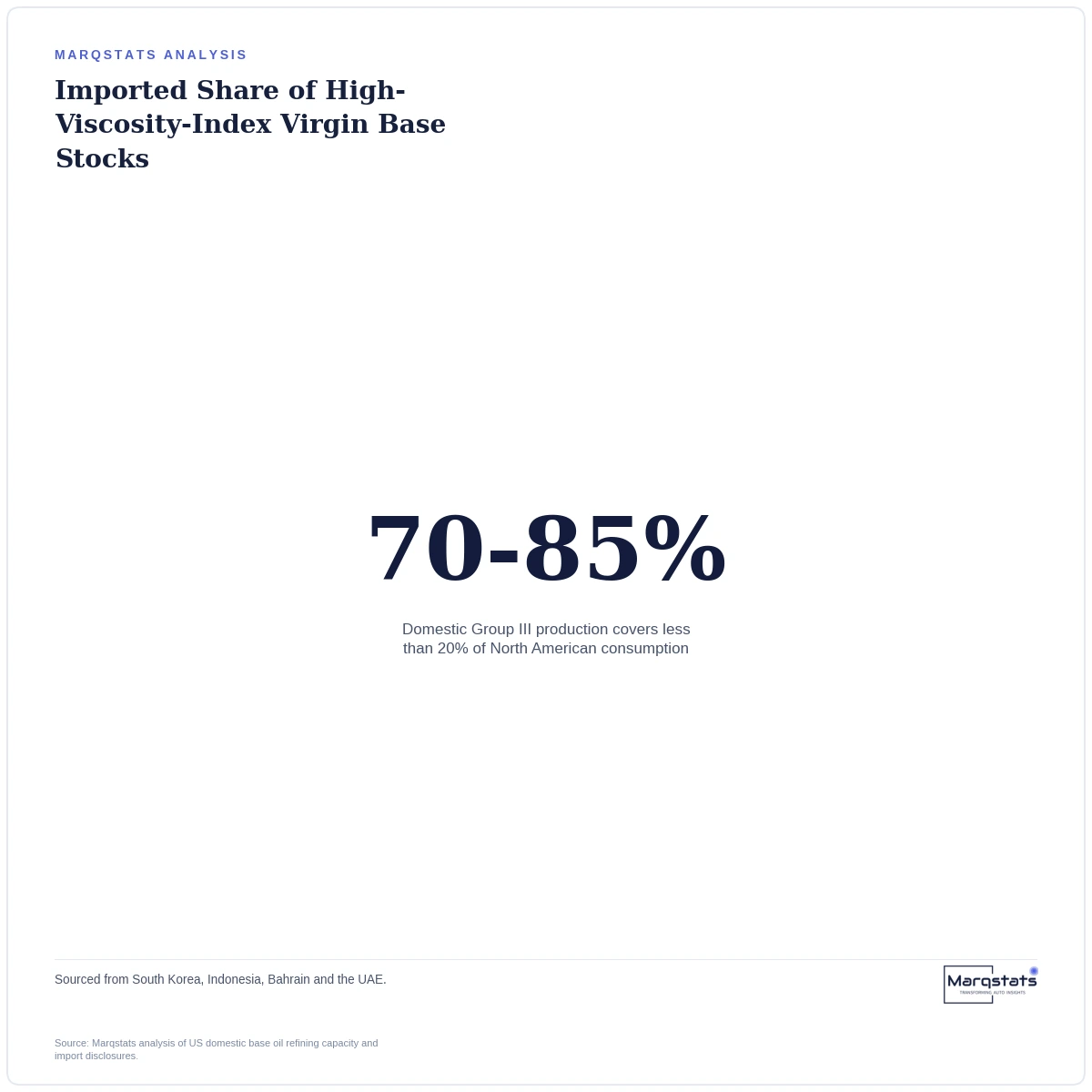
The domestic refining complex is the world's leading producer of Group II base oils, anchored by Motiva Enterprises' Port Arthur Manufacturing Complex, which maintains a rated capacity of 40,300 barrels per day of mostly Group II production, alongside substantial volumes from Chevron, ExxonMobil, Phillips 66 and Calumet. But prior to current expansion projects, domestic Group III production accounted for less than 20% of North American Group III consumption. The gap gets filled by imports, an estimated 70% to 85% of high-viscosity-index virgin base stocks, sourced from refining centers in South Korea, Indonesia, Bahrain and the United Arab Emirates.
What happened when that import dependency actually got tested
This isn't a hypothetical vulnerability, it materialized directly during 2025 and early 2026. Disruptions affecting Middle Eastern export terminals and commercial maritime transit corridors through the Strait of Hormuz and the Red Sea reduced global Group III export availability. Industry assessments indicated that between 20% and 50% of anticipated swing Group III export supply was taken offline or rerouted, driving domestic spot and contract Group III prices to more than twice their five-year historical averages. This wasn't a distant, abstract geopolitical concern - it showed up directly as a cost line item for American lubricant blenders and, eventually, consumers.
What the industry is actually doing about it
The response has been concrete rather than theoretical. ExxonMobil initiated construction of a dedicated Group III production facility at its Baytown, Texas refinery complex, directly addressing the domestic capacity gap. Motiva expanded specialty hydroprocessing operations to increase domestic Group III availability alongside its existing Group II strength. These are genuine capital commitments aimed at reducing reliance on the same import corridors that caused the 2025-2026 price spike, though building and ramping new refining capacity takes years, meaning the underlying import dependency won't close quickly.
The counter-argument: is new domestic capacity actually enough to meaningfully change the import dependency picture?
A fair skepticism is whether announced capacity additions, a single new facility at Baytown and expanded hydroprocessing at Motiva, are genuinely large enough relative to the scale of the existing Group III deficit to meaningfully reduce US reliance on Middle Eastern imports, rather than simply adding a modest supplement alongside continued heavy import dependence. This is a reasonable concern given how large the existing gap is: domestic production covering under 20% of consumption represents a substantial shortfall that a small number of new projects can't fully close on their own. What these investments likely represent, more realistically, is a first meaningful step toward reducing the most acute price-volatility exposure at the margin, rather than a wholesale resolution of the underlying import dependency, which will probably persist as a structural feature of this market for years to come even after these specific projects come online.
What this means for refiners and blenders
- Domestic refiners with flexible hydroprocessing facilities should prioritize upgrading Group II units to produce Group II+ and Group III cuts, following the model demonstrated by ExxonMobil's Baytown expansion and Motiva's hydroprocessing investments.
- Lubricant blenders should evaluate supply diversification and hedging strategies specifically for Group III procurement, given the demonstrated price volatility during Middle Eastern shipping disruptions.
- Investors evaluating this market should treat domestic Group III capacity expansion announcements as a leading indicator of reduced long-term supply chain risk, while recognizing the near-term import dependency will likely persist.
Why Group I and Group IV don't solve the same problem
It's worth being precise about why other base oil categories can't simply substitute for the missing Group III capacity. The domestic market actually holds a structural surplus in Group I base oils, legacy solvent-refined stocks used mainly in monogrades, marine lubricants, industrial gears and greases, positioning the US as a net exporter in that specific category. Group IV polyalphaolefins, the premium synthetic tier above Group III, are domestically available through producers like Ineos Oligomers and ExxonMobil Chemical, but at meaningfully higher cost, positioning them for extreme-temperature and racing applications rather than mainstream passenger car formulation at scale.
Group III sits in a specific, awkward middle position: too chemically demanding for the Group I and Group II capacity America has in abundance, but not premium enough to justify the cost of universal Group IV substitution across the mass passenger car market. That's precisely the gap the new mandatory specifications widened, and precisely the gap import dependency has been filling.
What re-refined oil adds to this picture
There's a domestic supply option worth noting that doesn't depend on new refining capacity at all: re-refined base oil, produced by processing used motor oil back into finished-grade base stock rather than starting from virgin crude. Clean Harbors, through its Safety-Kleen Sustainability Solutions subsidiary, operates the largest used oil collection and re-refining network in North America, processing approximately 249 million gallons of waste liquids annually into API-licensed Group II+ and Group III base stocks. That's a genuinely domestic, closed-loop source of exactly the higher-viscosity-index chemistry the market is short on, and it doesn't carry the same geopolitical shipping-corridor exposure that virgin Group III imports do.
bp's Castrol unit has moved to scale this specific advantage directly, entering a multi-year partnership with Safety-Kleen to grow its Castrol MoreCircular brand, collecting used fleet oil and supplying high-performance circular engine oils back into commercial fleets and workshop chains. As virgin Group III import risk becomes more visible to the industry, re-refined base oil capacity looks increasingly like a genuine strategic hedge, not merely a sustainability talking point.
The full market picture
Marqstats' complete United States automotive lubricants aftermarket analysis, including the full upstream base oil supply chain breakdown, is available in the linked report below.
Related reportUnited States Automotive Lubricants Aftermarket Size, Share & Forecast 2026 – 2030