
A Rounding Error Three Years Ago
That kind of shift usually takes far longer than three years to materialize in an industry as capital-intensive and habit-driven as vehicle maintenance, which makes the speed here worth understanding on its own terms, not just the final percentage.
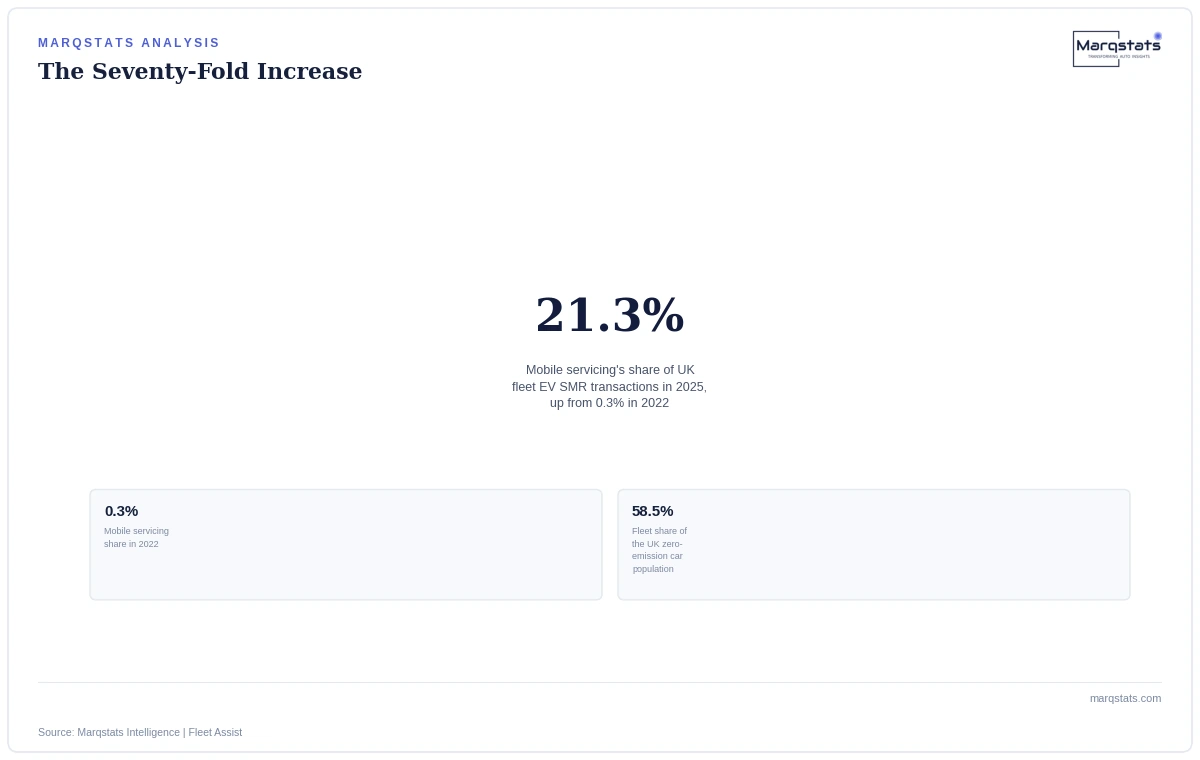
In 2022, mobile servicing accounted for 0.3% of UK corporate electric car maintenance transactions — close enough to a rounding error that it barely registered as a distinct channel at all.
The Number Today
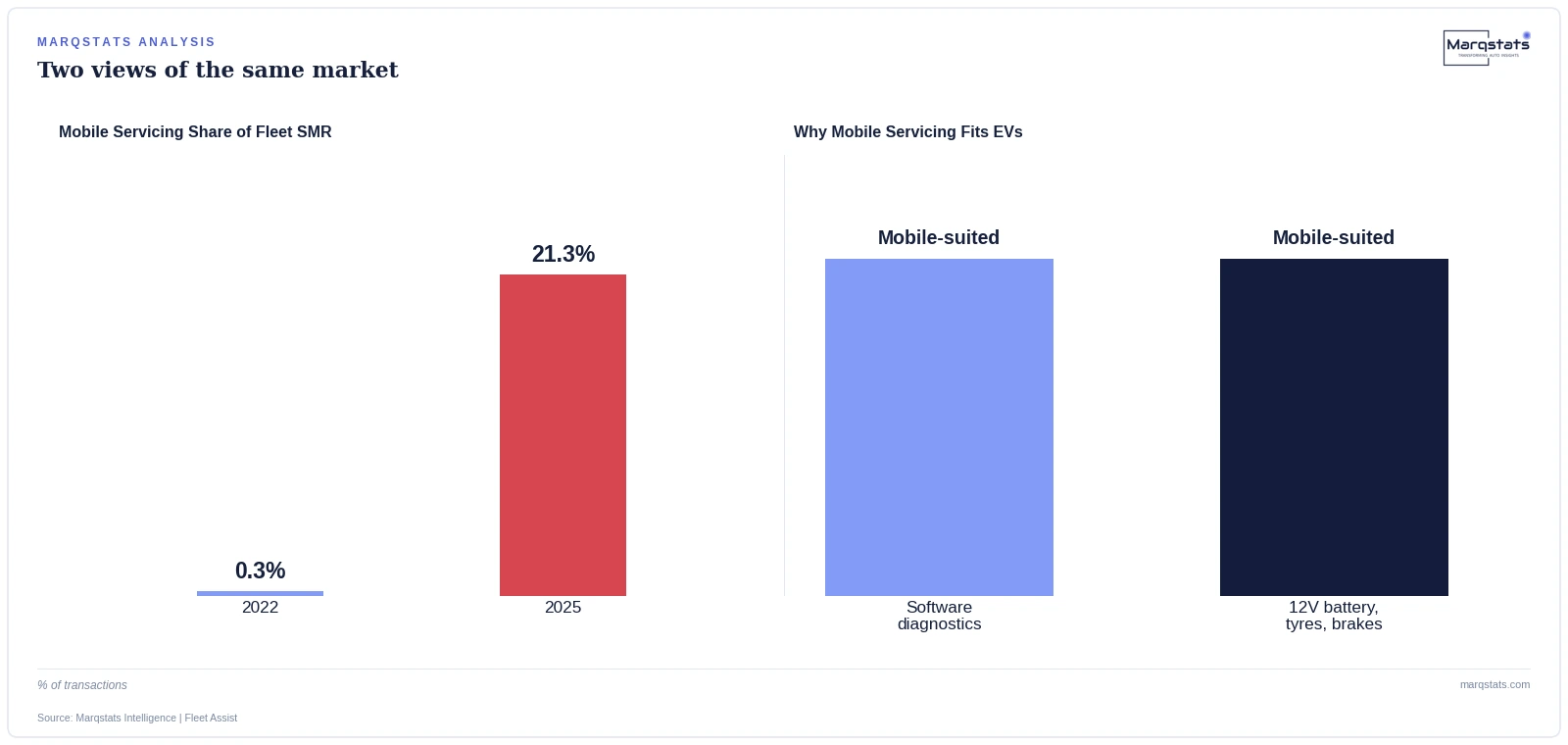
By 2025, Fleet Assist's own operational records show mobile servicing units completing 21.3% of all corporate electric car SMR transactions — roughly a seventy-fold increase in three years.
Why Mobile Servicing Fits EVs Specifically Well
The shift isn't a general trend toward convenience. It traces to something specific about what EV maintenance actually involves: software diagnostic readouts, 12V battery replacements, tyre changes, and brake servicing are all tasks a mobile mechanic can genuinely perform at a customer's depot or driveway, without the specialized fixed infrastructure that, say, a live high-voltage battery module repair would require.
Why Fleets Specifically Drove This, Not Retail Owners
Corporate and commercial fleets, which account for 58.5% of the UK's zero-emission car population, have every incentive to minimize vehicle downtime — a van sitting in a workshop queue is a van not generating delivery revenue. Mobile servicing addresses that directly, and centralized fleet clearinghouses like Fleet Assist and Epyx 1link could route routine EV service work to mobile providers systematically, in a way an individual retail owner booking a single appointment never could.
A Named Comparison: Why This Growth Rate Is Genuinely Unusual
Most channel shifts in automotive aftermarket take a decade or more to move meaningfully. Going from 0.3% to 21.3% in three years is a genuinely fast structural shift, not a gradual trend — and it happened specifically because EV maintenance's task mix lines up unusually well with what a mobile mechanic can do, a coincidence of vehicle architecture and service model that traditional ICE fleet maintenance never had.
Where the Growth Ceiling Likely Sits
Mobile servicing is unlikely to keep expanding indefinitely at this pace, since complex high-voltage battery module repairs and structural collision work still genuinely require fixed workshop infrastructure -- clean rooms, battery lifting benches, calibrated ADAS target rigs -- that a van simply cannot carry. The realistic ceiling sits somewhere well short of full market capture, concentrated specifically in the routine, non-invasive service categories it already dominates.
What This Means for Workshop Networks
The practical implication: brick-and-mortar independent garages that haven't yet integrated mobile servicing capability or established digital interfaces with fleet management aggregators risk genuine disintermediation from a large and rapidly growing share of the UK's operational EV fleet — this is no longer a niche channel worth ignoring.