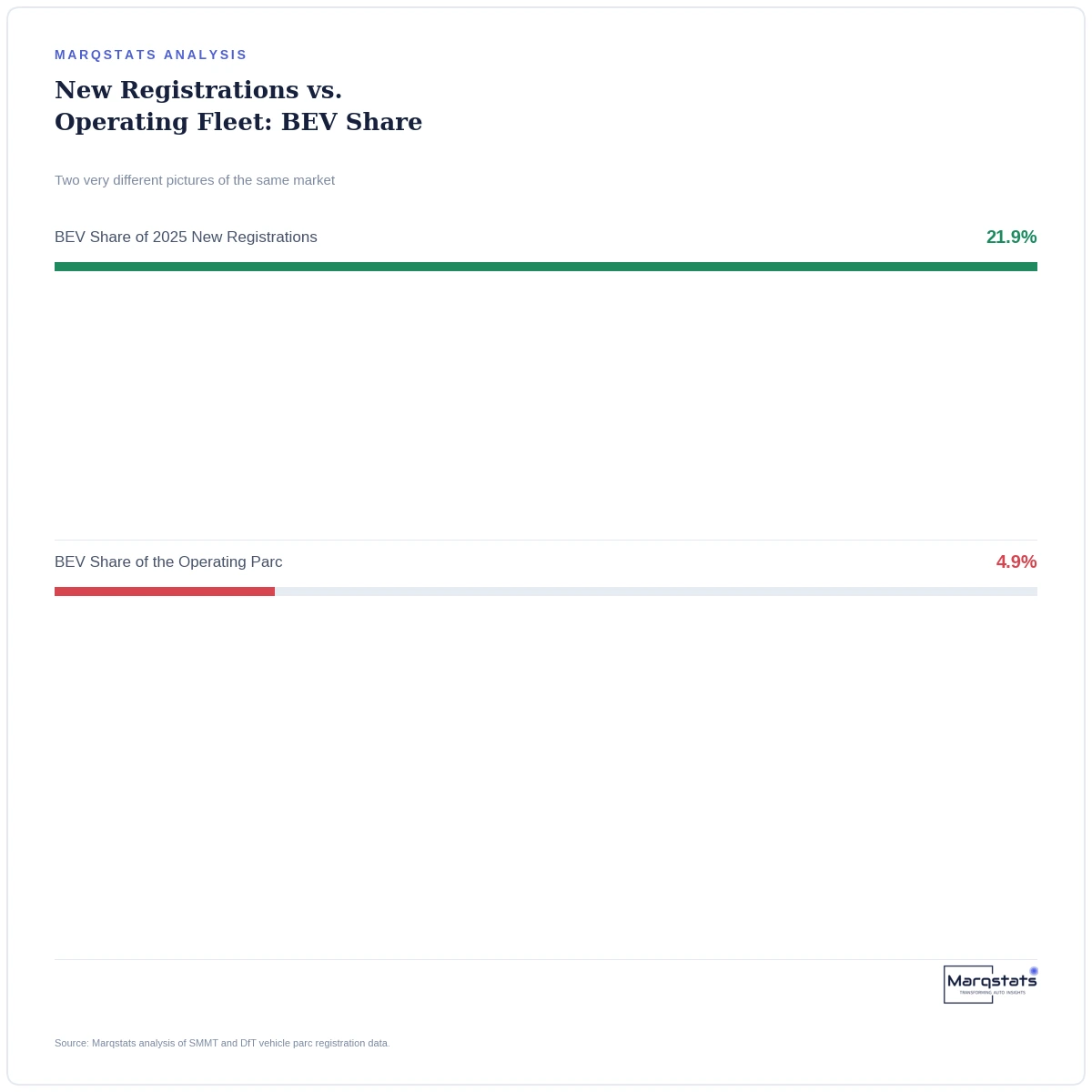
22% of new UK cars are electric. Only 5% of cars on the road actually are.
It's a genuinely easy mistake to make: seeing that over a fifth of new UK car sales are now electric, and assuming petrol and diesel are rapidly disappearing from British roads. Look at what's actually driving around the country, rather than what's being sold this year, and the picture looks very different.
Two numbers, two very different questions
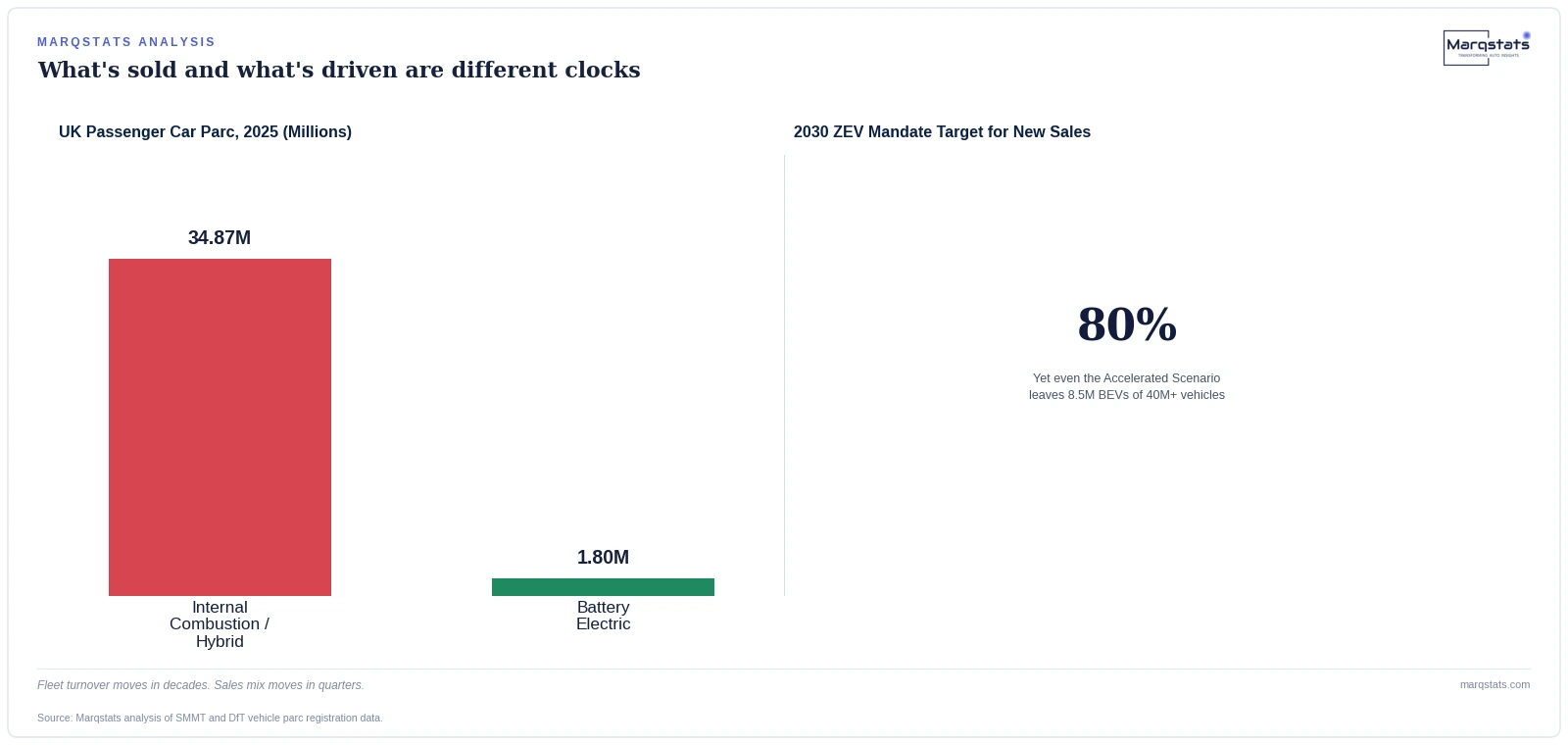
These two statistics aren't contradictory, they're simply answering different questions. The 21.9% figure measures what people bought this year. The 4.9% figure measures what's actually on the road right now, out of the UK's full 36.68 million-vehicle passenger car parc. Just 1,797,809 of those vehicles are battery-electric. The other 34.87 million continue to rely on an internal combustion engine, whether pure petrol, pure diesel, hybrid or plug-in hybrid.
Why the gap is this wide
The explanation is straightforward once you think about vehicle lifespan rather than sales volume. A new registration is a single event, one car changing hands. The operating parc is the accumulated total of every vehicle bought over roughly the last fifteen years that hasn't yet been scrapped. The UK's average car age reached 9.7 years in 2025, and scrappage typically doesn't happen until close to fourteen years. Even a genuinely rapid shift in what's being sold today takes well over a decade to meaningfully reshape what's actually on the road, simply because the existing combustion fleet doesn't vanish the moment electric sales accelerate.
One number tells you what Britain bought this year. The other tells you what Britain is actually driving.
— Marqstats Analyst Team
Why this matters directly for garages and oil suppliers
This isn't an abstract statistical curiosity, it has direct commercial consequences for anyone in the automotive maintenance business. A garage owner or lubricant supplier who extrapolates future demand from new-car electrification headlines alone would badly misjudge near-term crankcase oil volume, since that volume tracks the 95.1%-combustion-dependent operating parc, not the roughly 22%-electrified sales mix. The UK automotive lubricants aftermarket reflects exactly this dynamic: even under the most aggressive electrification scenario modeled, volume contracts by only 3.51% annually through 2030, a controlled decline, not a collapse.
Why this gap will eventually close, just slower than headlines suggest
None of this means the shift toward electric vehicles isn't real or significant, it clearly is. The UK's statutory Zero Emission Vehicle mandate requires 80% of new car sales to be zero-emission by 2030, and that trajectory will genuinely reshape the operating parc over time. The point is simply that the transition unfolds on a fleet-turnover timeline measured in years and decades, not a sales-mix timeline measured in quarters. Even under the Baseline Structural Transition Scenario, which assumes the ZEV mandate proceeds exactly as planned, the operational internal combustion parc remains above 30 million vehicles through 2030.
The counter-argument: could accelerating BEV sales momentum compound into a faster parc shift than this suggests?
A fair objection is that BEV sales share has itself climbed rapidly from a much smaller base just a few years ago, and continued acceleration, combined with expanded scrappage incentives removing older combustion vehicles, could compound into a meaningfully faster parc-level shift than a simple extrapolation from today's 4.9% figure implies. This is precisely the logic behind the market's own Accelerated Electrification and Scrappage Scenario, which models exactly this compounding effect, and even there, operational BEV numbers only reach 8.5 million by 2030, still leaving a substantial majority of the fleet running on internal combustion engines. Even under an aggressive acceleration case, the underlying stock-versus-flow dynamic means the operating parc simply cannot electrify as fast as new sales figures alone might suggest.
What this means for garages, blenders and investors
- Lubricant blenders and distributors should size near-term UK demand against SMMT and DfT operating parc data specifically, not new vehicle registration statistics, to avoid underestimating crankcase lubricant volume.
- Independent workshops and motor factors should plan inventory and staffing around the genuinely large, ageing internal combustion parc rather than reacting to new-car electrification headlines alone.
- Investors evaluating this market should model demand against the three named scenarios' operational BEV parc projections specifically, since even the aggressive case leaves a substantial combustion fleet through 2030.
The full market picture
Marqstats' complete UK automotive lubricants aftermarket analysis, including the full three-scenario forecast through 2030, is available in the linked report below.
Related reportUnited Kingdom Automotive Lubricants Aftermarket Size, Share & Forecast 2026 – 2030